//edupediapublications.org/journals/index.php/IJR/ https:
online: Available
301 |
P a g e
Estimation of Project Duration and Cost Using Building
Information Modeling (BIM)
Ahmed Abdulameer Arab Al-Taie, Iraq
M.E/M.Tech, (Construction Engineering and Management) Department of Civil Engineering
Osmania University [email protected] Abstract
Building Information Modeling is a powerful tool in the construction industry. The use of BIM help in creation and use of a three – dimensional model (3D) virtual paradigm that assists the design, construction and operation of a building. BIM is a faster and more effective way for designing and
construction management. It
improves the quality of design and reduces rework during construction, which serves as the advantages according to the perception of AEC professionals. It can also help in controlling delays in relation to a planned schedule. BIM provides
accurate quantity take-offs,
improves scheduling time tables
and consequently diminishing total project contingencies and costs. The building of the College of Administration and Economics in Iraq at Waset is considered as a case study to realize the actual uses and benefits of Building Information Modeling (BIM). A 3D model is developed in Revit Architecture software and estimate total project duration by using primavera P6 software and link with Navisworks to extracted 4D model and estimated the total project cost 5D.
Keywords: Building Information
Modeling 4D, 5D, BIM time and cost estimation.
INTRODUCTION
//edupediapublications.org/journals/index.php/IJR/ https: online: Available 302 |
P a g e
of the infrastructure and construction sector. The construction industry is very complex industry which involves various parties in different processes and stages of project which work together to achieve the target success of any project. the construction sectors is widely affected by many problems such as cost overrun, time overrun and also the quality of end product which is not achieved due to various problem during the constructions stage of the project [1] . Building Information Modeling is one of the technologies helps control on problem. Computable information about a building projects this dependable digital methodology into three dimensional (3D) drawings in the three primary dimensional width, height and depth with the time as the fourth dimension (4D), cost as the fifth (5D). 4D model based scheduling simulation can be used to monitor the progress at site without being actually present there. It can also help in monitoring delays in relation to a planned schedule .5D model based estimating produces accurate quantities for the efficient estimation of architectural, structural and services components. These quantities can be extracted at various stages at concepts stage for generating budgets, at the end of design development stage for floating tenders. The BIM tool is to be helps for design, defining the building form and spaces, visualization to analyzing costs, time. it is a construction management (CM) tool useful for a real simulation process of the BIM is useful for increasing total quality, providing accurate quantity take-offs, improving scheduling timetables,
consequently diminishing total project contingencies and cost.[2]
BIM VS. CAD
//edupediapublications.org/journals/index.php/IJR/ https: online: Available 303 |
P a g e
LITERATURE REVIEW
The impact of BIM implementation on the traditional conventional building design methods. The BIM is extends this methodology into three dimensional (3D) drawings in the three primary dimensional width, height and depth with the time as the fourth dimension (4D) and cost as the fifth (5D). 4D model based scheduling simulation can be used to monitor the progress at site without being actually present there. It can also help in monitoring delays in relation to a planned schedule. 5D model based estimating produces accurate quantities for the efficient estimation of architectural, structural and services components. These quantities can be extracted at various stages: at concepts stage for generating budgets, at the end of design development stage for floating tenders, at GFC stage for verifying contractor bills. The BIM tools is to be helps for design, defining the building form and spaces, visualization to analyzing costs, time and energy performance. It is a construction management (CM) tool useful for a real simulation process of the ongoing building project. In the undertaken case study, BIM is useful for increasing total project quality, providing accurate quantity take-offs, improving scheduling timetables, consequently project contingencies and costs. The case study presented in this paper suggested contractual arrangement for the building project resulted in improved productivity, better coordination, reduced error and rework of construction [2].
The aim of this study is to suggest the extended functions and the future directions
for 4D CAD with several effective application cases of 4D CAD so that the application of that can be efficiently improved. Due to the growing interests in BIM, 4D CAD is being applied to a practical business of construction as a supporting tool for BIM.4D CAD is simply one of many tools for the successful implementation of construction projects including civil engineering projects; it is neither an essential technology nor a fix-it-all instrument for construction management. The application of 4D technology to construction sites will prove successful only when the tool is proactively leveraged in a way tailored to individual sites with its effects fully understood. Amid growing interest in BIM and the active discussion about its benefits, construction technicians and other stakeholders should develop and apply technologies and methodologies for the implementation of BIM.[5]
Methodology and Model
Development
//edupediapublications.org/journals/index.php/IJR/ https:
online: Available
304 |
P a g e
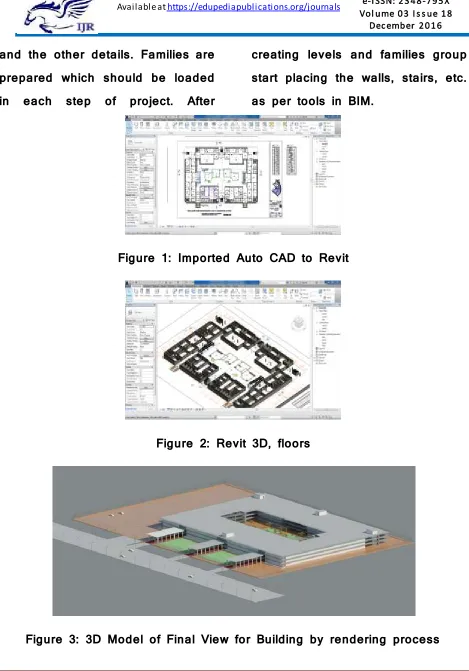
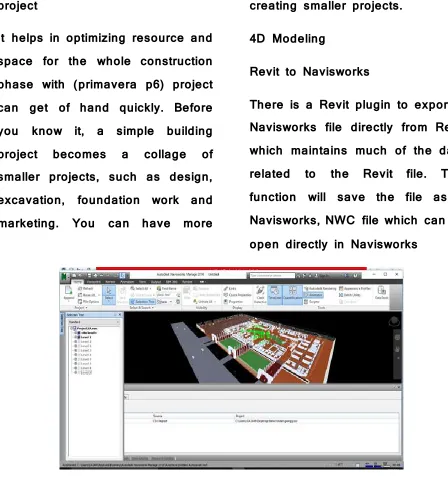
and the other details. Families are prepared which should be loaded in each step of project. After
creating levels and families group start placing the walls, stairs, etc. as per tools in BIM.
Figure 1: Imported Auto CAD to Revit
Figure 2: Revit 3D, floors
//edupediapublications.org/journals/index.php/IJR/ https:
online: Available
305 |
P a g e
Planning and scheduling of the project
It helps in optimizing resource and space for the whole construction phase with (primavera p6) project can get of hand quickly. Before you know it, a simple building project becomes a collage of smaller projects, such as design, excavation, foundation work and marketing. You can have more
control over your project by creating smaller projects.
4D Modeling
Revit to Navisworks
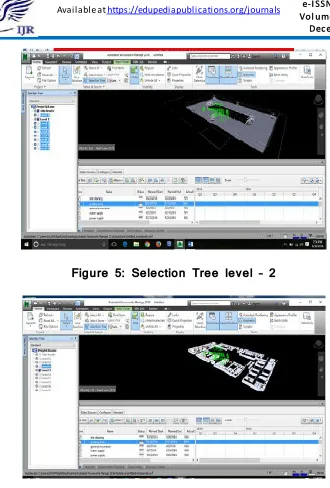
There is a Revit plugin to export a Navisworks file directly from Revit which maintains much of the data related to the Revit file. This function will save the file as a Navisworks, NWC file which can be open directly in Navisworks
//edupediapublications.org/journals/index.php/IJR/ https:
online: Available
306 |
P a g e
Figure 5: Selection Tree level – 2
//edupediapublications.org/journals/index.php/IJR/ https:
online: Available
307 |
P a g e
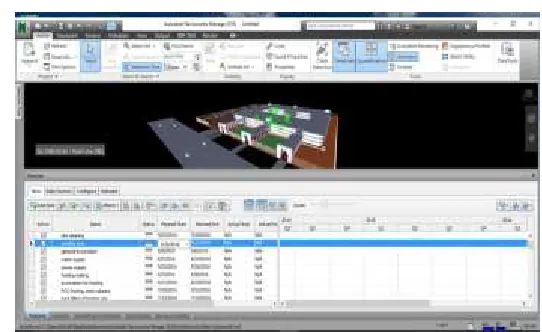
Figure 7: 4D scheduling of the Project in Navisworks Time liner
Quantity Take- Offs (QTO) and Cost Estimating 5D
A process in which Building Information Modeling (BIM) can be used to assist in the generation of accurate quantity take-offs and cost estimates throughout the lifecycle of a project. This process allows the project team to see the cost effects of their changes, during all phases of the project, which can
help curb excessive budget
overruns due to project
modifications. Specifically, BIM can provide cost effects of additions and modifications, with potential to save time and money and is most beneficial in the early design stages of a project.
Results
Building information modeling 5D cost estimation for 3D prototype
Type Cost
(Rs.)
Heigh t
Volum e (m³)
Total
.25*.7 4200 10 0.16 682.84
//edupediapublications.org/journals/index.php/IJR/ https:
online: Available
308 |
P a g e
.25*.7 4200 10 0.16 682.84
.25*.7 4200 10 0.16 682.84
.25*.7 4200 10 0.16 682.84
.25*.7 4200 10 0.16 682.84
.25*.7 4200 10 0.16 682.84
.25*.7 4200 10 0.16 682.84
.25*.7 4200 10 0.16 682.84
.25*.7 4200 10 0.16 682.84
.60*60 4200 10 0.33 1404.69
.60*60 4200 10 0.33 1404.69
.60*60 4200 10 0.33 1404.69
.60*60 4200 10 0.33 1404.69
24" 450 10 0.27 121.24
24" 450 10 0.27 121.24
24" 450 10 0.27 121.24
24" 2 450 7.43 0.20 90.08
24" 2 450 7.43 0.20 90.08
24" 2 450 7.43 0.20 90.08
24" 2 450 7.43 0.20 90.08
24" 2 450 7.43 0.20 90.08
24" 2 450 7.43 0.20 90.08
Grand total
702 2598120 623632.96
//edupediapublications.org/journals/index.php/IJR/ https:
online: Available
309 |
P a g e
Type Height Width Cost (Rs)
Total
D3 1.981 1.829 950 3442
30" x 80"
2.032 0.762 950 1471
30" x 80"
2.032 0.762 950 1471
30" x 80"
2.032 0.762 950 1471
D1 2.134 1 950 2027
34" x 84"
2.134 0.864 950 1750
36" x 84"
2.134 0.914 950 1853
D4 2.4 1.6 950 3648
D1 2.134 1 950 2027
D1 2.134 1 950 2027
Grand total
//edupediapublications.org/journals/index.php/IJR/ https:
online: Available
310 |
P a g e
Floor Schedule
Type Volume Cost
(Rs)
Total
Generic - 12" 2
112.39 2160 1614098
Generic - 12" 2
82.03 2160 1178026
Generic - 12" 2
1.52 2160 21800
Generic - 12" 2
25.41 2160 364925
Generic - 12" 2
60.05 2160 862394
Generic - 12" 2
2.36 2160 33861
Generic - 12" 2
20.82 2160 298966
Generic - 12" 2
1.43 2160 20475
Generic - 12" 2
57.80 2160 830091
Grand total: 33
61020 51460560
//edupediapublications.org/journals/index.php/IJR/ https:
online: Available
311 |
P a g e
Type Length Cost
(Rs)
Total
Handrail - Rectangul ar
7.618 400 3047.154
Handrail - Rectangul ar
13.78 400 5512.166
Handrail - Rectangul ar
7.618 400 3047.154
Handrail - Rectangul ar
13.78 400 5512.166
Handrail - Rectangul ar
13.783 400 5513.181
Handrail - Rectangul ar
7.618 400 3047.154
Handrail - Rectangul ar
13.78 400 5512.166
Handrail - Rectangul ar
//edupediapublications.org/journals/index.php/IJR/ https:
online: Available
312 |
P a g e
Grand total
48 1920
0
1309214.87 5
Ramp Schedule
Family Type Width Cost
(Rs) Ramp 15.555*1.7
99
1 49500
Ramp 15.555*1.7 99
1 49500
Ramp 15.555*1.7 99
1 49500
Ramp 15.555*1.7 99
1 49500
Ramp 15.555*1.7 99
1 49500
Ramp 15.555*1.7 99
1 49500
Grand total
6 297000
Roof Schedule
Type Volume Cost
(Rs)
//edupediapublications.org/journals/index.php/IJR/ https:
online: Available
313 |
P a g e
6" 1295.82 2610 22192136
6" 1295.61 2610 22188652
6" 1290.99 2610 22109493
Generic - 12"
7.11 2610 60844
Generic - 12"
6.37 2610 54544
Generic - 12"
6.81 2610 58332
Generic - 12"
7.11 2610 60844
6" 36.61 2610 627026
6" 36.61 2610 627026
6" 36.61 2610 627026
Grand total: 10 68605923
Stair Schedule
Type Width Cost
7" max riser 11" tread
1.43 37000
7" max
riser11"tread
1.43 37000
7" max riser 11" tread
1.43 37000
//edupediapublications.org/journals/index.php/IJR/ https:
online: Available
314 |
P a g e
tread
7" max riser 11" tread
1.43 37000
7" max riser 11" tread
1.43 37000
7" max riser 11" tread
1.43 37000
7" max riser 11" tread
1.43 37000
7" max riser 11" tread
1.43 37000
Grand total: 12 444000
Structural Framing Schedule Type Lengt
h
Volum e
Cost (Rs)
Total
.6*.4 7.405 1.83 2880 5256.3
6
.6*.4 7.375 1.87 2880 5374.0
8
.6*.4 7.675 1.89 2880 5443.2
0
.6*.4 6.233 1.59 2880 4584.4
4
.6*.4 6.385 1.48 2880 4275.0
//edupediapublications.org/journals/index.php/IJR/ https:
online: Available
315 |
P a g e
.6*.4 6.09 1.56 2880 4485.5
6
.6*.4 7.375 1.77 2880 5097.6
0
.6*.4 7.094 1.75 2880 5041.6
2
.6*.4 8.25 1.98 2880 5702.6
3
.6*.4 7.375 1.77 2880 5097.6
0
.6*.4 7.275 1.65 2880 4752.0
0
.6*.4 6.918 1.61 2880 4643.1
9
.6*.4 8.719 2.09 2880 6026.3
0 Grand total
585 168480
0
2930698.3 0
Window Schedule Heigh
t
Widt h
Sill Heig ht
Cost (Rs)
Total
1.829 1.198 0.305 675 1479
//edupediapublications.org/journals/index.php/IJR/ https: online: Available 316 |
P a g e
1.5 2 0.914 675 2025
1.5 2 0.914 675 2025
2 2 0.305 675 2700
2 2 0.305 675 2700
0.5 1.198 1.067 675 404
0.5 1.198 1.067 675 404
1.5 2 1.052 675 2025
Grand total Count4 92 332100 Rs. 955560 m² Wall Schedule Ty pe ( M ) A rea (m ²) C os t (R s) Br ick wa ll con st ru c tion P ut ty pa int cos t P ut ty pa int fina l cos t Tot al w al l cos t
0.25 18 121
5
2240 1
495 9126 31528
0.25 16 121
5
1888 6
495 7694 26580
0.25 7 121
5
7989 495 3255 11243
0.25 7 121
5
8538 495 3478 12016
0.25 15 121
5
1851 4
495 7543 2605 6
0.25 8 121
5
9814 495 3998 1381 2 0.25 17 121
5
2057 2
//edupediapublications.org/journals/index.php/IJR/ https: online: Available 317 |
P a g e
0.25 11 121 5
1333 2
495 5432 1876 3
0.4 3 148
5
4421 495 1474 5895
0.4 4 148
5
5364 495 1788 7152
0.27 2 126
0
2106 495 828 2934
0.27 13 126
0
1688 5
495 6633 2351
8
0.27 23 126
0 2938 7 495 1154 5 4093 1 Grand total Count 1462 3047512 1 Conclusion
3D BIM (building information modeling) model has been developed by integrating 2D AutoCAD drawing and 3D visualization using Revit Architecture software.
4D planning by linking the baseline plan from Primavera with the
developed 3D model using
Navisworks helped effectively in visualizing the sequence of the activities. This will result in accurate plans and will minimize planning errors to a large degree.
5D model has been developed by generating the cost estimates of each component of the model. Cost estimation model is connected to the 3D model so that any change in the design would be immediately reflected in total cost estimation of the developed model.
References
1. ShekharJadhav, Ghadge A.N. Application of Building Information Modeling inConstruction Projects – A Critical Review, International Journal of Engineering Research, Volume No.5, pp.: 26-31, (2016). 2. Amol A. Metkari, Dr. A. C. Attar,
Application of Building Information ModelingTool for Building Project, International Journal of Science and Research (IJSR), Volume No 4, pp. 324-329, ( 2013).
3. Joong-Min Kwak, Gwang Yeol Choi , Nam Jin Park, Haw Jin Seoand Leen Seok Kang, 4D CAD
Application Examples and
//edupediapublications.org/journals/index.php/IJR/ https:
online: Available
318 |
P a g e
Management Technology IPEDR, volume No.13, pp.163,(2011) .
4. Saeed Rokooei, Building
Information Modeling in Project Management:Necessities, Challenges and Outcomes, Science Direct, pp87-95, (2015).
5. Joong-Min Kwak, Gwang Yeol Choi , Nam Jin Park, Haw Jin Seoand Leen Seok Kang, 4D CAD
Application Examples and
Directions for Development in Civil Engineering Projects, International Conference on Education and Management Technology IPEDR, volume No.13, pp.163,(2011) .
6. Markus König, Christian Koch, Ika Habenicht, Seven Spieckermann,
7. Intelligent BIM Based Construction Scheduling Using Discrete Event Simulation , IEEE, Volume12, pp. 662-673, (2012) .