HD Remote Sensing Image Protection Approach
based on Modified AES Algorithm
Basher J. Hamza
1Communication Engineering Department, Technical Engineering College/Najaf, Al-Furat Al-Awsat Technical University, Ministry of Higher Education & Scientific Research, Najaf, Iraq.
Email: [email protected]
Abstract-- Sheltering of multimedia information from different
types of adversary has become important for people and states. A high definition image has a large amount of data, and thus, keeping it secret is difficult. Another challenge that security algorithms must face with respect to high definition images in remote sensing applications is pattern appearances, which results from existing regions with high density in the same color, such as sky regions. A New image security algorithm collect between ciphering algorithm and hiding technique is suggested in this paper. The new hiding algorithm proposed here starts by applying reordering and scrambling operations to the six Most Significant Bit planes of the secret image, and then, it hides them in an unknown scene cover image using arithmetic operation. Then, Thestego-image encrypted using modified AES algorithm. Several parameters were used including the visual scene, histogram analysis, entropy, security analysis, and execution time to evaluate the proposed algorithm.
Index Term-- Image processing. Image encryption.Image
hiding.Hybrid security system.
I. INTRODUCTION
The protection of visual and image information from different types of attackers has become important for people and governments (1; 2). Usually, remote sensing need high security algorithms to protect important government images. In a digital world, ciphering and hiding are both aimed at safeguarding the data from attackers. Encryption techniques effectively protect multimedia information by converting it into an unknown form to the adversary (3). Images are represented in two forms, either in the frequency domain or spatial domain, where it can be encrypted in any domain partially or fully(4). Image encryption approaches in the frequency domain are typically based on the Fractional Fourier Transform “FrFT” (5; 6), Fast Fourier Transform “FFT”(7), Discrete Cosine Transform “DCT” (8), or Fresnel Transform “FrT” (9; 10). Most of the ciphering algorithms in the frequency domain are dependent on the coefficients of those transforms, where the secret signal transformed to the frequency domain is based on one of those transformers before it is encrypted.
Image encryption in the spatial domain changes the image into an inapprehensible form based on changes in the pixel value, “diffusion”, and/or the pixel location, which is called “confusion” (11). Encryption in the spatial domain is more effective than in the frequency domain in terms of simplicity and computational cost. In the spatial domain, ciphering algorithms change the information into an inapprehensible
form based on changes in the pixel locations (i.e., confusion) or pixel values (diffusion), using various technologies (12; 11; 13). Several researchers are using chaos theory for ciphering (14; 13; 8; 15; 16;17). However, chaos theory- based ciphering algorithms are not very secure and require additional computations (18). Many recently proposed ciphering algorithms are based on image decomposition technology (19; 20; 21; 22). However, previous techniques suffer from drawbacks such as atonality in the security level because the number of bit planes and the content of each bit plane are constant. Additionally, there is little or, in some cases, almost no key space in these approaches, that leads to a decrease in the computational cost of the attacks.
In the third or fourth decade of the last century, ideas to conceal the presence of data that is transmitted, i.e., “hiding data”, have appeared (23). Data hiding refers to embedding secret data into a cover medium such as an image, a video and audio, or text (24). In general, hiding techniques can be classified into two groups based on the purpose of hiding the data; these groups are steganography and digital watermarking. Steganography is the technique in which secret information is hidden in a host media such that the secret massage in the stego-media becomes invisible to the eavesdropper (25). Digital watermarking is to hide information in a host media in such a way that an attacker cannot supplant or change the hidden information from the watermarked media (26).
method was proposed in (30; 31; 22) using different encryption algorithms and hiding techniques. However, all of the previous hybrid methods used the LSB technique for hiding purposes, which impairs their performance.
In this paper, new metis image security algorithm is proposed based on a combination of encryption and hiding techniques. A new hiding algorithm is proposed based on simple arithmetic operations, to hide the secret image in an unknown scene cover image. The modified AES algorithm proposed in (31) is used to encrypt the stego-image that is produced from the proposed hiding algorithm.
The remainder of this paper is organized as follows: Section 2 describes the previous studies. Section 3 shows the proposed approach. Section 4 reviews the experimental results, and conclusions are drawn in Section 5.
II. OVERVIEW OF RELATED STUDIES
One of the most widely used encryption algorithms in smart cards, cell phones, automated teller machines, and www servers is the AES algorithm (32). However, this algorithm requires many computations and suffers from artifact appearances in the ciphered images when the original image has a large region of a single color (33; 4). Table 1 below summarizes a comparison between methods based on different techniques for image encryption.
Table I
Comparison between previous methods in different techniques of image encryption.
A popular and effective technique for images hiding data in the spatial domain is Least Significant Bit, or "LSB", which is based on replacing the LSB of the host pixel value with one bit of the secret data. A number of methods have been proposed to improve the performance of the LSB technique, such as LSB matching (LSBM) (34) and LSB matching revisited (35) (LSBMR) . Additionally, the hiding capacity of LSB, LSBM, and LSBMR is small, partially because these methods address a given pixel or pixel pair without considering the relationship between neighboring pixels. Several methods that were proposed are based on differencing
between neighboring pixels to separate between edge and smooth regions and hide secret bits at different rates in those regions adaptively(36; 37). On the other hand, some methods have suggested enhancing the quality of the stego-image that results from the LSB replacement technique by applying an optimal pixel adjustment process (OPAP), which depends on the difference between the cover and stego pixel values (24; 38). Table 2 reviews a simple comparison between the different hiding algorithms in the related studies, using
different parameters.
Table II
Comparison between related works of image hiding methods.
III. HYBRID IMAGE SECURITY ALGORITHMS (HISA) Most of the hybrid security algorithms have a weakness in the security level that is produced from using the simple LSB method in the hiding part, which makes these methods susceptible to attacks by a number of adversaries (22). In this paper, a new hybrid algorithm based on modified AES algorithm and a new hiding techniques with high capacity.
The hybrid security algorithm proposed in this work is a combination of the Modified Advanced Encryption Standard (MAES) and Ex-OR Hiding Method (ExHM). The HISA is a lossy security algorithm because it uses the ExHM algorithm, which loses the two least significant bit planes of the secret image. The binary bit planes secret image will be reordered before ciphered it using MAES. Then the ciphered secret
method Encryption
speed
Computation amount
Ciphered image scene
Pattern appearance
Security level
Chaos theory based
encryption algorithms Low high good Moderate Very good
Decomposition based
encryption algorithms high low good high good
Encryption algorithms combining between AES and decomposition
moderate high good moderate good
method Hiding capacity Stego-image quality Security level
LSB low good low
LSBM moderate good low
LSBMR moderate Very good moderate
Hiding method based on differencing between
neighboring pixels high Very good moderate
image will hide in the unknown scene cover image to increase the hiding capacity.
In general, 8-bit grey-scale images are represented by 8 bit planes when decomposed using binary system. Important to know how many binary bit planes that can be lost with keeping reconstructed image with high quality. Obviously, at least 5 MSBs are required to reconstruct the decomposed image with approved levels of quality (39). Therefore, 6 MSBPs will be used from the secret image to reconstruct it with high quality.
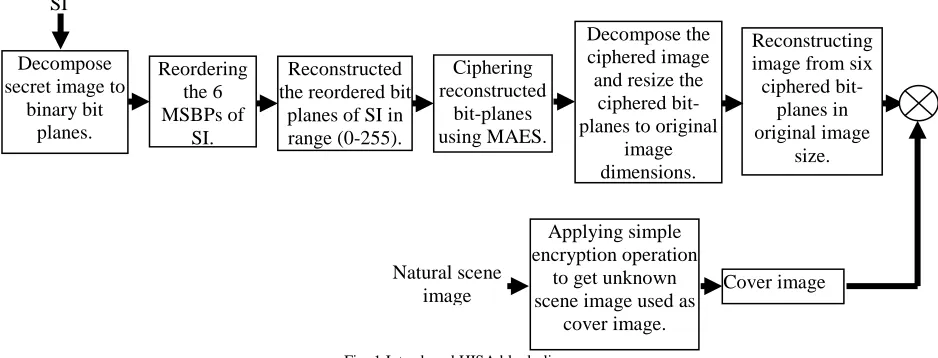
The HISA is explained in steps below: 1. Decomposing the secret image to binary bit
planes based on Eq. (1)
where codes ( ) are the binary
representation of the non-negative decimal number D.
2. Reordering the 6 MSBs of the secret image using Eq. (2):
wherePsb and Psa are the bit planes of the secret images before and after reordering, respectively; and (a=8, 7… 3), b is a number defined between transmitter and authenticated receiver.
1. Convert the six reordered bit planes to vectors.
2. Convert the vectors to decimal in range 0-255 ( take each 8-bits).
3. Ciphering the reconstructed image results from step4 using Modified AES algorithm proposed in (31).The modified AES image encryption algorithm proposed in (31) that used as part of the hybrid security algorithm
suggested in this article have important enhancement of AES. The proposed modification is done by adding a key stream generator to generate the key in key expansion operation. (A5/1, W7) techniques are used to generate the key stream which increase the security image levels and turn the encryption performance.
4. Decomposing the ciphered secret image to binary bit planes using Eq. 1
5. Re-size the decomposed ciphered image to get six bit planes in original image dimensions.
6. reconstruct image with original image size from six bit planes to get pixels in range (0-63).
7. Hiding the ciphered image results from step8 in the unknown scene cover image through applying the Eq. 3 below to get the stego-image:
(3)
Where SPV, CPV & TPV are Stego, Cover and Secret pixels values respectively.
The security level of the LSB technique is very weak; if an attacker is aware that an image is a stego-image, he can extract the secret data easily. In contrast, the hidden data using the suggested method cannot be extracted easily by the adversary because he must have exactly the same cover image to determine exactly the difference between the stego and cover pixel and then determine the secret image pixel that corresponds to that difference, where this determination is impossible. On the other hand, ciphering of secret image with respect to stego-image have two advantage, first one, increase the security levels where if the attacker getting the cover image and he can extract the secret image he will find it ciphered. Secondly, decrease the encryption/decryption time to 75% because only six of eight binary bit planes will be ciphered. Figure 1below shows an block diagram of suggested HISA:
∑
(1)
( ) ( )
Fig. 1.Introduced HISA block diagram.
IV. EXPERIMENTAL RESULTS
Two tests of high- definition images, one remote sensing and the other is natural scene image, are used as secret images in this section. The performance of the introduced ExHM algorithm is evaluated at the beginning of this section.
The evaluation will concentrate on the extracted image only because the cover image and, thus, the stego-image are unknown scene images. Several parameters, such as the visual scene, PSNR, Q-index, SSIM, and PPCC , are used to check the similarity between the original and extracted versions of the secret image. Additionally, the histogram analysis of the stego-image will be used to test the ability of the proposed method against statistical attacks. Finally, the capacity of the proposed method will be compared with some other hiding methods. Afterward, the performance of HISA will be evaluated through the following: firstly, the visual scene will be compared with ExOR, and MAES. Secondly, the security levels of the hybrid method will be analyzed and compared with MAES. Finally, the required time to execute the hybrid system will be compared with the encryption time MAES.
1. ExOR algorithm performance evaluation 1.1. Similarity Testing:
As explained in section 3, two LSB planes of secret images are missed in the hiding operation; thus, checking the
similarity between the extracted and original versions of the secret image is very important.
A. The visual scene: here, we use the naked eye to check whether the original secret and extracted images are identical for the 2 test images. Figure2 shows that the human eyes cannot be sensitive to any differences between the original and extracted images for the two sample images tested.
B. Peak Signal to Noise Ratio PSNR: The PSNR is one of the parameters that are used to check the image similarity. If the two tested images are identical, then the PSNR is equal to infinity; also, if the value of the PSNR is more than 30 dB, then the human eyes cannot be sensitive any difference between the two tested images (38). Table 3 shows the values of PSNR for the two tests, where its value conforms that of the similarity of the original and extracted image in the allowable range.
C. SSIM, Q-index, and PPCC: These are other parameters that are used to check the similarity between the two images. The range value of these parameters is in the range of 1 to -1, where identical images have the value 1 for all of the parameters. The values of SSIM, Q-index, and PPCC for all of the tested images are shown in Table 3. The results of those three parameters confirm the similarity between the original and extracted images, where those values are very near 1.
Table III
Statistical measurements of images similarity between original and extracted images for ASHA.
The tests images Parameters
PSNR SSIM Q-index PPCC
Test1 Remote sensing (10801920)
38.1243 0.9478 0.9962 0.9828
Test2 Natural Scene
(10801920)
39.4365 0.9872 0.9982 0.9921
Decompose secret image to
binary bit planes. Reordering the 6 MSBPs of SI. Cover image Decompose the ciphered image and resize the
ciphered bit-planes to original
image dimensions. Ciphering reconstructed bit-planes using MAES. Reconstructed
the reordered bit planes of SI in range (0-255).
Reconstructing image from six ciphered bit-planes in original image size. Natural scene image Applying simple encryption operation
to get unknown scene image used as
cover image. Secret image
(a) (b)
(c) (d)
Fig. 2. Visual scene of similarity test between original and extracted images of ASHA with image dimensions 10801920 pixels. a) the original test1image “HD medical”; b) the original test2image “HD remote sensing”; c) The extracted image “HD medical”; d) the extracted image “HD remote sensing”.
1.2. Security Analysis of ExOR method:
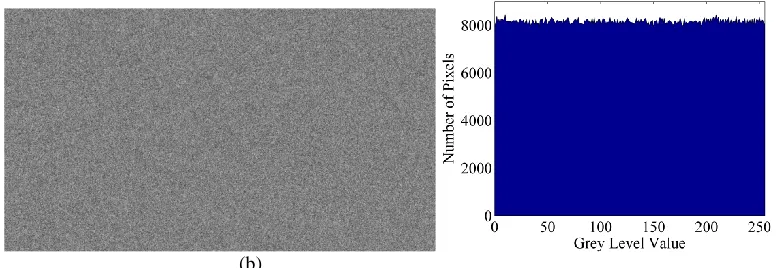
In this subsection, the visual scene and histogram distribution of the cover and stego-image will be compared to check the range of resistance of the proposed ExORmethod against statistical attacks, here the secret image will reorder just without ciphering . As previously mentioned, the cover image is an encrypted image, which means that its histogram is uniformly distributed. Thus, the histogram of the stego-image should also be uniformly distributed to prevent the statistical
attackers from knowing any information about the hidden image.
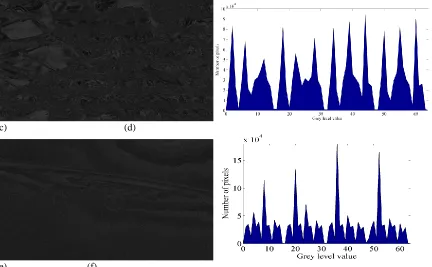
Figure3 shows the visual scene and histogram distribution of the cover and images for two image tests. The stego-image visual scenes of the two tests are good without any artifacts. On the other hand, the histogram is uniformly distributed, as appears in Figure3d and 3f. Therefore, the proposed hiding method is strong against statistical attackers.
(c) (d)
(e) (f)
Fig. 3.Visual scene and histogram analysis of cover and stego-image of ASHA “HD 10801920 pixels”. a) The cover image; b) the cover image histogram; c) The stego-image of test1 secret remote sensing image; d) the stego-image test1 secret remote sensing image histogram; e) the stego-image of test2 secret medical
image; f) the stego-image test2 secret medical image histogram.
1.3. Capacity Comparison
The aim of the proposed hiding method is to increase the hiding capacity and improve the security level. The proposed algorithm satisfies the goal of hiding an image in an image that has the same size and type. Table 4 shows the comparison between the proposed scheme and a number of hiding methods. The results that appear in Table 4 are the number of bytes of a secret message that can be hiding in the cover
image, which has the dimensions 512×512 pixels (GS or RGB). The capacity of the proposed method is better compared to most of the methods that are based on LSB, as shown in Table 6. The capacity of the method proposed in (Yang et al. 2008) is close to the proposed method’s capacity but is not sufficiently high to hide an image in an image of the same size and type.
Table IV
The capacity comparison between proposed and other methods in (byte).
2. Performance evalution of proposed hybrid algorithm (HISA):
The performance of HISAwill be evaluated through comparing, first, HISA with ExOR hiding method and MAES in terms of the visual scene and, second, the security levels of HISAand MAES. Finally, the protect image time of HISA,MASE and ExOR hiding method are compared.
2.1. Visual scene
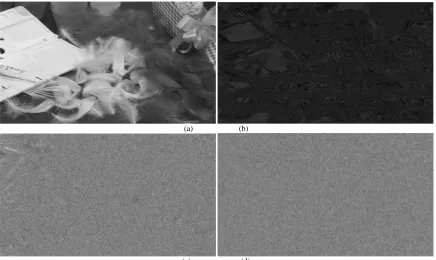
The visual scenes of the original secret image, stego-image of ExOR, encrypted image by MAES, and result image from HISAare shown in Figures4 and 5. In those Figures., the results appear too clearly show that the HISAvisual scene is the best compared with the image results from ExOR and MAES.
Grey scale image
The method Capacity (Byte) (Mielikainen 2006) [35] 98,304
(Chan & Cheng 2004) [24] 131,072
(Wu & Tsai 2003) [25] 56,291 (Wang et al. 2008) [40] 57,146 (Yang et al. 2008) [41] 134,514
Proposed hiding method 196,608
(a) (b)
(c) (d)
Fig. 4.Visual scene of hiding, MAES, and hybrid algorithms “natural scene 10801920”. a) The original image; b) The stego- image of Ex-OR hiding method; c) The encrypted image by MAES; d) The protected image by HISA.
(a) (b)
(c) (d)
Fig. 5. Visual scene of original, Hiding, MAES, and hybrid image “remote sensing 10801920”. a) The original image; b) The stego- image of Ex-OR hiding method; c) The encrypted image by MAES; d) The protected image by HISA.
2.2. Histogram Analysis
The second parameter used to evaluate the performance of HISA is the histogram analysis because the histogram distribution gives indicators that are helpful of statistical
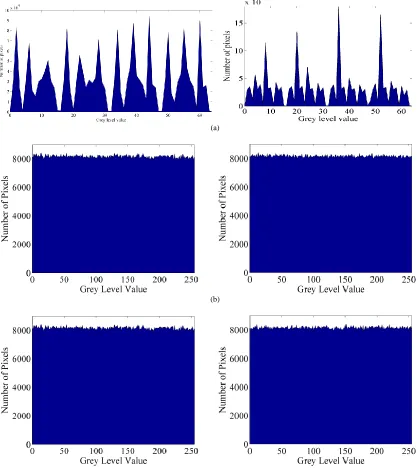
attackers. The results that appear in Figure 6 clearly show that the histogram of HISA was uniformly distributed for the two
(a)
(b)
(c)
Fig. 6. Histogram analysis of Test1 “Natural scene 1080×1920” and Test2 “remote sensing 1080×1920”.a)Hiding; b) MAES; c) HISA.
2.3. Security Analysis
The security of HISA will be analyzed and compared with MAES through correlation coefficients, key space, effect of noise attacks, and entropy.
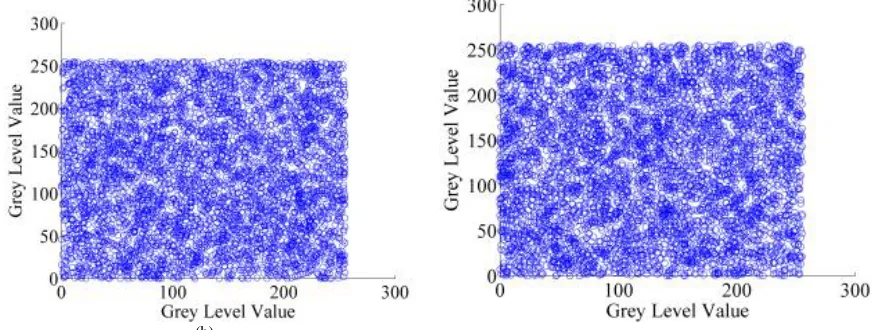
A. Correlation coefficients: The correlation coefficients of HISA for 2 test images are shown in Figure7. Figures.7a and 7b show that the HISA produces a protected image with a very low correlation between adjacent pixels. The statistical values of the correlation coefficients of the ciphered image by MAES and the protected image by HISA are shown in Table V.
Table V
Correlation coefficients of the original and ciphered images by MAES and HISA.
Type of image Test1 Medical 10801920 Test2 Rem. Sen. 10801920
Original image 0.9879 0.9862
Ciphered by MAES 0.0098 -0.0129
(a) (b)
Fig. 7. Correlation coefficients of HISA; (a) Test1 “natural scene 1080×1920”; (b) Test 2 “remote sensing 1080×1920”.
B. Entropy: The entropy values of the original and ciphered images using MAES and HISA are shown in Table VI for 2 test images. The results in Table 6 show that the HISA are satisfied entropy so close to 8 and are better of MAES entropy value.
The results of the histogram analysis, correlation coefficients and entropy proved that the proposed hybrid algorithm is
strong against statistical attacks.
Table VI
Entropy values of original and ciphered images by MAES and HISAfor 2 tests. Type of image Test1 (natural scene 10801920) Test2(remotesensing. 10801920)
Original image 3.9188 5.0382
MAES 7.9993 7.9981
HISA 7.9999 7.9999
C.Key space: The key space of the proposed hybrid algorithm is a combination of the MAES and Ex-OR hiding key space. The hiding method key space results from factor b in Eq. 2 where this number un determined in length and the security level is proportional with b length. Of course, if the b length increased the time reordering and then hiding time is increased. Also, making Ex-OR operation between secret and cover images increase the key space so much which equal to 2M×N , where M & N are cover image dimensions. On the other hand, the second part of HISA algorithm key space is equal to MAES key space which equal to 2128 . So, the final key space of HISA is shown in Eq. (4).
( ) (4)
where M and N are the cover image dimensions, B is depend on the method of b number generating. From Eq. (4), the key space is very large and cannot take all of the possible cases for all of the key space. Therefore, the hybrid system is very strong against a brute force attack.
D. Execution time: In addition to the security level of an image security algorithm, the execution time is an important factor and is very influential on the performance of a security algorithm, especially with HD image security. The simulation was executed using an HP laptop with the following specifications: system model: HP Pavilion g4 Notebook PC; processor: Intel (R) Core™ i5-2430M CPU@ 2.40 GHz
(4CPUs) ~ 2.4 GHz; memory: 8192 MB RAM; BIOS: and InsydeH2O version 03.61.01F.62. A comparison among the ExOR hiding, MAES, and HISA methods is introduced in terms of the execution time. A total of about 20 test images of size 2025 KB (1080×1920 pixel) were used in this experiment. The execution time of the average of the used tests was 185, 283, and 396 second for hiding, MAES, and hybrid
algorithms, respectively. As noted, the execution time of HISA is less than the combined execution times of Ex-OR and MAES.
The performance evaluation of the hybrid security system proposed in this research proved that this system improved the performance of MAES by enhancing the visual scene and entropy value of the ciphered image and, in addition, increased the key space with the important number 2MN
V.
C
ONCLUSIONSThe first step of the HISA algorithm is ciphering six most significant bit planes of secret image using MAES after reordering them. Then, second step is hiding an image pixel results from ciphered bit-planes which become in range (0-63) in a cover image pixel through applying the Ex-OR operation. Several parameters are used to evaluate the proposed hybrid algorithm, such as the visual scene, histogram distribution, entropy, key space, and execution time. The experimental results show that the HISA algorithm has final visual scene and histogram better than of hiding and ciphering algorithms through overcome the pattern appearance problem, in additive to increase the key space and enhance the value of entropy and correlation coefficients.
REFERENCES
[1] Akhshani, A., Behnia, S., Akhavan, A., Hassan, H. A., Hassan, Z. (2010). A novel scheme for image encryption based on 2d piecewise chaotic maps. Optics Communications, 283(17), 3259-3266.
[2] Sudharsanan, S. (2005). Shared key encryption of jpeg color images. IEEE Transactions on Consumer Electronics, 51(4), 1204-1211.
[3] Podesser, M., Schmidt, H., Uhl, A. (2002). Selective bitplane encryption for secure transmission of image data in mobile environments. 5th Nordic Signal Processing Symposium on board Hurtigruten. Anjuran Norway.
[4] Moon, D., Chung, Y., Pan, S., Moon, K., Chung, K. (2006). An efficient selective encryption of fingerprint images for embedded processors. ETRI Journal , 28(4), 9.
[5] Fan, G., Chen, L., Zhao, D. (2008). A half-blind color image hiding and encryption method in fractional fourier domains. Optics Communications, 281(17), 4254-4260.
[6] Zhou, N., Wang, Y., Gong L. (2011). Novel optical image encryption scheme based on fractional mellin transform. Optics Communications, 284(13), 3234-3242.
[7] Borujeni., S. E. (2000). Speech encryption based on fast fourier transform permutation. The 7th IEEE international conference on electronics, circuits and systems. Jounieh-Lebanon, 290-293. [8] Liu, H., Wang X. (2011). Color image encryption using spatial
bit-level permutation and high-dimension chaotic system. Optics Communications, 284(16–17), 3895-3903.
[9] Chang, T., Hwang, E., Lee, C. (2011). Position multiplexing multiple-image encryption using cascaded phase-only masks in fresnel transform domain. Optics Communications, 284(18), 4146-4151.
[10] Hone, H. (2011). An optical image cryptosystem based on hartley transform in the fresnel transform domain. Optics Communications, 284(13), 3243-3247.
[11] Chong, F., Miao, Y., Liu, X., Chen, J. (2011). A novel chaos-based bit-level permutation scheme for digital image encryption. Optics Communications, 284(23), 5415-5423.
[12] Schneier, B. (1996). Applied Cryptography. John Wiley & Sons. [13] Li, X., Cho, S., Kim, S. (2014). Computational integral
imaging-based 3d digital watermarking scheme using cellular automata transform and maximum length cellular automata. Multidimensional Systems and Signal Processing, 25(3), 405-424. [14] Akhavan, A., Samsudin, A., Akhshani, A. (2011). A symmetric
image encryption scheme based on combination of nonlinear chaotic maps. Journal of the Franklin Institute, 348(8), 1797-1813. [15] Borujeni, S., Eshghi, M. (2013). Chaotic image encryption system
using phase-magnitude transformation and pixel substitution. Telecommunication Systems, 52(2), 525-537.
[16] Ye, R. (2011). A novel chaos-based image encryption scheme with an efficient permutation-diffusion mechanism. Optics Communications, 284(22), 5290-5298.
[17] Zhu, Z., Zhang, W., Wong, K., Yu, H. (2011). A chaos-based symmetric image encryption scheme using a bit-level permutation. Information Sciences, 181(6), 1171-1186.
[18] Alexander, N., Pisarchik, M. (2012). Chaotic map cryptography and security. In Nova Science Publishers. Encryption: Methods, Software and Security (pp.301-332).
[19] Chen, L., Zhao, D., Ge, F. (2013). Image encryption based on singular value decomposition and arnold transform in fractional domain. Optics Communications, 291(0), 98-103.
[20] Jiancheng, Z., Ward, R., Dongxu Q. (2004). A new digital image scrambling method based on fibonacci numbers. Proceedings of the International Symposium on Circuits and Systems (ISCAS 04), 3, 965-968.
[21] Zhou, ., Panetta, K., Agaian, S. (2009). Image encryption algorithms based on generalized p-gray code bit plane decomposition. The Forty-Third Asilomar Conference on Signals, Systems and Computers, 400-404.
[22] Wei, Z., Cheng, Z., Cui, Y. (2008). Image data encryption and hiding based on wavelet packet transform and bit planes decomposition.The 4th International Conference on Wireless Communications, Networking and Mobile Computing,. 1-4. [23] Moulin, P. & Koetter, R. (2005). Data-hiding codes. Proceedings
of the IEEE, 93(12), 2083-2126.
[24] Chan, C. K., & Cheng, L. M., (2004). Hiding data in images by simple LSB substitution. Pattern Recognition, 37(3), 469-474. [25] Wu, D. & Tsai, W. (2003). A steganographic method for images
by pixel-value differencing. Pattern Recognition Letters, 24(9–10), 1613-1626.
[26] Cox Ingemar J., Leighton F., Shamoon T. (1997). Secure spread spectrum watermarking for multimedia. IEEE Transactions on Image Processing, 6(12), 1673-1687.
[27] Adale, D. A. (2011). Hybrid Information security models: crypto-steg and crypto-steg-crypto systems. Thesis in Masters of Computer Science, Department of Systems and Computer Science, Howard University.
[28] Karthikeyan, B., Vaithiyanathan, V. , Thamotharan, B. , Gomathymeenakshi, M., Sruti, S. (2012). LSB replacement stegnography in an image using pseudorandomised key generation. Research Journal of Applied Sciences, Engineering and Technology, 4(5), 491-494.
[29] El-Emam, N. (2007). Hiding a large amount of data with high security using steganography algorithm. Journal of Computer Science, 3(4), 223-232.
[30] Gupta, S., Goyal, A., Bhushan, B. (2012). Information hiding using least significant bit steganography and cryptography. I.J.Modern Education and Computer Science, 6, (27-34).
[31] Kavitha, Kavita, K., Ashwini K., Dunghav, P. (2012). Steganography using least signicant bit algorithm. International Journal of Engineering Research and Applications, 2(3), 338-341. [32] Department of Commerce, N. I. O. S. a. T., Information
Technology Laboratory (Itl). (2001). Advanced Encryption Standard (AES) (Fips Pub 197). Computer Security Standard, Cryptography. 5285 Port Royal Road, Springfield, VA 22161, National Technical Information Service (NTIS): 51.
[33] Grangetto, M., Magll, E., Olmo, G. (2006). Multimedia selective encryption by means of randomized arithmetic coding. IEEE Transactions on Multimedia, 8(5), 905-917.
[34] Han, J., Park, C., Ryu, D., Kim, E. (1999). Optical image encryption based on xor operations. Optical Engineering, 38(1), 47-54.
[35] Mielikainen, J. (2006). LSB matching Revisited. IEEE Signal Processing Letters,13(5), 285-287.
[36] Hempstalk, K. (2006). Hiding behind corners: using edges in images for better steganography. Proceedings Of The Second Computing Women Congress (Cwc 2006): Student Papers, Hamilton, New Zealand, 5-7.
[37] Weiqi, L., Fangjun, H., Jiwu, H. (2010). Edge adaptive image steganography based on lsb matching revisited. IEEE Transactions on Information Forensics and Security, 5(2), 201-214.
[39] Zainal N. & S.M. Wadi (2013). Grey Scale Image Hiding Method Based on Decomposition Operation. IEEE Student Conference on Research & Development, Putrajaya, Malaysia.
[40] Wang, C., Wu, N., Tsai, C., Hwang, M. (2008). A high quality steganographic method with pixel-value differencing and modulus function. Journal of Systems and Software, 81(1), 150-158. [41] Yang, C., Weng, C., Wang, S., Sun, H. (2008). Adaptive data