MEASURING EFFECT OF CULTURALLY
RESPONSIVE LEARNING ENVIRONMENT
FOR COMPUTING EDUCATION IN
AFRICAN CONTEXT
Ebenezer Anohah, Jarkko Suhonen
University of Eastern Finland, Finland E-mails: [email protected], [email protected]
Abstract
A relevant research area in computing education is to explore aspects that motivate and promote learning in culturally responsive learning environments. This research contributes towards understanding how indigenous knowledge can be used to create a meaningful learning environment for learning object-oriented programming. The aim of research is to explore the effect of a culturally responsive learning environment for computing education in Ghana high school context. This research comprised teaching
interventions that emphasized cultural significance and stimulation of Oware game as metaphors and
related analogies to teach object oriented programming. The results indicated that a culturally responsive environment had a positive effect on high school students’ conceptual understanding of object-oriented programming concepts and attitudinal change to computing education.
Key words:computer attitude, computer achievement, object-oriented concepts, Oware game, indigenous
knowledge, integrationist approach.
Introduction
Computing educators especially in developing countries have been interested to explore how indigenous knowledge could be integrated to computing education. The literature reveals that incorporationist, separatist and integrationist approaches exist in engaging indigenous knowledge and science education (Naidoo & Vithal, 2014). The integrationist argues that science emanated from indigenous knowledge systems around the world and that other cultures have valuable knowledge for science education (Diwu & Ogunniyi, 2012). However, indigenous knowledge is multifaceted body of knowledge, practices, and representations that are maintained and developed with close interactions with the local natural environments (Owuor, 2008). This resonates with proposition that the role of indigenous knowledge is to support and integrate scientific knowledge through analogies (Dalvit, Murray & Terzoli, 2008). The primary idea behind integrating indigenous knowledge into teaching is that students’ foreknowledge from cultural background helps connect familiar knowledge structures to unfamiliar concepts, and this will enhance conceptual understanding of learners.
7 organized for fresh high school students that enlightened on career options in computing field. Nevertheless, this pedagogical approach does not include an opportunity for students to interact with computing concepts. For example, Margolis, Ryoo, Sandoval, Lee, Goode and Chapman (2012) suggest that high school is a critical time to engage students with computing to get them interested in related studies at higher education level.
The research adapted an integrationist approach (Naido & Vithal, 2014) by exploring the effect of the culturally responsive learning environment, designed based on an African indigenous game, towards students’ conceptual understanding of object-oriented concepts in high school context in Ghana. Besides, the research wanted to explore the effect of the culturally responsive learning environment to students’ computer attitudes, e.g. how they felt about computer technologies and related activities (Erdogan, 2009; Prokop, Tuncer & Chuda, 2007; Taysuz, 2010). Specifically, the research sought to explore the effect of culturally responsive learning environment for those students who had different intention to study computing after high school. We define intention to be the likelihood that a person will engage in a given behavior in a specific cultural and societal context (Ajzen & Fishbein, 1980; Lux, Kofler and Marques, 2010). As such, this research aims to measure the effect of culturally responsive learning environment to high school students’ for computing education in Ghana context.
Research questions: (1) What was the effect of culturally computing environment on computer attitudes of high school students who had different intention towards computing studies after high school? (2) Were the high school students able to comprehend related analogies connecting object oriented paradigm and indigenous practices?
Research hypothesis: A culturally responsive learning environment had a significant effect on high school students’ conceptual understanding of object-oriented programming concepts.
Culturally Responsive Learning Environment in Computing Education
A culturally responsive learning environment embeds indigenous knowledge with scientific knowledge (Eglash, 2007). While indigenous and scientific knowledge cannot be completely harmonized, the leading idea behind the design of culturally responsive learning environments is to explore how the two systems can complement each other in a meaningful way (Breidlid, 2009). There is a pedagogical stance that computing concepts can be first introduced based on indigenous practices and then presented in a way that reflects western knowledge (Ilutsik, 2014; Kawagley 2006; Lipka & Ilutsik, 2014). Thus, the indigenous knowledge structures can be used to make the learning content more concrete and easier to understand based on learners’ cultural background. There have been several studies, which investigate integration of Africa cultural heritage in computing education (Babbitt, Lachney, Bulley & Eglash, 2015; Eglash, Krishnammorthy, Sanchez & Woodbridge. 2011, Eglash, Gilbert & Foster, 2013). It has been shown that indigenous knowledge can be used to arouse interest, increase performances and attitudes of students towards computing (Eglash et al., 2011; de Beer and Whitelock, 2009). The indigenous knowledge systems can also be used to concretize the abstract nature of computing concepts (Owuor, 2008). For instance, Eglash, Krishnammorthy, Sanchez and Woodbridge (2011) used fractal stimulation to create Koch curve. Similarly, they used cultural significance of logarithmic curves in Adinkra symbols as research intervention to teach geometric transformations and Cartesian planes. Other uses of indigenous knowledge include reconfiguring the students’ relations between culture and technology (Eglash, 2007) and creating a safe learning environment for underrepresented learners (Eugene and Gilbert, 2008).
IN THE 21 CENTURY Volume 73, 2016
8 games and has lots of indigenous practices that resonate with computing concepts. During the preceding colonial era there was a myth among Africans that the counting valuable possessions will lead to their destruction (Zaslavsky, 1999). To circumvent this taboo, counting of events or properties was indirectly done by setting up a device such as Oware board (Zaslavsky, 1999). Traditionally, African time management depended on nature itself as the clock to count events. The actual number of days was not important, since a year was not calculated in terms of mathematical days but rather in terms of events. For instance, there was the month of the first rains, the weeding month, the beans harvest, the hunting month and raining month again (Zaslavsky, 1999). The reoccurring of some months in these events suggests cyclical nature of African time concept. The sequence of events in African time management have association with counting numbers 1,2,3,4, which are counting numbers greater than zero. Since the year differs in mathematical length, numerical calendars were both impossible and meaningless in traditional African life.
Meanwhile, object-oriented concepts are used to model and represent real world entities and their interactions (Poo, Kiong & Ashok, 2007). For example, Oware board game can be used as a cultural artifact for modeling basic-oriented concepts. The Oware board is a two player game. The game is played using 12 “pits” and 48 marbles. A player scoops marbles or seeds from pit and drops them one by one in counterclockwise or anti-clockwise movement. Each player has extra home pit for storing captured marbles. Connectedly, Oware board stands for modeling object-oriented paradigm that has class of players and pits with similar attributes and methods. Attributes of these objects may have different states. However, Oware class board constructs have common operations (methods) such as getMoves (), makeMove (move),
evaluate (player), currentPlayer () and isGameOver (). These methods then emphasize the message passing and expressions, statements and control flow mechanisms. Instantiation of pit and player objects allows static main method to send messages to the common operations for display of feedback. The concept of initialization constructor ensures perpetual display of the Oware board interface as well as resetting of the game with four marbles in each pit. The Oware game emphasizes counting numbers up to 48 and represents integers as a primitive type. The four starting marbles in each pit change as the game progresses and demonstrate variables in computing education. Besides, the state of values in each pit on the board can be considered as arrays with varying storage of numbers.
Research Methodology
General Background of Research
Mfantsipim High School in Ghana was selected for this research because of researchers’ accessibility to the school and well equipped nature of the computer laboratory for the research. Altogether thirty-one (31) participants from diverse ethnic groups (Akan, Ewe and Ga) participated in the research. All participants were adults of ages between 18 to 20 years. The participants were science students whose elective subjects were Chemistry, Physics, Elective Mathematics and Biology. Besides, all schools in Ghana offer Information and Communication Technology as core subjects in the high school education curriculum. However, programming concepts were not part of their standard school curriculum.
9 Instrument and Procedures
The research used one group pretest-posttest experimental design, which enabled us to compare the results of questionnaires before and after a teaching experiment (Kirk, 1982). The teaching experiment was done in an eight-week introductory Java programming course covered topic such as primitive types, class constructs, definition of instances and methods, object instantiation, messaging passing and expressions, statements and control flow mechanisms. During research experiment, the cultural significance of the Oware game was emphasized to participants, which was followed by reinforcement of indigenous practices with simulation of the sowing game (Gifford, Bley, Ajayi and Thompson, 2008). The Oware game options allowed configuration from three playing modes: (1) computer plays computer, (2) computer plays human and (3) human plays human. Besides, the players could opt for number of seeds/marbles per pit in the Oware game. The computer against students playing mode was mainly used in the experiment. After the stimulation, the Oware game was introduced as a conceptual model for object-oriented concepts, which emphasized, for example, counterclockwise movements as loops, pits that represented arrays, seeds as variables, and methods of picking and sowing seeds. Finally, Jeliot visualization environment was used when introducing basic Java object oriented programming concepts to students (Sutinen & Vesisenaho, 2006).
The pretest questionnaire was administrated before the object-oriented programming course. The first part of the pretest questionnaire included a question (The “Sure” group and “Not Sure” group) about students’ interest to study computing at the higher education level. The second section of the pretest questionnaire, titled Computer Attitudes, dealt with students’ attitudes towards computers, which included a set of claims which were answered using a Five-point Likert scale, where 1 = strongly disagree, 2 = disagree, 3 = don’t know, 4 = agree, 5 = strongly agree. In the third section of the pretest questionnaire, titled Conceptual Understanding of Object-oriented Concepts, the students first answered a set of questions about object-oriented programming with dichotomous choices from 1 = no to 2 = yes. In the follow up question, the students were asked to indicate the certainty or uncertainty of their answer to the object-oriented programming questions using a three-point scale, where 1 = uncertain, 2 = certain, 3 = completely certain. Several researchers have adopted the same strategy of using a follow up question measuring responses on numerical certainty scale (Li & Mattson, 1995; Johannesson, Liljas & Johansson, 1998; Champ & Bishop, 2001). Loomis and Ekstrand (1998) found statistically significant, positive relationship between certainty scores and respondents’ prior knowledge.
After the course, the posttest questionnaire was administered to students, which consisted of three parts. The first, second and third parts of the posttest questionnaire were the same intention type, computer attitude and understanding of object-oriented concept questions in the pretest questionnaire. However, the final section of the posttest questionnaire (Assimilation of Object-oriented Programming) sought for students’ analogical reasoning about Oware game as conceptual model for object oriented programming. As such, the students answered to a set of claims related to analogies between Oware game and computing concepts using a Five-point Likert Scale, where 1 = strongly disagree, 2 = disagree, 3 = don’t know, 4 = agree, 5 = strongly agree.
Data Analysis
IN THE 21 CENTURY Volume 73, 2016
10 that the lowest reliability still falls within the contestable range of Cronbach alpha levels from 0.50 to 0.77 in literature (Rhoads & Hubele, 2000). On the whole, the reliability coefficient values showed that students seemed to have understood the questions on the questionnaires and responded consistently.
Results of Research
Computer Attitudes
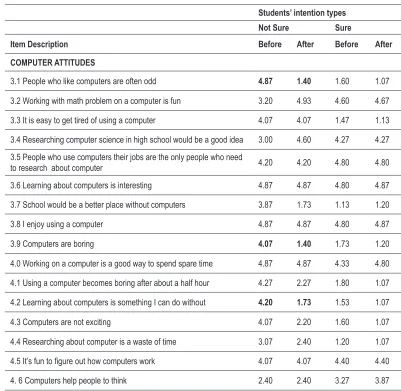
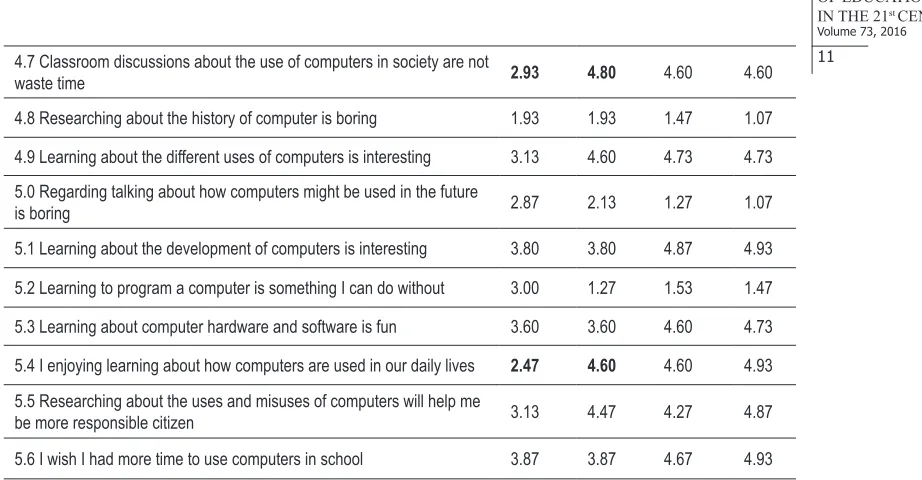
In the first part of the pretest questionnaire, 15 students indicated that they had an intention (the “Sure” group”) to study computing after high school, while 16 students stated that they had no intention (the “Not Sure group”) to study computing at higher education level. Table 1 summarizes the students’ answers related to computer attitudes before and after the experiment. The results are divided according to the students’ intention to study computing after high school.
Table 1. Students’ responses to computer attitudes before/after teaching experiment based on intention types (Mean).
Students’ intention types
Not Sure Sure
Item Description Before After Before After
COMPUTER ATTITUDES
3.1 People who like computers are often odd 4.87 1.40 1.60 1.07
3.2 Working with math problem on a computer is fun 3.20 4.93 4.60 4.67 3.3 It is easy to get tired of using a computer 4.07 4.07 1.47 1.13 3.4 Researching computer science in high school would be a good idea 3.00 4.60 4.27 4.27 3.5 People who use computers their jobs are the only people who need
to research about computer 4.20 4.20 4.80 4.80
3.6 Learning about computers is interesting 4.87 4.87 4.80 4.87
3.7 School would be a better place without computers 3.87 1.73 1.13 1.20
3.8 I enjoy using a computer 4.87 4.87 4.80 4.87
3.9 Computers are boring 4.07 1.40 1.73 1.20
4.0 Working on a computer is a good way to spend spare time 4.87 4.87 4.33 4.80 4.1 Using a computer becomes boring after about a half hour 4.27 2.27 1.80 1.07 4.2 Learning about computers is something I can do without 4.20 1.73 1.53 1.07
4.3 Computers are not exciting 4.07 2.20 1.60 1.07
4.4 Researching about computer is a waste of time 3.07 2.40 1.20 1.07 4.5 It’s fun to figure out how computers work 4.07 4.07 4.40 4.40
11 4.7 Classroom discussions about the use of computers in society are not
waste time 2.93 4.80 4.60 4.60
4.8 Researching about the history of computer is boring 1.93 1.93 1.47 1.07 4.9 Learning about the different uses of computers is interesting 3.13 4.60 4.73 4.73 5.0 Regarding talking about how computers might be used in the future
is boring 2.87 2.13 1.27 1.07
5.1 Learning about the development of computers is interesting 3.80 3.80 4.87 4.93
5.2 Learning to program a computer is something I can do without 3.00 1.27 1.53 1.47 5.3 Learning about computer hardware and software is fun 3.60 3.60 4.60 4.73 5.4 I enjoying learning about how computers are used in our daily lives 2.47 4.60 4.60 4.93 5.5 Researching about the uses and misuses of computers will help me
be more responsible citizen 3.13 4.47 4.27 4.87
5.6 I wish I had more time to use computers in school 3.87 3.87 4.67 4.93
As seen in Table 1, the culturally responsive learning environment had a positive effect on the computer attitudes of those students who were “Not Sure” about computing studies at the higher education level. For example, after the experiment their opinion regarding people who liked computers changed. Again, the students in the “Not Sure” group had a different view regarding the excitement of the computers. Before the experiment, the student in the “Not sure” group thought that computers were boring. Then after the experiment they thought that computers were not boring. Besides, they would appreciate if computer science was made an additional elective subject in the high school curriculum. We have used bold formatting in Table 1 to indicate the most interesting results related to computer attitude questionnaire.
Conceptual Understanding of Object-Oriented Concepts
Table 2 summarizes the participants’ responses to the questionnaire section Conceptual Understanding of Object-Oriented Concept before and after the experiment.
Table 2. Students’ conceptual understanding to object-oriented concepts (counts).
Responses
Before After
Yes No Yes No
Items UC C UC C UC C UC C
8.1 Object is experienced as a model of some real work
phenomenon that is intractable 20 5 3 2 1 27 1 1
8.2 Class is experienced as a description of attributes and methods of the object as a model of some real world
phenomenon 14 3 5 8 1 28 0 1
8.3 Methods call should specify object identifier, a method
name and arguments 16 5 4 5 0 28 1 1
8.4 Object from the same class share the same definition of
attributes and methods 21 5 2 2 0 29 0 1
8.5 Object methods are operations or behaviors 13 6 7 4 0 30 0 0
IN THE 21 CENTURY Volume 73, 2016
12 8.7 Object instances are individuals with their own state 15 8 1 6 1 28 0 1 8.8 Objects from the same class many not have the same
attributes 17 11 1 1 0 29 0 1
8.9 Objects from the same class share definition of
attrib-utes and methods 17 5 3 5 0 30 0 0
9.0 Objects from the same class may not have the same
attributes values 16 13 1 0 0 29 0 1
9.1 Methods is a set of operation executed by an object
upon the receipt of call 18 10 1 1 0 29 0 1
9.2 conditional statements allow for conditions to be
executed 20 5 1 4 0 29 0 1
Totals Number of Responses 208 78 34 40 3 345 2 10
Note: UC = Uncertain; C = Certain
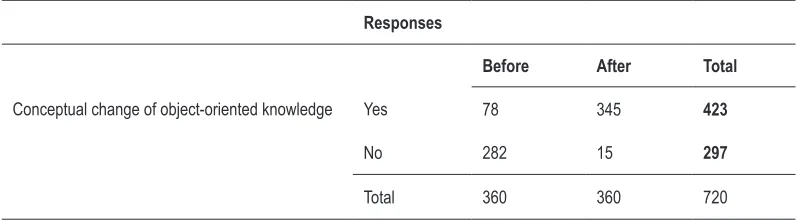
To prepare contingency table for Pearson’s Chi Square statistical procedure, all “Yes” responses on the subscale associated with “Uncertainty” were recoded as “No” responses. On the other hand, “Yes” responses associated with “Certainty” and “Completely Certainty” were recoded as “Yes” responses. Nevertheless, “No” responses regardless of association with “Uncertainty”, “Certainty” and “Completely Certainty were recoded as “No” responses. Table 3 shows contingency table to ensure that assumptions for Pearson’s Chi Square test are observed. According to Field et al. (2009), for the Pearson’s Chi Square to be meaningful it is imperative that expected frequencies in each cell should be greater than 5. Therefore, the contingency table meets the assumptions for Pearson’s chi square test.
Table 3. Statistical contingency table of dichotomous responses to object oriented paradigm for all students.
Responses
Before After Total
Conceptual change of object-oriented knowledge Yes 78 345 423
No 282 15 297
Total 360 360 720
13
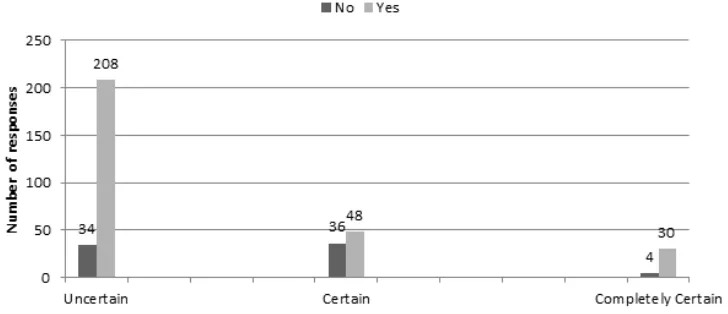
Figure 1: Students` understanding to object oriented concepts before experiment.
Figure 2: Students` understanding to object oriented concepts after experiment.
Assimilation of Basic Object-Oriented Programming Concepts
IN THE 21 CENTURY Volume 73, 2016
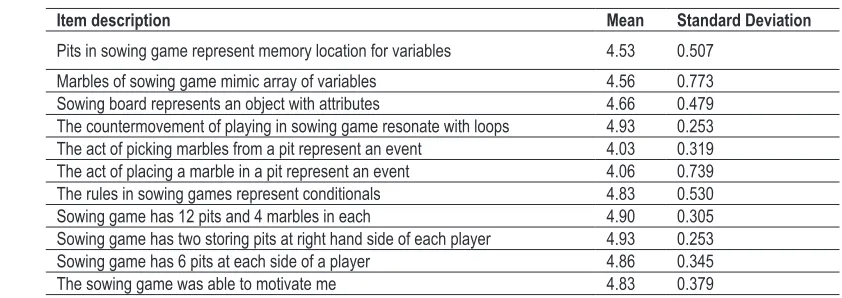
14 Table 4. All students’ responses to object-oriented indigenous knowledge.
Item description Mean Standard Deviation
Pits in sowing game represent memory location for variables 4.53 0.507 Marbles of sowing game mimic array of variables 4.56 0.773 Sowing board represents an object with attributes 4.66 0.479 The countermovement of playing in sowing game resonate with loops 4.93 0.253 The act of picking marbles from a pit represent an event 4.03 0.319 The act of placing a marble in a pit represent an event 4.06 0.739 The rules in sowing games represent conditionals 4.83 0.530
Sowing game has 12 pits and 4 marbles in each 4.90 0.305
Sowing game has two storing pits at right hand side of each player 4.93 0.253 Sowing game has 6 pits at each side of a player 4.86 0.345
The sowing game was able to motivate me 4.83 0.379
Discussion
The research explored effects of culturally responsive learning environment upon high school students’ computer attitudes, analogical reasoning, and conceptual understanding of object-oriented programming in Ghanaian high school context. The results show variations in computer attitudes of the students who had different intentions towards computer studies. Again, those students who were sure about future computer studies had stable and positive computer attitudes. On the contrary, students who were not sure about future computer studies positively changed their computer attitudes after being exposed to culturally responsive learning environment. Also, the high school students participating to the experiment showed understanding about analogical reasoning between indigenous practices and object oriented concepts. The stated hypothesis emphasized that learning object-oriented programming in culturally responsive learning environment had a significant effect on high school students’ conceptual understanding of object-oriented concept. The hypothesis was accepted with Chi-square statistic of 408.60 bigger than critical values at df=1 and significant at p<0.001. We can conclude that those students who had positive attitudes towards culturally responsive learning environment attain significantly high conceptual understanding and analogies in object oriented programing regardless of their intention types. The results partly confirm the findings that positive computer attitude is related to computing achievement of students (Eglash, Krishnammorthy, Sanchez & Woodbridge, 2011; Eglash, Gilbert & Foster, 2013). Similarly, the results are consistent with the conclusion that indigenous technologies are built on metaphors and analogies that may not exist or may have different connotations outside their respective communities (Sutinen & Vesisenaho, 2006; Tedre, Sutinen, Kahkonen & Kommers, 2006). As such, indigenous knowledge can be integrated into computing education providing metaphors to support teaching and learning (Dalvit, 2008). Indigenous knowledge systems have rich cultural heritage to support culturally responsive computing education in developing countries from Africa.
Reliability and Validation
15 towards something, one can predict individuals’ pattern of responses to an object. Furthermore, when there is clear connection between an objective and any attitudes that are formed, the degree of predictability will be highest. If we understand students’ attitudes towards computers, we should be able to predict computer related behaviors and choices (Ajzen & Fishbein, 1977). Several actions were taken to resolve threats to internal validity of the experimental design such as: Testing - the research avoided sensitizing participants to major topics about object-oriented paradigm. Statistical Regression – the students were not chosen for pretest on the basis of scores but rather intentions type. Instrumentation – there were no changes to calibration of measuring instrument for both pretest and posttest.
Conclusions
The research empirical evidence shows students’ conceptual understanding to object- oriented paradigm and remarkable attitudinal change of some students who were not sure about computing studies after high school education. Surprisingly, these kinds of students expressed the desire that computer science was made an additional elective subject in the high school curriculum. In effect, if attitudes of less attractive students towards computing education are to change, we will need to introduce more culturally responsive learning environments. Exciting computing instruction should use learner’s cultural background as foreknowledge to enhance conceptual understanding.
References
Ajzen, I.., & Fishbein, M. (1977). Attitude-behavior relations: A theoretical analysis and review of empirical research. Psychological Bulletin,84 (5), 888.
Ajzen, I., & Fishbein, M. (1980). Understanding attitudes and predicting social behavior. Englewood Cliffs, NJ: Prentice Hall.
Babbitt, W., Lachney, M., Bulley, E., & Eglash, R. (2015). Adinkra mathematics: A research of ethnocomputing in Ghana. Multidisciplinary Journal of Educational Research, 5 (2), 110-135. Bear, G. G., Richards, H. C., & Lancaster, P. (1987). Attitudes toward computers: Validation of a computer
attitudes scale. Journal of Educational Computing Research,3 (2), 207-218.
de Beer, J., & Whitlock, E. (2009). Indigenous knowledge in the Life Sciences classroom: Put on your De Bono hats! The American Biology Teacher, 71 (4), 209-216.
Breidlid, A. (2009). Culture, indigenous knowledge systems and sustainable development: A critical view of education in an African context. International Journal of Educational Development, 29 (2), 140-148.
Champ, P. A., & Bishop, R. C. (2001). Donation payment mechanisms and contingent valuation: An empirical research of hypothetical bias. Environmental and Resource Economics, 19 (4), 383-402.
Dalvit, L., Murray, S., & Terzoli, A. (2008). The role of indigenous knowledge in computer education in Africa. In: Learning to Live in the Knowledge Society, Volume 281 of the Series IFIP – The International Federation of Information Processing (pp. 287-294). Springer.
Diwu, C. T., & Ogunniyi, M. B. (2012). Dialogical argumentation instruction as a catalytic agent for the integration of school science with indigenous knowledge systems. African Journal of Research in Mathematics, Science and Technology Education, 16 (3), 333-347.
Eglash, R. (2007). Ethnocomputing with Native American design. In L.E. Dyson, M. Hendriks, & G. Stephend (Eds.). Information Technology and Indigenous People (pp. 210-219). IGI Global. Eglash, R., Krishnamoorthy, M., Sanchez, J., & Woodbridge, A. (2011). Fractal simulations of African
design in pre-college computing education. ACM Transactions on Computing Education, 11 (3), 1-17.
IN THE 21 CENTURY Volume 73, 2016
16 Erodogan, Y. (2009). Paper-based and computer-based concept mappings: The effects on computer achievement, computer anxiety and computer attitude. British Journal of Educational Technology, 40 (5), 821-836.
Erodogan, Y., Aydin, E., & Kabaca, T. (2008). Exploring the psychological predictors of programming achievement. Journal of Instructional Psychology, 35 (3), 264.
Eugene, W., & Gilbert, J.E. (2008). C-PAL: cultural-based programming for adult learners. In Proceedings of the 46th Annual Southeast Regional Conference, pp. 450-453.
Field, A. (2009). Discovering statistics using SPSS. Sage Publications Company.
Gifford, C., Bley, J., Ajayi, D., & Thompson, Z. (2008). Searching & game playing: An artificial
intelligence approach to Mancala. University of Kansas, Lawrence, KS.
Johannesson, M., Liljas, B., & Johansson, P. O. (1998). An experimental comparison of dichotomous choice contingent valuation questions and real purchase decisions. Applied Economics, 30 (5), 643-647.
Kawagley, A. O. (2006). A Yupiaq worldview: A Pathway to ecology and spirit. Waveland Press. Kirk, R. E. (1982). Experimental design. John Wiley & Sons, Inc.
Li, C. Z., & Mattsson, L. (1995). Discrete choice under preference uncertainty: An improved structural model for contingent valuation. Journal of Environmental Economics and Management, 28 (2), 256-269.
Lipka, J., & Ilutsik, E. (2014). Transforming the culture of schools: Yup¡ k Eskimo Examples. Routledge, New York.
Loomis, J., & Ekstrand, E. (1998). Alternative approaches for incorporating respondent uncertainty when estimating willingness to pay: The case of the Mexican spotted owl. Ecological Economics, 27 (1), 29-41.
Lux, M., Kofler, C., & Marques, O. (2010). A classification scheme for user intentions in image search. In CHI’10 Extended Abstracts on Human Factors in Computing Systems (pp. 3913-3918). ACM. Margolis, J., Ryoo J. J., Sandoval, C. D., Lee, C., Goode, J., & Chapman, G. (2012). Beyond access:
Broadening participation in High School Computer Science. ACM Inroads, 3 (4), 71-78. Moroz, P. A., & Nash, J. B. (1997). Bath county computer attitude scale: A reliability and validity scale.
In Annual Meeting of the American Educational Research Association, pp. 1-11.
Naidoo, P. D., & Vithal, R. (2014). Teacher approaches to introducing indigenous knowledge in school science classrooms. African Journal of Research in Mathematics, Science and Technology Education, 18 (3), 253-263.
Owuor, J. (2008). Integrating African indigenous knowledge in Kenya’s formal education system: The potential for sustainable development. Journal of Contemporary Issues in Education, 2 (2), 21-37.
Poo, D., Kiong, D., & Ashok, S. (2007). Object-Oriented Programming and Java. Springer Science & Business Media.
Prokop, P., Tuncer, G., & Chuda, J. (2007). Slovakian students’ attitudes toward biology. Eurasia Journal of Mathematics, Science and Technology Education, 3 (4), 287-295.
Sutinen, E., & Vesisenaho, M. (2006). Ethnocomputing in Tanzania: Design and analysis of a contextualized ICT course. Research and Practice in Technology Enhanced Learning, 1 (3), 239-267.
Rhoads, T. R., & Hubele, N. F. (2000). Student attitudes toward statistics before and after a computer-integrated introductory statistics course. IEEE Transactions on Education, 43 (2), 182-187. Tedre, M., Sutinen, E., Kähkönen, E., & Kommers, P. (2006). Ethnocomputing: ICT in cultural and social
context. Communications of the ACM,49 (1), 126-130.
Tuysuz, C. (2010). The effect of the virtual laboratory on students’ achievement and attitude in Chemistry.
International Online Journal of Educational Sciences, 2 (1), 37-53.
17
Received: July 28, 2016 Accepted: October 02, 2016
Ebenezer Anohah Doctoral Candidate in Computer Science Education, University of Eastern Finland, P.O. Box 111, FI – 80101 Joensuu, Finland, Finland
E-mails: [email protected]
Jarkko Suhonen PhD., Senior Researcher, University of Eastern Finland, P.O. Box 111, FI – 80101 Joensuu, Finland Finland