Forestry & Natural-Resource Sciences Last Correction: Sep. 30, 2016
ENTROPY DYNAMICS IN CONE PRODUCTION OF LONGLEAF
PINE FORESTS IN THE SOUTHEASTERN UNITED STATES
Xiongwen Chen
1, Dale G. Brockway
2, Qinfeng Guo
31
Department of Biological and Environmental Sciences, Alabama A&M University, Normal, AL, USA
2
USDA Forest Service, Southern Research Station, Auburn, AL, USA
3
USDA Forest Service, Eastern Forest Environmental Threat Assessment Center, Research Triangle Park, NC, USA
Abstract. Sporadic temporal patterns of seed production are a challenge for the regeneration and restoration of longleaf pine, which is a keystone component of an endangered ecosystem in the southeastern United States. In this study, long-term data for longleaf pine cone production, collected at six sites across the southeastern region, was examined from the perspective of information entropy. Our results indicate that long-term monitoring data usefully reflects the information entropy and trajectory in cone production. The entropy of cone production for longleaf pine forests at all sites increased slowly through time. However, a slight decrease in entropy was also noted. Entropy across all sites remained within 1.28–1.77 until 2016. High linear correlation existed between entropy and log (time length). The maximum entropy model (MaxEnt) overestimated the information entropy at each site, although the dynamics were similar. Joint entropy among all sites might reflect an emergent pattern for entropy across the region. Our study provides an important approach for characterizing ecosystem dynamics by information flow in adaptive ecosystem management.
Keywords: Pinus palustris Mill., keystone species, endangered ecosystem, restoration, informa-tion flow.
1
Introduction
Longleaf pine (Pinus palustris Mill.) forest is an im-portant ecosystem in the southeastern United States prin-cipally because of its economic (e.g., timber and related forest products) and ecological values (e.g., high biodi-versity and excellent wildlife habitat) (Jose et al. 2006, Hodges 2006). Much of this high biodiversity can be attributed to an understory rich in native plants and the many animals, which it supports. Longleaf pine ecosys-tems once covered about 37 million ha in a broad area from southeastern Virginia to eastern Texas (Frost 1993), of which 23 million ha were dominated by longleaf pine and 14 million ha were in mixture with other tree species. Longleaf pine forests occupied a variety of habitats, from xeric sandhills to mesic uplands to poorly drained flat-woods to montane areas. Following European settle-ment, the extent of longleaf pine ecosystems dramatically declined. According to forest inventory and analysis data (FIA, Forest Service), only about 1.02 million ha of longleaf pine forest remained in 1995 (Outcalt and
Sheffield 1996). The remaining forests are listed as an endangered ecosystem (Noss et al. 1995).
One very important factor contributing to the de-cline of longleaf pine forests is sporadic seed production, which limits longleaf pine regeneration and complicates its restoration and management (Frost 2006). The phys-iological development of longleaf pine seed from initial primordia through mature cone to viable seed is a lengthy process, which can extend nearly three years (Brockway et al. 2006). The long duration of this process may be a contributing reason as to why longleaf pine produces in-frequent seed crops. If existing members cannot produce sufficient cone crops, then populations of this species may face local extinction, thus degrading entire ecosystems dependent on this keystone species.
Its annual variation in cone production is thought to be mainly related to variable weather conditions; al-though, the exact mechanisms controlling such dynamics are not known. Previous studies have correlated cone production (cones tree−1year−1) with monthly precip-itation and average temperatures at local and regional
while average monthly temperatures explains only 33.7%. After comparing cone production and local weather con-dition across the southeastern region, including Escambia Experimental Forest, Guo et al. (2016) concluded that the response of cone production to climate is complex. The frequency of high cone production did not match the frequency of high annual precipitation. Long-term and multi-site data demonstrated the limitations (e.g., incompleteness and bias) of short-term data from a single study site. The results from one site based on a short-time observation are not consistent with results from other sites or in a long time period. So far there is no general model available to predict the cone production at each site across the region or the overall behavior of the cone production for longleaf pine forest due to the spatial and temporal heterogeneity. It is necessary to have the knowledge of the emergent behavior of cone production in the entire region so that the management strategies can be explored. Since it is difficult to study the emergent properties of a complex system by using a reductionist approach, which was broadly used for study-ing cone production, it may be more useful to try a top-down approach, such as that from an information perspective.
Cone production in longleaf pine forests could be considered a self-organization process, whose network of interactions among plants, soil and light serves as a means for the exchange of matter, energy and information among the component parts and surroundings. Cone pro-duction results from the interchange of a tree (or forest) with its surrounding environment through the transfer of light, water, nutrients, CO2 and O2. Information flow,
just like energy or material flow, is a basic property and process of open and complex ecosystems, by which the system and its parts extract, or produce meaning and/or action from signals spontaneously by self-organization (Sousa 2010). Information ecology is a science, which studies the laws governing the influence of information summary on the formation and functioning of bio-systems (Eryomin 1998). Complexity, ambiguity, and nonlinear-ity are a part of an information ecology. Entropy is not merely a physical quantity, but it is also a reasoning tool to reflect information. The principle of maximum entropy (MaxEnt) means that subject to precisely stated prior data, such as a proposition that expresses testable information, the probability distribution which best rep-resents the current state of knowledge, is the one with the largest entropy (e.g., Jaynes 1957). The MaxEnt has been frequently used in ecology (Harte 2011), such as modeling species distribution. Chen et al. (2016) ana-lyzed the entropy of cone production at multiple time scales and found a high correlation between the entropy
the region. In order to further understand the emer-gent properties of cone production, it is still necessary to study (i) how entropy dynamics evolved through time at each site; (ii) whether the responses in entropy of cone production for longleaf pine forests were similar at different locations or whether they converged to the same entropy (i.e., did the dynamics of cone production at each site follow MaxEnt concept?); and (iii) whether the entropy of cone production at each site reached the maximum at a certain stage, and what was the pattern of joint entropy? This knowledge can help us to better understand the dynamic properties of cone production for longleaf pine forests in the region.
2
Material and methods
2.1 Data Cone production data for longleaf pine were collected by research scientists at Southern Research Station of USDA Forest Service as part of a long-term monitoring effort. Each spring, observers used binoc-ulars at numerous sites across the southeastern region to count the number of green cones in the crowns of mature longleaf pine trees growing in low-density stands. At least 10 trees were sampled in stands on each site. The average number of cones on all sampled trees was used to represent the cone production on each site. De-tailed information can be found in Brockway (2016). In our study, six sites with the most complete data were selected from the regional monitoring effort. These six sites include the (1) Escambia Experimental Forest in southern Alabama, (2) Red Hills of northern Florida, (3) Blackwater River State Forest in the western pan-handle of Florida, (4) Jones Ecological Research Center in southwestern Georgia, (5) Sandhills State Forest in northeastern South Carolina, and (6) Kisatchie National Forest in central Louisiana.
2.2 Methods In our study, information entropy is defined as the Shannon entropyHε(x)of cone production
at different lengths of years (ε) as the following:
Hε(x) =− X
pε(x)Log10pε(x), n X
i=1
pε(x) = 1
Where:
pε(x) is the percentage of cone production (x) at the
i-th year measured inεyears from the first year of record.
The time length of ε includes 4, 5, 6. . . 0.58 years (from 1961 to 2016 for Escambia EF site).
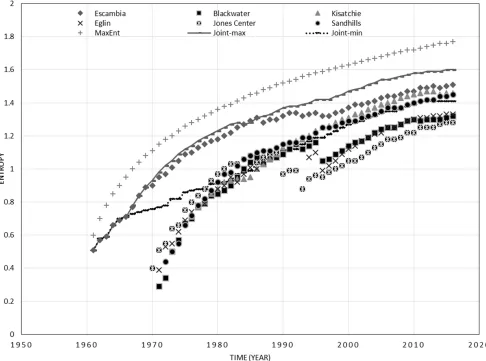
Figure 1: The dynamics in entropy of cone production for longleaf pine forests at six sites and the joint entropy across the southeastern United States (joint-min: joint entropy with minimums; joint-max: joint entropy with maximums).
MaxEnt was estimated whenpε(x) = 1/n.
The joint Shannon entropy of cone production, for the multiple sites, is estimated by the joint probabilitypε(xmax)
andpε(xmin), withxmaxandxminthe maximum and
min-imum of cone production among the 6 sites during that year, respectively (Jumarie 2000). The joint entropy can be used for characterizing an emergent pattern, which may be quite different with the pattern at each site (Chen et al. 2005).
3
Results and Discussion
Generally, the entropy of cone production for lon-gleaf pine forests increased gradually through time at all sites, but a slight decrease in entropy also appeared at some sites (Fig. 1). Despite a dramatic change in cone production at each site, the entropy dynamics were relatively stable. These long-term data proved useful in reflecting the information entropy trajectory for cone
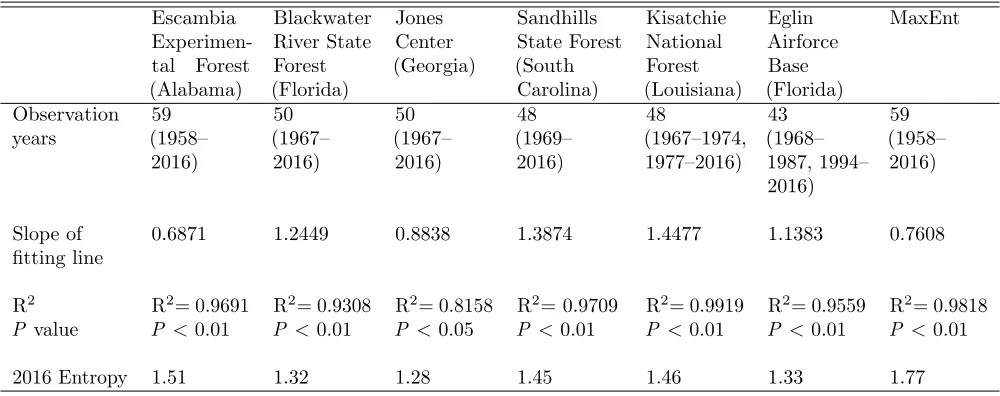
production. Sudden change was usually related to a big increase or decrease in cone production, although missing data might also cause change, such as at the Eglin site (FL). Such change was possibly related to environmental change (Chen et al. 2016). Until 2016, the entropy at all sites was within 1.28–1.77. The entropy dynamics of cone production, with a logarithmic expression of time length (years) at each site, could be fitted by a linear model and the slopes of fitting lines could be classified into two groups (Tab. 1). One group including Blackwa-ter (FL), Kisatchie (LA), Eglin (FL), and Sandhills (SC) was within the slope of 1.1383–1.4477. The second group was within the slope of 0.6871–0.8838 for Escambia (AL), Jones Center (GA), and MaxEnt. All these algorithms and narrow ranges of slope might be used to predict cone production in the next year.
Escambia Experimen-tal Forest (Alabama) Blackwater River State Forest (Florida) Jones Center (Georgia) Sandhills State Forest (South Carolina) Kisatchie National Forest (Louisiana) Eglin Airforce Base (Florida) MaxEnt Observation years 59 (1958– 2016) 50 (1967– 2016) 50 (1967– 2016) 48 (1969– 2016) 48 (1967–1974, 1977–2016) 43 (1968– 1987, 1994– 2016) 59 (1958– 2016) Slope of fitting line
0.6871 1.2449 0.8838 1.3874 1.4477 1.1383 0.7608
R2 P value
R2= 0.9691 P <0.01
R2= 0.9308 P <0.01
R2= 0.8158 P <0.05
R2= 0.9709 P <0.01
R2= 0.9919 P <0.01
R2= 0.9559 P <0.01
R2= 0.9818 P <0.01
2016 Entropy 1.51 1.32 1.28 1.45 1.46 1.33 1.77
the past years. MaxEnt would overestimate the regular entropy at each site in this study, because it assumed that cone production would be similar every year, but it might provide a limitation for estimating entropy. Xiao et al. (2015) found that MaxEnt was not correct when char-acterizing the size-density relationship and intraspecific distribution of body size. So for this study, the MaxEnt model may not properly reflect the entropy dynamics in cone production across the region.
The joint entropy with maximums among all sites was lower than the MaxEnt, but slightly higher than the regular entropy. It could serve as the upper limit of entropy for all sites. There was a high correlation between joint entropy with maximums and MaxEnt (y= 0.9815x+0.1814,R2=0.9934,p<0.01). The joint entropy
with maximums and minimums among all sites set the upper and lower boundaries for the entropy of each site (1.41–1.60), although the corresponding cone production might vary dramatically here because log10 was used for
transformation. Log2 transformation could be used if
for a more accurate estimation of cone production. Any regular entropy could be considered as abnormal if it deviated from the joint entropy too much. A joint entropy indicator was used to characterize the emergent pattern and detect abnormal distribution for two grass species in a desert environment (Chen et al. 2005). The joint entropy is a special kind of Bayesian statistics because only the maximum or minimum values were selected among sites each year. Information entropy may provide a useful way to predict cone production in the future at each site and across the region.
From the above results, the implications for longleaf pine forest management can be considered from several perspectives. The similar trajectory of entropy dynamics
at all sites means that the irregular cone production of longleaf pine may share some common characteristics of self-organization. Based on the trajectory at each site and overall trend at the regional level, cone production at corresponding sites might be estimated early. The sudden change of entropy might indicate major or abrupt environmental changes. The joint entropy (both mini-mum and maximini-mum) could be used not only to estimate the emergent property of cone production across the en-tire region, but also to identify the abnormal change in entropy dynamics at each site based on the joint entropy of minimum or maximum values in cone production. The turning points in entropy dynamics provide clues for fur-ther studying local ecosystem and environmental changes, such as those at Blackwater (FL), Eglin (FL), and Jones Center (GA). These results suggest that necessary mon-itoring at the ecosystem level should be set up at each study site in order to better understand the dynamics of cone production.
to study seed production and other processes in other ecosystems.
Acknowledgement
This work was partially supported by USDA NIFA McIntire Stennis Program (1008643) (ALAX011-4515). Thanks are due to two reviewers and editor’s comments and suggestions, which improved this work.
References
Brockway, D.G. 2016. Longleaf Pine Cone
Prospects for 2016 and 2017. USDA
For-est Service, Southern Research Station.
http://srs.fs.usda.gov/longleaf/subunit/longleaf-pine-2016-report.pdf
Brockway, D.G., K. W. Outcalt, and W. D. Boyer. 2006. Longleaf pine regeneration ecology and methods. In The Longleaf Pine Ecosystem: Ecology, silviculture, and restoration. S. Jose, E. J. Jokela, and D. L. Miller [Eds.]. Springer Science, New York, pp 95-133.
Chen, X., B.-L. Li, and S. Collins. 2005. Multiscale mon-itoring of a multispecies case study: two grass species at Sevilleta. Plant Ecology 179: 149-154.
Chen, X., Q. Guo, and D. G. Brockway. 2016. Analyzing the complexity of cone production in longleaf pine by multiscale entropy. Journal of Sustainable Forestry 35: 172-182.
Eryomin, A. L. 1998. Information ecology - a viewpoint. International Journal of Environmental Studies 54: 241-253.
Frost, C. C. 1993. Four centuries of changing landscape patterns in the longleaf pine ecosystems. In The Lon-gleaf Pine Ecosystem: ecology, restoration and manage-ment. S. M. Hermann [Ed.]. Proceedings Tall Timbers Fire Ecology Conference No. 18, pp. 17-43.
Frost, C. C. 2006. History and future of the longleaf pine ecosystem. In: The Longleaf Pine Ecosystem: Ecology, silviculture, and restoration. S. Jose, E. J. Jokela, and D. L. Miller [Eds.]. Springer Science, New York, pp 9-42.
Guo, Q., S. J. Zarnoch, X. Chen, and D. G. Brock-way. 2016. Life cycle and masting of a recovering key-stone indicator species under climate change. Ecosys-tem Health and Sustainability 2(6):e01226.
Harte, J. 2011. Maximum entropy and ecology: a theory of abundance, distribution, and energetics. Oxford University Press, Oxford.
Hodges, A. W. 2006. The naval stores industry. In The Longleaf Pine Ecosystem: ecology, silviculture, and restoration. S. Jose, E. J. Jokela, and D. L. Miller [Eds.]. Springer Science, New York, pp 43-48.
Jose, S., E. J. Jokela, and D. L. Miller. 2006. The Longleaf Pine Ecosystem: An overview. In The Longleaf Pine Ecosystem: Ecology, silviculture, and restoration. S. Jose, E. J. Jokela, and D. L. Miller [Eds.]. Springer Science, New York, pp 3-8.
Jaynes, E. T. 1957. Information theory and statistical mechanics. Physical Review 106: 620-630.
Jumarie, G. 2000. Maximum Entropy, Information with-out Probability and Complex Fractals: Classical and Quantum Approach. Kluwer Academic Publishers, Dordrecht, The Netherlands.
Noss, R. F., E. T. LaRoe, and J. M. Scott. 1995. Endan-gered ecosystems of the United States: a preliminary assessment of loss and degradation. USDI National Biological Service, Biological Report 28, Washington DC.
Outcalt, K. W, and R. M. Sheffield. 1996. The longleaf pine forest: Trends and current conditions. USDA Forest Service, Southern Research Station, Resource Bulletin SRS-9.
Pederson, N., J. S. Kush, and R. S. Meldahl. 1998. Cor-relating climate and longleaf pine cone crops: Is there a connection? In Proceedings of the 2nd Longleaf Al-liance Conference, 1998 November 17-19. Charleston, SC. Longleaf Alliance Report No. 4. Auburn University, AL. Longleaf Alliance: 140-143.
Pederson, N., J. S. Kush, R. S. Meldahl, and W. D. Boyer. 2000. Longleaf pine cone crops and climate: A possible link. In: Proceedings of the tenth biennial southern silvicultural research conference; February 16-18, 1999, L. A. Shreveport and J. D. Haywood [Eds.]. Gen. Tech. Rep. SRS-30. USDA Forest Service, Southern Research Station, Asheville, NC, pp 255-258.
Sousa, J. 2010. Using emergent information flow pat-terns of organization ecosystem for information system management. In ENTERprise Information Systems. International Conference, CENTERIS 2010, Viana do Castelo, Portugal, October 20-22. 2010, Proceedings, Part I. J. E. Quintela Varaj˜ao, M. M. Cruz-Cunha, G. D. Putnik, and A. Trigo [Eds.]. Springer-Verlag, Berlin, pp. 395-402.