Effects of Chemical Reaction on MHD Flow Past an Impulsively Started
Infinite Vertical Plate with Variable Temperature and Mass Diffusion in
the Presence of Hall Current
B. Prabhakar Reddy1,2* , J. Peter1
1 Department of Mathematics, College of Natural & Mathematical Sciences, The University of Dodoma, P. Box No. 338, Dodoma, Tanzania
e-mail: [email protected]
2 Department of Mathematics, Geethanjali College of Engineering & Technology, Keesara, Medchal - 501301, Telangana, India
e-mail:[email protected]
*corresponding author
Abstract
In this paper, the effects of chemical reaction on unsteady MHD flow of viscous incompressible electrically conducting fluid past an impulsively started oscillating vertical plate with variable temperature and constant mass diffusion in the presence of Hall current have been presented. The dimensionless governing partial differential equations of the flow have been solved numerically by using the Crank-Nicolson implicit finite difference scheme. The numerical solutions for primary fluid velocity, secondary fluid velocity, fluid temperature and fluid concentration are plotted graphically whereas the numerical results of primary skin friction, secondary skin frictions, rate of heat and mass transfer are presented in tabular form for various parameters involved. A comparison has been provided between the present results and with the existing analytical solutions by the Laplace transforms technique. It has been found that the results of the present study are in excellent agreement with previously obtained results.
Keywords: MHD, chemical reaction, magnetic parameter, Hall current, oscillating vertical plate
1. Introduction
The objective of the present study is to investigate the effects of chemical reaction on unsteady MHD flow past an impulsively started oscillating infinite vertical plate with variable temperature and constant mass diffusion in the presence of Hall current. The main purpose of the present study is to extend the recent work of Rajput and Kanaujia (2016) with incorporating the effect of chemical reaction which should increase the applicability of the studies reported in the literature. A comparison of the present results in the absence of chemical reaction was made with the results of Rajput and Kanaujia (2016) obtained by exact solution (Laplace transform technique). It was found that our results are in excellent agreement with the results of Rajput and Kanaujia (2016).
2. Formulation of the Problem
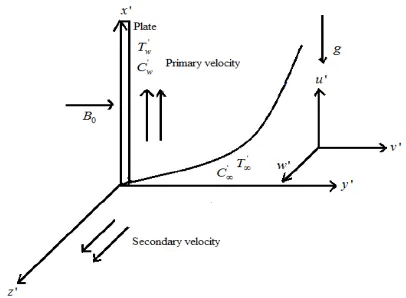
Consider the unsteady MHD flow of viscous incompressible electrically conducting fluid past an impulsively started oscillating vertical plate taking chemical reaction into account. A uniform magnetic field →B of strength B0 is applied in the direction perpendicular to the fluid flow.
Choose a Cartesian co-ordinate system with the x'− axis along the plate in the vertically upward direction, the 'y− axis perpendicular to the direction of the plate and z'− axis is normal to the
' '
x y− plane. The physical model of the problem is shown in Fig.1. Initially, at time t' 0,≤ the temperature of the fluid and the plate is T'
∞ and the concentration of the fluid is C∞' . At time ' 0,
t > the plate starts oscillating in its own plane with frequency ω', the temperature of the plate and the concentration of the fluid, respectively are raised to '
w
T and '.
w
C As the plate is of infinite extent and electrically non-conducting, all the physical quantities, except the pressure, are functions of 'y and t'.
Fig. 1. Flow geometry and physical coordinate system
The generalized Ohm's law on taking Hall current into account Cowling, (1957) is given by:
0 ( ) ( )
e e
J J B B q B
B
ω τ σ
→ → → → → →
+ × = + × (1)
collision time. The equation of continuity .∇ =→q 0 gives v' 0= everywhere in the flow since
there is no variation of the flow in 'y− direction, where →q=( ', ', ')u v w and u v w', ', ' are respectively, velocity components along the coordinate axes. The magnetic Reynolds number is so small that the induced magnetic field produced by the fluid motion is neglected. The solenoid relation ∇ =.→B 0 for the magnetic field →B=( ,B B Bx' y', z') gives By'= constant say B0. i.e.,
0
(0, ,0)
B B
→
= everywhere in the flow. The conservation of electric current ∇ =.→J 0 yields jy' =
constant, where J ( , , ).j j jx' y' z' →
= This constant is zero since jy'=0 at the plate which is
electrically non- conducting. Hence, jy'=0 everywhere in the flow.
In view of the above assumption, equation (1) yields
' ' ( ' ' )0
x y x
j −mj =σ E −w B (2)
' ' ( ' ' )0
z x z
j +mj =σ E +u B (3)
where (m=ω τe e) is the Hall parameter which represents the ratio of electron-cyclotron frequency and the electron-atom collision frequency. Since the induced magnetic field is
neglected, Maxwell equation E H t
→
→ ∂
∇× = −
∂ becomes E 0 →
∇ × = which gives ' 0
' x E y ∂ =
∂ and
' 0. ' z E y ∂ =
∂ This implies that Ex'= constant and Ez' = constant everywhere in the flow and choose this constants equals to zero, i.e., Ex'=Ez'=0.
Solving for jx' and jz' from Eqs. (2) and (3), on using Ex'=Ez'=0,
0
' 2 ( ' ')
1
x B
j mu w
m
σ
= −
+ (4)
0
' 1 2( ' ')
z B
j mw u
m
σ
= +
+ (5)
Taking into consideration the assumptions made above, under the Boussinesq’s approximation, i.e., the density changes with temperature, which gives rise to the buoyancy force, and using Eqs. (4) and (5), the basic governing equations of the flow are derived as:
2 2 ' * ' 0 2 2 ' ' ( ' ') ( ' ) ( ' )
' ' (1 )
B
u v u u mw g T T g C C
t y m
σ β β
ρ ∞ ∞
∂ = ∂ − + + − + −
∂ ∂ + (6)
2 2
0
2 2
' ' ( ' ')
' ' (1 )
B
w v w mu w
t y m
σ ρ
∂ = ∂ + −
∂ ∂ + (7)
2 2
' '
' p '
T k T
t ρC y
∂ = ∂
2
' 2
' ' '( ' )
' '
C D C C C
t y γ ∞
∂ = ∂ − −
∂ ∂ (9)
The corresponding initial and boundary conditions are:
' '
' ' ' '
0
' '
' 0; ' 0, ' 0, ' , ' for all '
' 0; ' cos ' ', ' 0, ' ( ), ' at ' 0
' 0, ' 0, ' , ' as '
w w
t u w T T C C y
t u u t w T T T T C C y
u w T T C C y
ω
∞ ∞
∞ ∞
∞ ∞
≤ = = = =
> = = = + − = =
→ → → → → ∞
(10)
where ', ', , , , ', ', ' , ', , ', , , , ,' '
w w
u w g β β∗ t C C C D T T T k υ ρ
∞ ∞ and Cp are respectively, velocity of the fluid in x'− direction, velocity of the fluid in z'− direction, acceleration due gravity, volumetric coefficient of thermal expansion, volumetric coefficient of concentration expansion, time, species concentration in the fluid, concentration in the fluid far away from the plate, species concentration at the plate, mass diffusion, temperature of the fluid, temperature of the fluid near the plate, temperature at the plate, thermal conductivity, kinematic viscosity, fluid density and specific heat at constant pressure.
Let us introduce the following non-dimensional parameters and quantities:
2
0 0
2
0 0 0
2 ' ' ' ' ' '
0
2 2 ' ' ' ' 3
0 0 0
' ' 3 0 ' ' ', , , ', ' , , , ( ) ( ) ( ) ' , , , , , ( ) ( ) ( ) . p c r w r w w w m C
y u t u
u w v v
u y t w S P
u v v u u D k
B v v T T C C g T T
M G
u u T T C C u
g C C
G u µ ω ω σ γ γ θ φ βν ρ βν ∞ ∞ ∞ ∞ ∞ ∞ = = = = = = = − − − = = = = = − − − = (11)
Using Eq. (11), into Eqs. (6)-(9), the following dimensionless governing equations of the flow are obtained:
2
2 (1 2)( ) r m
u u M u mw G G
t y m θ φ
∂ =∂ − + + +
∂ ∂ + (12)
2
2 (1 2)( )
w w M mu w
t y m
∂ =∂ + −
∂ ∂ + (13)
2 2
1 r
t P y
θ θ
∂ = ∂
∂ ∂ (14)
2 2
1 c
t S y
φ φ γφ
∂ = ∂ −
∂ ∂ (15)
where , , , , ,u wθ φ G G M m P Sr m, , , ,r c and γ are respectively, dimensionless primary velocity, dimensionless secondary velocity, dimensionless temperature, dimensionless concentration, thermal Grashof number, mass Grashof number, magnetic parameter, Hall parameter, Prandtl number, Schmidt number and chemical reaction parameter.
0; 0, 0, 0, 0
0; cos , 0, , 1 at 0
0, 0, 0, 0 as
t u w C y
t u t w t C y
u w C y
θ
ω θ
θ
≤ = = = = ∀
> = = = = =
→ → → → → ∞
(16)
3. Method of solution
The above system of governing partial differential equations (12)-(15), subject to initial and boundary conditions (16) have been solved numerically for various values of parameters of interest by using the well known Crank-Nicolson implicit finite difference scheme. The finite difference equations corresponding to the equations (12)-(15) are as follows:
, 1 , 1, 1 , 1 1, 1 1, , 1,
2
, , 2 , ,
2 2
2( )
( )
(1 )
i j i j i j i j i j i j i j i j
r i j m i j i j i j
u u u u u u u u
t y
M
G G u mw
m θ φ + − = − + − + + + + + − − + + ∆ ∆ + + − + + (17)
, 1 , 1, 1 , 1 1, 1 1, , 1,
2 , , 2 2 2 2( ) ( ) (1 )
i j i j i j i j i j i j i j i j
i j i j
w w w w w w w w
t y
M w mu
m + − = − + − + + + + + − − + + ∆ ∆ − − + (18)
, 1 , 1, 1 , 1 1, 1 1, , 1,
2
2 2
1
2( )
i j i j i j i j i j i j i j i j
r
t P y
θ + −θ θ− + − θ + +θ+ + +θ− − θ +θ+
=
∆ ∆ (19)
, 1 , 1, 1 , 1 1, 1 1, , 1,
, 2
2 2
1
2( )
i j i j i j i j i j i j i j i j
i j c
t S y
φ φ φ φ φ φ φ φ
γφ
+ − = − + − + + + + + − − + + −
∆ ∆ (20)
The initial and boundary conditions (16)become:
,0 ,0 ,0 ,0
0, 0, 0, 0,
max, max, max, max,
0, 0, 0, 0
cos( ), 0, , 1
0, 0, 0, 0
i i i i
j j j j
j j j j
u w
u t w t
u w θ φ ω θ φ θ φ = = = = = = = = = = = = (21)
Here the index i refers to y and j refers to time ,t also ∆ =y yi+1−yi and ∆ =t ti+1−ti. The flow domain is restricted to a rectangle of finite dimensions with y→ ∞ is approximated by
max 6
y = and tmax=4, where ∆ =y 0.025 and ∆ =t 0.0025 are mesh sizes such that the computational domain is divided into 240 1600× mesh points. These step sizes are finalized when the code was run with slightly changed values of mesh sizes, and no significant change was observed. This is justified since the boundary condition (21) is satisfied within the tolerance of
4
{
( )2 ( )2}
O ∆y + ∆t which tends to zero as ∆ →y 0 and ∆ →t 0 which justifies the consistency of the scheme. Stability and consistency together ensure convergence of the scheme.
The primary skin friction τx and secondary skin friction τz are given by
0 0 and x z y y u w y y τ τ = = ∂ ∂ = = ∂ ∂
The Nusselt number Nu and Sherwood number Sh are given by
0 0 and u y y N Sh y y θ φ = = ∂ ∂ = − = − ∂ ∂
Validation of the scheme: To validate the present numerical scheme, a comparison has been made by considering primary and secondary skin frictions τx and τz in the absence of chemical reaction with the results of Rajput and Kanaujia (2016) obtained by analytical solution (Laplace transform technique) shown in Table 1 and 2. An excellent agreement is noticed in this comparison which validates the present numerical scheme. This justifies the correctness of the results presented in the manuscript.
r
G Gm M m
Presented result x τ Results by Rajput and Kanaujia (2016) x τ Presented result z τ Results by Rajput and Kanaujia (2016) z τ 10.0 10.0 2.0 0.5 1.1780 1.1778 0.2149 0.2150 20.0 10.0 2.0 0.5 1.5309 1.5307 0.2211 0.2208 10.0 20.0 2.0 0.5 3.1769 3.1768 0.2566 0.2560 10.0 10.0 3.0 0.5 0.9621 0.9621 0.3065 0.3062 10.0 10.0 2.0 1.0 1.3388 1.3387 0.2799 0.2795
Table 1. Primary and secondary skin frictions for 0.71, 2.01, 30 ,0 0.2
r c
P = S = ωt= t= when
0. γ =
r
P Sc
ω
t t Presented result x τ Results by Rajput and Kanaujia (2016) x τ Presented result z τ Results by Rajput and Kanaujia (2016) z τ 0.71 2.01 30 0.2 1.1780 1.1178 0.2149 0.2150 7.00 2.01 30 0.2 1.0070 1.0063 0.2109 0.2107 0.71 5.00 30 0.2 0.6888 0.6887 0.1977 0.1972 0.71 2.01 45 0.2 1.7317 1.7314 0.1981 0.1983 0.71 2.01 30 0.25 1.5748 1.5744 0.2490 0.2489Table 2. Primary and secondary skin frictions for Gr =10.0,Gm=10.0,M =2.0,m=0.5when
As seen from Tables 1 and 2, both primary and secondary skin frictions are enhanced when thermal Grashof number, mass Grashof number, Hall parameter and time increased whereas both primary and secondary skin frictions are reduced when Prandtl number and Schmidt number increased. An increase in the magnetic parameter tends to decrease primary skin friction and increase the secondary skin friction whereas phase angle has the reverse effect.
4. Results and Discussion
In order to determine the impact of physical parameters on the flow, numerical calculations have been carried out for different values of , , ,M m G G P Sr m, , , ,r c γ ωt and t. The obtained results for primary fluid velocityu, secondary fluid velocityw, fluid temperature θ and concentrationφ are presented graphically in Figs. 2-15, whereas numerical values of primary skin friction ,τx secondary skin frictions τz and rate of heat and mass transfer are presented in Tables 1-4. Throughout the study, Prandtl number is kept constant at 0.7, which corresponds to air at 293K
and one atmosphere and Schmidt number is taken 0.23, which corresponds to hydrogen. The default values of other physical parameters are Gr =10,Gm =10,M =1, m=0.5,ωt=30 ,0
1.0
γ = and time t=0.2, unless otherwise specified.
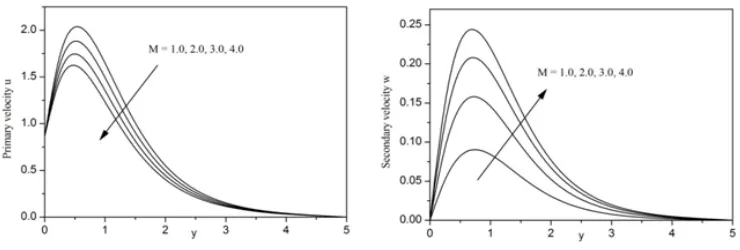
Figure 2 displays the effect of magnetic parameter M on the primary and secondary fluid velocities. The application of a magnetic field perpendicular to the flow direction of an electrically conducting fluid, experiences an electric field and produces current perpendicular to both magnetic field and flow direction. The product of electric field and magnetic field creates a force which is known as Lorentz force. The direction of the Lorentz force is always opposite to the direction of the flow in the absence of applied electric field which opposes the fluid velocity. This implies that increase in the magnetic field parameter tends to retard the primary fluid velocity whereas it tends to accelerate the secondary fluid velocity. This tendency of the magnetic field is clearly supported by the physical reality.
Fig. 2. Primary and secondary fluid velocities for varying magnetic parameter .M
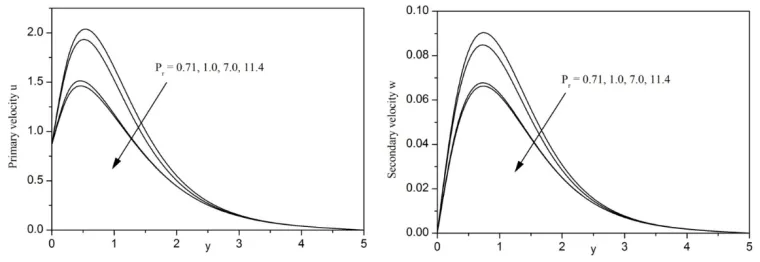
and secondary fluid velocities. Prandtl number is the ratio of momentum to thermal diffusivities. Increase in the Prandtl number corresponds to stronger momentum diffusivity and weaker thermal diffusivity. This implies that increase in the Prandtl number tends to decelerate both primary and secondary fluid velocities. Figure 5 shows the influence of Schmidt number Sc on the primary and secondary fluid velocities. The values of Schmidt number are chosen as Sc=0.23,0.64,1.20 and 2.63, which corresponds to hydrogen, water vapor, sulfur dioxide and naphthalene, respectively. Schmidt number is the ratio between viscous forces and mass diffusivity. As Sc
increases both primary and secondary velocities are expected to reduce since the increase in Sc
means increase of viscous force which leads the decrease of the velocity components.
Fig. 3. Primary and secondary fluid velocities for varying Hall parameterm.
Fig. 5. Primary and secondary fluid velocities for varying Schmidt number .Sc
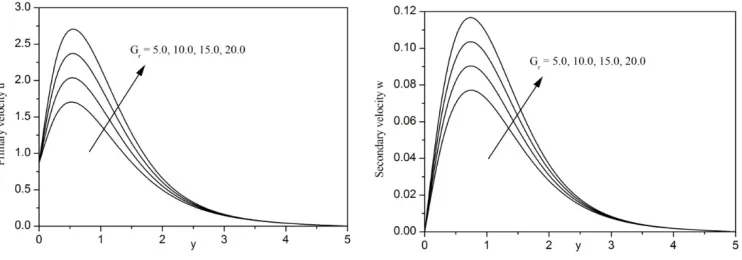
The effects of thermal Grashof number Gr on the primary and secondary fluid velocities are presented in Fig. 6. As increase in thermal Grashof number Gr leads to decrease drag forces and, hence, fluid velocity increase. This implies that the increase in the thermal Grashof number tends to enhance both primary and secondary fluid velocities. Here, the positive values of thermal Grashof number correspond to cooling of the plate. Figure 7 presents the effects of mass Grashof number Gm on the primary and secondary fluid velocities. The mass Grashof number defines the ratio of species buoyancy force to the viscous hydrodynamic force. As mass Grashof number increases, the viscous hydrodynamic force decreases. As a result, momentum of the fluid is higher. This implies that both primary and secondary fluid velocities tend to increase with increasing mass Grashof number. Also, it is noticed that both primary and secondary velocities suddenly raise near to the plate and after reaching maximum velocity both velocity components gradually decrease to zero as y→ ∞.
Fig. 7. Primary and secondary fluid velocities for varying mass Grashof number Gm.
The effects of chemical reaction parameterγ on the primary and secondary fluid velocities are depicted in Fig. 8. It can be seen that an increase in γ tends to decrease both primary and secondary velocities. Figure 9 shows the effects of phase angle
ω
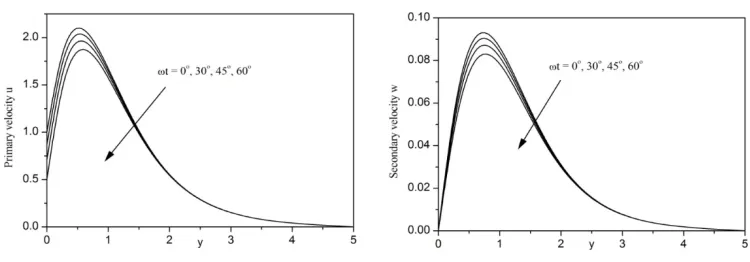
t on the primary and secondary fluid velocities. An increase in the phase angleω
t leads to decrease the buoyancy force and, hence, decreases the fluid momentum. This implies that increase in the phase angle tends to decelerate both primary and secondary fluid velocities. The effects of time t on the primary and secondary fluid velocities are presented Fig. 10. As time progresses, both primary and secondary velocities are getting accelerated due to increasing buoyancy effects.Fig. 9. Primary and secondary fluid velocities for varying phase angle
ω
t.Fig. 10. Primary and secondary fluid velocities for varying time parametert.
Fig. 11. Temperature θ for varying Prandtl number .Pr
Fig. 12. Temperature θ for varying time parametert.
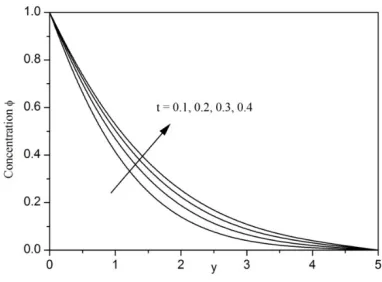
The variation of fluid concentration φ for different values of Schmidt number Sc is presented in Fig. 13. To be more realistic, the values of Schmidt number are chosen to represent the diffusing chemical species of most common interest like hydrogen (Sc =0.23), water vapor
(Sc=0.64), sulfur dioxide (Sc=1.20) and naphthalene (Sc =2.23). It is noticed that an increase in Schmidt number tends to decrease the fluid concentration. Physically, increase in Sc leads to decrease in molecular diffusivity which results in a decrease of concentration boundary layer. Figure 14 presents the effect of chemical reaction parameter γ on the fluid concentration
.
Fig. 13. Concentration φ for varying Schmidt number .Sc
Fig. 14. Concentration φ for varying chemical reaction parameter .γ
Table 3 presents the numerical values of Nusselt number for various values of Prandtl number and time parameter. As seen from Table 3, Nusselt number increases with increasing Prandtl number and time parameter. The numerical values of Sherwood number for various values of Schmidt number, chemical reaction parameter and time presented in Table 4. It is clearly seen from Table 4 that an increase in Schmidt number and chemical reaction tend to increase the Sherwood number whereas it decreases with increasing time.
r
P t Nu
0.71 0.2 0.083336
1.00 0.2 0.098578
7.00 0.2 0.237110
0.71 0.3 0.125004
0.71 0.4 0.166670
Table 3. Nusselt number for different values of Pr and t
c
S γ t Sh
0.23 1.0 0.2 0.296856
0.64 1.0 0.2 0.481744
0.23 2.0 0.2 0.349644
0.23 1.0 0.3 0.280462
Table 4. Sherwood number for different values of ,Sc γ and t.
5. Conclusions
The governing system of partial differential equations has been examined for the effects of chemical reaction on unsteady MHD flow past an impulsively started oscillating infinite vertical plate in the presence of Hall current. Significant findings of the study are summarized as follows:
1. Prandtl number, Schmidt number, chemical reaction parameter and phase angle tend to decelerate both primary and secondary fluid velocities whereas thermal Grashof number, mass Grashof number, Hall current and time tend to accelerate both primary and secondary velocities.
2. Magnetic parameter tends to retard the primary fluid velocity and opposite effect is observed on the secondary fluid velocity.
3. Prandtl number tends to decrease fluid temperature whereas time has the opposite effect. 4. Schmidt number and chemical reaction parameter tend to decrease the fluid
concentration whereas the time has the opposite effect.
5. Primary and secondary skin frictions get reduced when Prandtl number and Schmidt number increase whereas the opposite effect is observed when thermal Grashof number, mass Grashof number, Hall current and time increase.
6. Magnetic parameter tends to decrease the primary skin friction whereas the reverse effect is observed on the secondary skin friction.
7. Phase angle tends to increase the primary skin friction whereas the opposite effect is observed on the secondary skin friction.
9. Schmidt number and chemical reaction parameter tends to increase Sherwood number and the opposite effect is observed when time progresses.
Acknowledgements
The authors wish to express their sincere gratitude to the editor and reviewers for careful reading of the manuscript and their valuable suggestions.
References
Anjalidevi S P, Kandasamy R (2000). Effects of chemical reaction, heat and mass transfer on MHD flow past a semi-infinite plate. Z. Angew. Math. Mech.. 80: 697-701.
Aboeldahab E M, Elbarbury E M E (2001). Hall current effect on magneto-hydrodynamic free convection flow past a semi-infinite vertical plate with mass transfer. Int. J. Eng. Sci. 39: 1641 – 1652.
Acharya M, Dash G C, Singh L P (2001). Hall effect with simultaneous thermal and mass diffusion on unsteady hydro-magnetic flow near an accelerated vertical plate. Ind. J. Phys. 75B(1): 168 – 176.
Cowling T C (1957). Magneto-hydrodynamics, Wiley Inter Science, New York.
Cortell R (2007). MHD flow and mass transfer of an electrically conducting fluid of second grade in a porous medium over stretching sheet with chemically reactive species, Chem. Eng. Process. 46: 721 – 728.
Das U N, Deka R K, Soundalgekar V M (1994). Effects of mass transfer on flow past an impulsively started infinite vertical plate with constant heat flux and chemical reaction,
Forsch Ingenieurwes. 60: 284-287.
Davidson P A (1999). Magneto-hydrodynamics in material processing – Annual Review Fluid Mech. 31: 273-300.
El-Fayez F M N (2012). Effects of chemical reaction on the unsteady free convection flow past an infinite vertical permeable moving plate with variable temperature. J. Surface Engineered Materials and Adv. Tech.. 2: 100-109.
Fife J (1998). Hybrid-PIC Modeling and electrostatic probe survey of Hall thrusters - PhD Thesis, Department of Aeronautics and Astronautics, MIT, USA.
Hardianto T, Sakamoto N, Harada N (2008). Computational study of diagonal channel magneto-hydrodynamic power generation. Int. J. Energy Tech. Policy. 6: 96-111.
Kholshchevnikova E K (1966). Influence of the Hall effect on the characteristics of a MHD generator with two pairs of electrodes. J. Appl. Mech. Tech. Phys. 7(4): 48-54.
Muthucumaraswamy R, Ganesan P (2001). First order chemical reaction on flow past an impulsively started vertical plate with uniform heat and mass flux. Acta Mechanica. 147: 45-57.
Morley N B, Malang S, Kirillov I (2005). Thermo-fluid Magneto-hydrodynamic issues for liquid breeders – Fission Sci. Tech. 47: 488-501.
Muthucumaraswamy R, Meenakshisundaram S (2006). Theoretical study of chemical reaction effects on vertical oscillating plate with variable temperature. Theo. Appl. Mech. 33(3): 245-257.
Mathon Ph, Nouri A, Alemany A, Chopart J P, Sobolik V, Baaziz D (2009). Electro-chemical processes controlled by high magnetic fields: applications to MHD sea water propulsion –
Magneto-hydrodynamics. 45: 281-288.
Mahapatra N, Dash G C, Panda S, Acharya M (2010). Effects of chemical reaction on free convection flow through a porous medium bounded by a vertical surface. J. Eng. Phys and Thermo-Phys. 83(1): 130-140.
Michaeli K, Tikhonov K S, Finkel’stein A M (2012). Hall effect in super conducting films -
Physical Review. B 86: 014515.
Maguna A N, Mutua N M (2013). Hall current effects on free convection flow and mass transfer past a semi infinite vertical flat plate. Int. J. Mathematics and Statistics studies. 1(4): 1-22. Pop I (1971). The effect of Hall current on hydro-magnetic flow near an accelerated plate. J. Math.
Phys. Sci. 5: 375-379.
Prabhakar Reddy B (2018). Hall effect on MHD transient flow past an impulsively started infinite horizontal porous plate in a rotating system. Int. J. Appl. Mech and Eng. 23(2): 471 – 483. Raptis A, Perdikis C (2006). Viscous flow over a non-linearly stretching sheet in the presence of
chemical reaction and magnetic field. Int. J. Non-Linear Mech. 41: 527-529.
Rajesh V, Varma S V K (2010). Chemical reaction effects on free convection flow past an exponentially accelerated vertical plate. Annals. J. Eng., VIII, Fascicule 1: 181 - 188. Rajesh V (2010). MHD and chemical reaction effects on free convection flow with variable
temperature and mass diffusion. Annals. J. Eng., VIII, Fascicule 3: 370 – 378.
Rajput U S, Neetu Kanaujia (2016). MHD flow past a vertical plate with variable temperature and mass diffusion in the presence of Hall current, Int. J. Appl. Sci. and Eng. 14(2): 115 – 123.
Shang J S, Surzhikov S T, Kimmel R, Gaitonde D, Menart J, Hayes J (2005). Mechanics of plasma actuators for hypersonic flow control - Prog. Aerospace. Sci., 41, 642-668.
Sharma B K, Jha A K, Chaudary R C (2007). Hall effect on MHD mixed convection flow of a viscous incompressible fluid past a vertical porous plate immersed in a porous medium with heat source/sink, Rom. J. Phys., 52(5-7): 487 – 503.
Sehkar D V, Reddy G V (2012). Effects of chemical reaction on MHD free convective oscillatory flow past a porous plate with viscous dissipation and heat sink. Adv. Appl. Sci. Res. 3(5): 3206-3215.
Thamizhsudar M, Pandurangan J, Muthucumaraswamy R (2015): Hall effects and rotation effects on MHD flow past an exponentially accelerated vertical plate with combined heat and mass transfer effects. Int. J. Appl. Mech and Eng. 20, 3: 605-616.
Van Wie D M. (2005). Future Technologies – Application of Plasma Devices for Vehicle System
– The Johas Hopkins University, Applied Physics Laboratory – Laurel, Maryland, USA – NATO Document.