Volume 14, Number 1, March 2019
A Proposed Model for Determining the Customer’s Use
of Mobile Banking Services in Saudi Arabia:
Toward the Differential Role of Gender
Ayman N. Alkhaldi
Department Management Information Systems University of Ha’il
Baqa’a Road, Ha’il, Kingdom of Saudi Arabia [email protected]
ABSTRACT
Gender differences among users of mobile banking (m-banking) services are a key factor in segmenting this important market and making appropriate decisions. It is important, therefore, to examine the influence of gender as a basis for sound decision-making with regard to m-banking service strategies. This study develops a conceptual model to determine the customer's awareness effect and the influence of gender differences on customers’ intention to use m-banking services in Saudi Arabia and the Middle East in general. The model is based on an extended mobile banking model of unified theory of acceptance and use of technology (UTAUT). The author uses a quantitative method in the form of a non-structured survey. A questionnaire was distributed in Saudi Arabia, and the responses were analyzed using SPSS and SEM with AMOS. The study provides evidence that user awareness, performance expectancy, and effort expectancy affect users’ intention to use banking, but that risk and the costs of use do not affect the use of m-banking. The study also finds that the gender factor does not play a role in the aforementioned variables.
International Journal of Business and Information
1. INTRODUCTION
In a global economy, the banking sector everywhere is continuously becoming more competitive. Each bank, therefore, needs to develop proprietary services to attract new customers and/or retain existing customers. Banks should cultivate customer satisfaction by conveying the maximum utility and convenience to them (Boonsiritomachai & Pitchayadejanant, 2017). Banks must have a digital platform with safe and fast access (Shaikh & Karjaluoto, 2015) such as mobile banking (m-banking), a form of modern self-service delivery that permits banks to provide services and information to their customers through mobile devices (Hassan et al., 2014). M-banking services should be an energetic part of a bank’s strategy to satisfy customers (Shaikh et al., 2015).
Many banking institutions in developing countries have transitioned to mobile devices as a potential platform for delivering their banking services. This advance was motivated also by the fact that, in developing countries, more people have cell phones than bank accounts. Statista (2015) reported just four years ago that there were 4.61 billion cell phone users in the world and that the number was expected to reach 4.77 billion in 2017, comprising 65% of the global population. Of these users, 60% live in developing countries (Geo et al., 2017). Although banks encourage customers to use mobiles for banking transactions, negative trends in the adoption of such new and innovative services create the imperative to conduct more studies to address issues that encourage users’ adoption of m-banking services in the developing world (Hanafizadeh et al., 2014).
Volume 14, Number 1, March 2019
Although, many research studies have investigated the relationship between demographic factors and different banking channels (e.g., Jamshidi et al., 2013), Abdinoor and Mbamba (2017) called for more studies that take into account the influence of demographic factors – especially the gender factor – in predicting customers’ adoption of m-banking (Geo et al., 2017) in developing countries. Recently, several researchers (e.g., Mishra & Singh, 2015; Shaikh & Karjaluoto, 2015) have stated the significance of demographic factors in affecting users’ perceptions associated with adoption of m-banking. In some cases, demographic factors are more significant than other factors, such as the usefulness or, or trust in, new technology. This was found to be true in Jordan, which is a Middle Eastern country (Alafeef et al., 2011).
A closer look at demographic factors has affirmed that the user’s gender is one of the most crucial demographic factors in implementing m-banking (Chiu et al., 2017). The gender factor can lead users to either reject or adopt m-banking (Laukkanen, 2016). The limited number of gender-based studies, particularly with regard to m-banking adoption, is evident (Kishore & Sequeira, 2016), especially in the Middle East. Baabdullah et al. (2018) have reviewed studies on mobile services (m-services) and found that only a handful have focused on Saudi Arabia. There is a need, therefore, to examine the people perspective with regard to m-services in Saudi Arabia; and to expand the theoretical horizon of unified theory of acceptance and use of technology (UTAUT) by considering other factors such as user’s awareness. The author of the current study has observed that, although gender differences are crucial in Saudi Arabia, no gender-based study has measured the degree of m-banking awareness in Saudi Arabia, nor investigated the customer’s gender role on m-banking in the Middle East as a whole.
Questions remain about the degree of awareness among bank customers with regard to m-banking in Saudi Arabia. To what extent does customers’ awareness of banking influence (directly and indirectly) their perceptions to adopt m-banking? How do customers’ gender differences moderate their intention to use m-banking in Saudi Arabia? What are the implications of the possible differences in terms of practitioners in banks? This study seeks to answer these and other questions by developing a conceptual model to determine the influence of customer's awareness of m-banking and the impact of gender differences on their intention to use m-banking in Saudi Arabia.
International Journal of Business and Information
comprehensive insight into the predictive factors influencing the user’s m-banking adoption. Fourth, it theoretically proposes and empirically tests the potential impact of a set of factors (i.e., theoretical model) that could determine customers’ intention to adopt an emerging mobile technology (i.e., m-banking). Ultimately, this study highlights the role of gender in m-banking services adoption intention. To the best of the author’s knowledge, this is the first study conducted in Saudi Arabia to investigate gender differences in m-banking adoption.
2. LITERATURE REVIEW
This discussion of the literature includes a review of customer awareness and gender differential in m-banking acceptance and a review of acceptable models of m-banking adoption.
2.1. Review of Customer Awareness and Gender Differential in M-Banking Acceptance
Several research studies have emphasized the major differences between male and female customers, particularly with regard to IT adoption (Baker et al., 2007; Al-Gahtani, 2008) and self-service technologies such as e- and m-banking services (Dean, 2008). Often, there is a lower awareness of technology among females, compared with males. For example, a study in India revealed that most male customers have a higher awareness of e-banking services. The results indicated that only 13.9% of males in India had a low awareness of e-banking, compared with 38.1% of females in that country (Dhandayuthapani, 2012). With regard to m-money security, males had 82.82% awareness, and females had an 82.37% level of awareness (Malero, 2015). A global survey involving SMS-based e-government services found that 70% of males were aware and that 48% of them adopted the services, whereas 50% of females were aware and only 30% of them adopted the services (Susanto & Goodwin, 2010).
Volume 14, Number 1, March 2019
It is notable that the role of the user’s awareness factor – which is expected to be a major determinant, along with the user’s gender – was not considered in prior studies. This gap emphasizes the need for further research focusing on the role of customer’s gender characteristics in m-banking, particularly in Saudi Arabia. Further studies would produce reliable results on the factors affecting the adoption of m-banking in the Arab Middle East (Al-Hosni et al., 2010). Examining demographic factors as well as social features would provide new insight into the significance of those factors (Shaikh & Karjaluoto, 2015).
The role of user’s awareness has been confirmed in several technologies. For instance, Bernier et al. (2015) found gender differences in awareness of the adoption of climate-smart technologies. They stated that awareness is essential to increase adoption. In general, lack of information about new technologies is more prevalent among women than men, a situation that often leads to a gender gap (Mittal, 2016). Users’ differences such as gender and prior knowledge of mobile technology can influence users’ perceptions of mobile technology (Al-Hunaiyyan et al., 2017). Peterman et al. (2014) reviewed existing microeconomic empirical literature on gender differences in use, access, and adoption of technological resources in developing countries and found that men generally had higher input measures than women. This finding reflects the influence of the user’s awareness factor alongside deferential gender, particularly in developing countries.
In m-banking services adoption, there are differences between male and female users (Azad, 2016; Mishra & Singh, 2015). For instance, Püschel et al. (2010) found that m-banking users in Brazil were mostly males, and Alafeef et al. (2011) found a similar result in Jordan. Joshua and Koshy (2011) found that males in India were more likely to use online banking services than females. Chiu et al., (2017) compared males with females with regard to m-banking service and found that men were more task-oriented and more open to technological innovations.
International Journal of Business and Information
usefulness failed to affect either males and females, whereas the perceived cost of services had a negative influence for both females and males. They concluded, therefore, that gender is a promising factor in the adoption of m-banking.
The importance of awareness of m-services in Saudi Arabia has been confirmed in several studies. For example, in their study of the influence of familiarity with e-government on the perceptions of Jordanians, Baabdullah et al. (2018) evaluated also the current situation regarding m-services in Saudi Arabia. They found that there is low adoption in the country and that related issues (e.g., users’ awareness of m-services) have seldom been surveyed in Saudi Arabia. They stated that it is necessary to select a theoretical base to fit the perspective of Saudi customers. Therefore, they extended UTAUT2 by adding the awareness factor, highlighting the importance of awareness of m-services in Saudi Arabia and its applicability through UTAUT. On the other hand, Alotaibi et al. (2017) reported inconsistent findings, indicating that awareness fails to influence intention to adopt m-government (not m-banking) in Saudi Arabia, which cannot be generalized to other types of m-services.
2.2. Review of Acceptance Models of M-Banking Acceptance
Several studies have applied various acceptance theories in investigating the role of demographic factors (e.g., gender) in users’ adoption of m-banking. For instance, the technology acceptance model (TAM) was extended by Goh and Sun (2014) and by Suoranta and Mattila, (2004) to take into consideration the gender factor. Teo et al. (2012) combined TAM with the theory of planned behavior (TPB), and Koenig-Lewis et al. (2010) integrated TAM and IDT. A study by Riquelme and Rios (2010) added risk and gender factors to the TAM. Yuan et al. (2016) integrated TAM with the task-technology-fit (TIF) model and the expectancy confirmation model (ECM . Laukkanen and Pasanen (2008) used innovation adoption categories; and Laforet and Li (2005) used attitude, motivation, and behavior.
Volume 14, Number 1, March 2019
The UTAUT is a comprehensive acceptance model that provides a unified view because it considers factors from eight different models, excluding replications of some variables (Venkatesh et al., 2003). The UTAUT not only emphasizes the essential determinants predicting users’ intention to adoption, but also allows investigators to analyze the likelihood of moderators that would constraint the influence of core determinants (Yu, 2012). The UTAUT, therefore, is a well-accepted model, especially for predicting user acceptance of m-commerce (Lai, 2012).
Since the aim of the current study is to determine the influence of customers’ gender differences on their intention to use m-banking, it extends the UTAUT and uses it as an acceptance model. The UTAUT originally included the gender demographic factor, which it theorized was a moderator. Furthermore, the UTAUT can explain approximately 70% of the variance in a user's intention to use a technology (Venkatesh et al., 2012). .
3. RESEARCH CONCEPTUAL MODEL AND HYPOTHESES
This study used the Alsheikh and Bojei (2014) m-banking model, which extended the original UTAUT to prove that the awareness factor is a predictor of customers' intention to adopt m-banking services in Saudi Arabia. The current study contributes by considering the possible gender differences among customers in adopting such m-services.The factors – namely, perceived ease of use, perceived usefulness, and perceived complexity – are not adapted in our conceptual model. This is because this study extends the UTAUT, which was developed by Venkatesh et al. (2003). They captured the essential elements of eight acceptance models to develop the UTAUT, where performance expectancy is driven by perceived usefulness, and they captured the factor of perceived ease of use and used complexity to outline effort expectancy (Yu, 2012).
International Journal of Business and Information
The factors that are considered in this study are: (1) awareness of services; (2) perceived cost of use; (3) performance expectancy; (4) effort expectancy; (5) perceived risk; (6) behavioral intention to use; and (7) gender. They are discussed in the following narrative.
3.1. Awareness of Services
A recent study by Abu-Shanab (2017) reported that users’ awareness of the cost of m-services can motivate them to adopt such services. From a different perspective, customers’ awareness of services is positively associated with users’ performance expectancy, as well as their effort expectancy of m-banking (Alsheikh & Bojei, 2014). Similarly, Ahmad and Gupta (2015) found that the more aware customers are of m-banking, the more they expected to perceive m-banking as easier to use, and useful, thus encouraging them to adopt such technology. The same findings were reported by Al-Somali et al. (2009) regarding Internet banking in Saudi Arabia. Laforet and Li (2005) found that lack of awareness can inhibit the adoption of m-banking services in Finland. The same result was reported by Abdinoor and Mbamba (2017) in Tanzania and by Amin et al. (2008) in Malaysia.
Users’ awareness of the benefits and legal issues of m-services and how to use such services can encourage them to accept the services (Abu-Shanab, 2017). Typically, the perceived risk rises with uncertain situations and/or the amount of related negative outcomes. That is, the more aware customers of m-banking are, the more likely they are to perceive m-banking as more secure, with lower risks, and this perception powers their intention toward m-banking (Ahmad & Gupta, 2015). The awareness factor is negatively correlated with users’ perceptions of m-banking risks (Laukkanen & Kiviniemi, 2010). Based on these findings, we posit the following hypotheses:
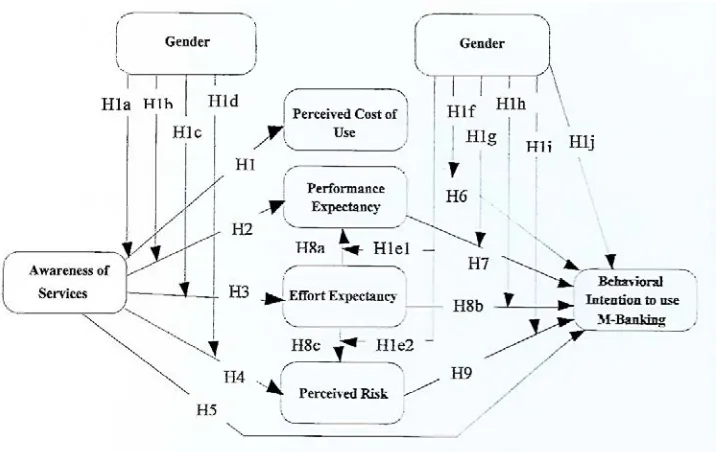
H1: User’s awareness of m-banking has a negative effect on the perceived cost of services of m-banking services.
H2: User’s awareness of m-banking has a positive effect on performance expectancy of m-banking services.
H3: User’s awareness of m-banking has a positive effect on effort expectancy of m-banking services.
Volume 14, Number 1, March 2019
Some studies have examined the effect of customers’ awareness of technology banking. For example, Safeena et al. (2011) found that users’ awareness has a positive effect on the intention to adopt m-banking. The same result was found by Kumar and Madhumohan (2014) with regard to Internet banking in India. Low awareness of m-banking is a key factor that can lead people to decide not to adopt such services (Ahmad & Gupta, 2015). Inconsistent findings were reported by Alotaibi et al. (2017), indicating that awareness failed to influence intention to adopt m-government (not m-banking) in Saudi Arabia, which cannot be generalized to other types of m-services. We posit the following hypothesis:
H5: User’s awareness of m-banking has a direct positive effect on behavioral intention to use m-banking.
3.2. Perceived Cost of Use
The concept, perceived cost of use, in the present study refers to the possible expense of using m-banking (i.e., access cost, equipment costs, and transaction fees). Perceived cost of use is a crucial factor affecting users' decisions to accept or reject a technology; i.e., the lower the costs, the more attractive it is for users to adopt the technology (Venkatesh et al., 2003; Chitungo & Munongo, 2013; Goh & Sun, 2014; Hanafizadeh et al., 2014; Abdinoor & Mbamba, 2017). However, AlSoufi and Ali, (2014) reported that perceived cost of use failed to influence users’ behavioral intention to use m-banking. The same result was found by Alsheikh and Bojei, (2014) in Saudi Arabia. We therefore propose the following hypothesis:
H6: The perceived cost of use has a negative effect on behavioral intention to use m-banking.
3.3. Performance Expectancy
When users intend to adopt a new technology, they generally have high expectations about the ability of the service to satisfy their needs. Performance expectancy, therefore, affects users’ intention to adopt m-banking services (Zhou et al., 2010; Jaradat &Rababaa, 2013; Alsheikh & Bojei, 2014), and e-banking services (Venkatesh et al., 2003). We therefore propose the following hypothesis:
International Journal of Business and Information
3.4. Effort Expectancy
Effort expectancy was found to significantly and positively affect users’ intention to adopt m-banking in Saudi Arabia (Alsheikh & Bojei, 2014) and also in Jordan (Jaradat & Rababaa, 2013). Zhou et al. (2010), however, reported the non-significance of effort expectancy on users’ intention to adopt m-banking. They found that, when a user expects difficulties and a greater effort in using m-banking, he or she develops a greater perception of risk and this affects their performance expectancy. The latter result was also stated by Tan and Lau (2016). These relationships were not investigated in Saudi Arabia. Thus, the current study hypothesizes:
H8a: Effort expectancy has a positive effect on performance expectancy of m-banking.
H8b: Effort expectancy has a positive effect on behavioral intention to use m-banking.
H8c: Effort expectancy has a positive effect on perceived of risk to use m-banking.
3.5. Perceived Risk
In the current study, perceived risk is associated with the financial risks that might occur in online transactions (Im et al., 2008). Some researchers have found that the adoption of a new technology is essentially related to people’s perception of the risk of such technology (Yang, 2009; Laforet & Li, 2005). Perceived risk is a major factor in m-services adoption (Wu & Wang, 2005). Several studies (e.g., Venkatesh et al., 2003; Laukkanen & Kiviniemi, 2010; Chitungo & Munongo, 2013; Hanafizadeh et al., 2014; Gupta et al., 2017) reported the negative effect of perceived risk on users' behavioral intention to use m-banking. Similar findings were reported by AlJabri and Sohail, (2012) with regard to Saudi Arabia, but AlSoufi and Ali, (2014) reported a weak influence in Bahrain. We propose the following hypothesis:
H9: Perceived of risk has a negative effect on behavioral intention to use m-banking.
3.6. Behavioral Intention to Use
Volume 14, Number 1, March 2019 3.7. Gender
Several studies have shown that gender plays a role in people’s adoption and use of online services. Adoption forms across gender are remarkable in numerous countries, sciences, technologies. In an economics psychology study, Powell and Ansic (1997) examined gender difference tendencies in financial decision-making. They found that females are less risk-seeking than males, irrespective of costs or uncertainty. Venkatesh et al., (2012) reported the significance of the gender factor as a moderator influencing the relationship between price value (associated with perceived cost) and behavioral intention to use technology, where the effect was stronger for females. They further stated that females are more cost aware than males and pay more attention to the price of products and services.
Users' demographic characteristics, along with perceived cost, might have an effect on their m-banking adoption (Suoranta & Mattila, 2004). For example, females are more concerned with the perceived cost of online access to m-banking services than are males (Cruz et al., 2010). Similar results were found by Baker et al. (2007) with regard to new technology adoption and by Al-Gahtani et al. (2007) with regard to IT adoption and use. In contrast, Chiu et al. (2017) reported that gender had no moderating effect on the relationship between perceived cost and behavioral intention to use m-banking in the Philippines. In Saudi Arabia, a user’s perception of risk was found to be the second salient variable affecting online services adoption (AlGhaith et al., 2010); yet the role of user’s gender is unknown in Saudi Arabia. In the current study, the following hypotheses are proposed:
H1a: Gender moderates the relationship between user’s awareness and perceived cost of m-banking use.
H1f: Gender moderates the relationship between the perceived cost of use and behavioral intention to use m-banking.
International Journal of Business and Information
home via the Internet (Siddiqui, 2008). Al-Ghaith et al. (2010) stated that studies with diverse perspectives on the issue can be easily found. Gatignon and Robertson (1985) observed the inconsistency and documented that the diffusion of technology use can be affected by social access, which refers to the knowledge (i.e., awareness) required to adopt a technology. In this regard, the current study proposes these hypotheses:
H1b: Gender moderates the relationship between user’s awareness and performance expectancy of m-banking.
H1g: Gender moderates the relationship between performance expectancy and behavioral intention to use m-banking.
With regard to e-commerce adoption, MacGregor and Vrazalic (2006) found that males expressed more concern about the difficulty than females. Ease of technology use expectation is greater for female adopters in general, especially when adopting a new mobile service (Venkatesh & Morris, 2000). In contrast, Teo et al. (2012) reported that females perceive m-banking to be more difficult and therefore have more effort expectancy than males do. Laukkanen and Pasanen (2008) and Koenig-Lewis et al. (2010) found that females are less expected to adopt m-banking than males. Inconsistent findings in the literature demonstrate the need for further investigation in a different country with different technology.
Volume 14, Number 1, March 2019
H1c: Gender moderates the relationship between user’s awareness and effort expectancy of m-banking.
H1e1: Gender moderates the relationship between effort expectancy and performance expectancy.
H1e2: Gender moderates the relationship between effort expectancy and perceived risk of m-banking.
H1H: Gender moderates the relationship between effort expectancy and behavioral intention to use m-banking.
Powell and Ansic (1997) found that females are less risk-seeking than males, irrespective of familiarity and uncertainty, in financial decision-making. In contrast, Garbarino and Strahilevitz, (2004) found that females perceive a higher risk than males do with regard to online shopping. This finding highlights the correlation between users’ gender and their risks in adopting IT. With regard to m-banking adoption, Laforet and Li (2005) reported that most users in China are males and that security issues such as perceived risk are critical in hindering m-banking adoption. There are contradictory findings in the literature. For example, a study by AlSoufi and Ali (2014) did not prove the negative effect of perceived risk on behavioral intention to use m-banking. Alsheikh and Bojei (2014), however, found such evidence in Saudi Arabia with regard to m-banking, and Al-Ghaith et al. (2010) found such evidence in Saudi Arabia with regard to online services adoption. The current study proposes the following hypotheses:
H1d: Gender moderates the relationship between user’s awareness and perceived risk of m-banking.
H1i: Gender moderates the relationship between perceived risk and behavioral intention to use m-banking.
e-International Journal of Business and Information
services than females. The same findings were reported about m-banking by Laukkanen and Pasanen (2008), indicating that females are less expected to adopt than males. Alalwan et al. (2015) found slight gender differences among users to adopt m-banking in Jordan, but Siddiqui (2008) found that the same is probably not true in Saudi Arabia. The current study offers this hypothesis:
H1j: Gender has a direct effect on the user’s behavioral intention to use m-banking.
The extension of the UTAUT using the aforementioned hypotheses is shown in the proposed research model (Figure 1) for the current study.
Figure 1: Proposed Research Model
4. METHODOLOGY
Volume 14, Number 1, March 2019
model. Questions in this section were adapted from prior studies and modified to fit the aim of the current study. Questions measuring performance expectancy, effort expectancy, and behavioral intention to use m-banking were adapted from Al-Somali et al. (2009), and questions relating to awareness of services, perceived risk, and perceived cost of use were adapted from Yuan et al. (2016). The questions were initially formulated in English and then translated into Arabic, which is the official language of Saudi Arabia.
4.1. Data Collection
The questionnaires were administered in two forms: hard copy and online. A total of 1,337 were distributed randomly to stratified targeted respondents (Saudi bank customers and mobile users) in different regions of Saudi Arabia between October 22, 2015, and April 20, 2016. A total of 389 valid questionnaires were obtained for analysis (a response rate of 29.1%).
4.2. Data Analysis
Statistical Package for Social Sciences (SPSS) Version 17 was used to produce frequency and descriptive statistics for the demographic profile of respondents and for the data on each item in the questionnaire. Then, reliability testing of scales and exploratory factor analysis were conducted for reliability and validity testing. To test the hypotheses, the study used a two-step structural equation modeling (SEM) approach – i.e., measurement model and structural model – using analysis of moment structure (AMOS).
4.3. Results
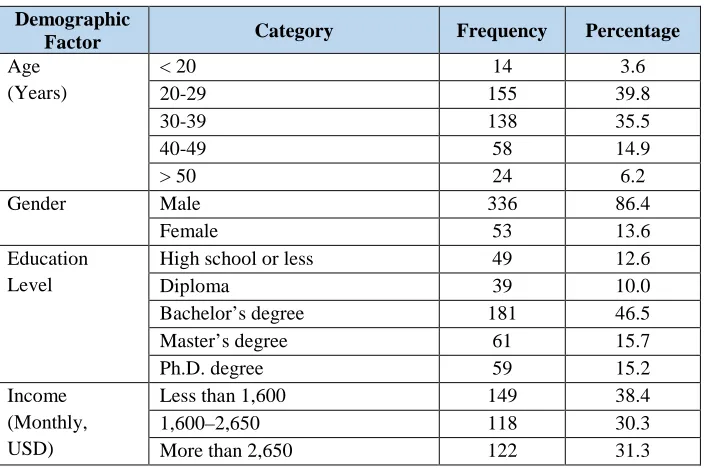
Table 1 presents a demographic profile of the survey respondents. As shown, most of the sample was young (20-39 years old), a majority (86.4%) were male, the education level was distributed, but mostly bachelor’s degree, and income was distributed almost equally.
International Journal of Business and Information
Table 1
Demographic Profile of Survey Respondents (N=389)
Demographic
Factor Category Frequency Percentage
Age (Years)
< 20 14 3.6
20-29 155 39.8
30-39 138 35.5
40-49 58 14.9
> 50 24 6.2
Gender Male 336 86.4
Female 53 13.6
Education Level
High school or less 49 12.6
Diploma 39 10.0
Bachelor’s degree 181 46.5
Master’s degree 61 15.7
Ph.D. degree 59 15.2
Income (Monthly, USD)
Less than 1,600 149 38.4
1,600–2,650 118 30.3
More than 2,650 122 31.3
Table 2
Descriptive Testing of Scales Analysis
Factor Mean Number of
Items
Standard Deviation
Awareness of services 3.31 4 1.04
Performance expectancy 3.49 5 0.79
Effort expectancy 3.98 4 0.81
The perceived cost of use 3.96 4 0.91
Perceived risk 2.88 4 1.02
Behavioral intention to use m-banking 3.11 3 0.94
Volume 14, Number 1, March 2019
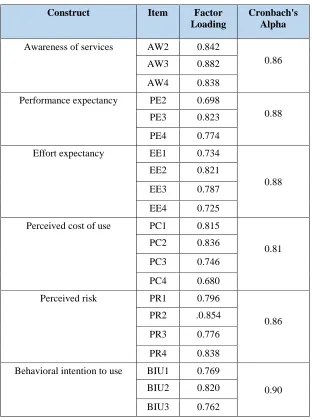
were omitted because they had double loadings. All other items were above 0.5 and loaded in under their components.
Table 3
Reliability and Convergent Validity Analysis
Construct Item Factor
Loading
Cronbach's Alpha
Awareness of services AW2 0.842
0.86
AW3 0.882
AW4 0.838
Performance expectancy PE2 0.698
0.88
PE3 0.823
PE4 0.774
Effort expectancy EE1 0.734
0.88
EE2 0.821
EE3 0.787
EE4 0.725
Perceived cost of use PC1 0.815
0.81
PC2 0.836
PC3 0.746
PC4 0.680
Perceived risk PR1 0.796
0.86 PR2 .0.854
PR3 0.776
PR4 0.838
Behavioral intention to use BIU1 0.769
0.90
BIU2 0.820
BIU3 0.762
International Journal of Business and Information
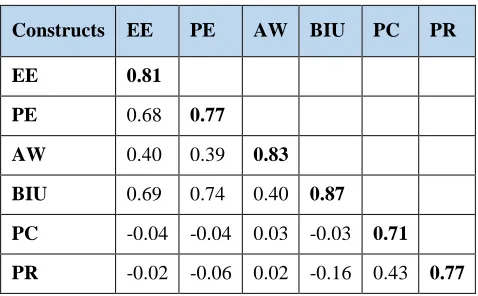
the off-diagonal elements for all constructs. Also, the AVE value for each construct was higher than all the squared correlations among any two constructs. Therefore, sufficient discriminant validity was confirmed.
Table 4
Discriminant Examination of the Constructs
Notes. AW= Awareness of Services, PE= Performance Expectancy, EE= Effort Expectancy, PC= Perceived Cost of Use, PR= Perceived Risk, BIU= Behavioral Intention to Use
4.4. Structural Equation Modeling
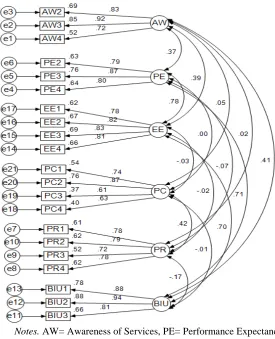
Structural equation modeling (SEM) consists of a set of statistical methods that enables analysis of the relationships between variables. SEM has two mechanisms – the measurement model and the structural model. In this study, the measurement model was evaluated using confirmatory factor analysis (CFA). The model was then examined by testing the hypothesized structural model. The CFA results shown in Figure 2 indicate that the overall model was fit and valid.
For the structural model, multi-group moderation analysis was used to examine the relationships among all factors in the proposed model using AMOS 16. Following Hair et al. (2010), the current study confirmed metric invariance prior to making a valid comparison among structural parameters in multi-groups of the gender moderator. This is necessary to identify the differences between groups. A chi-squared difference test was conducted to determine whether there is an invariant moderating effect for each gender moderator on the other constructs. Afterward, hypothesis testing was achieved according to the hypothesized moderator (gender).
Constructs EE PE AW BIU PC PR
EE 0.81
PE 0.68 0.77
AW 0.40 0.39 0.83
BIU 0.69 0.74 0.40 0.87
Volume 14, Number 1, March 2019
Notes. AW= Awareness of Services, PE= Performance Expectancy, EE= Effort Expectancy, PC= Perceived Cost of Use, PR= Perceived Risk, BIU= Behavioral Intention to Use
Figure 2. Measurement Model Using CFA
International Journal of Business and Information
model. Based on these results, the gender effect, direct and indirect (i.e., moderating), should not be tested further.
Table 5
Criteria and Results of Measurement Model Fit
Fit Indices Criteria References Result Comment
χ2/df (CMIN/df)
<3 is a good fit; <5 is an acceptable fit.
Hair et al. (2010); Byrne (2010)
2.11 (Sig, 0.000)
Good fit
RMSEA <0.05 is an excellent fit; <0.08 is a good fit; <0.1 is an acceptable fit.
Byrne (2010)
0.059 Good fit
GFI >0.95 is an excellent fit; > 0.90 is a good fit; > 0.80 is an acceptable fit.
Hair et al. (2010)
0.903 Good fit
AGFI 0.871 Acceptable
fit
IFI 0.952 Excellent fit
CFI 0.951 Excellent fit
TLI 0.941 Good fit
Notes. The indices are: CMIN = minimum discrepancy, χ2 = chi-square, df = degree of freedom, RMSEA = root mean square error approximation), GFI = goodness-of-fit index, AGFI = adjusted goodness-of-fit index, CFI = comparative fit index, IFI = incremental fit index, and TLI = the Tucker-Lewis index.
Table 6
Criteria and Results of Structural Model Fit
Fit Indices Criteria References Result Comment
χ2/df (CMIN/df)
<3 is a good fit; <5 is an acceptable fit.
Hair et al. (2010); Byrne (2010) 1.21 (Sig, 0.034) Good fit
RMSEA <0.05 is an excellent fit; <0.08 is a good fit; <0.1 is an acceptable fit.
Byrne (2010)
0.024 Excellent fit
GFI >0.95 is an excellent fit; > 0.90 is a good fit; > 0.80 is an acceptable fit.
Hair et al. (2010)
0.997 Excellent fit
AGFI 0.978 Excellent fit
IFI 0.999 Excellent fit
CFI 0.999 Excellent fit
Volume 14, Number 1, March 2019
6. DISCUSSION
As mentioned earlier, this study did not test the moderating effect of the gender variable on the hypothesized direct relationships among the independent variables because the model was not different across gender groups. Thus, the gender variable was found not to moderate the direct relationships in the proposed model (i.e., Hypotheses 1a, 1b, 1c, 1d, 1e1, 1e2, 1f, 1g, 1h, 1i, and 1j,). This finding is inconsistent with the results reported by Yu (2012). Several previous studies (Cruz et al., 2010; Baker et al., 2007; Al-Gahtani et al., 2007 reported that females were more concerned about cost than were males and that males were more aware of risks than were females.
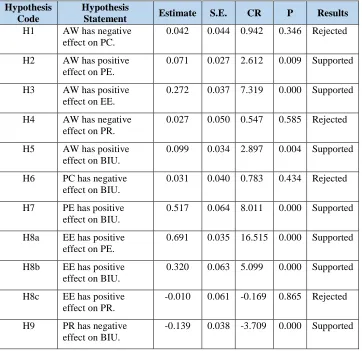
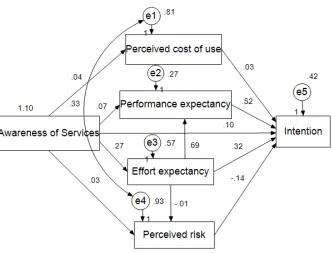
As shown in Table 7 and in Figure 3, the results support seven of the proposed direct effect hypotheses, but do not support the remaining four. Consequently, the awareness of services factor was found to be insignificant to affect the perceived cost of use and perceived risk (Hypotheses 1 and 4, respectively). This result is inconsistent with the findings of Ahmad and Gupta (2015); and Laukkanen and Kiviniemi (2010), who reported that the more aware that customers are of m-banking, the more they are expected to perceive m-banking as more secure and less risky. The results are also dissimilar to the findings of Abu-Shanab (2017), who reported that users’ awareness about the cost of m-services can encourage them to adopt such services.
In addition, this study found that the awareness of services factor was significant to affect performance expectancy and effort expectancy (i.e., Hypotheses 2 and 3). This finding is inconsistent with the results of Alsheikh and Bojei (2014), who found that customers’ awareness of m-banking services is positively associated with their performance expectancy and their effort expectancy of such a system. As expected, Hypothesis 5 was supported. This finding is consistent with the result reported by Alotaibi et al. (2017); i.e., that awareness did not influence the intention to adopt m-government (not m-banking) in Saudi Arabia. The result, however, is inconsistent with the findings of Safeena et al. (2011) and (Ahmad and Gupta 2015), who reported that users’ awareness of m-banking is a key factor that could lead people to decide to adopt m-banking.
International Journal of Business and Information
Table 7
Results of Hypotheses Testing
Hypothesis Code
Hypothesis
Statement Estimate S.E. CR P Results
H1 AW has negative effect on PC.
0.042 0.044 0.942 0.346 Rejected
H2 AW has positive effect on PE.
0.071 0.027 2.612 0.009 Supported
H3 AW has positive effect on EE.
0.272 0.037 7.319 0.000 Supported
H4 AW has negative effect on PR.
0.027 0.050 0.547 0.585 Rejected
H5 AW has positive effect on BIU.
0.099 0.034 2.897 0.004 Supported
H6 PC has negative effect on BIU.
0.031 0.040 0.783 0.434 Rejected
H7 PE has positive effect on BIU.
0.517 0.064 8.011 0.000 Supported
H8a EE has positive effect on PE.
0.691 0.035 16.515 0.000 Supported
H8b EE has positive effect on BIU.
0.320 0.063 5.099 0.000 Supported
H8c EE has positive effect on PR.
-0.010 0.061 -0.169 0.865 Rejected
H9 PR has negative effect on BIU.
-0.139 0.038 -3.709 0.000 Supported
Volume 14, Number 1, March 2019
Figure 3. Structural Model
International Journal of Business and Information
The unexpected result of Hypothesis H8c is dissimilar to the findings stated by Tan and Lau (2016), but consistent with those reported by Zhou et al. (2010) that the expectation of more difficulties and effort by users would lead to greater perceptions of risk.
As posited in Hypothesis 9, the current study found evidence for a significant negative effect of risk on intention to use m-banking. The result is consistent with that of AlSoufi and Ali (2014), who reported, however, that perceived risk has a weak effect on users' intention to use m-banking services.
7. CONCLUSION
This study deducts a new m-banking conceptual model that integrally focuses on users’ gender along with other social factors, as antecedents of m-banking adoption. The proposed model highlights the synthesis of the gender characteristic of users in the adoption of m-banking services. Although the proposed model did not continue to test gender-moderating differences in the adoption of m-banking services, the model can be applied to different cultures, technologies, and types of users, which may produce different results. Furthermore, the model can be used to synthesize new moderator variables and to study technology acceptance, especially in developing countries.
The current study adds to the literature by reviewing, analyzing, and comparing related studies. It reports useful findings associated with the direct effect of several factors that have not been surveyed in such a synthesized way. The findings can be generalized to Saudi Arabia and can be used by banks as guidelines for developing marketing strategies.
Volume 14, Number 1, March 2019
As discussed earlier, young people (under the age of 19) are not aware of m-banking services and do not have high-performance expectancy; therefore, banks should focus on this segment of customers, perhaps by marketing their m-banking services on social network platforms. Ultimately, Saudi banks should implement marketing strategies to retain current users of m-banking and to attract non-users. These efforts could raise the rate of use of online banking services (Al-Malkawi et al., 2016).
The current study has limitations that should be considered in future work. First, the population sample was chosen using simple random sampling techniques, which resulted in a sample dominated by males, in which females accounted for only 14% of the respondents. Since a demographic factor (i.e., gender) was being considered, it might have been more appropriate to use a stratified sampling method, which could have yielded a satisfactory number of females and a more equal subgroup representation.
Second, future studies are advised to collect statistics from banks regarding the actual rate of m-banking users, rather than relying entirely on behavioral intention to use these services.
Third, future studies could apply the results of prior research in a case study of a particular bank to clarify how the variables operate for that bank. For instance, Laslom (2015) assessed satisfaction with Internet banking in the case of Saudi British Bank and found that only 4.5% of its customers used m-banking as the core channel for their transactions, whereas 82% of their customers used Internet banking as their main channel for transactions.
APPENDIX: Questionnaire Constructs, Items, and Questions
Constructs Code Items/Questions
Awareness of Services
AW1 I know about mobile banking services.
AW2 I have received enough information about the benefits of using mobile banking services.
AW3 I have received enough information of how to use mobile banking services.
AW4 I have received information about the security system of mobile banking services from the bank.
International Journal of Business and Information
APPENDIX (Cont’d)
Performance Expectancy
PE1 I would find mobile banking services beneficial. PE2 Using mobile banking services would enable me to
accomplish banking tasks more quickly.
PE3 Using mobile banking services would increase my productivity in handling my banking tasks.
PE4 Using mobile banking services would enhance my bank transaction quality.
PE5 Using mobile banking services would increase my efficiency in conducting my banking tasks.
Effort Expectancy
EE1 My interaction with mobile banking services would be understandable.
EE2 It would be easy for me to become skillful at using mobile banking services.
EE3 I would find mobile banking services easy to use.
EE4 I would find mobile banking services flexible to interact with. Perceived
Cost of Use
PC1 I think bank charge (e.g., transaction fee, SMS alerts) is expensive when using mobile banking services.
PC2 I think mobile operator charge (e.g., accessing the Internet, SMS charges) is expensive when using mobile banking services.
PC3 I think the equipment cost (e.g., buying a new mobile phone) of using mobile banking services is expensive.
PC4 I think mobile banking services are more expensive than other banking channels.
Perceived Risk
PR1 I think using mobile banking services for monetary transactions would be risky.
PR2 I think using mobile banking services has no assured privacy. PR3 I have worries about whether banking transaction performance
via mobile phone would be satisfactory.
PR4 I think mobile banking services are more risky than other banking channels.
Behavioral Intention to use
BIU1 I intend to use mobile banking services in the future. BIU2 I would use mobile banking services for different kinds of
banking transactions.
Volume 14, Number 1, March 2019 REFERENCES
Abdinoor, A., & Mbamba, U.O. (2017). Factors influencing consumers’ adoption of mobile financial services in Tanzania, Cogent Business & Management 4(1), 1392273. DOI: 10.1080/23311975.2017.1392273
Abu-Shanab, E.A. (2017). E-government familiarity influence on Jordanians’ perceptions,
Telematics and Informatics 34(1): 103-113.
Ahmad. I., & Gupta. K. (2015). A study on customers’ attitude towards mobile banking adoption in India, International Journal of Marketing & Financial Management 3(11), 49-70.
Alafeef, M.; Singh, D.; & Ahmad, K. (2011). Influence of demographic factors on the adoption level of mobile banking applications in Jordan, Journal of Convergence Information Technology 6(12), 107-113.
Alalwan, A.A.; Rana, N.P.; Dwivedi, Y.K.; Lal, B.; & Williams, M.D. (2015). Adoption of mobile banking in Jordan: Exploring demographic differences on customers’ perceptions, In Conference on e-Business, e-Services and e-Society (13-23), Springer.
Al-Gahtani, S.S.; Hubona, G.S.; & Wang, J. (2007). Information technology (IT) in Saudi Arabia: Culture and the acceptance and use of IT, Information & Management 44(8), 681-691. https://doi.org/10.1080/1097198x,2914,10856364
Al-Gahtani., S. (2008). Testing for the applicability of the TAM model in the Arabic context: Exploring an extended TAM with three moderating factors, Information Resources Management Journal 21, 1-26. DOI:10.4018/irmj.2008100101 Al-Ghaith, W.; Sanzogni, L.; & Sandhu, K. (2010). Factors influencing the adoption and
usage of online services in Saudi Arabia, The Electronic Journal of Information Systems in Developing Countries 40(1), 1-32.
https://doi.org/10.1002/j.1681-4835.2010.tb00283.x
Al-Hosni, N.; Ali, S.; & Ashrafi, R. (2010). The key success factors to mobile commerce for Arab countries in Middle East, Proceedings of the 12th International Conference
on Information Integration and Web-based Applications & Services, 787-790. Al-Hunaiyyan, A.; Alhajri, R.; & Al-Sharhan, S. (2017). Instructors’ age and gender
differences in the acceptance of mobile learning, International Journal of Interactive Mobile Technologies 11(4), 4-16. DOI: 10.3991/ijim.v11i4.6185
Al-Jabri, M., & Sohail, S. (2012). Mobile banking adoption: Application of diffusion of innovation theory, Journal of Electronic Commerce Research 13(4), 379-391. Al-Jabri, I.M. (2016). Customers' perceptions of mobile banking services: Are there any
International Journal of Business and Information
Al Khasawneh, M.H. (2015). An empirical examination of consumer adoption of mobile banking (m-banking) in Jordan, Journal of Internet Commerce 14(3), 341-362. https://doi.org/10.1080/15332861.2015.1045288
Alkhunaizan, A., & Love, S. (2013). Effect of demography on mobile commerce frequency of actual use in Saudi Arabia, In Advances in Information Systems and Technologies
(125-131). Springer, Berlin, Heidelberg.
Al-Malkawi, H.A.; Mansumitrchai, S.; & Al-Habib, M. (2016). Online banking in an emerging market: Evidence from Saudi Arabia, International Journal of Electronic Finance 9(1), 1-17.
Alotaibi, R.; Houghton, L.; & Sandhu, K. (2017). Factors influencing users’ intentions to use mobile government applications in Saudi Arabia: TAM applicability,
International Journal of Advanced Computer Science and Applications 8(7), 200-211. https://doi.org/10.14569/IJACSA.2017.080727
Alsheikh, L., & Bojei, J. (2014). Determinants affecting customer’s intention to adopt mobile banking in Saudi Arabia, International Arab Journal of e-Technology 3(4), 210-219.
Al-Somali, S.A.; Roya, G.; & Ben, C. (2009). An investigation into the acceptance of online banking in Saudi Arabia, Technovation29(2), 130–141.
AlSoufi, A., & Ali, H. (2014). Customers perception of m-banking adoption in the Kingdom of Bahrain: An empirical assessment of an extended TAM model,
International Journal of Managing Information Technology 6(1), 1-13.
Amin, H.; Hamid, M.R.A.; Lada, S;, & Anis, Z. (2008). The adoption of mobile banking in Malaysia: The case of Bank Islam Malaysia Berhad (BIMB), International Journal of Business and Society 9(2), 43-53.
Azad, M.A.K. (2016). Predicting mobile banking adoption in Bangladesh: A neural network approach, Transnational Corporations Review 8(3), 207-214.
https://doi.org/10.1080/19186444.2016.1233726
Baabdullah, M., & Williams, Y.K.D. (2013). Evaluating the Unified Theory of Acceptance and Use of Technology (UTAUT2) in the Saudi Arabian Context, Nascent Connections 2013, p. 8.
Baabdullah, A.M.; Alalwan, A.A.; & Al Qadi, N.S. (2018). Evaluating the current situation of mobile services (m-services) in the Kingdom of Saudi Arabia, In Emerging Markets from a Multidisciplinary Perspective (149-160). Springer.
Volume 14, Number 1, March 2019
Berkman, C. (2005). Internet filtering in Saudi Arabia in 2004. Retrieved from http://www.opennetinitiative.net/studies/saudi
Bernier, Q.; Meinzen-Dick, R.; Kristjanson, P.; Haglund, E.; Kovarik, C.; Bryan, E.; Ringler, C.; & Silvestri, S. (2015). Gender and institutional aspects of climate-smart agricultural practices: Evidence from Kenya, CCAFS Working Paper No. 79. Copenhagen, Denmark: CGIAR Research Program on Climate Change, Agriculture and Food Security (CCAFS).
Boonsiritomachai, W., & Pitchayadejanant, K. (2017). Determinants affecting mobile banking adoption by generation Y based on the Unified Theory of Acceptance and Use of Technology Model modified by the Technology Acceptance Model concept, Kasetsart Journal of Social Sciences.
https://doi.org/10.1016/j.kjss.2017.10.005
Byrne, B.M. (2010). Structural Equation Modeling With AMOS: Basic Concepts, Applications, and Programming, 2nd ed., New York: Taylor & Francis Group.
Chitungo, S.K., & Munongo, S. (2013). Extending the technology acceptance model to mobile banking adoption in rural Zimbabwe, Journal of Business Administration and Education 3(1), 51-79.
Chiu, J.L.; Bool, N.C; & Chiu, C.L. (2017). Challenges and factors influencing initial trust and behavioral intention to use mobile banking services in the Philippines, Asia Pacific Journal of Innovation and Entrepreneurship 11(2), 246-278.
029 -0217 -08 -https://doi.org/10.,1108/APJIE
Cruz, P.; Neto, P.F.; Munoz-Gallego, P.; & Laukkanen, T. (2010). Mobile banking rollout in emerging markets: Evidence from Brazil, International Journal of Bank Marketing 28(5), 342–371. https://doi.org/10.1108/02652321011064881 Dean, D.H. (2008). Shopper age and the use of self-service technologies, Managing Service
Quality: An International Journal 8(3), 225–238. https://doi.org/10.1108/09604520810871856
Dhandayuthapani, S.P. (2012). E-banking practices and customer satisfaction in Thanjavur district Tamilnadu: An empirical study (Ph.D. thesis). Retrieved from Bharathidasan University, Department of Commerce and Financial Studies.
http://hdl.handle.net/10603/9514
Dwivedi, Y.; Rana, N.; Chen, H.; & Williams, M. (2011). A Meta-analysis of the Unified Theory of Acceptance and Use of Technology (UTAUT), In Nüttgens, M., et al. (eds.), Governance and Sustainability in Information Systems, Managing the Transfer and Diffusion of IT (155-170), Springer Berlin Heidelberg.
International Journal of Business and Information
Gatignon, H., & Robertson, T.S. (1985). A prepositional inventory for new diffusion research, Journal of Consumer Research 11, 849-867.
https://doi.org/10.1177/002224298905300104
Gender and Technology Spring. (2009). Gender and technology in Amish and Saudi Arabian cultures. Retrieved from: http://gandt.blogs.brynmawr.edu/web-papers/writing-groups/gender-and-technology-in-amish-and-saudi-arabian-cultures Ghalandari, K. (2012). The effect of performance expectancy, effort expectancy, social
influence and facilitating conditions on acceptance of e-banking services in Iran: The moderating role of age and gender, Middle East Journal of Scientific Research 12(6), 801-807.
Glavee-Geo, R.; Shaikh, A.A.; & Karjaluoto, H. (2017). Mobile banking services adoption in Pakistan: Are there gender differences? International Journal of Bank Marketing 35(7), 1090-1114.
Goh, T.T., & Sun, S. (2014). Exploring gender differences in Islamic mobile banking acceptance, Electronic Commerce Research, 14(4), 435-458.
Gupta, S.; Yun, H.; Xu, H.; & Kim, H.W. (2017). An exploratory study on mobile banking adoption in Indian metropolitan and urban areas: A scenario-based experiment,
Information Technology for Development 23(1), 127-151. https://doi.org/10.1080/02681102.2016.1233855
Haider, M.J.; Changchun, G.; Akram, T.; & Hussain, S.T. (2018). Do gender differences play any role in intention to adopt Islamic mobile banking? An empirical study,
Journal of Islamic Marketing 9(4). DOI: 10.1108/JIMA-11-2016-0082.
Hair, J.F., et al. (2010). Multivariate Data Analysis: A Global Perspective, 7th ed., New
Jersey: Pearson.
Hanafizadeh, P.; Behboudi, M.; Koshksaray, A.A.; & Tabar, M.J.S. (2014). Mobile-banking adoption by Iranian bank clients, Telematics and Informatics 31(1), 62-78. https://doi.org/10.1016/j.tele.2012.11.001
Hassan, M.M.; Rahman, A.; Afrin, S.; & Rabbany, G. (2014). Factors influencing the adoption of mobile banking services in Bangladesh: An empirical analysis,
International Research Journal of Marketing 2(1), 9-20. DOI: 10.12966/irjm.02.02.204
Im, I.; Kim, Y.; & Han, H.J. (2008). The effects of perceived risk and technology type on users’ acceptance of technologies, Information & Management 45(1), 1-9.
https://doi.org/10.1016/j.im.2007.03.005
Volume 14, Number 1, March 2019
Jaradat, M.I.R.M., & Al Rababaa, M.S. (2013). Assessing key factors that influence the acceptance of mobile commerce based on modified UTAUT, International Journal of Business and Management 8(23), 102-112. DOI: 10.5539/ijbm.v8n23p102 Joshua, A.J., & Koshy, M.P. (2011). Usage patterns of electronic banking services by urban
educated customers: Glimpses from India, Journal of Internet Banking and Commerce 16(1), 1-12.
Kishore, S.V., & Sequeira, A.H. (2016). An empirical investigation on mobile banking service adoption in rural Karnataka, SAGE Open6(1).
DOI: abs/10.1177/2158244016633731
Koenig-Lewis, N.; Palmer, A.; & Moll, A. (2010). Predicting young consumers' take up of mobile banking services, The International Journal of Bank Marketing 28(5), 410- 432. https://doi.org/10.1108/02652321011064917
Kumar, S., & Madhumohan, S. (2014). Internet banking adoption in India, Journal of Indian Business Research 6(2), 155-169.
https://doi.org/10.1108/JIBR-02-2013-0013
Laforet, S., & Li, X. (2005). Consumers' attitudes towards online and mobile banking in China, International Journal of Bank Marketing 23(5), 362-380.
https://doi.org/10.1108/02652320510629250
Lai, C.F. (2012). Extended UTAUT model of mobile commerce: An empirical study of negative user acceptance behaviours of mobile commerce in Hong Kong (Ph.D. thesis), Retrieved from: Macquarie Graduate School of Management, Macquarie University.
Laslom, S.M. (2015). Assessment of Internet banking satisfaction: case of Saudi British Bank (SABB) (unpublished master’s thesis), Retrieved from: King Saud University, AlReyadh, Kingdom of Saudi Arabia.
Laukkanen, T. (2016). Consumer adoption versus rejection decisions in seemingly similar service innovations: The case of the internet and mobile banking, Journal of Business Research 69(7), 2432-2439. https://doi.org/10.1016/j.jbusres.2016.01.013
Laukkanen, T., & Pasanen, M. (2008). Mobile banking innovators and early adopters: How they differ from other online users? Journal of Financial Services Marketing 13(2), 86–94. https://doi.org/10.1057/palgrave.fsm.4760077
Laukkanen, T., & Kiviniemi, V. (2010). The role of information in mobile banking resistance, International Journal of Bank Marketing 28(5), 372–388.
https://doi.org/10.1108/02652321011064890
International Journal of Business and Information
Malero. A. (2015). Measuring security awareness on mobile money users in Tanzania,
International Journal of Engineering Trends and Technology 20(1), 44-47. DOI: 10.14445/22315381/IJETT-V20P210
Mishra, V., & Singh, V. (2015). Selection of an appropriate electronic banking channel alternative: Critical analysis using analytical hierarchy process, International Journal of Bank Marketing 33(3), 223–242.
https://doi.org/10.1108/IJBM-09-2013-0099
Mittal, S. (2016). Role of mobile phone-enabled climate information services in gender-inclusive agriculture, Gender, Technology and Development 20(2), 200-217. https://doi.org/10.1177/0971852416639772
Peterman, A.; Behrman, J.A.; & Quisumbing, A.R. (2014). A review of empirical evidence on gender differences in nonland agricultural inputs, technology, and services in developing countries, In Gender in Agriculture (145-186). Springer, Dordrecht. Powell, M., & Ansic, D. (1997). Gender differences in risk behaviour in financial
decision-making: An experimental analysis, Journal of economic psychology 18(6), 605-628. https://doi.org/10.1016/S0167-4870(97)00026-3
Püschel, J.; Mazzon, J.A.; & Hernandez, J.M.C. (2010). Mobile banking: proposition of an integrated adoption intention framework, International Journal of Bank Marketing, 28(5), 389–409. https://doi.org/10.1108/02652321011064908
Riquelme, H.E., & Rios, R.E. (2010). The moderating effect of gender in the adoption of mobile banking, International Journal of Bank Marketing 28(5), 328–341.
https://doi.org/10.1108/02652321011064872
Safeena, R.; Hundewale, N.; & Kamani, A. (2011). Customer's adoption of mobile-commerce: A study on emerging economy, International Journal of Education, e-Business, e-Management and e-Learning 1(3), 228-233.
Sekaran, U., and Bougie, R. (2013) Research Methods for Business: A Skill-Building Approach, 6th ed., ISBN-13: 978-1119942252, New York:Wiley.
Shaikh, A., & Karjaluoto, H. (2015). Mobile banking adoption: A literature review,
Telematics and Informatics 32(1), 129–142. https://doi.org/10.1016/j.tele.2014.05.003
Shaikh, A.A.; Karjaluoto, H.; & Chinje, N.B. (2015). Consumers' perceptions of mobile banking continuous usage in Finland and South Africa, International Journal of Electronic Finance 8(2-4), 149-168.
DOI: 10.1504/IJEF.2015.070528
Volume 14, Number 1, March 2019
Slyke, C.; Comunale, C.; & Belanger, F. (2002). Gender differences in perception of web-based shopping, Communications of ACM 45(7), 82-86.
DOI: 10.1145/545151.545155
Sohail, M.S., & Al-Jabri, I.M. (2014). Attitudes towards mobile banking: Are there any differences between users and non-users? Behaviour & Information Technology 33, 335-344. https://doi.org/10.1080/0144929X.2013.763861
Statista (2015). Number of mobile phone users worldwide from 2013 to 2019 (in billions). Retrieved from: http://www.statista.com/statistics/274774/forecast-of-mobile-phone-users-worldwide.
Suoranta, M., & Mattila, M. (2004). Mobile banking and consumer behavior: New insights into the diffusion pattern, Journal of Financial Services Marketing 8(4), 354-366. DOI: 10.1057/palgrave.fsm.4770132
Susanto, T.D., & Goodwin, R. (2010). Factors influencing citizen adoption of SMS-based e-government services, Electronic Journal of e-government 8(1): 55-71.
Tan, E., & Lau, J. (2016). Behavioural intention to adopt mobile banking among the millennial generation, Young Consumers 17(1), 18-31.
https://doi.org/10.1108/YC-07-2015-00537
Teo, A.C.; Tan, G.W.H.; Cheah, C.M.; Ooi, K.B.; & Yew, K.T. (2012). Can the demographic and subjective norms influence the adoption of mobile banking? International Journal of Mobile Communications 10(6), 578-597.
DOI: 10.1504/IJMC.2012.049757
Venkatesh, V., & Morris, M.G. (2000). Why don't men ever stop to ask for directions? Gender, social influence, and their role in technology acceptance and usage behavior,
MIS Quarterly 24(1), 115-139. DOI: 10.2307/3250981
Venkatesh, V.; Thong, J.Y.; & Xu, X. (2012). Consumer acceptance and use of information technology: Extending the unified theory of acceptance and use of technology, MIS Quarterly 36(1), 157-178. DOI: 10.2307/41410412
Venkatesh, V.; Morris, M.G.; Davis, G.B.; & Davis, F.D. (2003). User acceptance of information technology: toward a unified view, MIS Quarterly 27(3), 425-478. DOI: 10.2307/30036540
Venkatesh, A.; Shih, E; & Stolzoff, N. (2000). A longitudinal analysis of computing in the home, In: Sloane, N., & Rijn, F. (eds.), Home Informatics and Telematics, pp. 205– 215, Springer, USA.
International Journal of Business and Information
Yang, A.S. (2009). Exploring adoption difficulties in mobile banking services, Canadian Journal of Administrative Sciences 26(2), 136–149.
https://doi.org/10.1002/cjas.102
Yu, C.S. (2012). Factors affecting individuals to adopt mobile banking: Empirical evidence from the UTAUT model, Journal of Electronic Commerce Research 13(2), 104-121. DOI: 10.12691/jbms-6-1-2
Yuan, S.; Liu, Y.; Yao, R.; & Liu, J. (2016). An investigation of users’ continuance intention towards mobile banking in China, Information Development 32(1), 20-34. https://doi.org/10.1177/0266666914522140
Yu, C.S., & Chantatub, W. (2016). Consumers' resistance to using mobile banking: Evidence from Thailand and Taiwan, International Journal of Electronic Commerce Studies 7(1). Retrieved from:
http://academic-pub.org/ojs/index.php/ijecs/article/viewFile/1375/308
Zhou, T.; Lu, Y.; & Wang, B. (2010). Integrating TTF and UTAUT to explain mobile banking user adoption, Computers in Human Behavior26(4), 760-767.
ABOUT THE AUTHOR