Learners General Quality Attributes within Courseware Design
AIMANTURANI1
FAIZAL-SHROUF1
MOHDESHTAY2
Applied Science University, Amman Jordan 1[email protected]
2[email protected] 3[email protected]
Abstract. here is a real need in the higher education sector to define and develop Learners General Quality Attributes (LGQA) that students should attain prior to their degree completion. These LGQA should be embedded within courseware design in a way to assure their effectiveness. Attaining these attributes by students is a crucial in the organizational environment and might be at the same level of importance as attaining degree’s specific knowledge. It is common to read in a job advertisement terms such as, “a candidate need to have a great communication skills”, “we are looking for a team player”, “has creative thinking skills”, etc.
Keywords:Learning Quality, Course Design, Learning Activity, Social Skills, Communication Skills.
(Received March 04, 2009 / Accepted April 26, 2009)
1 Introduction
The learning opportunities provided by E-Learning tech-nologies are encouraging universities to systematically invest in them to enhance the student experience. This trend has generated a renewed interest in evaluating ef-fective instructional learning designs [2]. The quality improvement has driven researchers to study how to sci-entifically measure students’ learning outcomes [5]. In addition, today’s knowledge-based economies are look-ing for people who can think critically and strategically to solve problems [7]. Learners General Quality At-tributes (LGQA) are something the organizational sec-tor is looking for when employing new graduates. Many researchers have indicated that activity-based learning could generate a rich environment for enhancing these graduate attributes [6]. Identifying and evaluating LGQA within courses is not easy to achieve. The subjective nature of such attributes makes it difficult to assess. Currently, there have been a couple of approaches to identify and evaluate LGQA embedded in courses. The first approach is evaluating learners’ own perceptions
on what types of LGQA they think the course has. The second approach is consulting course designers on what types of LGQA they think their course enhances. The limitation of these approaches is that there might be a gap between what designers hope and what actually happens [6]. It is more ideally to rely on more than one approach to provide such evaluation. A collabora-tive effort is needed by different stakeholders (teachers, students, faculty administrator, organizational manage-ments, etc) to perform such evaluation in more precise manner. Also it is important to define a general LGQA development process that includes specific steps with identifiable outputs. Similar to other general process, it should include answers to key questions, such as:
• Goals (which)
• Steps (what)
• Deliverables (what)
• Techniques (how)
Table1 presents the elements of such process. The in-structional designer of a course needs to have in his mind what type of LGQA he needs to emphasize in his course such as, oral/written communication skills, higher thinking skills, social interaction skills, etc. Four main steps in this process are related to four key actors (instructor, quality assurance reviewer, faculty adminis-trator, and student). As a starting point, it is important to identify these attributes early during course design-ing. Then there is a need to provide realistic evidence that such course design will facilitate attaining such at-tributes. This is simply done by requiring learning de-signers to map specific learning activities included in his course to a specific set of LGQA. Then a validation stage is needed to verify the LGQA achievement. Two main activities are used to perform this. First, an inde-pendent quality assurance reviewer can be assigned to inspect that mapping. Second, for additional verifica-tion, a student’s questionnaire can be used at the end of the semester. Finally, various reports can be obtained showing the status of LGQA levels regarding students, courses, and schools along with their related progress over the time. Specific techniques can be used within these steps. For instance, Brainstorming can be used by instructional designers or more widely by stakeholders to identify the desired LGQA. Interviews and question-naires can be used to collect students’ feedback during the validation stage. Walkthrough can be also used to inspect the LGQA mapping by the reviewer.
Question Items
Key Question: Which Graduate Quality Attributes are de-sired to be achieved in this learning module? Deliverables LGQA requirements
LGQA attaining reports Steps 1.Defining desired LGQA
2.LGQA Learning Activities mapping 3.LGQA validating
4.LGQA reporting Techniques Brainstorming
Interviewing Questionnaire Walkthrough Roles Instructional Designer
Learner QA reviewer Faculty Administrator
Table 1:LGQA process
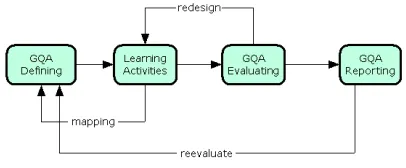
LGQA process is an iterative process (shown in Fig-ure 1). It is not a strict straightforward process with no ability to return backward. Instructional designer can return to the "LGQA Defining" step during the mapping stage, if for instance he finds out that some of
learn-ing activities are misslearn-ing. In other hand, if students’ feedback results were not as expected, instructional de-signer can return back and redesign these activities to enhance these attributes. Reporting is an essential com-ponent that enables faculty administrators to perform their analysis and provides a proper level of guidance for instructors to add or enhance specific LGQA in their courses
Figure 1:LGQA process
2 Learning Activities and LGQA
Nomination technique procedure:
• 1. Posting ideas, no criticism or elaboration is al-lowed in this step.
• 2. Discussing posted ideas to obtain clarification and evaluation.
• 3. Idea-prioritizing, each participant is asked to assign a mark for each idea.
• 4. Idea-reporting, reporting the highest idea to other groups (done by chairperson).
In the following table, Table2, we have identified six Learners General quality attributes related to the Group Nomination Technique.
LGQA Step
Creative thinking 1- Ideas Posting Analytical thinking 2- Ideas Discussion Reflecting 3- Ideas Voting Decision-making 4- Idea Selection Time management
Team Knowledge sharing Leadership
General
Table 2:the graduate quality attributes related to Group Nomination Technique
In addition, we have analyzed the entire set of syl-labuses within our faculty (Information Technology Fac-ulty) to identify what type of assignments and activities that they have. We have managed to identify 10 com-mon types of LGQA that are shown in Table 2. These results can be used in defining a template that suggests what type of LGQA a course might has according to the activities that it includes.
A further work is needed to be done in this field by researchers to identify and standardize a wider range of attributes that could be used within specialized tools to support instructors in implementing such approach
3 WORTHY
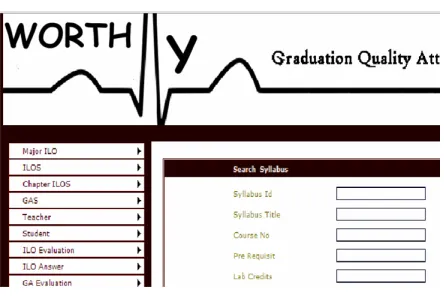
WORTHY is a web application tool that has been built by our group to be applied in our faculty starting from the next semester. The main objective is to increase the awareness among our colleagues of the importance of LGQA. WORTHY has been built according to the pro-cess specified in this paper. WORTHY is sucpro-cessfully integrated with the LMS used in our university. An en-try point for mapping LGQA in WORTHY is through
LGQA Examplesf oundinthesyllabus Oral
Communica-tion
Presentation, Group Discussion
Written Commu-nication
Document based assignments
Creative Thinking Brainstorming, Case Study
Critical Thinking Debating and negotiating group based activity
Reflective Think-ing
Reviewing articles
Leadership Group based with a leader based assign-ments
Searching ability Assignment that require information searching
Decision Making Group based assignments with multiple solutions
Time Management Timed based projects Team Knowledge
Sharing
Group discussion, group based tasks
Table 3:The 10 common tasks in LGQA
Figure 2:Worthy Screenshot
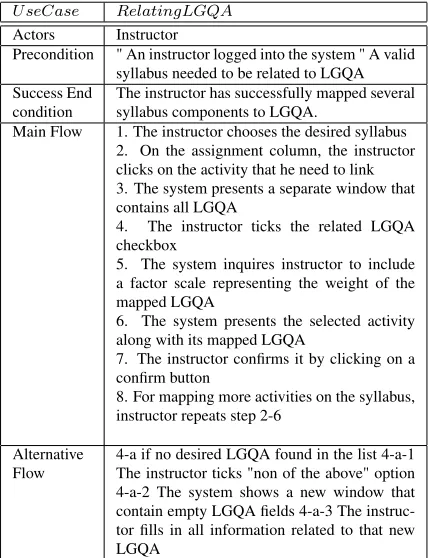
the syllabus page. During the construction of the syl-labus, the system enables an instructor to link any ac-tivity component (in the assignment column) to the 10 predefined LGQA that are shown in Table 3. In addi-tion, instructor can define an extra LGQA by selecting a "non from the above" option. As soon as the instructor selects one of the LGQA types, the system will inquire him to include a factor scale representing the weight of that LGQA within the linked activity. Still the instructor can have the option to relate more than one attribute to a single activity. A detailed use case for relating LGQA to a syllabus is shown in Table 3.
U seCase RelatingLGQA Actors Instructor
Precondition " An instructor logged into the system " A valid syllabus needed to be related to LGQA Success End
condition
The instructor has successfully mapped several syllabus components to LGQA.
Main Flow 1. The instructor chooses the desired syllabus 2. On the assignment column, the instructor clicks on the activity that he need to link 3. The system presents a separate window that contains all LGQA
4. The instructor ticks the related LGQA checkbox
5. The system inquires instructor to include a factor scale representing the weight of the mapped LGQA
6. The system presents the selected activity along with its mapped LGQA
7. The instructor confirms it by clicking on a confirm button
8. For mapping more activities on the syllabus, instructor repeats step 2-6
Alternative Flow
4-a if no desired LGQA found in the list 4-a-1 The instructor ticks "non of the above" option 4-a-2 The system shows a new window that contain empty LGQA fields 4-a-3 The instruc-tor fills in all information related to that new LGQA
Table 4:Relating LGQA Use Case
group meeting between the instructor and the reviewer could be done to clear up these mapping conflicts. Sec-ond, WORTHY automatically generates an online tionnaire following the course completion. This ques-tionnaire is based on the LGQA included in the syl-labus. Each LGQA is mapped to a predefined ques-tion where students in that course are asked to answer. These questions may be closed and/or open type tions. The closed questions are 1-5 scale-based ques-tions. These questions are defined by learning design-ers at an earlier stage. They are defined according to a general type of questions. For example, the "Oral Com-munication Skill" LGQA can be mapped to this ques-tionnaire’s question, "After completing this course, I feel now more confident when I am presenting in front of a group". All questions are stored in a repository in which the system can access to generate the appropriate questionnaire. WORTHY has also an instant graphical-based reporting. It enables various stakeholders to gen-erate reports according to different level of usage. For instance, students can view a detailed report contain-ing all activities that they performed durcontain-ing their study. They can also view their LGQA levels. In addition, they can get a separate view that compares their LGQA level
to the average student’s level. Instructor can view a re-port that contains students’ feedback results. Faculty administrator can access course LGQA reports to com-pare courses’ level with the previous years’ level. A higher level of management has the ability to compare different schools’ levels and their progress during the years.
4 Conclusion
The main objective behind this research was to built a system that enables both student and instructor to par-ticipate effectively in the process of developing educa-tional activates in way to achieve important graduate qualities. These quality attributes are well known in the organizational sector. In relevant literature they have been called by terms such as, "Graduate Attributes", "21st Century attributes", etc. Identifying and enhanc-ing such attributes is both a critical and challengenhanc-ing. It needs a collaboration and commitment from all stake-holders to achieve this objective. We have implemented a tool "WORTHY" as a proof of concept. This tool will be deployed next semester within our faculty (In-formation Technology faculty). In addition, an evalu-ation study will be conducted to verify our goals and objectives. We are planning to publish the results of that study probably after a couple of years from the de-ployment of WORTHY. Currently we are gathering data throughout questionnaires and interviews to use it as a baseline data to compare it against the future data
5 Acknowledgement r
We would like to owe thanks to Applied Science Uni-versity (ASU), Faculty of Technology and the depart-ment of Computer Science, Jordan for supporting this research
6 References
[1] Bonk, C.J. and Wisher, R.A. Applying Collaborative and e-Learning Tools to Military Distance Learning: A Research Framework, United States Army Research In-stitute for the Behavioral and Social Sciences, Alexan-dria, 2000.
[4] Frangenheim, E. Reflections on Classroom Think-ing Strategies. Paul Chapman Educational PublishThink-ing, London, 2005.
[5] Hern?ndez-Leo, D., Asensio-Pérez, J.I., Dimitri-adis, Y., Bote-Lorenzo, M.L., Jorr?n-Abell?n, I.M. and Villasclaras-Fern?ndez, E.D., Describing Effective Col-laborative Learning Flows Using IMS Learning Design. in 4th IASTED International Conference on Web-Based Education, (Grindelwald, Switzerland, 2005), 273-278. [6] James, B., Lefoe, G. and Hadi, M., Working ’through’ graduate attributes: A bottom-up approach. in Transforming knowledge into Wisdom: Holistic Ap-proaches to Teaching and Learning, Higher Education Research and Development Society of Australasia, (Miri, Sarawak, 2004), 174-184.
[7] Oblinger, D. Will E-business Shape the Future of Open and Distance Learning? Open Learning, 16 (1). 9-26, 2001.
[8] Palmer, G., Peters, R. and Streetman, R. Coop-erative Learning. Orey, M. ed. Emerging perspectives on learning, teaching, and technology, 2003.