Language-independent VirtuaL
BioLogy exercise for the
deVeLopment of Key
competences for
LifeLong Learning
Miro Puhek, Andrej Šorgo university of maribor, slovenia e-mail: [email protected], [email protected]
Abstract
Natural sciences in Slovenia are not as popular as we would like them to be. Biology teaching and learn-ing in great part consist of memorizlearn-ing the facts and not so much of developlearn-ing competences. Laboratory
and field work are recognized as methods where students can achieve subject specific and generic compe -tences, as recommended by different international organizations. Such key competences are mathematical competence and competences in science and technology, and digital competences. Although competences
cannot be learned but have to be achieved, the task seems epical when students can hardly find computer
supported didactical tools in their own language.
On the Faculty of Natural Sciences and Mathematics virtual biology exercise Mendelian Genetics with a translational tool was developed. Teachers have the possibility to translate it into desired foreign lan-guage. Virtual exercise is interactive and encourages the critical thinking approach to reach the high level cognitive skills and development of different competences.
Key words: Mendelian Genetics, virtual laboratory, simulations, competences.
Introduction
european parliament has published a framework of eight key competences for lifelong learning (recommendation of european parliament, 2006). this framework describes the es-sential knowledge, skills and attitudes related to each of these competences. even if all compe-tences are recognized as equal they cannot be developed equally in a framework of each school subjects. starting from this point of view the most important competences in the natural scienc-es are mathematical competence and basic competencscienc-es in science and technology, and digital competence (Špernjak and Šorgo, 2009 b). the mathematical competence includes knowledge of basic laws of mathematics and numbers, the competences in science and technology
intro-duce the usage of scientific methods for explanation of natural phenomenon and critical think -ing. the digital competence stands for the unavoidable importance of the usage of technology. the competences cannot be transferred, but must be developed and the best way to assure that in the education process is to include activities, where critical thinking, solving problems and active participation of the students is encouraged (prince, 2004; savery, 2006).
of education in the 21st century Volume 24, 2010 107
where students can achieve subject specific and generic competences as it is recommended by
different international organizations (unesco, 2008; european parliament, 2006). the devel-opment of competences in science and technology are also encouraged through the computer supported laboratory work (Špernjak and Šorgo, 2009 a) and multimedia (starbek et al., 2010). the tool used for learning purposes has to be not only educational, but also interesting, because then it attracts students and develops their desire to learn (fancovicová, 2010).
the society is dealing with rising globalization, which makes the competence of com-munication in a foreign language even more important. on the other hand, the roots of an indi-vidual should not be forgotten or ignored, or in other words, the importance of the competence of being able to communicate in the mother tongue should not be diminished. this competence can be harder to develop especially in the educational systems of nations with smaller groups of native speakers, because they have to include literature that is written in for them foreign language. the language problems can be solved in different ways. one of it is the usage of
translating tools and dictionaries (Schloman, 2000), or the usage of materials without text (pic
-tures, silent movies, animations without text), where language does not play a key role (Puhek
and Šorgo, 2009). the simulation mendelian Genetics was developed in slovenian to enable students to learn and inquire genetics in their mother tongue. in the other hand it is also enabled to translate the simulation into any foreign language, including english.
simulation mendelian Genetics was developed to engage students’ critical thinking.
The virtual exercise presents an interactive environment where salvations of problems from
the real world are enabled – in our case the colour of labradors. the students practice basic
mathematical competence when dealing with variance and calculating the numbers of specific
offspring. to reach the high level cognitive skills, they have to predict the colour and the
geno-type of the animal and after that check their results with the simulation. The exercise increases critical thinking, because the student is able to continue to the next level only if the problem is
solved. the digital competences are encouraged by managing the simulation itself. finally, for the simulation to be available for different nations, menu for translations to other languages is included. teachers now have the possibility to translate the simulation and use it in “mother” language of students (competence of communicating in mother tongue) without further obsta-cles or they can even use it in multi-cultural classes (competence to communicate in foreign languages).
Methodology of Research
General Background of Research
one of the eight basic competences, presented by the european commission, is the communication in the mother tongue. When dealing with the education, things are not equal
anymore and (usually non-English) students have to satisfy with materials only in the official language. The problem reaches even further, when students try to find a topic through internet.
sometimes they manage to get only a few (probably outdated) hits that cover the topic or there are no hits at all. since internet is becoming more and more important educational tool
(fan-covicova et al., 2010) and students find it more useful than printed resources (Mayfield and Ali, 1996), it is crucial for them to have good chances to find appropriate learning materials.
Data Collecting
In the first part of the research a comparison between hits from Google in different
languages was made. Words were chosen decreasingly from general words like “biology” to
When searching for a clue in Google, the searching results almost always include the hits from Wikipedia. in the second part of the research a comparison between the articles in different languages in Wikipedia was made. firstly, the total number of articles in different languages was counted. the numbers of articles were provided by the administrator of the en-cyclopaedia. later the articles were copied into microsoft Word and the words and characters were counted.
Language-Independent Computer Simulations
in the simulation mendelian Genetics the students are put into the role of modern Gregor
Mendel. Mendel was an Austrian priest who was breeding “famous” peas. During his experi
-ments the core of classical genetics, with the first and second Mendel’s law, was born. The sim -ulation is build interactively to support critical thinking and active learning approach – students
have to be active to pass to the next level of the exercise. Instead of peas the Labradors were
used to show students that in the real world science is present everywhere.
the simulation is an independent (self-running) application with no need of special preparation to run it. it was developed in lazarus (free pascal) that emulates delphi. because lazarus is an open source software (Gpl licence), its usage is for free and like that easier to spread among users. for usage of the simulation, students need the basic knowledge of
comput-ers. In case of some schools (for example vocational school for Computer science), even simple exercises can be developed. Unlike Java, which works as “written once and run anywhere”,
lazarus is “written once and compiled anywhere”. the problems with previous installation of application and importance to have internet to run it were avoided. the simulation was tested on different Windows operating systems (Xp, Vista, Windows 7) and is supposed to work also
(probably with some modifications or emulators) on Linux systems and Mac OS.
Results of Research
Searching for Information with Google
Approximately 85% of the users make Google the most visited webpage in Slovenia (Brečko, 2010). In the first part of the research a comparison between hits from Google in dif
-ferent languages was made, because it is probably the first choice of Slovenian students when
they are dealing with problems they come across. table 1 presents the results of searches for different years (Šorgo, 2003; puhek and Šorgo, 2009; puhek and Šorgo, 2010).
Table 1. Google hits of the words in different languages for different years (Šorgo, 2003; Puhek and Šorgo, 2009; Puhek and Šorgo, 2010).
WORD LANGUAGE HITS (2003) HITS (2009) HITS (2010)
Biology English 4.780.000 166.000.000 192.000.000
biología Spanish / 6.950.000 9.020.000
Biologie German / 5.670.000 4.440.000
biyoloji Turkish / 2.310.000 3.520.000
bioloěija Latvian / 216.000 182.000
biologija Slovenian 10.800 178.000 238.000
Heart attack English 667.000 47.200.000 58.900.000
of education in the 21st century Volume 24, 2010 109
Herzinfarkt German / 1.080.000 1.110.000
kalp krizi Turkish / 1.320.000 1.740.000
sirdslçkme Latvian / 51.300 65.600
srčni infarkt Slovenian 137 52.600 127.000
Eustachian tube English 10.600 806.000 332.000
trompa de Eustaquio Spanish / 30.400 118.000
Eustachi Röhre German / 8.070 11.300
östaki borusu Turkish / 11.700 58.000
eistâhija kanâla Latvian / 5.220 6.230
evstahijeva cev Slovenian 5 5.430 7.670
The Case of “Stumps” in Wikipedia
Wikipedia is another popular page in Slovenia (Brečko, 2010) and is often cited in the
student papers. in the table 2 are presented the results of searching word phrases for articles in different languages with the numbers of words (and characters without spaces) in them. the
character * next to some Slovenian and Turkish searching words means that the article was de
-fined as a “stump”. For two Latvian words there were no articles found at all. Finally, the total
number of articles in Wikipedia in different languages is presented in table 3.
Table 2. Words in different languages counted from articles in Wikipedia.
WORD LANGUAGE WORDS CHARACTERS (WITHOUT SPACES)
Biology English 6.386 37.068
biología Spanish 4.736 25.985
Biologie German 3.306 22.731
biyoloji Turkish 2.588 18.727
bioloěija Latvian 1.760 11.406
biologija Slovenian 792 4.930
Heart attack English 13.115 78.358
ataque al corazón Spanish 7.712 43.011
Herzinfarkt German 6.018 41.298
kalp krizi* Turkish 359 2433
sirdslçkme Latvian / /
srčni infarct* Slovenian 293 1908
Eustachian tube English 1.328 7.347
trompa de Eustaquio Spanish 337 1.858
Eustachi Röhre German 525 3.454
östaki borusu* Turkish 112 818
eistâhija kanâla Latvian / /
evstahijeva cev* Slovenian 73 475
LANGUAGE ARTICLES
English 3.414.353 Spanish 647.547 German 1.122.285
Turkish 149.957 Latvian 29.940
Slovenian 116.000
Simulation Mendelian Genetics
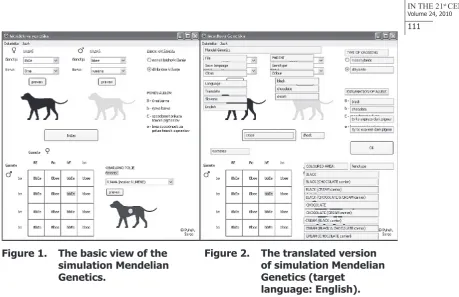
the basic view of the simulation mendelian Genetics is presented in the figure 1. first students have to choose which type of breading they would like to test. in the menu on the
right they can choose between “Monohibridno kriţanje” (Law of Segregation) and “Dihibridno kriţanje” (Low of Independent Assortment). Basically the difference between them is in the number of alleles. The meaning of alleles is explained in the special legend under the menu.
simulation menedelian Genetics is programmed to encourage student to be active when
gaining the feedback. It works based on the following principle: firstly, the student tries to solve
the problem and afterwards, if he/she is right, the result in the form of a picture appears on
the screen, with which the next stage is enabled. At the beginning the genotype and the colour
of each parent should be linked together. if both answers are correct, student can breed the
dogs with click on the button “kriţaj” (breed). The genotype of the offspring fills the Punnett’s square. The next exercise is to choose the showed genotype with the right phenotype from the
drop-down list. the genotype is marked randomly and is different every time. again, if the answer is correct, the picture of chosen labrador is shown.
the simulation is also supported by the menu for translation into other languages –
menu “Jezik” (language). If the user pushes the button “prevedi” (translate), the text inputs are
activated and appear on the screen. this application enables the user to translate all words into
the desired language (Figure 2). When the translation is inserted, it can be confirmed with the button “OK”. The new language can be saved into the text file, which can be reached through
of education in the 21st century Volume 24, 2010 111
Figure 1. The basic view of the simulation Mendelian Genetics.
Figure 2. The translated version of simulation Mendelian Genetics (target
language: English).
Discussion
Manten (1974) reported the rise of scientific articles in English and the fall of scientific
works in German and in french. phillipson (2006) has characterized english as an invasive, im-perialist language in europe. Goodman (2008) found out that spanish students more likely saw the language as a barrier than their english colleagues. Šorgo (2003) declared that the problems of not understanding the foreign language increases with the student’s youthness and can get in primary school even to the level that the problems of understanding can get insurmountable (puhek and Šorgo, 2009).
As it was expected (with spread of technology and internet), the number of hits in Goog -le is increasing in all languages. it is true that the quantity is not everything, but if there are
just a few sources, you will more probably not find what you are looking for. Many hits are
actually fake and are presenting different blogs, forums, subpages, hits in similar languages etc.
With more than 500 million users or 27, 3% of total world internet users (Miniwatts Marketing Group, 2010), official internet language is still English (Šorgo, 2003). For example Spanish, as the third most spoken language that present 7,8% of the world’s internet users or even the remaining world’s languages (without top 10 languages) that presents 17,8% of the world’s languages, cannot be compared to the expand of English.
many researchers from different disciplines already dealt with the problem of effective-ness in teaching. one of the main conclusions was that the students have to be active during the class. if this is illustrated on the case of orchestra, then the students have to play the instruments instead of just sit and listen like the audience.
When designing didactical tools, these findings have to be taken into consideration. If students are supposed just to click through the exercises, they will soon get bored and focus
their attention somewhere else. although it is almost impossible to develop a special tool that
can be used in every situation and in every language, the presented simulation defines a good
approach that could be useful for many teachers. one of the basic competences in the area of education - the communication in mother tongue - represents also one of problems, which was
discussed earlier about the difficulties the majority of students around the world faces when
searching for the didactical tools in their own language.
the language-independent simulation can be translated into the desired language and then used on different occasions. despite some disadvantages of that procedure, as the fact that somebody still needs to know the basic language and translate it into desired one, we created an option for more users to use the simulations as if the simulations were only in english. the idea of our work is to develop a product that can be dispatched through the World Wide Web (or with other media like usb sticks) and can then be used by everyone, especially by the users
that can hardly find educational tools in their non-English languages. The simulations are de -signed like self-running programs, so they do not need internet connection and can run almost everywhere.
Acknowledgements
We greatly acknowledge the support of the ministry of education and sport of republic of slovenia and european social fund in the frame of “project: development of natural sci-ence competsci-ences” performed at the faculty of natural scisci-ences of university of maribor.
References
Brečko, B. (2010). Spletna obiskanost. Raba interneta v Sloveniji. Retrieved 20/09/2010, from http:// www.ris.org/index.php?fl=2&lact=1&bid=11408&menu=0
Fancovicová, J., Prokop, P., & Uşak, M. (2010). Web-Site as an Educational Tool in Biology Education:
a case of nutrition issue. Educational Sciences: Theory & Practice, 10(2), 907–921.
Goodman, B., Jones, R., & Macias, M. S. (2008). An exploratory survey of Spanish and English nursing
students’ views on studying or working abroad. Nurse Education Today, 28(3), 378–384. Google slovenia. retrieved 20/09/2010, from http://www.google.si/
lazarus project. retrieved 20/09/2010, from http://www.lazarus.freepascal.org/
Maten, A. A. (1974). The problems of language in agricultural-scientific intercommunication. Agriculture and Environment, 1(2), 115–128.
Mayfield, J., & Ali, K. S. (1996). The internet as an educational tool. Computers & Industrial Engineer-ing, 31(1-2), 21–24.
miniwatts marketing Group. (2009). internet World users by language. retrieved 10/09/2010, from http://www.internetworldstats.com/stats7.htm
of education in the 21st century Volume 24, 2010 113 Prince, M. (2004). Does Active Learning Work? A Review of the Research. Journal of Engineering Edu-cation, 93(3), 223–231.
Puhek, M., & Šorgo, A. (2009). Jezikovno neodvisne simulacije laboratorijskih del namenjene pouku bi -ologije. in: Proceedings of Nova vizija tehnologij prihodnosti. Ljubljana: Evropska hiđa, 2009, 318-324. Retrieved 10/09/2010, from http://www.infokomteh.com/Admin/Docs/Zbornik%20celotnih%20prispev kov%20mednarodne%20konference%20InfoKomTeh%202009%203.pdf.
Puhek, M., & Šorgo, A. (2010). Development of basic competences in science and technology in minori -ties with language-independent computer simulations. in: Paper at the International Conference on New Horizons in Education, INTE-2010, Turkish Republic of Northern Cyprus. famagusta, 2010.
recommendation of the european parliament and of the council, of 18 december 2006, on key
compe-tences for lifelong learning [Official Journal L 394 of 30.12.2006]. Retrieved 30/9/2010, from
http://eur-lex.europa.eu/LexUriServ/LexUriServ.do?uri=OJ:L:2006:394:0010:0018:en:PDf
Savery, J. R. (2006). Overview of problem-based learning: definitions and distinctions. Interdisciplinary Journal of Problem-based Learning, 1(1), 9–20.
schloman, b. (2000). information resources: “breaking through the foreign language barrier: resources on the Web.” Online Journal of Issues in Nursing. retrieved 01/09/2010, from http://www.
nursingworld.org/MainMenuCategories/ANAMarketplace/ANAPeriodicals/OJIN/Columns/Informa
-tionResources/ForeignLanguageBarrierWebResources.aspx
Starbek, P., Starčič Erjavec, M., & Peklaj, C. (2010). Teaching genetics with multimedia results in better
acquisition of knowledge and improvement in comprehension. Journal of Computer Assisted Learning, 26(3), 214–224.
Šorgo, A. (2003). Searching for information on the internet – what if your students cannot speak English?
International Journal of Instructional Media, 30(3), 315–319.
Špernjak, A., & Šorgo, A. (2009a). Comparison of Attitudinal Differences with Three Different Styles of Biological Laboratory Exercises among Elementary School Students. Didactica Slovenica-Pedagođka obzorja, 24(3/4), 68–86.
Špernjak, A., & Šorgo, A. (2009b). Predlog za razvoj osnovne kompetence v znanosti in tehnologiji ter digitalne pismenosti pri pouku naravoslovnih predmetov v osnovni đoli s pomočjo računalniđko pod -prtega laboratorijskega dela. Didakta, 18/19(127), 20–25.
unesco. (2008). ict competency standards for teachers. competency standards modules. retrieved
10/10/2010, from http://cst.unesco-ci.org/sites/projects/cst/The%20Standards/ICT-CST-Competency%2 0Standards%20Modules.pdf
Adviced by Laima Railienė, University of Šiauliai, Lithuania
MiroPuhek Researcher, Faculty of Natural Sciences and Mathematics, University of Maribor, Korođka cesta 160, Maribor, Slovenia.
E-mail: [email protected]
Andrej Šorgo Ph.D in Biology, Assistant Professor of Didactics of Biology, Faculty of Natural Sci-ences and Mathematics, University of Maribor, Korođka cesta 160, Maribor, Slovenia. E-mail: [email protected]