A Study of Bankruptcy prediction accuracy of
Altman Adjusted and Zavgren models in firms
accepted in Tehran stock exchange.
(based on Altman adjusted model by
Kordestani and colleagues)
1Hanieh Shahdoust,
2Mohammad Reza Karimi pouya,
3Behzad Parvizi
1
Master of Accounting, Faculty of Humanities, Department of Accounting, Islamic Azad University, Hamedan Branch, Hamedan (IRAN)
2,3
Faculty member, Islamic Azad University, Hamedan Branch, Hamedan (IRAN)
Corresponding author:[email protected]
ABSTRACT: The bankruptcy predicting models are the tools of decision making of the investment in a company and investigating the financial of business unit by the manager and other consumers of the companies bills.Today,various numbers of models are used for predicting the bankruptcy that along all of the models ,Altman's and Zavgren 's models can be refered,but these models are designed in another economic environmemts and they have high percent of errors in Iran environment.In order to decrease this error,Kordestani et al.Accomplished an adjustment on Altman's model in a research and they did increase the precision of the model for predicting the bankruptcy to 95% in the base year.the aim of this research is to compare the precision of predicting of Adjusted Altman's model and Zavgren 's models.In order to do that,the financial informations of 172 firms accepted in Tehran Stock Exchange were gathered and were studied in two groups of safe(in a good condition) and bankruptcy companies between the years 2009 and 2013.the results of this study demonstrates that the precision of Adjusted Altman's model in predicting the insolvent companies is 95.5% and the one for Zavgren 's model is 18.2%.Therefore the Adjusted Altman's model is more accurate rather than Zavgren 's model in predicting the bankruptcy of firms accepted in Tehran Stock Exchange.
Key words:Bankruptcy, Altman's model, Adjusted Altman's model,Zavgren 's model.
INTRODUCTION
Considering the increasing competition of the companies and organizations in order to gain benefit and financial sources, possibility of their bankruptcy has increased too. Therefore among the anxieties and troubles of managers, investor, creditors and costumers of the company is the confidence of commercial continuation activity. Because the commercial unit activity cessation will have the most effect on them and results heavy economic and social cost. Investors with anticipation of bankruptcy risk not only avoid wasting its invest but also use this as a tool for decreasing the risk of its invest. Commercial unit managers also while they are aware of apposite danger of bankruptcy can adopt precautionary preparations in order to avoid bankruptcy. But whatever is indisputable is that the unorganized financial situations don’t emerge rapidly. Rather hide among the rest volume of financial and non-financial information, so users of financial bills should use appropriate tools and criterion to organize financial crisis and commercial units which bankruptcy anticipation model are appropriate tool for this intent, but should consider that presented models have different accuracy and the suitable model is the one which has the most accuracy in contrast of others. On this purpose we practice at the existing research we compare two statistics model of multiple diagnostic analysis and logit which have the most percent of use between the statistics models.
History of research
162
“operational costs percent to impure stored profit”. Of considerable researches at this field we can refer to Beaver studies (1966). He introduced one variable technique for classification of the companies to two groups with use of some financial ratios. Financial ratios are used as single and the separation points for each ratio was calculated based on the minimum incorrect classification. One of the first audit analysis for bankruptcy anticipation was done by Edward Altman in 1968. Altman information related to 5 financial ratios; invest in circulation to total holding, stored profit to total holding, profit before interest to and tax to total holdings, value of stock owner’s salary to total value of clerical debts and sales to total holdings for 33 couple of bankrupted companies and was successful with similar measure and industry between 1946-1965gathred and with use of multiple audit analysis statistic technique (MDA) analyzed these information and estimate the Z-SCORE equation. Zavgren in 1985 introduced a model based on non-parametric statistics analyses as logit. Unlike previous researchers including Altman who at arrangement of their models were using normal assumption Zavgren didn’t operate based on being normal assumption. So because in arrangement of the model’s coefficient logit analysis was use the measurement accuracy of his model was more in contrast with models which didn’t use of this way.
Fereydune Raqhnamaye Rudposhti, Razye Alikhani, Mehdi Maran Juri (2009), did a research as application of the Altman and Falmer bankruptcy anticipation models in accepted companies at Tehran paper money, the results indicate that there is a meaningful difference between two models and also Altman bankruptcy anticipation model acts more conservative than Falmer.
Abulfazl Ghadiri Moghadam, Masoud Gholmpur Fard, Farzaneh Nasir zadeh(2009 ) did a research as application analysis of Springate and Altman at accepted companies anticipation in Tehran Stock Exchange. The results show that Altman has the more accuracy.
Farzin Rezayi, Mahdi Golduz (2010) in a research as comparing the bankruptcy pattern anticipation of Zavgren, Zmijewski and Shirata at accepted companies in Tehran Stock Exchange the result that each three patterns have the ability of application at accepted companies in Tehran Stock Exchange with acceptable certainty.
Reza Jamshidi, Eftekhar Sadeghkhani and Zahra Nuri(2014) did a research as comparing anticipation power of Zavgren 's model at accepted companies in Tehran Stock Exchange, results indicates that anticipation of Zavgren 's model has the usage for managers, investors and creditors and governmental companies.
Gholamreza Kurdestani, Rashid Tatli and Hamid Kosari (2014) in a research as Altman’s adjusted model anticipation ability evaluation of Newtone Financial inability and companies’ bankruptcy stagesachieved the result that this pattern could anticipate financial inability for 3 years before bankruptcy and bankruptcy in base year with good accuracy.
Account of research issue:
With increasing number of treatments and its extension in Tehran Stock Exchange and necessity of usage of suitable tools on the grounds of companies’ financial situation analysis for investment using of bankruptcy anticipation models which could forecast the financial situations of the companies with accuracy is needed.(Yaghub Nejad and Sheikhi 2009)
The researchers have done many efforts in order to design bankruptcy anticipation models which have high accuracy, but whatever should be consider is that the designed models for bankruptcy anticipation in economic environments different from Iran’s economic situations (for being different criterion of choosing sample companies and rules and discipline in Iran and other countries like America) are designed and do not possess primary accuracy at those countries. Among these models can refer to Altman’s model, so our countries researchers (Kurdestani and his colleagues) proceed to adjustment of Altman’s model coefficients could increase the accuracy of the model to 95%at bankruptcy anticipation.
The aim of research:
The main goal of this research provides service and help to investors, creditors and analysts at paper money stock, in order to asset companies’ financial powers by two adjusted models of Altman and Zavgren.The other goal is to compare two adjusted models of Altman and Zavgren in Iran’s financial and economic situations.
Questions:
One of the questions in this research is that : is there any meaningful difference between the accuracy of the adjusted models of Altman and Zavgren at accepted companies’ bankruptcy anticipation in Tehran Stock Exchange or not?
163
Models and variables of research
At this research there is a dependent variable and is the indicator of the companies’ financial situation and also is that being bankrupt and lack of bankruptcy and is a qualitative variable.
Independent variables (X) are all ratios used in order to anticipate companies’ bankruptcy at Altman and Zavgren adjusted models.
Altman’s adjusted model:
T- scoreA =0.291𝑥1+2.458𝑥2−0.301𝑥3−0.079𝑥4−0.05𝑥5
= Working Capital to Total Asset. = Retained Earning to Total Asset. = EBIT to Total Asset. = Book Value of Equity to Book Value of Debt. Sales to Total Asset.
If T -0.14 the possibility of bankruptcy is high. (95%)
If -0.14 stays at complete financial inability.
If 0.02 company stays at cash shortage and inability in commercial and financial debt payments.
If 0.36 company stays at hidden financial inability.
If company have financial solvency. Zavgren's model:
Z= 0.23883 – 0.108 – 1.583 – 1.7 + 3.074 + 0.486 – 4.35 – 0.11
= Average Invoices to Sale. = Average Received Accounts to Average Invoices. = (Cash Invoice + Short-term Investment) to Total Asset. = Quick Assets to Curent Debts. = Operating Earning to (Total Asset-Curent Debt). = Long-term Debts to (Total Asset-Curent Debt). = Sale to (Fixed Asset + Net Working Capital).
Bankruptcy possibility is a number between zero and one, the more closer to one bankruptcy possibility is higher and closer to zero the bankruptcy possibility is lower.
P= bankruptcy possibility P=
(Jamshidi and his colleague, 2014).
Research hypothesis:
First hypothesis: there is meaningful difference between accuracy of Altman's adjusted and Zavgren's models in accepted companies’ bankruptcy anticipation in Tehran Stock Exchange.
Second hypothesis: Zavgren's model have the more accuracy than Altman’s adjusted model in accepted companies’ bankruptcy anticipation in Tehran Stock Exchange.
Population and sample:
According to matter and research aims statistics society includes accepted companies’ in Tehran Stock Exchange which have had activity during 2009 to 2013. At this research samples include two groups of solvent and bankrupt companies. Choosing criterion for bankrupt companies is 141 act of commercial law of Iran. Following limitations in order to choose the two sample groups are considered:
Financial year of the companies ends with Esfand 29.
Companies should not change their financial year at the interval time.
Their information should be accessible
Calculated independent variables (ratios) for companies in each two models should not have the amounts of zero or unlimited.
Tools and ways of gathering data:
164
Zavgren's model anticipated results to two groups of solvent and bankrupt, amounts of P 0.5 considered bankrupted companies and amounts of P 0.5 considered solvent companies.
Abstract bases, records and research literature:
There are undistinguished words in financial literature for bankruptcy. Some of them are: unidealistic financial situation, failure, commercial unit lack of success, extremity, bankruptcy, inability in financial debt payments and etc. In culture failure is defined as: don’t have description and reality or insufficiency of cash in short-term (Hajiha, 2005). Gitman (1996) declared that bankruptcy happens when the debts exceed of the value of the existent holding market in company (Nabavi and the colleagues). Farahani (1368) declares that: bankruptcy consist of debtor render his total holding for creditor. But whenever acquit of bankruptcy is able to begin his work (Bahrami, 2010). According to clause 412 of Iran’s commercial law, merchant and commercial company bankruptcy is due to cessation of funds remittance which are responsible (Mansur, 2014).
Data’s and discoveries’ analysis:
First hypothesis: there is a meaningful difference between accuracy of Altman's adjusted model and Zavgren's model at accepted companies’ bankruptcy anticipation in Tehran Stock Exchange.
hypothesis : there is not a meaningful difference between accuracy of Altman's adjusted and
Zavgren's model at accepted companies’ bankruptcy anticipation in Tehran Stock Exchange.
:
hypothesis : there is a meaningful difference between Altman's adjusted model and Zavgren's model accepted companies’ bankruptcy anticipation in Tehran Stock Exchange.
:
In order to analysis of the first hypothesis Khi-2 test is used.
Table 1- analysis of the research first hypothesis
models groups frequency percent Khi-2
amount Freeness degree Meaning level Altma88-Zavgren 88 Altman 88
Solvent 12 54.5
0.826 21 0.418
Bankrupt 10 45.5
Zavgren 88
Solvent 15 68.2
Bankrupt 7 31.8
Altma89-Zavgren 89
Altman 89
Solvent 7 31.8
0.001 21 4.294
Bankrupt 15 68.2
Zavgren 89
Solvent 19 86.4
Bankrupt 3 13.6
Altman
90-Zavgren 90
Altman 90
Solvent 3 13.6
0.001 21 6.062
Bankrupt 19 86.4
Zavgren
90 Solvent 17 77.3
Bankrupt 5 22.7
Altman 91-Zavgren
91
Altman
91 Solvent 1 4.5
0.001 21 5.631
Bankrupt 21 95.5
Zavgren 91
Solvent 16 72.7
Bankrupt 6 27.3
Altman 92-Zavgren
92
Altman
92 Solvent 3 13.6
0.001 21 5.405
Bankrupt 19 86.4
Zavgren 92
Solvent 19 86.4
Bankrupt 3 13.6
Altman total-Zavgren
total
Altman total
Solvent 1 4.5
0.001 21 8.45
Bankrupt 21 95.5
Zavgren total
Solvent 18 81.8
165
Table number 1 shows that achieved meaningful levels of Khi-2 statistics except 2009 is less than 0.05, so there is meaningful difference between the accuracy of Altman's adjusted and Zavgren's model in bankruptcy anticipation of accepted companies in Tehran Stock Exchange except 2009 and the first hypothesis is accepted.
Second hypothesis: Zavgren's model has more accuracy than Altman adjusted model in accepted companies’ bankruptcy anticipation in Tehran Stock Exchange.
Assumption: Zavgren's model don’t have more accuracy than Altman's adjusted model in accepted companies bankruptcy anticipation in Tehran Stock Exchange.
:
Assumption: Zavgren's model has more accuracy than Altman's adjusted model in accepted companies’ bankruptcy anticipation in Tehran Stock Exchange.
:
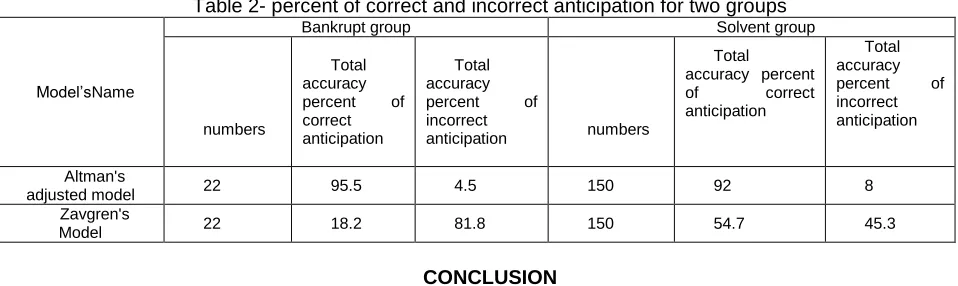
Considering the achieved results of first hypothesis identifies that total accuracy of Altman adjusted in bankruptcy anticipation is 95.5 % while the total accuracy of Zavgren's model in bankruptcy anticipation is 18.2%. so total accuracy of Altman's adjusted model is more than Zavgren's model in accepted companies’ bankruptcy anticipation in Tehran Stock Exchange, therefore second hypothesis is refuted.
Table 2- percent of correct and incorrect anticipation for two groups
Model’sName
Bankrupt group Solvent group
numbers
Total accuracy percent of correct anticipation
Total accuracy percent of incorrect
anticipation numbers
Total accuracy percent
of correct
anticipation
Total accuracy percent of incorrect anticipation
Altman's
adjusted model 22 95.5 4.5 150 92 8
Zavgren's
Model 22 18.2 81.8 150 54.7 45.3
CONCLUSION
Results of test show that there is a meaningful difference between Altman's adjusted model and Zavgren's model in bankruptcy anticipation in each year except 2009. Error percent of Altman adjusted model in bankrupted companies’ financial inability anticipation is 4.5% and correctness percent of anticipation is 95.5%. In contrast Error percent of Zavgren's model in bankrupted companies’ financial inability anticipation is 81.8% and correctness percent of anticipation is 18.2. Also error percent of Altman's adjusted model in solvent companies’ anticipation is 8% and correctness percent is 92%. Zavgren's model in incorrect anticipation of solvent companies has 45.3% error and its correctness percent is 54.7%. So analysis of the information is the sign of first hypothesis confirmation of the research, it means that there is meaningful difference between Altman's adjusted model and Zavgren's model in accepted companies’ bankruptcy anticipation and also is the indicator of the lack of confirmation, it means Zavgren accuracy model in accepted companies bankruptcy anticipation in Tehran Stock Exchange is more than Altman's adjusted model.
RESOURCES
Altman, Edward I(1968). “Financial Ratios, Discriminant Analysis and the prediction of Corporate bankruptcy”. Journal of Finance, 23,pp 589-607.
Bahrami, Zhila.(2010). A review on bankruptcy models and correctness percent of Altman model at Iran stock. Financial management. 3. 101-127.
Dehghan Nistanki, Mahdi. Noruzi Rasul Abadi, Ali.(2009). Authentic Practical Model bankruptcy anticipation. Official Accountancy.4. 36-41.
Etemadi, Hussain. Farajzadeh Dehkordi , Hassan(2008) A review on bankruptcy anticipation models. Accountancy. 39-54.
Ghaem Magham Farahani, Mohammad Hussain. (2012).Business Rights: Bankruptcy and Refinement. Mizan Publication
166
Hajiha, Zohreh. Ghaem maghami, Mahdi. (2012). Conservative Accountancy role analysis in Company’s Bankruptcy risk reduction (The evidence of Iran’s invest Market based on Zavgren Bankruptcy model). Management Accountancy.13. 5. 1-15. Jamshedi, Reza. SadeghKhani, Aftekhar, Noori, Zahra, SherGholami, Fatemeh.(2014). A survey of the Capability of Applied Environmental and Biological Sciences, 4, PP188-194.
Khajavi, Shokrolah. Amiri, Fatemeh sadat.(2013). Recognizing significant elements effective in company’s bankruptcy with TOPSIS-AHP technique. Empirical studies of Financial Accountancy.38.11. 69-90.
Kurdestani, Gholamreza. Tatli, Rashid. Kosari, Hamid.(1393) Evaluation of Altman’s adjusted model anticipation ability of Newton Financial inability and companies’ bankruptcy. Scientific Research Quarterly of Investment Knowledge.9.3.83-99.
Mansur, Jahangir.(2014). Business Law Sum of Laws with the latest Revise. Nashr Didar Publication.
Nabavi Chashmi, Seyed Ali. Ahmadi, Musa. Mahdavi Farah Abadi, Sadegh.(2010). Companies’ bankruptcy anticipation with the use of Logit Model. Management and Financial Engineering portfolios.5.55-81.
Newton, G.w. (2010). Bankruptcy and Insolvency Accounting, practice and procedure. Volume 1. John Wiley & Sons. Seventh Edition.
Soleimani, Gholamreza. Companies’ Bankruptcy Theories and Design of a New Theory. Human and social sciances.8.3.1382.77-94.