An Adaptive and Historical Approach to Optimize Data Access in
Grid Computing Environments
RENATOPORFIRIOISHII1
RODRIGOFERNANDES DEMELLO2
1UFMS – Federal University of Mato Grosso do Sul
FACOM – Faculty of Computing
P.O. Box549, 79070-900 Campo Grande (MS) – Brazil [email protected],
2USP – University of São Paulo
ICMC – Institute of Mathematics and Computer Sciences P.O. Box668, 13560-970 São Carlos (SP) – Brazil
Abstract. The data Grid, a class of Grid Computing, aims at providing services and infrastructure to data-intensive distributed applications which need to access, transfer and modify large data storages. A common issue on Data Grids is the data access optimization, which has been addressed through dif-ferent approaches such as bio-inspired and replication strategies. However, few of those approaches consider application features to optimize data access operations (read-and-write). Those features define the application behavior, which supports the optimization of operations, consequently, improving the overall system performance. Motivated by the need of efficient data access in large scale distributed environments and by the affordable improvements of application characteristics, this paper proposes a new heuristic to optimize data access operations based on historical behavior of applications. Through-out experiments we concluded that applications are better optimized by anticipating different numbers of future events, which vary over the execution. Then, in order to address such issue, we proposed an adaptive sliding window which automatically and dynamically defines how many future operations must be considered to improve the overall application performance. Simulations were conducted using the OptorSim simulator, which is commonly considered in this research field. Our experimental evaluation confirms that the proposed heuristic reduces application execution times up to50%when compared to
other approaches.
Keywords: data access optimization, grid computing, cluster computing, optimization algorithms, re-source allocation, modeling and simulation.
(Received February 23rd, 2011 / Accepted May 2nd, 2011)
1 Introduction
The availability of low-cost microprocessors and the computer network evolution have made feasible the de-velopment of distributed systems. In such systems, pro-cesses communicate one another in order to perform the same computing task. Besides reducing costs, those
systems are scalable and more flexible than real parallel machines [7].
on process scheduling optimization, data prefetching, distributed file systems, fault tolerance and security. As those systems became more available as well as the Internet has allowed the access of long-distance re-sources, scientists started interconnecting them to solve more complex problems [33]. That approach started the development of grid computing environments, in which resources are usually heterogeneous, geograph-ically distributed and accessible to several users [33]. The intrinsic features of these platforms have required new researches on job scheduling, data access, fault tol-erance and security strategies [33]. Besides the evolu-tion of every topic, the Data Access Problem (DAP) is still a major concern when dealing with grids, mainly due to data location and consistency [8]. Other issues that should be considered are the data migration, repli-cation, distribution and also the evaluation of the data access impact on job scheduling approaches [11].
Besides considering the aforementioned topics, re-lated works (Section 2) present three main drawbacks. The first is that most of the works consider exclusively read-only operations [5]. Such situation tends to re-strict the execution of real-world applications. They mainly neglect such subject due to the complexity in-volved in keeping data consistent. The second draw-back is that many works consider static data access op-timization approaches, i.e. they do not adapt themselves according to dynamic grid computing features, such as users logging into and out, computers connecting and disconnecting. The last drawback is that the overall sys-tem performance depends on data access patterns, what varies according to job system calls. In this way, it is very important to understand, estimate and/or predict the job behavior as a way to optimize read-and-write operations.
The three main drawbacks of related works have motivated an initial investigation [19], in which we evaluated a heuristic to optimize job read-and-write op-erations on distributed environments, based on applica-tions historical behavior. In that paper, we optimized next file access operations by considering a window of future events (every event corresponds to a file access operation). However, in that study, we considered fixed-length windows and confirmed they result in an unsatis-factory response time to grid environments, mainly due to the high heterogeneity of computational resources (CPUs, hard disks and networks) and the variation of reading and writing operations during the process exe-cution. By considering initial experiments presented in that paper, we observed that the interposition of read-and-write events (i.e., events of different types under the same window length) affects the efficiency of the
win-dow. Thus, we were motivated to investigate whether a window of future events under the same type of opera-tion could improve data accesses and, therefore, reduce costs.
Based on such hypothesis, this paper proposes an adaptive sliding window to optimize data access by improving replication, migration and consistency deci-sions. An adaptive window is defined over the historical behavior of applications, and it represents the number of future events that our heuristic analyzes to optimize decisions. The adaptive window constantly adjusts its length according to the dynamic behavior of processes, i.e., the number of similar operations (readings or writ-ings) under execution. As this approach considers his-torical job behavior, applications need to be executed at least once.
The specific contributions of this paper are: 1) the formalization of the Data Access Problem (DAP); 2) an analytical optimization model to address DAP, aiming at minimizing the overall application execution times; 3) proposal of an adaptive sliding window approach to define how many historical events are considered in the optimization process. 4) simulations to evaluate the ef-ficiency of the adaptive sliding window under a wide range of environments and system configurations (how read-and-write operations are distributed over time).
Besides all the listed contributions, experimental re-sults confirm that this new adaptive heuristic outper-forms other commonly considered ones (e.g., LRU, LFU and Economic Model, presented in Section 5) in approximately 50% when dealing with grid
environ-ments.
This paper is organized as follows: Section 2 re-views related work; Section 3 models the Data Access Problem (DAP); the proposed adaptive heuristic is psented in Section 4; Section 5 presents simulation re-sults and, finally, concluding remarks.
2 Related Work
Several studies have been conducted to improve data ac-cess on grid environments. Such works are mainly fo-cused on data replication, distribution and consistency.
Oliker et al. [27] propose a static data allocation approach and three data-oriented job scheduling algo-rithms (SI, RI, SYI). The approach attempts to opti-mize the system overall performance by allocating jobs where data is available. Among the evaluated schedul-ing algorithms, SI reduces the average execution time by60%when compared to local approaches, and can execute40%more jobs.
KNN) to select the best replicas from grid sites. To select the best replica, the authors design an optimiza-tion technique that considers the network latency and the disk state. Different file access patterns are inves-tigated and compared to the KNN algorithm. KNN shows a performance improvement for sequential and unitary random file access patterns.
Sun & Xu [34] propose two consistency algorithms: Lazy-Copy (LC) and Aggressive-Copy (AC). LC up-dates replicas only when needed, i.e., when a user re-quires them. This may reduce the bandwidth consump-tion, avoid unnecessary transfers when data are modi-fied but not required. AC updates replicas whenever a change occurs in the original file. Therefore, AC fully guarantees the consistency, while LC partially guaran-tees it. In the comparison between the two algorithms, the Aggressive-Copy reduces the access latency, whilst Lazy-Copy reduces the bandwidth consumption.
Wang et al. [36] consider the parallel access of data replicas. The access time is minimized by overlapping requests, what tends to increase the throughput. The proposed solution (called MSDT) carries on replicat-ing data in idle intervals as a way to improve system performance. That work does not consider data consis-tency. Results present a speedup factor in the range of
2.72 ∼ 3.06when comparing MSDT to another
tech-nique (called NoObserve) [15].
Oldfield & Kotz [26] propose the Armada frame-work which launches applications and defines how files are distributed. It also provides access control and data access mechanisms. It builds graph structures to repre-sent the processing and data flow. Experiments com-pare restructured applications to original ones. Ar-mada improves throughput of wide-area networks in
40%when compared to original applications.
Dang & Li [11] propose a tree-type structure to cor-relate data in grid regions aiming at reducing file trans-fers. When a job needs a file, the approach looks for high correlation data before asking for transfers. This reduces network costs and improves the overall appli-cation performance.
Elghirani et al. [14] define a data management ser-vice to replicate files on sites as well as a Taboo Search approach to schedule jobs aiming at optimizing run-time and system utilization. The Taboo Search attempts to find good data replication solutions, considering job data accesses and processing time. Results present per-formance improvements from8% to35%, depending on the replication and job scheduling approaches.
Kim et al. [22] propose a technique to improve data access, matching nodes to the best remote data sources. The authors consider a trace-based synthetic
scenario on PlanetLab to evaluate their heuristic. Re-sults show that the resource selection outperforms con-ventional techniques such as latency-based or random allocations.
Chervenak et al. [10] propose a framework called Replica Location Service (RLS) which maintains and provides information on physical locations of replicas. RLS is used in a variety of production environments such as the Laser Interferometer Gravitational Wave Observatory (LIGO) [3], Earth System Grid (ESG) [1] and Pegasus [12]. Authors presented a performance study demonstrating that the individual RLS servers have performed well and scale up to millions of entries compared to the native MySQL using ODBC clients.
AL-Mistarihi & Yong [4] propose an approach to address the replica selection problem. The authors con-sider the Analytical Hierarchy Process (AHP) to solve that problem, and they evaluate this approach in an ex-tension of the OptorSim simulator. AHP was employed to solve this optimization problem using a simplifica-tion of multiple objectives into a single one. However, the authors evaluated AHP comparing it only against a random approach. They could and should at least compare the performance of AHP against strategies in-cluded in the OptorSim simulator, such as LRU, LFU and the Economic Model.
It is important to observe that all previous presented studies do not consider the dynamic behavior of appli-cations when taking decisions, likewise, they do not take advantage of future read-and-write operations to optimize data accesses.
The dynamic behavior of applications motivated Ishii & Mello [19] to propose a heuristic that adopts a fixed length window of future events which aims at anticipating reading and writing operations. Using fu-ture events, the heuristic optimizes decisions on repli-cating, migrating and keeping consistency. This study confirmed that windows of future events can indeed im-prove application performance in some scenarios. For example, when considering environments with read-only operations, the heuristic improved as much as
100%, however under a low frequency of writing op-erations (5%of writing and95%of reading operations)
and low frequency of reading operations (95%of
writ-ing and5%of reading operations), the heuristic could
not reduce application execution times.
accesses and, therefore, reduce application execution times. Thus, in this paper, we propose an adaptive sliding window to optimize data accesses by improving replication, migration and consistency decisions.
Figure 1: Example of network interconnection
3 The Data Access Problem
This section aims at defining the Data Access Problem (DAP). We start with an empirical case study and then we proceed with the formal definition of DAP.
3.1 An Empirical Case Study
In order to empirically state the DAP, we propose the following hypothetical case study: let two parallel ap-plications be composed of the processes presented in Table 1, where MI represents the million of instructions executed by processes (during their lifecycles); MR and MW are, respectively, the number of KBytes/sec read and write from/into the main memory; HDR and HDW are, respectively, the number of KBytes/sec read and write from/into the hard disk (or secondary mem-ory); NETR and NETS are, respectively, the number of KBytes/sec received and sent through the computer network – in this case, the sender (for NETR) and the receiver (for NETS) processes are presented. For ex-ample, Table 1 row1shows that processp0consumes 1,234MI, reads 123KBytes/sec (and does not write
data into memory, i.e. MW= 0), it still reads 78
KBytes/sec from the hard disk (and it does not write data into the hard disk, i.e. HDW=0), receives 12
KBytes/sec from processp1and sends532KBytes/sec
to processp1.
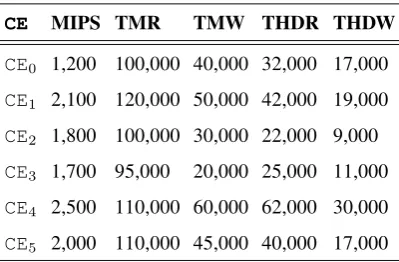
Now consider that these processes are allocated on a set C of computers which is described in Table 2, whereCEis a computing element; MIPS represents the processing capacity in million of instructions per sec-ond; TMR and TMW are, respectively, the read-and-write throughput of the main memory (in KBytes/sec); THDR and THDW are, respectively, the read-and-write throughput of the hard disk (also in KBytes/sec). Let
Table 1: Processes behavior
App 0
MI MR MW HDR HDW NETR NETS
p0 1,234 123 0 78 0 12 –p1 532 –p1
p1 1,537 23 89 0 12 532 –p0 12 –p0 App 1
MI MR MW HDR HDW NETR NETS
p2 1,221 823 70 78 543 10 –p3 321 –p4
p3 1,137 223 179 324 212 423 –p4 10 –p2
p4 2,237 23 17 12 0 321 –p2 423 –p3
the allocation operator be defined by∝, where an ex-ample of allocation, assuming an application composed of 5 processes, is given by p0 ∝ CE0, p1 ∝ CE1, p2 ∝ CE2, p3 ∝ CE3 andp4 ∝ CE4. Computers in Care interconnected according to Figure 1, which also presents an example of network bandwidths and laten-cies.
Table 2: Grid site characteristics
CE MIPS TMR TMW THDR THDW
CE0 1,200 100,000 40,000 32,000 17,000
CE1 2,100 120,000 50,000 42,000 19,000
CE2 1,800 100,000 30,000 22,000 9,000
CE3 1,700 95,000 20,000 25,000 11,000
CE4 2,500 110,000 60,000 62,000 30,000
CE5 2,000 110,000 45,000 40,000 17,000
Also consider that all5processes (described in
Ta-ble 1) of the2parallel applications access a set of files F = {f0, f1, . . . , f9}. In order to solve the DAP, in
an optimal way, we must explore all possible file dis-tributions over the6computing elements and evaluate the access cost for every processpi. In such situation, permutations would be performed to find out all pos-sible solutions. For example, let a solution where the subset of files{f0, . . . , f6}is allocated onCE0and all
others, i.e. {f7, f8, f9}, are placed onCE1. The set of
all possible solutions, for any instance of the problem, is obtained by computingnz, wherenis the number of computing elements andzis the number of files. Con-sequently, in the previously mentioned instance, the so-lution space is equal to610
= 60,466,176.
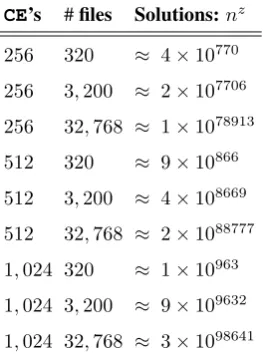
expected problem solution space would follow the or-ders of magnitude defined in Table 3, in which we ex-pect to address thousands of computers storing millions of files.
Table 3: Solution space to distribute files over computing elements
CE’s # files Solutions:nz
256 320 ≈ 4×10770
256 3,200 ≈ 2×107706
256 32,768 ≈ 1×1078913
512 320 ≈ 9×10866
512 3,200 ≈ 4×108669
512 32,768 ≈ 2×1088777
1,024 320 ≈ 1×10963
1,024 3,200 ≈ 9×109632
1,024 32,768 ≈ 3×1098641
3.2 Formal Definition
A grid computing environment can be represented as a non-directed graphG = (S, L), where the set of
ver-texesS represents the grid sites (networks of worksta-tions, parallel machines, clusters, etc.) and the set of edges L is composed of communication links in be-tween grid sites. Also consider a setF containing z files, whose sizes are modeled by functionθ(.) :F →
Z+. Each grid site
s ∈ S has none, one or more ele-ments with the storage capacity defined byΩ :S→Z+
which is the size in MBytes of the storage element into a grid sites. Functionαj,i:F ×S →Z+ defines the cost of storing filej on sitesi. In the same way, the functionδ(.) : F×S → Q+considers the links inL
to model the communication cost in between grid sites. Functionαis constrained such asαj,i≤Ωi ∀j, i.
Consider the setAwhich containskparallel appli-cations executing on a large scale distributed environ-ment. Let the functionφ(.) :A → Z+ represent the
number of processes of each parallel application. Con-sider setPwhich contains all processes of allkparallel applications, i.e. the number of terms inP is equal to
h= �
a∈A
φ(a). All processes are previously allocated
on the distributed system according to any scheduling criterion. Every element inP has a set Rassociated, which containsmread-or-write file requests. A process contains particular features, here defined as behavior,
such as processing, memory and input-and-output uti-lization. Every process, consequently, requires differ-ent amounts of resources provided by setSof grid sites as well as the set of communication linksL. A process p∈Pmay access none, one or many files inF.
The cost to transfer filefin between two grid sitess ands�is modeled in Equation 1. It depends on file size θ(f)and distanced(s, s�
)in between both sites, which
is measured in terms of the network latency and band-width. Costψis assumed when a constraint forbids the replication of filefto grid sites�.
δ(s, s� ) =
�
θ(fj)d(s, s�) wheres∈S, j= 1, . . . , z
ψ=∞ otherwise
(1) A filef must be transferred from the shortest path sites∈Swhose cost is minimum and defined by func-tiond(s, s�). The access cost for reading a file
f, stored in a site s, is, therefore, given by Equation 2. Write operations induct replica updates for every filef ∈F, which consumes resources as described in Equation 3.
rcost(f) =δ(s�, f) = arg min(θ(f)d(s, s�))∀s∈S (2)
wcost(f) =�
j
δ(s�
, fj)∀jlocal and remote replicas
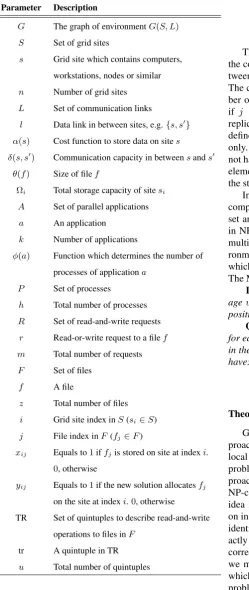
(3) By unifying Equations 2 and 3, the total cost to ac-cess a filefis determined in Equation 4, considering all processes inP. Table 4 describes each model parame-ter, afterwards the data access problem is formalized.
Λ(f) =�
p∈P �
j
rcost(fj) +wcost(fj) (4)
Consider a set P of processes which were previ-ously scheduled on grid sites inS with storage capac-ities defined byαand transfer costs byδ(s, s�
). Let a
set of files F with a given initial file distribution xij and sizeθ(f). Assume a set of quintuples TR which
describes read-or-write operations on files inF. The optimization problem, DAP, consists in determining a new file distributionyij according to the energy func-tion defined in Equafunc-tion 5, which is constrained ac-cording to Equations 6 and 7 and follows the domains: xij ∈ {0,1}, ∀i, jandyij ∈ {0,1} ∀i, j.
Γ(DAP) = min
n �
i z �
j
Table 4: Model parameters
Parameter Description
G The graph of environmentG(S, L)
S Set of grid sites
s Grid site which contains computers,
workstations, nodes or similar
n Number of grid sites
L Set of communication links
l Data link in between sites, e.g.{s, s� }
α(s) Cost function to store data on sites
δ(s, s�
) Communication capacity in betweensands�
θ(f) Size of filef
Ωi Total storage capacity of sitesi
A Set of parallel applications
a An application
k Number of applications
φ(a) Function which determines the number of
processes of applicationa
P Set of processes
h Total number of processes
R Set of read-and-write requests
r Read-or-write request to a filef
m Total number of requests
F Set of files
f A file
z Total number of files
i Grid site index inS(si∈S)
j File index inF(fj∈F)
xij Equals to1iffjis stored on site at indexi.
0, otherwise
yij Equals to1if the new solution allocatesfj
on the site at indexi.0, otherwise
TR Set of quintuples to describe read-and-write operations to files inF
tr A quintuple in TR
u Total number of quintuples
n �
i
xifj≤n (6)
z �
j
yij = 1, i= 1, . . . , n (7)
The energy function (Equation 5) attempts to reduce the cost to request files, considering the distance in be-tween grid sites, amount of data and storage capacity. The constraint presented in Equation 6 limits the num-ber of file replicas, which can not surpassnsites, i.e. if j = n all storage elements in the grid have one replica off each. The constraint given by Equation 7 defines that every replica must be allocated on one site only. This constraint implies that storage elements do not have more than one replica of filef. All computing elements connected to a grid site access the replica on the storage element of that grid site.
In order to prove that the data access problem is NP-complete, we demonstrate that it is contained in the NP set and it is NP-hard. To demonstrate that the DAP is in NP, a reduction is conducted from the allocation of multiple copies of the same file on a distributed envi-ronment (here called Multiple File Allocation (MFA)) which is proven to be NP-complete according to [16]. The MFA problem is defined as:
Instance: GraphG(V, E), for eachv ∈ V a us-ageu(v) ∈ Z+ and a storage cost
s(v) ∈ Z+, and a
positive integerK.
Question: Is there a subsetV� ⊆
V such that, if for eachv∈V we letd(v)denote the number of edges in the shortest path inGfromvto a member ofV�, we have:
�
v∈V�
s(v) + �
v∈V�
d(v)×u(v)≤K? (8)
Theorem 1. DAP is NP-complete.
Garey & Johnson [16] present three different ap-proaches to prove NP-complete problems: restriction, local replacement and component design. Consider a problemΠ ∈ N P, the proof using the restriction ap-proach consists in showing that Π contains a known
NP-complete problemΠ� as a special case. The main idea lies in the specification of additional restrictions on instances ofΠ, so that the resulting problem will be
identical to�. The problem
Πdoes not need to be
NP-complete, we look for similarities of theΠ� basic components and relate them to theΠproblem. The last
type of proof is the component design, which considers the constituents of the target problem instance to design components to be combined and represent the instance of the already known NP-complete problem.
Proof. In this paper, we prove that DAP is NP-hard by using the restriction-proof approach. DAP is contained in NP due to it is possible to build a non-deterministic machine to verify the graph G(S, L) in polynomial time. When building the machine, the following is non-deterministically defined: for each s ∈ S an alloca-tionxij in which the filefj is mapped, and, for each
l ∈ L the costα(s, s�). The verification step checks out, for eachf ∈ F, whether the grid site mapping is valid, this is, if
n �
j
xj ≤ n. Finally, the condition
n �
j
yij = 1, i = 1, . . . , n is evaluated for the new
allocation of files inF.
Consequently, an instance of DAP is translated into a MFA one. We initially map every element of the set V in elements inS. Then, we define the numberzof files. Those files are initially allocated on sites inS, in a random way. This file allocation respects the con-straint that each grid sites∈Shas the maximum stor-age capacity ofs(v). Besides that,d(v)is mapped into d(s, s�
)what represents the cost to transfer filef ∈ F in between two grid sitessands�, and the function
u(v)
is mapped intoθ(f), which models the file size. For ev-ery elemente∈E, there is a correspondentl ∈Lwith network latency and bandwidth associated.
In the MFA problem, Equation 8 formalizes the ob-jective function which aims at minimizing costs related to the allocation of multiple copies of the same file. This equation is bounded byK. Similarly, in the DAP problem, the objective function is defined by Equation 5 which also attempts to minimize access costs.
Finally, consider an instance for the DAP where: given a requestr ∈ R which is launched by a pro-cessp ∈ P when reading or writing on a filef ∈ F. For any instance of DAP where|S| ≥2and|L| ≥2, the problem presents exponential characteristics and it is considered NP-complete.
4 Data Access Approach
After stating the DAP, we may address it by using exact or approximation approaches. Exact approaches guar-antee optimal solutions for the problem. However, they
may be very time consuming, depending on the prob-lem and the instance. For small instances, they might offer acceptable run-time, but, for large instances, they are prohibitive [35]. This fact motivated the develop-ment of approximation strategies considering heuristics and metaheuristics. A heuristic is an algorithm that, based on the problem knowledge or experience, leads to appropriate solutions, but there is no guarantee to ob-tain optimal solutions [16].
Heuristics are commonly considered due to their trade off in between the solution quality and the time complexity. Metaheuristic is a type of heuristic to solve a class of problems and not only a specific one. Exam-ples of metaheuristics are: Genetic Algorithms (GA) [18], Ant Colony Optimization (ACO) [13] and Simu-lated Annealing (SA) [23].
Genetic algorithms have been used as search and op-timize techniques in several domains [30]. They are based on the natural selection theory, which guaran-tees the survival of the most adequate individuals, i.e. the ones that represent good solutions. This approach does not ensure optimal solutions for all problem in-stances, but provides appropriate solutions for a reason-able number of NP-Complete problems [30].
ACO-based algorithms support the search for paths in between a given source and a destination. This bio-inspired approach is based on the stigmergy strat-egy and the pheromone concentration. Stigmergy is a communication mechanism used by ants to coordi-nate global functions. As ants randomly walk look-ing for food, they lay down pheromone (chemical com-ponent released by ants) on trails. When another ant is looking for the food path, it has a certain proba-bility to follow the previous crossed path (according to the pheromone concentration). This approach iter-atively reinforces good paths, supporting the search for shortest-path solutions on graphs.
Simulated Annealing aims at finding a global mini-mum for a given energy function [23]. This nomencla-ture comes from an analogy to the metallurgic process of annealing, which consists of the controlled heating and cooling of materials as a way of finding stable en-ergy states. Those states, for instance, help metallurgic processes to reduce physical defects on different mate-rials. This technique introduces the system temperature concept, which defines the annealing scheduling (heat-ing and cool(heat-ing operations). SA supports the search of global minimal of energy functions.
[18], Ant Colony Optimization (ACO) [13] and Simu-lated Annealing (SA) [23]. However, one issue prevents the adoption of such techniques, which is the dynamic behavior of data accesses. Those metaheuristics would model the DAP by evaluating the current accesses as well as future ones. However, their objective functions would compose such information in the current mo-ment, in a way that they tend to optimize the average behavior. Therefore, such approaches may privilege remote accesses while they could improve the system overall performance by replicating data and supporting local operations. Better solutions could be obtained by assessing behavior changes and using them to antici-pate data operations. In order to develop such method, we must identify the dynamics involved in the process behavior.
Given the disadvantages presented by the meta-heuristics, we propose a novel heuristic to approach the data access optimization using historical applica-tion behavior and the adaptive sliding window length. As the heuristic considers the historical process infor-mation, we can anticipate process read-and-write op-erations and, therefore, replicate data locally before needed, what tends to reduce access costs. When data is locally available, read-and-write operations execute faster, what avoids access delays. The anticipation of process events is used to take decisions on data replica-tion, migration and consistency.
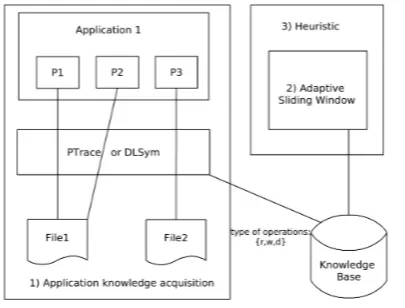
The proposed approach follows the workflow de-fined in Figure 2, which is composed of the modules: 1) application knowledge acquisition; 2) adaptive slid-ing window length; and 3) the Heuristic. The followslid-ing sections describe the features of each module, including their integration.
Figure 2: The proposed approach
4.1 Application Knowledge Acquisition
This paper considers applications behavior to guide a novel heuristic to improve decisions on replication, mi-gration and consistency of files. The behavior is com-posed of read-and-write operations issued by applica-tion processes.
There are two approaches to extract process be-havior: monitoring and event interception. Monitor-ing periodically requests information of a given sys-tem. Examples of monitoring tools are SMART (Self-Monitoring Analysis and Reporting Technology) [31], Linux Vmstat [37] and Tcpdump [20]. System moni-toring is usually based on counters. Counters are vari-ables which account the system utilization within spe-cific time intervals. For example, consider SMART. Let it request the number of hard disk reads and obtain0at
a given instant. After10seconds, it asks for the
infor-mation again and the system returns5, what means that
five read operations were executed in between the first and the second monitoring points. The monitoring ap-proach grabs the amount of data and what kind of event has happened in a certain time interval, but it does not inform when exactly an event happened and its detailed information. The second approach intercepts process events and calls a procedure to inform about them (this approach obtains the exact event moment as well as its detailed information). However, depending on the event complexity (such as process system calls) and cost, the interception may become prohibitive. Examples of the intercepting tools are the Unix DLSym [21] and Ptrace [32].
DLSym allows the interception of dynamic proce-dure calls (from dynamic libraries). This is, when the program calls a function, instead of having the code in-ternally, it loads a shared library and runs the procedure. This approach avoids procedure rewriting and also al-lows the interception of calls. Consequently, any pro-cedure in a dynamic shared library can be intercepted, what helps to build monitoring tools. On the other hand, Ptrace transparently intercepts process signals and sys-tem calls. It is usually employed to build diagnosis and debug tools. Ptrace does not use dynamic libraries and can intercept any Unix application.
monitor-ing approach may hide behavior in between samplmonitor-ing intervals.
After extracting the application behavior, we trans-form the sequence of events in series of numer-ical values which represent time instants. Ev-ery event is described by the quintuple tr = {pid,inode,amt,time,op} where pid is the identifier of the process that performs the operation,
inodeis the file identifier,amtis the amount of data read or written,timeis the time interval in between operations andopis the operation type (whether read-ing or writread-ing). A series forusampling intervals is, therefore, defined as TR= {tr0,tr1, . . . ,tru−1}which
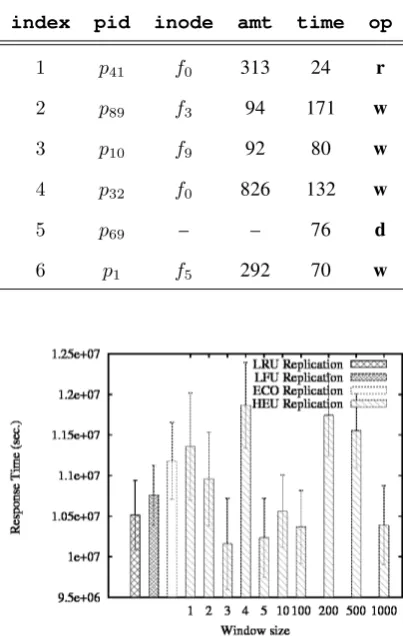
is used to analyze relations among events. Those events are included in a trace file for future usage. Table 5 presents an example of a trace file.
Table 5: Example of trace file
index pid inode amt time op
1 p41 f0 313 24 r
2 p89 f3 94 171 w
3 p10 f9 92 80 w
4 p32 f0 826 132 w
5 p69 – – 76 d
6 p1 f5 292 70 w
Figure 3: The impacts of sliding window variation
4.2 Adaptive Sliding Window Length
The sliding window length defines the number of future events that the heuristic analyzes to optimize decisions,
which impact on the system performance. An example of the impact the sliding window has on applications execution is shown in Figure 3, that considers a sliding window approach with fixed length. Four techniques were evaluated: LRU, LFU, Economic model (see Sec-tion 5), and the heuristic with fixed window length (la-bel HEU in Figure 3) [19].
We observe that, for the sliding window length 4,
the application execution time is higher. We observed this fact occurs due to the heterogeneity and the inter-position of writing and reading operations. This also happens for sliding windows200and500, where there
is also high heterogeneity in terms of operations. We experimentally confirmed that the more homogeneous is the execution order of reading and writing operations (i.e. similar operations are arranged consecutively), the longer can be the prediction horizon, i.e. more future events can be considered and, therefore, we can set larger window lengths.
This fact motivated this work that proposes of an adaptive sliding window approach which considers the type and number of operations. Thus, we proposed pa-rameterβto adapt the window length according to con-secutive homogeneous operations (i.e. reading or writ-ing). Equation 9 defines the Adaptive Sliding Window (ASW), whereWt+1is the next window length,Wtis the current window length, Op is the number of homo-geneous operations andβis the factor which determines modifications in the window length.
Wt+1=Wt×(1−β) +Op
2×WtOp
×β (9)
For example, given W1 = 10, Op = 4andβ = 0.10, we would obtain a next window length equals to W2= 9. Note that the window adapts according to the
number of operations under the same type, see Figure 4. On the other hand, when Op is equal toWt(seeW4
in Figure 4) the next window length increases consider-ably,W5= 11. Parameterβ is experimentally defined
(as presented in Section 5.4).
Figure 4 presents a sample trace file with process behavior information (in this example we focused only in reading (r) and writing (w) operations) obtained through the interception approach (Section 4.1). The first part of the Figure 4 shows the initial window length (W1= 10) and all consecutive operations. The second
part shows how to compute of the next sliding window length based on Equation 9. Finally, the last part shows the subsequent windowsW2= 9, W3= 8, W4= 7and W5= 11, which clearly demonstrates the adaptation of
Initializing the Adaptive Sliding Window
W1=10
� �� �
rrrrwwrwwr rwrrwwrwwwwwwwrrwrrrrrrr
Calculating window length
rrrr
� �� �
Op=4
wwrwwr→W2= 10∗(1−β) + 4 2∗104
∗β= 9
r
����
Op=1
wrrwwrww→W3 = 9∗(1−β) + 1 2∗1
9 ∗β= 8
wwwww
� �� �
Op=5
rrw→W4= 8∗(1−β) + 5 2∗58
∗β= 7
rrrrrrr
� �� �
Op=7
→W5= 7∗(1−β) + 7 2∗7
7 ∗β= 11
Window length after executing the ASW approach
W2=9
� �� �
rwrrwwrww
W3=8
� �� �
wwwwwrrw
W4=7
� �� �
rrrrrrr
W5=11
� �� �
rwrrrwwrrwr
Figure 4: Example of the Adaptive Sliding Window withβ= 0.10.
By using this mechanism, we compute the number of similar operations and define the length of the next window of future events. Thus, it limits how many fu-ture events will be analyzed. Then, we consider the window to anticipate data transfers, bringing informa-tion locally and, therefore, reducing future access costs. Without the adaptive mechanism, we should set a fixed length for the sliding window, which is only possi-ble experimentally (requiring the evaluation of a range of values for the length). Besides that, a fixed length might be good for part of the application execution, while it would reduce the performance in other situa-tions (time instants). Therefore, the length needs to be dynamically adapted according to the instantaneous be-havior of the process (we consider one specific adap-tive window per process). Moreover, using the adapadap-tive mechanism, the window fits the process behavior over time, making it more flexible and efficient.
4.3 The Proposed Heuristic
Let P = {p0, p1, . . . , ph−1} be the set of all
pro-cesses previously scheduled on grid sites, F = {f0, f1, . . . , fz−1} be the set of files to be accessed,
andO = {r, w, d} (whereris read,wis write andd represents idle moments) represent the set of types of operations. Let TR model the series of process behav-ior, where each element tr∈TR describes an operation
opover a filef, executed by processp.
Thus, we anticipate data access operations over TR by using an adaptive sliding window ASW → [ty, tx] (consideringx > y). This sliding window models the number of future events (process behavior) considered when optimizing process data-access operations.
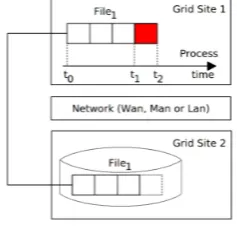
The mechanism of anticipation aims at transferring files before they are requested by jobs in execution. This mechanism reduces the access cost due to files are requested beforehand and they are locally replicated. Consequently, all this scenario reduces the total execu-tion time of applicaexecu-tions. In Figure 5, a file will be re-quested att1, and it was totally transferred in advance.
On the other hand, in Figure 6, the file is requested in t1, however the transfer was not completed and, in this
case, the heuristic still needs to transfer the spare data. In this last scenario, the total cost ist2−t1.
Figure 5: The file is completely transferred
Figure 6: The file is partially transferred
In this way, consider a processpwhich executes op-erations over a filef. Now, letpbe at the current exe-cution or time instanttcand there is a window of events up to the time instanttf, wheretf > tc. The proposed heuristic evaluates if filef can be retrieved (i.e. to find the latest version of a replicaf�) to the local site where it is needed. If so, transfer costs and access delays are reduced and the process performance is improved. In this circumstance, there are two ways of retrievingf, both imply costΓ(Equation 5):
1. iftc+ Γ≤tf, then we can completely retrieve file
f, which reduces the process execution time, inΓ
units, to access it;
2. iftc+ Γ > tf, then we can reduce tf −tc time units in overall process execution.
The proposed heuristic is presented in Algorithm 5 and in other auxiliary procedures as follows (procedures listed in Algorithms 1, 2, 3 and 4).
The method Retrieve(f) (Algorithm 1) estab-lishes a new local copy (replication) of the remote file f and assesses the copy removal option (for data mi-gration purposes). The methodRead(tr) (Algorithm 2) receives a quintuple tr and, if filef is invalid then it applies the methodRetrieve(f) and finally reads it. The methodWrite(tr) works similarly (Algorithm 3). The methodInvalidate(f) (Algorithm 4) receives a file and updates all replicas as invalid.
Algorithm 1Retrieve(f) Require:
Theffile. Ensure:
f�replica file retrieved from nearest site. 1: S←sites subset where there aref copies 2: foreachs∈Sdo
3: Λ(f) =� p∈P
�
jrcost(fj) +wcost(fj)
4: end for 5: returnf�
Every grid site s ∈ S (where the environment is represented by the graphG(S, L)) has an associated set
of processes which were previously scheduled accord-ing to any policy. The methodgetNextProcess(s)
(Algorithm 5, line3) returns a processpscheduled on sites. Every grid site scontains the historical traces of processes (TR, line4). The pseudocode in between lines5and13performs operations tr∈TR, considering the possible types: read, write or idle. From line14to
44, the heuristic assesses the feasibility of replication,
Algorithm 2Read(tr) Require:
Quintuple{pid,inode,amt,time,op}. Ensure:
Readingamtfrom file referenced byinode. 1: iff is “invalid"then
2: Retrieve(f) 3: end if
4: reads
Algorithm 3Write(tr) Require:
Quintuple{pid,inode,amt,time,op}. Ensure:
Writingamtto the file referenced byinode. 1: iff is “invalid"then
2: Retrieve(f) 3: end if
4: writes
Algorithm 4Invalidate(f) Require:
Thef file. Ensure:
The subsetSof outdatedf replicas.
1: S←site subset where there aref copies. 2: foreachs∈Sdo
3: update copycsoff as “invalid" in sites.
Algorithm 5 DAP Heuristic
Require:
Set of processP ={p0, p1, . . . , ph−1}; Set of filesF ={f0, f1, . . . , fz−1}; Set of quintuples TR={tr0,tr1, . . . ,tru−1}; initialASW= 100; ASW>1;β= 0.10. Ensure:
Set of file replicasF�
. 1: foreachp∈Pdo
2: p←getNextProcess()
3: foreachtr∈TRdo
4: ifp=getProcess(tr)then
5: ifgetOperation(tr)=“Read"then
6: Read(tr)
7: else ifgetOperation(tr)=“Write"then
8: Invalidate(f)
9: Write(tr)
10: else
11: Sleep(tr.time) 12: end if
13: else if tr.index≤uthen
14: j←tr.index 15: ASW←initialASW
16: k←1; Op←0; diff←true 17: prevOp←getOperation(tr) 18: while k < ASW AND j <|TR|do 19: ifp=getProcess(trj)then
20: ifgetOperation(trj)=“Read"then 21: iffis invalidateORf is not localAND
none bringing the datathen
22: Retrieve(f)
23: end if
24: else
25: iffis invalidateORfis not localthen
26: Retrieve(f)
27: end if
28: end if
29: k←k+ 1
30: currentOp←getOperation(tr) 31: if prevOp=currentOPANDdiffthen
32: Op←Op+ 1
33: prevOp←currentOp
34: else
35: diff←false
36: end if 37: end if
38: j←j+ 1
39: end while
40: initialASW←ASW×(1−β) +Op2× Op
ASW×β
41: if initialASW<2then
42: initialASW←2
43: end if 44: else
45: Sleep(tr.time) 46: end if
47: end for 48: end for
migration, consistency and retrieval of files, according to the historical events in sliding window. Lines32to 34compute the number of similar operations in the
cur-rent window.
Line41computes the next window length and line
43is a special case when window length is less than
2. This special case is a restriction which denies the absence of further updates in order to avoid shorter-length windows (which could risk the adaptive ap-proach). Line46corresponds to the situation in which
sites is not responsible by processpand there is no event in the sliding window, therefore,sremains idle for a period oftime.
4.4 Complexity evaluation
In order to understand the complexity of the proposed heuristic, we focused on the dominant computations in the Algorithm 1. The outer loop (line 1) is
re-peated at mostP times, therefore, its time complexity isO(|P|). The loop at line3is execute, in worst case, |TR|times. Further, for each iteration of the inner loop (line18), lines from19to38have the time complexity ofO(|TR|). We concluded that the total time complex-ity of the heuristic algorithm isO(P×TR2
). Thus, our heuristic algorithm is low-order polynomial and can be run quickly for various grid environments with several sites.
5 Experiments
Grid computing researches are based on two types of experiments: real and simulations [11]. Experiments in real environments are usually more reliable and confirm proposed approaches in practice. However, applications may run for long periods and, furthermore, they need to be correctly and functionally implemented. Most likely failures occur during those executions, which in-fluence the results accuracy. Other workloads, imposed on the environment, may also interfere in experiments. Finally, it is very difficult to have fully dedicated en-vironments to avoid those interferences, mainly when considering the inherently large scale of grid comput-ing scenarios.
Simulations approximate real experiments by mod-eling (using equations) those environments and their it-erations (computers, processes, opit-erations, etc.). The advantages of simulations over real experiments are: no need of building real systems; no limits of experimen-tal scenarios; full control of the environment and repro-ducibility of experiments.
Eu-ropean DataGrid EDG Project [5]. This simulator was originally developed to model the dynamic effects of data replication, and it is used to model the LCG (Large Hadron Collide Computing Grid), also considered by other works [22, 4, 10].
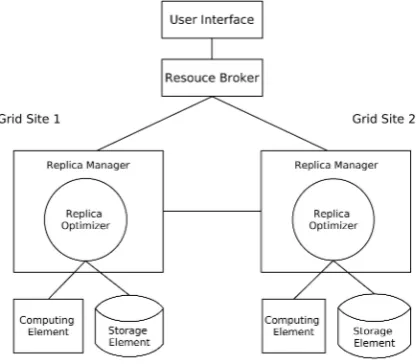
OptorSim models grid environments by using sites interconnected through communication links (Figure 7). Every grid site contains at least one computing el-ement (CE, or computer), and one storage element, or both. Every grid site executes a local replica optimizer (RO) to take replication decisions and there is a single global resource broker (RB) to decide on job schedul-ing. OptorSim models jobs to access a set of files, which may be replicated on grid sites, according to the
RO. A replica catalog (RC) maps logical names to physi-cal files and a replica manager (RM) handles replications and also registers them in the catalog. Figure 7 presents all components of the OptorSim simulator.
Figure 7: Simulated Data Grid architecture
This simulator allows users to specify the grid topol-ogy by providing parameters forCE’s and communica-tion links. In this work, we consider a topology gener-ated by BRITE [25], a complex-network topology gen-erator which provides bandwidth and latency informa-tion based on well-accepted models. Topology gener-ators are widely used to model large-scale network en-vironments [25], such as the Internet. BRITE was con-sidered due to its flexibility, adaptability and interoper-ability [25]. The BRITE output file contains commu-nication links with their associated bandwidths and la-tencies which are used, by OptorSim, to model the grid environment.
OptorSim requires the definition of a job list to be associated to a set of files. Jobs may access a subset of those files, according to an access pattern. The
sim-ulator also has four algorithms to take job scheduling decisions: Random, QueueLength,AccessCost
andQueueAccessCost.Randomrandomly assigns a job to a CE, similarly to Legion scheduling [9].
QueueLengthassigns jobs to the shortest-queueCE, what may represents the idler resource.AccessCost
estimates the access time for all files required by a job, then, the job is assigned to theCEwith the lowest es-timated cost. The last algorithm operates similarly to the latter, but it also considers queue length (hybrid ap-proach).
In addition to the scheduling algorithm, Op-torSim provides five access optimization
ap-proaches: 1) In SimpleOptimiser, no
replication is performed, files are remotely
ac-cessed; 2) DeleteOldestFileOptimiser
replicates files when jobs need them, remov-ing the least-recently-used (LRU) replicas; 3)
DeleteLeastAccessedFileOptimiser
replicates files when jobs need them, remov-ing the least-frequently-used (LFU) replicas; 4)
EcoModelOptimiserBinomial considers an economic model to determine replications. In this approach, file replicas are removed ac-cording to a Binomial estimation function; 5)
EcoModelOptimiserZipf considers an eco-nomic model to replicate files. Replicas are re-moved according to a Zipf estimation function. We employed the approaches LRU, LFU and
EcoModelOptimiserZipf in the experiments (Section 5.4) in order to compare them with the heuristic proposed in Section 4.3.
OptorSim provides performance metrics for its en-tities. For grid sites, OptorSim provides: number of re-mote reads; number of local reads; percentage of time that everyCEhas been active; number of file transfers that were routed through a site; and the total time (in seconds) consumed to run all jobs submitted to a site. For storage elements, OptorSim provides: capacity and usage, in MB, of theSE. OptorSim also provides the following metrics for computing elements: job execu-tion time, in milliseconds; job execuexecu-tion time added to the queuing time; number of remote file reads of aCE; number of jobs currently executed by aCE; number of local file reads of aCE; percentage of time that aCEwas running jobs; list of the files accessed by jobs running on a specificCE; and, finally, the total time (in seconds) to execute all jobs.
5.1 OptorSim Extensions
1) trace files; 2) write operations, and 3) adaptive slid-ing window of historical operations.
OptorSim provides different file access pattern approaches: 1) SequentialAccessGenerator, where files are sequentially accessed; 2) In
RandomAccessGenerator, files are ac-cessed using a uniform distribution; 3) In
RandomWalkUnitaryAccessGenerator, files are accessed using a unitary random walk distribution; 4) RandomWalkGaussianAccessGenerator,
where files are accessed using a
Gaus-sian random walk distribution; and 5) In
RandomZipfAccessGenerator, files are ac-cessed using a Zipf random distribution. Those access patterns dynamically generate the job behavior, what did not meet our needs to have historical operations. That motivated us to develop a new approach: 6) a trace-based file access approach, where events represent process operations (behavior). Those events provide the following information for every operation: process identification (pid), interval in between con-secutive access operations (time), file identification (inode), operation type (op) and volume of data (amt). Table 5 presents an example of a trace file.
Moreover, the original OptorSim provides only read operations, thus, we also needed to extend it to incorpo-rate write operations. This extension was based on the cost (Equation 3) to write data and propagate it to file replicas, as presented in Algorithms 3 and 4.
Finally, we developed an adaptive sliding window strategy to provide future events (operations) based on historical information, as previously presented in Equa-tion 9. Experiments have confirmed that the adaptive sliding window heavily impacts the heuristic perfor-mance (Section 5.4).
5.2 Environment Parametrization
A128-site grid was considered in experiments. Every
grid site was composed of oneSE where the capac-ity was modeled by an exponential probabilcapac-ity function with average100GB (parameter Ω described in
Sec-tion 3). CommunicaSec-tion links were modeled by us-ing the BRITE topology generator which considers the Barabasi model for Autonomous System [25]. In ad-dition, BRITE adopts a Heavy-Tail distribution func-tion to define the addifunc-tion of nodes and bandwidth (the minimum bandwidth was10Mbits/s and the maximum
1,024Mbits/s). An exponential distribution function was considered to model communication delays (with average0.5seconds).
Experiments were configured with128jobs (one per grid site). More jobs may be considered, however when
a set of jobs runs in a specific grid site, the behavior of each job contributes to the data access behavior issued by that grid site. Then, by having one job per site, we can indeed represent the data access patterns of several individual jobs allocated into the same grid site.
A uniform distribution function (average 10) was
used to determine the number of files accessed by every job (i.e. the set of files accessed by a job). Files in the OptorSim have fixed size and can be model by follow-ing the chunk representation in the GFS [17]. The be-havior of every job is assigned to the simulator by using a configuration file, which may be synthetic or obtained by using an interception approach (Section 4.1 and Ta-ble 5). All jobs have the same probability to run in ev-eryCEof the environment. An exponential distribution function was adopted to model the job inter-arrival time (average1,500ms).
Processing capacities were obtained by using the benchmark SPEC CINT 2000, which is a standard way of measuring CPU performance. It generates a perfor-mance measurement based on a reference machine (Sun Ultra 10) [2]. For example, a Pentium IV has a perfor-mance of0.5CINT 2000. In this work, everyCEis ho-mogeneous and has a processing power of1.0k CINT 2000 (or1,000CINT 2000). The CPU homogeneity does not influence in the data access operations which are the main focus of this paper.
We consider the same job scheduling algo-rithm in every experimental scenario, which is the
QueueAccessCost(Section 5) and the same trace file to describe the data access pattern of files (Section 5.1).
5.3 Intrusion Analysis when Capturing Information
We evaluated costs involved in acquiring the necessary application knowledge (operations, also called events) to generate trace files and, therefore, assessed the pro-posed approach. The same cost involved in obtaining such information would be necessary in a real envi-ronment. Two acquiring approaches were considered: Ptrace [32] and the DLSym [21] under two
bench-marks: Nbench [24] and Bonnie [6]. Nbench
probes the CPU capacity in terms of float-point oper-ations as well as the memory subsystem.Bonnie per-forms read-and-write operations on files. Experiments were executed30times on aIntel Core i7 CPU 2.67GHz, 8GB RAM and 250GB HD. We have evaluated the execution time of such benchmarks with and without acquiring mechanisms. Table 6 presents results which confirm that the intrusion is lower than
execution time and its standard deviation, respectively. This confirms that the second approach, this is DLSym, would better suit on a real environment, that is why we selected it.
Table 6: Information capture approach evaluation
Bench Time(s) Ptrace DLSym
Nbench 272.81 309.69 276.78 ±5.99 ±20.26 ±5.46
Bonnie 10.41 11.97 10.47
±0.03 ±0.07 ±0.04
Nbench Impact 11.91% 1.43%
Bonnie Impact 13.03% 0.57%
5.4 Results
This section presents experimental results which are or-ganized according to the previously described environ-ment: 128-site grid. Charts present bars which
corre-spond to the average of30executions (this number of executions is based on the Central Limit Theorem [29], which supports the obtainment of a significative statis-tical measurement).
Experiments are categorized according to the per-centage of read-and-write operations. For example, Figure 9 presents an environment with5%of the writ-ing operations, i.e., the trace file has5%of events clas-sified asw (Table 5).
We evaluated three optimization techniques: LRU, LFU and the Economic Model (ECO). All those tech-niques are available in the OptorSim simulator. We also compared the results of such techniques against the heuristic proposed is this paper. The DAP heuris-tic is evaluated under different values of parameterβ: {0.05,0.10,0.15}.
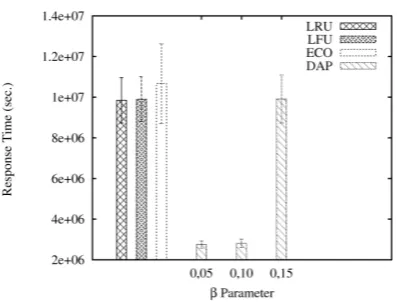
In Figure 8, the simulated environment has 100%
of reading operations and10files are accessed by jobs.
Thex-axis corresponds to parameterβ considered by the heuristic and they-axis represents the average ex-ecution time of jobs (in seconds). As shown in Figure 8, the heuristic was capable of reducing the job execu-tion time in one order of magnitude, when compared to other data replication techniques.
Figure 8: Environment with100%of reading operations
Figure 9: Environment with5%of writing operations
In Figure 9, the environments deal with5%of
writ-ing and95%of reading operations and10files are ac-cessed by jobs. The heuristic reduced the execution time in one order of magnitude, but, whenβ = 0.15, the results are similar to the other techniques.
In Figure 10, the simulated environments present
95%of writing and 5% of reading operations and10
files are accessed by jobs. The heuristic has reduced job execution times in around40%. Whenβ = 0.15,
the heuristic results were worse than other replication techniques.
We also compared the results of the adaptive heuris-tic to the ones obtained in the initial paper [19]. From that, we concluded that this heuristic presents similar execution times to the environments under 100% of
reading operations, and this new approach was10%
bet-ter for the environment under5%of writing operations
and15%better for the environment under95%of
writ-ing operations, what confirms the need for an adaptive window.
These results confirm improvements in application performance and suggest the adoption of the adaptive sliding window length. We observed that the adap-tation of the sliding window is better when consider-ingβ ∈ [0.05,0.10]. In the considered scenario, we experimentally confirmed thatβ ∈ [0.05,0.10] gives more relevance to the current window,Wt, according to Equation 9, and when increasingβ, more relevance is given to Op. This fact, allow us to conclude that as β gets lower, the adjustment of the window length is improved.
The reduction of access costs was obtained due to the adaptation of the sliding window length (i.e., the window now follows the dynamic behavior of pro-cesses), which updates the number of future events considered when taking decisions on data replication, migration and consistency. We also observed that the greater the differences in access patterns (different types of operations – read, write and idle – interposed), the unstabler the application performance is.
6 Conclusions
This paper has presented a history-based data access op-timization approach for grid computing environments. Our main objective is to minimize the application exe-cution time by optimizing data accesses and, therefore, improve decisions on replication, migration and consis-tency. From that, we proposed an adaptive sliding win-dow length which aims at providing the dynamic be-havior of application operations to our data access opti-mization heuristic.
The proposed approach also considers concepts of monitoring and intercepting system calls to capture ap-plications operations and compose processes histories (i.e. the trace files obtained by intercepting calls). We kept such histories due to we believe that it is very im-portant to understand, estimate and/or predict processes
behavior as a way to optimize read-and-write opera-tions, which was cleared confirmed. In addition, we defined an analytical optimization model for the Data Access Problem (DAP), which was considered to study approaches for minimizing the overall application exe-cution times.
Simulations were conducted to study the efficiency of our heuristic using the adaptive sliding window length, under a wide range of environments and sys-tem configurations (frequency of read-and-write op-erations). Experimental results confirm that our ap-proach outperforms other commonly considered ones (e.g., LRU, LFU and Economic Model) in approxi-mately50%when dealing with grid environments.
Be-sides using historical information, the results motivate further work in designing and implementing on-line prediction mechanisms to take autonomic decisions on data replication, migration and consistency.
Acknowledgments
This paper is supported by CNPq-Universal (National Counsel of Technological and Scientific Development), under grant no. 470739/2008-8, CAPES (Coordina-tion of Improvement of Higher Educa(Coordina-tion) and FUN-DECT (Foundation to Support the Education, Science and Technology Development of Mato Grosso do Sul) no. 23/200.402/2008 from Brazil. Any opinions, find-ings, and conclusions or recommendations expressed in this material are those of the authors and do not neces-sarily reflect the views of CNPq, CAPES or FUNDECT.
References
[1] The Earth System Grid–ESG Project.
www.earthsystemgrid.org, 2005.
[2] SPEC’s CPU Benchmark. See the definition of CINT2000 at http://www.spec.org/, Mar 2010.
[3] Abramovici, A., Althouse, W. E., Drever, R. W. P., Gürsel, Y., Kawamura, S., Raab, F. J., Shoe-maker, D., Sievers, L., Spero, R. E., Thorne, K. S., Vogt, R. E., Weiss, R., Whitcomb, S. E., and Zucker, M. E. LIGO: The Laser Interfer-ometer Gravitational-Wave Observatory. Science, 256(5055):325–333, 1992.
[5] Bell, W. H., Cameron, D. G., Millar, A. P., Capozza, L., Stockinger, K., and Zini, F. Op-torsim: A Grid Simulator for Studying Dynamic Data Replication Strategies. International Jour-nal of High Performance Computing Applications, 17(4):403–416, 2003.
[6] Bray, T. Bonnie benchmark.
http://www.textuality.com/bonnie/, Jun 2009.
[7] Buyya, R. High Performance Cluster Computing – Architecture and Systems, volume 1. Prentice Hall, 1999.
[8] Chang, R.-S. and Chang, J.-S. Adaptable replica consistency service for data grids. In Proc. 3th Int. Conf. on Information Technology: New Gen-erations, pages 646–651, April 2006.
[9] Chapin, S. J., Katramatos, D., Karpovich, J., and Grimshaw, A. S. The Legion resource manage-ment system. In Feitelson, D. G. and Rudolph, L., editors, Job Scheduling Strategies for Paral-lel Processing, pages 162–178. Springer Verlag, 1999.
[10] Chervenak, A. L., Schuler, R., Ripeanu, M., Amer, M. A., Bharathi, S., Foster, I., Iamnitchi, A., and Kesselman, C. The globus replica loca-tion service: Design and experience. IEEE Trans. Parallel Distrib. Syst., 20(9):1260–1272, 2009.
[11] Dang, N. N. and Lim, S. B. Combination of repli-cation and scheduling in data grids. International Journal of Computer Science and Network Secu-rity, 7(3):304–308, Mar 2007.
[12] Deelman, E., Blythe, J., Gil, Y., Kesselman, C., Mehta, G., Vahi, K., Blackburn, K., Lazzarini, A., Arbree, A., Cavanaugh, R., and Koranda, S. Map-ping Abstract Complex Workflows onto Grid En-vironments. Journal of Grid Computing, 1(1):25– 39, March 2003.
[13] Dorigo, M. and Di Caro, G. The ant colony opti-mization meta-heuristic. In Corne, D., Dorigo, M., and Glover, F., editors, New Ideas in Optimization, pages 11–32. McGraw-Hill, London, 1999.
[14] Elghirani, A., Subrata, R., and Zomaya, A. Y. Intelligent scheduling and replication in data-grids: a synergistic approach. In Proc. 7th IEEE Int.Symposium on Cluster Computing and the Grid, pages 179–182, Washington, DC, USA, 2007.
[15] Feng, J. and Humphrey, M. Eliminating Replica Selection - Using Multiple Replicas to Acceler-ate Data Transfer on Grids. In Proc. 10th Int. Conf. of Parallel and Distributed Systems, page 359, Washington, DC, USA, 2004. IEEE Com-puter Society.
[16] Garey, M. R. and Johnson, D. S. Computers and Intractability : A Guide to the Theory of NP-Completeness. W. H. Freeman & Co., New York, NY, USA, 1990.
[17] Ghemawat, S., Gobioff, H., and Leung, S.-T. The google file system. SIGOPS Oper. Syst. Rev., 37(5):29–43, 2003.
[18] Goldberg, D. E. Genetic Algorithms in Search, Optimization and Machine Learning. Addison-Wesley Longman Publishing Co., Inc., Boston, MA, USA, 1989.
[19] Ishii, R. P. and de Mello, R. F. A history-based heuristic to optimize data access in distributed en-vironments. In 21st IASTED International Con-ference Parallell and Distributed Computing and Systems (PDCS2009), Cambridge, MA, Nov. 2-4 2009.
[20] Jacobson, V., Leres, C., and McCanne, S. TCP-Dump Man Pages. Available at: Linux Systems, calling the man command for tcpdump, Mar 2010.
[21] Jung, C., Woo, D.-K., Kim, K., and Lim, S.-S. Performance characterization of prelinking and preloadingfor embedded systems. In Proc.
7th ACM & IEEE Int. Conf. on Embedded Soft-ware, pages 213–220, New York, NY, USA, 2007. ACM.
[22] Kim, J., Chandra, A., and Weissman, J. B. Using data accessibility for resource selection in large-scale distributed systems. IEEE Trans. Parallel Distrib. Syst., 20(6):788–801, 2009.
[23] Kirkpatrick, S., Gelatt, C. D., and Vecchi, M. P. Optimization by simulated annealing. Science, Number 4598, 13 May 1983, 220, 4598:671–680, 1983.
[24] Mayer, U. F. Linux/unix nbench.
http://www.tux.org/˜mayer/linux/bmark.html, Mar 2010.
Modeling, Analysis and Simulation of Computer and Telecommunication Systems, pages 346–353, 2001.
[26] Oldfield, R. and Kotz, D. Improving data access for computational grid applications. Cluster Com-puting, 9(1):79–99, January 2006.
[27] Oliker, L., Biswas, R., Shan, H., and Smith, W. Scheduling in heterogeneous grid environments: The effects of data migration. In Proc.12th Int. Conf. on Advances in Computing & Communica-tions, Ahmedabad, INDIA, Jan 2004.
[28] Rahman, R. M., Barker, K., and Alhajj, R. Replica selection in grid environment: a data-mining ap-proach. In Proc. Symposium on Applied Comput-ing, pages 695–700, New York, NY, USA, 2005. ACM.
[29] Schefler, W. C., editor. Statistics: concepts and applications. Benjamin-Cummings Publishing Co., Inc., Redwood City, CA, USA, 1988.
[30] Semenov, M. A. and Terkel, D. A. Analysis of convergence of an evolutionary algorithm with self-adaptation using a stochastic lyapunov func-tion. Evol. Comput., 11(4):363–379, 2003.
[31] SMART. Self-Monitoring, Analysis and
Reporting Technology. Available at:
http://en.wikipedia.org.wiki/s.m.a.r.t., 2010.
[32] Spillane, R. P., Wright, C. P., Sivathanu, G., and Zadok, E. Rapid file system development us-ing ptrace. In Proc. Workshop on Experimental Computer Science, page 22, New York, NY, USA, 2007. ACM.
[33] Stockinger, H. Defining the Grid: a snapshot on the current view. The Journal of Supercomputing, 42:3–17, 2007.
[34] Sun, Y. and Xu, Z. Grid replication coherence protocol. In Proc. 18th Int. Symposium on Par-allel and Distributed Processing, pages 232–239, April 2004.
[35] Voß, S. Meta-heuristics: The state of the art. In ECAI ’00: Proceedings of the Workshop on Lo-cal Search for Planning and Scheduling-Revised Papers, pages 1–23, London, UK, 2001. Springer-Verlag.
[36] Wang, C.-M., Hsu, C.-C., Chen, H.-M., and Wu, J.-J. Efficient multi-source data transfer in data
grids. In Proc. 6th IEEE Int. Symposium on Cluster Computing and the Grid, pages 421–424, Washington, DC, USA, 2006. IEEE Computer So-ciety.