Multi‑sensor fusion based on multiple
classifier systems for human activity
identification
Henry Friday Nweke
1,2*, Ying Wah Teh
1*, Ghulam Mujtaba
1,3, Uzoma Rita Alo
4and Mohammed Ali Al‑garadi
5Abstract
Multimodal sensors in healthcare applications have been increasingly researched because it facilitates automatic and comprehensive monitoring of human behaviors, high‑intensity sports management, energy expenditure estimation, and postural detection. Recent studies have shown the importance of multi‑sensor fusion to achieve robustness, high‑performance generalization, provide diversity and tackle challenging issue that maybe difficult with single sensor values. The aim of this study is to propose an innovative multi‑sensor fusion framework to improve human activity detection performances and reduce misrecognition rate. The study proposes a multi‑ view ensemble algorithm to integrate predicted values of different motion sensors. To this end, computationally efficient classification algorithms such as decision tree, logistic regression and k‑Nearest Neighbors were used to implement diverse, flexible and dynamic human activity detection systems. To provide compact feature vector representation, we studied hybrid bio‑inspired evolutionary search algorithm and correlation‑based feature selection method and evaluate their impact on extracted feature vectors from individual sensor modality. Furthermore, we utilized Synthetic Over‑sampling minority Techniques (SMOTE) algorithm to reduce the impact of class imbalance and improve performance results. With the above methods, this paper provides unified framework to resolve major challenges in human activity identifica‑ tion. The performance results obtained using two publicly available datasets showed significant improvement over baseline methods in the detection of specific activity details and reduced error rate. The performance results of our evaluation showed 3% to 24% improvement in accuracy, recall, precision, F‑measure and detection ability (AUC) compared to single sensors and feature‑level fusion. The benefit of the proposed multi‑ sensor fusion is the ability to utilize distinct feature characteristics of individual sensor and multiple classifier systems to improve recognition accuracy. In addition, the study suggests a promising potential of hybrid feature selection approach, diversity‑based multiple classifier systems to improve mobile and wearable sensor‑based human activ‑ ity detection and health monitoring system.
Keywords: Wearable sensors, Multiple classifier systems, Activity identification, Multiple sensor fusion, Activity detection, Multi‑view stacking ensemble, Feature‑level fusion
Open Access
© The Author(s) 2019. This article is distributed under the terms of the Creative Commons Attribution 4.0 International License (http://creat iveco mmons .org/licen ses/by/4.0/), which permits unrestricted use, distribution, and reproduction in any medium, provided you give appropriate credit to the original author(s) and the source, provide a link to the Creative Commons license, and indicate if changes were made.
RESEARCH
*Correspondence: [email protected]. my; [email protected] 1 Department of Information Systems, Faculty of Computer Science and Information Technology, University of Malaya, 50603 Kuala Lumpur, Malaysia
Introduction
In recent times, sensor technologies for health monitoring have advanced greatly due to the decrease in the cost and availabilities of sensor-embedded devices. The implementa-tions and analysis of sensor data generated by these devices are vital in wide areas of applications such as smart homes, cyber-physical applications, assisted living, security, elderly care, lifelogging, and sports activities. In health-based applications, sensor data are analyzed to identify various simple and complex activities such as walking, running and doing basic household activities or operating industrial machinery [1]. In addition, sensor data analytics provide a mechanism to detect fall and inaccurate posture in the elderly population that may present a high risk of fall and Identification of what consti-tutes actual fall would aid prevention with their negative health cost tendencies [2].
Generally, human activity identification has been explored in various sensors types. These include wearable, video, ambient and smartphone-based methods [1, 3]. How-ever, video-based methods are affected by lightening variability, inability to differentiate between target and non-target information during data collection, and issue bother-ing on user privacy. Besides, ambient sensors devices deployed for collections of data such as sound, pressure, temperature and vital signs are mostly installed in particular locations and may not be effective for ubiquitous health monitoring [1]. Lately, the use of wearable and smartphone embedded sensors for human activity identification have also attracted high interest among researchers. Wearable and smartphones are ubiqui-tous devices with varieties of built-in sensors such as accelerometers, GPS, gyroscopes, magnetometer, microphones, etc. for consistent monitoring of physiological signals, comprehensive health check, indoor localizations and pedestrian navigations [3, 4]. Applications of these devices for identification of various activity details are as results of their pervasiveness, continuous tracking of human activity details and provision of continuous monitoring through cyber-physical systems. Therefore, wearable and smart-phone devices provide a better alternative for ubiquitous and continuous monitoring of activity details.
machine-learning algorithm over concatenated feature vectors for human activity detec-tion might limit their performances. Also, it difficult to understand the contribudetec-tion of each sensor modalities and find optimal features for activity classification. Finally, the approach may result in increased misclassification rate and inability to handle high dimensional data for comprehensive physical activity detection [3]. According to recent comprehensive evaluations of several classification algorithms [13, 14], no single classifi-cation model is sufficient for a particular human activity detection task.
To provide enhanced performance and diversity in recognition of human activity details, multi-sensor fusion strategies have been proposed in recent studies [15, 16], in which various sensor modalities outlined earlier are integrated using raw sensor signal, extracted features or decisions predicted by individual classification algorithms. The central ideas of fusion protocols are to incorporate diverse sensor modalities to increase reliabilities, robustness and enhanced generalization of human activity detection frame-works. In addition, multi-sensor fusion methods help to minimize uncertainty and effects of indirect captures which is quite challenging to eliminate with only single sen-sor modality [17].
Among the various methods for multi-sensor fusion, multiple classifier systems [3] that fuse several diverse machine learning algorithms to arrive at superior decisions than single classifier provide the best alternative. Multiple classifier systems methods are highly recommended to resolve issues on complexity, high dimensionality, and disparity in sensor data. This would result in improved accuracy, robustness and generalization of activity classification framework. Typical multiple classifier system methods that have played a vital role in human activity detection and health monitoring include bagging, boosting, sensor feature manipulation, model initialization and stacking ensemble [3, 18]. These methods take a random sampling of the training data or different weak clas-sification algorithms to create diversities of opinions integrated through voting, fuzzy decision rule, Dempster–Shafer theory or Random committee.
ensemble algorithm is, to utilize complementary but distinct feature vectors from each sensor modalities and diversity base classifiers to build robust, flexible and efficient activity identification system.
Although recent study [18] have shown that the use of multi-view stacking ensemble methods can greatly improve human activity identification for mobile and wearable sen-sor data. However, there are still issues to tackle in order to implement a comprehensive and robust activity detection framework. First, current multi-view stacking ensem-ble algorithm utilizes the same classification algorithm as base classifiers to train each view and combined the predictive values with the same classification algorithm. In a recent study in other domain [24], multi-view stacking ensemble produces robust and efficient results with the implementation of diverse classification algorithms. Moreover, this paper utilized computationally efficient classification models such as decision tree, k-Nearest Neighbor, and logistic regression to implement the proposed activity detec-tion framework. Second, many datasets for human activity recognidetec-tion show high level of class imbalance [6]. Class imbalance problem is a difficult issue in human activity identification as it may lead to performance results that produce bias predictive values towards the majority activity classes and low performance towards the minority activ-ity classes. And this issue frequently occurs in human activactiv-ity identification and health monitoring after feature selection to reduce the size feature vectors [6]. The dataset used in this paper show some level of class imbalance, in which activity classes such as jump-ing, ascending and descending stairs have less number of instances compared to walk-ing activity frequently performed in real life. To solve the problem, we apply Synthetic Minority Over-Sampling Technique (SMOTE) to the sensor data to increase the minor-ity class and this approach improves the performance of our activminor-ity identification sys-tem [25]. Finally, the use of irrelevant feature vectors in human activity classification task would lead to overfitting, low performances and increased computation time. The paper proposes to implement a bio-inspired meta-heuristic evolutionary search algorithm integrated with correlation-based feature selection to produce compact feature vectors.
Contributions
The major contributions of this paper are presented below:
1. To propose a robust and efficient multi-view stacking ensemble algorithm for human activity identification and health monitoring. The developed algorithms are in three phases of implementations. First, k-Nearest Neighbors and decision tree were used as base classifiers to train each view in the dataset and k-Nearest Neighbors as meta-classifier (k-NN–DT–k-NN). Second, logistic regression, k-Nearest Neighbors and decision tree were used as base classifiers and logistic regression was used as meta-classifier (LR–k-NN–DT–LR). Finally, logistic regression, k-Nearest Neighbors and decision tree were deployed as base classifiers and average performance results of k-Nearest Neighbors and logistic regression as meta-classifiers (k-NN–DT–LR– (k-NN–LR)); we built the models after an extensive evaluation of the four single clas-sification algorithms used in this paper. We compare both the proposed multi-view stacking methods, feature-level fusion, and single classifier performances;
2. To evaluate the impact of bio-inspired metaheuristic evolutionary search algorithm integrated with correlation based features selection algorithm to produce compact feature vectors for implementation of computationally efficient human activity iden-tification framework.
3. To demonstrate the impact of Synthetic Minority Over-Sampling Technique (SMOTE) to balance the minority activity classes and reduce bias towards majority activity classes.
4. To provide analysis of the recent approaches for multi-sensor based human activity recognition.
5. Extensive experiments to explore the effectiveness of the proposed methods using two publicly available datasets and compare the significance of the multi-view stack-ing ensemble with weighted majority voting, Bagging and Random Subspace ensem-ble [16, 26, 27] based multiple classifier system methods.
Outline
The rest of this paper is structured as follows. “Review of related works” section pre-sents the background and related works. “Problem formulation” section describes prob-lem formulation for human activity identification using multi-view stacking ensemble methods. “Proposed methodology” section presents the multi-view stacking ensemble algorithm architecture that includes signal processing, feature extraction and normali-zation, feature selection and proposed algorithms. “Experiments” section discusses the experimental setups; the results obtained at each evaluation and compare the multiple classifier system methods with existing methods. “Conclusion and future works” section concludes the study.
Review of related works
the process encompasses procedures for implementation of mobile and wearable sensors based activity assessment using various sensor modalities. These procedures include data collection; signal processing, feature extraction, feature selection and activity clas-sification. For instance, Biagetti et al. [30] proposed wireless architecture for data acqui-sition and monitoring of sport activities using surface electromyography (sEMG) and accelerometer sensors. The authors achieved 83.7% accuracy using k-Nearest Neighbor classifier. In a recent study, Bhattacharjee et al. [31] evaluated various machine learning algorithms for daily activity monitoring. Machine learning algorithms evaluated using motion sensors collected with smartphone device include support vector machine, per-ceptron neural networks, backpropagation neural networks and recurrent neural net-works. Further information on human activity monitoring using various sensor modality are reported in recent studies [3, 32]. In this paper, our review is focused on studies that developed protocols to integrated data, features and multiple classification algorithms for the purpose of activity monitoring and assessment.
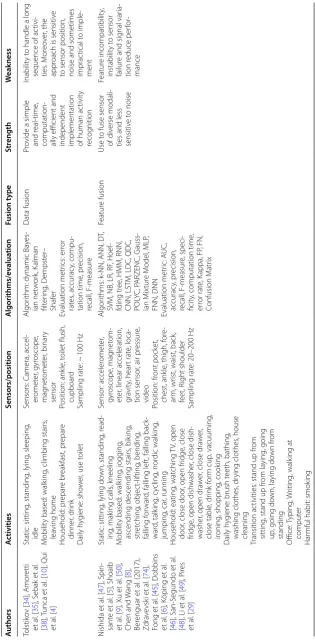
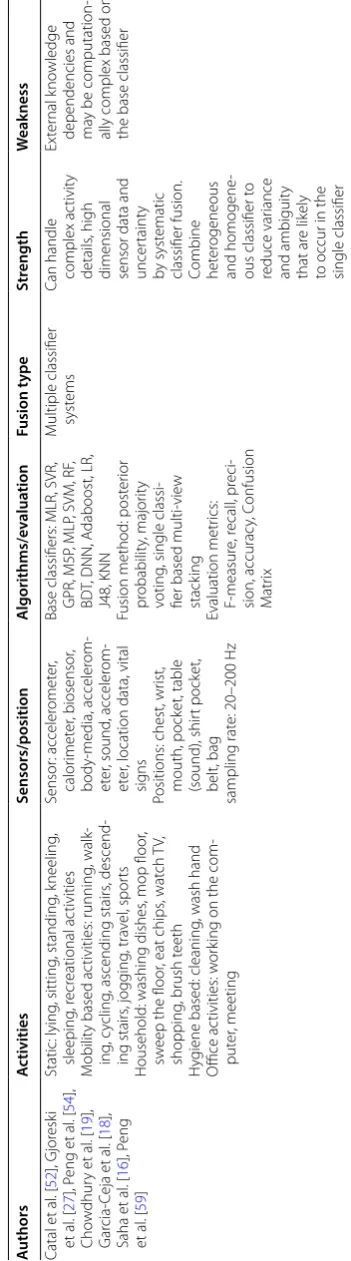
A number of fusion methods have been proposed for the implementation of compre-hensive human activity identification and monitoring using multiple sensors in recent years. These approaches are grouped into data-level, feature-level, and multiple classifier (decision fusion) frameworks. These methods integrate different sensors, feature vectors and classification algorithms for the purpose of human activity detection, assessment, prediction and monitoring. The data and feature-level fusion discussed in this section are those related to human activity recognition and monitoring using motion sensors of various modalities. In addition, the multiple classifier system methods are those related to activity prediction and classification. Moreover, we discuss the sensor used, the num-ber of subjects for data collections, numnum-ber of activities, sensor types used, strength, weakness of each method. Table 1 summarizes the various metrics of each paper imple-mented recently for human activity detection in the area of data fusion, feature-level fusion, and multiple classifier systems.
Data‑level fusion
Table 1 Summar y of r ec en
t studies on human ac
tivit y r ec ognition thr ough da ta fusion A uthors A ctivities Sensors/position A lgorithms/e valua tion Fusion t ype Str ength W eak ness Tolstik ov [ 34 ], Amor etti et al . [ 35 ], S ebak et al . [ 38 ], Tunca et al . [ 10 ], Qui et al . [ 4 ] Static: sitting , standing , lying , sleeping , idle M obilit
y based: walk
ing
, climbing stairs
, lea ving home Household: pr epar e br eakfast, pr epar e dinner , dr ink Daily h yg iene: sho w er
, use t
oilet Sensors: C amera, accel ‑ er omet er , gyr oscope , mag net omet er , binar y sensor Position: ank le , t oilet flush, cupboar d Sampling rat e: ~ 100 H z Algor
ithm: dynamic Ba
yes ‑ ian net w or k, K alman filt er ing , D empst er – Shaf er Evaluation metr ics: er ror rat es , accurac y, compu ‑ tation time , pr ecision, recall , F ‑measur e Data fusion Pr
ovide a simple and r
eal
‑time
,
computation
‑
ally efficient and independent implementation of human ac
tivit y recog nition Inabilit y t
o handle a long
sequence of ac
tivi ‑ ties . M or eo ver , the appr
oach is sensitiv
e
to sensor position, noise and sometimes imprac
tical t o imple ‑ ment N ishida et al . [ 47 ], Spin ‑ sant e et al . [ 5 ], Shoaib et al . [ 9 ], X u et al . [ 50 ], Chen and W ang [ 8 ], Ber enguar et al . (2017), Zdra ve vsk i et al . [ 74 ], Fong et al . [ 45 ], D obbins et al . [ 6 ], K öping et al . [ 46 ], San ‑S egundo et al . [ 48
], Li et
al . [ 49 ], P ires et al . [ 29 ] Static: sitting
, lying do
wn, standing , r ead ‑ ing , mak ing calls , k neeling M obilit
y based: walk
ing
, jogg
ing
,
ascending descending stairs
, bik ing , str et ching , objec t‑ lif ting , bending , falling f or war
d, falling lef
t, falling back
‑ war d, talk ing , c ycling , nor dic walk ing , jumping , car , running Household: eating , wat ching TV , open door
, close door
, open fr
idge
, close
fridge
, open dish
washer
, close dish
‑
washer
, open dra
w
er
, close dra
w er , close table , dr ink f or m cup , vacuuming , ironing , shopping , cook ing Daily h yg
iene: brush t
eeth, bathing , washing clothes , dr ying clothes , house cleaning Transition ac
tivities: stand up fr
om
sitting
, stand up fr
om la
ying
, going
up
, going do
wn, la ying do wn fr om standing O ffice: Typing , W riting , walk ing at comput er Har
mful habit: smok
ing Sensor : acceler omet er , gyr oscope , mag net om ‑ et er
, linear acceleration,
gra vit y, hear t rat e, loca ‑ tion sensor
, air pr
essur e, video Position: fr ont pock et, chest, ank le
, thigh, f
or
e‑
ar
m, wr
ist, waist, back
, feet, R ight shoulder Sampling rat e: 20–200 H z Algor ithms: k
‑NN, ANN, D
T,
SVM, NB
, LR, RF
, Hoef
‑
fding tr
ee
, HMM, RNN,
CNN, LSTM, LDC, QDC, POL
YC, P ARZENC, G auss ‑ ian M ix tur e M odel , MLP , FNN, DNN Evaluation metr ic: A UC, accurac y, pr ecision, recall , F ‑measur e, speci ‑ ficit
y, computation time
, er ror rat e, K appa, FP , FN, Confusion M atr ix Featur e fusion Use t
o fuse sensor
of div
erse modali
‑
ties and less sensitiv
e t o noise Featur e incompatibilit y, instabilit y t o sensor failur
e and sig
Table 1 (c on tinued) A uthors A ctivities Sensors/position A lgorithms/e valua tion Fusion t ype Str ength W eak ness Catal et al . [ 52 ], Gjor esk i et al . [ 27 ], P eng et al . [ 54 ], Cho w dhur y et al . [ 19 ], G ar cia ‑C eja et al . [ 18 ], Saha et al . [ 16 ], P eng et al . [ 59 ] Static: lying , sitting , standing , k neeling , sleeping , r ecr eational ac tivities M obilit
y based ac
tivities: running , walk ‑ ing , c ycling
, ascending stairs
, descend ‑ ing stairs , jogg ing , tra vel , spor ts
Household: washing dishes
, mop floor
,
sw
eep the floor
, eat chips
, wat
ch
TV
,
shopping
, brush t
eeth
H
yg
iene based: cleaning
, wash hand
O
ffice ac
tivities: w
or
king on the com
‑ put er , meeting Sensor : acceler omet er , calor imet er , biosensor , body ‑media, acceler om ‑ et er , sound , acceler om ‑ et er
, location data, vital
sig
ns
Positions: chest, wr
ist, mouth, pock et, table (sound), shir t pock et, belt, bag sampling rat e: 20–200 H z
Base classifiers: MLR, SVR, GPR, M5P
, MLP
, SVM, RF
,
BD
T, DNN, A
daboost, LR,
J48, KNN
Fusion method: post
er ior pr obabilit y, major ity voting
, single classi
‑
fier based multi
‑vie w stack ing Evaluation metr ics: F‑ measur e, r ecall , pr eci ‑ sion, accurac y, C onfusion M atr ix M
ultiple classifier syst
ems
Can handle complex ac
tivit
y
details
, high
dimensional sensor data and uncer
taint
y
by syst
ematic
classifier fusion. Combine het
er
ogeneous
and homogene
‑
ous classifier t
o reduce var iance and ambiguit y that ar e lik ely
to occur in the single classifier
Ex
ter
nal k
no
wledge
dependencies and ma
y be computation
‑
also been implemented such as extended Kalman filtering, Quaternion based extended Kalman filtering and Rao-Blackwellization unscented Kalman filtering to deal with vari-ous challenges such as sensor orientation, postural instabilities and sensor placements in human activity detection [36, 37].
Furthermore, Qiu et al. [4] proposed an extended Kalman filtering approach to inte-grate motion sensors for pedestrian navigation application and noted that such method provides a robust algorithm for human activity detection. Sebbak et al. [38] proposed a Dempster–Shafer theory method to fuse varieties of sensor modalities for human activity identification and comprehensive health monitoring. The use of Dempster– Shafer theory helps to reduce uncertainty and imprecision in sensor representation and increases reliability. While Phan et al. [39] developed a graph-based theory to integrate social sensor and physical sensor data for context-aware activity recognition in order to reduce computation complexity in mobile-based implementation.
The main advantages of data-level fusion are the ability to provide simple, real-time, computationally efficient and problem independent implementation of human activ-ity recognition [33]. However, some of the data level fusion methods are challenging to handle long sequence activity at real-time (such as Dempster–Shafer and Bayesian the-ory). In addition, data-level fusion is sensitive to sensor positions, noise and sometimes impractical to implement in real-time [40].
Feature‑level fusion
Integration of feature vectors extracted from various sensor modalities is the most implemented fusion methods for human activity recognition. Feature-level fusion meth-ods combine features extracted from mobile and wearable sensors such as ECG, GPS, accelerometer, gyroscope, magnetometer, visual sensors, etc. using various machine learning algorithms. The main attractions of feature-level fusion are the ability to fuse sensor from diverse devices and less sensitive to noise. In the last few decades, various studies have been published for human activity classification using feature level fusion. Here, this paper only discusses recent implementation while further discussion can be found in a recent review in the area [3, 7].
detection, recognition of transition activities, human motion tracking, real-time context-aware navigation, and pedestrian location navigations. Zdravevski et al. [42] developed enhanced and real-time multimodal sensor-based activity detection and monitoring using logistic regression with a fusion of inertial sensors and physiological signals. Fea-ture concatenation methods that involve the fusion of vision based sensors and inertial sensors have also been proposed using machine learning for human activity detection and health monitoring. The fusion methods enable identification of mobility changes, complex and concurrent activity details and behaviour tracking [43]. However, each sen-sor modalities provide different statistical properties for recognition of particular activ-ity details and maybe not be optimal to aggregate these features before applying learning algorithms [44]. Moreover, the fusion of vision-based sensors with other sensor modali-ties is still challenging due to issues bothering on privacy and lack of scene semantics.
Recently, Fong et al. [45] proposed shadow features for efficient activity classification and health monitoring. The proposed feature vectors were computed from the dynamic nature of the human body motion and machine-learning algorithms were applied to infer dynamic body movement and underlying momentum of activity details. The main improvements of the proposed shadow features over previous studies are the incre-mental nature, simplicity and low computation time of shadow features for mobile and wearable device implementation. Shoaib et al. [9] evaluated the fusion of motion sensor for complex human activity detection using machine-learning algorithms. The authors extracted computationally efficient feature vectors from accelerometer, gyroscope, and magnetometer and combine these features using Naïve Bayes classifiers. On the other hand, Köping et al. [46] proposed comprehensive frameworks to integrate varieties of sensor modality by utilizing a codebook feature learning approach. The proposed frame-work integrates features extracted from smartphones, smartwatches, and smart glasses. The use of a codebook approach to extract underlying sensor data helps to summarize the local characteristics of the data and thereby improve activity detection accuracy. In a related method, Nishida et al. [47] evaluated a Gaussian mixture model-based fusion of accelerometer and acoustic sound for human activity recognition. Feature vectors were extracted from the sensors separately and then trained with a Gaussian mixture model, while combination was done using a weighted likelihood estimate to recognize indoor and outdoor activities. Also, San-Segundo et al. [48] evaluated motion sensor data fusion using features computed from time and frequency domain transformation of each sen-sor data. The authors modelled time variation in activity details that makes the algo-rithm robust against degradation. In addition, they propose long short-term memory to model long-term dependencies in activity variation.
using smartwatches. Finally, Xu et al. [50] proposed three-phase multi-level complemen-tary feature learning approach to integrate low-level, mid-level and high-level features extracted from the motion sensor using kernel-based support vector machine. More-over, evaluation of the proposed approach on three publicly available datasets shows enhanced performance improvements against existing low-level methods.
However, issues such as feature incompatibility, robustness to sensor failure and vul-nerability to uncertain noise or interference due to variation sensitivity greatly reduce the performance of feature-level fusion methods. Furthermore, finding optimal features and feature extraction methods require extensive domain knowledge which is time-con-suming [19]. Besides, there may be an issue related to high computation time from the extraction of semantic-based features and dictionary that results to inclusion of irrel-evant features. The above challenges and limitations have made the use of feature-level fusion and single machine learning impractical for robust and efficient implementation of human activity detection system.
Multiple classifier systems
Recently, multiple classifier system methods that integrate decisions obtain from differ-ent machine learning algorithms to improve activity iddiffer-entification and comprehensive health monitoring have received great deal to research efforts [3]. The use of deci-sion fudeci-sion approaches for human activity identification is necessitated by the need to improve the performance accuracy, robustness, efficiency, and generalizability of the single classification algorithm. Hence, multiple classifier systems fusion is appropriate to handle complex activity details, high dimension sensor data, and uncertainty by deploy-ing systematic integration of individual classifier to produce consensus opinions. In addition, multiple classifier system methods combine heterogeneous and homogeneous classifiers to reduce the ambiguity that is unlikely when such classifier is used alone [15]. Moreover, multiple classifier system methods for human activity classification provide a mechanism to resolve issues related to diagnostic errors using classifier diversity, bias and variances, reduce computation complexity and better algorithm representation [3]. Therefore, integration of multiple decisions from individual classifier minimize issues related to overfitting, increase the probability of finding optimal solutions and enable efficient implementation of learning algorithms. Implementation of multiple classifier system would help to resolve issues such as pattern variations, signal degradation, sensor failures, and spatial variability of data, environmental fluctuation and insufficient com-putation resources can be minimized by the use decision fusion approaches for human activity classification [33, 51].
integrate multiple accelerometer sensor data attached at different placement positions of the body. The proposed method calculates class weights for each model and then fine-tuned these weights based on score functions using the posterior probability of the pre-dicted class labels. Then, the class label with the highest score was selected as the final prediction. In their recent implementation, the authors further [26] evaluated different methods to combine decisions predicted by classification algorithms for human activity recognition. These include weighted majority voting, Naïve Bayes combiner and Behav-ior Knowledge Space (BKS) using multiple accelerometer sensor data. They noted that the majority voting outperformed ensemble learning approach such as random forest and bagged decision tree.
In a related study, Catal et al. [52] evaluated ensemble methods to integrate decisions generated with classification algorithms such as decision tree, multi-layer perceptron and logistic regression for human activity identification using accelerometer sensor data collected from 36 subjects. The evaluation showed the impact of decision-level fusion for human activity classification as the authors achieved 98% accuracy with an average of probability fusion method. Tripathi et al. [53] investigated the fuzzy decision rule algo-rithm that uses simple combination rule for adaptive based human activity identifica-tion. The authors formulated new classifier as a batch of new activity details. In addition, Peng et al. [54] proposed hierarchical complex human activity recognition frameworks by fusion of acceleration and physiological signals. The paper utilized diverse feature vectors computed from various sensor modalities such as acceleration and physiological signals by exploiting their differing modalities. Moreover, clustering algorithms were uti-lized to generate a component of complex activities and topic model to generate latent semantic of complex activity details. The output of the final classification is combined at the classifier level. They noted that the approach helps to reduce information loss and burden of data annotation. Guan and Plötz [55] implemented epoch bagging method for human activity identification by utilizing probabilities selection of the subset of the original data for mini-batch based training of Long Short Term Memory and stochastic based gradient descent learning. The main advantage of the approach is the ability to generate robust decision from each epoch values to improve the performances of the human activity detection framework.
by exploiting position specific condition to improve performance results. Therefore, the training and testing data were drawn from different placement positions.
One of the early studies for multi-view stacking ensemble for human activity recog-nition was proposed by [18] to independently combine feature vectors extracted from the accelerometer and acoustic sound sensor. In this case, each of the accelerometer and sound sensor was trained with Random forest as the base classifier and the predicted labels of each sensor were combined using Random Forest Meta-classifier. They noted that the stacked generalization fusion approach helps to preserve the statistical charac-teristics of each sensor thereby enhancing the performance accuracy and reliabilities of the activity recognition system. However, acoustic sensor data are ineffective in recog-nition of different activity details such as ambulatory activities, health monitoring and assisted living for the elderly and fall detection. Others include fitness tracking for effec-tive living, postural identification and mobility changes [4, 9, 60]. Identification of these activities provides comprehensive health condition and well-being in people with spe-cial need and their health status for caregivers. The under-listed activities are accurately and effectively performed using motion sensors that involve whole body motion or local interactions with the sensor attached to the objects. Therefore, the acoustic sound sen-sor is only deployed for differentiating between indoor and outdoor activities [47].
Second, this present paper differs distinctly from previous studies by proposing an innovative and unified framework for the evaluation of feature-level and multiple clas-sifier systems for human activity recognition. The paper comprehensively evaluates the impact of class imbalance issues and meta-heuristic feature selection approach for selection of relevant and compact feature vectors to enhance human activity recogni-tion framework and reduce computarecogni-tion time. Third, the paper implement diversity based multi-view stacking ensemble algorithm to improve human activity detection by the integration of different classification models at both base classifiers and meta-clas-sifier level. The use of different classification models for multi-view stacking ensemble algorithm provides flexibility, enhanced performance generalization, robustness, reduce uncertainty and ambiguity by classifier-level fusion of outputs generated by various clas-sification model. Finally, the paper provides an extensive evaluation of the proposed methods using challenging motions sensor data and the performance results indicated improvement over baseline methods. The summary of recent studies on human activity recognition using data fusion is presented in Table 1.
Problem formulation
This paper aims to investigate how to improve the performance of human activity detec-tion algorithm through a multi-view ensemble approach. To achieve that, the paper extensively investigated two fusion methods for human activity recognition. The meth-ods investigated are feature-level fusion and multiple classifier systems as discussed in “Review of related works” section. In feature level fusion, features extracted from accel-eration ( acci ), gyroscope ( gyri ) and magnetometer ( magi ) sensors were concatenated and trained with a single classification algorithm. The input to the activity detection frame-work are feature vectors extracted from each sensor modality. The concatenated features
Fi and activity classes bi are represented in the expression in Eq. (1).
(1)
Fi =
acci⊕gyri⊕magi,bi
Then, the classification algorithm is used to map the training feature vectors to the activity classes and this process is shown in Eq. 2,
where M is the classification algorithm and bi is activity classes.
However, the use of a single machine-learning algorithm on concatenated features would fail provide an efficient and robust activity detection framework. Therefore, the paper further proposed a second evaluation method termed multi-view stacking for human activity recognition. This multiple classifier system (ensemble algorithms) meth-ods train the feature vectors extracted from the individual sensor (accelerometer, gyro-scope, and magnetometer) using different classification algorithms and then fused the intermediate output at the classifier level. Given the motion sensor data, Xs=(F,b) that represent the training feature vectors generated from the motion sensor at each time windows. Where F is the feature vectors and b is the activity classes.
Here, the motion sensor represents the accelerometer, gyroscope, and magnetometer sensor data described earlier. The aim is to develop an innovative evaluation proce-dure to build adaptive decision fusion for human activity detection. Following the same approach as depicted in [59], we detail the problem formulation as follows.
represent the accelerometer, gyroscope, and magnetometer while bi representing the
activity details (Eq. 3). The training data (features from each sensor), Xs are trained with M number of base classifiers, where M= {m1,. . . .,mn} represents individual classi-fiers. We have two or three base classifier combination in three implementation proce-dures. The predicted class label after training the first-level classifier is shown in Eq. (4)
where Mn(x) is the prediction probabilities returned by each base classifiers Mn when input Xs is trained with an activity label b.
Then, the output prediction probabilities generated by each base classifiers are then combined with the meta-classifier as shown in Eq. (5).
where P=
M1(acc),M2(gyr),M3(mag) and MSC is the multiple classifier systems.
“Decision fusion using multi-view stacking ensemble method” section presents further explanation of procedures for training the multi-view stacking method for human activ-ity detection.
Proposed methodology
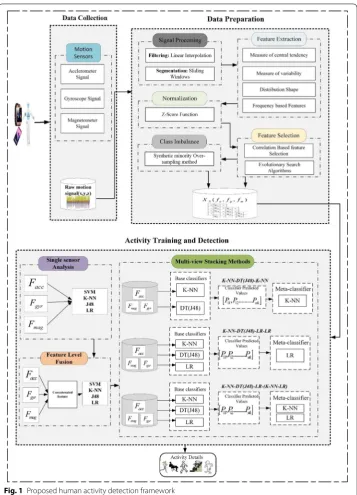
The proposed multiple sensor modalities fusion for human activity identification consist of six steps as depicted in Fig. 1.
These steps include data collection, signal processing, feature extraction and normal-ization, feature selection and classification of physical activity details. The experimen-tal evaluation steps consist of (1) single sensor analysis, (2) sensor fusion using feature concatenation and (3) multi-view stacking that combine the predictive probabilities of different sensor modalities before fusion. In addition, the study evaluates the impact of (2)
M:Fi →bi,
(3) F=
acci,gyri,magi,bi,
(4)
b←arg maxMn(x),
(5)
class imbalance by using Synthetic minority over-sampling techniques (SMOTE) to bal-ance the activity classes with less number of instbal-ances.
The first step in human activity detection is data collection (Fig. 1). Here, two datasets collected with wearable devices named Dataset 1 and Dataset 2 were used in this study. The datasets contain different data of various modalities and include accelerometer, gyroscope, and magnetometer collected at a frequency of 204.8 Hz and 50 Hz respec-tively. Sensor data collected with mobile and wearable sensor are corrupted with sen-sor impurities due to signal degradation, therefore the signal processing help to remove
noise before feature extraction as shown in the step. The third step of the process is fea-ture extraction.
Feature extraction is the most important aspect of human activity recognition as the process helps to transform the raw signal into descriptive feature vectors. Here, differ-ent features broadly categorized into time and frequency domain were extracted from the raw sensor data. These features were then normalized to limits the features to cer-tain ranges and that have shown to enhance classifiers’ performances. “Feature extrac-tion and normalizaextrac-tion” section provide further explanation on the feature extraction process.
Furthermore, most of the features extracted may not contribute positively for activity identification; the paper proposes a combination of bio-inspired metaheuristic feature selection aided by correlation based features selection to select the most discriminant features before activity classification. “Feature selection” section provide full descrip-tion of feature selecdescrip-tion processes adopted. The final steps depicted in the proposed method are single sensor analysis, feature-level fusion and multi-view stacking ensemble approach. In single sensor analysis, feature vectors extracted from each sensor modality and placement is fed to classification algorithm to build model for activity detection. On the other hand, feature-level fusion stage integrate feature vectors extracted from the sensor modalities before activity detection using machine-learning algorithms. Finally, multi-view stacking approach integrate decision from different classification algorithms and sensor modality. “Decision fusion using multi-view stacking ensemble method” section describes the multi-view stacking ensemble algorithms. We applied these steps simultaneously to all the positions utilized in experimental settings. The positions con-sidered in this study include the ankle, chest, and wrist.
In Fig. 1, these steps are depicted in details.
Signal processing
Wearable and mobile inertial sensors (accelerometer, gyroscope, and magnetometer) based human activity classification requires sequence of procedures to process the sen-sor data before actual activity classification using different machine learning algorithms. Raw sensor data are corrupted by signal artifacts such as noise, missing values due to signal degradation or loss of battery life. We converted the raw sensor data, made of three axes (x, y, z) to time series and then filtered to remove noise. Filtering is important in human activity classification framework in order to remove low-frequency data, the geometric bias of sensor dimension, improve correlation and linear relationship between each data point [16]. In this study, linear interpolation was used to input missing val-ues and the valval-ues at the end of the activity sequence were replaced with the previous activity data. This approach is very effective data transformation and signal processing method in human activity recognition system [11, 19]. To reduce computation time and accurately recognize activity details, data segmentation approach was applied on the raw sensor data to divide the data into a series of segments. The sliding window approach is considered in this study for its effectiveness in human activity detection [61].
window sizes to enable accurate comparison with other published works in human activ-ity recognition. For Dataset 1, we adopted the procedure recommended in the original research [63] to segments the data using 5 s (1024 samples with 204.8 Hz sampling rate) with 50% overlapping at each window size. While Dataset 2, a window size of 2-s (100 samples with 50 Hz sampling rate) was used as recommended in [19] without overlap-ping to accurately capture the activity details. We choose the small window sizes because most of the activities involved in the study are ambulatory activities that require small window sizes to recognize. These include activities such as walking, descending stairs, running or jogging [42, 64]. Each of the sensor modality (accelerometer, gyroscope, and magnetometer) used in this study were separately processed by applying the linear inter-polation function L() and data segmentation function Sg() developed and then saved for feature extraction.
Feature extraction and normalization
Feature extraction process reduces the signal into feature vectors that are discriminative enough to describe the activity details, minimize activity classification error and reduce computation time. In human activity classification, several features have been proposed for human activity detection which can be broadly classified into time and frequency domain features [65]. Time domain features involve the extraction of signal or statisti-cal metrics from raw signals and show how signal changes with time. The main advan-tages of time domain features are their ability to provide low computational time and are applicable for online and real-time activity detection. In contrast, frequency domain features help to show the distribution of signal energy and are efficient for recognition of repetitive activities [6, 9]. Therefore, given window sizes of dt seconds ( N = fs × dt
samples), we extracted different feature vectors to characterize the original signal and present a compact representation of the activities performed at each window samples. Here, fs represent the sampling frequency of each inertial signal used in this study. For
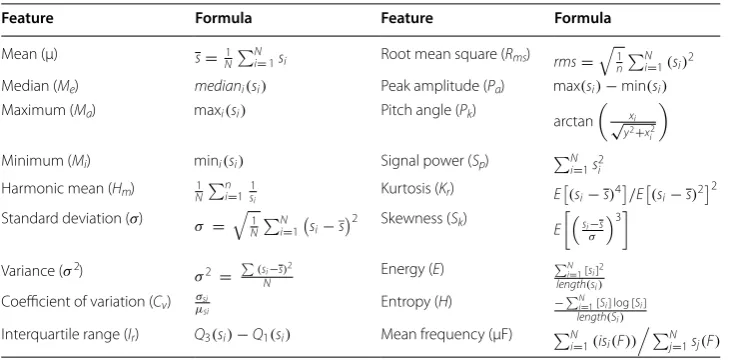
each 3-axis of the motion signal (accelerometer, gyroscope, and magnetometer), we extracted 18 feature vectors of both time and frequency domain listed in Table 2. Fifty-four features were extracted from each motion sensor. From Dataset 1, these features
Table 2 List of extracted features from each sensor modality
Feature Formula Feature Formula
Mean (µ) s=N1N
i=1si Root mean square ( Rms) rms=
1 n
N i=1(si)2
Median ( Me) mediani(si) Peak amplitude ( Pa) max(si)−min(si)
Maximum ( Ma) maxi(si) Pitch angle ( Pk)
arctan
xi √
y2+x2
i
Minimum ( Mi) mini(si) Signal power ( Sp) N
i=1s2i
Harmonic mean ( Hm) N1ni=11s
i Kurtosis ( Kr) E
(si−s)4/E(si−s)2 2
Standard deviation ( σ)
σ =
1
N
N i=1
si−
_
s2 Skewness ( Sk)
E
si−s
σ 3
Variance ( σ2)
σ2 = (si−s)2
N Energy ( E)
N
i=1[si]2 length(si)
Coefficient of variation ( Cv) µsiσsi Entropy ( H) −Ni=1[Si] log [Si]
length(Si)
Interquartile range ( Ir) Q3(si)−Q1(si) Mean frequency (µF) N
i=1(isi(F))
N
were extracted from accelerometer and gyroscope placed on the ankle, chest, and wrist. Therefore, we computed 324 feature vectors from Dataset 1. We extracted the same set of features from Dataset 2 (accelerometer, gyroscope, and magnetometer) placed at the ankle and wrist. In total, 324 feature vectors were extracted from Dataset 2. The feature sets extracted have been subdivided into different categories [66] as explained below.
a. Time domain features: Time domain features extract statistical or mathematical quantities from raw signals in order to depict signal characteristics. The time domain feature vectors extracted from raw sensor data are a measure of central tendencies, degree of variation and distribution of signal shape.
i. Measure of central tendency These features describe how the signal is close to the central values and depict the location of the central points. Features extracted as measure of central tendency include mean, maximum, minimum, median and harmonic mean of each 3-axis of the raw signal. These features require less computation time to process with minimal computational require-ment. Furthermore, measure of central tendency based features have shown significant performance improvement for posture recognition, differentiation of static and dynamic activities and energy expenditure estimation [3, 65]. ii. Measure of variability These feature set represent degree at which the motion
sensor signals are distributed over a distances between the central points. The higher the degree of variation, the worse the distribution of the raw sig-nals. The feature extracted as measure of variabilities are standard deviation, variance, coefficient of variation, interquartile range, root mean square, signal magnitude area, magnitude of area under the curve, pitch angle, signal power and peak amplitude. Measure of variability based features have low computa-tion cost and important to determine the stability and probability distribucomputa-tion of raw signals [65, 66].
iii. Distribution of shape Signal based feature helps to understand the shape and distribution of the raw sensor signal. The distribution of shape-based features computed from the raw sensor signal includes skewness and kurtosis. Skew-ness measures the asymmetric probability distribution of the signals while kur-tosis determines the flat or spike of the sensor data distribution. Distribution of shape-based features have extensively shown impressive results in human activity detection, health monitoring and related applications [3, 19, 66].
the detection of activities such as cycling, jogging, running and so on [65]. All the feature vectors extracted from both Dataset 1 and Dataset 2 are listed in Table 2 with their corresponding formula used to calculate each feature.
After the feature extraction process, the computed features were then normalized to zero mean and unit variance in order to reduce the features to certain ranges. This pro-cess has proven to be effective for improved classification accuracy in the human activity detection system especially for features with dynamic range. The Z-score normalization procedure [26, 67] was utilized in this study. The mean value of the feature vectors was subtracted from the individual signal data point and divided by the standard deviation. The Z-score normalization is shown in Eq. (6) below, where x¯ and σ represent the mean and standard deviation of each data point respectively.
Feature selection
However, not all the extracted feature vectors from each sensor modality used in this study (accelerometer, gyroscope, and magnetometer) shown in Table 2 may be useful for developing effective and efficient activity detection framework. The use of unnecessary feature would lead to overfitting, low performance and high computation time [3, 26]. Therefore, we deployed feature selection methods to reduce the features and increase performances. In this case, optimal features vectors were selected by utilizing different feature selection methods [68]. However, choosing the best feature selection methods to reduce the dimensionality of the data is still challenging as different feature selec-tion approach works differently in different training data. For this reason, we created an intersection of two feature selection methods. Here, the study proposes bio-inspired meta-heuristic (evolutionary search algorithm) integrated with correlation-based fea-ture selection to select the most appropriate feafea-ture vectors and reduce redundancy and computation time. The evolutionary search algorithm is a meta-heuristic and wrap-per-based feature selection method while the correlation-based feature is a filter based method. The combination of these two feature selection methods would help to select the most discriminative feature vectors. First, we applied correlation based features selection on the training data to estimate the correlation between each class and feature vectors. The features were ranked based on the correlation and features with correlation threshold of > 0.15 were selected to be used for further dimensionality reduction using bio-inspired metaheuristic feature selection approach. Correlation-based feature selec-tion approach is fast and efficient to select discriminant feature vectors and to effectively rank the computed features. To further improve the features and classification results, correlation-based features are integrated with Bio-inspired feature selection (evolution-ary search algorithm) to further reduce the dimensionality of the data. Using correlation based features with selection criteria, we selected some feature vectors, but these feature vectors may not be representative enough to ensure accurate activity classification. On the other hand, an evolutionary search algorithm is a form of the meta-heuristic search algorithm that simultaneously explores several points in search space and navigates the search space stochastically to avoid being trapped in local minima. Therefore, the (6) x′ = xi − ¯x
evolutionary algorithm maintains an individual population over the training instances and time as depicted in Eq. (7)
where x represent the potential to the problem at hand. Evolutionary search algorithm exploits biologically inspired mechanism inform of recombination, mutation, fitness, and selection to iteratively select the best training instances for activity classification and health monitoring [69, 70]. The processes for developing an evolutionary algorithm for feature selection are described below:
1. For initial set value t=0 , construct new population values p(t)=xti,. . . .,xtn
that represent a set of starting point to explore evaluation instances;
2. Evaluate each selected features to give their abilities to predict the intended target which is some measure of its fitness;
3. Select a new population over training instances p(t+1) by stochastically selecting
the individual from the initial population p(t);
4. Some of the new population are further transformed by means of genetic operators to form new solutions.
5. Step 1 to 4 are recursively repeated until certain criteria are reached. These crite-ria include reaching the number of iteration, given fitness score is achieved or the evolutionary algorithm converges to near-optimal solutions. The termination criteria depend on the one that is achieved first.
The parameters used in choosing the best feature sets for human activity classifica-tion using an evoluclassifica-tionary algorithm are default parameters in WEKA machine learn-ing toolkits to ensure reproducibility. The list of the selected features uslearn-ing evolutionary algorithm (EA) and correlation-based feature selection methods are shown in Appendix. The selected feature vectors were used to develop the proposed feature-level and deci-sion-level fusion through multi-view stacking.
Activity class imbalanced distribution
In various real-world applications such as medical diagnosis, fraud detection, activ-ity detection, and health status monitoring, data are expected to be imbalanced. In this case, a certain activity that is frequently performed in nature has majority classes while less performed activities have less number of classes. Such imbalanced class distribution tends to overwhelm the minority classes and produce accuracy that is skewed towards the majority classes [6]. Class imbalanced occur when there is a high variance between the majority activity classes and minority activity classes. Therefore, balancing the train-ing data would improve the classification algorithm performances. Two methods com-monly used for solving the class imbalanced problem are the Random under-sampling (RUS) and Synthetic Minority Oversampling Techniques (SMOTE) [71]. Random under-sampling methods reduce the majority classes to equal the number of minority classes. However, it may lead to loss of important information when Random under-sampling is applied to balance the dataset. On the other hand, SMOTE generates new training data from the nearest neighbor of the line joining the minority classes. The approach aug-ments the training dataset of the minority classes by randomly generating new instances
(7)
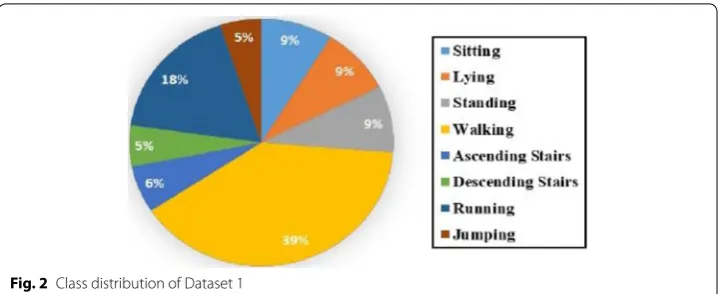
from the original training data and avoid over-fitting. Here, we utilize the SMOTE [25] to increase the minority activity classes following a recent study in human activity recog-nition [6]. We oversampled the minority classes such as Descending stairs, Jumping and descending stairs to solve the problem related to imbalanced dataset [71]. Figure 2 shows the activity class imbalanced distribution in Dataset 1.
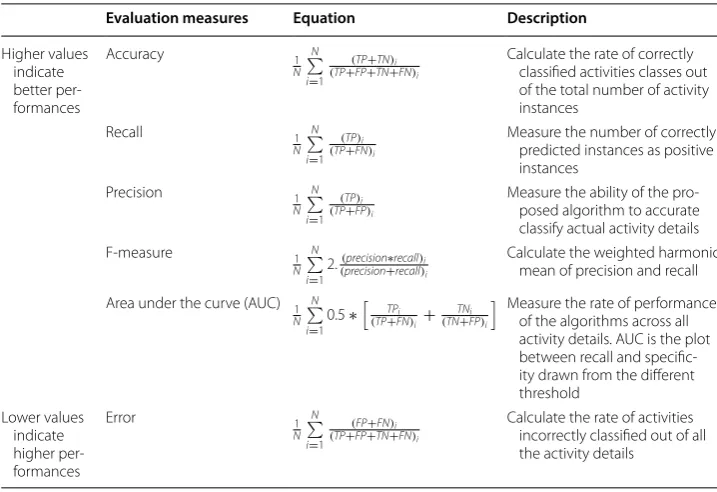
To access the impact of class imbalance on the dataset and proposed method, area under the curve (AUC) that performance was introduced. Area under the curve is more robust than other performance metrics such as accuracy, recall and F-measure in class imbalance scenario. Moreover, AUC is independent of data skewness and class activity distributions. In addition, area under the curve has been used to assess the impact of class distribution in human activity identification and related applications [6, 71].
Classification algorithms
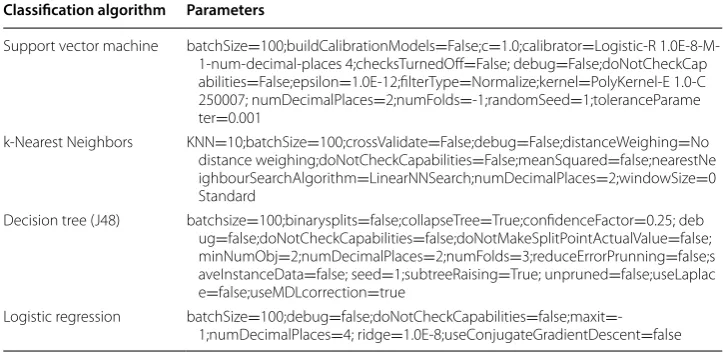
In human activity classification, it is difficult to build accurate and effective decision fusion using the single classification model. Therefore, this paper first evaluates the indi-vidual classifier on the sensor modalities used in our study and then, the same classifiers were used to build the feature-level fusion and multi-view stacking ensemble methods. Moreover, it is challenging to identify all the activity details using a single classification algorithm. To this end, classification algorithms that have been used for human activity detection to ensure accurate evaluation and comparison were selected. The classification algorithms used in this study include the decision tree (J48), support vector machine, k-Nearest Neighbors (k-NN) and logistic regression [3, 16]. These classification algo-rithms were chosen because they have produced improved performance results in human activity detection and similar tasks [3, 16, 24]. Moreover, each classification algorithm has different philosophy implementation for the learning process and selecting appropri-ate classification algorithm is important for building robust and efficient human activ-ity detection system. In subsequent sections, these classification algorithms are discussed and their parameter tuning values are presented in Table 5, “Experimental setup” section.
Decision tree (J48)
Decision tree provide learning and classification algorithm that recursively divide train-ing data or features from sensor modalities into node segments made up of root node, internal splits, and leaves [72]. A decision tree is a non-parametric algorithm that does
not require assumption on the training feature distribution and can model the non-linear relationship between the training feature vectors and activity classes. Various classes of the decision tree have been extensively proposed for human activity detec-tion in recent studies due to its algorithm efficiency and easy to understand process. In addition, the decision tree allows the easy and rule-based hierarchical representation of activity details [73, 74]. In this study, we implemented the J48 decision tree.
Support vector machine (SVM)
Support vector machine (SVM), developed by [75] provide powerful classification algo-rithms based on statistical learning theory and employ the use of hyperplane that sepa-rates the training data using maximal margin [76]. Given a training instance of feature vectors extracted from different sensor modalities XS{x1,x2,. . . .,xS} , support vec-tor machine optimally separate the classes into different activities. However, the sup-port vector machine requires large training examples to avoid overfitting and extensive parameter tuning in order to obtain high-performance generalizations [42].
K‑Nearest Neighbors (k‑NN)
k-Nearest Neighbors is a non-parametric and lazy learning algorithm that use instance-learning methods to store instances and classifiers new training data using similarity index measure such as Euclidean distances. k-NN is one of the simplest and most effec-tive algorithms for human activity recognition and has provided competieffec-tive performance and pattern recognition problems [3, 77]. Furthermore, k-NN is effective in handling large training features that are too large to fit into memory and use simple Euclidean distance to measure the similarities between training and testing feature vectors in human activity recognition [9, 42]. K-Nearest Neighbors learning activity patterns from training features vectors by comparing the similarity between specific test data sample with a set of train-ing instances based on the closest neighbor k-values that shows the number of neighbors utilized to determine the classes. With the above process, k-Nearest Neighbors provide a faster and more accurate recommendation with desirable quality for activity recognition. In our implementation, the value of k was set to 10, although we tested other values of k, but k= 10 provided the best result using our datasets.
Logistic regression (LR)
Logistic regression is fast, simple and compact classification model that has been exten-sively applied for human activity detection and health monitoring [16, 74]. Logistic regres-sion provides an easy interpretation of the model and importance of feature vectors. Moreover, the model is easily parallelizable. In logistic regression model, the relationship between training data and activity detail are modeled in order to accurately detect activity classes. The input values are linearly combined using weights or coefficient values in order to make predictions on the training data. In addition, logistic regression model has pro-vided an efficient algorithm for human activity classification in recent years [78].
Decision fusion using multi‑view stacking ensemble method
of human activity identification systems. With a data fusion approach, issues bothering on data uncertainty, and the effect of direct captures that are challenging to eliminate with sin-gle sensor modalities are minimized [3]. As earlier pointed out, multi-sensor development of human activity identification can be achieved at three levels, which includes data fusion, feature level fusion, and multiple classifiers approaches. These fusion mechanisms provide means of integrating multiple sensor modalities for comprehensive human activity moni-toring and other related applications. However, existing studies in multiple sensor fusion majorly explore feature level fusion that combines features extracted from multiple sen-sors and fed to a single machine learning algorithm for human activity detection. The main drawback of such method is the inabilities to learn sensor specific activities and statistical properties for effective activity monitoring. In addition, there is an issue bothering on feature incompatibility that highly decreases performance results [7, 79]. Therefore, it is challenging to understand the performances of each sensor modalities in human activities detection.
Furthermore, these methods are unable to handle a long sequence of complex activity details. In addition, feature incompatibility and signal variation greatly affect algorithm performance in the feature level fusion approach using single classification algorithms. In order to improve the performance results of human activity detection, this paper pro-poses decision fusion using multi-view stacking method. In decision fusion method, deci-sions produced by multiple classifiers are integrated to handle complex systems, high dimensional data and reduce uncertainty especially in heterogeneous sensor scenario [3]. Specifically, the paper proposes multi-sensor fusion through stacking ensemble of heterogeneous classifier fusion to improve human activity detection algorithms. Stack-ing ensemble (stackStack-ing generalization) first proposed in [22] is efficient multiple classifier system for decision fusion of data of different modalities to achieve diversity and reduce misclassification rate. The underlying concept of staking is how to combine the decision obtain from heterogeneous or homogeneous classifiers with meta-classifiers to improve performance [80]. Therefore, the proposed multi-sensor fusion involves multiple stages that involve choosing the base classifiers, training the base classifiers on the training data and then Meta classifier to integrate the results of the base classifiers [24]. The base clas-sifiers are set of classification algorithms, M1,. . . .,Mi and meta-classifier(s) Mi+1 are trained on the prediction of the base classifiers. The rationale is to improve classification results by training the metal learner on the misclassification of the base classifiers.
The output predicted values of each K-fold PStk comprised of the output predicted probabilities of each class and predicted class label of each base classifier is then gener-ated and trained with Meta classifier(s) Mi+1 . With training and testing for K-fold cross-validation, the prediction outputs for all sensor modalities are pooled together into
[PStk =PA11,. . . .,PStk]b where t represent the classifier index, k is the test part of the
K-fold cross-validation and b is the total number of classes (in our case, eight activity classes).
The pooled output predicted probabilities along with the predicted labels and true class labels for all the sensor modalities are represented as
PSik =PA11,. . . .,PSik,Xs,ya
These include:
• Multi-view stacking with k-NN, J48, and k-NN (MST-k-NN–J48–k-NN): k-NN and decision tree were used as based base classifiers and k-NN as the Meta classifier; • Multi-view stacking with LR, k-NN, and J48 (MST-LR–k-NN–J48–LR): LR, k-NN,
J48 were used as base classifiers and LR as the Meta classifier.
• Multi-view stacking with LR, k-NN, J48 and (k-NN-LR): (MST-LR–k-NN–J48 (k-NN–LR)): LR, k-NN, and J48 as base classifiers and LR and k-NN as the Meta classifier. The final result is the average of the prediction of the two classification algorithms.
In each experimental configuration, tenfold cross-validation was used on the train-ing data to generate the meta-level classifier data. This approach is important to avoid overfitting the training data [18]. Algorithm 1 shows the generic process for training the stacking generalization approach adopted in our experiments.
Experiments
This section presents the experimental implementation of feature-level fusion and multi-sensor fusion using multi-view stacking methods for human activity recognition. Furthermore, the impact of increasing the minority class by apply Synthetic Minority Over-sampling (SMOTE) is also evaluated. Moreover, the section presents the datasets, model validation, experimental setup, and performance evaluation.
Datasets description
Dataset 1: This dataset was first collected and analyzed in [63] for hierarchical multi-sensor based classification of activity of daily living using Shimmer multi-sensor nodes placed on the right ankle, chest, right hip and right wrist. All the sensors used in the experi-ment were a motion sensor that records 3D accelerometer and 3D gyroscopes while 19 subjects perform 13 activities of daily living. These activities include sitting, lying, stand-ing, washing dishes, vacuumstand-ing, sweepstand-ing, walkstand-ing, ascending stairs, descending stairs, treadmill running, bicycling on the ergometer (50 w), bicycling on the ergometer (100 w) and rope jumping recorded at a sampling rate of 204.8 Hz. The range of the accelerom-eter used in the experiment was ± 6 g. The range of gyroscope was ± 500 °/s for sensor nodes placed on the chest, hip and wrist and ± 2000 °/s for sensor nodes on the hip. Our study utilizes the sensor placed at the ankle, chest and wrist and subsets of the activi-ties for evaluation of our proposed multi-sensor fusion based on multi-view stacking. The subset of activities used includes sitting, lying, standing, walking, ascending stairs, descending stairs and jumping using a segmentation window size of 5 s (1024 samples for each sensor data) with 50% overlapping at adjacent windows. This was the original window size segmentation used in the evaluation of the data in hierarchical multi-sensor based classification of activity of daily living [63] with a mean classification rate of 89.6%. Details of the two datasets used in our experimental evaluation are presented in Table 3.
of accelerometer, gyroscope and vital sign data collected from ten subjects while per-forming 12 physical activities while Shimmer2 sensor device was used to record the data from each subject in the experiment. During data collection, the motion sensors were placed on the subject’s left ankle, right wrist, and chest. The sensor placed on the chest also provided 2-lead electrocardiography (ECG) measurement for health monitoring to ascertain the effect of exercise on the participants. The sampling rate used for sensing activities was 50 Hz in which the sensor monitor 3D acceleration ( ± 6 g) placed on the ankle, chest, and wrist, 2-lead electrocardiography (ECG), 3D gyroscope placed on the ankle, chest, and wrist, and 3D Magnetometer on the ankle and wrist. The subjects wore the sensor while performing activities that included standing still, sitting and relaxing, lying down, walking, climbing stairs, and waist bends forward, frontal elevation of arms, knees bending (crouching), cycling, jogging, running and jumping front and back. These activities were performed for 1 min range and some were performed 20×. In this paper, we analyze accelerometer, gyroscope and magnetometer sensors placed at the ankle and wrist for multimodal data fusion approach. However, 2-lead ECG measurement is not analyzed in our study in line with the original experiments. In addition, subsets of the data sets were considered in our experiments, these include Standing still, sitting and relaxing, lying down, walking, climbing stairs, cycling, jogging and running.
Experimental setup
The signal preprocessing, data segmentation, features extraction and normalization dis-cussed previously were implemented in MATLAB 2016 (reference https ://in.mathw orks. com/) for each activity sequence and combined into master feature vectors (MFVs). The extracted master feature vectors were stored as .csv files and converted to attribute rela-tion file format (.arff). Then, the dimension of the master feature vectors was reduced to select the most discriminant features by applying the correlation-based features and followed by Evolutionary search algorithm to further reduce the feature vectors. The
Table 3 Summary of datasets used and data processing methods
Dataset 1 Dataset 2
Sensors Shimmer sensor devices containing 3D
accelerometer, 3D gyroscope Shimmer2 sensor device IMU containing 3D accelerometer, 3D gyroscope, 3D magnetometer and 2‑lead electrocar‑ diography (ECG)
Placement Right ankle, chest and right wrist Ankle and wrist
Physical activities performed sitting, lying, standing, washing dishes, vacuuming, sweeping, walking, ascending stairs, descending stairs, running, bicycling on the ergometer (50 w), bicycling on the ergometer (100 w), rope jumping.
Standing still, sitting and relaxing, lying down, walking, climbing stairs, waist bend forward, the frontal elevation of arms, knee bending(crouching), cycling, jogging, running, jumping
Number of activities 13 12
Number of participants 19 10
Sampling rate 204.8 Hz 50 Hz
Filtering method Linear interpolation Linear interpolation
Window type and size 5 s with 50% overlap 2 s
Feature selection methods Evolutionary search method, Correla‑
tionAttributeEval, Ranker Evolutionary search method, Correlation‑AttributeEval, Ranker