GROUPING BASED USER DEMAND
AWARE JOB SCHEDULING
APPROACH FOR COMPUTATIONAL
GRID
P.SURESH
Assistant Professor (Senior Grade), Department of IT, Kongu Engineering College,
Perundurai, Erode Tamilnadu, India E-mail:[email protected]
P.BALASUBRAMANIE Professor,
Department of CSE, Kongu Engineering College,
Perundurai, Erode, Tamilnadu, India.
E-mail:[email protected]
Abstract:
Grid Computing is a high performance computing that solves complicated tasks and provides powerful computing abilities. Scheduler is very much responsible for effective utilization of resources and less processing time. Most of the scheduling algorithms failed to consider user satisfaction and resource utilization. This paper introduces a new grouping based scheduling algorithm that takes user satisfaction into account. In this approach, grouping of fine grained jobs to coarse grained jobs and scheduling those coarse grained jobs based on the deadline is done. The simulation is done using GridSim toolkit and the results have been compared with the user demand aware scheduling Algorithm and the results show the user satisfaction is more and achieves better hit rate, processing time and makespan. Thus the grouping based user demand aware algorithm results in increased user satisfaction and better makespan and processing time.
Keywords: User Deadline; Grouping; Resource Utilization; Makespan; Grid Scheduling.
1. Introduction
Grid computing is an emerging technology for sharing of geographically distributed heterogeneous resources. It is more suitable for scientific and business problems that require a great number of processing cycles or need to process large amount of data. Generally the grid is divided into two categories such as computational grid and data grid.
Computational grid is a collection of distributed computing resources, within or across different administrative domains that are aggregated to act as single computing resource. Data grid is mainly used for controlling, storing and accessing of huge amounts of data or information.
The resources in grid are linked through internet and create virtual supercomputers to solve complex problems.Alternatively grid computing has many issues such as scheduling, load balancing, resource management and security. Among many of the challenges of grid computing, scheduling is one of the most challenging issue which deals with reducing the processing time of executing jobs in different resources.
Scheduling algorithm has three phases. They are resource discovery, choosing of appropriate resources to the jobs based on resource information and execution of the jobs in various resources from different administrative domains. Grid scheduling is a decision making that operates at different levels of grids. Local scheduling is used at the level of clusters, usually to balance load. Global scheduler is used to map user jobs to resources according to their requirements and properties.
considering the scheduling of jobs many factors will be improved such as CPU utilization rate, throughput and user satisfaction.
To reduce the transmission time and to increase the CPU utilization, fine grained jobs are grouped together to form course grained jobs and the grouped jobs are scheduled to resources based on user deadline. An effective scheduling algorithm has to reduce the makespan and also the processing time by including the transfer rates of data and also reduces the communication overhead. On the other hand the scheduling has to improve the user satisfaction. Typically, it is difficult to find an optimal resource allocation which minimizes the execution time of the jobs and utilize the resources effectively.
1.1.Related Works
This section describes many scheduling algorithms for computational grid tasks. These algorithms mainly developed to reduce makespan and processing time. A job-grouping based scheduling which does not consider dynamic characteristics and utilization of the resources [Liu and Liao (2009)]. A greedy meta-scheduling algorithm based on multiple simultaneous requests. Scheduler identifies the sites that can start the job earliest. This algorithm is mainly designed for homogeneous resources and did not consider data requirements [Subramani et al. (2002)].
Muthuvelu et al. (2005) presents dynamic Job grouping strategy which concentrates on maximizing the utilization of Grid resource processing capabilities and reducing the overhead time and cost taken to execute the jobs through a batch mode dynamic scheduling. But this algorithm did not consider the user demand of each task and did not improve the user satisfaction.
Selvarani and Sudha Sadhasivam (2010) developed a heuristic approach based on Particle Swarm Optimization algorithm for scheduling tasks in grid environment. This scheduling algorithm groups the tasks in non uniform manner and scheduling is done based on the processing capability of the resources. By grouping the jobs, this approach optimizes computation/communication ratio and the utilization of resources is also increased. User demands of the tasks are not considered for scheduling the tasks.
Keat and Fong (2006) developed an algorithm in which grouping of independent jobs with small processing requirements into suitable jobs with large processing requirements and considered network bandwidth into account for scheduling, but it did not consider the dynamic characteristics of resources, sufficient utilization of the resources and user demand of the tasks.
Jie Lin et al. (2007) observed that an application demand aware performs better when user satisfaction is taken into account but data requirement and dynamic characteristics of the resources are not considered.
Suresh et al. (2011) developed a prioritized user demand algorithm which considered user deadline for allocating jobs from different users to different heterogeneous resources from different administrative domains. In this algorithm better makespan and more user satisfaction is achieved but data requirement is not considered.
Soni et al. (2010) proposed a job scheduling algorithm to group the light-weight or small jobs into a coarse-grained or group of jobs, which will reduce the communication time, processing time and enhance resource utilization. But it is not concentrated on user satisfaction.
Ranganathan and Foster (2002) proposed a set of job-scheduling and movement algorithms for data-intensive applications. This algorithm considered computation scheduling and data scheduling are independent; they do not incorporate with each other to get suitable resources for a job.
Suresh and Balasubramanie (2012) presented user demand aware scheduling algorithm for data intensive tasks which considers user deadline, execution time and communication time for scheduling the tasks to resources. But dynamic characteristics of resources and processing overhead are not considered in this algorithm.
2. Materials and Methods
2.1 Problem Formulation
Scheduling algorithm is needed for allocating the jobs based on the availability of the resources. Most of the existing algorithms did not consider the dynamic characteristics of the resources, communication time to transfer the data and user demand of the submitted jobs.
2.2 Proposed Scheduling Architecture
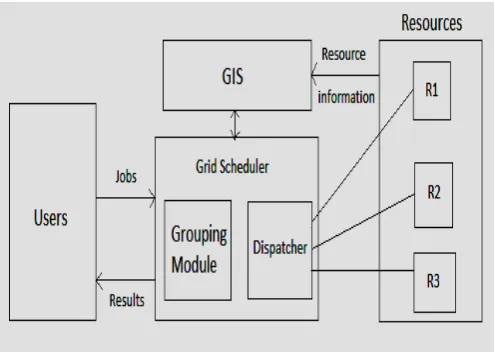
Fig. 1 Scheduling Architecture
Fig.1 depicts the proposed scheduling architecture. User submits the jobs to the grid scheduler which has two major components, grouping module and dispatcher. Grid information service collects information such as resource capability, availability and bandwidth for transferring the data.
The grouping module groups the fine grained jobs to coarse grained jobs based on the user deadline to improve the performance by reducing the communication time and processing overhead. Scheduler selects the appropriate resources to the grouped jobs based on information provided by the grid information service. Dispatcher is used to dispatch the grouped jobs to the locations of the resources in different administrative domains. Finally the results are transferred to the users. This architecture assumes that the execution time of each job in each resource is known priori.
Scheduler collects the jobs from various users that are differed based on length (MI), input file size (bytes), user deadline (seconds), output file size (bytes). Grid information service gathers information about the resources like processing capability (MIPS), bandwidth (bps) and availability (granularity time). The proposed scheduling strategy maximizes the utilization of the resources, reduces processing time of jobs and network delay to schedule and execute jobs on the grid. This algorithm groups several fine-grained jobs into coarse grained jobs based on the user deadline of the jobs, resource capability and availability of the resources.
2.3 Grouping Strategy
The grouping strategy is given below: Gridlet lengthi ≤ MIPS(Rj) × AT(Rj)
Ggridletsizei≤ BR(Rj) × Tcomm_i
and Tcomp_i / Tcomm_i >1
where
Ggridletlengthi - length of grouped gridlets (MI)
AT(Rj) - availability time of each resource
Gridletsizei - size of grouped gridlets (Mb)
BR(Rj) - baud rate of resource j
Tcomm_i - communication time and
Tcomp_i - computation time of grouped gridlets
2.4 Proposed GUDA Algorithm
The proposed algorithm makes use of the user deadline and resource capability for scheduling. In order to reduce the makespan along with user satisfaction, the algorithm follows many steps and it is given below. Step 1: The scheduler receives number of jobs m and their list Ji with user deadline UDi where 1 ≤ i ≤ m from
the user.
Step 2: The scheduler receives the number of resources avaliable ‘n’ from GIS and the resource list (Rj) is
created with their status.
Step 3: Set Ggridletlengthi=0 and Ggridletsizei=0.
Step 4: Sort the jobs in joblist Ji in ascending order based on user deadline UDi.
Step 6: For all jobs in Ji and For all resources in Rj
Step 6.1: Calculate EET(Ji,Rj)=MI (Ji) / MIPS(Rj)
where EET(Ji,Rj) is the expected execution time of job Ji in resource Rj.
Step6.2: Select resource Rj in sorted order and multiply MIPS(Rj) and AT(Rj).
Step 6.3: If jobs in Joblist Jk
Do
if(Gridletlengthi + joblengthk≤ MIPS(Rj) × AT(Rj)) && if (Gridletsizei + jobsizek≤ BR(Rj) × Tcomm_i)
&& if (Tcomp_i / Tcomm_i >1)
k=k+1 else
goto step 6.4
Step 6.4: Dispatch Gridleti to the resource Rj and remove the jobs grouped from the Joblist.
Step 6.5: Increment i
Step 6.6 : Repeat step 6.3 till Joblist is empty.
3. Results and Discussion
3.1 Simulation Setup
This algorithm aims in reducing the makespan and reducing the communication time which is achieved by grouping of submitted fine grianed jobs to coarse grained jobs. The proposed algorithm is implemented using GridSim 5.0 toolkit.
Fig.2 Resource Arrangement in GridSim
The characteristics of resources like Baud rate, MIPS are varied in table 1.Similarly the job characteristics like user deadline, MI and size in Mb are varied for 512 jobs as follows:
User Deadline : 10 to 200 seconds Job MI : 50 to 200 Job Size (Mb) : 200 to 1000
Resource
Machine 1 Machine 2
Table 1: Attributes and Sample charactesistics of 16 Reosurces
Res ID No of
PE
MIPS of each PE
Total MIPS
Baud Rate (Mbps)
Availability Time (Sec)
R1 2 100 200 1500 3
R2 12 100 1200 1700 5
R3 3 130 390 1400 2
R4 8 150 1200 1200 1
R5 3 200 600 1600 6
R6 6 120 720 1100 7
R7 8 110 880 1200 9
R8 5 160 800 1000 3
R9 3 100 300 1500 7
R10 10 140 1400 1100 9
R11 9 190 1710 1800 6
R12 11 130 1430 2000 4
R13 13 100 1300 1300 8
R14 7 170 1190 2100 2
R15 15 120 1800 1800 4
R16 6 110 660 1900 7
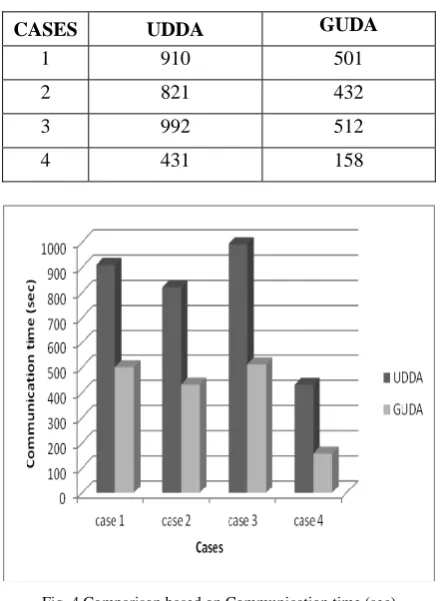
The simulation is done with 4 different cases of 512 jobs and 16 resources and the proposed GUDA algorithm is compared with th UDDA algorithm based on makespan, communication time and computation time. Both communication time and computation time affects the overall makespan. The comparison based on computation time is given in fig. 3. and the values are depicted in table 2.
Table 2. Comparison based on computation time(sec)
CASES UDDA GUDA
1 1802 1758
2 1452 1403
3 1602 1553
4 2300 2289
This ensures that the computation time is more or less same in both the algorithms (without grouping and with grouping). The comparison based on communication time which is the essence of grouping methodology is given in fig. 4 and the values are depicted in table 3.
Table 3. Comparison based on communication time(sec)
CASES UDDA GUDA
1 910 501
2 821 432
3 992 512
4 431 158
Fig. 4 Comparison based on Communication time (sec)
This ensures that the communication time of GUDA (with grouping) is much reduced than the UDDA algorithm (without grouping). This has the effect of reduced makespan which is given in fig. 5. and the comparison values based on makespan is given in table 4.
Table 4. Comparison based on Makespan(sec)
CASES UDDA GUDA
1 2712 2259
2 2273 1835
3 2594 2065
4 2731 2447
Fig. 5 Comparison based on Makespan (sec)
the computation time remains more or less same. The number of jobs successfully executed is also considerably same as the algorithm without grouping(UDDA).
4. Conclusion and Future work
The problem of reducing the communication overhead in grid scheduling is addressed in this paper with a solution of grouping of jobs along with user satisfaction. The simulation results shows that the proposed GUDA scheduling algorithm shows minimized communication time and minimized makespan. This approach is successful for static scheduling along with the consideration of availability of resources as a dynamic nature of resources and it can be extended by considering the load balancing measures.
References
[1] Jie Lin, Bin Gong, Hui Liu, Chaoying Yang, Yuhui Tian, (2007). An Application Demand aware Scheduling Algorithm in Heterogeneous Environment, IEEE Proceedings of the 11th International Conference on Computer Supported Cooperative Work in Design, IEEE Xplore press, Melbourne,Vic,pp509-604, DOI:10.1109/CSCWD.2007.4281504.
[2] Keat.N.W and Fong.A.T, (2006). Scheduling framework for bandwidth-aware job grouping-based scheduling in grid computing, Malaysian Journal of Computer Science, Vol. 19, No. 2, pp. 117-126. “myjurnal.um.edu.my/filebank/published_ article/2065/392.pdf” [3] Liu.Q and Liao.Y, (2009). Grouping-based Fine-grained Job Scheduling in Grid Computing, IEEE First International Workshop on
Educational technology And Computer Science, Vol.1, pp. 556-559. doi :10.1109/ETCS.2009.132.
[4] Muthuvelu.N, Liu.J, Soe.N.L, Venugopal.S, Sulistio.A, and Buyya.R, (2005). A dynamic job grouping-based scheduling for deploying applications with fine-grained tasks on global grids, in Proc of Australasian workshop on grid computing”,vol.4,pp.41–48. http://www.ibrarian.net/navon/page.jsp?paperid=1548903&searchTerm=de+dialog”
[5] Ranganathan.K and Foster.I, (2002). Decoupling Computation and Data Scheduling in Distributed Data-Intensive Applications, Proceedings of 11th IEEE International Symposium on High Performance Distributed Computing (HPDC-11), Edinburgh, Scotland, July 2002, IEEE CS Press, USA.“studies.ac.upc.es/doctorat/ENGRAP/decouple.pdf”
[6] Selvarani.S and Sudha sadhasivam.G, (2010). Improved job-grouping based pso algorithm for task scheduling in grid computing, International Journal of Engineering Science and Technology Vol.2(9),4687-4695. www.ijest.info/docs/IJEST10-02-09-144.pdf [7] Soni.V.K,, Sharma.R and Mishra.M.K, (2010). Grouping-Based Job Scheduling Model In Grid Computing, World Academy of
Science, Engineering and Technology, “http://www.waset.org/journals/waset/v41.php”
[8] Subramani.V, Kettimuthu.R, Srinivasan.S, and Sadayappan.P, (2002). Distributed Job Scheduling on Computational Grids Using Multiple Simultaneous Requests, In Proceedings of the 11th IEEE Symposium on High Performance Distributed Computing (HPDC 2002), pages 359- 366,Edinburgh,Scotland. “www.mcs.anl.gov/~kettimut/publications/hpdc02.pdf”
[9] Suresh.P, Balasubramanie.P and Keerthika.P, (2011). Prioritized User Demand Approach for Scheduling Meta Tasks on Heterogeneous Grid Environment, International Journal of Computer Applications (0975 – 8887), Volume 23– No.1, June 2011. DOI: 10.5120/2856-3670
[10] Suresh.P and Balasubramanie.P, (2012). User Demand Aware Scheduling Algorithm for Data Intensive Tasks in Grid Environment, European Journal of Scientific Research, ISSN 1450-216X Vol.74 No.4,pp.609-616.