University of New Hampshire Scholars' Repository
Computer Science Scholarship
Computer Science
1-1-1986
Information and Experience in Metaphor: A
Perspective From Computer Analysis
Sylvia Weber Russell
University of New Hampshire, Durham, [email protected]
Follow this and additional works at:
https://scholars.unh.edu/compsci_facpub
This Article is brought to you for free and open access by the Computer Science at University of New Hampshire Scholars' Repository. It has been accepted for inclusion in Computer Science Scholarship by an authorized administrator of University of New Hampshire Scholars' Repository. For more information, please [email protected].
Recommended Citation
Sylvia Weber Russell Computer Science Department
University of New Hampshire Durham, NH 03824
Published in
Among metaphor researchers, the idea that anything specific could be claimed about the metaphoric process, especially on the basis of computerized metaphor analysis, is sometimes greeted with the comment that metaphor is inherently vague and not formalizable, that meaning cannot be equated with symbolic repre-sentations in any case, and that any attempt at computer interpretation is therefore destined to fail. Johnson (1982) argues that nonstructural or "preconceptual" elements of metaphor preclude any programmed simula-tion of the human ability to process metaphors. In the area of artificial intelligence, Winograd (1983) suggests that the computational paradigm is ill-suited to deal with the evocative aspects of language. Metaphor certainly has an evocative aspect, and this limit is acknowledged here. To date, however, little attempt has been made to sort out those aspects of metaphor that can be represented, to see what can in fact be done by computer analysis of both linguistic and extra-linguistic factors, whether for the purpose of information processing or for the sake of studying metaphor or linguistic communication itself.
The artificial intelligence approach to metaphor differs in motivation from approaches of researchers in some other disciplines; it is generally concerned with interpreting metaphor in the context of automated text or discourse comprehension, rather than with the nature of metaphor as a topic in itself. This article, however, assumes that the computational approach to natural language understanding--both metaphoric and non-metaphoric--has a potential contribution to make reg arding the understanding of expressive metaphor. That is, it assumes that efforts to specify elements of a computer model might reveal how metaphor comprehension is conceivably done--or not done.
The "validity" of a computer model along some specified dimension is suggested by its output, which in this case consists of literal paraphrases of the implicit meanings of input metaphors. A question of general interest is whether computer paraphrases reflect human understanding of metaphor, and whether they could approach human paraphrases of metaphor. The view assumed in this article does not go so far as to intend lit-erally terms such as "computer understanding" and "computer interpretation." Rather, it is in contrast to both the view which regards the computational or artificial intelligence approach to language as an irrelevant piece of engineering, and the view which claims that computer programs will and should truly "understand" metaphor. A reasonable way of explicating the position presented here would be to consider a computational approach oriented toward depth of interpretation--an approach which takes both the informative and evocative aspects into account. It is this kind of approach on which the proposed model is based.
THE QUESTION OF COMMUNICATED CONTENT
Metaphor interpretations potentially produced by existing computational procedures might be adequate for determination of text coherence in the context of automatic processing. For metaphors which depart from mere physical similarity, howev er, the interpretations would not necessarily be "good" ones by human stan-dards; human judges would recognize that there is often a difference between their own understanding and the concepts represented by the computer output. People could readily produce a string of adverbial descriptors and various phrases to give a more complete description of what was being said through such metaphors.
A challenge for a computer program would be to be able to produce such descriptors in a generalized fashion, but would even this be enough? An analysis of"He waltzed into a buzz saw of criticism"that pro-duces a representation corresponding to"He unwittingly behaved in a way such that he was criticized"is ade-quately informative insofar as it indicates appropriate literal attributes and actions of the actors, but it does not present us with the speaker’s attitudes--or evoke any chuckles. It appears that the more emotive or expressive (vs. explanatory) and the more creative or novel (vs. frozen) the metaphor, the more that seems to be missing from a computer output analysis.
comprehension of the metaphor. The analysis to be presented here rests on a view of meaning discussed more formally by MacKay (1969). That is, I am concerned not only with specification of logical properties of the metaphor itself, but also with the intent of the originator and the effect on the recipient of the metaphor. This approach serves the more general computational aim of analyzing metaphor in terms of human interests and goals.
An assumption critical to analysis along these lines concerns representation in terms of components or "primitives." Some of the available computer approaches depend on componential analysis of metaphoric expressions, while others tend to leave metaphoric terms intact, allowing richer interpretations but leaving some critical analysis problems unsolved. Since a metaphorically employed word is used in an extended sense, the information processing aspect of "understanding" metaphor depends partly on the extraction of inferences and other factors that areimplicitin the metaphoric statement. Determining the nature of the extension neces-sitates componential analysis, at least in a broad sense. At the same time, this process breaks up the image on which the meaning of the metaphor relies. Thus, recourse to analysis in terms of components does not consti-tute an assumption that a metaphor is in reality perceived through components. The loss of cognitive content postulated by Black (1962) for human explication of metaphor applies with at least as much force to computer analysis.
The proposals presented in this article deal with certain aspects of comprehension in cessing terms, but do not necessarily imply that metaphor or meaning is accounted for by the information-pro-cessing view or that the suggested representations exist in the mind as such. With an artificial intelligence per-spective, we are concerned only with possibilities of automatically approximating a human’s description or explanation of a metaphor through components. Although programs cannot capture, in terms of serial compo-nents, any image involved in metaphor understanding, they can extract factors that are invariant under meta-phoric extension in terms of both components symbolizing the utterance and factors such as the goals of the originator. The program can then use these as a basis for coherence with respect to understanding the text or conversation in which the metaphor occurs. In an exploratory vein, the present discussion of such a program will confront the quixotic task of representing some of the vaguer aspects of metaphor.
I begin with some illustrations of how metaphorically expressed attitudes and experiences reflect the originator’s intention toward the recipient. Then I (a) specify some computational tasks for a metaphor inter-pretation procedure which includes the extraction of experiential factors, (b) summarize other artificial intelli-gence work and the extent to which such tasks are addressed, (c) briefly give a theoretical framework for a pre-viously implemented metaphor analysis program and an outline of its operation, (d) provide a basis for formal-izing both informative and evocative aspects of verbal and nominal metaphor in terms of the relation between originator and recipient, (e) attend to the problem of determining salience for nominal metaphor and take into account reasons for salience, and finally (f) make some observations regarding limits of the described represen-tations. The article concludes by showing how, from a linguistic point of view, metaphoric expression facili-tates the originator’s realization of purpose.
EXPERIENTIAL METAPHOR AS A TOOL OF INTENTION
In line with some current thinking in various disciplines, we can consider much of language as goal-directed behavior. In the field of artificial intelligence, Perrault and Allen (1980) and Allen and Perrault (1980) base their analysis of indirect speech acts on the view that the purpose of participants in a conversation is to have some effect on each other, whether this effect is an action or a new attitude. The assumption here is that if an interpretation of a linguistic expression is derived without regard to the intention of the originator, it cannot be said to represent the complete meaning of the expression.
relevance to metaphor is intention in the sense of a (sometimes ulterior) motive.1Such intentions may deter-mine experiential components of a metaphor. Lakoff and Johnson (1980) have pointed out that literal language may not be able to convey such components. A consideration of this question is prerequisite to any theoretical conclusions about the capability of both computer programs and people to paraphrase metaphor. To inv esti-gate that aspect of metaphor which appears to elude computer representation as well as perhaps human para-phrases, it is useful to look at examples which are particularly evocative.
Consider the statement of AFL-CIO’s Lane Kirkland that the Reagan Administration is practicing "Jon-estown economics" with a budget that "administers economic Kool-Aid to the poor"(King, 1982). As with prosaic metaphorical usage in general, the assumption here is that one is vaguely familiar with the metaphoric vehicle (here, the Jonestown incident), and that one shares the prevalent attitude toward this vehicle. The speaker obviously wishes to exploit the listener’s stored experience of shock associated with mass killings and apply it to a perception of the administration’s budget. The speaker could have used a simple adjective such as
"cruel,"but chose this metaphor instead. Thus the listener not only is made aware of the speaker’s assessment, but also experiences the shock associated with the Jonestown event and, momentarily at least, applies this rejection to the administration’s budget. The metaphor has made use of both information and experience of negative emotions to persuade the listener. The listener may consequently either accept this image, fulfilling the speaker’s intent, or may recoil from the comparison, if it seems too remote or even in poor taste.
Another example of persuasion through metaphor (actually a simile, but the point in this case is the same) appeals to humor (Dreikurs, 1964). A mother, trying to get her oblivious children to cease their rowdy behavior in the yard, is described as continually bursting though the front door"like a cuckoo clock"with the message that she has"just about had enough of you kids." Without the cuckoo clock image, the reader might still have understood that the mother was not making any progress in her attempts, and that the children were ignoring her. Howev er, by evoking the perception--or rather unawareness--of a cuckoo clock to which one has become accustomed, the simile places the mother in an image (consistent with that held by the children) which merges her with the mechanical cuckoo. It is the humor of this--the simultaneous allusion to two disparate sit-uations both seen as mildly negative--as much as any rational inferences from this image, which makes the reader see how ineffectual the mother’s approach really is and thus evokes sympathy for the writer’s point.
Literary description often entertains through metaphor by allowing fantasy. As Verbrugge (1980) points out, this is not to say that metaphor is merely an ornament. Viewed somewhat mechanistically, narrative prose sometimes invites the reader to "take a break from the information storage process" and enjoy the description. This in turn may motivate the reader to make a greater effort to visualize the topic or to identify with a charac-ter; alternatively, it may distract the reader. Consider the description of a house with passageways among which were to be found single steps"that seemed like spies from lost battalions, lying in wait and wondering where the rest had gone" (Garfield, cited in Townsend, 1974). The superimposition of"wondering spies"on what are ostensibly unremarkable steps retains the reader’s attention as he or she shares an image originated by the writer.
These examples illustrate two possible intentions behind certain types of metaphor. One ispersuasion,or sympathy for a particular point of view. Turbayne (1971) takes such "shifts in attitude through highlighting or filtering" as the mark of a good metaphor. A second intention isentertainment,which itself may serve another end. These intentions are fulfilled by appeals to the recipient’s own attitudes toward familiar experiences, which have greater force to the extent the recipient has directly participated in such experiences. A metaphor vehicle points to and illuminates a concept or experience that an originator wishes to share, just as, analo-gously, specific examples in nonmetaphoric discourse may trigger one’s own recreation or discovery of what the originator wishes to explain. The vehicles that are used guide the recipient’s interpretations in line with the originator’s intentions.
1 This sense is not to be confused with the more general use of the term, as in the frequently made distinction between speaker’s
In all the preceding examples, information and intentionally evoked experience are simultaneously involved in the metaphor. Howev er, whereas informational aspects of a novel metaphor could be communi-cated by paraphrases or sets of inferences or perhaps by other metaphors, the experiential aspect is particular to the vehicle image used, which may vary from one individual to another, but especially from one culture to another.
Computer programs, of course, can experience neither sympathy, entertainment, emotion, nor simultane-ously perceived images. As automated recipients, they can analyze or break up the concept which serves as the vehicle, but not interpret or put back together an image with all its evocations. To the extent that an original metaphor is meant to motivate, symbolic representations of the metaphor are disappointing. However, consid-ering the representation of both information and intentionally evoked experience in metaphor may point to bet-ter compubet-ter inbet-terpretations, which refer to if not realize what MacKay (1969) calls the "functional signifi-cance" of the communicated expression. The following section presents some computational requirements for interpreting a class of metaphor that includes experiential factors. It begins by relating possible computational approaches to some conventional theories of metaphor.
COMPUTATIONAL TASKS
Black (1972, 1979), following Richards (1936), developed an "interaction" theory (as opposed to a "sub-stitution" or "comparison" theory) of metaphor. Without committing ourselves to any one theory as a whole, we can say that most computer implementations reflect limitations associated with the substitution theory. In particular, properties linked to the metaphorically used word (vehicle or source) are directly mapped to or sub-stituted for the concept being expressed (topic or target), as if the transferred words were identical to rather than isomorphic to perceived properties of the topic of the metaphor, and could thus replace the metaphor. The interaction theory, by contrast, implies that the transferred properties become transformed through the metaphor, rev ealing something new. Furthermore, most artificial intelligence proposals, in keeping with the substitution theory, ignore connotations and valuations implicit in the transferred properties. A system design which accounted for the metaphoric extension (as opposed to literal transfer of ambiguous words) and included experiential components would be a step closer to realization of the interaction theory.
This orientation is not as critical for metaphor which is based mainly on physical similarities between target and source (e.g. the physical similarity between literal and metaphoric senses of "plow"in "The ship plowed the sea,"and the common properties of the nominals in"The highway became a snake"). By contrast, in metaphors such as"He buried himself in forgetfulness"or"Dreams are gold mines,"either the target domain or source domain (or both) is not (merely) physical. These "concept-as-object" or "abstract" metaphors are avoided in most analyses of metaphor. They are important, however, in that they are based not merely on per-ceptual similarities or literally extended properties, but rather on underlying properties perceived as similar through some common (often experiential) component. Abstract metaphor is therefore particularly relevant to any discussion of experiential factors implicit in metaphor, and its representation will receive most of our atten-tion here.
In the process of implementing such a system of metaphor comprehension, one question to be addressed concerns how the parts of a metaphor are represented, which in turn determines whether and how extended inferences can be computationally extracted from the metaphor. Because our particular concern here is to show how salient factors are extended and extracted, representations must be based on some kind of analysis, such as semantic decomposition, that allows us to retrieve or describe such factors.
understand the text. Generation of responses to indirect speech acts or sentence fragments through a planning system is a focus of the work of Perrault, Allen and Cohen (1978; see also Allen & Perrault, 1980; Perrault & Allen, 1980). If a metaphor serves the intentions and goals of the originator, it can be seen as fitting into a plan concerning the person to whom the metaphor is addressed. In an analysis of at least some metaphors, there-fore, the choice of alternative salient characteristics can conceivably be disambiguated if the goal of the origi-nator is known. Conversely, a goal of an origiorigi-nator of an experiential metaphor, or a plan element, can be sur-mised through calculation of a likely effect of a metaphor. This article examines particular aspects of metaphor in line with the latter possibility. Howev er, this discussion minimizes reference to extrasentential discursive context in favor of considering what can be extracted from various kinds of knowledge about terms within the metaphor itself.
Of primary interest in this discussion, then, are (a) representations that isolate extensible inferences and intended experiential factors such as affects and (b) guides to salience determination that give insights into the nature and purpose of metaphor. These factors have been both addressed and ignored to varying degrees in artificial intelligence work on the processing of metaphor.
ARTIFICIAL INTELLIGENCE RESEARCH ON METAPHOR
All the approaches presented here deal at least implicitly with metaphoric inferences in a broad sense. In addition, most refer to structure-mapping mechanisms for transferring information from variously formatted "frames," or organized representations of knowledge, for metaphorically used concepts. The approaches, how-ev er, vary in their ability to represent metaphoric extension, especially of connotations.
The work of Gentner (1975, 1980, 1982), though in the area of psychology, is related to the concerns expressed here. In her experiments on verb recall, Gentner has found support for the theory that verbs are stored as interrelated sets of components, which suggests that component properties and relations (rather than verbal concepts as a whole) are extended in metaphor. Gentner views the ground of a metaphor (i.e., the shared aspects of topic and vehicle) in terms of identifiable predicates that express attributions or relations. She has presented experimental evidence that it is relations which are principally extended (and therefore salient) in metaphorical and analogical comparisons. Thus for the statement"The atom is analogous to the solar system,"
the objects in both the atomic and solar systems participate in similar relations: sun/nucleus ATTRACTS planet/electron, planet/electron ATTRACTS sun/nucleus, sun/nucleus MORE MASSIVE THAN planet/elec-tron, planet/electron REVOLVES AROUND sun/nucleus. By contrast, the attributes of the sun--YELLOW, HOT, MASSIVE (absolute sense)--are not extended to the nucleus of the atom.
Gentner thus describes the broad types of properties likely to be extended, within the basic attribute/rela-tion dichotomy. The kind of representaattribute/rela-tion system she assumes (i.e., of verbal decomposiattribute/rela-tion, as in the propo-sitional networks of Norman & Rumelhart, 1975) is suited to representing these and further distinguished properties. With respect to affective metaphor, as found in expressive metaphor such as poetry, Gentner points out difficulties in specifying clear structure mappings. She maintains that in expressive analogy the emphasis is on the number and density of the relationships rather than on their clarity and consistency; she also maintains that surface sensory attributes play a greater role in expressive metaphors, which are thus less "abstract." In her experiments, however, subject data in fact showed a positive correlation between clarity and expressiveness. Furthermore, Gentner has made an interesting observation with respect to a Shakespearean literary metaphor
("Juliet is the sun"),whichisrelatively clear. In the contextual metaphoric passage of this sentence, the pri-mary subject being conveyed is relationships (viz., Juliet causes hope and gladness in Romeo, just as the sun does). The incorporation of such affective relationships into structural representations is a feature of the pro-posed computational system.
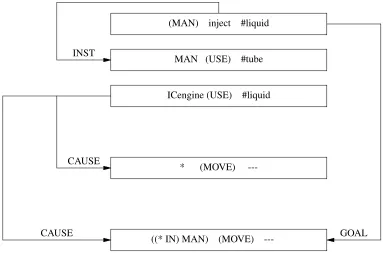
he represents the verb "drink" as a CAUSING to MOVE, preferably done by an ANIMATE SUBJECT (= agent) to a liquid (OBJECT), TO a particular ANIMATE aperture (THRU PART) and INTO the SELF (= the animate agent). The analytic output determined by this structure complements information derived from knowledge structures stored with definitions of contextual nominals. For example, for "car,"Wilks gives the partial knowledge structure of Figure 1.
For"My car drinks gasoline," "drink"in the input indirectly matches"inject"in the knowledge structure: both are CAUSE (to) MOVE verbs with the case-based inference that the object (liquid, gasoline) is IN the car. Furthermore, to determine what cars literally do with gasoline, the procedure seeks the structure in the knowl-edge representation which is the closest match to the input source structure. This would be "IC (Internal Com-bustion) Engine (USE) #liquid," because #liquid matches the object in the source structure("gasoline")and IC Engine is a part of a car and may substitute for it. Thus USE can be projected onto "drink,"giving"My car uses gasoline." Wilks’s system, then, heuristically arrives at an interpretation by actively using world knowl-edge to alter verb sense representations as required by contextual nominals.
For physical-domain metaphors in which there is a strong semantic link between the nominal concepts, the incorporation of projection into metaphor analyses provides interpretations which are more reliable and more specific than interpretations derived from mere extraction of information from the vehicle. On the other hand, it is unclear how such mechanisms would be applied to more creative metaphor or to abstract metaphor, where corresponding literal interpretations are not as obvious and are not necessarily suggested by a knowl-edge structure of the subject nominal. For instance, there does not appear to be a unique knowlknowl-edge structure for "country," since that concept is not unambiguously thought of as having well-defined functions. Aside from the question of projection, the capability to extend structures and inferences is present in Wilks’s system, but there is no focus on affective and other underlying salient factors.
(MAN) inject #liquid
MAN (USE) #tube
ICengine (USE) #liquid
* (MOVE)
---((* IN) MAN) (MOVE) ---INST
GOAL CAUSE
CAUSE
In more recent research in this area, Fass and Wilks (1983) incorporate this method with other strategies to recognize metaphor. This further development is motivated in part by the observation that the strategy previ-ously described, when confronted with"The car drank gasoline and purred to itself,"could find no interpreta-tion for"purred to itself." To represent the metaphorical ambiguity (is"car"seen as animate or is"drink"the car-like consuming of gasoline?), Fass and Wilks draw on two other strategies. For the first clause,"The car drank gasoline," a "change-the-expectation" strategy changes the expected SUBJECT of "drink" from ANI-MATE to VEHICLE. A competing "change-the-data" strategy changes the subject nominal"car"from VEHI-CLE to ANIMATE. The missing subject nominal for"purred to itself"is derived from the representation indi-cating the latter strategy, because the unaltered subject nominal (VEHICLE) in the former representation leads to a "preference violation" (the preferred subject of "purred" is ANIMATE). This gives the representation "(car (ANIMATE)) --> (purred (SUBJ ANIMATE))." This kind of analysis is directed toward the recognition of ambiguity as opposed to interpretation. The output does not reflect a concern with literal topic components, such as the nature of the noise made by the car (engine).
Indurkhya’s (1985) treatment of phrasal (mainly verbal) metaphor is concerned with the feasibility of implementing the structure-mapping mechanism and with the algorithmic and computational properties of such a mechanism. The object of his study is the precise specification of structural coherence of mappings (consis-tency of structural constraints in source and target domains). Because Indurkhya relies on the matching process (which he sees as the determination of structural analogy) for selection of elements transferred to the target domain, his focus is on physical-domain metaphors, in which literal similarity is apparent. He also gives some attention, however, to "weakly coherent" metaphors, in which there is no evident literal similarity. In this area, his assignment of unmatched information to the target from the source domain is similar to the procedure discussed later in this article.
In Indurkhya’s system, domain knowledge is represented as lists of statements in predicate calculus. In his approach, he considers, for example,"The sky is crying,"preprocessed as "cry (sky)." Here"cry"is in the EMOTIONAL-STATE domain and "sky" is in the WEATHER domain. These domain representations are therefore retrieved, as shown in Table 1.
Table 1
Examples of Indurkhya’s Domain Representations
DOMAIN 5: EMOTIONAL-STATE
1. cry(eyes) ->fall-down(tear-drops, eyes)
2. cry(eyes) <-> cry(person) ANDpart-of(person, eyes) 3. cry(person) -> very-happy(person)Θvery-sad(person) 4. laugh(person) -> very-happy(person)
5. very-happy(person) -> NOT very-sad(person) 6. [blue(eyes)Θdark(eyes)Θbrown(eyes) ]
AND NOT [blue(eyes) ANDdark(eyes) ANDbrown(eyes) ] 7. liquid(tear-drops)
8. heavy(tear-drops)
DOMAIN 6: WEATHER
1. blue(sky) <-> sunny(sky)
6. contains(sky, full-moon) -> night ANDclear(sky) 7. contains(sky, full-moon) -> NOT starry(sky) 8. raining(sky) -> cloudy(sky)
9. raining(sky) -> [gray(sky) AND day] OR [dark(sky) AND night ] 10. raining(sky) <->fall-down(rain-drops, sky)
11. snowing(sky) -> cloudy(sky)
12. snowing(sky) -> [gray(sky) AND day] OR [dark(sky) AND night] 13. snowing(sky) <->fall-down(snow-flakes, sky)
14. heavy(rain-drops) 15. liquid(rain-drops) 16. light(snow-flakes) 17. solid(snow-flakes)
Note. The construct "XΘY" means "(X OR Y) AND NOT (X AND Y)", i.e. "X or Y but not both". From"A Computational Theory of Metaphor Comprehension and Analogical Reasoning"(Tech. Rep. No. 85/001, pp. 162-163) by B. Indurkhya, 1985, Boston: Boston University. Copyright 1985 by B. Indurkhya. Reprinted by permission.
The procedure first looks at constraints of EMOTIONAL-STATE in which"cry"appears. At some point, Constraint 1 matches both Constraints 10 and 13 of WEATHER. Constraint 13 suggests the mapping "(cry -> snowing); (eyes -> sky); (tear-drops -> snow-flakes)." In verifying the coherence of this mapping, it is found that Constraints 7 and 8 are contradicted by Constraints 17 and 16 of WEATHER, respectively, so they are not transferable. If the context demands another interpretation, Constraint 10 of WEATHER is chosen, in which case Constraint 1, 7, and 8aretransferable, leading to the interpretation "raining (sky)." A further procedure, which posits the existence of a token in WEATHER corresponding to "person" of EMOTIONAL-STATE, allows transfer of human attributes such as "sadness." Thus, although Indurkhya does not refer to how conno-tations and experience work in comprehension of metaphor, he does allow for the transfer of affects in the form of inferential statements which appear in the domain frame of the vehicle.
With regard to the goal of extensibility, Indurkhya does not have a system of primitives to facilitate the extraction of implicit information. However, the predicate calculus statements that make up his domain knowl-edge frames are somewhat redundant and may include paraphrases in terms of lower level verbs (such as
"move-through"). Such lower level verbs serve a function equivalent to that of primitives in an interpretation of
"The ship plowed through the sea"in terms of "sailing." Thus in contrast to most of the researchers to follow, Indurkhya does not ignore the problem of extension by relying exclusively on transfer of high-level identical predicates.
On the other hand, a working model of metaphor comprehension would require further semantic analysis to ensure intelligible target interpretations. For instance, the specification of"sky"as an actor of"rain"seems forced. Both in his method and in that of Wilks (who also looks at the metaphoric topic in his "projection" process), there is a domain-assignment problem for nominals which potentially belong to many specific domains. That is, it would seem that the classification of"sky"must remain more general (e.g., PHYSICAL) or ambiguous until weknowthat we are talking about rain or weather. Wilks, however, through his case-based inferences and semantic relationships within his frames, is able to confirm his "guess" for the example he gives. Lacking this facility, Indurkhya’s system would have difficulty finding a match for"My car drinks gasoline."
With an orientation somewhat different from that of the preceding researchers, Hobbs (1979, 1981) maintains that the mechanisms for selecting relevant inferences from metaphor and for formalizing the context which determines such selection are those which a natural language understanding system uses to process non-metaphorical language. In his system, metaphoric extension is represented by axioms formulated in terms of predicate calculus. Thus the general metaphor which expresses a variable as an entity at a location is formal-ized as "variable(x)& value(w,y,x)--> at(w,x,y)";ifwis the condition ofybeing the value of the variablex,
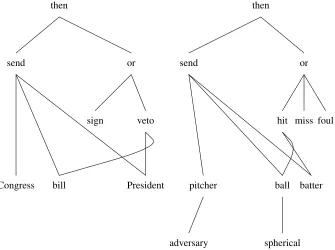
To represent complex novel metaphors, Hobbs proposes "schemata," which he defines as collections of axioms interrelated by the co-occurrence of some of the same predicates. To illustrate, he uses the example,
"We insist on serving up these veto pitches that come over the plate the size of a pumpkin,"from a Democratic congressman complaining about President Ford’s vetoes (Salmans, DeFrank, Buresh, & Hubbard, 1975). Situ-ations are encoded, for example, as "send (SD,C,B,P)," where SD is the action by Congress C of sending the bill B to the President P, and "pitch(p,x,y,z),"in whichpis the pitchingpby the pitcherxof the ballyto the batterz. The metaphor is then represented as two schemata linked as in Figure 2.
To uncover the analogy, Hobbs tries to match predicates describing the metaphorical terms with those derived from world knowledge about the topic (cf. Wilks’s "projection" from a knowledge structure). Thus
"sending a ball to a pitcher"(from baseball knowledge) is matched with"sending a bill to the President"(from knowledge about vetoes).
This example indicates how natural language understanding program mechanisms and concept matching in particular can play a role in computerized metaphor comprehension. In denying that metaphors are "recog-nized" as such or are processed differently from literal language, however, Hobbs ignores systematic semantic analysis of the metaphorically extended concepts themselves. (Is"send"a unique representation component, or were overlapping senses fortuitously matched?) Also, with its high-level focus on situations, this approach does not address the extraction of evocative and other factors underlying metaphorically used words.
then then
send or send or
sign veto hit miss foul
Congress bill President pitcher ball batter
adversary spherical
Figure 2. An example of Hobbs’s representation of metaphor as linked schemata.
market" with "more" in the "MORE IS UP" metaphor formula. Propositions attached to "soaring" can be transferred to"gold market":"The increase is rapid and not firmly supported; if it tumbles it may undergo a negative state change." Here there is a mapping from physical to financial states that is carried through the analysis of the other part of the sentence:"Speculators brace[prepare]for a[physical/financial negative state change caused by a physical/financial]crash."
Carbonell demonstrates that metaphors are sometimes used to structure entire conversations. For instance, the goal of"defeating"or"curing inflation"follows from"INFLATION IS WAR"and"INFLATION IS A DISEASE"metaphors, respectively. The process of determining transferred inferences is aided by reference to transferable salient properties or categories assembled in an invariance hierarchy. This heuristic hierarchy explicitly ranks potentially salient factors (as observed through study of about 200 examples). Carbonell’s hierarchy, in decreasing order of expected invariance, is:
(1) A goal-expectation setting for the animate actors involved (if any), as in the "INFLATION IS WAR"
example.
(2) Planning and counterplanning strategies among competing or cooperating actors.
(3) Causal structures.
(4) Functional attributes.
(5) Temporal orderings.
(6) Natural tendencies (water tends to go downhill; therefore electricity tends to go towards the voltage
drop).
(7) Social roles (in the"INFLATION IS A DISEASE"metaphor, wage-earners are patients).
(8) Structural relations (see Gentner).
(9) Descriptive properties (less likely to be preserved in metaphor).
(10) Object identity (almost never mapped: there are no tanks in the"battle against inflation").
In more recent work, Carbonell and Minton (1983) specify their analogy-based mechanisms in terms of transfer of portions of a graph consisting of concepts (nodes) linked by relations. Thus for"X is a puppet of Y,"
the node CONTROL between the object"puppet"and the actor"puppeteer"is transferred to the node between
"X"and"Y." The absence of an appropriate pre-existing mapping for the source domain initiates the compari-son of source and target domains to create new mappings, a process constrained by the invariance hierarchy.
Carbonell and Minton thus have both a heuristic means of determining that a property is salient and spe-cific representations to support the analogy recognition they see as underlying metaphor analysis. As in the case of Hobbs, however, their research on metaphorical reasoning and analogies is mainly at the level of situa-tions. They do not deal with either the metaphoric nature or affective features of transferred properties them-selves. For example, analogical inferences such as "firmly supported" do not appear to be further analyzed (disambiguated) in Carbonell’s and Minton’s system.
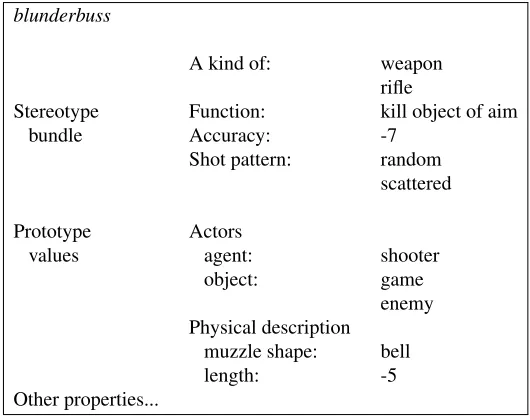
Kilpatrick (1982) directly addresses the determination of transferred salient properties of the vehicle in nominal metaphor. In his view, metaphor comprehension is "the ability to use shared stereotypic values to understand the metaphorical utterance" (p. 84). His approach is therefore to store stereotypical and prototypi-cal properties directly with the vehicle concept, as opposed to searching for possibly salient properties in a knowledge representation of the concept. He defines vehicle frames in terms of "stereotypic bundles" as well as nonstereotypic properties. Thus, for the example"The hearings are a blunderbuss,"the stereotypic bundle for"blunderbuss"is retrieved from its frame definition, given in Table 2.
application to the hearings.
Table 2
Kilpatrick’s (1982) Frame for the Nominal"Blunderbuss."
blunderbuss
A kind of: weapon
rifle
Stereotype Function: kill object of aim
bundle Accuracy: -7
Shot pattern: random
scattered
Prototype Actors
values agent: shooter
object: game enemy Physical description
muzzle shape: bell length: -5 Other properties...
Note. From "An A-Frame Model for Metaphor" by P. W. Kilpatrick, 1982, Proceedings of the International Conference on Cybernetics and Society(p. 85). Copyright 1982 by IEEE. Reprinted by permission.
Weiner (1984), in approaching (mainly physical domain) nominal metaphor, has proposed a means of integrating salience information into hierarchically organized knowledge representations, while implicitly rep-resenting prototypicality. As a starting point, she refers to Ortony’s (1979a, 1979b) theory of how salience and asymmetry function in human metaphor processing--in particular, that nominal metaphor is based on predicates which are of high salience for the vehicle and low salience for the topic.
Weiner’s definition of salience assumes a taxonomic structure of concepts with the most general at the top of the hierarchy and the most specific at the bottom. A salient predicate, then, is one that implies inherent prominence (e.g., great size) or separation from other concepts in the hierarchy (cf. Winston’s "extreme value" and "distinction with respect to a class," to be discussed). The hierarchy distinguishes properties that are pecu-liar to the concept itself (and more likely to play a critical role in the metaphor) from those due to its position in the hierarchy (cf. Kilpatrick’s illustrative frame, in which "accuracy" and "shot pattern" are specific stereo-typic properties of a "blunderbuss," but the capacity of "blunderbuss"as a "weapon" can also enter into a metaphor). Also, the incongruity which serves as a basis of a good metaphor can be easily determined from such a hierarchy. For instance,"Penguins are (like) wolves"is more metaphoric than"Dogs are (like) wolves,"
because"dogs"and"wolves"have a shared superordinate, namely,"canines."
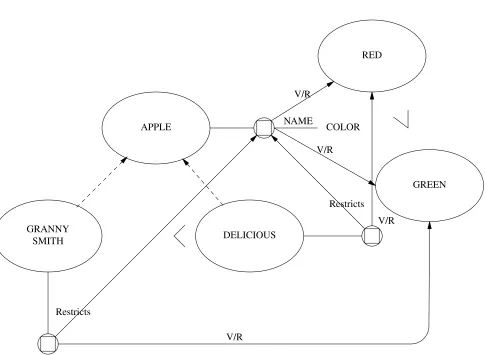
the metaphor"Jane’s cheeks are (like) apples."
RED
GREEN APPLE
GRANNY
SMITH DELICIOUS
V/R Restricts
Restricts V/R
V/R
V/R NAME
COLOR
Figure 3. Weiner’s representation of the nominal "apple". Note. From "A Knowledge Representation Approach to Understanding Metaphors" by E. J. Weiner, 1984,Computational Linguistics, 10,p. 11. Copy-right 1984 by Association for Computational Linguistics. Reprinted by permission.
Weiner adds, aside from tools to represent prototypicality, a value range as a possible value restriction and a salience measure as a role parameter. Thus"hand"has a TEMPERATURE value range of 3 to 6, and the TEMPERATURE of"ice"has a (colder) value of 7 and a salience value of 1, where the possible salience range is from 0 to 1. Since JOHN’S HANDS does not restrict the Roles of the Generic Concept HAND, "John’s hands are (like) ice" can then be recognized by the system as (a) a hyperbole, because the V/R for the Role TEMPERATURE is extreme in the vehicle but not in the topic and (b) a metaphor, because the vehicle and the topic do not share a proximate superordinate in the taxonomy. Raising the salience of the TEMPERATURE Roles of the topic thus gives the information that John’s hands are extremely cold relative to normal hand tem-peratures.
Winston (1978) also treats mainly physical domain nominal metaphor. Howev er, in contrast to those preceding approaches that deal explicitly with salient properties or types of salient properties, he introduces a theoreticalrationalefor determination of salience for nominals. In the course of his work on learning, he has arrived at some principles that aid the selection of potentially salient properties from a frame definition of all the properties of a metaphorically used concept, namely, importance of a property, extreme value, and distinc-tion with respect to the class of the object. (Weiner has integrated the latter two into her representadistinc-tions.)
Winston uses these principles to hypothesize "transfer frames" that act as tentative "filters" for properties to be transferred from the source to the target concept. An example of a source frame for"fox,"consulted for the metaphor"Robbie is a fox,"is given in Table 3.
Table 3
Examples of Winston’s Frames for Nominals.
Source frame for"fox":
FRAME NAME SLOT VALUE
FOX A-KIND-OF SMALL-MAMMAL
COLOR RED CLEVERNESS VERY-HIGH
Source frame for (specific)"box":
BOX-1 A-KIND-OF BOX
COLOR GREEN
MATERIAL WOOD
PURPOSE STORAGE
PURPOSE A-KIND-OF FUNCTIONAL-PROPERTY
IMPORTANCE VERY-HIGH
Note. From "Learning by Creating and Justifying Transfer Frames" by P. Winston, 1978, Artificial Intelli-gence, 10,pp. 151, 155. Copyright 1978 by North-Holland Publishing Company. Reprinted by permission.
The transfer frame then includes CLEVERNESS: VERY-HIGH as an extreme value. Table 3 also shows that the PURPOSE of a (here specific) "box,"namely STORAGE, is "globally important" and is thus included in the transfer frame. Existing properties of the target concept derived from memory and the discursive context are then used as filters to select among transfer frames and thereby decide what values actually get passed through to the target.
In summary, none of the above work explicitly distinguishes experiential or subjective factors in theory or implementation. Several researchers, however, specify various aspects of the task of determining salient properties in general. In particular, Weiner integrates prototypicality and salience into a representation system in which hierarchic relationships between concepts are exploited; Carbonell ranks specific types of properties as to probable salience; and Winston gives general characteristics of salient properties.
These approaches are all of value to metaphor analysis. Yet in the absence of deterministic semantic analysis of the metaphorically used concept, they do not yield target domain interpretations in terms other than ambiguous source domain words. In confronting these issues, the approach described in the following sections uses both salience classifications and semantic analysis to proceed toward a working model which is poten-tially useful to metaphor research.
FRAMEWORK OF A METAPHOR ANALYSIS MODEL
It seems reasonable to consider verbs before nominals in any formalization attempts, because nominals can be defined in terms of verbal and attributive properties, which themselves provide the ground of a metaphor. Thus, in the presentation of my system, a program description for verbs precedes that for nominals, though the preliminary theoretical discussion refers to both kinds of metaphor. The basis of the model to be described is the Metaphor Analysis Program (Russell, 1975, 1976), which produces analyses of syntactically simple verbal metaphor. This program relies on a semantic analysis which accounts for the metaphoric exten-sion. In this section, the theoretical context and operation of the initial program are briefly presented.
Analogy-Based Extension
Searle (1979) maintains that a goal of a theory of how metaphor works should be to establish principles that relate the speaker’s "utterance meaning" to the metaphoric expression. For verbal metaphors, such as"She poisoned the discussion" (Searle’s "relational" metaphor and Miller’s, 1979, "predicative" metaphor), Searle states that the principles which relate the utterance meaning to the metaphoric expression enable a listener to select a target relation or property by giving a respect in which the target and the metaphoric usage in its literal sense might be similar or otherwise associated. In the Metaphor Analysis Program, this "respect" of similarity is made explicit by isolation of the structure of a verb from its domain in the knowledge base. The structural components underlying the metaphorically used (source) verb are transferred to a literal (target) paraphrase of the sentence and therefore are common to the target relation and source relation. This "common ground" of concepts in different domains defines an analogy as perceived and/or created by the originator of the metaphor.
The term "analogy" as applied to metaphor usually calls to mind the lexical format"X is the y of z." The assumption underlying the above analysis, however, is that analogy can also be seen as implicit in semantic componentsof any metaphor in which an extended structure can be identified. Thus "drop," "lose," "forget"
and"become bored"as defined in the Metaphor Analysis Program all share at least a "leave state" component. This view does not presuppose any psychological validity of reference to analogy in metaphor comprehension (see Hoffman, 1985). Rather, the characterization of metaphor in terms of analogy is used in the present model without any claims that humans process metaphor in this way.
In terms of a computer model, analogies can be stated in several ways (see Miller, 1979). One form of analogy conveyed by verbal metaphor is {metaphoric predicate IS TO metaphoric domain AS literal predicate IS TO literal domain}. Thus in"The country leapt to prosperity," {"leap-to"(start to have new locative state) IS TO physical (locative) domain AS start to have new possessive state IS TO control (possessive) domain}. A corresponding analogy for the nominal metaphor"Encyclopedias are gold mines"is { (use)"encyclopedias"IS TO (receive valuable concept in) mental domain AS (use) "gold mines"IS TO (receive valuable concept in) possessive domain}.
presented here implies that in novel metaphor, literal or familiar meanings of the vehicle words are at some point referred to in the analysis process. In other words, creative metaphor does represent something new and unfamiliar, but at the same time it is a normal linguistic phenomenon.
Program overview
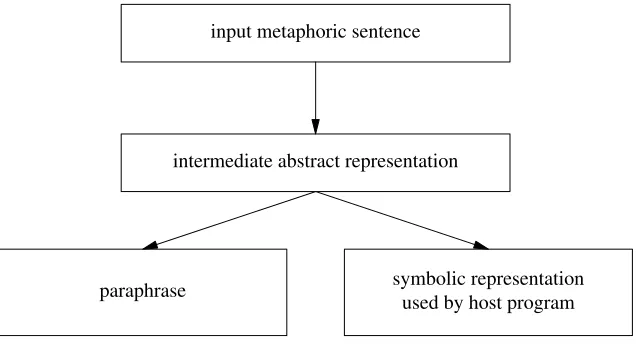
As a component of a language understanding system, the Metaphor Analysis Program would typically be activated by domain inconsistency between the verb of a simple sentence and its contextual nominals. The nominals are first mapped into a structural verb representation which is abstract (i.e., it excludes domain-spe-cific properties such as physical instruments and the character of associated objects) and is therefore extensible. The resulting representations, together with an indication of the target domain category as determined by con-textual nominals, comprise the intermediate target representation. From this representation, the program gener-ates a paraphrase which either (a) includes a new target domain verb in the structure-determined category of the vehicle verb (not always appropriate because of insufficient discriminating properties) or (b) lexically main-tains the separation of domains from extensible components. The intermediate representations could alterna-tively be converted to concept-level symbolic target representations usable by a host language understanding system and related to the knowledge structures of that system. Figure 4 gives a global overview of the proce-dure.
input metaphoric sentence
intermediate abstract representation
paraphrase symbolic representation
used by host program
Figure 4. General operation of the Metaphor Analysis Program.
Thus the physical domain metaphoric (stylized) input"carpet drink ink"is paraphrased as "ink start to be in carpet." The abstract metaphor "country leap to prosperity"is paraphrased as "country suddenly start-to be prosperous" or alternatively, "country suddenly start-to have economic-control concept (i.e., wealth) high amount."
REPRESENTING VEHICLE CONCEPTS
Verb Factors
The assumption that metaphor is used for particular nondeclarative purposes suggests semantic defini-tions of verbal vehicle concepts that include connotadefini-tions represented as the import or effect of the concept. Each verb representation should include (a) potential effects on one who is undergoing the process represented by the verb, and (b) potential impressions on the recipient of the metaphor.
Verb representations which incorporate these experiential effects can be characterized in terms of "explicit" and "implicit" factors. The state or resultant state predicated by the metaphor is by definition explicit and, as an "end-state," can be thought of as a (non-experiential) effect.2 To be (literally or metaphorically) alive, for example, is an inherent result of being born, and therefore an explicitly conveyed part of a "be born" predication.
The indicated experiential effects, along with elementary (non-experiential) components that characterize the action of a verb, represent implicit factors. The importance of retrieving experiential factors in metaphor analysis has an analog in the computer analysis of nonmetaphoric language. For instance, Schank and Abelson (1977) point out that words often have connotations that can be formalized computationally as goals in con-junction with conceptual structures. Thus"kiss"is associated with a certain quality of relationship, or attitude (Case a) that can be ascribed to the one who kisses. Computer programs must extract such connotations from the word, if they are to make inferences similar to those a human would make upon encountering a usage of
"kiss." Sloman and Croucher (1981) and Dyer (1982) also note the importance of affects in conveying infor-mation about goals relevant to computer comprehension of narratives.
The effect described by Case b is an implicit factor that is not only affective (as in the preceding exam-ple) but also subjective. Subjectivity in nonmetaphoric language may take the form of what Breal (1900/1964) called a "dialogue with the reader," as in"He has no doubt(orcertainly) arrived." Schank (1972) confronts a similar phenomenon in the area of automatic text comprehension by correlating adverbs with beliefs of the speaker. Other nonmetaphoric examples with different grammatical formats are"the dubious notion"and"she knows(vs. believes) that...,"where the verb"know"implies that the originator shares the belief. In metaphor, subjectivity often takes the form of evocative connotations that reflect the originator’s attitude toward the expressed situation.
The assumption underlying the model presented here is that all of these implicit effects are introduced metaphorically by way of vehicle experience which the originator hopes the recipient will share. Thus, through an appropriate vehicle definition, a metaphorically used verb can be analyzed by a program in terms of extracted intentions and attitudes, which it then associates with the actor of the verbal concept and/or the recip-ient of the metaphor. Such experrecip-iential factors constitute symbolic effects (unrealizable in the absence of a physiological body) intended by a goal-directed originator. This approach allows for representation of Paivio’s (1979) "mediational response" and is consistent with Verbrugge’s (1980) call for the inclusion of affects in semantic description. The observation that such an extensible attitude can be expressed as an effect on particu-lar animate nominals also builds on Gentner’s (1980) theory that (complex) structures or relations, including affective relations, rather than (simple) attributes are principally extended in metaphor. That is, it is not only relations between parts of the vehicle concept which are extended in metaphor, but also the relationship between actors or speakers/writers (e.g. Romeo) and the vehicle concept (e.g., Juliet as"the sun"). A formal-ization of these attitude components or mediational responses is a step toward identifying the role of subjectiv-ity and intention in metaphor.
For purposes of extension, then, a verb definition can be organized in terms of factors, independent of domain, as shown in Table 4.
2 A resultant state is essentially a "RESULTATIVE inference" as defined by Rieger (1975), as well as one of the "case-based
Table 4
Extension-Oriented Organization of Verbal Concepts
I. Explicit (predicated information, such as resultant state)
II. Implicit (modifying information referring to specific components) A) Verb qualifiers, such as repetition
B) Attitude or response of participant, such as effort
C) Response of recipient in terms of emotions in diluted form, such as fear
Examples of how some individual components describe explicit and implicit effects are the following: for"The legislature hammered at the proposal," a verb factor is "repetition"; for "She glided to the presidency," the response of the participant is "without effort"; for "The legislature guillotined the proposal" the predicated effect is that "the proposal is no longer functional," and the response of a recipient is one of "shock" or "sudden fear," as intended by the writer. As effects, all these factors are extended to the target representation in the analysis program. Since responses are formally related to specific components of denotative structures, the computer program has a way of drawing inferences concerning these components in further information pro-cessing. Without this capability, for instance, a program could not make adequate sense out of the text,"He plowed through his memories; she glided through the same ones." In short, we have the beginnings of a way to deal formally with vague feelings about metaphorically used concepts.
Extension: Abstract Components and Conceptual Domains
Given this factorization of verbal concepts, how can we formalize verb constituents in a way that allows their correct integration into the target domain? To look at an illustrative case, Smith and Montgomery (1982), in their study of verbs used in sports headlines, considered whether there is any limit or pattern to the different ways sports writers can describe winning and losing. They pointed to a semantic category of verbs represent-ing "barely winnrepresent-ing" or "not losrepresent-ing" in the context of sports headlines("elude," "sidestep," "hold off," "repel," "hang on,"etc.), namely "avoidance of destruction." A program must recognize the category of a metaphori-cally used word, if an analogous term is to be chosen for target-domain expression. The identification of the same predefined category for all verbs in this example, however, proceeds partly from knowing in advance how the verb is used metaphorically. To allow for verb differences that become evident apart from the sports con-text (among the listed verbs,"hang on"is alone in not including an adversary in its immediate semantic con-text), verb definitions should be based on abstract components rather than on explicit categories. Paraphrases based on component representations often seem too general; they can be made more specific, however, if the representations are combined with expectations of the target domain to provide a symbolically "merged" rep-resentation. For instance, the analysis program could extract a "loss of control" component as an explicit effect from a metaphorically expressed sports verb; the generation of a more specific word, such as "defeat," however, would be based on a relationship between "loss of control" and "defeat" in a sports domain "script" (in the sense of Schank & Abelson, 1977) and perhaps also from knowledge that headlines describe end results. The described procedure itself would thus be "unaware" that"Cosmos stun Teamen"implied ultimate loss of the game by the Teamen, but would in fact contribute to this interpretation.
metaphorically used verbs and any existing substitutes literal for other domains can be realized in the verb rep-resentations. In contrast to the word-oriented analyses used by some of the previously cited researchers, the representation components themselves comprise a relatively small (slightly redundant) set of "primitive"3 ele-ments (see Appendix).
In terms of information processing, we can view abstract verb structures, together with affective compo-nents, as the ground of a verbal metaphor which is extended from one domain to another. To determine whether metaphoric extension is in fact present, a program must be able to recognize a domain difference between the verb and a dependent (usually adjacent) nominal, so that the structure of the verb can be extended to the domain of the nominal in what can be viewed as a disambiguation process. For instance, the sentence
"The idea blew up"does not mean that the idea literally (physically) blew up, because"idea,"unlike the literal sense of"blew up,"is not physical.
For each verb in its literal sense and for each nominal, therefore, a domain must be defined. (If the literal domain is uncertain, the choice of domain is not critical. The choice merely determines whether an assimilated metaphoric expression is interpreted in its intended target domain by extension mechanisms or as a literal usage.) Consideration of a domain taxonomy is tied specifically to general usages of verbs (e.g., "carry"),
rather than to verb phrases (e.g.,"carry the ball"),which might convey specific domains of cultural activity. A metaphorical usage is therefore determined by a difference inconceptualdomains or modalities (referred to as "levels" in previous work) rather than in specific domains of world knowledge such as sports. Domains that have been incorporated are as follows:
PHYSICAL-- ANIMATE, INANIMATE (various spatial relations)
MENTAL-- INTELLECT (i.e. FACTUAL or PROPOSITIONAL), ATTITUDE, VOLITION SENSORY-- SIGHT, SOUND, and so on
CONTROL--INTRINSIC (= personal), EXTRINSIC
(EXTRINSIC CONTROL of OBJECT = economic, EXTRINSIC CONTROL of ACTION = political)
"Winning"and"losing,"then, are INTRINSIC-CONTROL verbs. A corresponding set of domains for nomi-nals additionally distinguishes TIME and SPACE nominomi-nals. Although many metaphors appear to be exten-sions from a PHYSICAL or CONTROL level, other extenexten-sions are possible (Russell, 1976).
For consistent extension of explicit effects for all domains, the multidomain character, e.g. of"team,"
must be represented. Thus, if the sentence"The Swiss Guards’ team pulverized the Uffizi Librarians’ team"is to be analyzed metaphorically (i.e. if the possibility that a team is physically"pulverized"is left aside), then the program must recognize that a function or quality of the team is the actual underlying object of pulverization. The predicated effect of "pulverize" is then consistent for both literal and various extended usages --the affected object no longer exists or functions. In the output analysis of the given example, then, the strategies used by the Librarians’ team cease or no longer function.
Extension of Experiential Factors
Sports-headline metaphors are notable as subjective rather than objective descriptions of an event. This is because, as Smith and Montgomery (1982) pointed out, many factors are involved in the creation of a sports headline, including variety and cleverness (puns, alliteration, etc.). Subjective experiential factors play a par-ticular role. For example, Smith and Montgomery’s research correlated a certain vaguely defined category of verbs("pulverize," "crush," "stun,"etc.) with the case of winning by a large margin or in an upset. The verb
3 The idea of "extensible primitives", whether seen as structures, features or affects is arguable, of course, and some reveal their
thus reflects reader expectations rather than the state of the team that is"pulverized,"which need be no differ-ent from that of a team that is"left in the dust." That is, while a team may experience defeat, reversed expecta-tions and effort, it does not necessarily experience a sense of being pulverized, ravaged, demolished, guil-lotined,4or any other of the multitude of verbs chosen by the sports writer as a result of his own (or of conven-tional) feelings or expectations and the goal of entertaining. It is the recipient of the metaphor who is intended to experience the intensity, surprise, etc. implied by the verb.
The emotions used to describe implicit effects are considered to be extended to all domains literally (though with diminished intensity), rather than analogically. No commitment has been made to any particular vocabulary of emotions. However, as further examples of their incorporation,"recoil"includes the specifica-tion PARTICIPANT (OBJECT: FEAR, DISGUST), in which "OBJECT" represents the one who recoils, "guil-lotine"includes a RECIPIENT: FEAR specification, and"be born"includes RECIPIENT: AWE. In addition to a simple affective response, an implicit affect-related goal, formulated as a proposition or belief, may also be defined in association with the vehicle verb.5
Examples
The examples given here partially illustrate how some of the defined components enter into verb repre-sentations. For instance, in the abstract part of the definition of the verb "plow through" (see Table 5), the "plower" is the conceptual OBJECT in the process of (TRANS: THRU-STATE) changing its locative relation-ship (OBJECT AT LOCATION), and FORCE: HIGH represents effort, difficulty or resistance as an implicit effect on the OBJECT.
Table 5
Extensible Frame for the Verb"Plow through."
STRUCTURE: (STATE-TYPE: OBJECT AT LOCATION ROLE: OBJECT
OTHER: TRANS: THRU-STATE)
ACT: (CONTINUOUS, SPEED: LOW)
PARTICIPANT: (OBJECT: (VOLUNTARY, FORCE: HIGH))
Many verbs have more complex underlying structures than"plow through,"and require nesting, nega-tion, or the use of closed-set connectives such as "purpose" links. However, the above very minimal represen-tation is sufficient to process the input sentence "He plow(s) through (his) memories"as a component-based representation which can be read as "He mentally with effort continuously slowly processes his memories" (see Russell, 1982, for additional processing needed to handle constraints on nominals). For the sports headline input"Eagles hang on,"a FORCE: HIGH component attached to"Eagles"represents effort, and negation of the loss of control is represented by
NOT TRANS: LEAVE-STATE (OBJECT AT LOCATION), where OBJECT = INTRINSIC-CONTROL and LOCATION = "Eagles." These components provide a basis for the paraphrase, "Eagles with effort avoid
4 Some of these verbs are so close in their effects that it is dubious whether even human recipients distinguish their responses to
such usages, except perhaps to entertain different vehicle images of the sports writer’s description. In this sense the sports writer’s choice is clearly arbitrary.
5 These responses and goals can be linked with information and inference mechanisms used in computerized nonmetaphoric text
losing control."
Under this system, verbs defined in terms of similar abstract components in different domains are theo-retically interchangeable for purposes of roughly equivalent metaphoric or nonmetaphoric expression. In an interpretation, if no literal verb exists which includes all the implicit components defined for the metaphorically used word, these components are added to the paraphrase. For example,"siphon off"would be defined by the knowledge base editor with a (+) CONTINUOUS verb descriptor. "Employers siphoned off their rights"could then be paraphrased as "Employers continuously (or gradually) took away their rights." Similarly, a paraphrase of "Employers whisked away their rights" would refer to the SPEED: HIGH and RECIPIENT: SURPRISE components of"whisk away,"giving "Employers quickly and surprisingly took away their rights." If, in addi-tion, in defining"siphon off"and"whisk away,"the editor associates with the agent a goal of not wanting the possessor of the affected OBJECT to be aware of the action, and/or a RECIPIENT response of DISAP-PROVAL, then these connotations are transferred to the output representation.
Such approximate analyses are certainly inadequate to fully describe the experience of plowing, hanging on, or siphoning off (literally or metaphorically); some discriminating detail is lost along with the specific nature of the experience. However, without recourse to ad hoc mechanisms, they do provide both informative general components suitable for integration into the target domain and connotations (such as "effort" as opposed to "enjoyment" in"plowing")essential to comprehension of the situation.
Representing Nominals through Verbal Predicates
Nominals as potential metaphoric vehicles can be defined in terms of properties or predicates that are candidates for metaphoric extension. For example, the meaning of"The sun is a magician"focuses on the ver-bal concept "transform" as derived from the function (job, role) of a magician; and the predication underlying
"The moon is the Rosetta Stone of the planets"(Jastrow, 1947) is based on "decipher in order to discover."
To account for metaphoric extension, the predicates must be formulated in terms of an extensible repre-sentation vocabulary such as the previously described abstract components determined for verbs. Thus "magi-cian" is represented through change-of-attribute components and a RECIPIENT response of SURPRISE.
"Rosetta Stone"is represented by change (= translation) of SENSORY-SIGHT concepts (= symbols) and use of the changed concepts in order to have MENTAL-INTELLECTUAL concepts; the RECIPIENT response is less stereotyped than for some concepts, but is in any case some attitude (e.g. INTEREST) with a POSITIVE con-notation. With a specific indication of how both verbs and nominals can be represented, we now turn to the second part of the analysis task, namely, the determination ofwhatis represented.
IDENTIFYING SALIENT PROPERTIES OF NOMINALS
Whereas most verbsensesare not ambiguous with respect to their perceived properties, for nominals, the identification of properties to be transferred to the output representation is a core problem. Before pursuing this task, we will look briefly at vehicle properties in the context of the nominal metaphor as a whole.
Topic, Vehicle and Common Ground
Miller (1979) formulated a theory of nominal metaphor in terms which posit a similarity between differ-ent properties of topic and vehicle. Searle (1979) claimed that this view "assigns an impossible computing task to the speaker and hearer" (p. 111). Without entering a debate on Miller’s theoretical position on metaphor, we can point out how the extended Metaphor Analysis Program could in fact implement Miller’s formulation.