INTRODUCTION
Several experimental and clinical studies have demon-strated that, besides its well-known effects on calcium homeostasis and bone metabolism, vitamin D has many other important functions [1,2]. Accumulating evidence has implicated vitamin D deficiency as a risk factor for several diseases [1-6]. Low level of vitamin D is proposed to be asso-ciated with insulin resistance and insulin secretion derange-ments resulting in the development of T2DM [7]. Several pathophysiological mechanisms have been proposed about this relationship [1,7,8].
Vitamin D exerts its effects by binding to the nuclear vita-min D receptors (VDRs)and in recent years VDRs have been
found in various tissues, including the skeletal muscle and the adipose tissue, which are the main determinants of peripheral insulin sensitivity [1,2,9]. Vitamin D insufficiency and T2DM have the same risk factors including the presence of inactive lifestyle and obesity [10]. Many studies have already demon-strated lower serum 25 (OH)D levels in overweight and obese patients [8,11]. This association may be explained by the stor-age of vitamin D in adipose tissue because of its high lipid sol-ubility and decreased exposure of obese subjects to sunlight because of their limited physical activity and restricted mobil-ity [8,10,12]. It has been already proven that physical activmobil-ity leads to the improvements in metabolism of glucose, calcium and vitamin D as well as to the reduction of body weight by increasing lipolysis [13,14].
Since hypovitaminosis D and metabolic syndrome are more pronounced in overweight and obese subjects in com-parison to normal-weight individuals, we aimed to determine the association between vitamin D deficiency, physical activ-ity and insulin resistance in these subjects.
*Corresponding author: Gülis Kavadar,
Physical Medicine and Rehabilitation Department, Medicine Hospital Barbaros mahallesi, Hoca Ahmet Yesevi caddesi 149 34203 Bağcılar, Istanbul, Turkey, E-mail: [email protected]
Submitted: 25 February 2015 / Accepted: 18 March 2015
The relationship between vitamin D status, physical
activity and insulin resistance in overweight and
obese subjects
Gülis Kavadar1*, Demet Tekdöş Demircioğlu2, Levent Özgönenel3, Tuluhan Yunus Emre4
1 Physical Medicine and Rehabilitation Department, Medicine Hospital, Istanbul, Turkey, 2Physical Medicine and Rehabilitation Department,
Memorial Hizmet Hospital, Istanbul, Turkey, 3Physical Medicine and Rehabilitation Department, Florence Nightingale Hospital, Istanbul,
Turkey, 4Department for Traumatology and Orthopedics, Memorial Hizmet Hospital, Istanbul, Turkey
ABSTRACT
Type 2 diabetes mellitus (T2DM) incidence has been increasing worldwide along with the rise of obesity and sedantery lifestyle. Decreased physical activity (PA) and obesity have also been associated with the low vitamin D levels. We aimed to determine the association between PA, vitamin D status and insulin resistance in overweight and obese subjects. A total of 294 (186 female, 108 male) overweight or obese subjects were included in this cross-sectional study. 25-hydroxy vitamin D (25(OH)D), insulin, fasting plasma glucose (FPG) and HbA1c levels were measured in blood samples. Body mass index (BMI), HOMA-index and total score of International Physical Activity Questionnaire-long form (IPAQ) were calculated. Insulin resistant subjects were compared with the non-resistant group. The mean age of the participants was 45±12.25 and 41.39±10.32; 25(OH)D levels were 8.91 ± 4.30 and 17.62 ± 10.47 ng/dL; BMIs were 31.29 ± 4.48 and 28.2 ± 3.16 kg/m², IPAQ total scores were 548.71±382.81 and 998±486.21 in the insulin resistant and nonresistant subjects, respectively. There was a statistically significant difference in terms of 25(OH)D, FPG, insulin levels, IPAQ total score and BMI between the two groups (p = 0.001, p = 0.001, p = 0.001, p = 0.001, p = 0.001). Significantly low 25(OH)D levels, high BMI and low PA in insulin resistant subjects confirm the importance of active lifestyle and the mainte-nance of normal vitamin D levels in overweight and obese subjects in prevention of T2DM.
KEYWORDS: Vitamin D deficiency; insulin resistance; obesity; physical activity
MATERIALS AND METHODS
This cross-sectional study was conducted in 294 over-weight or obese patients who attended an obesity clinic at a community hospital in Istanbul, Turkey, between 1st of
November and 30th of April, during the months of reduced
sunlight.
A written consent was obtained from each participant. The study protocol was approved by the Hospital’s Ethics Committee.
The clinical characteristics of the subjects (age, gender, weight, height) were recorded and the blood tests were per-formed. Height and weight were measured in subjects wear-ing light clothwear-ing without shoes. The calculation of body mass index was performed according to a standardized protocol based on the weight and height measurements. Overweight was defined as a BMI of 25.0 -29.99 kg/m² and obesity was defined as a BMI of 30 kg/m² or higher. These definitions are consistent with the criteria proposed by National Heart, Lung and Blood Institute and World Health Organization [15].
The subjects who had medical conditions that could pos-sibly affect vitamin D concentration, such as parathyroid dis-eases, hepatic or renal disorders, malabsorption syndromes, sunlight allergies as well as the patients using calcium or vitamin D derivatives, antiepileptic drugs, antidiabetic medi-cations, rifampicin or corticosteroids were excluded from the study.
Blood tests were performed on blood samples obtained from the eligible participants during a morning session after a 9-hour-long fast. Fasting plasma glucose (FPG)and HbA1c concentrations were measured by enzymatic and chro-matographic methods using commercially available kits (Bio-system S.A and Human Germany®).
Serum insulin concentrations were measured by an automated, electrochemiluminescent immunometric assay (Cobas E411, Roche Diagnostics, Germany) with 8% cross-reactivity with proinsulin and a total analytical impre-cision less than 7,5% for values between 55 and 2100 pmol/L (7.7 and 291 mIU/mL).
Insulin resistance was estimated using homeo-static model assessment (HOMA-IR). The HOMA-IR was calculated as follows: HOMA-IR: (Fast Plasma Glucose (mmol/L)× Insulin (μIU/mL))/22.5 [11].
The cutoff value was set as 2.7. Subjects were stratified into two groups according to HOMA-IR: the insulin resistant group as Group 1 (HOMA- IR > 2.7) and the non-resistant group (HOMA-IR < 2.7) as Group 2.
Serum 25 (OH)D concentrations were measured using a commercially available radioimmunoassay kit (Minividas Biomeriux, France). According to the report of the Institute of Medicine, vitamin D status is categorized as: risk
of deficiency < 12 ng/mL, risk of inadequacy 12-19 ng/mL, suf-ficiency 20-50 ng/mL [16].
The official Turkish version of the International Physical Activity Questionnaire-long form (IPAQ) was used to estimate the level of physical activity [17]. The questionnaire consists of 27 items that cover four different domains of physical activity (working, transportation, housework and gardening and lei-sure-time) as well as the time spent sitting. All questions refer to the previous seven days. The results were presented as an estimation of energy expenditure in metabolic equivalent-min-utes per week (MET hours/week). According to IPAQ scoring protocol, the MET hour/week for a specific activity (walking or moderate intensity activity or vigorous intensity activity) is computed by multiplying the MET value of a particular activity (3.3 for walking, 4.0 for moderate intensity activity, and 8.0 for vigorous intensity activity)by the hours spent in that particular activity (e.g. walking MET-minutes/week at work = 3.3 × walk-ing hours × walkwalk-ing days at work). To calculate physical activity scores, only the activities lasting at least 10 minutes at a time were taken into account. Algorithms for calculating the con-tinuous physical activity scores were used to estimate physical activity based on participants’ answers. In addition to the total physical activity score, separate scores for each of the four phys-ical activity domains were also calculated [18].
Statistical analysis
The data were analyzed using SPSS 15.0 statistical package (SPSS Inc., IBM Corporation, USA). Data analysis included frequencies, mean ± standard deviation. Student’s t- test and the Mann-Whitney U-test were used to analyze independent samples. Pearson correlation tests were used for the correla-tions. p value < 0.05 was considered statistically significant.
RESULTS
Two hundred ninety four subjects were included in the study. The group 1 included 77 female subjects (52.4%)and 70 male subjects (47.6%), while the group 2 included 109 female subjects (74.1%) and 38 male subjects (24.9%). The mean age was 45±12.25 years, the mean 25 (OH)D level was 8.91± 4.30 ng/dL and the mean BMI was 31.29 ± 4.48 kg/m² in the group 1. On the other hand, in group 2, the mean age was 41.39±10.32 years, the mean 25 (OH)D level was 17.62±10.47 ng/dL and the mean BMI was 28.12± 3.16 kg/m². The BMI values were higher in Group 1 compared to Group 2 (p = 0.001). The mean FPG, insulin, and HbA1c levels were significantly higher in the insu-lin resistant group (p = 0.001, p = 0.001, p = 0.021).
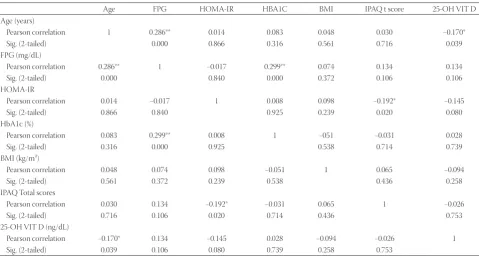
A statistically significant negative correlation was found between IPAQ total score and HOMA-IR in Group 1, (p = 0.02, r = -0.192). No significant correlation was found between the 25 (OH) vitamin D and blood glucose levels, IPAQ total score, HOMA-IR and insulin levels in both groups (p > 0.05)(Table 2).
DISCUSSION
The most remarkable finding in this study is that a low serum level of vitamin D and lower physical activity were in correlation with insulin resistance in overweight and obese subjects. Many studies have been conducted in order to establish the association between hypovitaminosis D and insulin resistance. However, this association has not been clearly defined since ethnicity, dietary intake, physical activ-ity and obesactiv-ity are potential confounders that may affect the
relationship between vitamin D and T2DM [19]. Several cross-sectional studies revealed a strong correlation between the low vitamin D levels and obesity, which is also commonly associated with insulin resistance [12, 20-22]. It is still an open issue whether lower 25 (OH)D concentrations directly affect the pathogenesis of insulin resistance or it is done through BMI. In the study published by Kabadi et al. [23], it was found that the combination of vitamin D deficiency and obesity had an impact on the risk of insulin resistance. In another study, no correlation was found between HOMA-IR and 25 (OH)D levels, after adjusting for BMI [24]. In a study that used glucose clamp technique for measuring insulin sensitivity, the authors suggested that there was no cause-effect relationship between the vitamin D concentrations and insulin sensitivity in obese subjects, emphasizing that both low serum 25 (OH)D con-centration and insulin resistance appear to be dependent on the increased body size [25]. In this study, we cannot discuss
TABLE 1. Comparison of biochemical parameters in individuals with and without insulin resistance Subjects with insulin resistance
(Group 1) (n=147) Subjects without insulin resistance (Group 2) (n=147) p value Mean Standart deviation Mean Standart deviation
Age (years) 45.00 12.25 41.39 10.32 0.073
FPG (mg/dL) 102.31 10.67 95.17 7.25 0.001
HbA1c 5.57 0.45 5.25 0.39 0.021
Insulin 16.07 5.00 7.30 2.54 0.001
BMI (kg/m²) 31.29 4.48 28.12 3.16 0.001
25-OH vitamin D (ng/dL) 8.91 4.30 17.62 10.47 0.001
IPAQ total score 548.71 382.811 998.27 486.21 0.001
Descriptive statistics and student T test were used for statistical analysis and p<0.05 considered statistically significant. PG: Fast Plasma Glucose; HbA1c: Hemoglobin A1c; BMI: Body Mass Index; 25OH Vitamin D: 25-hydroxyvitamin D; IPAQ: International Physical Activity Questionnaire
TABLE 2. Correlations of biochemical and clinical parameters in individuals with or without insulin resistance
Age FPG HOMA-IR HBA1C BMI IPAQ t score 25-OH VIT D
Age (years)
Pearson correlation 1 0.286** 0.014 0.083 0.048 0.030 −0.170*
Sig. (2-tailed) 0.000 0.866 0.316 0.561 0.716 0.039
FPG (mg/dL)
Pearson correlation 0.286** 1 −0.017 0.299** 0.074 0.134 0.134
Sig. (2-tailed) 0.000 0.840 0.000 0.372 0.106 0.106
HOMA-IR
Pearson correlation 0.014 −0.017 1 0.008 0.098 −0.192* −0.145
Sig. (2-tailed) 0.866 0.840 0.925 0.239 0.020 0.080
HbA1c (%)
Pearson correlation 0.083 0.299** 0.008 1 −051 −0.031 0.028
Sig. (2-tailed) 0.316 0.000 0.925 0.538 0.714 0.739
BMI (kg/m²)
Pearson correlation 0.048 0.074 0.098 −0.051 1 0.065 −0.094
Sig. (2-tailed) 0.561 0.372 0.239 0.538 0.436 0.258
IPAQ Total scores
Pearson correlation 0.030 0.134 −0.192* −0.031 0.065 1 −0.026
Sig. (2-tailed) 0.716 0.106 0.020 0.714 0.436 0.753
25-OH VIT D (ng/dL)
Pearson correlation −0.170* 0.134 −0.145 0.028 −0.094 −0.026 1
Sig. (2-tailed) 0.039 0.106 0.080 0.739 0.258 0.753
whether there is a direct relationship between vitamin D defi-ciency and insulin resistance, because the BMI scores are not adjusted between the two groups. By choosing overweight and obese patients, we aimed to evaluate the effects of vita-min D and physical activity levels on insulin resistance and progression to T2DM in the long term.
Obesity is known to promote insulin resistance [11], while an increased adiposity has been consistently associated with reduced serum 25 (OH)D concentra-tions [12, 22, 26]. Some intervention studies have reported significant improvements in HOMA-IR scores and/or insu-lin secretion after vitamin D supplementation in obese or overweight subjects [27,28]. Moreover, vitamin D supple-mentation seems to have an effect on losing weight, but it is suggested that energy balance should be controlled for a better result [29]. Evidence suggests that physical activity (especially cardiorespiratory fitness)and normal vitamin D levels, reduce insulin resistance and help maintenance of weight loss, decreasing thus the risk of chronic diseases, including type 2 diabetes [13, 30]. In our study, the physical activity levels of the subjects in the insulin-resistant group were reported as lower.
Brock showed that vigorous physical activity and obe-sity are strong and modifiable contributors to the vitamin D status [31]. Physical activity may increase serum level of 25 (OH)D by increasing lipolysis and by enhancing mobiliza-tion of deposited vitamin D from the fat compartments [13].
In this study, insulin resistance was associated with the low 25 (OH)D and IPAQ levels. The significantly higher levels of FPG, HbA1c and insulin in the study group may indicate a long-term muscle insulin resistance. Furthermore, high preva-lence of hypovitaminosis D and restricted physical activity in obese subjects also suggest the important role of maintenance of a normal vitamin D concentration and an active lifestyle in prevention of obesity and diabetes.
The main strength of the present study was the patient selection procedure. We selected those subjects who attended the obesity clinic during the winter months, when the expo-sure to sunlight was reduced. There were no ethnic differ-ences, no renal or liver diseases and no drug use that might have affected vitamin D and insulin metabolism.
The main limitation of our study was the relatively small sample size. In addition, we used indirect measures rather than the bioelectrical impedance or magnetic resonance imaging to measure adiposity. Indirect measures, rather than hypergly-cemic or euglyhypergly-cemic clamp techniques, were also employed to test insulin sensitivity. Physical activity was assessed with a self-reporting questionnaire. Moreover, we were not able to exclude lifestyle factors such as dietary habits and social status that could have affected insulin and vitamin D metabolism in study participants.
CONCLUSION
The focus of insulin resistance treatment in overweight and obese patients should be broadened to encompass not only the body weight reduction, but also the normalization of vitamin D levels and intensification of physical activity.
DECLARATION OF INTERESTS
The authors declare no conflict of interests.
REFERENCES
[1] Sung CC, Liao MT, Lu KC, Wu CC. Role of vitamin D in insulin resis-tance. J Biomed Biotechnol 2012;634195. DOI: 10.1155/2012/634195. [2] Mackawy AMH, Badawi MEH. Association of vitamin D and
vitamin D receptor gene polymorphisms with chronic inflam-mation, insulin resistance and metabolic syndrome components in type 2 diabetic Egyptian patients. Meta Gene 2014;2:540-556. DOI: 10.1016/j.mgene.2014.07.002.
[3] Lopes MR, Ribeiro PA, Ledur P, Souza GC. Vitamin D insuf-ficiency is associated with lower physical function in patients with heart failure and diabetes. J Diabetes Res 2014;320930. DOI: 10.1155/2014/320930.
[4] Agmon-Levin N, Theodor E, Segal RM, Shoenfeld Y. Vitamin D in systemic and organ-specific auto- immune diseases. Clin Rev Allergy Immunol 2013;45(2):256-266. DOI: 10.1007/s12016-012-8342-y. [5] Pittas AG, Lau J, Hu FB, Dawson-Hughes B. The role of vitamin D
and calcium in type 2 diabetes. A systematic review and metaanal-ysis. Clin Endocrinol Metab 2007;92:2017-2029. DOI: 10.1210/ jc.2007-0298.
[6] Kendrick J, Targher G, Smits G, Chonchol M. 25-Hydroxyvitamin D deficiency is independently associated with cardiovascular dis-ease in the Third National Health and Nutrition Examination Survey. Atherosclerosis 2009;205(1):255–260. DOI: 10.1016/j. atherosclerosis.2008.10.033.
[7] Forouhi NG, Ye Z, Rickard AP. Circulating 25-hydroxyvitamin D concentration and the risk of type 2 diabetes in individuals with prediabetes but not with normal glucose tolerance. Diabetologia 2012;55(8):2173-2182. DOI: 10.1007/s00125-012-2544-y.
[8] Mezza T, Muscogiuri G, Sorice GP, Prioletta A. Vitamin D defi-ciency: a new risk factor for type 2 diabetes? Ann Nutr Metab 2012;61(4):337-348. DOI: 10.1159/000342771.
[9] Candido FG, Bressan J. Vitamin D: Link between osteoporosis, obe-sity and diabetes? Int J Mol Sci 2014;15(4):6569-6591. DOI: 10.3390/ ijms15046569.
[10] Alvarez JA, Ashraf A. Role of vitamin d in insulin secretion and insu-lin sensitivity for glucose homeostasis. Int J Endocrinol 2010;351385. DOI: 10.1155/2010/351385.
[11] Minambres I, Hernandez JS, Sanchez-Quesada JL. The Association of hypovitaminosis D with the metabolic syndrome is inde-pendent of the degree of obesity. Int J Endocrinol 2012; 691803. DOI: 10.5402/2012/691803.
[12] Wortsman J, Matsuoka LY, Chen TC, Lu Z, Holick MF. Decreased bioavailability of vitamin D in obesity. Am J Clin Nutr 2000;72(3):690-693.
[13] Al-Othman A, Al-Musharaf S, Al-Daghri NM, Krishnaswamy S. Effect of physical activity and sun exposure on vitamin D sta-tus of Saudi children and adolescents. BMC Pediatr 2012;12:92. DOI: 10.1186/1471-2431-12-92.
[14] Brock K, Cant R, Clemson L, Mason RS, Fraser DR. Effects of diet and exercise on plasma vitamin D levels in Vietnamese immi-grant elderly in Sydney, Australia. J Steroid Biochemical Mol Biol 2007;103(3-5):786-792. DOI: 10.1016/j.jsbmb.2006.12.048.
and treatment of high blood cholesterol in adults. Circulation 2002;106(25):3143-3421.
[16] Ross AC, Taylor CL, Yaktine AL, Del Valle HB. Dietary refer-ence intakes for calcium and vitamin D in Institute of Medicine Committee to Review Dietary Reference Intakes for Vitamin D and Calcium. Washington DC: The National Academies Press; 2011. [17] Ozturk M. Evaluation of validity and reliability of International
Physical Activity Questionnaire and determination of the level of physical activity in college students. Ankara: Hacettepe University Health Sciences Institute; 2005.
[18] Craig CA, Marshall AL, Sjostrom M, Bauman AE, Booth ML, Ainsworth BE, et al. International physical activity questionnaire: 12-country reliability and validity. Medical Science Sports Exercise 2013; 35(8): 1381-1395. DOI: 10.1249/01.MSS.0000078924.61453.FB. [19] Pittas AG, Dawson-Hughes B, Li T, Van Dam RM, Willet WC.
Vitamin D and calcium intake in relation to type 2 diabetes in women. Diabetes Care 2006;29(3):650-656. DOI: 10.2337/ diacare.29.03.06.dc05-1961.
[20] Lu L, Yu Z, Pan A. Plasma 25-hydroxyvitamin D concentration and metabolic syndrome among middle aged and elderly Chinese individ-uals. Diabetes Care 2009;32(7):1278-1283. DOI: 10.2337/dc09-0209. [21] Hyppönen E, Power C. Vitamin D status and glucose homeostasis
in the 1958 British birth cohort: the role of obesity. Diabetes Care 2006;29(10):2244-2246. DOI: 10.2337/dc06-0946.
[22] Ou HY, Karnchanasorn R, Lee LZ, Chiu KC. Interaction of BMI with vitamin D and insulin sensitivity. Eur J Clin Invest 2011;41(11):1195-1201. DOI: 10.1111/j.1365-2362.2011.02525.x. [23] Kabadi SM, Lee BK, Liu L. Joint effects of obesity and
vita-min D insufficiency on insulin resistance and type 2 diabetes mellitus: Results from the NHANES 2001-2006. Diabetes Care 2012;35(10):2048-2054. DOI: 10.2337/dc12-0235.
[24] Gulseth HL, Gjelstad IMF, Tierney AC. Serum vitamin D concentration does not predict insulin action or secretion in European subjects with the metabolic syndrome. Diabetes Care 2010;33(4):923-929. DOI: 10.2337/dc09-1692.
[25] Muscogiuri GI, Sorice GP, Prioletta A, Policola C, Della Casa S, Pontecorvi A, et al. 25-hydroxyvitamin D concentration cor-relates with insulin sensitivity and BMI in obesity. Obesity 2010;18(10):1906-1910. DOI: 10.1038/oby.2010.11.
[26] Liel Y, Ulmer E, Shary J, Hollis BW, Bell NH. Low circulating vitamin D in obesity. Calcif Tissue Int 1998; 43(4):199-201. DOI: 10.1007/BF02555135.
[27] Nagpal J, Pande JN, Bhartia A. A double blind, randomized, placebo controlled trial of the short-term effect of vitamin D3 supllemen-tation on insulin sensitivity in apparently healthy, middle aged, centrally obese men. Diabetic Medicine 2009;26(1):19-27. DOI: 10.1111/j.1464-5491.2008.02636.x.
[28] Pittas AG, Harris SS, Stark PC. The effects of calcium and vitamin D supplementation on blood glucose and markers of inflammation in nondiabetic adults. Diabetes Care 2007;30(4):980-986. DOI: 10.2337/dc06-1994.
[29] Mathus-Viegen EM. Prevelance, pathophysiology, health conse-quences and treatment options of obesity in the elderly: a guideline. Obes Facts 2012;5(3):460-483. DOI: 10.1159/000341193.
[30] Scragg F, Sowers M, Bell C. Serum 25-hydroxyvitamin D, dia-betes and ethnicity in the third NHANES. Diadia-betes Care 2004;27(12):2813-2818. DOI: 10.2337/diacare.27.12.2813.