Original Research Article
Nurses’ knowledge and practices related to pain assessment in critically
ill patients in a selected private hospital in Bangladesh
Sipra Mondol
1,2, Faisal Muhammad
2*, A. B. M. Alauddin Chowdhury
2INTRODUCTION
The critically ill patients normally are characterized to experience pain. In the face of life threatening injury or illness, pain and its treatment are forgotten, or under-appreciated by the health care providers.1-3 Pain assessment is said to be at the top level in proper pain relief and also an important goal in patients care.4 The universal goal for healthcare providers is a maintaining an optimal level of comfort for critically ill patients, because a pain is one of the major experiences that can
maintain a patients’ comfort.5
The gold standard of pain assessment given the subjective nature of pain is the self-reporting of the pain.6 Unsatisfactorily managed acute pain has a negative impact on the physical and psychological consequences as well as negative impact to many organ systems.7
Pain can compromise recovery and as well as negative impact to both mortality and morbidity as a result of such effects.8 Good analgesia is particularly vital for critically ill patients, this is due to its psychological and
ABSTRACT
Background: Most of the time pain is difficult to assess and manage because of being inherently a subjective experience influenced by multiple factors. The perception and tolerance of pain may vary because of different psychological and social influences of the patient. Therefore it is important for health care providers to assess the pain so that individualized management interventions can be provided. This study was aimed to assess the nurses’ knowledge and practices related to pain assessment in critically ill patients.
Methods: A descriptive cross-sectional study was carried out among 200 registered nurses working at different ICU in Square Hospital. The study was conducted within April to August 2017. A non-probability purposive sampling technique was used. The data was collected using pre-tested self-administered semi-structured questionnaire and it was analysed using SPSS 22.0 version.
Results: About 81% of the respondents were in the age group 22-32 years and the mean age of the respondents was 27.74±12.06 years. About 79.0% of the respondents were female and 59.5% of the respondents had diploma in nursing. The mean monthly income of the respondents’ was 19450.5 taka. The majority (59.5%) of the respondents had less than 2 years’ service experience. About 85.5% of the respondents said it is important to assess the pain and need for analgesia before, during, and after wound care.
Conclusions: Our findings reported that the nurses were reasonably knowledgeable about the principles of pain assessment. More than four-fifths of the respondents had adequate knowledge about pain assessment.
Keywords: Pain, Assessment, Knowledge, Practice, Nurses, Patients
1
Square College of Nursing, Dhaka, Bangladesh
2
Department of Public Health, Faculty of Allied Health Sciences, Daffodil International University (DIU), Dhaka, Bangladesh
Received: 05 August 2018
Revised: 09 September 2018
Accepted: 11 September 2018
*Correspondence:
Dr. Faisal Muhammad, E-mail: [email protected]
Copyright: © the author(s), publisher and licensee Medip Academy. This is an open-access article distributed under the terms of the Creative Commons Attribution Non-Commercial License, which permits unrestricted non-commercial use, distribution, and reproduction in any medium, provided the original work is properly cited.
physiological benefits.9 The ability to deep breath and cough with minimal pain and discomfort enhances respiratory function, facilitates physiotherapy, expedite weaning from mechanical ventilation and encourages earlier mobilization as well.9 Due to this evidence, proficient pain management for critically ill patients is a significant factor in meeting their needs and increased the chance of recovery.10 The American Pain Society (APS) identifies pain assessment as the number five vital sign.11 Pain control adequately is also considered as a basic human right, humane, and neuro-hormonally beneficial to the patient.12,13 The provision of pain management and comfort to all patients unable and able to communicate by health care professionals is said to be an ethical issue.14
Although pain being a significant issue or challenge within the critical care environment, the problem has not been addressed adequately by critical care nurses.10 Clinician-related barriers, such as knowledge deficits regarding the pain assessment and management principles contribute considerably to suboptimal pain management among critically ill patients.6 Inaccurate pain assessment and the resulting inadequate treatment among critically ill adults have been found to have serious physiological and psychological sequelae.13,15 This study was aimed to assess the nurses’ knowledge and practices related to pain assessment in critically ill patients in a selected private hospital in Bangladesh.
METHODS
A descriptive cross-sectional type of study was conducted during a period of April to August 2017 at different ICU in Square Hospital LTD, Dhaka Bangladesh. It encompasses medical critical care units, Neurosurgery, neonatal ICU, Pediatrics ICU and the Emergency units.
A total of 200 registered nurses were selected using non-probability purposive sampling technique. Nurses who were in the selected ICU during the period of this study and met the inclusion criteria were included. Those who were not available or decline to participate were excluded. The questionnaire used was pre-tested before starting the data collection. The information was collected using self-administered semi-structured questionnaire and all the data collected were coded numerically and entered into the SPSS 22.0 version for analysis. The descriptive analysis of data was presented as tables. A Pearson Chi-square test was also done, a p-value less than or 0.05 was considered statistically significant.
Ethical considerations
The study was approved by Faculty of Allied Health
Sciences Ethics Committee (FAHS), Daffodil
International University Dhaka Bangladesh.
RESULTS
Socio-demographic characteristics of the respondents
Table 1 showed that more than four-fifth (81%) of the respondents were in the age group 22-32 years old and the mean age of the respondents was 27.74±12.06 years. Close to eight-tenths (79%) of the respondents were female and the rest were male. The majority (59.5%) of the respondents had diploma, followed by bachelor degree in nursing (25%) and the rest had masters and above level of education. Above half (57%) of the respondents were unmarried and more than eight-tenths (84%) of the respondents were Muslims. About 70% of the respondents’ monthly income was 12001-22000 taka and the mean monthly income of the respondents was 19450.5 taka. The majority (59.5%) of the respondents had less than 2 years’ service experience and most of the respondents had less than 2 years’ experience as a nurse in this unit (ICU).
Table 1: Socio-demographic characteristics of the respondents (n=200).
Variables Frequency Percentage (%)
Age (years)
≤21 4 2.0
22-32 162 81.0
33-43 24 12.0
44 and above 10 5.0
Mean±SD 27.74±12.06
Gender
Male 42 21.0
Female 158 79.0
Educational level
Diploma 119 59.5
B.Sc. in nursing 50 25.0
Masters & above 31 15.5
Marital status
Married 88 44.0
Unmarried 112 57.0
Religion
Muslim 168 84.0
Non-Muslim 32 16.0
Monthly income (Taka)
≤12000 2 1.0
12001-22000 140 70.0
22001-32000 36 18.0
33000 & above 22 11.0
Mean 19450.5
Years of experience as a registered nurse
<2 years 119 59.5
2-5 years 28 14.0
Above 5 years 53 26.5
Years of experience as a nurse in this unit
< 2 years 99 49.5
2-5 years 58 29.0
Nurses’ knowledge related to pain assessment in critically ill patients
Table 2 showed that more than four-fifths (84%) of the respondents currently had adequate knowledge about pain assessment and above half (58.5%) of the respondents were using a pain assessment tool. About 74.5% mentioned that the pain scores and management discussed during nurse to nurse report and 74.5% of the respondents stated that pain assessment and management are also discussed during unit rounds. About 69.0% mentioned that pain assessment and management is a unit priority and more than eight-tenths (85.5%) of the respondents said it is important to assess the pain and need for analgesia before, during, and after wound care. Nine-tenths (90%) of the respondent’s mentioned that it is important to assess the pain and need for analgesia before, during, and after Drain removal and 70% of the respondents stated that It is important to assess the pain and need for analgesia before, during, and after spontaneous breathing (weaning) trial. About 83.5% of the respondents mentioned that before, during and after Patient repositioning it is important to assess for pain and need for analgesia.
Table 2: Nurses’ knowledge related to pain assessment in critically ill patients (n=200).
Items Yes
N (%)
No N (%) Current adequate knowledge
about pain assessment 168 (84) 32 (16) Using a pain assessment tool 117 (58.5) 83 (41.5)
Pain scores and management discussed during nurse-to-nurse report
149 (74.5) 51 (25.5)
Pain scores and management
discussed during unit rounds 149 (74.5) 51 (25.5) Pain assessment and
management is a unit priority
138 (69) 62 (31)
It is important to assess for pain and need for analgesia before, during, and after wound care
171 (85.5) 29 (14.5)
It is important to assess for pain and need for analgesia before, during, and after drain removal
180 (90) 20 (10)
It is important to assess for pain and need for analgesia before, during, and after spontaneous breathing (weaning) trial
140 (70) 60 (30)
Before, during and after patient repositioning it is important to assess for pain and need for analgesia
167 (83.5) 33 (16.5)
Nurses’ knowledge related to pain assessment in critically ill patients
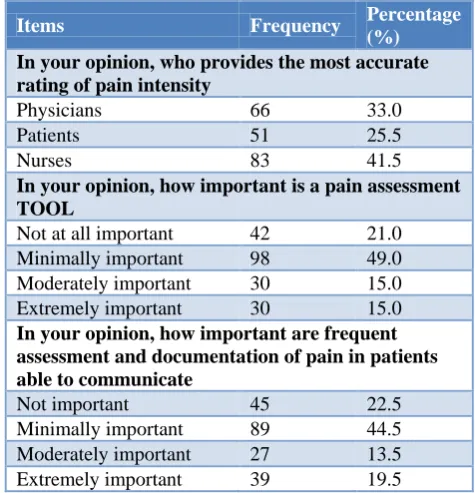
Table 3 showed that the majority (41.5%) of the respondent’s opinion regarding who provides the most accurate rating of pain intensity was nurses, followed by physicians (33%) and the rest of the respondents mentioned patients (25.5%). Close to half (49%) of the respondents mentioned that pain assessment tool is minimally important, followed by not at all important (21%). About 44.5% of the respondents stated that frequent assessment and documentation of a pain in patients able to communicate was minimally important.
Table 3: Nurses’ knowledge related to pain assessment in critically ill patients (n=200).
Items Frequency Percentage
(%) In your opinion, who provides the most accurate rating of pain intensity
Physicians 66 33.0
Patients 51 25.5
Nurses 83 41.5
In your opinion, how important is a pain assessment TOOL
Not at all important 42 21.0
Minimally important 98 49.0
Moderately important 30 15.0
Extremely important 30 15.0
In your opinion, how important are frequent assessment and documentation of pain in patients able to communicate
Not important 45 22.5
Minimally important 89 44.5
Moderately important 27 13.5
Extremely important 39 19.5
Nurses’ practices related to pain assessment in critically ill patients
Table 4 showed that most of the respondents (61.5%) were using a pain assessment tool for patients sometimes, followed by routinely (23%), often (11%) and seldom (4.5%). About 71% of the respondents used to read any guidelines for pain assessment and management for critically ill patients and more than seven-tenths (77.5%) were feeling competent in effectively assessing patients for having pain. About 61% of the respondents always agreed with patients statements about their pain and 73.5% of the respondents were documenting the findings after pain assessment for patients able to communicate.
Association between level of education and other variables
using pain assessment tool. However it has been reported that educational level of the respondents was found significantly associated with current knowledge
(p<0.001) about pain assessment and using a pain assessment tool (p<0.000).
Table 4: Nurses’ practices related to pain assessment in critically ill patients (n=200).
Items Frequency Percentage (%)
Frequency of using a pain assessment tool for patients
Seldom (1-25%) 9 4.5
Sometimes (26-50%) 123 61.5
Often (51-75%) 22 11.0
Routinely (76-100%) 46 23.0
Reading any guidelines for pain assessment and management for critically ill patients
Yes 142 71.0
No 58 29.0
Feeling competent in effectively assessing patients for having pain
Yes 155 77.5
No 45 22.5
Always agree with patients’ statements about their pain
Yes 122 61.0
No 78 39.0
Documenting the findings after pain assessment for patients able to communicate
Yes 147 73.5
No 53 26.5
Table 5: Association between level of education and other variables (n=200).
Variables Educational level Chi-square P value
Diploma B.sc in nursing Masters/PhD Total
Current knowledge about pain assessment
Yes 109 28 31 168 40.181 P<0.001
No 10 22 0 32
Using a pain assessment tool
Yes 62 24 31 117
No 57 26 0 83 26.269 P<0.001
Total 119 50 31 200
DISCUSSION
In the present study about 84% of the respondents currently had adequate knowledge about pain assessment. Our finding is higher than the one reported in a similar study, where only 41% of the nurses indicated that they had sufficient knowledge.16 Above half (58.5%) of the respondents were using a pain assessment tool and about 74.5% of the respondents mentioned that pain scores and management discussed during nurse to nurse report. Nine-tenth (90%) of the respondent’s mentioned that it is important to assess for pain and need for analgesia before, during, and after drain removal. Critically ill patients have a right to pre-emptive analgesia. It’s among the scientific practices or principles for pain management.17
Close to half (49%) of the respondents said pain assessment tool is minimally important, followed by not at all important (21%). About 44.5% of the respondents
said frequent assessment and documentation of a pain in patients able to communicate is minimally important. This is contrary to the findings of other studies conducted in Tanzania and Canada who reported minimal or no documentation practices among nurses caring for critically ill patients.18,19
tool (p<0.001). Some studies also reported that there is increasing evidence on the impact of continuing education programmes on pain assessment practices.22,23
CONCLUSION
The findings of this study revealed that the nurses were reasonably knowledgeable about the principles of pain assessment. Nevertheless, lack of knowledge on some key principles of pain assessment is worth noting. More than four-fifths of the respondents currently had adequate knowledge about pain assessment. It also reveals that educational level of the respondents was found significantly associated with current knowledge about pain assessment and using a pain assessment tool.
Recommendations
This study recommended a need to implement a continuous professional education program regarding the pain and its assessment. It also recommends for a supportive environment to ensure proper and continued use of tools, protocols and charts.
ACKNOWLEDGEMENTS
The authors would like to thank Department Public Health, Daffodil International University, Dhaka Bangladesh and Square College of Nursing, Dhaka, Bangladesh.
Funding: No funding sources Conflict of interest: None declared
Ethical approval: The study was approved by Faculty of Allied Health Sciences Research Ethics Committee” through Department of Public Health, Daffodil International University Dhaka Bangladesh
REFERENCES
1. Puntillo KA. Pain experiences of intensive care patients. Heart Lung. J Clin Care. 1990;19:526-33. 2. Bruster S, Jarman B, Bosanquet N, Weston D, Erens
R, Delbanco TL. National survey of hospital patients. British Med J. 1994;309:1542-6.
3. Gelinas C. Pain management in critically ill ventilated adult: Validation of the Critical- Care Pain Observation Tool and Physiologic Indications. Clin J Pain. 2007;23:497-505.
4. Gelinas C, Fillion L, Puntillo KA, Viens C, Fortier M. Validation of the critical care pain observation tool in adult patients. American Journal of Critical Care. 2006;15:420-7.
5. Arif M, Grap JM. Comfort and sedation. In Sole MB, Klein DG, Moseley MJ (Eds.), Introduction to Critical Care Nursing. 2009: 55-83.
6. Pasero C, Puntillo K, Li D, Mularski RA, Grap MJ, Erstad BL, et al. Structured approaches to pain management in the ICU. Chest. 2009;135:1665–72.
7. Bower TC, Reuter JP. Analgesia sedation and neuromuscular blockade in the 56 trauma patient. In McQuillam KA, Makic MBF, Whalen E. (Eds.), Trauma Nursing from resuscitation through rehabilitation. 4th edition. Saunders Elsevier; 2009: 372-421.
8. Rose L, Haslam L, Craig D, Knechtel L, Fraser M, Pinto R. et al. Survey of assessment and management of pain for critically ill patients. Intensive Critical Care Nursing. 2011;27:121-8. 9. Ashley E. Pain management in critically ill 2009.
Available at: from http://findarticles.com. Accessed on 3 June 2018.
10. Shannon K, Bucknall T. Pain management in critical care: What have we learnt from research: Intensive Critical Care Nursing. 2003;19:154-62.
11. Zimmermann PG. Pain assessment and
management. In Scheetz L. (Eds.) Triage Nursing Secrets; 2006: 55-64.
12. Brennan F, Carr DB, Cousins M. Pain management: a fundamental human right. Anesthesia Analgesia. 2007;105:205–21.
13. Thomas J. Practical peri-operative pain control in children and adults. South African J Anaesthesia Analgesia. 2008;14:11-7.
14. Herr K, Coyne PJ, Key T, Manworren R, McCaffery M, Merkel S. et al. Pain assessment in the nonverbal patient: position statement with clinical practice recommendations. Pain Manag Nurs. 2006;7:44-52. 15. Turina M, Miller F, Tucker C, Polk HC. Short-term
hyperglycemia in surgical patients and a study of
related cellular mechanisms. Ann Surg.
2006;243:845-51.
16. Kituyi WP, Imbayo KK, Wambani JO, Sisenda TM, Kuremu RT. Postoperative pain management: Clinicians’ knowledge and practices on assessment and measurement at Moi Teaching and Referral Hospital. East Central African J Surg. 2011;16:20-24.
17. Macintyre PE, Schug SA, Scott DA, Visser EJ, Walker SM. APM: SE 59 Working group of the
Australian and New Zealand College of
Anaesthetists and Faculty of Pain Medicine 2010. Acute Pain Management: Scientific Evidence (3rd Edition). Available at: https://www.nhmrc.gov.au/. Accessed on 3 June 2018.
18. Haonga BT, Makupa JE, Muhina RI, Nungu KS. Pain management among adult patients with fractures of long bones at Muhimbili Orthopaedic Institute in Dar-es-Salaam, Tanzania. Tanzan J Health Res. 2011;13:107-11.
19. Watt-Watson J, Stevens B, Garfinkel P, Streiner D, Gallop R. Relationship between nurses’ pain knowledge and pain management outcomes for their post–operative cardiac patients. J Adv Nursing. 2001;36:535–45.
21. Taylor A, Stanbury L. A review of post-operative pain management and the challenges. Curr Anaesthesia Critical Care. 2009;20:188-94.
22. Bedard D, Purden M, Certosini C. The pain experience of post-surgical patients following the implementation of evidence-based approach. Pain Management Nursing. 2006;7:80-92.
23. Maysoon SA. Postoperative pain assessment and management;the effects of educational program of Jordanian nurses’ practices, knowledge and attitudes
2009. Available at: www.CutePDF.com. Accessed on 3 June 2018.