Original Research Article
A cross-sectional study on menstrual hygiene practices among school
going adolescent girls (10-19 years) of Government Girls
Inter College, Saifai, Etawah
Nandini Gupta
1, Peeyush Kariwala
2, Anand M. Dixit
1*, Parag Govil
3, Mahima
1, Pankaj K. Jain
1INTRODUCTION
As described by World Health Organization (WHO) adolescence is the transitional phase of growth and development between childhood to adulthood (10-19 years).1 In attainment of full maturity, there are many variations from physical, psychological, emotional and physiological. There are many problems faced during this potentially turbulent period by adolescents. When there is imbalance between growth and hormones, a child can present with being short or tall, menstrual irregularities,
obesity and acne.2 Menstruation is one such condition where, every girl go through physical and psychological changes and they have to cope up with this natural process. For a female to live healthy, productive and dignified lives, it is essential that they are able to manage menstrual hygiene effectively. During menstruation, access to clean water, sanitation and hygiene services, including water for washing clothes, having some private area to change clothes or sanitary pads, facilities for hygienic disposal of used clothes and pads, and a proper health education regarding management of menstrual
ABSTRACT
Background: Menstrual hygiene is a key concern of adolescent health. Females spend around six to seven years of their lives menstruating. Still the menstrual hygiene management (MHM) is mostly neglected. Menstrual hygiene is a taboo; even females are uncomfortable discussing and educating their daughters about this topic. To understand the problem faced by females during menstruation specially in their adolescent age this study was conducted. This study was done to find out knowledge about menstrual hygiene, to study hygiene related practices among school going adolescent girls of Government Girls Inter College (GGIC), Saifai, Etawah.
Methods: School based cross-sectional study was undertaken among the adolescent school going girls of GGIC, who were purposively selected. All girls of between the age group of 10 19 years who have attained menarche were selected and the sample size came out to be 212.
Results: The mean age of attainment of menarche was 13.17 years with majority of girls having no idea about menstruation before menarche (76.4%). 48.6% girls used only sanitary pads as the absorbent material. It was concluded that there is significant association between the absorbent material used and the socio-economic status of the family (p=0.03173).
Conclusions: There is a need of accurate and adequate information about menstruation and its effective management. The restrictions which are imposed on girls during menstruation should be understood and dealt in a proper way. Thus this study was conducted.
Keywords: Adolescence, Menstruation, Hygiene
Department of Community Medicine, 1UPUMS, Saifai, Uttar Pradesh, 2Dr. RML IMS, Lucknow, Uttar Pradesh,
3
CMC, Ludhiana, Punjab, India
Received: 12 August 2018
Accepted: 12 September 2018
*Correspondence:
Dr. Anand M. Dixit,
E-mail: [email protected]
Copyright: © the author(s), publisher and licensee Medip Academy. This is an open-access article distributed under the terms of the Creative Commons Attribution Non-Commercial License, which permits unrestricted non-commercial use, distribution, and reproduction in any medium, provided the original work is properly cited.
hygiene is an important part.3 Poor personal hygiene and unsafe sanitary conditions can lead to increased vulnerability to reproductive tract infections, pelvic inflammatory disease and other complications. According to Thakre et al, we can achieve MDG- 2 on universal education and the MDG-3 on gender equality and women empowerment by maintaining good menstrual hygiene.4 This issue of menstrual hygiene is inadequately acknowledged and has not received proper attention. Although a natural process, menstruation is linked with several misconceptions and practices which sometimes results in adverse health outcomes. The data about the level of knowledge and practices with respect to menstruation are beneficial for planning a program for improving the awareness level and promoting their quality of life. Hence, the present cross sectional study was carried out.
Aim and objectives
This study was done to find out knowledge about menstruation, to study hygiene related practices and taboos associated with menstruation among school going adolescent girls (10-19 years) of Government Girls Inter College (GGIC), Saifai, Etawah.
METHODS
A school based cross-sectional study was undertaken among the adolescent school going girls of Government Girls Inter College (GGIC), Saifai, Etawah, who were purposively selected. All girls of above mentioned school between the age group of 10-19 years who have attained menarche were selected. Total sample size came out to be two hundred twelve. The study was conducted between 15th August to 30th September, 2016. GGIC is a state run Government Inter College for girls.
Inclusion criteria
Includes adolescent girls of age group 10-19 years, who are attending GGIC from classes 6th to 12th and have attained menarche
Exclusion criteria
Girls who are not in the above mentioned age group or have not attained menarche and are not willing to participate in study were excluded from our study. Study tools and technique
After taking written permission from the school authorities, the teachers of class 6th to 12th were explained the purpose of study, a rapport was built with the students and verbal consents were taken. All the girls who attained menarche were included in the study and interviewed. The data was collected by a personal interview by post graduate students who were trained prior to the interview
of all the study participants. The questionnaire was a pre-designed, pretested on a sample population other than study population and necessary changes were done. The questionnaire includes the demographic details of the participant including the parents’ education, occupation, their socio-economic status, along with awareness about menstrual hygiene, practices followed by them and taboos attached with it. At the end of data collection, an audio visual session was conducted for educating the girls about the normal physiology of menstruation, the importance of maintaining hygiene and safe hygienic practices during menstruation. Questions and concerns of the participants were also addressed at the end of the session.
Statistical analysis
Data was coded and entered in Microsoft excel sheet and then imported into IBM SPSS (Statistical Package for the Social Sciences) software version 21 and analyzed accordingly.
RESULTS
Various socio-demographic details of study participants were taken into account, a pie chart showing the age distribution of study participants, almost two-third of girls are in age group of -15 years with mean age of 15.45±1.31, while the age range was 13-18 (Figure 1).
Figure 1: Age distribution of study participants.
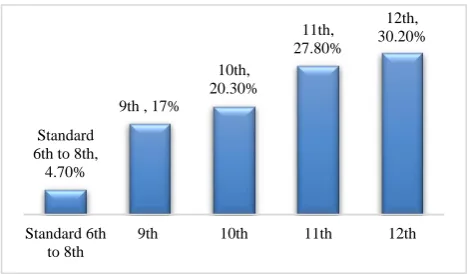
Figure 2: Education status of study participants.
10 to 13 yrs 9%
14 to 16 yrs 70% 17 to 19 yrs
21%
10 to 13 yrs 14 to 16 yrs 17 to 19 yrs
Standard 6th to 8th, 4.70%
9th , 17%
10th, 20.30%
11th, 27.80%
12th, 30.20%
Standard 6th to 8th
A bar diagram representing education status of study participants shows that approximately one third of girls were in 12th standard (30.2%) and about 28% are in 11th standard (Figure 2).
Figure 3: Socio-economic status of study participants.
According to modified B. J. Prasad classification March 2016 CPI=268, shows that most of the girls belong to lower class of socio-economic status (49.1%) and only 0.9% were in upper class (Figure 3).
Figure 4: Age of attainment of menarche (years).
Mean age of attainment of menarche was 13.17 +/- 1.4 years. The age of attainment of menarche. 161 (75.94%) girls are of age group 13-15 when they attained menarche. While only 2.36% girls attained it between 16-19 years (Figure 4).
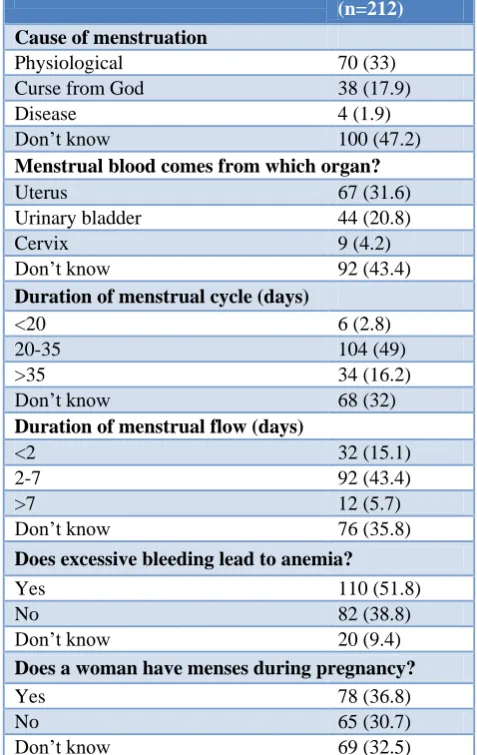
As we can observe in Table 1 the knowledge regarding menstruation in girls, majority (47.2%) of girls have no idea about the cause of menstruation while only 33% mentioned it to be a physiological cause. 43.4% of girls had no idea from where the menstrual blood comes from and only 31.6% mentioned it to be from uterus. Most of the girls (49%) knew about the normal duration of menstrual cycle. Normal duration of menstrual flow was also mentioned correctly by most of the girls (43.4%). Most of the girls also knew that excessive bleeding can lead to anemia i.e. 51.8% while 36.8% girls mentioned that menstruation continues in pregnancy also (Table 1).
Table 1: Regarding knowledge about menstruation.
Number (%) (n=212) Cause of menstruation
Physiological 70 (33) Curse from God 38 (17.9)
Disease 4 (1.9)
Don’t know 100 (47.2)
Menstrual blood comes from which organ?
Uterus 67 (31.6)
Urinary bladder 44 (20.8)
Cervix 9 (4.2)
Don’t know 92 (43.4)
Duration of menstrual cycle (days)
<20 6 (2.8)
20-35 104 (49)
>35 34 (16.2)
Don’t know 68 (32)
Duration of menstrual flow (days)
<2 32 (15.1)
2-7 92 (43.4)
>7 12 (5.7)
Don’t know 76 (35.8)
Does excessive bleeding lead to anemia?
Yes 110 (51.8)
No 82 (38.8)
Don’t know 20 (9.4)
Does a woman have menses during pregnancy?
Yes 78 (36.8)
No 65 (30.7)
Don’t know 69 (32.5)
Table 2 shows that majority of girls had no idea about menstruation before attainment of menarche (76.4%). More than three fourth (80%) of the girls gained information regarding menstruation from their mothers. A total of 47.2% girls had a feeling that menstruation is a burden. 48.6% girls used only sanitary pads as the absorbent material and 25.9% uses old cloth piece. Majority of girls change their sanitary pads/cloth more than once a day (61.8%). Most of the girls (95.5%) mentioned that they do not re-use cloth/pads while only 0.9% girls accepted that they re-use the cloth after washing it. Majority of girls (51.4%) dispose off their used sanitary pads/cloth in open field and about 8.5% dispose it off in well/lakes. More than two third (68.4%) girls used to buy their own sanitary napkins and only 2.9% received it from ASHA of their particular village. In table 2, this is also observed that more than half of girls (52.8%), used soap and water to clean their genital area during menstruation and just 0.9% used luke warm water.
0.90% 3.80%
13.70%
32.50%
49.10%
0.00% 10.00% 20.00% 30.00% 40.00% 50.00% 60.00%
Upper class
Upper middle class
Middle class
Lower middle class
Lower class
46
161
5
0 20 40 60 80 100 120 140 160 180
Table 2: Hygiene practices during menstruation.
N (%) Heard about menstruation before menarche (N=212)
Yes 50 (23.6)
No 162 (76.4)
Source of information regarding menstruation before menarche (multiple responses)
Family members (mother/sister) 40 (80)
Teachers 2 (4)
Friends 9 (18)
Material used during menstruation (N=212)
Sanitary pads 103 (48.6)
New cloth pieces 19 (9)
Old cloth pieces 55 (25.9)
Mixed use 35 (16.5)
Change of sanitary pad/cloth (N=212)
Once daily 68 (32.1)
More than once daily 131 (61.8)
Once in 2-3 days 13 (6.1)
Re-use of cloth (N=110)
Yes 1 (0.9)
No 105 (95.5)
Sometimes 4 (3.6)
Method of disposal of sanitary pad/cloth (N=212)
Dispose in open 109 (51.4)
Dispose in waste bin 79 (37.3)
Dispose in sanitary latrine 6 (2.8)
Dispose in well/lake 18 (8.5)
Source of sanitary pads (multiple responses)
ASHA 4 (2.9)
Family (mother/sister) 47 (34.6)
Self-Purchase 93 (68.4)
Genital area cleaned during menstruation with (N=212)
Plain water 98 (46.2)
Luke warm water 2 (0.9)
Soap and water 112 (52.8)
Table 3: Relationship between absorbent material used and socioeconomic status.
SES
Material used
Total n (%) Sanitary pads
N (%)
New cloth piece N (%)
Old cloth piece N (%)
Mixed use N (%)
Upper, upper middle and middle 27 (69.2) 1 (2.6) 6 (15.4) 5 (12.8) 39 (100)
Lower middle and lower 76 (43.9) 18 (10.4) 49 (28.3) 30 (17.3) 173 (100)
Total 103 (48.6) 19 (9) 55 (25.9) 35 (16.5) 212 (100)
²=12.42, df=3, p=0.03173.
Table 4: Relationship between absorbent material used and mother’s education.
Mother’s education
Material used
Total n (%) Sanitary pads
n (%)
New cloth piece n (%)
Old cloth piece n (%)
Mixed use n (%)
Illiterate, primary and high school 76 (43.4) 19 (10.9) 50 (28.6) 30 (17.1) 175 (100)
High school and above 27 (72.9) 0 (0) 5 (13.5) 5 (13.5) 37 (100)
Total 103 (48.6) 19 (9) 55 (25.9) 35 (16.5) 212 (100)
Table 3 shows the relationship between absorbent material used and SES of the family, chi square test was applied and it describes that there is significant association between the absorbent material used and SES. Table 4 shows the relationship between absorbent material used and mother’s education, chi square test was applied and this is again found to be significant.
Table 5: Restrictions practiced during menstruation.
Restrictions (multiple responses) N (%)
Visit to holy places 212 (100)
Touching stored food 105 (49.5)
Entry in kitchen 83 (39.2)
Household work 20 (9.4)
Sleep on routine bed 11 (5.2)
Going school 1 (0.5)
Table 6: Problem faced in school during menstruation.
Problems N (%)
Menstruation affecting school performance (n=212)
Yes 120 (56.6)
No 92 (43.4)
School absenteeism due to menstruation (n=212)
Yes 81 (31.2)
If yes, regular 26 (12.3)
Sometimes 55 (25.9)
No 131 (61.8)
Menstrual hygiene privacy in school (n=212)
Yes 172 (81.1)
No 40 (18.9)
Access to clean water (n=212)
Yes 212 (100)
No 0 (0)
Share problems with (multiple responses)
Family 129 (60.8)
Friends 91 (42.9)
Teachers 1 (0.5)
Supply of sanitary pads in school (N=212)
Yes 4 (1.9)
No 205 (96.7)
Sometimes 3 (1.4)
Feel comfortable in school (N=212)
Yes 127 (59.9)
No 85 (40.1)
Reason of being uncomfortable (N=85)
Abdominal pain 50 (58.8) Fear of getting stained 23 (27.1)
Headache 2 (2.3)
Uneasiness 6 (7.1)
Weakness 4 (4.7)
In India, there are some restrictions when a girl is menstruating which are followed in almost every family,
some such restrictions have been discussed here in Table 5. In this table we can observe that 100% girls have restrictions in visiting holy places. 49.4% girls are not allowed to touch the stored food while only a single girl (0.5%) mentioned about missing her school during menstruation.
In Table 6, some important problems faced by girls in school during menstruation are discussed, because of which there is increased tendency of missing schools. A total of 56.6% (120) girls felt that the menstruation does affect their performance in school, 12.3% girls regularly missed their schools during menstruation every month. 81.1% (172) girls feel that they have proper privacy in school related to their menstrual hygiene. 100% girls get their access to clean water in schools. Most of the girls i.e. 96.7% (205) mentioned that they were not provided with sanitary pads in school. About half of the girls (58.8%) mentioned abdominal discomfort as their most common factor of being uncomfortable in school.
DISCUSSION
show nearly same results as76.23%, 82% girls had no idea about menstruation and in one more study only 23.2% girls knew about menstruation.4,5,10 In our study mothers are the major source of knowledge regarding menstruation in about 80% and in other studies it was 59.7%, 62%, 83% and 64.9%which is almost similar to our study.5,8,10,11 In our study, majority of girls’ dispose of sanitary pads or cloth used in open field (51.4%) while in another study it was found that majority girls incinerate the cloth they are using i.e. 61.3%while 57.6% of girls using sanitary pads are disposed of in closed bin by wrapping it in paper while Madhusudan et al shows that majority of girls dispose of the sanitary pads by burning them i.e. 43.2% and 36.8% dispose in dustbinand by another study we can see that 50.6% were disposing the sanitary pads in open dustbins.5,6,9 Varied restrictions are followed by most of the girls in our study, possibly due to the different rituals in their communities, the same were practiced by their mothers or other elderly girls in the family, due to their ignorance and false perceptions about menstruation, visit to holy places was most common (100%) seen in other studies also.4-6 A meta-analysis was done by Eijk etalwhich involves data from 138 studies involving 193 subpopulations and 97,070 girls.12 This meta-analysis shows that in 88 studies, half of the girls reported being informed prior to menarche (PP 48%, 95% CI 43% to 53%, I2 98.6%). Commercial pad use was more common among urban (PP 67%, 57% to 76%, I2 99.3%, n=38) than rural girls (PP 32%, 25% to 38%, I2 98.6%, n=56, p<0.0001), with use increasing over time (p<0.0001). Inappropriate disposal was common (PP 23%, 16% to 31%, I2 99.0%, n=34).
CONCLUSION
Menstrual hygiene is an issue which needs to be addressed at all levels. This study has highlighted the need of adolescent girls to have accurate and adequate information about menstruation and its appropriate management. Formal as well as informal channels of communication such as mothers, sisters and friends, need to be emphasized for the delivery of such information. There is a strong need to address issues like the restrictions which are imposed on or practiced by the adolescent school girls. Hence an educated adolescent girl will take care of her girl child in the future and will maintain the cycle of spreading the information to the next generation.
Limitations
Considering the limitations of this study in terms of sampling method, additional studies may be needed using a wider geographic scope, in order to produce sufficient and comprehensive results.
Funding: No funding sources Conflict of interest: None declared
Ethical approval: The study was approved by the Institutional Ethics Committee
REFERENCES
1. World Health Organisation. Available at: http://www.who.int/topics/adolescent_health/en/. Accessed on 24th August, 2016.
2. Medovy H, Man W. General Practices- Problems of adolescence. Canad Med Ass J. 1964;90(24):1354-60.
3. Menstrual hygiene in South Asia A neglected issue for WASH (water, sanitation and hygiene) programmes, Thérèse Mahon and Maria Fernandes. Gender & Development 2010, copyright Oxfam GB; Gender & Development. Available at: http://www.informaworld.com/smpp/title~db=all~c ontent=g 919513531. Accessed on 28th August 2016.
4. Thakre SB, Thakre SS, Reddy M, Rathi N, Pathak K, Ughade S. Menstrual Hygiene: Knowledge and Practice among Adolescent School Girls of Saoner, Nagpur District. J Clin Diagnos Res. 2011;5(5):1027-33.
5. Madhusudan M, Chaluvaraj TS, Chaitra MM, Ankitha S, Pavithra MS, MahadevaUrthy TS. Menstrual Hygiene: Knowledge and Practices among Secondary School girls of Hosakote, Rural Banglore. Int J Basic Applied Med Sci. 2014;4(2):313-20.
6. Parmeaswari PJ, Udayshankar PM, Cynthia S, Vidhyashree MD, Abeselvi A, Syed Iqbal Sultan. School Survey to Assess Menstrual Hygiene Practices Among Teenage Girls in Chennai, India. Middle-East J Sci Res. 2014;21(9):1448-53.
7. Chauhan S, Kariwal P, Kumari, Vyas S. A study to evaluate abnormal menstrual patterns among adolescent girls in Bareilly. Int J Med Res Health Sci. 2015;4(3):601-7.
8. Israr H. IRSP Pakistan, Menstrual Hygiene promotion need in Mardan. Available at: www.
ircwash.org/sites/default/files/IRSP-2010-Menstrual.pdf. Accessed on 24th April 2018. 9. Seenivasan P, Caroline Priya K, Arthi E, Gaviya G,
Kanchana Devi B, Karunya C. A cross sectional study on awareness about menstrual hygiene among rural women. Stanley Med J. 2015;2(2):17-21. 10. Baseline survey report on School Girls’ Menstrual
Hygiene Management issues, 2014.
11. Singh SP, Singh M, Arora M and Sen P. Knowledge assessment regarding puberty and menstruation among school going adolescent girls of district Varanasi, UP. Indian J Prev Soc Med. 2006;37:9-14. 12. Eijk AMV, Sivakami M, Thakkar MB, Bauman A, Laserson KF, Coates S, et al. Menstrual hygiene management among adolescent girls in India: a systematic review and meta-analysis. BMJ Open. 2016;6:e010290.