E 24 MECHANICAL ENGINEERING: Computational Mechanics JOURNAL OF ENGINEERING SCIENCES
ЖУРНАЛ ІНЖЕНЕРНИХ НАУК
ЖУРНАЛ ИНЖЕНЕРНЫХ НАУК
Web site: http://jes.sumdu.edu.ua DOI:
10.21272/jes.2019.6(2).e4
Volume 6, Issue 2 (2019)Computer Engineering and Design of Cast Parts for Internal Combustion Engine Crankcase
Akimov O. V.1, Marchenko A. P.1, Alyokhin V. I.1, Soloshenko V.2, Shinsky O. Y.3, Klymenko S. I.3, Kostyk K. O.1*1 National Technical University “Kharkiv Polytechnic Institute”, 2 Kyrpychova St., 61002 Kharkiv, Ukraine; 2 “General Electric” Ltd, 110/114 Krakowska Al., 02-256 Warsaw, Poland;
3 Physico-Technological Institute of Metals and Alloys of the National Academy of Sciences of Ukraine, 34/1 Vernadskogo Blvd., 03142 Kyiv, Ukraine
Article info:
Paper received:
The final version of the paper received: Paper accepted online:
September 14, 2019 November 30, 2019 December 5, 2019
*Corresponding Author’s Address:
[email protected]
Abstract. This paper discusses the formulation of the problem of designing the cast parts block-crankcases engine in order to ensure its quality for the case study of cast iron parts of the cylinder block inline four-cylinder gasoline engine with the capacity of 1.4 dm3. Material Ch190B is gray cast iron with optional chemical composition, and sulfur – no more than 0.15 %, phosphorus – no more than 0.1 %, structure – perlite plate. The results obtained in this work confirm the conclusions about the possibility of reducing the metal content of the casting and changing the technical conditions of its manufacture. According to the results of the research, the developed recommendations are aimed at stabilizing the characteristics of the metal, reducing metal consumption, and changing the technical conditions for the defectiveness of this type of castings. Recommendations for changing the configuration of the partition in order to reduce the metal content of the casting and recommendations for changing the Technical Conditions for casting defects were stated for the casting block crankcase 4ChN12/14. For defects of discontinuity type, the maximum size was defined, and controlled places of their detecting were defined.
Keywords: CAD, CAE, block-crankcase, 3D model, casting defect.
1
Introduction
In the ranking of the international organization of automakers “OICA” Ukraine rose one step and from the fourth group got to the third, among the countries that produce more than 400 thousand cars a year. These findings at a press conference said President of the Association of carmakers of Ukraine "Ukravtoprom" Michael Resnick.
Based on the above, Ukrainian automakers are faced with large science-intensive tasks to improve the performance of modern internal combustion engines produced in Ukraine. Improving the performance of modern internal combustion engines is impossible without a deep modernization of their design, whether the engine as a finished product, its components or individual parts. As shows domestic and world experience, perfect can be only a design based on the design which incorporated the technological aspects of the manufacture of parts and engine components, this approach ensures optimal performance of the engine [1].
Journal of Engineering Sciences, Volume 6, Issue 2 (2019), pp. E 24–E 30 E 25
2
Literature Review
The current state of the issue of design of engine parts and CAD of technological preparation of production at one of the defining stages of production of engine parts – the manufacture of cast engine parts – does not allow talking about an effective compromise, often in real production, we can talk about deep contradictions [1, 3– 5]. The reason for this is the lack of knowledge of many processes occurring during the formation of the casting and ultimately determine the real, not theoretically designed design of the part, as well as the accuracy of the geometric parameters, which is one of the main indicators of the quality of cast parts of the internal combustion engine. The influence of the deviation fields of the cast parts quality indicators on the parametric and functional reliability of the engine parts is not determined. This, in turn, leads to a decrease in the reliability of the engine parts, reduce their performance and service life [6, 7].
The absence of methods for determining the influence of casting design, size fluctuations, casting defects and dispersion of mechanical properties on the state of the elements of the future parts of the ice does not allow to predict the level of technical perfection of cast parts of the ice at the stage of their design [8, 9]. Therefore, it is not possible to increase the operational level and life of cast parts of the ice, to lay their high performance at the design stage without parallel optimization of the process parameters.
3
Research Methodology
This publication presents a series of studies carried out at the departments of Internal Combustion Engines and Foundry NTU “KhPI” and is dedicated to the problem of ensuring the quality of the cast parts of the internal combustion engine of a difficult geometrical configuration according to the criterion of functional and parametric reliability (of body parts) [10–12]. In accordance with this criterion in the design and technological design it is necessary to set and perform the following tasks:
• identification of marriage cast motor parts;
• identification of "bottlenecks" in the part design from the technological point of view;
• simulation of the stress state of cast parts; • modeling of crystallization processes;
• identification of residual stress formation factors at the stage of cast parts manufacturing.
This paper discusses the formulation of these problems in order to ensure the quality of the first object of study-cast iron parts of the cylinder block inline four-cylinder gasoline engine capacity of 1.4 dm3 for the car
DAEWOO SENS. Customer “AvtoZAZ-Motor” Melitopol (Ukraine), material Ch190B – gray cast iron with optional chemical composition, sulfur – no more than 0.15 %, phosphorus - no more than 0.1 %, structure – perlite plate. Manufacturer LLC “Ukrainian Foundry Company”, serial-700 cast parts per month.
4
Results
The material of such cast parts, in addition to the mechanical strength, must have the necessary density of the structure. On the basis of the conditions and requirements of the material in the article was considered such aspects as:
• analysis of the solidification process of cast parts; • analysis of places of the possible appearance of shrinkage defects.
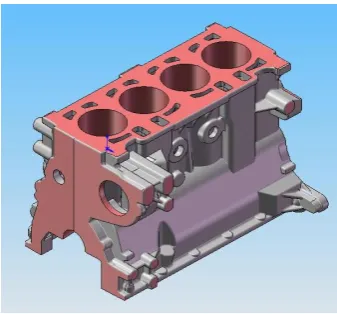
As the 3D model created by us shows, a feature of the cylinder block design is a combination of thin-walled (body thickness 2–4 mm) and thick-walled (body thickness 10–20 mm) arrays (Figure 1), which adversely affects the cast part quality control on the direction of metal crystallization.
To solve the problems associated with the crystallization of the metal conducted research related to the processes of solidification of the cast parts of the cylinder block. For this task, the system of automated modeling of LVM Flow casting processes was chosen, which, with respect to our problem, has certain advantages over its analogs, which include the simplicity of the problem statement, the adequacy of the simulation results and, with the correct formulation of the problem, the relative speed of calculation of the filling and crystallization processes.
Figure 1 – 3D model of the cylinder block
LVMFlow is a software application package for computer simulation of casting. Computer modeling allows us to trace all the processes occurring in the metal when filling out the form, solidification, the occurrence of shrinkage defects before the industrial manufacture of the products themselves. The model equations are solved by the FDM (finite difference) method on a regular rectangular difference grid.
E 26 MECHANICAL ENGINEERING: Computational Mechanics Figure 2 – The nature of solidification of the metal cast part
at a liquid phase content of 25 %
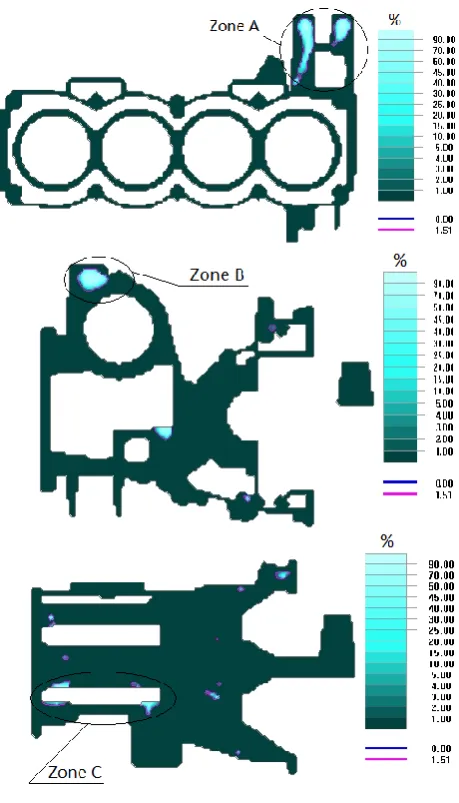
According to the results of the simulation performed by the program, the areas of alleged defect formation were identified (in the LVM Flow program, the model of shrinkage defect formation is based on the percolation theory and is determined as a percentage, as shown on the scale), which are presented in (Figure 3).
A qualitative analysis of the solidification of the cast part and the places of possible defects identified by the program allows determining the problematic places in zones A, B, and C (Figure 3).
The following data were used to model the cylinder block-crankcase: cell size 1.996 mm; total number of cells 17.620.200; casting ultrasonic 607.572; separation coating-layer thickness of 0.3 mm and thermal conductivity of 302 W/(m·K); casting material is special cast iron; specified casting temperature 1400 °C; mold material is furan mixture; initial temperature 20 °C.
Based on such initial data, a simulation was carried out, which revealed the places of the possible origin of defects of shrinkage nature.
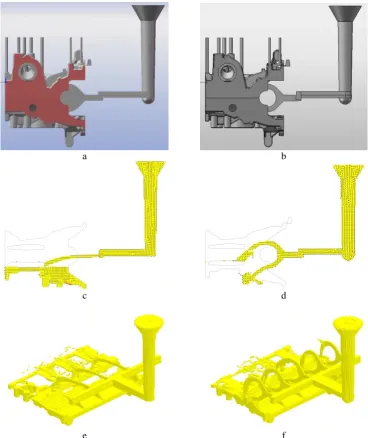
To eliminate such defects, it was decided to upgrade the existing Gating system (Figure 4 a). As the simulation results (Figure 4 c), the Gating system was not completely filled, leading to reduced efficiency of feeders (used not all of the calculated areas) when filling forms with metal.
Presented in Figure 4 c and Figure 5 e metal flow in the form leads to a decrease in the rate of rising of the metal, resulting in the formation of crusts, usually containing oxides and inclusions. In the future, the crust is pressed against the mold surface with a liquid metal (Figure 4 c), there is a breakthrough with the formation of gas bubbles and non-metallic inclusions. Also, when analyzing the modeling of the pouring process, it can be concluded that in the initial stage, a jet of metal hits the rod, blurs it, leading to blockages and changes in geometric dimensions.
Figure 3 – The area of the possible appearance of defects of shrinkable character
In the streamlined Gating system (Figure 4 b) the feeder was divided. As a result, a more uniform temperature distribution was obtained during the cooling of the metal in the form, thereby reducing the risk of shrinkage shells and shrinkage looseness in the casting. Also, the modernized Gating system began to provide a more uniform filling throughout the cavity of the form, which reduced the probability of splashing, the formation of splashes. A jet of metal does not fall into the end of the rod, thus does not destroy it.
Journal of Engineering Sciences, Volume 6, Issue 2 (2019), pp. E 24–E 30 E 27
a b
c d
e f
Figure 4 – Examples of gating systems and fill them with metal
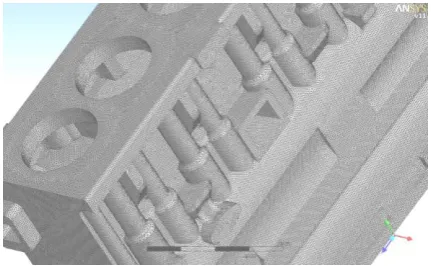
Figure 5 – Finite-element model of the block-crankcase of the internal combustion engine
Thus, the modeling of the pouring process in the LVM Flow program showed that the use of an upgraded Gating system reduced the probability of shrinkage defects, blockages from non-metallic and oxide inclusions, as well as the destruction of the rod by the jet of the poured metal. The use of a streamlined Gating system in the manufacture of the casting block-crankcase of the cylinders of the internal combustion engine will achieve a high quality and performance properties of the finished part.
E 28 MECHANICAL ENGINEERING: Computational Mechanics
5
Discussion
As the second object of research was selected as a cast-iron casting block-sump inline four-cylinder diesel 4ChN12/14.
The problem of ensuring the quality of cast iron casting block crankcase inline four-cylinder 4ChN12/14 was considered in the following aspects:
• static load analysis of the block-crankcase casting and modeling of the casting load capacity;
• analysis of natural oscillations;
• modeling of phase transition and cooling of block-crankcase casting;
• physical and chemical properties of the melt casting • dimensional and geometric analysis of castings and stabilization of geometrical parameters;
• some aspects of the use of computer technology to improve the efficiency of foundry production, including the creation of expert systems based on statistical processing of accumulated databases and knowledge of technological defects in castings.
Thus, to estimate the distribution of residual stresses in the block-crankcase casting, a finite element model was used based on 1.3·106 tetrahedral finite elements with
restrictions on the nodes of the end surfaces, where 2 degrees of freedom from 3 were fixed (Figure 6).
Figure 6 – Finite-element model of the block-crankcase
Figure 7 presents the temperature distribution of the basic casting of the block-crankcase, which occurs after the phase transition of all nodes of the model in the solid-state, C0 and the microstructure of cast iron in the danger zone.
The figure shows that in the central zone of the block crankcase, the most dangerous place for the stress-strain state, graphite is coarse, mechanical properties are low.
In the modernized design, after complete solidification, the microstructure is characterized by a smaller size of graphite inclusions, which is explained by a higher crystallization rate in the thinner wall of the casting. As a result, lower residual stresses and higher mechanical properties (Figure 8.)
Figure 7 – Temperature distribution on the base casting of the block-crankcase arising after the phase transition
of all nodes of the model in the solid-state and the microstructure in the center of the cast part
Figure 8 – Temperature distribution in the modernized casting of the block-crankcase arising after the phase transition
of all nodes of the model in the solid-state and the microstructure in the central part of the casting
A comparative assessment of the block-crankcase of the basic and manufactured according to the modernized design shows that in the latter case there is no residual stress zone. In the basic design of the zone, the zone of maximum intensity of residual stresses (according to the results of static tests) coincides with the zone of fatigue crack occurrence. On the basis of the analysis of the obtained finite element model of the model to assert that the uneven distribution of stresses and their magnitude in the base casting of the crankcase are a potential source of reducing the functional reliability of the housing during the operation of the engine (Figure 9).
Journal of Engineering Sciences, Volume 6, Issue 2 (2019), pp. E 24–E 30 E 29 Distribution of
residual shear stresses (gray – minor, white and black – maximum) after cooling the BASE casting block crankcase.
The zone of maximum intensity of residual stresses (the same area the occurrence of fatigue cracks) in the FE model of the casting of the crankcase.
6
Conclusions
The results obtained in this work confirmed the conclusions about the possibility of reducing the metal content of the casting, changing the technical conditions of its manufacture. According to the results of the research, recommendations were developed aimed at stabilizing the characteristics of the metal, reducing the metal consumption, and changing the technical conditions for the defectiveness of this type of castings. Recommendations for changing the configuration of the partition in order to reduce the metal content of the casting and recommendations for changing the Technical Conditions for casting defects manifested on the walls and walls of the casting block crankcase 4ChN12/14. For defects of discontinuity type, the maximum size is defined, controlled places of manifestation are redefined.
Figure 9 – Distribution of residual shear stresses after cooling of the base casting
of the block crankcase
Figure 10 – The results of dynamic testing on FEM for the base of the casting block-crankcase: a – the third own mode shape of the BASE of the block-crankcase 589 Hz; b – the form of intensity of dynamic stresses
on the third SF of oscillations of the BASE block crankcase, 589 Hz
7
Acknowledgments
We thank Professor of the Department of aircraft engine design at the National Aerospace University named by N. Ye. Zhukovsky “KhAI”, D.Sc., Professor
Oleksandr V. Bilohub and Vice-rector of the National Technical University “Kharkiv Polytechnic Institute”, D.Sc., Professor Andriy P. Marchenko for theoretical and technical help.
References
1. Becker, E. P. (2004). Trends in tribological materials and engine technology. Tribology International, Vol. 37(7), pp. 569–575, doi: 10.1016/j.triboint.2003.12.006.
2. Ye, H. (2003). An overview of the development of Al-Si-alloy based material for engine applications. Journal of Materials Engineering and Performance, Vol. 12(3), pp. 288–297, doi: 10.1361/105994903770343132.
3. Carvalho, O., Buciumeanu, M., Madeira, S., Soares, D., Silva, F. S., Miranda, G. (2015). Optimization of AlSi–CNTs functionally graded material composites for engine piston rings. Materials and Design, Vol. 80, pp. 163–173, doi: 10.1016/j.matdes.2015.05.018.
E 30 MECHANICAL ENGINEERING: Computational Mechanics
5. Harries, S., Abt, C., Brenner, M. (2019). Upfront CAD-Parametric modeling techniques for shape optimization. Advances in Evolutionary and Deterministic Methods for Design, Optimization and Control in Engineering and Sciences, Springer, Cham, pp. 191–211, doi: 10.1007/978-3-319-89988-6_12.
6. Seifi, M., Salem, A., Beuth, J., Harrysson, O., Lewandowski, J. J. (2016). Overview of materials qualification needs for metal additive manufacturing. JOM, Springer, Vol. 68(3), pp. 747–764, doi: 10.1007/s11837-015-1810-0.
7. Zhang, J. H., Chen, M. (2015). Assessing the impact of China’s vehicle emission standards on diesel engine remanufacturing.
Journal of Cleaner Production, Vol. 107, pp. 177–184, doi: 10.1016/j.jclepro.2015.03.103.
8. Sharma, R. S., Singhal, I., Gupta, S. (2018). Innovative Training Framework for Additive Manufacturing Ecosystem to Accelerate Adoption of Three-Dimensional Printing Technologies. 3D Printing and Additive Manufacturing, Vol. 5(2), pp. 170– 179, doi: 10.1089/3dp.2017.0003.
9. Dhahad, H. A., Alawee, W. H., Marchenko, A., Klets, D., Akimov, O. (2018). Evaluation of Power Indicators of the Automobile Engine. International Journal of Engineering & Technology, Vol. 7(4.3), pp. 130–134.
10. Akimov, O., Gusau, I. G., Marchenko, A. P. (2015). An overview of the computer-integrated systems and manufacturing technologies of pistons of internal combustion engines. Eastern-European Journal of Enterprise Technologies, Vol. 6, Issue 1(78), pp. 35–42, doi: 10.15587/1729-4061.2015.56318
11. Akimov, O. V. (2004). Modern systems of computer-aided design, engineering analysis and technological preparation of production. Eastern-European Journal of Enterprise Technologies, Vol. 6(12), pp. 21–36.
12. Alekhin, V. I., Akimov, O. V., Marchenko, A. P. (2008). Computer-integrated modeling of casting processes in the cylinder block Daewoo Sens. Bulletin of NTU “KhPI”, “Machine Science and CAD”, Issue. 2, pp. 3–7.
УДК 004.93
Комп’ютерний інжиніринг та проектування литих деталей
блок-картерів двигунів внутрішнього згорання
Акімов О. В.1, Марченко А. П.1, Альохін В. І.1, Солошенко В.2, Шинський О. Й.3, Клименко С. І.3, Костик К. О.1*
1 Національний технічний університет «Харківський політехнічний інститут», вул. Кирпичова, 2, 61002, Харків, Україна 2 ТОВ «Дженерал Електрік», Краківська ал., 110/114, 02-256, м. Варшава, Польща;
2 Фізико-технологічний інститут металів та сплавів НАН України, бул. Акад. Вернадського, 34/1, 03142, Київ, Україна
Анотація. Відповідно до критерію функціональної і параметричної надійності при конструкторсько-технологічному проектуванні корпусних деталей були поставлені та вирішені наступні задачі: ідентифікація браку литих деталей двигунів внутрішнього згорання; виявлення «вузьких» місць у конструкції деталі з технологічної точки зору; моделювання напружено-деформованого стану литих деталей; моделювання процесів кристалізації; виявлення факторів формування залишкових напружень на етапі виготовлення литих деталей. У цій статті розглядається вирішення вищезазначених питань з метою забезпечення якості першого об’єкта дослідження – чавунної литої деталі блоку циліндрів рядного чотирициліндрового бензинового двигуна об’ємом 1,4 дм3 для автомобілів DAEWOO SENS. Для вирішення поставленої проблеми, пов’язаної з кристалізацією металу, були проведені дослідження процесів затвердіння литих деталей блоку циліндра. Була обрана система автоматизованого моделювання ливарних процесів LVMFlow. Рівняння моделі розв’язувались методом скінченних різниць (FDM) на регулярній прямокутній різницевій сітці. Отримані у даній роботі результати підтверджуються висновками про можливість зниження металоємності виливки і зміни технічних умов її виготовлення. За результатами проведених досліджень були розроблені рекомендації, спрямовані на стабілізацію характеристик сплаву, зниження металоємності ливарної форми та зміни технічних умов щодо дефектності даного виду виливок. Були надані рекомендації щодо зміни конфігурації перегородки з метою зниження металоємності виливки та рекомендації щодо зміни технічних умов на дефекти виливки, що проявляються на стінках і перетинах ливарного блок-картера 4ЧН12/14. Було встановлено, що для ливарних дефектів типу несуцільності визначається максимальний розмір і перевизначаються контрольовані місця.