ISSN: 2395-3519
International Journal of Advanced Trends in
Computer Applications
www.ijatca.com
Performance Analysis and Enhanced Burst Segmentation
Policy for Optical Switching
Sukhwinder Singh1, Shamandeep Singh2
1
Sukhwinder Singh Chandigarh University
Gharuan, Mohali CSE Department [email protected]
2
Shamandeep Singh Chandigarh University
Gharuan, Mohali Assistant professor in CSE
Abstract:
The optical networks square measure a logical option to meet the growing communication demands, with fiber links giving immense bandwidths on the order of twenty five THz. so as to satisfy these growing wants, optical wavelength division multiplexing (WDM) communication systems are deployed in several telecommunications backbone networks. In WDM networks, channels square measure created by dividing the information measure into variety of wavelength or frequency bands, every of which might be accessed by the end-user at peak electronic rates . So as to with efficiency utilize this information measure, we'd like to style economical transport architectures and protocols supported progressive device technology.Keywords:
WDM, OPS, OCS, OBS, PQ: Priority Queuing, QoS : Quality of ServiceI.
INTRODUCTION
The optical networks area unit is a logical option to meet the growing communication demands, with glass fiber links providing vast bandwidths on the order of twenty five terahertz. so as to satisfy these growing wants, optical wavelength division multiplexing (WDM) communication systems are deployed in several telecommunications backbone networks. In WDM networks, channels area unit created by dividing the information measure into variety of wavelength or frequency bands, every of which might be accessed by the end-user at peak electronic rates [1]. So as to with efficiency utilize this information measure, we want to style economical transport architectures and protocols supported progressive device technology. The second generation optical spec consists of wavelength add-drop multiplexers (WADMs) wherever traffic will be added or born at every WADM node [3-4]. Because the quantity of bypass network traffic is sometimes high, WADMs facilitate to cut back the general price by selection dropping and adding traffic on some
wavelengths and so bypassing the traffic on the opposite wavelengths untouched.
The third generation optical network architectures area unit supported a mesh network of multi-wavelength fibers interconnected by all-optical interconnection devices like passive star couplers, passive routers and active switches.
To study and analyze varied optical burst switch arts alternatives in terms of the burst handling techniques and with the come-at-able use of fiber delay-line for
buffering and competition resolution. Degree
ISSN: 2395-3519
Figure 1: Evolution of optical networks
The projected style incorporates little fiber circuit (FDL), economical burst assembly additionally as dynamic route selection techniques, for rising OBS system„s performance, in terms of lower block probability and higher output. Also, to spice up the performance of the projected style in terms of performance metrics like lower switch interval, queuing delay, higher wavelength utilization, worth effectiveness etc, as AN alternate, another performance oriented congestion free OBS description supported optical label method, has been investigated. Further, the performance of the projected OBS architectures has been analyzed and compared with the quality architectures.
Figure 2: Design of a multi-service OBS edge node
II.
Proposed Algorithm
The operating of the planned mechanism is as follows: 1. Receive a Burst
2. Scan its ingress/egress address
3. If either the reserved slot or outgoing slot for Burst is offered
Then
Forward the Burst through the outgoing slot
Lookup the matched entry within the arrival-record table
Else
Drop or Buffer the Burst Go to 2
4. If either the matched entry or match-counter reaches a planned worth
Then
Reserve the slot range for the ingress/egress address for a planned worth
Else
Add AN entry with the slot range and ingress/egress address
Increase the counter by one 5. Go to 1
Although the on top of planned mechanism doesn't mandate the employment of FDL, its QoS performance will be considerably improved even with restricted FDL to resolve rivalry for information measure among multiple bursts.
When burst collision happens as a result of there's no accessible outgoing slot, the core node will attempt to portion the blocked burst in later outgoing slots by exploitation FDL that store one or a lot of bursts and delay transmission. It prevents the loss of non-buffered bursts thanks to competition with buffered bursts.
Scheduling System Operation
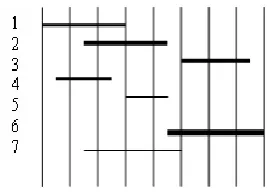
Figure 3: Interval representation
As mentioned on top of, the channel time is partitioned off into a sequence of equal time windows. Throughout every window, a core node keeps aggregation BHPs incoming over the management channel. To be eligible for being regular during this time window, the BHP arrives before its hour. Typically, the window hour is well before of the particular channel time throughout that DBs is transmitted (taking into thought alternative process times like programming time). The sequence of processes as seen by a core node for one channel programming window is as follows:
1. Burst header packets area unit batched.
ISSN: 2395-3519 4. Finally, once DBs arrive, they're forwarded in step
with the schedule set up.
Figure 4: Internal Graph
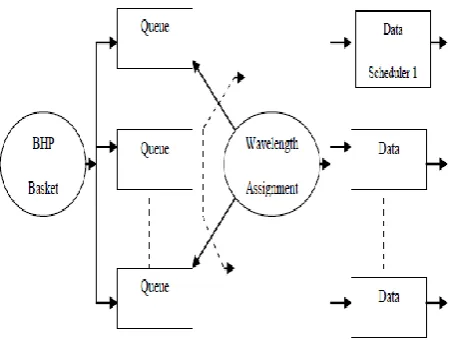
In the planned theme, heuristic interval programming algorithmic rule has been distributed by the channel computer hardware to schedule DBs onto a channel. The fundamental perform of this algorithmic rule is to form an interval graph out of the set of DBs delivered by the classification and channel assignment module. The channel computer hardware then uses this graph to get the utmost range of bursts that may be regular. to realize this, the computer hardware leverages the distinctive properties of AN interval graph so as to seek out a lot of most size within the graph i.e. most stable set of the graph. A lot in purposeless graph may be a set of vertices, every combine of that is connected by a footing in. The lot downside is an improvement downside of finding a lot of most size in graph. The utmost lot downside (MCP) may be a laborious combinatorial downside, classified as NP-Complete. The target of this algorithmic rule is to seek out a lot of most size in graph employing a verification and elimination methodology. If the algorithmic rule provides an output then it's the utmost size lot therein given graph, however it's unacceptable to produce an boundary for the time it takes. Thus, this algorithmic rule is heuristic in nature (heuristic interval programming algorithmic rule has been accustomed realize a lot of most size in graph).
Figure 5: Classifier with channel assignment
Proposed Reservation theme
The most parts of OBS edge router are: Packet computer program Unit, knowledge Channel Unit and management Unit.
1. Packet computer program Unit (PAU): It collects the input packets and places them in bound burst boxes to make bursts. The incoming buffer acts as a computer program for knowledge flows. The computer hardware additionally makes burst request to regulate unit to initiate a sway info packet. The applied mathematics multiplexing is employed to extend utilization of bursts or knowledge channels.
2. Knowledge Channel Unit (DCU): it's the abstraction for a possible wavelength channel to transmit a burst. There are unit 2 states for an information channel. Within the reservation state, resources like wavelength, transceiver and OXC ports area unit allotted to the info channel and therefore a wavelength channel is setup. When the burst is transmitted, the wavelength channel is torn down and also the resources area unit discharged. Within the unharnessed state, the info channel simply waits for brand spanking new reservation command from management unit.
3. Management Unit (CU): The management unit takes care of the management packet. The management packet includes enough info for burst routing, offset time (on that the burst can arrive) and burst length.
III.
Simulation Results
ISSN: 2395-3519 Table 1: Comparison of OBS architecture with proposed
architecture
OBS
Architecture
Throughput Burst Loss Probability
Delay
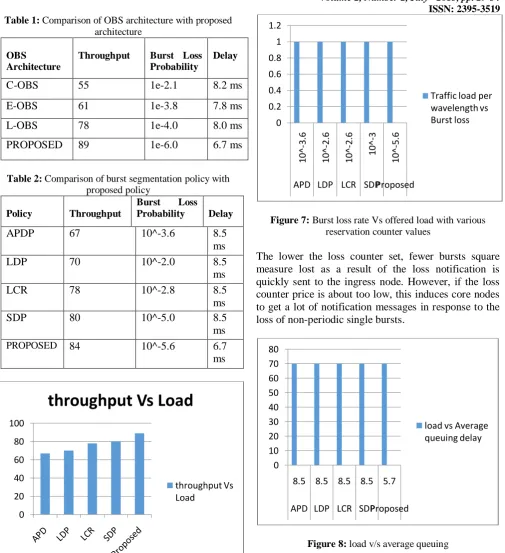
C-OBS 55 1e-2.1 8.2 ms
E-OBS 61 1e-3.8 7.8 ms
L-OBS 78 1e-4.0 8.0 ms
PROPOSED 89 1e-6.0 6.7 ms
Table 2: Comparison of burst segmentation policy with proposed policy
Policy Throughput
Burst Loss
Probability Delay
APDP 67 10^-3.6 8.5
ms
LDP 70 10^-2.0 8.5
ms
LCR 78 10^-2.8 8.5
ms
SDP 80 10^-5.0 8.5
ms
PROPOSED 84 10^-5.6 6.7
ms
Figure 6: Burst loss rate Vs offered load with various flow lengths
The burst loss rate of the mechanism with numerous values of FDL. The burst loss rate is attenuated dramatically. Whereas it's actually potential to boost burst loss rate by permitting bursts to use quite 2 FDL buffers, however that risk isn't thought-about here as a result of its expensive and tough to implement.
Figure 7: Burst loss rate Vs offered load with various reservation counter values
The lower the loss counter set, fewer bursts square measure lost as a result of the loss notification is quickly sent to the ingress node. However, if the loss counter price is about too low, this induces core nodes to get a lot of notification messages in response to the loss of non-periodic single bursts.
Figure 8: load v/s average queuing
That with the planned theme higher results ar obtained in terms of channel utilization. the advance is discovered over the complete vary of mean offered load (0.1 to 0.8). Associate improvement of the planned programming over the traditional JIT programming is shown, specifically at high masses (0.8 to 1.2).
0 20 40 60 80 100
throughput Vs Load
throughput Vs Load
0 0.2 0.4 0.6 0.8 1 1.2
10^
-3
.6
10^
-2
.6
10^
-2
.6
10^
-3
10^
-5
.6
APD LDP LCR SDPProposed
Traffic load per wavelength vs Burst loss
0 10 20 30 40 50 60 70 80
8.5 8.5 8.5 8.5 5.7
APD LDP LCR SDPProposed
ISSN: 2395-3519
Figure 9: Throughput v/s Load
Traffic has higher performance with the projected theme, particularly once the load of the network is larger than seventy. Moreover, as a result of category one traffic consumes additional information measure, it conjointly degrades the performance of sophistication zero traffic. However, it shows that the whole block likelihood within the network is sort of constant, that indicates that projected theme doesn't degrade the block likelihood of the network.
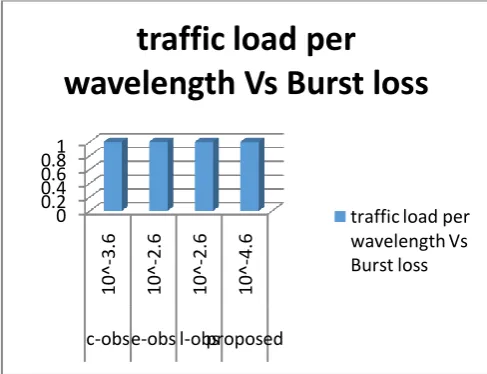
Figure 10: Traffic load per wavelength vs burst loss
The projected theme offers lower burst loss chance than the standard theme. This is often as a result of within the projected theme, owing to previous info at every edge router, the traffic isn't targeting specific link. It‟s ascertained that the projected theme with range of previous info packets (N=2) offers lower burst loss chance than that with range of previous info packets (N=0). This is often as a result of the transmission of previous info packets allows edge routers to induce a lot of info and therefore, the quantity of discarded bursts is reduced during this method.
IV.
Conclusion
To alleviate resource competition, we've got given another economical theme supported resource-reservation and adaptation network flow routing (RR-ANFR). The projected theme tends to offer a lot of flow proportions to the longer ways once traffic load will increase. The performance of RR-ANFR is healthier as compared to equal proportion multi-path flow routing (EPFR) and hop-length based mostly multi-path flow routing (HLFR). Although, each EPFR and (HLFR) distributes traffic flows across multiple ways, they perform worse as a result of they fail to stay track of the variable traffic things within the network. By analysis on the bases of policy and architecture, we can say that our proposed method is give better results in terms of throughput, burst loss and delay.
Future Work
The potential area unit as of future work are to research the end-to-end delay for the projected reservation schemes, to gauge the performance within the case of over 2 packet categories and to research reservation techniques to support delay-based QoS. With optimum offset time with the projected theme, it should be potential to supply nominal loss whereas additionally guaranteeing end-to-end delay.
REFERENCES
1. K. Dolzer, “Assured horizon-An efficient framework for service differentiation in optical burst switched networks,”
Proceedings of SPIE/IEEE OPTICOMM, pp. 149-159, 2002.
2. E. Kozlovski, M. Duser, A. Zapata and P. Bayvel, “Service differentiation in wavelength-routed optical burst-switched networks,” Proceedings of IEEE Optical Fiber
Communications (OFC‘02), pp. 774-776, 2002
3. Q. Zhang, V. M. Vokkarane, B. Chen and J. P. Jue, “Early Drop and Wavelength Grouping Schemes for Providing Absolute QoS Differentiation in Optical Burst Switched Networks,” Proceedings of IEEE GLOBECOM 2003. 4. Q. Zhang, V. M. Vokkarane, J. P. Jue and B. Chen, “Absolute QoS Differentiation in Optical Burst-Switched Networks,” IEEE Journal on Selected Areas in
Communications,vol. 22(9), pp. 1781-1795, 2004.
5. Birman, “Computing approximate blocking probabilities for a class of all-optical networks,” IEEE J. Selected Areas
in Communications, vol. 14, pp. 852-857, 1996.
6. J. M. Yates, J. P. R. Lacey, M. P. Rumsewicz and M. A. Summerfield, “Performance of networks using wavelength converters based on four-wave mixing in semiconductor optical amplifiers,” IEEE Journal of Lightwave Tech., vol. 17, pp. 782-791, 1999.
7. C. Qiao, “abeled optical burst switching for IP-over-WDM integration,” IEEE Communications Magazine, vol. 38(9), pp.104–114, 2000
8. R. Dutta, G.N. Rouskas, “A Survey of Virtual Topology Design Algorithms for Wavelength Routed Optical Networks,” Optical Networks Magazine, vol. 1(1), pp. 73- 89, 2000
70 75 80 85 90
throughput Vs load
throughput Vs load
0 0.2 0.4 0.6 0.81
10^
-3
.6
10^
-2
.6
10^
-2
.6
10^
-4
.6
c-obse-obs l-obsproposed
traffic load per
wavelength Vs Burst loss
ISSN: 2395-3519 9. H. Zang, J. Jue and B. Mukherjee, “A Review of Routing
and Wavelength Assignment Approaches for Wavelength Routed Optical WDM Networks,” Optical Networks
Magazine, vol. 1(1), pp. 47-60, 2000
10. Chlamtac, A. Fumagalli and C.-J. Suh, “Multi-buffer delay line architectures for efficient contention resolution in optical switching nodes,” IEEE Trans. Communications., vol. 49, pp. 2089-2098, 2000
11. M. Düser, E. Kozlovski and P. Bayvel, “Analysis of a Dynamically Wavelength-Routed Optical Burst Switched Network Architecture”, Journal of Lightwave Technology, vol. 20(4), pp. 574-586, 2002
12. D. Miguel, E. Kozlovski and P. Bayvel, “Provision of End-to-End Delay Guarantees in Wavelength-Routed Optical Burst-Switched Networks,” Next Generation Optical
Network Design and Modeling, pp. 85-100, 2003.
13. Chunshen Xin “A hybrid optical switching approach,”
Proceedings of IEEE GlobeCom, San Francisco, 2003.
14. E. Van Breusegem, “Overspill routing in optical networks: a new architecture for future-proof IP over WDM networks,” Proceedings of OptiComm, Dallas/TX, 2003. 15. Zapata, P. Bayvel, “Dynamic wavelength-routed optical burst switched networks: Scalability analysis and comparison with static wavelength-routed optical networks,” Proceedings of Optical Fiber Communication Conference