Original Research Article
A cross-sectional study on the assessment of impact of demonetization
of Rs.500 and Rs.1000 currency notes on the socio-economic and health
status of the people residing in an urban area of Kanchipuram district
S. Hariharan, J. Krishnakumar, T. Stephen*
INTRODUCTION
Demonetization is the process by which the government decides to withdraw the money which is currently legal tender.1 The Government of India took the historic move of demonetising high value currency notes viz. Rs. 500 and Rs. 1000 currency notes of Mahatma Gandhi Series from the midnight of 8th November 2016, following which these high value currency notes ceased to be a
legal tender.2 The Government’s proposal involved the elimination of these high value currency notes from circulation and a gradual replacement of them with a new set of notes. People were given a time period of up to Dec 30,2016 to exchange the old notes held by them.2 The reasons given by Government of India for demonetization move are to control counterfeit currency notes that could be contributing to terrorism which is a matter concering national security and to eliminate the “black economy”.2 ABSTRACT
Background: The Government of India took the historic move of demonetising Rs.500 and Rs.1000 currency notes of Mahatma Gandhi Series from the midnight of 8th November 2016, following which these high value currency notes ceased to be a legal tender.It was a radical move by the Government which had an impact on the socio-economic and health status of the people. The study was conducted to assess the impact of demonetization move on the socio-economic and health status of the people residing in Anakaputhur area of Kanchipuram district.
Methods: A cross-sectional, questionnaire based study was conducted on people residing at Anakaputhur area of Kanchipuram district. A sample size of 272 people was obtained using convenient sampling method. The study was conducted from 1.3.2017 to 1.4.2017. Data entry was done in Microsoft Excel and analysis was carried out in SPSS 22 software. Descriptive analysis was done.
Results: Of the total study population of 272 people, 157 were females and 115 were males. Majority of the participants (58.1%) had used only cash for making their payments. Majority of participants (60%) responded that they were satisfied with the demonetization move. Majority of participants (67%) responded that the demonetization move would lead to overall economic development of our country.
Conclusions: Even though the Government’s intention behind demonetization was good, the process by which the move was implemented could have been better. Government could have taken proper anticipatory measures to prevent cash crunch.
Keywords: Demonetization, Cash, Deposition, Economy
Department of Community Medicine, Sree Balaji Medical College and Hospital, Bharath University, Chennai, Tamil Nadu, India
Received: 21 February 2018 Revised: 29 March 2018 Accepted: 30 March 2018
*Correspondence: Dr. T. Stephen,
E-mail: [email protected]
Copyright: © the author(s), publisher and licensee Medip Academy. This is an open-access article distributed under the terms of the Creative Commons Attribution Non-Commercial License, which permits unrestricted non-commercial use, distribution, and reproduction in any medium, provided the original work is properly cited.
It was a radical move by the Government because Rs.500 and Rs.1000 banknotes together accounted for 86.4% of the total value of banknotes in circulation and in terms of volume, these notes constituted about 24.4% of total banknotes in circulation.3 Therefore the study was conducted to assess the impact of demonetization move on the socio-economic and health status of the people residing in Anakaputhur area of Kanchipuram district.
METHODS
Study population
People residing at Anakaputhur area of Kanchipuram district.
Study area
Field practice of Urban Health and Training Centre (UHTC), Sree Balaji Medical College and Hospital(SBMCH), Anakaputhur, Kanchipuram district.
Sample size: 272 people.
Inclusion criteria
Inclusion criteria were people above 18 years of age and who are willing to give consent to participate in the study.
Exclusion criteria
Exclusion criteria were people below 18 years of age and who are not willing to give consent to participate in the study.
Sampling method: Convenient sampling.
Study period: 1 March 2017 – 1 March 2017
Data collection
A structured questionnaire was used, which was filled by the investigator during the interview with the participants after obtaining their informed consent.
Statistical analysis
Data entry was done in Microsoft Excel and analysis was carried out in SPSS 22.
RESULTS
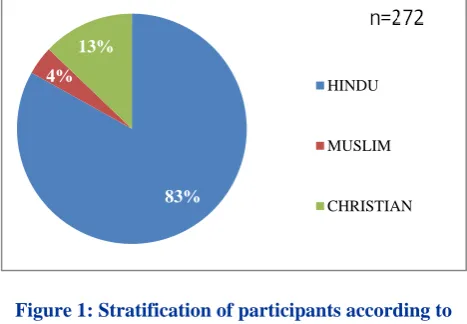
Of the total study population of 272 people, 157 were females and 115 were males. Among the study participants majority (58%) of them were females. Majority of the participants (39%) belonged to the age group of 25-44 years (Table 1). Among the participants majority of them (83%) belonged to Hindu religion
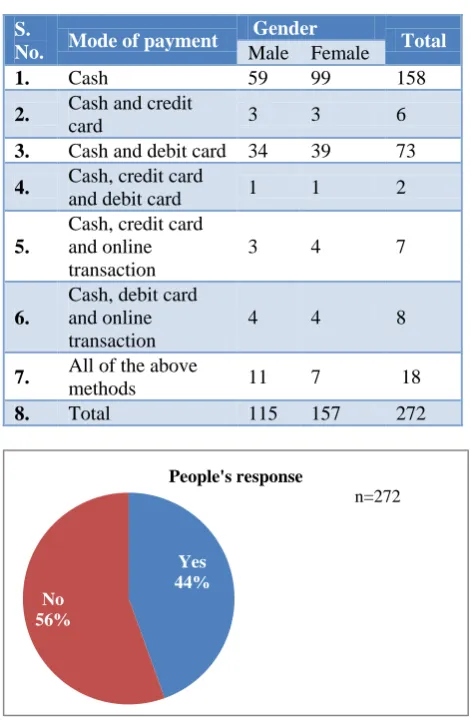
(Figure 1). Among the participants majority (29.4%) of them belonged to lower-middle socio-economic class (III) according to modified Kuppuswamy’s socio-economic status scale (May 2014)(Table 2).4 Among the study participants majority of them (88%) have bank account. Majority of the participants (58.1%) had used only cash for making their payments. Only 6.7% of the participants had used all the four methods for making payments viz. cash, credit card, debit card and online transaction (Table 3). Among the study participants, for making payments, females preferred to use only cash (63%) than males (51.3%) (Table 4).Majority of participants (60%) responded that they were satisfied with the demonetization move (Figure 2). 52% of participants felt that the demonetization move would help Government to unearth black money (Figure 3). Majority of participants (65%) responded that the demonetization move would help the Government to prevent funding of terrorism. Majority of participants (64%) responded that the Government had made adequate arrangements for deposition of money while 36% of participants responded that the Government had not made adequate arrangements for deposition of money. Majority of the participants (56%) responded that the Government had not made adequate arrangements for withdrawal of money while only 44% of participants responded that the Government had made adequate arrangements for withdrawal of money (Figure 4).
Figure 1: Stratification of participants according to their religion.
Figure 2: satisfaction level among participants
83% 4%
13%
HINDU
MUSLIM
CHRISTIAN
Satisfied 60% Unsatisfied
40%
Table 1: Age distribution among the study participants.
Age group No of people Percentage(%)
15-19 3 1.1
20-24 73 26.8
25-44 106 39.0
45-64 71 26.1
65-79 19 7.0
Total 272 100.0
Table 2: Stratification of participants according to their socio-economic class.
Socio-economic class
No of
people Percentage(%)
Upper (I) 63 23.2
Upper-middle (II) 63 23.2 Lower-middle (III) 80 29.4 Upper-lower (IV) 61 22.4
Lower (V) 5 1.8
Total 272 100.0
Table 3: Method for making payment.
S.
No. Payment method
No of
people Percentage(%)
1. Cash 158 58.1
2. Cash and credit
card 6 2.2
3. Cash and debit
card 73 26.8
4. Cash, credit card
and debit card 2 .7
5.
Cash, credit card and online transaction
7 2.6
6.
Cash, debit card and online transaction
8 2.9
7. All of the above
methods 18 6.7
8. Total 272 100.0
Figure 3: Will this move help the government to unearth black money?
Table 4: Stratification of payment methods according to the gender.
S.
No. Mode of payment
Gender
Total Male Female
1. Cash 59 99 158
2. Cash and credit
card 3 3 6
3. Cash and debit card 34 39 73
4. Cash, credit card
and debit card 1 1 2
5.
Cash, credit card and online transaction
3 4 7
6.
Cash, debit card and online transaction
4 4 8
7. All of the above
methods 11 7 18
8. Total 115 157 272
Figure 4: Do you think government has made adequate arrangements for withdrawal of money?
Figure 5: Does the move cause you any stress?
53% of participants responded that the Government had made adequate arrangements for exchange of old notes while 47% of participants responded that the Government had not made adequate arrangements for exchange of old notes. Majority of participants (67%) responded that the demonetization move would lead to overall economic development of our country. 47% of participants responded that they had been under stress because of the
52% 34%
14%
People's response
Yes
No
May be
n=272
Yes 44% No
56%
People's response
n=272
Yes 47% No
53%
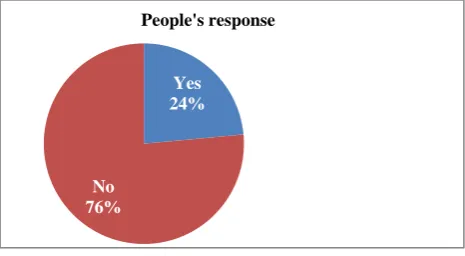
demonetization move (Figure 5). Majority of the participants (76%) responded that the demonetization move did not affect them from seeking timely healthcare while only 24% of participants responded that the demonetization move affected them from seeking timely health care (Figure 6).
Figure 6: Does the move affect you from seeking timely healthcare?
DISCUSSION
In the present study, majority of participants (60%) responded that they were satisfied with the demonetization move which is comparable to the findings of the study done by Chandani Majoomdar titled, “Demonetization: A General Survey On Advantages and Disadvantages”, which showed that 57.5% of participants were satisfied with the demonetization move.5 In the present study, 52% of participants responded that the move would help the Government to unearth black money which is comparable to the findings of the study done by Dr. Samuel Schueth and Alex Moler titled, “Effects of Demonetization on Financial Inclusion in India”, which showed that 53% of participants responded positively that the move would help the Government to unearth black money.6 In the present study, majority of participants (67%) responded that the demonetization move would lead to overall economic development of our country while in the study done by Dr. Samuel Schueth and Alex Moler titled, “Effects of Demonetization on Financial Inclusion in India”, 34% of participants responded that the move would be beneficial for the country.6 In the present study, 47% of participants responded that they had been under stress because of the demonetization move while in the study done by PHD Research Bureau Team titled, “Impact of Demonetization on Economy, Businesses and People”, 58% of participants faced stress because of the demonetization move.7
Limitations
Firstly, the study involved participants from only Anakaputhur area of Kanchipuram district; secondly, the sample size was small, therefore the findings of this study cannot be extrapolated to the whole population
CONCLUSION
In the present study, even though majority of the participants (88%) had a bank account, still 12% people do not have a bank account. Hence necessary measures have to be taken to ensure that all the citizens possess a bank account, which would also help them to avail benefits of Government schemes and policies. In the present study majority of the participants (58.1%) especially females use only cash for making their payments. Therefore necessary measures have to be taken to increase cashless modes of transaction like debit card, credit card, online transaction and mobile wallet services. This would reduce the dependence on cash for making payments. Pertaining to the process by which the move was implemented, majority of the participants (64%) were satisfied with the arrangements made by the Government for deposition of money while only 44% of participants were satisfied with arrangements made for withdrawal of money from the bank and about 53% of participants responded that the Government had made adequate arrangements for exchange of old notes. Even though the Government’s intention behind demonetization of old 500 and 1000 rupees currency notes was good, the process by which the move was implemented could have been better.
Recommendations:
Government could have taken proper anticipatory measures to prevent cash crunch. It could have devised methods that were practical and easy for the people to deposit their money in the bank. Similarly suitable measures could have been implemented for facilitating withdrawal of money and exchange of old notes. It is further recommended that Health Insurance coverage should be increased dramatically. Measures like provision of ATMs at hospitals,free transport services for patients and educating the masses to avoid cost-cutting on healthcare could have been done. Further community based studies should be done to assess the impact of demonetization on the general public.
Funding: No funding sources Conflict of interest: None declared
Ethical approval: The study was approved by the Institutional Ethics Committee
REFERENCES
1. Kamatchi ME, Kalaimani G. Impact of Demonetization on Indian Economy. IOSR J Humanities Social Sci. 2016:1:50-4.
2. Tax Research Team. Demonetisation: Impact on the Economy, 2016 Nov.
3. Reserve Bank of India. Annual Report 2015-16. Available at https://www.rbi.org.in/scripts/annual reportpublications.aspx?id=1181. Accessed on 20 January 2018.
Yes 24%
No 76%
4. Oberoi SS. Updating Income Ranges for Kuppuswamy’s Socio-Economic Status Scale for the Year 2014.
5. Majoomdar C. Demonetization: A General Survey on Advantages and Disadvantages. J Commerce, Economics Management. 2017;1(3):11-8.
6. Samuel S, Alex M. Effects of Demonetization on Financial Inclusion in India. Intermedia. Available at http://finclusion.org/ uploads/file/Effects%20of %20Demonetization%20on%20Financial%20Inclus ion%20in%20India.pdf. Accessed on 17 February 2018.
7. PHD Research Bureau. Impact of Demonetization on Economy, Businesses and People. Available at
http://phdcci.in/image/data/Research%20Bureau-2014/Economic%20Developments/paper/Study%20 on%20Impact.pdf. Accessed on 9 February 2018.