Original Research Article
Assessment of death registration coverage and its delays in district
Faridkot: an urban rural comparison
Anupamdeep, Preeti Padda*, Sanjay Gupta, Vishal Gupta, Shalini Devgan, Shamim Monga
INTRODUCTION
Various vital events occurring in Individual’s life have been used since time immemorial to measure population dynamics and according to united nations live births, deaths and marriages can be used for administrative and legal purposes.1, 2
CRS which forms the backbone in the country for collection of data on births and deaths in the country was started by the British for control of pestilence and
disease.3 Birth registration began in 1866 while death registration commenced in 1873. During this era, registration was quite less as it was voluntary in nature. The birth and death registration was made compulsory only in 1969 when RBD Act was passed. Only since then, the importance of death registration has come into being. Various organizations decided to fight against various diseases, analyze the data related to mortality/death to measure the success making death registration even more vital. The various other benefits of death registration includes proof of time and date of death; relieving the individual from social, legal and official obligations by
ABSTRACT
Background: Death registration has been made compulsory under the RBD Act 1969 as it acts as a back bone for
planning services and formulates policies. According to CRS 2013, at national level, 70.9% of deaths were registered which is far from magic figure of 100% despite of concerted efforts of government. So this study was conducted to assess the coverage of death registration and its delays.
Methods: A cross sectional study was conducted over a period of one year where 332 households(166 each from urban and rural area reporting deaths in last two years were included in study after taking informed written consent. Relevant information was collected using a predesigned and pretested questionnaire by house to house survey. Coverage was calculated with possession of death certificate. Data was compiled and analyzed using EpiInfo07 (CDC, Atlanta, USA).
Results: Out of 332 deaths, 245 (74%) out of which only140 (57%) possessed the death certificate. The main cause of
death was cardiac diseases. Maximum coverage was seen in the age group 41-60 years. Delay in registration was seen in 48% with significantly higher proportion in rural area (59%) than in urban area (40%). Reasons for delay were time constraints, lack of knowledge and financial constraints. Socio demographic variables like religion, caste, type of family, family size and SES were not found to be associated with delay.
Conclusions: The coverage of death registration was comparatively higher than national data and delay was observed
in about half of the death registration coverage.
Keywords: Death, Registration, Death certificate, Coverage, Delay
Department ofCommunity Medicine, Guru Gobind Singh Medical College, Faridkot, Punjab, India
Received: 26 February 2019
Revised: 04 April 2019
Accepted: 05 April 2019
*Correspondence:
Dr. Preeti Padda,
E-mail: [email protected]
Copyright: © the author(s), publisher and licensee Medip Academy. This is an open-access article distributed under
the terms of the Creative Commons Attribution Non-Commercial License, which permits unrestricted non-commercial use, distribution, and reproduction in any medium, provided the original work is properly cited.
declaration of death; claim on property; to settle property inheritance; and authorization of family to get insurance and other benefits.4
SDGs occupy a central place among the initiatives which are undertaken at Global level to improve the CRS. Target 16.9, comments upon providing legal identity for all and another target 17.19 i.e. “By 2030, build on existing initiatives to develop measurements of progress on sustainable development that complement gross domestic product, and support statistical capacity-building in developing countries” uses the indicator of proportion of countries that have achieved 100 percent birth registration, and 80 percent death registration.5 To reach universal civil registration of births, deaths, marriages and other vital events for all people by 2030, the World Bank and WHO have developed an investment plan for scaling up global civil registration and vital statistics systems 2015-2024.6
Over the span of about 45 years, since the enactment of RBD Act, India has made a tremendous improvement in registration of deaths. In 2004, death registration was 55.2%. This figure has risen to 70.9% in 2013.7 According to CRS-2013, Punjab has reached the magical figure of 100% in death registration. It has been observed that majority of the people who die at home fail to get registered. Even if they get registered, a delay (>21 days) has been seen. Death certificates are seeked only when needed for legal and administrative purposes.3
Many barriers like cultural values and distance prevent people from registering deaths. Certain countries do not have the necessary laws or infrastructure to make it obligatory to register deaths whereas in some countries, only people who live in cities have access to registration services.8
Therefore, we have conducted this study primarily to assess the coverage of death registration in rural and urban areas of Faridkot and its associated factors with secondary objectives of assessment of cause and place of death.
METHODS
The present study was conducted in urban and rural field practice areas of Department of Community Medicine, Guru Gobind Singh Medical College, Faridkot after obtaining ethical clearance from institutional ethical committee. This was a descriptive cross sectional study conducted over a period of one year i.e. from May 2017-April 2018.
Sample size was calculated using formula for estimation of single proportion with a specified precision i.e.
n>π (1-π) v2
/d2
where π=70.9 (according to CRS 2013) 7
Based on which 332 households reporting death in last two years were included in the study to obtain a proportion of 70.9% with 95% confidence interval ±5% precision.
For equal representation from urban and rural areas, 166 each from the calculated sample size were taken respectively. The list of households in the field practice area formulated the sampling frame and the household reporting a death in last two years acted as a sampling unit of the study
Out of five mohallas (urban) and five villages, two were selected randomly. A house to house visit was done to enlist the houses reporting death in last two years. Second visit was made in the listed households and one to one interviews were conducted with the head of family after obtaining informed written consent. A predesigned and pre tested Questionnaire was used to collect relevant information. The data collection consisted of two sections
where section one was concerned with socio
demographic information of head of the family and section 2 included socio demographic information about the deceased like age and sex, manner of death, place of death and cause of death
During the interview, information about possession of death certificate was obtained from head of family. If the family possessed death certificate, date of issue of death certificate and date of death were noted. In absence of death certificate, the reasons for the same were sought.
The questionnaire was translated into local language (Punjabi). To check the validity of the tool and see whether it measures what it is supposed to measure, it was translated from local language to English from unknown assessor.
During house to house visit, household found locked after two repeated visits and those who failed to give a written consent for participation were excluded from the study.
The list of households which reported a death in last two years was compared with death register of respective MPHW-F. Those not found in their register were labelled as not registered and excluded from further analysis.
The Sarpanch of the selected villages and the Municipal Counsellor of the selected mohallas were contacted and informed about the study and its purposes.
Operational definitions
Death: means the permanent disappearance of all evidence of life at any time after live-birth has taken place.
Death registration coverage: It was considered among those who possessed the death certificate.
Precoded sheets were used to enter data in Microsoft excel to minimize the errors which was imported into epi info07 (CDC, Atlanta, USA) for further analysis. Frequencies and proportions were calculated wherever necessary.
For time to event analysis, median time taken for death registration was calculated by subtracting date of death from the date of registration available on death certificate. It was further classified into delay and non delay. Chi square test was used to determine the various factors associated with death registration coverage and the delay in registration. P value of less than 0.05 was considered to be significant.
RESULTS
A total of 332 households, 166 each from urban and rural area reporting a death within last two years were included. As far as socio demographic profile of head of
family was concerned, 72% were males and 64% were unskilled/skilled workers by occupation. Litracy rate was 65% and majority followed Sikhism.33% and 30% belonged to lower middle and upper middle class of socio economic status according to B.G. Prasad’s classification and only 4% were from class V i.e. lower.
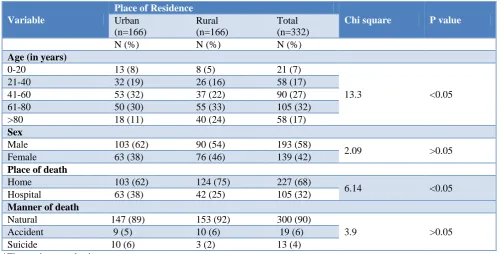
Table 1 shows the age and sex distribution of deceased where overall 32% belonged to age group 61-80years and least belonged to age group 0-20 years (7%). Slightly higher proportion of deceased were in the age group of 41-60 years in urban i.e. 32% in comparison to rural areas (22%). The overall difference found to be statistically significant. Among the deceased 62% were males in urban areas. Majority deaths occurred at homes i.e. 68%, but they were proportionately higher in rural area (75%) and urban rural difference was found to be statistically significant.90% died a natural death and suicide accounted only for 4%.
Table 1: Distribution of deceased according to age, sex, place and manner of death.
Variable
Place of Residence
Chi square P value
Urban (n=166)
Rural (n=166)
Total (n=332)
N (%) N (%) N (%)
Age (in years)
0-20 13 (8) 8 (5) 21 (7)
13.3 <0.05
21-40 32 (19) 26 (16) 58 (17)
41-60 53 (32) 37 (22) 90 (27)
61-80 50 (30) 55 (33) 105 (32)
>80 18 (11) 40 (24) 58 (17)
Sex
Male 103 (62) 90 (54) 193 (58)
2.09 >0.05
Female 63 (38) 76 (46) 139 (42)
Place of death
Home 103 (62) 124 (75) 227 (68)
6.14 <0.05
Hospital 63 (38) 42 (25) 105 (32)
Manner of death
Natural 147 (89) 153 (92) 300 (90)
3.9 >0.05
Accident 9 (5) 10 (6) 19 (6)
Suicide 10 (6) 3 (2) 13 (4)
*Figures in parenthesis are percentages.
Table 2: Distribution of cause of death according to place of residence.
Cause of death
Place of residence
Rural (n=166)
Urban (n=166)
Total (n=332)
N (%) N (%) N (%)
Cardiac Diseases 81 (49) 69 (42) 150 (45)
Stroke (CVA) 5 (3) 7 (4) 12 (4)
Cancers 8 (5) 11 (6) 19 (6)
Diabetes 3 (2) 14 (9) 17 (5)
Kidney Disorders 4 (2) 6 (4) 10 (3)
Liver Disorders 2 (1) 13 (8) 15 (4)
Accidents 7 (4) 9 (5) 16 (5)
Suicides 3 (2) 9 (5) 12 (4)
Bronchial Asthma 1 (1) 9 (5) 10 (3)
TB 1 (1) 3 (2) 4 (1)
HIV 1 (1) 1 (1) 2 (1)
Unknown 41 (24) 9 (5) 50 (15)
* Figures in parenthesis are percentages.
Table 3: Coverage of death registration (possession of death certificate) in relation to place of residence.
Possession of death certificate Urban (n=119)
Rural (n=126)
Total
(n=245) Chi square P value
N (%) N (%) N (%)
Yes 79 (66) 61 (48) 140 (57)
8.07 <0.05
No 40 (34) 65 (52) 105 (43)
*Figures in parenthesis are percentages.
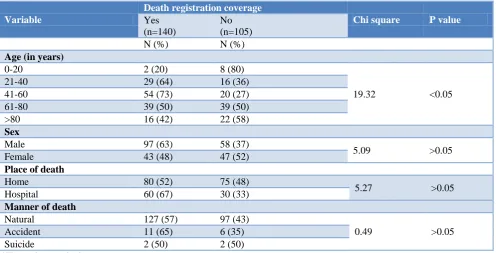
Table 4: Association of coverage of death registration with age, sex of the deceased and place and manner of death (n=245).
Variable
Death registration coverage
Chi square P value
Yes (n=140)
No (n=105)
N (%) N (%)
Age (in years)
0-20 2 (20) 8 (80)
19.32 <0.05
21-40 29 (64) 16 (36)
41-60 54 (73) 20 (27)
61-80 39 (50) 39 (50)
>80 16 (42) 22 (58)
Sex
Male 97 (63) 58 (37)
5.09 >0.05
Female 43 (48) 47 (52)
Place of death
Home 80 (52) 75 (48)
5.27 >0.05
Hospital 60 (67) 30 (33)
Manner of death
Natural 127 (57) 97 (43)
0.49 >0.05
Accident 11 (65) 6 (35)
Suicide 2 (50) 2 (50)
*Figures in parenthesis are percentages.
Table 5: Status of delayed registration (>21 days) in relation to place of residence.
Delay in registration Urban
(n=79)
Rural (n=61)
Total
(n=140) Chi square P value
<21 days 48 (60) 25 (41) 73 (52)
5.39 <0.05
>21 days 31 (40) 36 (59) 67 (48)
*Figures in parenthesis are percentages.
On comparison of the listed households and MPHW-F’s register, only 74% were found to be registered with somewhat equal proportions in both urban and rural areas. Only 24% were registered by the hospital staff with slightly higher proportion being registered by them were from urban areas and the difference was found to be statistically significant.
NCDs were the main cause of death where cardiac diseases were found to be in higher proportion (45%) as shown in Table 2.
proportion possessed the death certificate in urban area (66%) in comparison to rural area i.e. 48% (Table 3)
Maximum coverage of death registration was seen among those who died between age group of 41-60 years (73%) and minimum (20%) was observed in age group of 0-20 years. The difference was found to be statistically significant (Table 4)
A delay in registration coverage of death was observed in 48% and it was found to be significantly higher in rural areas (59%) than in urban areas i.e.40% (Table 5).
The time taken for death registration coverage ranged from 0 day to 550 days with median of 22 days and 95% CI of 20-29 days. The main reasons for delay in registration time constraints (84%) followed by lack of knowledge (13%) and financial constraints (3%).
DISCUSSION
The present study was conducted in urban and rural field practice areas of Department of Community Medicine, Guru Gobind Singh Medical College, Faridkot with the objectives to assess the coverage of death registration and its delay. Further the factors which affected the coverage as well as the delay in registration were also determined.
In the present study, a total of 332 families were visited which reported a death in any age group in last two years. A total of 74% deaths were registered where majority were registered by the MPHW-F (76%). The median time taken for death registration was 6 days (95% CI 5-8 days). 58% of those who died in last two years were males and 68% of the deaths occurred at home.
NCDs were identified to be the main cause of death among both urban and rural areas with cardiac diseases occupying the main proportion (45%). Coverage of death registration was significantly higher in urban areas (66%) in comparison to rural areas i.e. 48% whereas overall death registration was found to be 57%.63% of male deaths were registered in comparison to only 48% of female deaths. Highest coverage of death registration was reported for the age group of 41-60 years and least for the age group of 0-20 years. As far as delay in registration was concerned, an overall 48% reported the same.
In the present study, it was observed that 68% of deaths occurred at home. Our results were similar to a study conducted by UNFPA in Kosovo which reported 65.4% of total deaths occurring at home.9 Higher proportion of deaths occurring at home is basically because of increased life expectancy in our country. Majority of the deceased belong to age 60 and above which die due to chronic ailment and as per the existing social norms in the society, older people suffering from chronic diseases are not taken to the hospital for treatment.
Out of the total deaths 74% were found to be registered with somewhat equal proportions in urban and rural areas. No significant urban rural difference was found as a very effective death and birth registration system is in place. The registration status reported in our study was higher than that study conducted in South Nigeria (60.3%).10 Similarly death registration was found to be relatively low in comparison to our study which reported 67% of death registration.11
Significantly higher proportion of deaths were being registered by MPHW(F) in comparison to the hospital staff as majority of deaths occurred at home in our study. MPHW (F) acts as the first contact person in the hierarchy of RBD Act who is responsible for conducting the same.
As 68% of deaths were reported to be occurring at home, the exact cause of death could not be assessed. Even those who possessed the death certificate and those who died in the hospital did not have a mention of cause of death. As per the responses of HOFs, majority of deaths were due to non communicable diseases like cardiac diseases, stroke, cancer and diabetes.
Death registration coverage i.e. possession of death certificate was found to be only 57% among the registered deaths whereas a relatively higher proportions i.e. 74.2% of the deaths registered possessed the certificate as reported by a study conducted in South Nigeria.10
Death registration coverage was found to be higher among males (63%) in our study. A study conducted in urban Nigeria also reported that sex of the deceased was significantly associated with registration of deaths.12
Highest death registration coverage was observed for those who died between the ages of 21 and 60 years. The main reason behind this could have been that majority in this age group would have been employed. Families would have obtained the death certificate for the purpose of collecting claims and benefits.11
In the present study, delay in death registration was found to be 52% and it was significantly higher in rural areas (59%) in comparison to urban areas (40%). The main reason behind this could have been higher levels of unawareness regarding the process of death registration. Further someone from the family has to travel to the nearest suvidha centre for getting the certificate which adds up to a delay especially for rural areas.
No study could be found after extensive review of literature which accounted for the delay in death registration.
As India had strong social values, it becomes difficult for the family members to visit the designated office within the stipulated time for the procurement of death certificate.
It can be concluded from the study that much less attention is being paid to the death registration in spite of existence of the Act which makes it compulsory. Death certificates are seeked only to solve the property issues and claim benefits. This can be owed to the lack of awareness and the lengthier process involved in it. Moreover, no documentation pertaining to cause of death was not available with families.Hence, efforts should be made to increase the awareness regarding the importance of death registration among religious leaders and community groups and develop a coordination with the health institutions to make the system responsive.
Funding: No funding sources Conflict of interest: None declared
Ethical approval: The study was approved by the Institutional Ethics Committee vide letter no. BFUHS/2K17p-TH/274
REFERENCES
1. Directorate O. OECD Glossary of Statistical Terms
- Vital event Definition. Available at: https://stats. oecd.org/glossary/detail.asp?ID=2870. Accessed 12 February 2019.
2. UN. Principles and recommendations for a vital statistics system. Statistical paper Ser.M.No.19, Revil, Sales No.E.73.xviii.9, New York.
3. Committee on Population and Demography.
Collecting Data for the Estimation of Fertility and Mortality. Washington D.C.: National Academy Of Sciences; 1981: 312.
4. Vakil no.1. All about Registration of Births and Deaths in India. Available at: https://www. vakilno1.com/legalviews/registration-births-deaths-india.html. Accessed on 12 February 2019.
5. Sustainable development goals. New York: United nations; 2017. Available at: https://www.un. org/sustain abledevelopment/development agenda. Accessed on 12 February 2019.
6. World bank group and world health organization. Global civil registration and vital statistics scaling up plan 2015-2024. Washington DC: world bank group;2014. Available from: https://www.world bank.org/en/topic/health/publication/global-civil-registration-vital-statistics-scaling-up-investment. Accessed 12 February 2019.
7. Government of India. The Registration Of Births And Deaths (Amendment) Bill, 2012. Available at: https://www.prsindia.org/uploads/media/Registratio n%20of%20births%20and%20deaths/REegistration %20of%20Births%20and%20Deaths%20(Amendm ent). Accessed on 12 February 2019.
8. Child rights international network. Text of
convention. United Kingdom; 2018. Available at: https://www.crin.org/en/home/rights/convention/ text-convention. Accessed on 12 February 2019.
9. UNFPA. Death Registration in Kosovo. Pristina:
Prism Research Office; 2010: 27.
10. Tobin E, Isah E, Obi A. Status of birth and death registration and associated factors in the South-south region of Nigeria. Ann Nigerian Med. 2013;7(1):3-7.
11. Musah A, Abdulai Z, Dawuni M, Abdul Hanan A. Evaluation of the Effect of Birth and Death Registration on Health Service Delivery (A Case of Tolon District of Ghana). Afr J Health Sci. 2015;5(2):32-41.
12. Williams AO. Assessment of the completeness of births and deaths registration in an urban Nigerian community. Afr Popul Stud. 2014;27(2):263-73.
Cite this article as: Anupamdeep, Padda P, Gupta S,
Gupta V, Devgan S, Monga S.Assessment of death