Int. J. Advanced Networking and Applications
Volume: 09 Issue: 04 Pages: 3492-3497(2018) ISSN: 0975-0290
3492
Object Oriented Secure Modeling using SELinux
Trusted Operating System
Dr. Nitish Pathak1*
1
Bharati Vidyapeeth's Institute of Computers Applications and Management (BVICAM), Guru Gobind Singh Indraprastha University (GGSIPU), New Delhi, India
Email: [email protected] Neelam Sharma
2
MAIT, Guru Gobind Singh Indraprastha University (GGSIPU), New Delhi, India
---ABSTRACT---This research paper proposes the object oriented experimental setup for secure web application development and use of security performance flexibility model to keep high security in web applications. This model allows system administrators to skip or disable some unnecessary security checks in distributed trusted operating systems through which they can effectively balance their performance needs without compromising the security of the system. For example, system admin can tell that video on demand server is allowed to skip only security checks on reading files, while database server is allowed to skip only security checks on seeking files. Which operation is need to be skipped and which operation is not need to be skipped is very much subjective in nature, this will depend upon the user’s requirement and the particular application’s requirement. The selection of these operations and system calls for a particular application is the part of software requirement elicitation process. This UML 2.0 based research work proposes object-oriented class-based software development, source code generation in C++ and the integration of security engineering into a model-driven software development.
Keywords: SELinux,SPF, Forward engineering, DTOS, UML 2.0
--- Date of Submission: Jan 03, 2018 Date of Acceptance: Jan 23, 2018 ---
I.
INTRODUCTION
I
n the last decade, there has been vast growth in the field of networking, sharing of data worldwide. And then comes the most extensively used thing Internet have made cyber security a very crucial aspect of research and development. Its matter of concern for both the common users and researchers connected all over the world. Despite of lot of works undergoing we are still unable to get something that reliable and silver bullet that it may provide us with complete security for our systems. Being so advanced we still lack the basic potential to create such a system that is capable of stopping viruses and accessing our confidential data from our systems [1]. The security methods developed, researched till yet are implemented in the application layer of the computers which is making our systems more prone to data insecurity. These methods includes encryption using a key i.e. cryptography, using firewalls, access control using authentication, and application layer access control. The most two burning domains are Cryptography and authentication techniques in which max research is being done. Although these are something very difficult to crack but no one knows the dynamic minds making some of probability of data insecurity [2]. To some extent using firewalls and application layer access control have helped us but they do have a drawback. These two techniques can help in stopping the attacks using viruses uploaded on internet but fails to protect from internal security issue thus finally making our system vulnerable [3].The biggest threat to our application layer is viruses and Trojan Horses. Once these two enters in our system they
have the potential to access and even modify each and every data present on the system. Now these days, to overcome the threats operating system application layer and the network entry points is used to implement the security measures. Although no preventive measures are used inside the kernel of Operating Systems. It is believed that security measures in kernel are much more effective than the application layer [4]. In fact, after lot of research such operating systems have been developed which have much more mechanisms inside the OS kernel providing us very good level of security thus securing our systems [5]. In reality, trusted operating systems are better choice for web applications to maintain the security concern, but this security will come at a cost. By using trusted systems, our web application will be more and more secure, but due to more security checks, the performance of the same system will disgrace in all respect [6].
Int. J. Advanced Networking and Applications
Volume: 09 Issue: 04 Pages: 3492-3497(2018) ISSN: 0975-0290
3493
effort and time to setup the desired security policy on the part of administrator [9]. The implementation of security policies, as per the requirement of user, is very complex in such systems. In this research paper, we are suggesting SEL Linux trusted operating systems for maintaining the security concern in web applications[10][11].
In the proposed design and development, we are using UML2.0 based conceptual modeling for the development of secure application. It makes the programming simpler, more effective and manageable [12]. This research work proposes SPF based secure software analysis, SPF based secure software design and SPF based secure software development. Far above the ground, quality of software design is necessary for the success of software [13].
II.
TRUSTED
OPERATING
SYSTEM
BASED
SECURE
WEB
APPLICATIONS
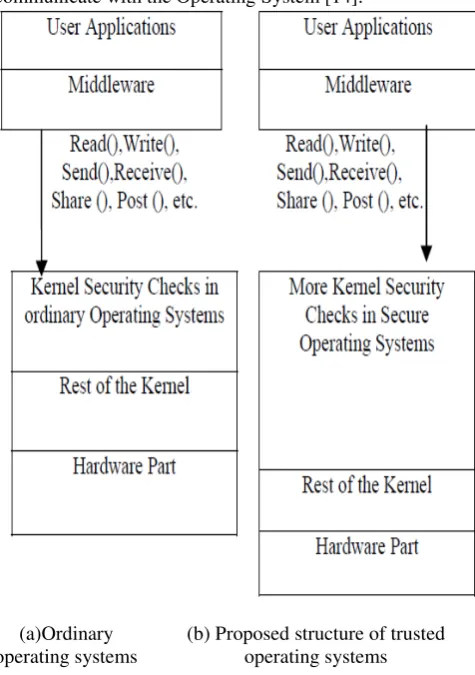
The essential structural design of this operating system is shown in Fig.1. Just for a reminder to the readers; architecture is just a concept although implementation can be done in a lot of ways. The architecture of traditional operating systems is given in Fig. 1(a). System call interface helps the application and middleware interface to communicate with the Operating System [14].
(a)Ordinary operating systems
(b) Proposed structure of trusted operating systems
Fig. 1: Structure of trusted operating systems and ordinary operating systems.
Fig. 1.(a), Illustrating thin or slim security layer of operating systems kernel security checks. Now in order to provide higher security, lots of security checks are there in
kernel of Trusted Operating Systems. Fig. 1(b) demonstrates the additional security checks in the kernel. This will cause trusted operating systems to be slower than standard operating systems [15]. Fig.1 (b) clearly depicts the thicker layer of kernel security checks. What all security measures are being taken in the kernel security check depends all on implementation and modeling. But the disadvantage of having extra security check is that whenever user tries to do any useful work it need to undergo all the checks thus deteriorating the system overall performance[16][17].
III.
PROBLEM
EXPLANATION
AND
OBJECT
ORIENTED
SOLUTION
METHODOLOGY
Before moving into the problem, we are dealing, first we will be talking about the basic principles of Secure Operating Systems. As was mentioned previously, the term Trusted OS is interpreted differently and vary from one company to another software company. During system programming, company develops the system software according to the requirement of end users. But there are some important features in all Trusted Operating Systems. They are as follows Least Privilege, Mandatory Access Control (MAC), Discretionary Access Control (DAC) and auditing [18][21].
For example, admin of the system can disable all the read checks in web server because they are actually useless which finally increases throughput of the web server. Web server deals with sole public data and public information. Since majority of data is public on any web server, task of checking it during read from disk is something useless because this data is already readable by each and every user using internet [19]. The real task of security comes when it comes to writing access. For any web server integrity is the main issue rather than its confidentiality. As we had stated that there are many types of workloads that are continuously being checked by the security mechanisms of kernel in which many of them are very much useless or undesired in a Trusted Operating System. Primary concern of these workloads is quality as well as integrity of data rather than security of certain operations since the data they consist can be public [20]. This let us conclude that by disabling security measures of some parts of OS performance can be increased.
Int. J. Advanced Networking and Applications
Volume: 09 Issue: 04 Pages: 3492-3497(2018) ISSN: 0975-0290
3494
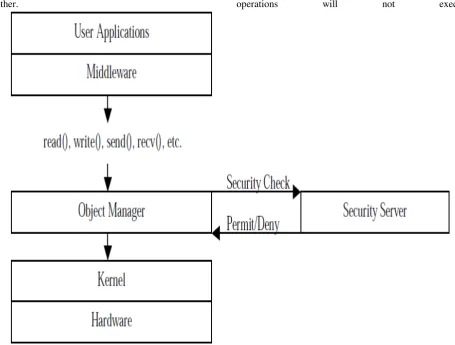
as Flask both are built and implemented upon kernels. Almost security policies can be implemented if we consider security server as a separate part or separate module. These separate modules can be easily modified as per web applications requirement. This is not hard and fast that security need always will be unchanging or statically placed within the kernel. These security needs and implementation will vary from one real life application to another.
The implementations of web application for maintain the security is very much subjective in nature. The security requirement for the same will depend upon the user’s needs. The object manager all the time calls the security server for checking the granted permissions. If security server grants permission for particular operations, then ok, operation or specific system call will be passed to kernel layer for execution. If permission is not granted, requested
operations will not execute.
Fig. 2: Flexible security policy architecture for trusted operating systems The security features and security policies can be altered,
as per need, dynamically as the system is in execution phase. Security layer will execute the security checks according to new altered security policies. In order to boost performance in DTOS as well as in Flask, security policy caching was recommended as a means to strengthen performance. The mainly referenced security checks are stored in a software-implemented cache, located in the module of object manager. This can surely increase the performance of systems. By caching recent security policies in the object manager, few parts of the security
check can be ignored. In this case, if security policies changed by authentic user, new security policies will be implemented with immediate effects. As stated all over this section, it seems the future of security in operating systems is dependent on two major factors. These two factors or themes are the development of TOS with very easier system administration work and system programming methods to apply a massive variety of security policies. At the time of implementation, these massive varieties of security policies will vary from one
application to another.
IV.
OBJECT
ORIENTED
SECURE
MODELING
FOR
WEB
APPLICATION
Object Oriented is an ever-growing discipline and since there lies, uncertainty for what really establishes sense of object-orientation; this encapsulates the nucleus factor and defines the vocabulary to be used in the remaining of theory. Object-Oriented Development is a set of practices and approaches for manufacturing software systems
grounded on real world abstractions. Object-Oriented approach delivers a relatively smooth approach for progressing from analysis, to design, through to implementation.
Int. J. Advanced Networking and Applications
Volume: 09 Issue: 04 Pages: 3492-3497(2018) ISSN: 0975-0290
3495
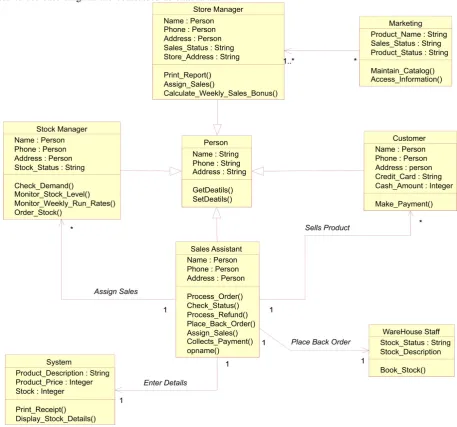
become the language of choice intended for developers who wish to imagine and model the system underneath progress. UML is used in many customs for expressing the concepts such as software specification, website structure and business modeling. In the proposed design and development, we are using UML2.0 based conceptual modeling for the development of secure application. In object oriented class diagram, designer will identify the classes. These classes can be identified through software requirement specification (SRS). As normal practices, actors of use case diagram are considered as classes and
the use cases are considered as member functions or methods of the classes. When we want to model the structure of a system or a web application, we can make use of object oriented class diagram. We develop the component based class diagram. In Store Stock Control Based Web Application, storing objects may be sales clerk, inventory, Credit card, Cheque, store manager, Payment, Person, marketing, stock manager, person, warehouse person, invoice, system, customer etc. (See Fig. 3.). The standard class diagram of Store Stock Control is as follows in Fig. 3.
Fig. 3: Class diagram for online store stock control web application. The class wise equivalent C++ code of this case study is
as follows-
Sample Code of C++ for understanding: class Person
{ public:
//##ModelId=553C976E01C4 GetDeatils();
//##ModelId=553C97750038 SetDeatils();
private:
//##ModelId=553C971B02D3 String Name;
//##ModelId=553C97380226 String Phone;
//##ModelId=553C975B0001 String Address;
};
#include "Person.h"
Int. J. Advanced Networking and Applications
Volume: 09 Issue: 04 Pages: 3492-3497(2018) ISSN: 0975-0290
3496
class Customer : public Person {
public:
//##ModelId=553C9B890326 Make_Payment();
private:
//##ModelId=553C9B5A003E Person Name;
//##ModelId=553C9B5E0028 Person Phone;
//##ModelId=553C9B64019E person Address;
//##ModelId=553C9B680189 String Credit_Card;
//##ModelId=553C9B6F0007 Integer Cash_Amount; };
#endif /*
#include "Person.h"
//##ModelId=553C99010386 class Stock Manager : public Person {
public:
//##ModelId=553C99340150 Check_Demand();
//##ModelId=553C99380262 Monitor_Stock_Level(); //##ModelId=553C9940011C Monitor_Weekly_Run_Rates(); //##ModelId=553C994F005E Order_Stock();
private:
//##ModelId=553C9912016D Person Name;
//##ModelId=553C991601B4 Person Phone;
//##ModelId=553C991B0229 Person Address;
//##ModelId=553C9920005D String Stock_Status;
}; #endif /*
WAREHOUSE_STAFF_H_HEADER_INCLUDED_AAC 32
A1B */
//##ModelId=553C9C2202FC class WareHouse Staff {
public:
//##ModelId=553C9C4B0368 Book_Stock();
private:
//##ModelId=553C9C2B02DE String Stock_Status;
//##ModelId=553C9C330009 Stock_Description;
}; #endif /*
With the help of above software development process, developers can identify software Metrics like no. of data
members, no. of data members per super class, no. of data members per sub class, member functions, the length of the program, Volume, vocabulary of a program, average number of live variables, Count of executable statements, member functions per class, data structure metrics, and information flow etc. These software Metrics can be identified through Hallstead software science measures and data structure metrics .With the help of above mentioned approach, software project planning will become easier to developers.
V.
RESULTS
AND
DISCUSSION
OF
SELINUX
TRUSTED
OPERATING
SYSTEM
SELinux trusted operating system is better choice for the development of secure web applications. Table 1and table 2 shows the performance results that are appropriate to security performance flexibility (SPF). These tables showing the results with SPF, without SPF and showing the performance compression. Through SPF model of SELinux operating system, we can implement the high security concerns for web applications.
TABLE 1: SECURITY CHECKS EXECUTED IN SELINUX TRUSTED OPERATING SYSTEM.
File System Tests SELinux without SPF
SELinux with System-SPF
model Random Disk Reads (K)
per second
94167 93135
Random Disk Writes (K) per second
79188 79508
Sequential Disk Reads (K) per second
335527 325591
Sequential Disk Writes (K) per second
149616 153174
Disk Copies (K) per second
102252 102744
TABLE 2: SECURITY CHECKS SKIPPED IN SELINUX TRUSTED OPERATING SYSTEM.
File System Tests SELinux Without
SPF
SELinux with System-SPF
model Random Disk Reads (K)
per second
94167 99762
Random Disk Writes (K) per second
79188 84768
Sequential Disk Reads (K) per second
335527 363571 Sequential Disk Writes
(K) per second
149616 159727 Disk Copies (K) per
second
102252 110315
Int. J. Advanced Networking and Applications
Volume: 09 Issue: 04 Pages: 3492-3497(2018) ISSN: 0975-0290
3497
software company, business and armed forces will not be available for normal user. So obtaining such source code in specific language is not as easy as we think. The privacy and security implementation for any system will vary from one Development Company to another.
VI.
CONCLUSION
This research paper presents a SPF based approach for web applications and the integration of security engineering into a model-driven software development. This research work showcase the effectiveness of UML 2.0 based object oriented modeling with primary focus of security through the system level SPF in web applications. This model allowed system administrators to skip or disable some unnecessary security checks in distributed trusted operating systems through which they can effectively balance their performance needs without compromising the security of the system. In this paper, we described experiential forward engineering, source code structuring and restructuring of secure software system. REFERENCES
[1] Davis, J. P. (2009). Propositional logic constraint patterns and their use in UML-based conceptual modelling and analysis. IEEE Transactions on Knowledge and Data Engineering, 19(3).
[2] Andrian, M.; and Denys, P. (2011). Using the conceptual cohesion of classes for fault prediction in object-oriented systems. IEEE Transactions on Software Engineering, 34(2).
[3] Barbara, P.; and Myra, S. (2012). Privacy-preserving query log mining for business confidentiality protection. ACM Transactions on the Web, 4(3). [4] Nitish Pathak, Girish Sharma and B. M. Singh
“Forward Engineering Based Implementation of TOS in Social Networking” published in International Journal of Computer Applications, Volume 102 - Number 11, Sep-2014, pp: 33-38, ISSN: 0975 - 8887.Foundation of Computer Science, New York, USA.
[5] Sara, C.; and Davide, M. (2013). A model-driven methodology to the content layout problem in web applications. ACM Transactions on the Web, 6(3). [6] Selby, R.W.; and Basili, V.R. (1987). Clean room
software development: an empirical evaluation. IEEE Trans. Software Eng., 13(9), 1027-1037.
[7] Betty, H.C.C.; and Enoch, Y. W. (2002). Formalizing and integrating the dynamic model for object-oriented modelling. IEEE Transactions on Software Engineering, 28(8).
[8] Nitish Pathak and Neelam Sharma “SPF BASED
SELINUX OPERATING SYSTEM FOR
MULTIMEDIA APPLICATIONS.” Published in International Journal of Reviews in Computing, ISSN: 2076-3328, pp.97-101, Vol.8, December-2011.
[9] Luiz, A. R.; and Daniel, S. (2006). An authoring environment for model-driven web applications. WebMedia'06, November 19–22, 2006, Natal, RN.
[10]Simona, B.; Jos,´E. M.; and Dorina, C. P. (2012). Dependability modelling and analysis of software systems specified with UML. ACM Computing Surveys, 45(1).
[11]Michel, R. V. C.; Werner, H.; and Ariadi, N. (2012). How effective is UML modelling? An empirical perspective on costs and benefits. Softw Syst Model, 571–580, Springer-Verlag.
[12]Pathak, N.; Sharma, G.; and Singh, B. M. (2015). Trusted operating system based model-driven development of secure web applications. Paper accepted for CSI - 2015; CSI - 50th Golden Jubilee Annual Convention, International Conference. [13]Pathak, N.; Sharma, G.; and Singh, B. M. (2015).
Towards designing of SPF based secure web application using UML 2.0. International Journal of Systems Assurance Engineering and Management, Springer.
[14]Marco, B.; Stefano, C.; and Piero, F. (2006). Process modelling in web applications. ACM Transactions on Software Engineering and Methodology, 15(4). [15]Georgia, M. K.; Dimitrios, A. K.; Christos, A. P.;
Nikolaos, D. T.; and Iakovos, S. V. (2008). Model-driven development of composite web applications. iiWAS2008, November 24–26, Linz, Austria. [16]Pathak, N.; Sharma, G.; and Singh, B. M. (2015).
Experimental designing of SPF based secure web application using forward engineering. IEEE and IETE Sponsored 9th International Conference, BVICAM, New Delhi.
[17]Peter, D.; Timothy, W.; and Prashant, S. (2012). Modellus: automated modelling of complex internet data center applications. ACM Transactions on the Web, 6(2).
[18]Pathak, N.; Sharma, G.; and Singh, B. M. (2017). UML 2.0 Based Framework for the Development of Secure Web Application.BVICAM's International Journal of Information Technology (BIJIT), DOI: 10.1007/s141870-017-0001-3, February, 2017, Springer
[19]Kim, H.; Zhang, Y.; Oussena, S.; and Clark, T. (2009), A case study on model driven data integration for data centric software development. ACM, 2009.
[20]Pathak, N.; Sharma, G.; and Singh, B. M. (2015). Experimental analysis of SPF based secure web application. International Journal of Modern Education and Computer Science (IJMECS), 7(2), 48-55, Hong Kong.