Original Research Article
Study of some epidemiological aspects of seizure disorders among
children in rural area of a district
Pralhad Sureshrao Potdar*
INTRODUCTION
The word `seizure` has come from the Latin word Sacire which means to take possession of.1 A seizure is defined as a transient, involuntary alteration of consciousness, behaviour, motor activity, sensation, or autonomic function caused by an excessive rate and hyper-synchrony of discharges from a group of cerebral neurons.2
A seizure is also referred to as a convulsion, fit, or attack. Seizures are the most common paediatric neurologic disorder, with 4% to 10% of children suffering at least
one seizure in the first 16 years of life.3 Most seizures occur before age 3 years because the causes (fever, metabolic disturbance, head trauma, central nervous system (CNS) infection, perinatal complications and acute encephalopathy, family history of seizure disorders) occur predominantly in early childhood.4 Seizure is a major public health problem across the world, not only because of the problem that arises as a result of seizure activities, but also due to the social & cultural stigma attached to it.5 The international league against epilepsy (ILEA, 1981) is working at international level while in India IEA (Indian epilepsy association), IES (Indian
ABSTRACT
Background: Seizures are the most common paediatric neurologic disorder, with 4% to 10% of children suffering at least one seizure in the first 16 years of life. Most seizures occur before age 3 years.
Methods: The present study was undertaken with an objective to study prevalence of seizure disorders among the children aged 14 yearsand below in rural area of a district and to study some socio-demographic factors and some risk factors associated with it among the study subjects. This was a community based cross-sectional descriptive study.
Results: The prevalence of seizure disorder in the area studied was 10.84%. Of the total 1200 subjects examined, 52.67% were males and 47.33% were females. Mean age of the study population was 6.48±3.33 years, median was 6 years. Age, sex, family history, and socio-economic status were highly statistically significant with risk of seizure disorders (p<0.01). H/o Head injury, H/o CNS infection were statistically age, sex, family history of seizure disorders and socio-economic status were independently associated with risk of seizure disorders (p<0.01).
Conclusions: prevalence of seizure disorder in the area studied was 10.84%.Significant association was observed between seizure disorder and age, sex, socio economic status, family history of seizure disorder, h/o infections and h/o head injury. Further research is needed to better understand the intricate relationship among socio-demographic risk factors and seizure disorders in order to ensure the best possible outcomes for individuals with seizure disorders.
Keywords: Seizure, Epilepsy
Department ofCommunity Medicine, GMC, Miraj, Maharashtra, India
Received: 23 March 2018
Revised: 18 May 2018
Accepted: 19 May 2018
*Correspondence:
Dr. Pralhad Sureshrao Potdar, E-mail: [email protected]
Copyright: © the author(s), publisher and licensee Medip Academy. This is an open-access article distributed under the terms of the Creative Commons Attribution Non-Commercial License, which permits unrestricted non-commercial use, distribution, and reproduction in any medium, provided the original work is properly cited.
epilepsy society) and epilepsy trust are working for epilepsy and seizure disorders.6
The increasing burden of epilepsy in India in coming years due to socio-demographic and epidemiological transition warrants public health community to give priority for this eminently preventable and manageable condition in healthcare delivery. However, a proper understanding of the epidemiology of epilepsy is required to discern and delineate factors that are of relevance (that can be modified) in prevention, management, and rehabilitation.7
So this study was carried out in rural area and included all types of seizures (mainly epilepsy and febrile seizures).
The purpose of the study was to study prevalence and some associated risk factors of seizure disorders among children from rural area of a district.
METHODS
The present study was undertaken with an objective to study prevalence of seizure disorders among the children aged 14 yearsand below in rural area of a district and to study some socio-demographic factors and some risk factors associated with it among the study subjects.
This was a community based cross-sectional descriptive study.
This study was conducted in rural area of Nanded district in Maharashtra state. According to data of a Primary Health Centre of the study area, total population of study
area for the year 2014 was 57,878 distributed in 32 villages. The study population included were all children of 0-14 years age group permanently residing in a defined geographic area i.e. area catered by a primary health centre in a rural area of a district. The study was carried out from July 2014 – December 2016.
Taking 8% (which was derived from a pilot study which was carried out with 50 randomly selected children as study subjects to calculate sample size and they were
interviewed using pre-designed semi structured
proforma) as prevalence of seizure disorders among children, the required sample size for the study was determined using following formula.
N= (z2×p×q)/ e2= (4×8×92)/(1.6)2= 1150
Sample size required for the study was 1150. 5% study population was added to above estimated sample size as to compensate non-response or incomplete answers. Thus final sample size was 1200.
Sampling technique
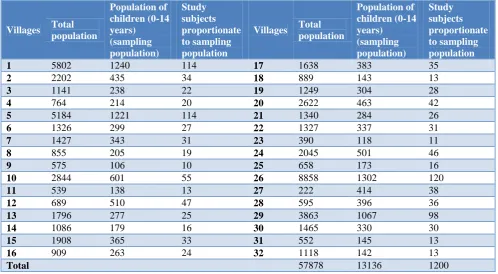
Probability proportional to size (PPS) sampling method was used. Sample proportionate to population size = [village population (0-14 years and below)×Total sample size 1200]÷Total population of sampling age group (13136).
Thus total 1200 study subjects (sample size) drawn from
13136 sampling population from each village
proportional to population size by using above formula as shown in Table 1.
Table 1: Village wise distribution of sample size according to PPS technique.
Villages Total
population
Population of children (0-14 years) (sampling population)
Study subjects proportionate to sampling population
Villages Total
population
Population of children (0-14 years) (sampling population)
Study subjects proportionate to sampling population
1 5802 1240 114 17 1638 383 35
2 2202 435 34 18 889 143 13
3 1141 238 22 19 1249 304 28
4 764 214 20 20 2622 463 42
5 5184 1221 114 21 1340 284 26
6 1326 299 27 22 1327 337 31
7 1427 343 31 23 390 118 11
8 855 205 19 24 2045 501 46
9 575 106 10 25 658 173 16
10 2844 601 55 26 8858 1302 120
11 539 138 13 27 222 414 38
12 689 510 47 28 595 396 36
13 1796 277 25 29 3863 1067 98
14 1086 179 16 30 1465 330 30
15 1908 365 33 31 552 145 13
16 909 263 24 32 1118 142 13
Total 57878 13136 1200
Selecting study subjects in a village
According to probability proportional to size (PPS) sampling system list of subjects population of children (0-14 years) for each village was prepared using list available from PHC and from this list of each village, the home of study subjects were selected by simple random sampling by using random number table. For locating home of study subjects address, help from anganwadi worker, link worker and local leaders were taken. If eligible selected subject(s) was (were) unavailable during the first home visit they were approached on another pre-informed date as per their convenience. Even after three visits, if the subject was non-respondent, then he/she was excluded from the study. Next eligible subject was enrolled in the study from next home. This methodology was followed till the desired sample size. This method was adopted in all villages for selection of study subject. All the children aged 14 years and below, whose parents had given written informed consent and Known cases of seizure disorders were included in study. Those who were not present at the time of visit on 3 consecutive visits, who were seriously ill and whose parents had not given consent for the study were excluded from study. Ethical committee approval was obtained prior to the start of the study from Institutional Ethics Committee of a Medical College.
Tools and techniques for data collection
The data was collected by visiting the recruited study subjects at their houses and by administering a
predesigned and semi-structured questionnaire. Before collection of the data written informed consent was taken from parents of all the study subjects after explaining the purpose of the study in detail.
Socio-demographic characteristics of study subjects were recorded. Information regarding medical history about seizure disorders was obtained from all subjects as per the pro-forma. Socio-economic status was determined by Modified B. G. Prasad socio-economic classification of family for the year 2015. Risk factors associated with seizure disorder were enquired.
The data was entered in excel sheet of Microsoft Excel 2013 version and analysed by Epi Info 7 version (Atlanta, Georgia, USA) for mean, standard deviation, chi square test and binary logistic regression considering the level of significance of p<0.05. Vancouver system of citing and listing the reference was used.
RESULTS
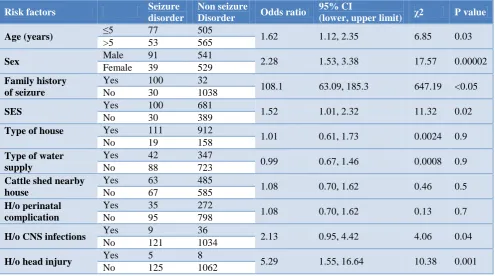
The prevalence of seizure disorder in the area studied was 10.84%.Of the total 1200 subjects examined, 52.67% were males and 47.33% were females. Mean age of the study population was 6.48±3.33 years, median was 6 years. Age of study subjects and seizure disorders was statistically significant (p=0.03). That is prevalence of seizure disorders decreased significantly with advancing age. The prevalence of seizure disorders was high among males compared to females (p<0.05).
Table 2: Bivariate analysis of risk factors associated with seizure disorders.
Risk factors Seizure
disorder
Non seizure
Disorder Odds ratio
95% CI
(lower, upper limit) χ2 P value
Age (years) ≤5 77 505 1.62 1.12, 2.35 6.85 0.03
>5 53 565
Sex Male 91 541 2.28 1.53, 3.38 17.57 0.00002
Female 39 529
Family history of seizure
Yes 100 32
108.1 63.09, 185.3 647.19 <0.05
No 30 1038
SES Yes 100 681 1.52 1.01, 2.32 11.32 0.02
No 30 389
Type of house Yes 111 912
1.01 0.61, 1.73 0.0024 0.9
No 19 158
Type of water supply
Yes 42 347
0.99 0.67, 1.46 0.0008 0.9
No 88 723
Cattle shed nearby house
Yes 63 485
1.08 0.70, 1.62 0.46 0.5
No 67 585
H/o perinatal complication
Yes 35 272
1.08 0.70, 1.62 0.13 0.7
No 95 798
H/o CNS infections Yes 9 36 2.13 0.95, 4.42 4.06 0.04
No 121 1034
H/o head injury Yes 5 8 5.29 1.55, 16.64 10.38 0.001
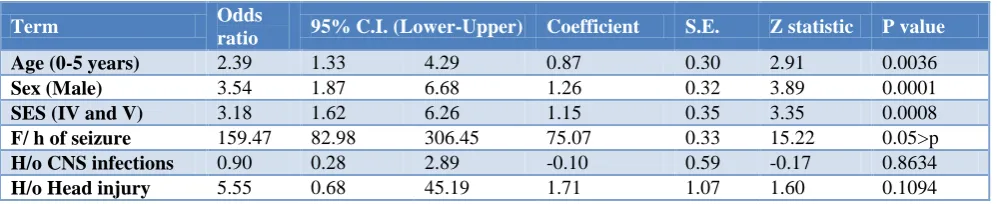
Table 3: Binary logistic regression analysis of risk factors of seizure disorders.
Term Odds
ratio 95% C.I. (Lower-Upper) Coefficient S.E. Z statistic P value
Age (0-5 years) 2.39 1.33 4.29 0.87 0.30 2.91 0.0036
Sex (Male) 3.54 1.87 6.68 1.26 0.32 3.89 0.0001
SES (IV and V) 3.18 1.62 6.26 1.15 0.35 3.35 0.0008
F/ h of seizure 159.47 82.98 306.45 75.07 0.33 15.22 0.05>p
H/o CNS infections 0.90 0.28 2.89 -0.10 0.59 -0.17 0.8634
H/o Head injury 5.55 0.68 45.19 1.71 1.07 1.60 0.1094
Among study subjects 52% were Hindus, 44.17% were Buddhist while 3.83% subjects belonged to Muslim. Among subjects 13.08% were from nuclear family, 82.67% belonged to joint family and 4.25% belonged to three generation family. It was observed that out of total study subjects 3.66% belong to upper socioeconomic class, 8.33% belongs to upper middle, 22.92% belong to lower middle class, 19.66% belong to upper lower and 555 (46.25%) belong to lower socioeconomic class. Prevalence of seizure disorders was highest 12.97% among study subjects belonging to Class V of socioeconomic status (p=0.0231). The prevalence of seizure disorders was increased significantly with decreasing socioeconomic status. Subjects with seizure disorder was significantly higher among subjects with family history of seizure disorder (75.76%) in comparison to subjects without family history of seizure disorders (2.81%). Statistically it was found that subjects with seizure disorder were not significant among study subjects having water supply from non-piped source (10.80%) in comparison to subjects having piped water source (10.85%). No significant association was found between higher among study subjects having cattle shed nearby house of study subjects (11.50%) in comparison to subjects having no cattle shed nearby house of study subjects (10.28%). Statistically it was found that subjects with seizure disorder was not significant among study subjects with h/o perinatal complications (10.64%) in
comparison to subjects without h/o perinatal
complications (11.40%). Statistically it was also found that seizure disorder was significantly higher among study subjects with h/o head injury (38.46%) in comparison to subjects without h/o head injury (10.53%). Statistically it was also found that seizure disorder was significantly higher among study subjects with h/o CNS infections (20%) in comparison to subjects without h/o CNS infections (10.48%). The result of bivariate analysis, showing the risk factors with Odd`s ratio, 95% C.I, χ2, p
value (Table 2). Age, sex, family history, and socio-economic status were highly statistically significant with risk of seizure disorders (p<0.01). H/o Head injury, H/o CNS infection were statistically significant with risk of seizure disorders (p<0.05).The result of binary logistic regression analysis, showing the risk factors with odd`s ratio, 95% C.I, p value (Table 3). Age, sex, family history of seizure disorders and socio-economic status were independently associated with risk of seizure disorders (p<0.01).
DISCUSSION
In present study prevalence of seizure disorders came out to be 10.84%. Our findings were supported by study of Fawi et al (12.46/1000).8 Real differences in prevalence may be related to the presence of endemic conditions such as neurocysticercosis or malaria, the medical infrastructure in place, including availability of preventive regional health programs, and accessible local medical care.
In present study, highest number of study subjects were in age group of 0-5 years 47.33% followed by 11-14 years were 37.58%. This finding of our study were supported by Fawi et al.8
In present study, 52.67% subjects were males and 47.33% subjects were females. Similar findings were observed by Hawley et al.9
In present study, out of total study subjects 3.66% belong to upper socioeconomic class, 8.33% belongs to upper middle, 22.92% belong to lower middle class, 19.66% belong to upper lower and 46.25% belong to lower socioeconomic class. Similar findings were observed by Khedr et al.10
Out of the total 1200 subjects, 1068 (89%) were not having any family history of seizure disorder. 132 were having family of history of seizure disorder out of which 97 (73.48%) study subjects were males, while 35 (26.51%) study subjects were females, which was similar to a study done by Al Rajeh et al.11
However on contrary to the present findings of Hawley et al. Difference in age group might be due to different setting and study group.9
The present study found that seizure disorders were more prevalent in males than in females
Similar findings to our study were given by Montanoet al (p=0.002).12 Findings of our study were contrary to studies of Fawi et al (p=0.188).8
Family history of seizure disorder was found to be a significant factor in our study which was supported by Ebrahimi et al.13
The present study showed socioeconomic status and seizure disorders, found to be statistically significant (p= 0.02319). The prevalence of seizure disorders was increased significantly with decreasing socioeconomic status, and this may be due to lower socioeconomic classes were associated with high health issues and deficient health facilities. Similar findings were observed by Schiariti et al.14 A higher prevalence of epilepsy was observed also among those with low socioeconomic status.
Statistically it was also found that subjects with seizure disorder was not significant (p=0.9988) among study subjects having kachcha house in comparison to subjects without kachcha house, In contrast to study of Abib et al (p=0.1).15
In present study, it was found that subjects with seizure disorder was not statistically significant among study subjects water supply from non-piped source in comparison to subjects having piped water source. Similar findings were observed by Abib et al (p=0.03).15 In the present study, statistically it was also found that seizure disorder is not significantly (p=0.49)among study subjects having Cattle shed nearby house in comparison to subjects not having cattle shed nearby house. Results of present study were in contrast with the study by Montano et al (p=0.001).12
In contrast to study of Khedr et al, in our study subjects with seizure disorder was not statistically significant among study subjects with perinatal complications (p=0.7108) in comparison to subjects without perinatal complications.10
Due to lack of availability of MCH services at peripheral level along with lack of trained staff and facilities are responsible for high number of perinatal complications.
In the present study, statistically it was also found that seizure disorder was significantly higher among study subjects with head injury (p=0.0013) in comparison to subjects without head injury. Findings of our study were supported by Medina et al.16
It was also found that seizure disorder is statistically significantly among study subjects with CNS infections (p=0.0437) in comparison to subjects without CNS infections. Findings of our study were also supported by Singh et al(p=0.02).17
We were not able to study all the predictors of seizure disorders due community based study.
CONCLUSION
Prevalence of seizure disorder in the area studied was 10.84%.Statistically significant association was observed between seizure disorder and age, sex, socio economic status, family history of seizure disorder, h/o CNS infections and h/o head injury. In this study no statistically significant association was observed between seizure disorder and type of water supply, Cattle shed nearby house, h/o perinatal complications, and type of house among study subjects.
Further research is needed to better understand the intricate relationship among socio-demographic risk factors and seizure disorders in order to ensure the best possible outcomes for individuals with seizure disorders.
Recommendation
Limitations of the study
The urban population was not included as the present study was conducted in a rural field practice area of medical college. The limitation of cross sectional study was recall bias to assess past history regarding CNS infection, prenatal complications, head injury, h/o of fever associated with seizure, seizure type.
Funding: No funding sources Conflict of interest: None declared Ethical approval: Not required
REFERENCES
1. Kasper DL, Braunwald D, Fauci AS, Hauser SL,
Longo DL, Jameson JL. Harrison’s principles of internal medicine. 16th edition. McGraw Hill Medical Publishing Division; 2005;2:2152-80. 2. Friedman MJ, Sharieff GQ. Seizures in children.
Paediatric Clin North Am. 2006;53(2):257-77. 3. Nelson LP, Ureles SD, Holmes G. An update in
pediatric seizure disorders. Ped Dent. 1991;13:128-35.
4. Huang CC, Chang YC, Wang ST. Acute
symptomatic seizure disorders in young children—a population study in southern Taiwan. Epilepsia. 1998;39(9):960-4.
5. Karim N, Ali A, Deuri SP. Care burden in epilepsy:
A study from northeast India. Int J Res Dev Health. 2014;2:84-9.
6. Geneva: World Health Organization; 2006. WHO.
Neurological Disorders: Public Health Challenges. 7. Amudhan S, Gururaj G, Satishchandra P. Epilepsy
in India I: Epidemiology and public health. Annals Indian Acad Neurol. 2015;18(3):263.
8. Fawi G, Khedr EM, El-Fetoh NA, Thabit MN,
Abbass MA, Zaki AF. Community- based epidemiological study of epilepsy in the Qena governorate in Upper Egypt, a door-to-door survey. Epilepsy Res. 2015;113:68-75.
9. Hawley SR, Ablah E, Hesdorffer D, Pellock JM, Lindeman DP, Paschal AM, et al. Prevalence of
pediatric epilepsy in low-income rural Midwestern counties. Epilepsy Behav. 2015;53:190-6.
10. Khedr EM, Shawky OA, Ahmed MA, Elfetoh NA,
Al Attar G, Ali AM, et al. A community based epidemiological study of epilepsy in Assiut Governorate/Egypt. Epilepsy Res. 2013;103(2-3):294-302.
11. Al Rajeh S, Awada A, Bademosi O, Ogunniyi A. The prevalence of epilepsy and other seizure disorders in an Arab population: a community-based study. Seizure. 2001;10(6):410-4.
12. Montano SM, Villaran MV, Ylquimiche L, Figueroa
JJ, Rodriguez S, Bautista CT, et al. Cysticercosis Working Group in Peru. Neurocysticercosis: association between seizures, serology, and brain CT in rural Peru. Neurology. 2005;65(2):229-33.
13. Ebrahimi H, Shafa M, Hakimzadeh Asl S.
Prevalence of active epilepsy in Kerman, Iran: a
house based survey. Acta Neurol Taiwan.
2012;21(3):115-24.
14. Schiariti V, Farrell K, Houbé JS, Lisonkova S. Period prevalence of epilepsy in children in BC: a population-based study. Can J Neurol Sci. 2009;36(1):36-41.
15. Abib CR, Mendoza-Sassi RA, Bech-Nappi J, Stein AT. Prevalence of seizures and associated factors in children under five living in a deprived municipality
of southern Brazil. Arq Neuropsiquiatr.
2007;65(3):581-6.
16. Medina MT, Durón RM, Martínez L, Osorio JR,
Estrada AL, Zúniga C, et al. Prevalence, incidence, and etiology of epilepsies in rural Honduras: the Salamá Study. Epilepsia. 2005;46(1):124-31. 17. Singh G, Bawa J, Chinna D, Chaudhary A, Saggar
K, Modi M, Sander JW. Association between epilepsy and cysticercosis and toxocariasis: a population-based case-control study in a slum in India. Epilepsia. 2012;53(12):2203-8.