MASTER THESIS
DESIGN OF AN IMPLEMENTATION
METHOD FOR CUSTOMIZABLE
SAAS SOLUTIONS
L.G. Sterrenburg
ii
Design of an Implementation Method for Customizable SaaS
Solutions
April 2019
Author
Name: L.G. Sterrenburg (Thierry)
Programme: MSc Business Information Technology
Institute: University of Twente
PO Box 217
7500 AE Enschede The Netherlands
Faculty: Electrical Engineering, Mathematics and Computer
Science (EEMCS)
E-mail: [email protected]
Graduation Committee
prof. dr. Maria-Eugenia Iacob
Department: Industrial Engineering and Business Information Systems
E-mail: [email protected]
dr. ir. Marten van Sinderen
Department: Computer Science
E-mail: [email protected]
Leon de Vries
Company: Cofano Software Solutions B.V.
iv This research is my master thesis that completes my master study ‘Business Information Technology’ at the University of Twente. As master student I got in contact with diverse companies with
interesting business cases. I appreciate all the experiences I have gained in the study.
This research is done in cooperation with Cofano Software Solutions. During the research I also worked on multiple implementation projects of customizable SaaS. Due to the projects, I gained more in depth experience in these projects, which helped me in this research. Our mutual aim was to define a standard and structured method for implementing customizable SaaS in the primary
business processes. The designed method should also be applicable for implementation projects of Cofano’s software.
First, I would like to thank my supervisors Maria Iacob and Marten van Sinderen for their valuable feedback and support. I appreciate the discussions that we had during the research. Your guidance sharpened this research.
Secondly, I would like to thank Leon de Vries for supervising me on behalf of Cofano Software Solutions. Thanks towards Marco Huijsman and Koos Leeuwenstein for providing a great work environment for performing this research. Also your interest in this research is much appreciated. Besides I would like to thank all my colleagues that have cooperated in the implementation projects and in this research for their effort and for sharing their experiences.
Finally, I would like to thank my family and especially my girlfriend Marlies for supporting me during my study and master thesis.
vi Software as a Service is a relative new business model for software to a customer. Often there is a periodic fee for using the software. Support and updates of the software are included in the subscription. For customizable SaaS, the customers play an active role in improving the software. A downside is that customers handle the SaaS solution as software on demand.
Implementing software in the primary businesses process of a business is critical project. The essential value of a service or product is gained in the primary business processes. It is of major importance that new software solutions support those primary business processes and that the software solution is adapted well by the business.
Currently there is no implementation method for implementating customizable SaaS in the primary business processes of enterprises. Hence, no suitable controls are available for these
implementations projects. This has resulted in longer implementation projects than estimated. In the end this can lead to unsuccessful implementations, what can be prevented by having an
implementation method.
This research has a research goal:
Develop and validate a method for implementation of SaaS solutions in the primary business processes.
In this research a SLR is performed for finding literature that connects with the research goal. After performing the SLR, it could be concluded that there is no implementation method for customizable SaaS solutions. Therefore a method for implementing customizable SaaS in the primary business processes has been developed and validated in this research.
The most important results of this research are:
In the literature no implementation method for customizable SaaS in the primary business process has been found.
A method for implementing customizable SaaS in the primary business processes has been developed in this research.
The steps in the implementation method are based on concepts found in literature and field experiences.
The developed implementation method has been validated by experts and their opnion towards the implementation method is very positive.
viii
1 Introduction ... 2
Business Models for Software ... 2
Barriers for SaaS Solutions ... 2
Primary Business Processes ... 3
Use Case Context ... 4
Research Goal ... 4
Research Questions ... 4
Research Methodology ... 4
Structure Report ... 5
2 Research Design ... 6
Method ... 6
Problem Statement ... 6
Literature Research Questions ... 7
Search Process ... 7
Exclusion Criteria ... 7
Quality Assessment ... 7
Data Collection ... 8
Results ... 10
3 Analysis ... 12
Change Management ... 12
Software Development Methodology ... 12
Data Migration ... 13
Multi-Tenant Software ... 13
Service Level Agreements ... 14
Service Agreements ... 14
Business Rules ... 15
Agile Project Management for SaaS ... 15
Customizable SaaS ... 17
4 Analysis Overview ... 20
5 Implementation Method ... 22
Model “as is” Process ... 23
Fit Gap Analysis ... 25
Define Product ... 27
ix
Planning ... 32
Software Development ... 34
Migration ... 36
Go Live ... 38
6 Validation ... 40
Validation Method ... 40
Expert Experiences ... 41
Validation of the Implementation Method ... 42
Updates to the Implementation Method ... 43
7 Conclusions ... 46
Research Questions ... 46
Contribution ... 47
Limitations ... 47
Future Work ... 48
Recommendations... 48
8 Bibliography ... 50
Appendix A. Expert Interview ... 54
Appendix B. List of Figures ... 55
x BPMN – Business Process Model and Notation
BPR – Business Process Reengineering CIB – Cloud Interoperability Broker
EROP - Events, Rights, Obligations and Prohibitions IaaS – Infrastructure as a Service
2
1
Introduction
Software as a Service (SaaS) is a relative new way of providing software to a customer. The business model behind SaaS solutions is that the customer does not have to buy the software, but instead pays a periodic fee. The SaaS provider is responsible for the deployment and maintenance of the software in the cloud. Therefore, customers do not have invest in IT-hardware for installing and running on premise applications. SaaS applications have a low total cost of ownership in comparison with on premise-installed applications. Where on premise-installed applications are often configured once, SaaS applications have periodic updates, which can be optionally deployed. This strategy ensures that the software stays up-to date and consequently does not age (fast). The down-side of these updates is that the customer sees the software as an on demand service. Customers don’t have to make an internal request for change, because no extra costs will be charged. They just send a request to the ASP (Application Service Provider) and expect it to be implemented within a short timeframe. As a result a growing number of customers results in a growing number of implementation requests.
Business Models for Software
The business model for customizable SaaS applications differs from the traditional model for on premise installed applications. Due to the difference in business model, the development of the software and deployment of the software are organized in another way. This has also an impact on the approach for implementing the software at customers.
On premise software is installed on the location or in a cloud environment. When the software is installed on the customer location, the hardware is managed by the customer. The initial costs for on premise software are high compared with the initial costs for SaaS. The software is often a basic off the shell package whereon additional modules can be installed. Besides it is possible to realize all sorts of customizations. The reason for the high initial costs are that customizations are realized and used for one customer only. Reuse of code is not applied much since those customizations are very specific requests and built for a particular version of the standard package. Updates of on premise software are only applied when necessary, because these updates come with additional upgrade costs and also result in a period of down-time.
The business model for SaaS applications is different. The initial costs are lower than for on premise software. Usually a starting fee has to be paid and thereafter there will be a monthly fee. This periodic fee includes the hosting of the software accompanying with periodic updates. All customers will use an application with the same code base. Therefore features have to be built once and can be provided to all customers. Customers are able to make requests for features, which are reviewed by the ASP and may end up on the roadmap. Before accepting and implementing a feature it is important to examine the impact on the application. The implementation or adaption of a feature will have an impact for all customers, since they share the same code base. In order to accept and support different views on the business operations, configuration options and settings can be used to make the application fit for different customers.
Barriers for SaaS Solutions
1. Introduction
3
The application is maintained and managed by the ASP on a remote location. This might raise reliability issues and could cause data loss. In case of application restarts or network interruptions the application is offline for a certain time. On premise software runs locally and will only be offline when the local network or server does are not functioning correctly. Due to the business model of SaaS applications there is limited customizability and limited configurability, because all customers have software with the same codebase. However, when needed the ASP can implement
configuration functions in order to meet all customizations and configuration requirements. Other mentioned downsides are:
Data confidentially, integrity and availability
Legal problems from cross-country distribution
No clear downtime agreements or reimbursement policies.
Primary Business Processes
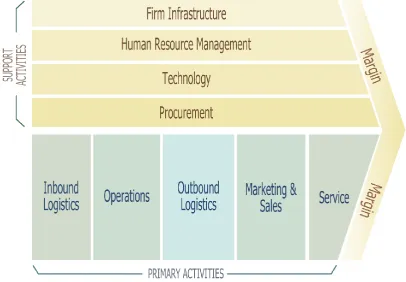
[image:14.595.93.500.346.628.2]Business processes are activities that add value to a business product. According to Porters’ value chain there are primary activities and support activities. The idea is that a product gains value with each activity. The sum of all gains from the activities is the margin that is gained at the end of the value chain. The primary activities contain the core business, where the actual product or service is delivered. The primary activities are explained below.
Figure 1: Porter’s Value Chain
Primary Activities
Inbound Logistics: All incoming movements of materials from suppliers
Operations: Activities needed to transform the input to an output.
Outbound logistics: All outgoing movements of the final product to customers or retailers.
Marketing & Sales: Activities needed for promoting and selling the service or product.
4 Businesses that are located in the tertiary sector only offer one or multiple services to their
customers. For these businesses, there are no inbound or outbound logistics, because they do not manufacture products. Implementation of software in the primary activities of a business requires a different approach than the implementation for supporting activities. The primary activities ensure that a product or service is delivered in the end. When software for controlling these activities is not implemented correctly, less or no value is added in the end.
Use Case Context
Cofano Software Solutions B.V. is an ASP of diverse products for managing business processes and logistics. All Cofano’s services are provided as Software as a Service. One of their logistic applications is STACK. It is an application for inland terminals, forwarders and chain directors for managing container transport. The application supports in manual and automatic order entry for container transport. It contains modules for truck planning, barge planning and train planning to provide full management for all usable modalities in the container transport. Also apps are built to enable hands on registration of actions. An example of such an app, is the terminal app for reachstackers, which is used for registration of actions on the terminal. The finance module ensures that bookings can be invoiced. STACK supports in the whole flow from order to cash. The implementation strategy for STACK is used as object of study in this research. The implementation strategy entails the complete process starting presenting the application for the first time to an interested party. It also covers the fit gap analysis, development of features for realizing the minimum viable product and migration to the SaaS application. Currently there is no implementation method or strategy used. Implementation is done using common sense and by making mutual agreements between the ASP and the customer. This has resulted in longer implementation processes than estimated and pre-arranged. Due to the maturing of the application, the number of interested parties rises. Along with the raising interest, there is also a rise in customers using the product and businesses where the implementation proces has started.
Research Goal
This research investigates the implementation of a SaaS application in the primary business processes of enterprises. Several enterprises are currently using STACK. The implementation and migration phase for these enterprises have been diverse. Besides there was also an implementation project that has been stopped after exceeding the estimated implementation time. In order to mitigate the risks of implementing a SaaS application, an implementation method that allows control over the implementation process has to be developed. We intend that the designed method can also be used for the implementation of other SaaS applications. The following research goal is defined:
Develop and validate a method for implementation of SaaS solutions in the primary business processes.
Research Questions
The following research questions must be answered in order to achieve the research goal: 1. How are SaaS solutions implemented in the primary processes of enterprises? 2. Which steps can be identified in the process of migration to a SaaS solution? 3. How can the designed implementation method be validated?
Research Methodology
1. Introduction
5
Structure Report
The report is structured as follows: Chapter 2 outlines the problem statement and describes the literature selection process. Chapter 3 contains an analysis of the selected literature followed by an overview of the analysis in chapter 4 . Chapter 5 shows the design of an implementation method that can be used for implementing a SaaS application in the primary business processes. The
6
2
Research Design
In this research a systematic literature review (SLR) will be used. This SLR give insight on available existing literature and knowledge gaps. The method for performing the SLR is described in section 2.1. Section 2.2 presents the problem statement for the SLR, followed by the research questions in section 2.4. Based on the research questions a search process is established in section 2.5. For the right data selection, exlusion criteria are defined, which can be found in section 2.6. The process for data collection is shown in section section 2.7. An overview of the results in shown in section 2.8.
Method
In order to perform a SLR a defined method is needed. Brereton and Budgen (Budgen & Brereton, 2006) defined characteristics for a systematic review. These characteristics are used for performing a SLR in this research. The following characteristics are defined by Brereton and Budgen (Budgen & Brereton, 2006):
review protocol
defined search strategy
documented search strategy
inclusion and exclusion specification
evaluation of obtained information
Besides the characteristics presented above, Brereton and Budgen (Budgen & Brereton, 2006) propose a process with three phases for reviews in Software Engineering:
Planning
Conducting
Reporting
The proposed process is used in this research. The planning phase is performed in the search process, where literature is searched that is connected with the topic. After defining the right search queries, the set of results will be reviewed. The review of the results can be mapped on the conducting phase. Reporting will is done in the section 'Discussion' where the relevancy and fit and gaps of the
literature will is discussed.
In “Systematic literature reviews in software engineering - A systematic literature review” (Kitchenham et al., 2009), Kitchenham et al. perform a systematic literature review. The SLR by Kitchemham et al. is an example for performing a SLR. The planning phase is represented by the research questions, search process, exclusion criteria and quality assessment. Conducting the SLR is done in the subsection 'Data Collection'. The last phase reporting is represented by the section results, which is followed by a detailed analysis.
Problem Statement
The business model of SaaS solutions is that there is main code base that can be sold as a service to customers for a periodic fee. The impact for the use of the software depends on the complexity of the software and the effected business processes. For there is one code base, all (potential) s have to find a fit for their processes in the software or the software should be extended with new functions. Besides processes can be made more efficient with new software, but in order to achieve this, processes may have to change in order to become more efficient.
2. Research Design
7
Literature Research Questions
The literature research questions should help in finding existing literature about how implementation of customizable SaaS is done. The keyword ‘enterprise’ and ‘business’ are exchangeable. However, using ‘enterprise’ as keyword result in more literature.
RQ1 How are SaaS solutions implemented in enterprises?
RQ2 How do client and provider cooperate in building customizable SaaS?
Search Process
The search process shows how the SLR is performed. The found literature should give an insight in what literature exist regarding the implementation of customizable SaaS in the primary business processes. In order to know how software and in particular a SaaS solution is implemented, the starting point of the search process was a broad scope, which was narrowed down to keep only the most relevant literature results. The main topic are split into four sections:
implementation
customizable
SaaS
primary business processes
For the part 'customizable' there are similar words, f.e. 'tailoring' or 'tailor-made' that are used in the branch of software engineering. SaaS is an abbreviation for Software as a Service, which may be used in literature instead of the abbreviation. The part of 'primary business processes' points where change of system will have an impact in the enterprise. However, these keywords might be to specific. Therefore enterprise software or enterprise applications might include relevant results, for enterprises is the target group for implementation. The keywords 'primary business processes' might be to specific for finding literature. Using 'enterprises' will be used as replacement for 'primary business process' in order to search with a broader scope.
Scopus and Google Scholar are used in the search process. Scopus is used as main search engine and the search queries are adjusted and improved for this search engine. Google Scholar is used as search engine to find interesting literature and explore usable key words. The key words found with Google Scholar are used for designing a search query in Scopus. The total number of results found in Google Scholar was to high even after using inclusion and exclusions for use in this SLR.
Exclusion Criteria
In order to get a good overview of the available literature the following criteria for exclusion are used:
Duplicate articles, because Scopus can deliver one article multiple times as result.
Books and book chapters, for they are not always available and the overall coverage of the books is not relevant in this SLR
Unavailable articles, for Scopus also shows articles which are not accessable.
Paid articles, for Scopus also shows results that are not freely accessable for the University of Twente.
Quality Assessment
8 effective filters are added to the search query. No further requirements are determined for grading an article on quality in order to keep the scope broad and to not miss any possible relevant
information. In the discussion the quality of articles or statements in articles will examined on quality and validity.
Data Collection
For collecting the data three search queries are defined that cover the relevant data in this SLR:
SaaS enterprise implementation
customizable SaaS
agile project management SaaS
The data collection for all three search queries are described below.
2.7.1 SaaS Enterprise Implementation
The first step in the searching process is designing a search query with all relevant key words. Since SaaS is the abbreviation for Software as a Service, this should be included in the search query. The following search query covers all results connected with the implementation of SaaS solutions in enterprises:
TITLE-ABS-KEY ( ( "SaaS" OR "Software as a Service" ) AND ( "enterprise software" OR "enterprise application" ) AND implementation ) {21 results}
A total of 21 results were returned.
The search query is relative broad scoped, which means that all kinds of SaaS solution
implementation for enterprises are returned. The results cover subjects such as "ERP as SaaS" and "cloud-computing". These subjects are not the core goal of the research, concluding that the search query should more focused on SaaS solutions as enterprise application or enterprise software. Exclusion
All results with an undefined author were excluded from the search results. This brought the number of results to 17. In the results there appeared one book chapter, which was unavailable. Therefore book chapters where excluded as source type as well. Furthermore results were excluded due to irrelevancy. Results with the keywords: 'costs' and 'metadata' were excluded. The results from: 'Confenis 2013 7th International Conference On Research And Practical Issues Of Enterprise
2. Research Design
[image:20.595.171.428.66.389.2]9
Figure 2: Literature Selection Process for “SaaS Enterprise Implementation”
Figure 2
2.7.1
Customizable SaaS
Besides the implementation of SaaS solution, the customisability of the solution is an important factor. Therefore a query is designed to retrieve results regarding the customisability of SaaS solutions.
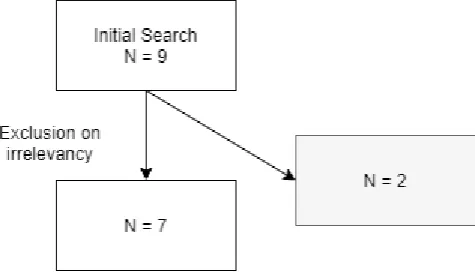
TITLE-ABS-KEY ( ( "customizable SaaS" OR "customisable SaaS" OR "customizable Software as a Service" OR "customizable Software as a Service" ) ) {9 results}
Exclusion
[image:20.595.179.417.608.745.2]With exclusion of the keyword 'XML' the irrelevant papers were filtered out. A total of 7 papers were selected as result for this search query.
10
2.7.2
Agile Project Management
Having the implementation and customization of SaaS covered. Other results about the
implementation of SaaS are found in the area of project managment. Therefore the following search query is used.
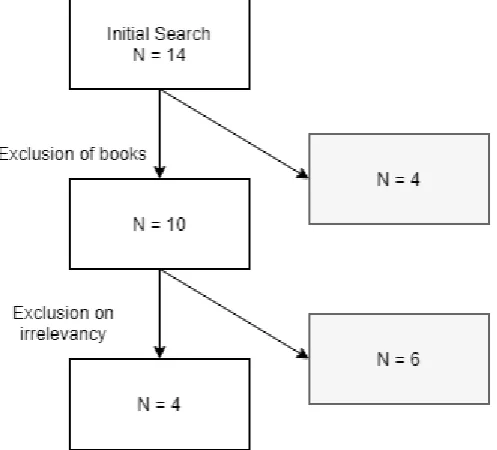
TITLE-ABS-KEY ( ( "agile project management" ) AND ( SaaS OR "Software as a Service" ) ) {14
results}
Exclusion
[image:21.595.176.425.213.438.2]After excluding irrelevant articles based on title and abstract 4 results were left.
Figure 4: Literature Selection Process for “Agile Proejct Management”
Results
The found literature in the section ‘Data Collection’ is shown in table 1. The results are categorized on search query.
Search Query Results Total
SaaS enterprise implementation
(Ali et al., 2016), (Aulbach et al., 2008), (Buford et al., 2015), (Grati et al., 2015), (Koski et al., 2016), (Molina-Jimenez et al., 2011), (Moore & Mahmoud, 2009), (Singhto & Phakdee, 2017), (Seethamraju, 2015)
9
customizable SaaS
(Liu et al., 2010), (Moens et al., 2016), (Moens et al., 2012), ( Moens & De Turck, 2014), (Mohamed et al., 2015), (Ruehl & Andelfinger, 2011), (Truyen et al., 2012)
7
agile project management SaaS
(Agarwal, 2011), (Bajighar & Shahzad, 2017), (Benefield, 2009), (Femmer et al., 2014)
[image:21.595.72.530.521.665.2]4
2. Research Design
12
3
Analysis
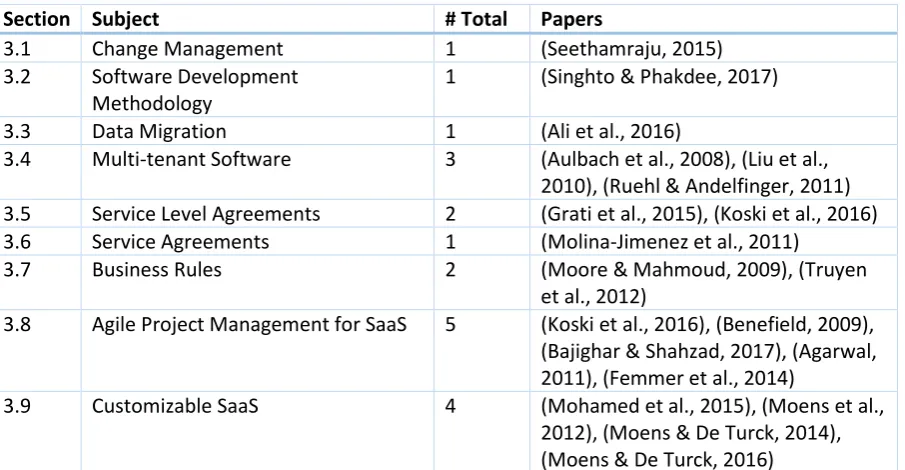
The retrieved results from the search queries in Scopus are analysed in this section. The found papers are categorized on subject. For each subject there is a separate section in this chapter. The analysis provides a global overview of the found literature in order gain insight in the available knowledge. The relevance and usability of the literature is examined in chapter 4.
Section Subject # Total Papers
3.1 Change Management 1 (Seethamraju, 2015)
3.2 Software Development Methodology
1 (Singhto & Phakdee, 2017)
3.3 Data Migration 1 (Ali et al., 2016)
3.4 Multi-tenant Software 3 (Aulbach et al., 2008), (Liu et al., 2010), (Ruehl & Andelfinger, 2011) 3.5 Service Level Agreements 2 (Grati et al., 2015), (Koski et al., 2016)
3.6 Service Agreements 1 (Molina-Jimenez et al., 2011)
3.7 Business Rules 2 (Moore & Mahmoud, 2009), (Truyen
et al., 2012)
3.8 Agile Project Management for SaaS 5 (Koski et al., 2016), (Benefield, 2009), (Bajighar & Shahzad, 2017), (Agarwal, 2011), (Femmer et al., 2014)
[image:23.595.75.528.156.391.2]3.9 Customizable SaaS 4 (Mohamed et al., 2015), (Moens et al., 2012), (Moens & De Turck, 2014), (Moens & De Turck, 2016)
Table 2: Categorization of the Papers per Subject
Change Management
Change Management is an important part of the implementation of a SaaS solution. The software is hosted by the software vendor and the client can often login via a web browser or app. Seethamraju (Seethamraju, 2015) state that small and medium sized enterprises do not get a sense of ownership. Users would possibly not accept or use a new feature. The identified challenges for the adoption of a new SaaS solution are:
Attidude towards the proposed change of the system
Lack of process understanding
Change in process steps
New activities to be performed
Replacement of resources
Lose of control, access by updating the roles and permissions of people
In order to have a successful implementation the above mentioned challenges must be dealt with.
Software Development Methodology
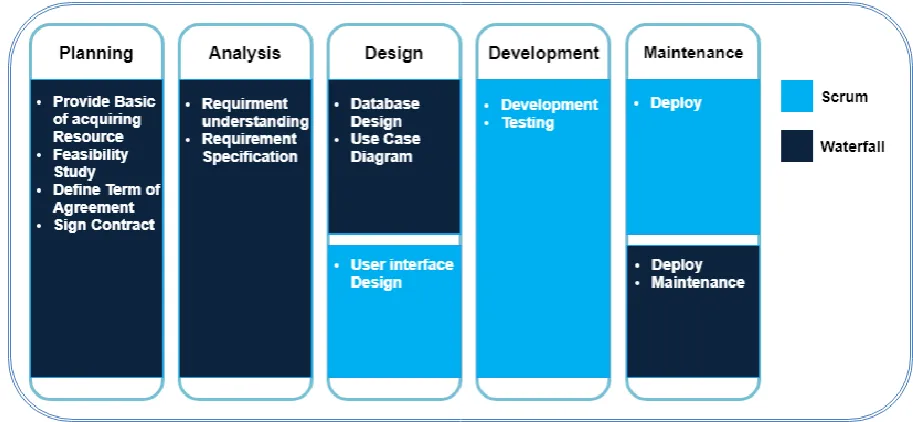
For software development diverse methodologies can be chosen, from waterfall to extreme
programming. Besides it is possible to use a hybrid development methodology, where only parts or a part from one or more methodologies are used for the development of the software. The
3. Analysis
[image:24.595.67.524.70.281.2]13
Figure 5: Blending Scrum and Waterfall Technique (Singhto & Phakdee, 2017)
Data Migration
When moving from one application to another data migration is often an important part of the transition. Data migration can be applied when the new application is similar of has partly similar features as the current used application. Ali et al. (Ali et al., 2016) explored the areas
cloud-computing that would benefit interoperability by standardization. The focus in that research lies on data migration from SaaS to SaaS applications. A cloud interoperability broker (CIB) is proposed as a solution for data migration. The CIB should enable SaaS clients to move from one SaaS application to another. A methodology (Ali et al., 2016) is designed to for migrating data covering the following steps:
Collection and Analysis of Metadata
Develop the Mapping Model
Solution Design
Implementation
Test the Solution
The collection of the metadata from both applications enables the CIB to develop a mapping model. The mapping mapping model ensures the right location for data in both applications is allocated. For each combination of applications a new mapping model has to be designed. The next step designing a solution for migrating the data with the help of the mapping model. Once the design is finished, the solution can be implemented and tested. If the tests failed, the mapping model should reviewed and the process should be resumed from the development of the mapping model. This process is
repeated until the tests are successful.
Multi-Tenant Software
14 row column. In this way tables for multiple tenants can be merged into one table. The downside is that there is an overhead of data, caused by the meta-data columns.
In multi-tenant systems enterprises are often the tenant and each tenant has multiple users that access the same data. Each tenant has their own processes and each process and be split up in services. In order to optimize the performance load balancing can be applied. Messages should be send to different priority queues (Liu et al., 2010).
Ruehl and Andelfinger (Ruehl & Andelfinger, 2011) designed an architectural model for
customization of SaaS applications on the tenant level. Because the processes for tenants may differ, the application should be adapted for each tenant's process. With the use of software product lines, the application can be tailored for all tenants.
Service Level Agreements
The contracts of a SaaS solution often comes together with a service level agreement (SLA). Since the SaaS provider often use a PaaS or IaaS solution there is service build on cloud layers offered to the end user. Grati et al. (Grati et al., 2015) designed a model to manage entities in a layered cloud construction for SLAs. In the model a service can be composed by other services with underlying SLAs. These SLAs then have a direct effect on the SLA of the composed service, because of the dependency. The management of these entities is important of SLA violation and possible penalties. SLAs are always established between two parties. For SaaS providers there are two SLAs, one
between the SaaS provider and and the other SLA is established between the IaaS provider and SaaS provider. Service Level Monitoring can be done to prove that the agreements in the SLA are met. A service can have a certain minimum availability (for example 99.9%) excluding planned maintenance. (Koski et al., 2016) The following calculation can be used for monitoring the availability:
uptime = 100 * (time-downtime)/time (Schwaber & Beedle, 2001)
Service Agreements
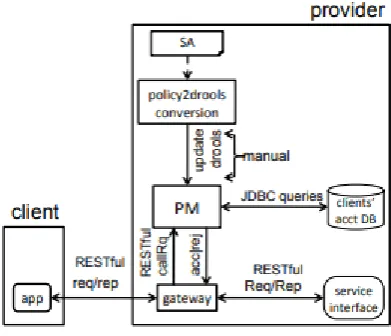
Where the SLAs describe the agreed quality of service (QoS) between the client and provider, the service agreement describes what services are provided to the client. The rules or limits for using a service can differ per client, which appoints to a customisability for the SA. An example for
3. Analysis
[image:26.595.199.395.77.245.2]15
Figure 6: Proof of Concept Implementation (Molina-Jimenez et al., 2011)
Business Rules
Business rules define which information is needed and which actions are triggered by the given information. The process of defining business rules is needed to transform (sub)process into a service component. The designed service should be able to automate (a part of) the process. Moore et al. (Moore & Mahmoud, 2009) used a case study to show how business rules can be stated in words and transformed to web service definitions in WSDL.
Business rules also apply in context-oriented programming. In the same branch enterprises may have different business rules or processes, but are performing and delivering the same service. According to Truyen et al. (Truyen et al., 2012) customizability can be achieved be designing multiple objects, which can be used by tenants by dependency injection. As use case a system for online hotel bookings is used. Where hotels can configure their own tariffs, for low season, high season and VIP guests (Truyen et al., 2012). All tenants make use of the base layer can are able to add layers for customization of the software.
Agile Project Management for SaaS
One of the most important things for SaaS products is care. Since the application is not installed on-premises, but is just a service there is low total cost of ownership. When customers are unsatisfied with the service it is, economically seen, easily to switch between similar SaaS applications. Besides users are intended to complain more easily about the user-friendliness of the application. (Koski et al., 2016) The application might be used by several types of users. Some users will be professionals in the application, others might use only a minimum set of features. The application should be have an intuitive interface in order to gain a higher user satisfaction (Koski et al., 2016).
"Being wrong about what customers want can mean losing a when another service provider, with possibly an inferior solution by many aspects,hits the expectation target exactly." (Koski et al., 2016) Customers see SaaS as an on demand service. Not only for the up-time of the service, but also for functionality development. Applying lean management on the deployment of the services might help in meeting the demand. Benefield (Benefield, 2009) describes four lean management techniques that can be applied on deployment strategies for SaaS:
Poka Yoke
Jidoka
16
Just in Time
Poka Yoke aims at mistake proofing. The release of new components for the software, and in special for long release cycles, may cause bugs. Variances of software environments should be kept to a minimum in order to be able to reproduce environments. Furhtermore mistakes and errors can be prevented by automated deployment and management tools. These tools can help in version control and connecting the right packages with a certain environment. When also test automation is
realised, changes in the software can be tested, tracked and managed well. Jidoka follows the principle of automatically building artifacts that meausre and reports errors. This method helps in builiding more stable software, testing and troubleshooting. The Kaizen method can be used for continuous improvement. Not alone for solving errors in the system, but also for understanding the workflow of the customers. When tracking the activity of users it is possible to figure out which functions are popular and which not. Eventual the software can be improved in such way that the workflow of the can be improved by the software. The just in time method aims at the reduce of waste. If only functionalities are build that are really required, the waste is left out. Software architecture may add waste to the project, for a part of the flexibility is handed in and redesign may be necessary in the future.
Autonomous software deployment should help software providers in achieving continuous development of their software. According to Bajighar and Shahzad (Bajighar & Shahzad, 2017) this can be achieved by by the adoption of some fundamental principles for software development management. Since cycles for software releases becomes shorter it is important that developers are perpetual in development mode, because new features are build continuously. Post-agility is mentioned as possible next step in software development. Where post-agile is a combination of Waterfall or planned development and agile techniques. The following princples are described for self-driving software development:
Every requirement is assigned a valuation
Every requirement is assigned to a task-list
Every task is assigned to a workflow
Every team member is assigned to at least one role
Every team member has a work queue
Every requirements delivery status is available on-demand
The valuation of a requirement is done based on four factors, namely:work size, size of function, effort and return on investment (ROI). All task for delivering the requirement are stated in a task-list. For each task on the task-list there are workflows. All team members have at least one role assigned, and more roles are possible. The task-list can be split up assigned a task with a certain workflow a queue of a team member. In this way it is possible to monitor what the status of a requirement is. For the application of the principles of self-driving software application Bajighar and Shahzad (Bajighar & Shahzad, 2017) propose the following six gears:
Rapid continuous design & requirements
Rapid continuous development
Rapid continuous feature assembly
Rapid continuous testing & acceptance
Rapid continuous marketing & training
3. Analysis
17
These gears ensure that every team member is continuously working on the development and evolution of the software.
Scrum as agile method can be used for short release cycles in software development. Especially Scrum type C allows to develop and release user stories fast (Agarwal, 2011).The concept of Scrum C, also known as continuous Scrum, is that each sprint has a release cycle of three weeks and each week a new sprints starts. This means the there are three sprints active simultaneously. Because there is every week a new release cycle and a new start of a sprint. User requests are picked up faster than in other types of Scrum. An use case at InstantApps has shown that with the use of Scrum C more work-items were finished in four release, than possible with other types of Scrum (Agarwal, 2011).
Due to the good connectivity and online collaboration tools, it becomes easier to set up distributed teams. Besides s that co-create the software can be geographically widespread, which can be a barrier for good transfer of requirement information. Femmer et al. (Femmer et al., 2014) designed an refined artifact model, based on an original model from previous research for organizing and managing software projects. The original model is used in a software project and during the project refined. The main artifacts of the refined model were: Planning, Requirement & Specification, Change Management and Testing. The original model was set up aiming at an agile way development. After refining the model it could be concluded that more traditional project management artifacts were added to the refined model. The artifacts from traditional project management were added, because more and more business context is needed when working with distributed teams.
Customizable SaaS
Customizable SaaS allows the software provider to serve multiple clients with diverse Software Product Lines (SPLs) within the same software package. A feature model can be designed for the application, where there can be mandatory, optional and alternative features. (Mohamed et al., 2015) The mandatory features belong to the core of the application and are required to let the software function. The optional features are additions to the core features to support or automate a part of the business process. Alternative features contain functionality for similar processes, but have a slight other type of content. For example products can be bought in a webshop by credit card or other online payment method. There is a fourth feature similar to the alternative features, but make use of the 'or' principle. On a certain point of the process, you have to choose for either the
functionality of feature A or the functionality of feature B.
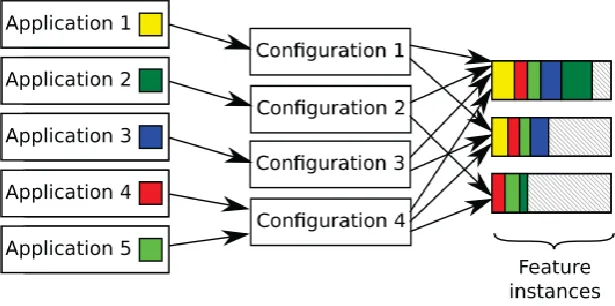
18 be deployed on a server (Application-Based Binary), but it is also possible to deploy feature instances on a server (Feature-Based Binary). Besides a hybrid approach is possible where common used application features are compiled in a single instance and additional features are included by using the feature-based binary approach.
[image:29.595.144.454.201.371.2]An idea for application can be originated as application for one tenant, but might be expanded as multi-tenant application.
Figure 7: Application-Based Binary (Moens et al., 2016)
Figure 8: Feature-Based Bianry (Moens et al., 2016)
[image:29.595.142.450.431.584.2]3. Analysis
19
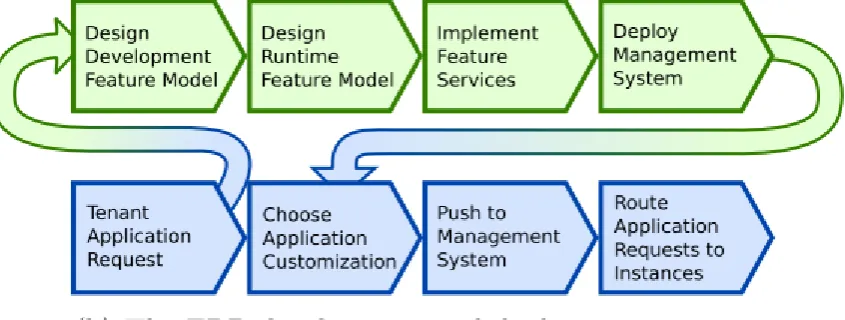
[image:30.595.85.508.320.480.2]have to integrated in the application. Due to the differences of implementation and the size of effect on the application for both variation types, there are two different development strategies.
20
4
Analysis Overview
Considering all the found literature there is no method for successful implementation of existing software in the primary business processes of an enterprise. However the found literature covers partially steps that are required during the implementation of customizable SaaS. Mainly the sections ‘Change Management’, ‘Software Development’, and ‘Data Migration’ are interesting and relevant as components of a complete implementation method. Where data migration will be an obvisous step in the implementation method, change management will be less visibile as step, but interwoven throughout the complete process.
Furthermore the customizability of the application is discussed in little detail. Customization can be established on different levels, namely the available services in the application, the SPLs that are realised by the application and service agreements. The results did not cover the customizability by continuous development of the software in combination with co-creation. Besides it might be needed to develop new features in addition to the current state of the software in order to support the business processes of a new client. The proposed methods for achieving customizability are aiming on the design of customizable applications instead of informing about how to handle with existing and connecting new customers on the same SaaS solution.
Literature regarding agile project management is moreover focused on delivering conitinously stable software. Building stable software is important and the techniques that are proposed can be used within agile software development methods, but it does not dwell on implementation methods. It can be concluded that there is a knowledge gap for the implementation of existing SaaS
applications (applications that are already used in production) at the and continuously development of the software. Since there is no complete implementation method for customizable SaaS
applications and the need from the business for such a method, brings me to the design of such a method. Though parts of the implementation method can be derived from the found literature, since they can be used within the implementation method.
4. Analysis Overview
22
5
Implementation Method
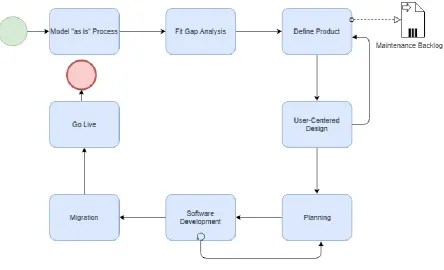
This chapter describes the phases of the implementation method. The method provides clear of all steps in the process. It is developed with a hybrid approach of Waterfall and Scrum in mind. The traditional approach is effective for projects with small to no requirement changes, where Scrum is suitable for handling requirement changes (Mahalakshmi & Sundararajan, 2013). However, this implementation method will differ from the standard approaches, for there is already a working software product. The hybrid approach will be applied for adjusting the software where needed and for having a clear implementation plan. The traditional waterfall approach will be used in the start of the implementation method for gathering the required information and for defining the scope of the project. Waterfall is a more predictive software development method than agile methods. Using Waterfall in the first steps of the implementation method helps in having a better insight in impact and planning the to be developed features. In order to be flexible during the implementation, Scrum will be applied as agile software development method. One of the advantages of using Scrum for developing software is that errors are fixed during the development of the software in contrary to Waterfall, where errors are fixed after completing all requirements (Cocco et al., 2011). When it appears that unforeseen requests must be added during the software development method, it is clear that the scope changes, which has an effect on the duration of the implementation phase. Off course unforeseen requests are as well as possible omitted by the “Fit Gap Analysis” and “Define Product” steps in the implementation method. Using a hybrid approach should make the
[image:33.595.73.518.402.672.2]implementation phase more predictable, omitting delays during the implementation for receiving information of other parties and still have the flexibility to test, evaluate and change functionality during the software development.
Figure 10: Implementation Method
Actors
5. Implementation Method
23
Product owner
Superuser
In the implementation method, the actor product owner is mentioned often, since there will be one or two dedicated persons for managing the implementation. The product owner is an actor in service of the ASP. The product owner is the link between the ASP and the customer. The customer also has to assign one or more persons to manage the project on the customer side. These persons are often the superusers and must have detailed process knowledge in order to support the implementation of the new SaaS solution. When the customer is mentioned in the implementation method, the
required action is often being addressed to the superusers.
Model “as is” Process
The choice for new software can be derived from the desire to optimize current business processes. IT is seen as one of the great enablers of change in organizations. IT in itself is not able to make the change, but it is supporting in optimizing processes (Davenport, 1993). Business Process
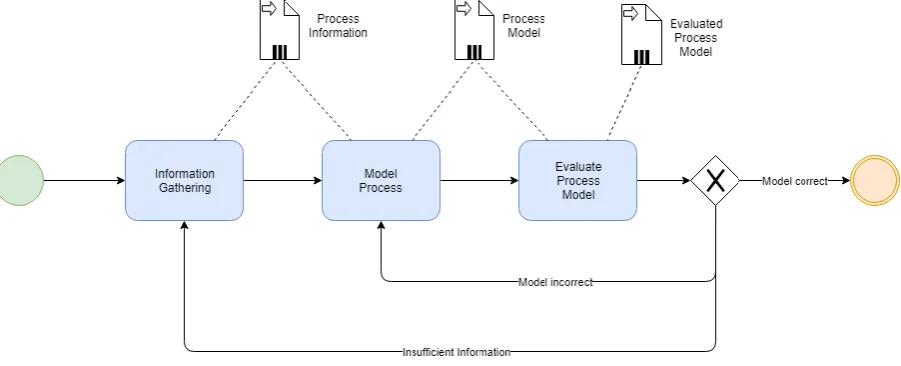
[image:34.595.74.525.331.514.2]Reenginering (BPR) is a method that can be used for optimizing the process. The method has certain phases, whereas the first stage is to model the “as is process”. Requirements for this phase are “a clear understanding of the , market, industry and competitive directions” (Attaran, 2004).
Figure 11: Model “as is” Process
5.1.1
Information Gathering
Input
When modelling business processes it is important to gather information as first step. A clear understanding about the processes and the corresponding inputs and outputs of the processes are required for modeling the “as is” process. Information should be gained about the processes that will be concerned during the reengineering. In case of software replacement by SaaS, this will be the processes that are currently performed in the software package that is going to be replaced. Besides all other processes that will covered in the new SaaS solution, but currently don’t have a supporting software solution.
Method
24
Output
After gathering the information the following outputs could be delivered:
Transcripts of the interviews with the customers
Process documentation of the current process
Screenshots of the current used system as addition for extra information regarding the transcripts
Contact details of stakeholders, both internal as external
5.1.2
Model Process
Input
The gathered information is usable for modelling the processes of the . These models help in getting a clear understanding of the current process and possible bottlenecks can be identified. (Ko, 2009) (O’Neill & Sohal, 1999) Besides the product owner gets closely involved with the processes. The communication will also be supported by an understanding of the existing processes (Davenport, 1993).In the end the current process models can be used to check if all processes are supported by the new SaaS solution.
Method
The Business Process Model and Notation (BPMN) (Object Management Group, 2011) is a standard for modelling business processes. It is readable and understandable for both technical and non-technical people. This also improves the common understanding of the current existing processes.
Output
The result of this action are the business process models of the processes that will be supported by the new SaaS solution. As an addition to the process descriptions specification of the inputs and outputs related to process can be delivered.
5.1.3
Evaluate Process Model
Input
The designed process models are the input for this step in the process. A correct and clear design of the process models is important. During the rest of the implementation project, these models can be used as source.
Method
The product owner and the customers will evaluate the business process models. This evaluation has three main goals.
Check if there are misconceptions in the process models;
check if all processes have been covered by the models;
5. Implementation Method
25
Output
After approving the designed process models, the models and information can be completed for the next step of the implementation method. The models can be shared in team folders and shared with the software development team.
Fit Gap Analysis
[image:36.595.159.437.221.398.2]The fit gap analysis is a technique to find the alignment between business processes and technology (Pajk, 2013). The analysis indicates fits of the software for supporting the business processes, but also the gaps. The found gaps have to be closed during the implementation process before the software is usable for the customer.
Figure 12: Fit Gap Analysis
5.2.1
Perform Fit Gap Analysis
Input
The gained common understanding of the processes to be reengineered and executable processes in the new SaaS solution are the basis of the fit gap analysis. The expertise and knowledge about the to be implemented software is required for matching the chosen software with the designed “as is” process models (Gulledge, 2006). The “as is” process models serve as reference models for the fit gap analysis (Pajk, 2013)
Method
The method and the approach of the fit gap analysis differs from standard methods. Usually business processes are reengineered to achieve certain optimization goals. After reengineering the business process a fit gap analysis is applied to check and compare information systems on compliance with designed processes. (Gulledge, 2006; Pajk, 2013) The difference in order steps originates from business model of customizable SaaS. Before selecting a software provider, the often performs an analysis for selecting a provider. This other approach fits in this implementation method, for it is designed from the point of view of an ASP. Pajk (Pajk, 2013) presents two types of fit gap analyses, the high level and detailed fit gap analysis. The high level fit gap analysis is mostly used for the selection procedure of a software solution. The detailed fit gap analysis is used during the
26
Figure 13: Detailed Fit Gap Analysis Process (Pajk, 2013)
Output
5. Implementation Method
27
Define Product
In the fit gap analysis are the found gaps between current business processes and the SaaS solution described. In addition to solutions for closing the gaps, the might requests for additional features. The requested features are often an extra stimulant for changing from software vendor. The found gaps and requested features can be translated to user stories. The user stories end up on the
[image:38.595.84.524.240.386.2]backlog. After defining the user stories, the minimum viable product (MVP) can be defined. The MVP is a subset of the defined user stories, which must be completed before going live. The user stories that are not in the subset of the MVP can be developed for this after going live. Both user stories and MVP must be evaluated by the and the product owner, so that scope is clear before starting the development of new software components. This approach fits in the hybrid Waterfall-Scrum strategy which is used in this implementation method.
Figure 14: Define Product
5.3.1
Gather User Requirements
Input
In addition to the functionality offered by the new SaaS solution and then found gaps that must closed, the customer can aslo request other features. Since there is already an established business process and in most cases a working software product, the customer can identify where these features can add value in the process. Detailed information about the requested functionality and the business rules to which the feature has to apply are necessary as guidance in the software development step of the method. Besides it is critical in omitting mismatches between the processes and the requirements of the supporting software (Boehm & Turner, 2005).
Method
Lauesen (Lauesen, 2002) developed a method for classifying requirements into four different levels:
Goal-level
Domain-level
Product-level
Design-level
Classifying the requirements is helpful in defining user stories and in a further stage for creating the functional designs, because the level of impact of the requirement is known. The goal-level
requirements describe which goal or KPI must be met when making use of the application. Domain-level requirements describe which features must be included by describing the tasks to be
28
Output
At the end of this a task user requirements should be described and categorized in the four
requirement levels. These requirements should clarify and describe feature functionality that has to be built. Goal-level requirements can be seen more as an overall goal rather than a hard
requirement. Most of the requirements that will be gathered will be within the domain-level, product-level and design-level requirement areas.
5.3.2
Define User Stories
Input
The fit gap analysis and the user requirements will be the source for defining the user stories. Insights gained from conversations should provide the product owner with most of all details. The goal is to create an overview of the required functionality as complete as possible. A complete overview of user stories can omit change requests that could be foreseen in advance, during the implementation.
Method
The gathered user requirements and the found gaps from the fit gap analysis can be written down as user stories. During the informative sessions with the customer, user requirements are defined. These requirements are often described from a customer perspective. The requirements are possible feature requests, which should be split up in users tasks. A feature or requirement can generate a set of user stories, which clarifies the functionality of a feature or properties of a requirement in more specific detail. The user stories can be planned on a Scrum board. User stories are manageable programming tasks for the software developers (Karlesky & Voord, 2015). Each user story must contain the following elements (Lucassen, Dalpiaz, Werf, & Brinkkemper, n.d.):
For whom is the feature built
What the user expect from the system
Why the functionality is expected from the system (optional)
[image:39.595.75.523.533.710.2]Lucassen et al(Lucassen et al., n.d.) defined the following criteria for defining high quality user stories.
5. Implementation Method
29
Output
The deliverables of this tasks are all the user stories retrieved from the fit gap analysis and the user requirements. The user stories can also be grouped by feature/functionality. The priority and dependencies on other user stories can possible give more depth insight, which will usable in the planning task.
5.3.3
Define Minimum Viable Product
Whereas a minimum viable product (MVP) is used much, in defining the requirements for a
prototype, in order to receive valuable feedback from the early adopters (Lenarduzzi & Taibi, 2016). The minimum viable product will be used in this method to define the scope of the software
implementation project before the ‘go live’ moment.
Input
The input for defining the MVP can be retrieved from the user stories that were defined upon the fit gap analysis and user requirements in the previous steps. Identified gaps and additional
requirements from the client are used as input for defining the MVP. The product owner and client can discuss the mandatory features during the user requirements gathering. For each stated
requirement it is important to have clear, how essential the requirement is for making improvements to the current process. Keeping in mind that BPR has as goal to improve current processes
(Davenport, 1993), which will be supported by the SaaS solution you have as ASP.
Method
In traditional software development cycles the scope of the project is equal to defining the requirements. In agile approaches the scope is more project focused rather than product focused (Boehm & Turner, 2005). This enables the software provider to assign a subset of the user stories to the project scope. The user stories that are out of scope are automatically assigned to the backlog for implementation after go live.
Output
The MVP shows an overview of the user stories that will be developed before the ‘go live’ moment. In order to get a clear overview the user stories should be grouped per functionality and in addition a short description of the complete functionality can be added. The MVP should also contain a section describing which user stories are defined but are out of the scope for the MVP. This section informs the customer about the cognizance of the requested functionality.
5.3.4
Evaluate Minimum Viable Product and User Stories
Input
The defined MVP is the subject of discussion in this task. In the lead to here there should have spoken between the and ASP for the establishment of the MVP and the user stories that it contains. A final check and agreement from the is sufficient to proceed to the impact phase.
Method
30
Completeness of the user stories
Defined scope of the MVP
It is best practice to evaluate the MVP in a physical session with the . Any notes about the MVP can directly processed in a revised version of the MVP, when the number of adjustments is low.
Output
An agreed MVP will be the deliverable. The MVP reflects the scope of the project and can also contain commitments from the ASP to the for feature development after going live. The evaluated MVP should be accepted by the directors or main responsible person of both the ASP and in order to omit future discussion about the evaluated MVP.
User-Centered Design
[image:41.595.73.525.374.548.2]Based upon the defined user stories and the MVP designs for the to be implemented features can be made. These designs will provide information to project team and is usable as reference. The scope of the project and requested features and their appliances will be more clear to the team. Well developed designs ensure that development of new features can continue even without extensive contact between the and the project team. As this method is used for existing applications new features should be integrated with the current system. Therefore the won’t be involved as much as in complete agile methods. Besides all s share the same codebase and therefore design decisions should be made by the project team or product owner and inspired by the customer.
Figure 16: User-Centered Design
5.4.1
Create User-Centered Designs
Input
5. Implementation Method
31
Method
The UCD will be developed on top of a set of user stories that belong to one feature. The UCD has to contain the following elements:
Goal of the feature
Feature description
Usage description
Prototype
Corresponding user stories
The goal of the feature will provide an explanation why the feature is requested and can give extra context information for the software developer. The basic principles are explained in the feature description. When the user or product owner has an idea for the working of the feature, it can be described in the usage description. A prototype or sketch of the features will be valuable for the frontend designer to implement the features in the right visualization. At last the corresponding user stories help to capture the overall scope of the feature and it can be used for keeping track of the user stories on the backlog.
Output
The designs delivered contain information about the features that have to developed and the corresponding user stories. These artifacts will be used as guidance by the software developers. It should provide them an insight in the perspective, requirements and how the feature will used. Costly revisions of the built software should be omitted as much as possible by using these designs as guide, for they are user-centered developed. Besides the customer is able to verify the design before all user stories are implemented. Design prototyping is faster than development prototyping
(Chamberlain et al., 2006) and can be used to omit unnecessary design revisions.
5.4.2
Evaluate User-Centererd Designs
Input
The created UCDs will server as input for the evaluation with the customer. Evaluating the designs with the customer omits misunderstandings about the features that are going to be built. Besides as ASP you also prevent a waste of resources by evaluating and validating the design before starting the development. Evaluation also contributes to the acceptance of the feature that will be built based on the design, since the design is approved by the customer.
Method
Evaluation of the deisgn should be done by the product owner as representative of the ASP and the superusers of the customer. The superusers should validate the design against the requirements from the business. After the validation of the design the superusers can approve or decline the concept. When the concept iis declined, adaptions should be made to design or even a complete new design can be created based on the gained insights.
Output
32
Planning
Planning is the process where the scope of the project is expressed in time and required resources. An accurate planning is important for scheduling budget, resources, time and costs (Nasir & Study, 2006). In the business models for SaaS applications, mainly the required resources and time and internal budget play a role, since the is being charged for the use of application instead of charging the directly for the development. Having an inaccurate planning estimation may have internal and external effects.
An inaccurate planning can request more internal budget, resources or time, which can affect the planning for other projects. On the other hand, the will very likely have acted on the estimated planning within in their organization. Personnel capacity may be reserved for implementation on both the customer side as the ASP side. Besides IT contracts of other software suppliers may already have been ended.
[image:43.595.72.524.314.468.2]For making a planning, several steps are must be taken. It is required to make an estimation of the scope of the project. After estimating the scope of the project, resources should be allocated to the project.
Figure 17: Planning
5.5.1
Estimate Project
There are three methodologies for making an estimation (Nasir & Study, 2006):
Analogy Method
Top Down Method
Bottom Up Method
The analogy method requires historical data of similar projects. By comparing the current project with completed projects, it is possible to make an estimation for the planning. The top down method is focused on the characteristics of the project and is more an abstract method for estimating the project. The bottom up method performs an estimation per component (Nasir & Study, 2006). Since the project has a backlog with user stories, the bottom up method can be applied for making an estimation per user story.
Input
The project will be estimated by story points. The project backlog is the resource that contains all items that have to be completed before the goes live with the software.
5. Implementation Method
33
Estimation backlog items will be done by assigning story points. Assigning story points is done during a team session while playing planning poker. The idea behind planning poker is that each team member makes an estimation of the required effort by playing a card with a number of points. Each team member has the same set of cards. All team members shown their card at the same moment, in order to avoid team members influencing each other. The team members that have a higher or lower estimate than the average team members are allowed to discuss their estimation until a consensus has been reached in team. This process must be repeated for each item.
Output
When each backlog item is reviewed, it is known how much it will probably costs to complete the project. The number of estimated story will also play a part in assigning resources to the project.
5.5.2
Assign Resources
The projects for customizable SaaS solutions differs from traditional project in the maintenance phase. Were in traditional projects a request for change in the maintenance phase can be seen as a new project with it’s own scope, customizable SaaS is often treated as software on demand as maintenance is included in the standard fee. Therefore there should be two teams, one for maintenance and one for new implementations, when the number of s is growing. Having a dedicated team for new implementations ensures that a certain allocation of resources is only working on implementation, which will result in a more reliable planning.
Input
For making the right distribution of resources, a number of items must be inventoried. The backlog items that are included in the MVP must be completed before going live. An estimate for these items has been made in the previous step. A first suggestion or goal for going live may already been given by the and can be included the process of allocating resources. It is also possible that there are multiple projects simultaneously for new implementations, which have to be taken into account.
Method
Each developer has to be evaluated on its velocity expressed in story points per sprint. Also the ratio between the maintenance team and the implementation team has to be defined. Based on the ratio and total velocity , a composition for the two teams can be established. It is possible to exchange team members between the two teams during the implementation, as long as the ratio will be retained. When the ratio changes, this will have an impact on the planning.
Output
The composition of implementation team and its velocity is defined and can be used creating a planning.
5.5.3
Create Project Planning
Input
The backlog items that are included in the MVP and their story points and velocity of the assigned team are required to make an effective planning. The planning for other new implementations and their backlog items also have to be considered.