Original Research Article
Awareness about rabies and health seeking behavior among animal bite
victims attending a tertiary care hospital of Jharkhand
Chandramani Kumar, Santosh Kumar Soren*, Surendra Singh, Neelanjali Kumari,
Vidya Sagar, Shashi Bhushan Singh
INTRODUCTION
Rabies is an acute, highly fatal viral disease of the central nervous system, caused by Lyssavirus Type 1. It is primarily a zoonotic disease of warm blooded animals, particularly carnivorous such as dogs, cats, jackals, and wolves. It is transmitted to man usually by bites or licks of rabid animals. Rabies in dogs is the source of 99% of human infection.1
Rabies occurs in 150 countries and territories, most commonly in Asia and Africa. Geographic boundaries
seem to play an important role here as water appears to be the most effective natural barrier to rabies. Australia, China, Japan, New Zealand, U.K., and the islands of Western Pacific all are free from the disease.2 Worldwide endemic canine rabies is estimated to cause 55,000 deaths.3 A rabies free area has been defined as one in which no case of indigenously acquired rabies has occurred in man or any animal species for 2 years.4 An estimated 45% of all deaths from rabies occur in the south east Asian countries of the world. The situation is especially pronounced in India, which reports about 18000 to 20000 cases of rabies a year and about 36% of
ABSTRACT
Background: Rabies is an acute fatal disease of central nervous system, caused by Lyssavirus Type 1. Rabies in dogs is the source of 99% of human infection. Awareness about rabies and health seeking behavior are crucial determinants of rabies control. Present study was done to assess awareness regarding animal bite and health seeking behavior among affected population.
Methods: A hospital based cross sectional study was conducted in central emergency department of Rajendra Institute of Medical Sciences, Ranchi, Jharkhand for a period of four months. A semi-structured questionnaire was used for data collection. Sample size was 114 using consecutive sampling method. The participants were interviewed after taking informed consent. Data collected were entered in MS Excel and analyzed using SPSS version 20.
Results: A total of 114 subjects participated in the study of which 83 (72.8%) were male and 31 (27.2%) female. Most commonly affected age group found was 21-30 years (35.1%). Majority 101 (88.6%) of them resided in urban areas, and only 79 (69.3%) acquired secondary education and above. Most of the animal bite was caused by dogs 102 (89.5%), unprovoked 79 (69.3%) in nature and most common site involved lower limb 70 (61.4%). Majority 68 (59.6%) of the dog bite wound were of category II. Only 55 (48.2%) of animal bite victims washed their wound with soap and water. Majority 58 (50.9%) of the study participants had no knowledge about consequences of dog bite. Median reporting time to tertiary institute was found to be four hours.
Conclusions: There was average level of awareness about rabies among animal bite victims attending RIMS, Ranchi.
Keywords: Awareness, Rabies, Health seeking behavior, Animal bite
Department of Preventive and Social Medicine, Rajendra Institute of Medical Sciences, Ranchi, Jharkhand, India
Received: 26 July 2019
Accepted: 04 September 2019
*Correspondence:
Dr. Santosh Kumar Soren, E-mail: [email protected]
Copyright: © the author(s), publisher and licensee Medip Academy. This is an open-access article distributed under the terms of the Creative Commons Attribution Non-Commercial License, which permits unrestricted non-commercial use, distribution, and reproduction in any medium, provided the original work is properly cited.
the world’s deaths from the disease.5
In India, rabies affects mainly people of lower socio-economic status and children between the ages of 5 and 15 years with total 20565 deaths reported from rabies per year.6
Community awareness regarding rabies and health seeking behavior are critical both for the prevention and control of the disease in humans and animals. Many Indian studies from different states has found varying level of awareness about the post dog bite management of animal bite wounds as well as about the disease rabies.7-12 However, there is relative paucity of information from Jharkhand in this regard. Present study was done to assess awareness regarding animal bite management and health seeking behavior among affected population.
METHODS
This was a hospital based cross sectional study. Over a four month period from September 2018 to December 2018, all patients attending central emergency department of Rajendra Institute of Medical Sciences (RIMS), Ranchi, Jharkhand were approached for the study. Consecutive total sampling method was used for this study. Total 126 participants were contacted during study period and 12 did not participate in study. Hence, total 114 participants willing to participate, were included in our study. A semi-structured questionnaire was used for data collection. The variables to describe their socio-demographic profile were age, sex, religion, occupation, residence, marital status, income and education were included in questionnaire. Socioeconomic status was
classified according to Modified B G Prasad
Classification 2017. Other questions were included to know about bite characteristics, awareness about rabies and health seeking behavior of respondents. The participants were interviewed after taking informed consent. Attendant of minor victims were interviewed and adult victims responded by themselves. The data were entered in MS excel spreadsheet and was analyzed using SPSS software. Chi-square test was used as test of significance and p value less than 0.05 was considered as statistically significant. Study was done after approval from institutional ethical committee.
RESULTS
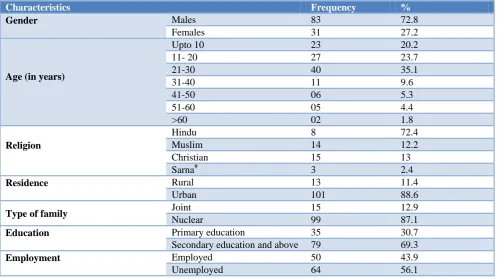
A total of 114 participants were included in our study. The age-group of 21-30 years was most commonly affected (35.1%) followed by 11 – 20 years of age group (23.7%). The median age of the animal bite victims was found to be 23 years. Males were most commonly involved 83 (72.8%) than females 31 (27.2%). Majority 101 (88.6%) of the animal bite victims were from the urban area and most 79 (69.3%) of the participants had completed secondary education and above (Table 1). Bite by stray animals 72 (63.2%) was reported more than the pet animals 42 (36.8%) among the animal bite cases. In the present study, dog bite 102 (89.5%) was found to be more common, followed by cats and other animals like monkey and mouse. Our study reveals that most of the animal bite cases were unprovoked 79 (69.3%). Lower limb 70 (61.4%) was the most common site of injury, followed by upper limbs 36 (31.6%). Majority of the patients reported with category II bite (59.6) followed by category III (25.4) (Table 2).
Table 1: Socio-demographic profile of study participants (n=114).
Characteristics Frequency %
Gender Males 83 72.8
Females 31 27.2
Age (in years)
Upto 10 23 20.2
11- 20 27 23.7
21-30 40 35.1
31-40 11 9.6
41-50 06 5.3
51-60 05 4.4
>60 02 1.8
Religion
Hindu 8 72.4
Muslim 14 12.2
Christian 15 13
Sarna# 3 2.4
Residence Rural 13 11.4
Urban 101 88.6
Type of family Joint 15 12.9
Nuclear 99 87.1
Education Primary education 35 30.7
Secondary education and above 79 69.3
Employment Employed 50 43.9
Unemployed 64 56.1
Characteristics Frequency %
Socioeconomic status*
Class 1 9 8
Class 2 12 10.3
Class 3 46 40.3
Class 4 24 20.8
Class 5 23 20.6
# Local religion of Jharkhand.
* As per Modified B.G. Prasad Classification 2017.
Table 2: Bite characteristics among victims (n=114).
Bite characteristics Number %
Animal involved Dog 102 89.5
Others* 12 10.5
Type of animals Pet 42 36.8
Free roaming 72 63.2
Type of bite Provoked 35 30.7
Unprovoked 79 69.3
Wound category
Category I 17 14.9
Category II 68 59.6
Category III 29 25.4
Affected body part
Face 5 4.4
Trunk 3 2.6
Upper limb 36 31.6
Lower limb 70 61.4
*Others included cat, rat etc.
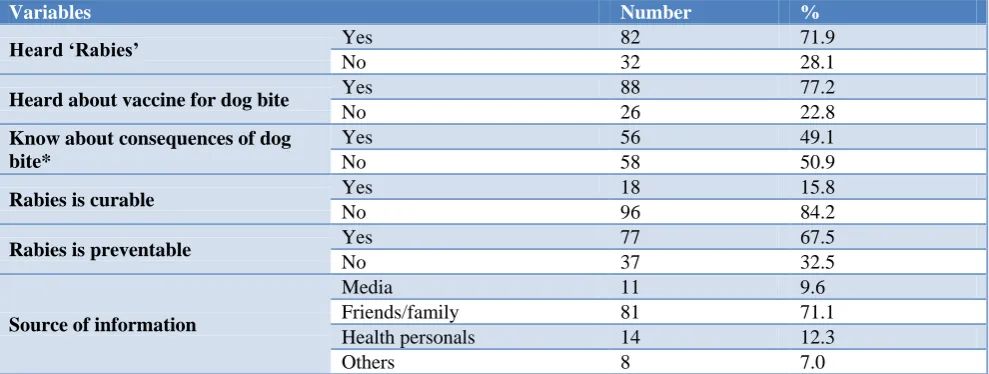
Table 3: Awareness about rabies (n=114).
Variables Number %
Heard ‘Rabies’ Yes 82 71.9
No 32 28.1
Heard about vaccine for dog bite Yes 88 77.2
No 26 22.8
Know about consequences of dog bite*
Yes 56 49.1
No 58 50.9
Rabies is curable Yes 18 15.8
No 96 84.2
Rabies is preventable Yes 77 67.5
No 37 32.5
Source of information
Media 11 9.6
Friends/family 81 71.1
Health personals 14 12.3
Others 8 7.0
*Common consequences were hydrophobia, madness, causes some fatal disease etc.
Among all the animal bite victims, 82 (71.9%) had heard about word ‘rabies’ and 88 (77.2%) knew about vaccine against dog bite. More than half of victims (50.9%) did not know consequences after dog bite. Among all victims, 18 (15.8%) were having misconception that rabies is curable and only 77 (67.5%) said that rabies is preventable. Friends and family members were most common 81, (71.1%) source of information for respondents (Table 3). Among all respondents, majority 67 (58.8%) had perception that after an animal bite wound should be washed first and remaining 47 (41.2%)
think that after bite one should directly go to hospital. Nearly all 112, (98.2%) respondents first of all visited to health care system after bite. Among those who reported to health care system first, 99 (87.7%) reported within 24 hours of bite. Nearly half of the respondents 55, (48.2%) washed wound with soap and water initially after bite whereas 7 (6.1%) respondents did not wash the wound. Among victims who were in need of immunoglobulin 22
(75.9%) took immunoglobulin (Table 4). Among
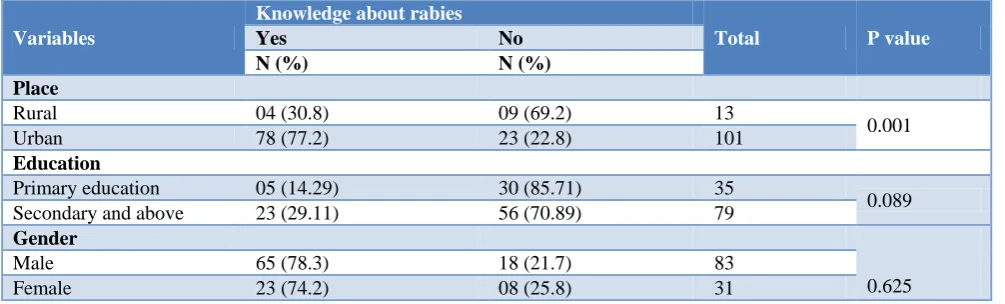
be statistically significant (p value=0.001). Although there was difference in knowledge about rabies on the
basis of education and gender of respondents, they were statistically insignificant (Table 5).
Table 4: Health seeking behavior (n=114).
Health seeking behavior Number %
Perception about first step after bite
Go to hospital 47 41.2
Wash wound with soap and
water 67 58.8
First place visited after bite
Health care system 112 98.2
Traditional healers 01 0.9
Others 01 0.9
Time taken to reach health care system (n=112)
Within 24 hours 99 87.7
More than 24 hours 13 12.2
Wound washed after bite
Water only 23 20.2
Water and soap 55 48.2
Water and antiseptics 29 25.4
Did not wash 07 6.1
Compliance for immunoglobulins (n=29)
Yes 22 75.9
No 07 24.1
Table 5: Association between knowledge about rabies and socio-demographic variables (n=114).
Variables
Knowledge about rabies
Total P value
Yes No
N (%) N (%)
Place
Rural 04 (30.8) 09 (69.2) 13
0.001
Urban 78 (77.2) 23 (22.8) 101
Education
Primary education 05 (14.29) 30 (85.71) 35
0.089
Secondary and above 23 (29.11) 56 (70.89) 79
Gender
0.625
Male 65 (78.3) 18 (21.7) 83
Female 23 (74.2) 08 (25.8) 31
DISCUSSION
In our study, we found that 72.8% of victims were males and 27.2% were females which resembles well with the findings of a study done by Tandon et alin Jammu, India in 2017, where it was found that 76% were males and 24% were females.13 In another study done by Tiwari et al in a rural community revealed higher male victims (70%) than female (30%).14 All these studies show higher preponderance of males to be a victim of animal bite irrespective of rural or urban area. This may be due to more outdoor activities by males than females. In study done by Tiwari et al. it was found that animal bite cases were distributed across all age group in adults in similar proportions.14 Another multicentric study by Sudarshan et al found that about 25% victims were children less than 14 years of age and remaining were more than 14 years old.6 Present study revealed that young people in the age group 21-30 years were the most common victims of animal bite i.e., 35.19%. However, we also found that
children up to age of 10 years constituted 23% of reported cases and remaining were older than 10 years. This finding is very similar to findings of study by Sudarshan et al.6
of body for animal bite. Studies from different part of country has supported this consideration by showing that most common sites for animal bite were upper and lower extremities.17,19-21
Our study also tried to assess awareness about disease caused by dog bite. In present study, 71.9% subjects had heard word ‘Rabies’. A study done by Valekar et al in a rural area of Maharashtra found that 77% people were knowing that some disease is caused by dog bite and among them only about 47% were knowing the term ‘Rabies’.22
Reason for lower level of knowledge on ‘Rabies’ could be the difference in study setting and population, as our study is hospital based and more people from urban area whereas later study was done in a rural area. Although in our study 71.9% subjects were aware of word ‘Rabies’, 77.2% people were knowing about some vaccine for dog bite cases. This difference may be attributed to fact that researchers were specific about word ‘Rabies’. Hydrophobia and madness were the common symptoms reported by subjects in study by Valekar et al and in present study also these were most commonly reported consequences among those who were aware of any consequences of Rabies.22
In this study we found that after animal bite majority people preferred to wash wound with soap and water before going anywhere and almost all people went to health care system for their treatment first of all. This is encouraging sign as it reflects better health seeking behavior of people. In present study, majority of subjects reported to health care system within 24 hours with median time taken was 4 hours. Study done by Chaudhari in West Bengal reported median time taken was 3 hours whereas only around 18% subjects reported within 24 hours.17 Reason for these differences may be accessibility of health care facilities, Low awareness and poor health seeking behavior of respondents. Wound washing with soap is an important and very crucial step in prevention of human rabies. In our study it was found that about half of victims washed their wound with soap and water, while around one fourth applied antibiotics after wound washing. Seven subjects did not wash wound at all. A similar finding with varying percentage has been reported in other Indian studies.17,22,23
Limitation
The limitation of our study was small sample size, hospital based study and less study duration. As the subjects included in the study were victims who attended a tertiary care centre, its findings cannot be generalized to the whole population.
CONCLUSION
More than two-third of the respondents had heard about rabies and more than three fourth knew about some vaccine for dog bite. Nearly half of study subjects
practiced wound washing with soap and water. Majority of subjects reported to health care system within 24 hours. Knowledge about rabies is significantly associated with place of residence.
ACKNOWLEDGEMENTS
The authors thank all the participants and staff of central emergency unit for their support. We are grateful for the expert help of faculties and also acknowledge critical manuscripts review by colleagues. We are also thankful to undergraduate medical students who were actively involved in data collection.
Funding: No funding sources Conflict of interest: None declared
Ethical approval: The study was approved by the Institutional Ethics Committee
REFERENCES
1. Park K. Epidemiology of communicable diseases. Park’s Textbook of Preventive and Social Medicine, 25th edition. Jabalpur: Bhanot Publishers; 2019: 302-307.
2. Barecha CB, Girzaw F, Kandi V, Pal M.
Epidemiology and Public Health Significance of Rabies. Perspectives Med Res. 2017;5(1):55-67.
3. Knobel DL, Cleaveland S, Coleman PG, Fevre EM,
Meltzer MI, Miranda ME, et al. Re-evaluating the burden of rabies in Africa and Asia. Bull of World Health Org. 2005;83(5):360-8.
4. World Health Organization (1984). Tech. Rep. Ser. No. 709.
5. In: Kole AK, Roy R, Koleb DC, eds. Human rabies
in India: a problem needing more attention. Geneva: 2014. Available at: http:// who.int/bulletin/ volumes/92/4/14-136044.pdf. Accessed on 5 July 2019.
6. Sudarshan MK, Mahendra BJ, Madhusudana SN,
Ashwoath Narayana DH, Rahman A, Rao NS, et al. An Epidemiological Study of Animal Bites in India: Results of a WHO sponsored National Multi-centric Rabies Survey. J Common Dis. 2006;38(1):32-9. 7. Jain P, Jain G. Study of general awareness, attitude,
behavior, and practice study on dog bites and its management in the context of prevention of rabies among the victims of dog bite attending the OPD services of CHC Muradnagar. J Family Med care. 2014;3(4):355-8.
8. Singh NK, Singh S, Jha A, Surekha K. Clinical Knowledge and attitudes of clinicians toward rabies caused by animal bites: J Evol Med Dental Sci. 2013;2(50):9685-90.
10. Ichhpujani RL, Chhabra M, Mittal V, Bhattacharya D, Singh J, Lal S. Knowledge, attitude and practices about animal bites and rabies in general community:
a multi‐centric study. J Commun Dis.
2006;38(4):355‐61.
11. Singh A, Bhardwaj A, Mithra P, Siddiqui A, Ahluwalia SK. A cross‐sectional study of the knowledge, attitude and practice of the general practitioners regarding dog bite management in northern India. Med J DY Patil Univ. 2013;6:142‐5. 12. Prakash M, Bhatti VK, Venkatesh G. Rabies
menace and control‐ An insight into knowledge, attitude and practices. Med J Armed Forces India. 2013;69(1):57‐60.
13. Tandon S, Kotwal SK, Malik MA, Singh M, Kumar
D, Shafiq M, et al. A community based survey on Rabies Control and Prevention using KAP in Jammu, India. J Animal Res. 2017;7(6):1019-28. 14. Tiwari HK, O’Dea M, Robertson ID, Vanak AT.
Knowledge, attitudes and practices (KAP) towards rabies and free-roaming dogs (FRD) in Shirsuphal village in western India: A community based
cross-sectional study. PLoS Negl Trop Dis.
2019;13(1):e0007120.
15. Gogtay J, Nagpal A, Mallad A, Patel K, Stimpson SJ, Belur A, et al. Demographics of animal bite victims and management practices in a tertiary care institute in Mumbai, Maharashtra, India. Indian J Med Res. 2014;139:459-62.
16. Ichhpujani RL, Mala C, Veena M, Singh J, Bhardwaj M, Bhattacharya D, et al. Epidemiology of animal bites and rabies cases in India. A multicentric study. J Commun Dis. 2006;38(1):32-9. 17. Chaudhari S. Knowledge, attitude and practice
about animal bite and rabies among victims
attending a rural hospital in eastern India. GJMEDPH. 2015;4:1-6.
18. Agarwal N, Reddaiah VP. Knowledge, attitude and practicing following dog bite: A community based epidemiological study. Health and Population -Perspectives and Issues. 2003;26(4):154-61. 19. Chauhan P, Saini G. Study of profile of animal bite
victims attending anti-rabies clinic at Jodhpur. Int J Med Sci Public Health. 2013;2(4):1088-91.
20. Patle R, Khakse G. Clinico-demographic and treatment seeking profile of children below 15 years attending the anti-rabies clinic. Int J Med Public Health. 2014;4(2):151.
21. Junaid M, Ahmad T, Gumashta R, Deoke AR. Epidemiological Study Of Dog Bite Victims In Anti Rabies Clinic Of A Tertiary Care Hospital. Int J Biol Health Sci. 2012;1(1):12-6.
22. Valekar SS, Kshirsagar MV, Ashtukar MD, Mhaske
M, Chawla PS, Fernandez K. A cross sectional study of awareness regarding dog bite and its management in rural community of Maharashtra. Int J Community Med Public Health. 2014;1(1):8-11. 23. Kakrani VA, Jethani S, Bhawalkar J, Dhone A,
Ratwani K. Awareness about dog bite management in rural population. IJCH. 2013;25(3):304–8.
Cite this article as: Kumar C, Soren SK, Singh S, Kumari N, Sagar V, Singh SB. Awareness about rabies and health seeking behavior among animal bite victims attending a tertiary care hospital of