MODEL-BASED APPROACH OF A DECISION PROCESSING UNIT IN A SMART
WOOD-PROCESSING COMPANY
M.Sc. Stalinski D.1,2, Prof. Dr.-Ing. Scholz D.1
Department of Mechanical Engineering, Münster University of applied Science, Germany 1
hobb Holzveredlung GmbH & Co. KG, Germany 2
Abstract: The paper deals with the development of a new type of production planning and control in a wood-processing company. The production is already highly automated and data from the production processes are gathered and stored in a database. The project picks up these technical basements in order to automatically provide intelligent decisions and make the factory even smarter.
Keywords: SMART FACTORY, OPTIMIZATION, DATA-DRIVEN PRODUCTION PLANNING AND CONTROL, ARTIFICIAL INTELLIGENCE, DECISION SYSTEM
1 Introduction
For a manufacturing company, the logistical performance is a fundamental competition factor just like high quality and low prices of the products. It is measured in short order throughput times and great adherence to schedules [1, 2]. In order to achieve high logistic performances, the production planning and control generally takes care of the best possible usage of the given resources of the enterprise. Thus, it has to take control of a high capacity utilization level, a low level of work in progress, short setup times and a low production delay [3]. Therefore, these logistical objectives are manipulated by defining production programs in the form of processing sequences and capacity allocations [4].
Improving one of the mentioned logistical objectives often leads to deteriorating at least one of the other objectives. This is well known as the dilemma of production planning and control [5]. Practically these tasks result in complex, multicriteria optimization problems. On the one hand these are complicated mathematical problems [6]. On the other hand there may be untapped logistical potentials which could be practically used by solving these problems. Nevertheless, these tasks are often still performed manually [7].
Innovative technologies in the context of industry 4.0 like CPS (Cyber-Physical Systems) and the IoT (Internet of Things) are found in smart factories. Besides the technical automation of processes and material flows, these technologies can lead in combination with ERP software (Enterprise-Resource-Planning) and MES (Manufacturing Executive System) to a high quality data base [8]. This even increases the logistical potentials by using modern computers and technologies to process the (big) data and automatically use it for planning and controlling a factory [8]. Nevertheless this is a highly nontrivial task and still requires a lot of engineering.
The subject matter of this paper is a project with a company called hobb Holzveredlung GmbH & Co. KG which is a german system manufacturer of fixed sizes for the wood-processing industry. It is part of a group of companies of a well-known german furniture brand and delivers semi-finished products for the furniture and the flooring industry as well as interior construction. The company already uses modern technologies regarding automation of processes, transportation, material handling and tracking. The last links in the chain of automation are the decisions taken in the production planning and control.
A cooperative research project was started in 2016 together with the Münster University of applied Science and the University of Wuppertal in order to develop a so-called decision processing unit [9]. This paper deals with the overall problems and issues which are identified within that development and will present integrated solution approaches.
In section 2 the prerequisites and the problems are presented. An approach for a solution to the problem is presented in section 3.
The results and the current status of the entire system are presented in section 4.
2 Prerequisites
While nearly all relevant technical aspects of the production regarding material flow, material handling, booking of confirmations and technical processes are automized, the supervising tasks of planning and controlling the production is still done by hand. As described in the previous section, a high quality data basis which includes the production data necessary for the decision taking already exists. Therefore, a decision processing unit which is able to process this data into useful decisions is in development.
2.1 Description of the discussed process
Production processes can basically be distinguished between the following three criteria [10].
• The technique differentiates between a continuous and a discontinuous process manufacture of products as well as a process of a single product.
• Different quantities of production are unit production, batch production and large series production.
• Last there is the relationship with the customer. Production to stock concerns a push-flow production while production to order concerns a pull-flow production.
Based on the introduced criteria, the discussed production process of the case study can be described as a discontinuous pull-flow batch production to order.
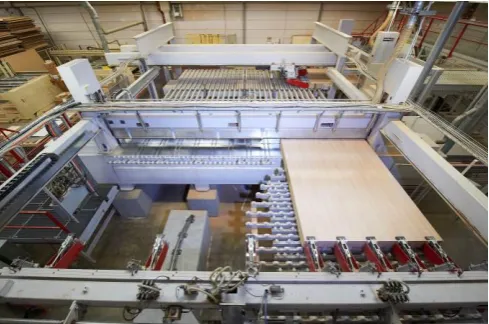
Fig. 1 Automized sawing machine
order and no product is produced without a customer order. Master data like order number, material number, geometric dimensions, quality, surface design etc. as well as process related data is part of every order, even if one specific product will never be ordered again. The range of products consists of three different types of semi-finished products respectively processes.
• There is the craft-based production of coating materials for furniture boards. This can on the one side be the manufacturing of veneer boards with specific dimensions. On the other side there is the trimming of artificial coatings like decor foils, paper, vinyl, etc.
• There is the cutting and trimming of wooden boards on automated saw machines (see Fig. 1). Boards made of chip, mdf, hdf, solid wood, etc. are cut to size on these machines.
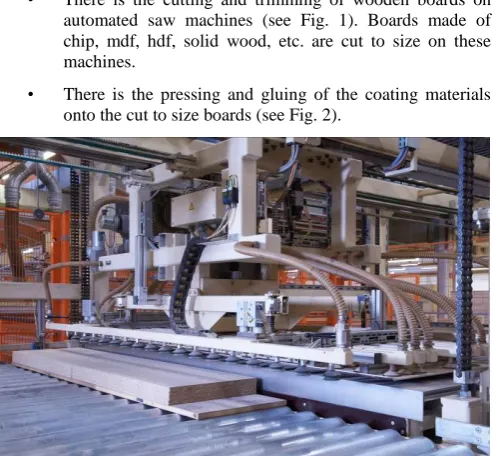
• There is the pressing and gluing of the coating materials onto the cut to size boards (see Fig. 2).
Fig. 2 Automized material handling of a pressing machine
The manufacturing process comprises a manual and an automized part. While the production of the coating materials consists of many craft-based and manual processes, the production of the wooden boards (cutting and coating) is nearly fully automized and controlled by RFID. Thus, the development of the decision processing unit focuses on this modern area of the production. The considered manufacturing system consists of two sawing machines, four pressing machines and one area for the crafted manufacturing of coating materials. As described, the coating area is not part of the decision processing. Furthermore there is a managed raw material warehouse which contains the „motherboards“ for cutting to size on the saws. If boards have to be coated on a pressing machine after sawing, they are transported to the machines and stored on roller conveyors.
The sawing machines are fed with boards from the warehouse by a forklift and there are no relevant setup times between different materials and production orders. On the pressing machines there are setup times between 15 minutes and 8 hours. The setup times depend on the different coating materials which need to be processed with different glues, different processing temperatures and different equipment. Some of the coating materials leave residues on the press plates, so that after processing these materials several times the machine must be cleaned. This results in possible setup times for heating up and cooling down, changing the glue for a pressing machine which implies cleaning up the gluing system and mounting different tools for handling different coating materials.
The boards are transported as stacks via automated roller conveyors on slave boards, while each of these stacks only consist of one material and one production order. The slave boards are equipped with a RFID tag (radio-frequency identification) which is linked to the production order of the board stack. This is in
combination with RFID antennas the basis of locating and tracking the board stacks in the production. Behind and between specific and relevant production cells there are RFID gates, where the RFID tags of the slave boards are registered by passing them. This triggers logic processes in the ERP system like booking of confirmations and goods movements. The result is a production controlling process which is highly automated and exact to the second. This leads to a high quality data basis, which is the technological basis of the new decision system [9, 11].
2.2 Description of the problem
The requirements of the decision processing unit for controlling the factory are on the one side the computation of allocations of production orders to pressing machines and on the other side the computation of production sequences for each sawing and pressing machine. The further requirements of the system are to take care of the following four criteria:
• minimizing production delay,
• minimizing setup times,
• minimizing work in progress and • maximizing machine utilization.
It was recognized quickly that planning the production system within a planning horizon longer than one day would be impracticable and that a high amount of flexibility is needed. Due to the knowledge and expertise of the process, scheduling over one day with a rolling horizon in periods of 30 minutes is desired. This follows from the fact that there are frequent events that lead to a new data basis of decision-making. These events are mainly changes of the availability of materials, so that either new raw material has arrived or the coating area finished a production order. Both cases are not predictable and lead to new situations which the system has to re-evaluate.
There are some special characteristics of the production process which require particular attention.
On the one hand sawing is a separating manufacturing process, where boards with different dimensions are cut out of one board. From a material managing and production controlling point of view this means that a production order for sawing one specific material results in many other production orders with specific materials. In practise, many customer orders which are cut from the same raw material are bundled together to one production order so that they can be cut out of the same raw staple of boards. This allows the use of a software based waste optimization system in order to increase the efficiency and the economy of the sawing process. But from a production planning view this results in a significantly higher level of complexity as it is shown in the following.
Each of the production orders which are bundled together to one raw material can contain material for a pressing machine or not. As a result one bundled production order can be a mixture of saw-only orders and production orders with material for different pressing machines. Furthermore the pressing production orders can be allocated to different pressing machines. Thus, different production sequences for one sawing machine have huge impacts on the whole production system.
sawing before being transported. The pressing machines can additionally be fed without sawing with external material from the warehouse.
The configuration of a pressing machine (temperature, glue, cleaning and tools) depends on the processed materials. Additionally, for many of the materials there are more than one possible configuration. The machines have different cycle times, so that the processing time of a production order depends not only on the material and on the count of boards, but also on the machines.
2.3 Analysis of the problem
Following detailed issues result from the discussed problems. Scheduling implies in this case the simultaneous computation of sequences of production orders for 6 production cells and the computation of allocations of production orders to a pool of 4 production cells. This is a type of np-hard combinatorial problem with multiple criteria [5]. This type of problems is well known for its complexity so that even small problem instances are practically not solvable [12]. In order to find practically useful solutions of such a mathematical problem, the use of metaheuristics is a proven way [13, 14, 15].
A metaheuristic is a kind of an iterative algorithm which finds solutions to a problem, but it cannot guarantee that it finds the best ones and it doesn’t need to know the problem structure [14]. Instead the use of an evaluation function is necessary for the application of a metaheuristic. This leads in this case to three more problems which are described in the following.
1. First there is the question of how a metaheuristic can be applied in general. Therefore, explicit variables of the production system have to be formulated which can be manipulated in order to be optimized. Furthermore there is the question of how possible solutions can be evaluated. A metaheuristic needs to compare different solutions, so that they are evaluated in an adequate way.
2. The second identified problem is the fact that not every single objective and restriction of the production processes can go into this evaluation and not everything will influence the evaluation. The (only) mathematical optimization of a combinatorial problem does not necessarily need to be the best decision in a practical way. As a result, the application of a metaheuristic has to allow to take rule based decisions within a mathematical optimization process. Therefore the metaheuristic shall be combined with different constructive heuristics. A constructive heuristic is generally a rule-based algorithm which is often adapted to a specific problem [16]. It creates a solution for a given problem by following rules instead of mathematically optimizing it.
3. Third there is the problem that not every kind of data that is needed is present in an usable form. Thus, additional data are needed. These are in particular processing times and set up times for the pressing processes. They are of fundamental importance for an automized scheduling process. The effort of additional data maintenance should naturally be low, so that setup times and processing times for each material and for each machine should not be entered manually, because this would be an immense effort.
3 Solution
The general solution of the scheduling problem is divided into the approaches of the discussed sub problems.
1. An approach for the acquisition of the additional data is presented. Therefore, a data model for the production system is developed.
2. A decision model is presented, which allows the application of a metaheuristic to the scheduling problem. Furthermore, this decision model allows the application of constructive heuristics.
3. An agent-based scheduling model is created, where the decision model is combined with an agent-based simulation of the machines.
3.1 Application of a production model
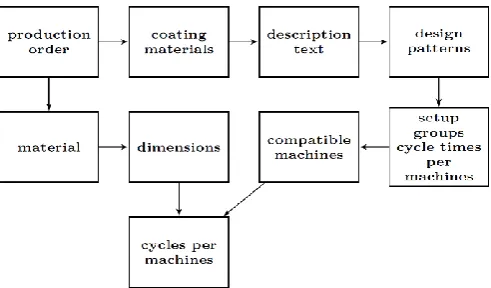
For the scheduling process itself, the missing processing and setup times have to be generated and an additional high amount of data maintenance should be avoided. Thus, confirmation data from the ERP system shall be used for a statistical computation of real processing times. This makes the creation of a data model necessary which allows the analysis of these data in an appropriate way. Therefore, materials, production orders and machines are designed as a data model. Furthermore this model shall be used as a simple way for entering model-based setup times. It is shown in the Fig. 3.
Fig. 3 Generating data with a production data model
The data model for the materials consists of the material number, the material description text and the geometric dimensions. These information are directly read from the ERP system. Additionally these information are complemented with the properties material type and material design. Depending on the description text, the materials are categorized by matching design patterns.
The data model for the production orders consists besides the order number and the delivery date additionally of the material designs of the coating materials. Therefore, depending on the different design patterns of the coating materials, production orders are automatically classified in possible setup groups for each possible pressing machine.
The pressing machines are modelled with the properties of their geometric dimensions. There are different rules for the process temperatures, the glue systems, the needed equipment and the residue behaviour, which can be entered for each compatible design patterns. Setup times are entered as cleaning times, times necessary for changing the glue system and time constants for heating up and cooling down.
3.2 Application of a decision model
For the application of a metaheuristic, specific input variables have to be defined. Therefore, a decision model is created, where discrete, real decisions are formulated. This allows a distinction between real decisions which should be enumerated and optimized and rules which should be implemented as constructive heuristics.
The decisions are modelled separately for the sawing machines and for the pressing machines. They result from a process analysis and are defined as follows. A sawing machine can on the one side be used to produce customer orders, which only have to be formatted without being coated. On the other side it can decide to produce materials, which have to be coated after formatting.
A pressing machine can also decide from a set of decisions. For each setup group the pressing machine can decide to change its setup and produce only orders which are compatible. Additionally it can decide to acquire production orders from the other pressing machines if they are compatible with its current setup.
The advantage of this approach is the concentration on real and relevant decisions so that uncritical or not predictable decisions are not optimized and can be modelled as sets of constructive heuristics [17].
3.3 Application of an agent-based scheduling model
The combination of the decision model with constructive scheduling heuristics is done by creating an agent-based scheduling model. This scheduling algorithm is based on a discrete-event simulation where production cells are implemented as software agents with heuristic-based behaviours. The agents can take the modelled decisions within a simulation run. Different decisions lead to different constructive heuristic behaviours. In this way, scheduling is done by constructive heuristics for each machine agent in a simulation run. The discrete decisions which the agents take shall be optimized by a metaheuristic. Therefore, the model computes a target value to evaluate different selections of the decisions.
During a simulation run, the planning horizon is divided into discrete time intervals. Within these intervals the machine agents can take decisions from their decision sets. The scheduling itself is implemented as constructive heuristics in the agent definitions. The basic sequences for each agent are created by sorting the production orders for each setup group depending on their delivery deadline. Further constraints are implemented as follows. If possible, production orders are sorted additionally depending on the customer and the raw material, in order to reduce travels distances of the forklifts.
3.4 Application of a metaheuristic
The first work on a stochastic optimization method goes back in 1952 [18]. There are many different types of combinatorial problems, so that these types of problems are a well-known matter of researches. Some of them are mostly theoretical problems, but most of them result from practical problems, as it is in this paper. They have in common that they are np-hard, which means, that they can only be solved with exponential time effort. As a result, even small instances of these problems are practically not solvable [19]. This leads to the development of metaheuristics. The most prominent and relevant ones (relating to this paper) are introduced in the following.
The traveling salesman problem is a synonym for finding the shortest way between a given set of points [20]. Typical applications are logistics where a car has to visit different places in a short time and drilling operations where a machine has to drill several holes into a workpiece [20]. Packing problems are in general problems where a given set of items have to be put into a container. A typical application is minimizing the waste of a sawing machine [21]. Scheduling problems are basically problems where processes have to be allocated to limited resources [6]. Prominent
applications are besides production planning the scheduling of tasks in a central processing unit (CPU) and the gate assignments at airports [22]. Furthermore there are parameter optimizations in general where individual parameters of a given system shall be optimized [23].
They have in common, that even apparently small instances result in practically not solvable complexities. Thus, there are different approaches of getting sufficiently good solutions in a reasonable amount of time. These metaheuristics are mostly independent of the given problem structures. Proven metaheuristics which are based on swarms and populations are ant colony algorithms, genetic algorithms, simulated annealing algorithms and particle swarm algorithms [14, 24]. They are iterative procedures with a wide range of possible applications. At the beginning of the algorithms they randomly produce populations of possible solutions. These are then compared to each other and based on the quality the algorithms are influenced in certain ways. As a result, these algorithms only need to evaluate many possible solutions without actively knowing of how they are created. By positively feeding the algorithms back with the information of the solution qualities, the algorithms can converge to practically good solutions.
For the application of a metaheuristic to the scheduling problem, a modification of the ant colony optimization is a proven approach as it is presented in [17]. It is applied to the decision model in order to find the best possible decisions for each machine agent.
4 Results
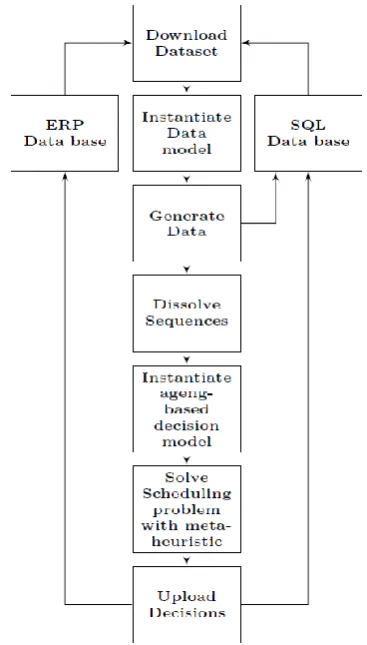
The entire system is technically implemented as a service application with a database on a server. It has a software interface to the ERP system, which enables the transfer of data between the systems.
Fig. 4 Program operation of the decision system
database, the iterative scheduling process begins. The results in the form of production sequences for each machine are uploaded into the ERP system and into the database. They are visualized in a web application as well as in the ERP system itself.
The system is integrated into the running production process and the computed decisions are already practically used. Field tests and long-term evaluations are performed. Feedback from the production management is discussed in order to evaluate and improve the decision system.
Thus, the target goals of the project are largely achieved and the quality of the decision system is currently analysed. The advantage of the system is the implementation of constructive heuristics in combination with a mathematical optimization using a metaheuristic.
5 Conclusion and future work
This paper presented model-based solution approaches for solving a practical scheduling problem in a highly automated wood-processing company. The main focus was a combination of constructive heuristics with the application of a metaheuristic in order to combine a rule based controlling system with a mathematical optimization method. Furthermore, additional data in the form of processing times had to be generated.
The modelling approaches have been implemented into the new decision system, which is already applied into the running production process. As a future work, an in-depth analysis of different metaheuristics is planned, in order to examine the best possible configuration of the decision system.
6 References
[1] Nyhuis, P.; Wiendahl, H.-P.: Logistische Kennlinien: Grundlagen, Werkzeuge und Anwendungen. Springer, Berlin, Heidelberg, 2012.
[2] Lödding, H.: Handbook of Manufacturing Control: Fundamentals, description, configuration. 2013.
[3] Wiendahl, H.-P.; Nyhuis, P.; Fischer, A.; Grabe, D.: Controlling in Lieferketten. In: Schuh, G. (Hrsg.): Produktionsplanung und -steuerung. Springer, Berlin u.a., 2006, S. 467–510.
[4] Schuh, G.; Brandenburg, U.; Cuber, S.: Aufgaben. In: Schuh, G.; Stich, V. (Hrsg.): Produktionsplanung und -steuerung 1. Springer Berlin Heidelberg, Berlin Heidelberg, 2012, S. 29–81.
[5] Weigert, G.; Rose, O.: Stell- und Zielgrößen. In: März, L.; Krug, W.; Rose, O.; Weigert, G. (Hrsg.): Simulation und Optimierung in Produktion und Logistik. Springer-Verlag Berlin Heidelberg, Berlin, Heidelberg, 2011, S. 29–40.
[6] Baker, K. R.; Trietsch, D.: Principles of sequencing and scheduling. Wiley, Hoboken, NJ, 2009.
[7] Widmer, M.; Hertz, A.; Costa, D.: Metaheuristics and Scheduling. In: Bassem, J. (Hrsg.): Metaheuristics for production scheduling. ISTE, London u.a., 2013, S. 33–68.
[8] Bartodziej, C. J.: The Concept Industry 4.0: An Empirical Analysis of Technologies and Applications in Production Logistics. Springer Fachmedien Wiesbaden, Wiesbaden and s.l., 2017.
[9] Stalinski, D.; Scholz, D.: Digitale Steuerung in der Holzbearbeitung. HK (2017) 4 , S. 114–115.
[10] Morana, J.: Logistics. John Wiley & Sons, Incorporated, Newark, 2018.
[11] Stalinski, D.; Scholz, D.: Prozessoptimierung durch
digitale Fertigungssteuerung: Vorstellung eines
Entwicklungsprojekts an einem Fallbeispiel aus der holzverarbeitenden Industrie. ZWF 112 (2017) 5 , S. 301–304.
[12] Deroussi, L.: Metaheuristics for Logistics. John Wiley & Sons, 2016.
[13] Klement, N.; Silva, C.; Gibaru, O.: Solving a Discrete Lot Sizing and Scheduling Problem with Unrelated Parallel Machines and Sequence Dependent Setup Using a Generic Decision Support Tool. In: Lödding, H.; Riedel, R.; Thoben, K.-D.; Cieminski, G. v.; Kiritsis, D. (Hrsg.): Advances in production management systems. Springer, Cham, 2017, S. 459–466.
[14] Cevik Onar, S.; Öztaysi, B.; Kahraman, C.; Yanik, S.; Senvar, Ö.: A Literature Survey on Metaheuristics in Production Systems. In: Talbi, E.-G.; Yalaoui, F.; Amodeo, L. (Hrsg.): Metaheuristics for Production Systems. 2016, S. 1–24.
[15] Bettwy, M.; Deschinkel, K.; Gomes, S.: An Optimization Tool for Process Planning and Scheduling. In: Grabot, B.; Vallespir, B.; Gomes, S. (Hrsg.): Advances in Production Management Systems. Innovative and Knowledge-Based Production Management in a Global-Local World. 2014, S. 443–450.
[16] Metaheuristics for production scheduling. ISTE, London u.a., 2013.
[17] Stalinski, D.; Scholz, D.: Prozessbegleitende Optimierung in der Produktionssteuerung: Ansatz für die Umsetzung einer praxistauglichen Selbstregelung. ZWF 113 (2018) 5 , S. 277–280.
[18] Robbins, H.; Monro, S.: A Stochastic Approximation Method. The Annals of Mathematical Statistics 22 (1951) 3 , S. 400–407.
[19] Gritzmann, P.: Grundlagen der mathematischen Optimierung: Diskrete Strukturen, Komplexitätstheorie, Konvexitätstheorie, lineare Optimierung, Simplex-Algorithmus, Dualität. Springer Spektrum, Wiesbaden, 2013.
[20] Reinelt, G.: The traveling salesman: Computational solutions for TSP applications. 1994.
[21] Scheithauer, G.: Introduction to Cutting and Packing Optimization: Problems, Modeling Approaches, Solution Methods. 2018.
[22] Pinedo, M. L.: Scheduling: Theory, algorithms, and systems. 2008.
[23] Feyel, P.: Robust control optimization with metaheuristics. ISTE, London and Hobooken, NJ, 2017.