2017 | VOLUME 13 |387 © ARCHIVES OF BUDO | SCIENCE OF MARTIAL ARTS
The ability to correct an on-going action: Accuracy
and correction time in elite fencing
Linus HRH Zeuwts
1ABCD, Katrien Koppo
2ABCD, Greet Cardon
1ABCD, Matthieu Lenoir
1ABCDE1
Department of Movement and Sport Sciences, Ghent University, Ghent, Belgium
2Department of Kinesiology, Exercise Physiology Research Group, FaBeR, Leuven, Belgium
Received:
15 September 2017;
Accepted:
09 November 2017;
Published online:
06 December 2017
AoBID:
11756
Abstract
Background and Study Aim: Performing an attack in fencing takes fractions of a second implying that there is little time to correct an on-going movement to anticipate the opponent’s action. Studies in the lab evaluated correction times in ar -tificial tasks but stand in shrill contrast to elite sports where via extensive training, motor programs are mas -tered and perfected. This study aim was to expand the knowledge on the capability of elite fencers to correct an on-going attack on a central target when the target suddenly changes position at random time intervals.
Material and Methods: Eight elite fencers (7 males, 18.3 ±4.66 years) performed a fente at a target as fast and accurate as possible. In 80% of the trials, a new target light was lit during the fente, and the fencers had to adjust their movement to hit the new illuminated target. Correction times were set at 100ms, 170ms, 240ms, 310ms or 380ms before the estimated epee-target contact. The number of successful adjustments and the radial error was reported.
Results: With increasing correction times (p<0.01), radial error decreased. Based on the correction times, the inflex -ion point was determined at 277ms. It was demonstrated that correct-ion time influenced the number of ad -justed trials (p<0.01). Fencers were able to adjust more trials when correction times were set at 310ms and 380ms (p<0.01).
Conclusions: Correction times in humans, which are often measured in laboratory settings, appear to apply for sports situ -ations as well. A quarter of a second is sufficient to correct an on-going movement in which the whole body is involved subtle but effectively when the target unexpectedly changes position.
Keywords: epee • feint • fente • foil • motor control • on-going attack • prise de fer
Copyright: © 2017 the Authors. Published by Archives of Budo
Conflict of interest: Authors have declared that no competing interest exists
Ethical approval: The research was approved by the ethical committee of the Ghent University Hospital (Belgium)
Provenance & peer review: Not commissioned; externally peer reviewed
Source of support: This study was granted by the Research Foundation of Flanders; grant number G0C7213N
Author’s address: Linus Zeuwts, Department of Movement and Sports Sciences, Ghent University, Watersportlaan 2, 9000 Ghent, Belgium; e-mail: [email protected]
Authors’ Contribution: A Study Design
B Data Collection
C Statistical Analysis
D Manuscript Preparation
INTRODUCTION
Humans are natural born movers, whether it is the simple task of picking up a cup of coffee or the more complex task of kicking a ball to a goal. Given that many movements have extensively been practised extensively, a blueprint or motor programme of the particular movement has been developed in the central nervous system [1, 2]. A motor programme refers to a series of mem -ory stored motor commands which are pre-struc -tured at the executive level [1, 3]. However, often the motor programme is not well fit the action we wish to undertake, or suddenly the dynamics of the context necessitate an adjustment which forces us to correct the on-going movement. The time to correct the on-going movement is also referred to as correction time. Paulignan et al. [4] reported in 1991 that it takes nearly 100ms to make the first corrections to an unex -pected movement of the target when performing a transport and grasp task, but it takes another 275ms to effectively move the hand in the new direction of the target. Brenner and Smeets [5] demonstrated that in simple motor tasks such as pointing to a target, 100ms to 200ms is enough to make corrections which concurs with the find -ings of Prablanc and Martin [6] who reported that one could adjust his pointing movement within 155ms to an abrupt movement of the target. However, most studies performed in the lab made use of artificial tasks which can be learned in a short time span and only involve a part of the body. In contrast, elite sports skills involve the whole body and movements are learned and optimised through extensive training. In fencing, for example, the more body mass is involved in the action, the more the inertia of this moving mass will influence the correction of the action.
Fencing is a fast-moving, open skill combat sport that is characterised by sequences of short high-intensity movements, spaced by peri -ods of low intensity and recovery [7]. The elite fencer is obliged to follow offensive and defen -sive kinetic patterns in which accuracy, fast reac -tion capacity and visual motor coordina-tion are essential for performance [8]. Similar to fastball sports such as tennis, table tennis or baseball, there is only a very short time interval to prepare a correct motor response to anticipate the oppo -nent’s action [9-11]. The execution of an attack only takes fractions of a second [12]. Performing
a fente in competition, for example, takes about
540ms [13]. When the opponent initiates a coun -termovement at 200ms after the onset of the
attack, is it still possible to correct the on-go -ing attack?
Accordingly, Roi and Bianchedi [14] suggested that the quickness of a fencer’s movement in response to the opponent’s actions is one the most important characteristics of elite fencing. Controlling and correcting of actions is therefore often of paramount importance. For example, the opponent feints to attack the fencer’s arm whereon the fencer will anticipate with an appro -priate counterattack. In the meantime, however, the opponent already corrected his attack by tak -ing the foil of the fencer with a prise de fer and places a hit on the chest of the fencer before the fencer could realise what has happened. In sports such as fencing or boxing, it is therefore essen -tial for the athlete to think a few steps ahead to respond, anticipate and correct as quickly and as accurately as possible to the behaviour of one’s opponent [7]. When a fencer has less time to cor -rect his attack, the faster he has to perform his action. Consequently, increasing the speed of the movement will inevitably compromise the accu -racy of the attack, according to Fitts’ [15] law of speed-accuracy trade-off [1, 3, 16].
Nevertheless, literature is scarce regarding what extent humans can correct on-going movements, in tasks involving the whole body. The study aim was to expand the knowledge on the capabil -ity of elite fencers to correct an on-going attack on a central target when the target suddenly changes position at random time intervals. A group of elite fencers was therefore examined on their capability to correct an on-going attack -ing action to a central target when the target sud -denly changes position at random time intervals. First, correction times of fencers in a real task are compared to correction times in laboratory tasks. Furthermore, it is hypothesised that with decreasing correction time, the accuracy of the action and the amount of successfully adjusted actions will decrease.
MATERIAL AND METHODS
Participants
For this study, eight elite epee fencers (7 males and 1 female) were recruited. Four of the fenc -ers were left-handed while the four oth-ers were right-handed. All fencers were competing in national, European and world-level tournaments. The participants signed informed consent prior Epee – fencing sword with
triangular blade and large bell guard.
Fente – or lunge refers to the attack which is performed by extending the rear leg while landing on the front foot.
Feint – a feint aims to initiate a reaction from the opponent. It is an attacking movement in all but its continuance.
Foil – the blunt-edged, light fencing sword.
to the start of the tests, which were approved by the ethical committee of the Ghent University Hospital. Specific characteristics of the fencers are presented in Table 1.
Procedures
Task
The task required the participants to perform a fente at the central target as fast and accurate as possible. Fente in fencing refers to a lunge, which is performed by stretching the attacking arm so that the fencer can aim at the central tar -get, followed by kicking the front foot forward and pushing the body forward with the hind leg. However, in 80% of the trials, a new target light was lit (below, above, on the left or the right of the target) during the movement. In such occa -sion, the fencer had to suddenly correct his/her action as accurately as possible to hit the new target. Participants were required to perform 10 series of 10 trials resulting in 100 trials. In total, there were 25 different conditions consisting of five different time intervals and five different tar -gets. Trials were divided into clusters of 50 trials in which each condition was randomly presented two times. The theoretical time intervals or cor -rection times were 100msec, 170msec, 240msec, 310msec and 380msec. Correction time refers to the time between the lighting of the LED in a target and the striking of the target (Figure 1); see Protocol for the calculation of the individual delay times.
Apparatus
The participant was asked to stand on a wooden plate in front of a board with five targets (Figure 2). The front foot was placed on a pressure sensor which was embedded in the wooden plate. This light sensor registered when the front foot left
the plate when performing an action, e.g. when performing a fente. The wooden plate could be placed closer or further from the target to cre -ate a comfortable distance for each participant to perform a fente.
The target board consisted of five different tar -gets. One was placed in the middle, and the four others were placed above, underneath and one on each side of the middle target respectively. Each target consisted of a black centre. The mid -dle target comprised of 10 concentric circles around the centre while the side target consisted of eight concentric circles. Starting from the inner circle, the radius of each concentric circle increased with 1 cm. The centre was a little larger than the circles since this was the intended target for each fente. In the centre of each of the four surrounding targets, a power LED-light (Luxeon Star White) was placed, controlled by a computer. In front of the target board, a plate of Plexiglas was mounted for protection. Also, the construc -tion was suspended so that it could be lowered or heightened in stages of 10 cm to match the participant’s profile.
An accelerometer [8302 A (x) S1 (K-Beam), Kistler] was attached to the back of the tar -get board to measure impact and time of the strike. The accelerometer, foot sensor and lights in the targets were connected to a black box PCIMDAS1602/16, in turn, connected to a com -puter which allowed measuring movement time and impact force of the fente. Furthermore, using Labview 7.1, it was determined which light and with which time interval one of the surrounding targets would be lit (correction times: 100msec, 170msec, 240msec, 310msec and 380msec). However, a LED was only lightened when a Table 1. Specific characteristics of the participants.
Variable Mean SD
Age (years) 18.3 4.66
Weight (kg) 67.9 7.90
Length (cm) 180.3 5.39
participant had initiated his action, and his foot left the foot sensor.
Two Sony handy cams (Sony DCR-HC 19E PAL, 50 Hz) were used to record the performance of the fencers. The first camera recorded the fencer in the sagittal plane for evaluation of the fente attack, while the other camera (camera 2) was used to film the target for product scores.
Protocol
Prior to the actual test, participants were allowed to perform a couple of practice trials to get accus -tomed to the task demands. Then each partici -pant was required to strike ten times as fast and as accurately as possible at the centre of the mid -dle target to measure the mean movement time
for a fente without choice. The mean movement
time, therefore, refers to the time between lifting
the front foot from the pressure sensor and the impact of the tip of the foil. Based on these prac -tice trials, it was concluded that 150ms needed to be added to the meantime to create a mean movement time with different choices. The mean movement time, with the addition of 150ms, was used to calculate the delay (time between the start of the movement and lighting of a LED) for each correction time in each condition. For exam -ple, in a slower fencer, the light had to be lit later to acquire the same correction time (larger delay; see Figure 3a) while in the fastest fencers, the light had to be lit sooner to acquire a similar cor -rection time (smaller delay; see Figure 3b).
Data analysis
Dependent variables
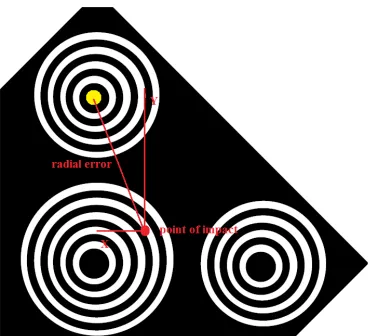
Based on the images from the witness camera, the following product scores for each trial could be calculated: (1) the radial error, (2) whether the participant attempted to ‘adjust’ his trial. For the radial error, the horizontal (ΔX) and ver -tical (ΔY) distance from the point of impact to the target were used to calculate the radial error (Magill, 2007) (Figure 4). A trial was categorised as ‘adjusted’ if the point of impact was more than 8.32cm (mean radial error ±2 SD in the tri -als without a peripheral light being lit) away from the centre of the middle target in the direction of the illuminated target. Once the mean radial errors for each correction time were calculated, a 3rd degree polynomial was fitted to the data, resulting in a function f(x) of which the inflexion point, i.e. the moment where the change in radial error in function of the time interval is highest, Figure 2. The target, consisting of five of once middle
target and four peripheral targets.
Figure 3a. Schematic overview of delay and correction time with lower movement time in a slower fencer.
could be determined.
Movement time was defined as the time interval between the release of the subject’s foot from the surface and the impact on the target. Based on the real movement time, the real correction time was estimated for each trial (real movement time – delay).
Statistical analysis
Statistics were performed using IBM SPSS Statistics 20.0. A 5 × 5 repeated measures ANOVA (5 light conditions × 5 correction times) was used to examine the differences in radial errors and adjusted trials. Significance levels were set at p≤0.05.
RESULTS
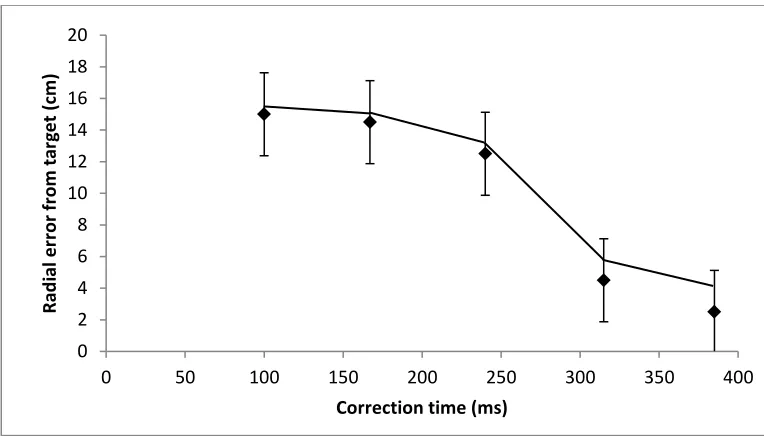
The results of the ANOVA indicated that the radial error decreased with increasing correc -tion time (F = 46.22, p < 0.01) (Figure 5). Fitting
a polynomial to the data yielded the following function: from which the radial error could be cal -culated based on the correction time. This func -tion has an explained variance (R2) of 0.9946 which implies that 99% of the difference in radial error can be explained by the difference in cor -rection time. To calculate the inflexion point, the derivative f’(x) of the function f(x) was used, and the zero-point of f’(x) was determined at 277 ms.
The radial error for the condition in which the participants did not have to adjust their attack (no light in a peripheral target), was significantly lower compared to the conditions in which the participants had to adjust their attack towards a peripheral light (t = 3.289, p < 0.05) (Table 2). Furthermore, there was no significant differ -ence in radial error for dominant hand (F = 1.910; p = 0.216). Some fencers noted that there was visual obstruction due to the bell guard of the foil when a light was lit at the side of the hand hold -ing the foil. However, no significant influence was found on the horizontal radial error (left or right) (F = 2.46; p = 0.168) when a light was lit at the respective side. Also between the first part of 50 trials and the last part of 50 trials, no significant difference was found in radial error (t = 1.079; p = 0.286).
Correction time was shown to significantly influ -ence the number of adjusted trials (F = 16.590; p<0.01) (Figure 6), e.g. the number of adjusted movements increased with increasing correc -tion time. Especially the correc-tion time condi -tions 310, and 380ms have significantly more adjusted trials compared to the three other con -ditions (F = 98.177; p < 0.01) since the inflexion point was situated around 270 ms. There was no significant difference in the number of adjusted trials between the different lights (F = 1.162; p = 0.411).
Figure 4. Visual representation is representing the calculation of the radial error. The yellow point represents a LED light, indicating the new target. The redpoint refers to the point where the fencer hit the target.
Table 2. Mean radial error (cm) and SD for the condition without a light (middle) en for the condition in which a peripheral light was lit.
Target Radial error (cm)
Peripheral 13.7 ±6.10
Upper target 14.1 ±6.94
Lower target 13.9 ±6.33
Left target 14.0 ±5.44
Right target 12.8 ±5.70
392| VOLUME 13 | 2017 www.archbudo.com
DISCUSSION
In this study on the ability of elite fencers to cor -rect an offensive action, the location of the target (five directions) and correction times (five correc -tion times) randomly changed in 80% of the tri -als after the fencer had initiated the fente. The results demonstrated that when a new target illu -minated 100ms before the tip of the foil would hit the original target, almost no correction was possible. There was only time for the fencers to realise their action would not be successful. The
number of successful corrections only slightly increased for the trials with longer correction times of 170ms (8.5%) and 240ms (20%). Since it has been demonstrated that in simple motor tasks, correction of an on-going movement such as pointing to an abruptly changing target, based on visual feedback could be made within 100ms to 155ms [5, 6], our results demonstrated that when the whole body was involved in the attack -ing action, correction times increased.
9
Figure 5.
Radial error as a function of correction time.
Figure 6.
A number of successful corrections as a function of correction time.
DISCUSSION
In this study on the ability of elite fencers to correct an offensive action, the location of the
target (five directions) and correction times (five correction times) randomly changed in 80%
of the trials after the fencer had initiated the
fente
. The results demonstrated that when a new
target illuminated 100ms before the tip of the foil would hit the original target, almost no
correction was possible. There was only time for the fencers to realise their action would not
be successful. The number of successful corrections only slightly increased for the trials with
longer correction times of 170ms (8.5%) and 240ms (20%). Since it has been demonstrated that
in simple motor tasks, correction of an on-going movement such as pointing to an abruptly
changing target, based on visual feedback could be made within 100ms to 155ms [5, 6], our
0 2 4 6 8 10 12 14 16 18 20
0 50 100 150 200 250 300 350 400
Rad ial e rr or fr om tar ge t (c m )
Correction time (ms)
0 10 20 30 40 50 60 70 80 90 100
0 50 100 150 200 250 300 350 400
Nu m be r o f c or re ction s (% )
Correction time (ms)
9
Figure 5.
Radial error as a function of correction time.
Figure 6.
A number of successful corrections as a function of correction time.
DISCUSSION
In this study on the ability of elite fencers to correct an offensive action, the location of the
target (five directions) and correction times (five correction times) randomly changed in 80%
of the trials after the fencer had initiated the
fente
. The results demonstrated that when a new
target illuminated 100ms before the tip of the foil would hit the original target, almost no
correction was possible. There was only time for the fencers to realise their action would not
be successful. The number of successful corrections only slightly increased for the trials with
longer correction times of 170ms (8.5%) and 240ms (20%). Since it has been demonstrated that
in simple motor tasks, correction of an on-going movement such as pointing to an abruptly
changing target, based on visual feedback could be made within 100ms to 155ms [5, 6], our
0
2
4
6
8
10
12
14
16
18
20
0
50
100
150
200
250
300
350
400
Rad
ial
e
rr
or
fr
om
tar
ge
t (c
m
)
Correction time (ms)
0
10
20
30
40
50
60
70
80
90
100
0
50
100
150
200
250
300
350
400
Nu
m
be
r o
f c
or
re
ction
s (%
)
Correction time (ms)
Figure 5. Radial error as a function of correction time.
The findings of the current study are therefore consistent with Anson premotor time (PMT) [17] who reported that an increase in the moment of inertia effectively increased simple reaction time and motor time when performing a rapid arm movement, influencing the overall response initi -ation time. In line with our hypothesis, the num -ber of successfully corrected fentes to the target increased with increasing correction time. When the correction time increased up to 310ms, 67% of the attempts were successfully corrected, and for 380ms, elite fencers successfully corrected their fentes towards the new target in 85% of the trials. It appeared that the deflection point for this kind of tasks is situated around 277ms, which implies that more than 50% of the attacks can success -fully be corrected when the tip of the foil is 277ms away from the target. It can, therefore, be con -cluded that a time span of 270ms is sufficient to perceive the new situation, to decide which correc -tions need to be made and to send the appropriate stimuli to the muscle groups involved in the action (Figure 6). Furthermore, the results demonstrated that elite fencers were able to adjust their attack towards the different peripheral stimuli equally well. Furthermore, there was no significant difference between right or left handed fencers [15].
According to the speed-accuracy trade-off [18], when an action needs to be corrected as quickly as possible, this will cause the accuracy of the action to decrease. In line with the expectations, the tar -get was hit more accurately when there was more time to correct the on-going action to the new target. While fencers were able to stab the tip of the foil within a circle of 5cm around the centre of the target when no correction was required, the radial error increased almost threefold when cor -rections needed to be made very quickly (100ms) (Figure 5). The performance of a fencer who has to adjust his action within a split-second will, there -fore, be less accurate the faster the adjustment needs to be made, which is extremely relevant regarding the feinting of movements.
Given that in fencing, movements are performed extremely fast, and accuracy of the action decreases with increasing speed, early recogni -tion of the target area of an opponent’s attack can, therefore, be expected a key factor for perfor -mance [11]. Indeed, elite fencers can extract sig -nificantly more information from the opponent’s actions and use that information to anticipate the direction of their attack. Excellent anticipatory skills can thus be considered a factor for success
and training [19, 20]. Given that performing a fente takes about 539ms and an opponent starts exe -cuting a countermovement after 200ms, it is pos -sible for highly skilled fencers to correctly adjust their attack. Future research might aim to explore in detail which areas of the opponent’s body are looked at during attacking initiation or preparatory phase in close temporal manner.
The current findings also provide valuable insights and implications for the detection of talent. Skills such as reaction time, accuracy, speed, and the ability to adjust/correct actions measured in the lab are essential properties for competition fenc -ers and they might provide an indication of tal -ent, especially since coaches have indicated that the ability to counter an opponent’s attack and the quickness to perform those actions can be regarded as one the most important character -istics in high-level fencing [14]. Although mea -surement of reaction time and correction time in the lab is cheap and easy to administer, lab -oratory-conditions significantly differ from a competition setting in which arousal might have influenced our results. During the competition, heart rate and stress will increase while in the lab both factors are most likely less pronounced.
CONCLUSIONS
The current study demonstrated that correction times in humans, which are often measured in lab -oratory settings, appear to apply for sports situa -tions as well. A quarter of a second is sufficient to correct an on-going movement in which the whole body is involved subtle but effectively when the target unexpectedly changes position. Fast and adequate responding to sudden changes in the game situation is also for other sports an essen -tial characteristic for successful performance.
HIGHLIGHTS
• The capability of elite fencers to correct an on-going attack was evaluated.
• With increasing correction times radial error decreased.
• Correction time influenced the number of adjusted trials.
REFERENCES
1. Magill RA. Motor learning and control. 8th ed. New York, USA: McGraw-Hill; 2007: 482 2. Gollhofer A, Taube W, Nielsen JB, editors.
Routledge Handbook of Motor Control and Motor Learning. Abingdon, OX: Routledge; 2012: 252-274
3. Schmidt RA, Wrisberg CA. Motor Learning and Performance: A problem-based approach to learning. 3rd ed. Champaign, IL: Human Kinetics; 2004: 381
4. Paulignan Y, MacKenzie C, Marteniuk R et al. Selective perturbation of visual input dur
-ing prehension movements - 2. The effects of changing object position. Exp Brain Res 1991; 83(3): 502-512
5. Brenner E, Smeets JBJ. Fast Responses of the Human Hand to Changes in Target Position. J Motor Behav 1997; 29(4): 297-310 6. Prablanc C, Martin O. Automatic control dur
-ing hand reach-ing at undetected two-dimen
-sional target displacements. J Neurophysiol 1992; 67(2): 455-469
7. Tsolakis C, Kostaki E, Vagenas G. Anthropometric, flexibility, strength-power and sport-specific correlates in elite fencing. Percept Mot Skills 2010; 110(3C): 1015-1028
8. Borysiuk Z, Waskiewicz Z. Information Processes, Stimulation and Perceptual Training in Fencing. J Hum Kinet 2008; 19: 63-82 9. Oudejans RR, Michaels CF, Bakker FC. The
effects of baseball experience on movement initiation in catching fly balls. J Sports Sci 1997; 15(6): 587-595
10. Rodrigues ST, Vickers JN, Williams M. Head, eye and arm coordination in table tennis. J Sports Sci 2002; 20(3): 187-200
11. Hagemann N, Schorer J, Canal-Bruland R et al. Visual perception in fencing: Do the eye movements of fencers represent their infor
-mation pickup? Atten Percept Psychophys 2010; 72(8): 2204-2214
12. Mohamed M, Hijazi K. Attention, Visual Perception and their Relationship to Sport Performance in Fencing. J Hum Kinet 2013; 39: 195-201
13. Guilhem G, Giroux C, Couturier A et al. Mechanical and Muscular Coordination Patterns during a High-Level Fencing Assault. Med Sci Sport Exerc 2014; 46(2): 341-350 14. Roi GS, Bianchedi D. The Science of Fencing
– Implications for Performance and Injury Prevention. Sport Med 2008; 38(6): 465-481
15. Fitts PM. The information capacity of the human motor system in controlling the ampli
-tude of movement. J Exp Psychol 1954; 47(6): 381-391
16. Schmidt R, Sherwood D, Zelaznik H et al. Speed-Accuracy Trade-offs in Motor Behaviour: Theories of Impulse Variability. In: Heuer H, Kleinbeck U, Schmidt K-H, edi
-tors. Motor Behaviour: Programming, Control and Aquisition. Berlin-Heidelberg: Springer-Verlag; 1985: 79-126
17. Anson JG. Effects of moment of inertia on sim
-ple reaction time. J Mot Behav 1989; 21(1): 60-71
18. Ripoll H, Kerlirzin Y, Stein J-F et al. Analysis of information processing, decision making, and visual strategies in complex problem solv
-ing sport situations. Hum Mov Sci 1995; 14: 325-349
19. Hagemann N, Strauss B, Cañal-bruland R. Training Perceptual Skill by Orienting Visual Attention. J Sport Exerc Psychol 2006; 28: 143-158
20. Vickers JN. Perception, cognition, and decision training: the quiet eye in action. Champaign: IL: Human Kinetics; 2007: 266