International Ayurvedic Medical Journal, (ISSN:2320 5091) (February, 2107) 5 (2)
A CLINICAL & COMPARATIVE STUDY OF VATGAJANKUSH RAS AND SALLAKI
TABLET IN THE MANAGEMENT OF GRIDHRASI WITH SPECIAL REFERENCE
TO SCIATICA
Verma Astha1A.K. Singh 2
1Final year P.G. Scholar Dept. of Kayachikitsa, S.A.M.C. Indore, India.
2MD Scholar 1 M.D. Kayachikitsa, HOD Of Kayachikitsa Department, Director Cum Principal2
Shubhdeep Ayurved Medical College, Hospital Indore & (P.G. Institute) Madhya Pradesh, India
Email:[email protected]
ABSTRACT
Gridhrasi is a Vatavyadhi or Rujapradhana Nanatmaja Vatavyadhi. It is characterized by Stambh (Stiffness), Ruk (Pain), Toda (Pricking pain) and Spandana (Frequents switching). These symptoms initially affect Sphik (Buttock) as well as posterior aspect of Kati (Waist) and then gradu-ally radiates to Posterior aspects of uru (Thigh), Janu(Knee), Jangha (Calf) and Pada (Foot) as de-scribed by all Acharyas. Vatagajankush ras & Sallaki Tablet both are effective medicines for Gridhrasi because of its Preventive, Promotive, Prophylactic and Rejuvenative properties as well as providing a radial cure. These two medicines are applicable in all the Vatavyadhis
Keywords: Gridhrasi, Sciatica, Vatgajankush ras, Sallaki.
INTRODUCTION
Gridhrasi is one of the most prevailing health problems in our day to day clinical practice. Modernization of life style of human being has created several disharmonies in his biological system. As the advancement of busy, professional and socioeconomic condition, improper sitting posture in offices, factories, continuous work and overexertion, jerking movements during traveling and sports – all these factors create undue pressure to the spinal cord and play an important role in producing Gridhrasi (low backache and sciatica). Likewise, progressive disorders affecting the pelvis and near-er structures are also precipitating this condition which indicates the way of gate shown by the pa-tients due to extreme pain just like a Gidhha (vulture), due to this disease not only inflicts pain but also causes difficulty in walking which is very much frustrating and embracing to the patient. Though, the disease is present in leg, it disturbs the daily routine and overall life of the patient.
“Sciatic Syndrom” is a condition described in modern medicineresembles with Gridhrasi, as its sign & symptoms are same, in sciatica there is pain in the distribution of sciatic nerve which begins from buttock and radiates downwards to the posterior aspect of thigh, calf and to the outer boarder of foot. Herniation or degenerative changes in intervertebral disc is the most common cause. There is often history of trauma, as twisting of the spine, lifting heavy objects, exposure to cold or due to bad posture.
AIMS AND OBJECTIVES
To assess the efficacy of Vatgajankush ras and Sallaki Tab in the Management of Gridhrasi. To find a simple, effective, and cheap drug that can be used for outpatient treatment of Gridhrasi. To assess any side effect during the course of treatment.
MATERIALS AND METHODS
The Study will be randomized Clinical Trial on total 60 patients. Patients will be randomly selected from OPD and IPD of P.G. department of Kayachikitsa, Panchakarma, of Shubhdeep Ayurved Medical College and Hospital Datoda, Indore (M.P.).
INCLUSION CRITERIA:
1. Patients should be willing to the trial and able to participate.
2. Presence of clinical features of Gridhrasi with back pain radiating to thigh, foot. 3. Age above 18 year and below 60 year. Irrespective of occupation and sex.
EXCLUSION CRITERIA
1. Patient age below 18 and above 60 years of age. 2. Patient with other systemic disorder and malignancy 3. Degenerative disorder with marked deformity. 4. Pregnant women and lactating mother.
5. History of major trauma causing fractures.
6. Patient of quad equine syndrome and other surgical emergencies.
7. Patient suffering from major systemic illness necessitating long term drug treatment (rheuma-toid arthritis, tuberculosis, psycho-neuro endocrinal disorder etc.) blood cancer, HIV, Hepatitis.
INVESTIGATIONS
DRUG INTERVENTION:
VATAGAJANKUSH RAS (Bh.r. 26/115)
Self-prepared in Pharmacy of S.A.M.C. INDORE (M.P.)
Dose : 250mg
SALLAKI TAB (Himalaya Pharmacy Bangalore)
Dose : 500 mg
For Both medicine
Dosage : 2 times a day, before meal
Route of Administration : Oral
Anupana : lahasun swaras 10 drops
Sahpana : madhu
Duration of therapy : 45 days
GROUPING & OBSERVATIONS
60 patients of Gridhrasi with irrespec-tive age, sex, religion was included for the study & these patient was randomly divided into three groups viz. Vatagajankush Ras (20 Patients), Sallaki Tablet (20 Patients), And Vatagajankush Ras + Sallaki Tablet (20 Pa-tients). In this study, subjective and objective
parameters will be followed from OPD/IPD of shubhdeep ayurveda medical college and PG institute Indore (M.P.).
FOLLOW-UP
Drug was given befor meal for 45 days also the patients were kept under follow up period of 15 days, so that the total overall effect of treatment could be assessed.
CRITERIA FOR DIAGNOSIS A. SUBJECTIVE CRITERIA 1. STAMBHA (Stiffness)
Throughout the day + + + Sever 3
Very often + + Moderate 2
Only in morning + Mild 1
No Stiffness - Normal 0
2. RUK (Pain)
Pain with sever difficulty in Walking + + + Sever 3
Pain & slight difficulty in walking + + Moderate 2
Pain but no difficulty in walking + Mild 1
No pain - Normal 0
3. TODA (Pricking sensation)
Pricking sensation throughout the day + + + Sever 3
Pricking sensation on–off + Mild 1
No Pricking sensation - Normal 0
4. SPANDAN (Twitching)
Daily throughout the day + + + Sever 3
Very often + + Moderate 2
On-off + Mild 1
No Twitching - Normal 0
5. GAURAVA(Heaviness)
Heaviness with sever difficulty in Walking + + + Sever 3 Heaviness with slight difficulty in walking + + Moderate 2
Mild Heaviness no difficulty in walking + Mild 1
No Heaviness - Normal 0
6. DAHA (Burning sensation)
Present + - 1
Absent - - 0
7. SUPTATA (Numbness)
Cannot move the leg or foot + + + Sever 3
Difficult in moving the leg or foot + + Moderate 2
Mild numbness can easy move the leg + Mild 1
No Numbness - Normal 0
OBJECTIVE PARAMETERS 1. SLR TEST
Less than 30 ̊└ withpain + + + Sever 3
More than 31 ̊└ to70 ̊└ withpain + + Moderate 2
More than 71 ̊└ withpain + Mild 1
More than 71◦└without pain - Normal 0
2. LASEGUE’S SIGN
Present + - 1
STATISTICAL ANALYSIS
As there were 3 groups in this study, ANOVA test was applied to prove the treat-ment was Statistically Significant or not.
Overall assessment of the treatment
All the Subjective or Objective values were applied to proper Statistical Methods to produce Result
Table no.1
Symptom Percentage Relief
Group A Group B Group C
Stambh 70.00 % 53.33 % 79.59%
Ruk 56.00 % 36.00 % 52.63%
Toda 89.47 % 60.00 % 81.08%
Spandan 87.50 % 50.00 % 90.90%
Gourav 68.96% 30.00% 70.70%
Daha 85.71% 80.00% 80.00%
Suptate 80.00% 83.33% 86.96%
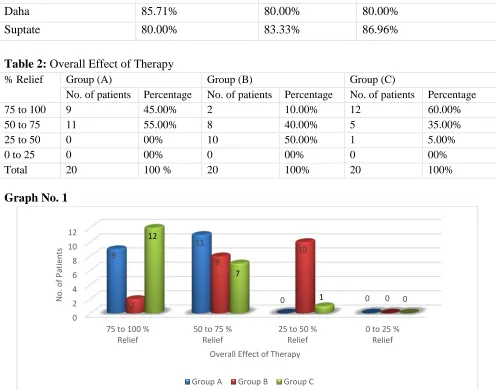
Table 2: Overall Effect of Therapy
% Relief Group (A) Group (B) Group (C)
No. of patients Percentage No. of patients Percentage No. of patients Percentage 75 to 100 9 45.00% 2 10.00% 12 60.00% 50 to 75 11 55.00% 8 40.00% 5 35.00%
25 to 50 0 00% 10 50.00% 1 5.00%
0 to 25 0 00% 0 00% 0 00%
Total 20 100 % 20 100% 20 100%
Graph No. 1
0 2 4 6 8 10 12
75 to 100 %
Relief 50 to 75 %Relief 25 to 50 %Relief 0 to 25 %Relief
9
11
0 0
2
8
10
0
12
7
1 0
N
o. o
f P
at
ie
nt
s
Overall Effect of Therapy
RESULT
Stambha, Ruka, Toda, Spandan, Gourav, Daha, and Suptate are proved to be significant in all the three groups but Group C is proved to be more significant than Group A and Group B.
Group C is also proved to be statisti-cally more effective for Objective parameter such as SLR test & Lasegual’s signthan other two Groups.
DISCUSSION
We try to think to treat this disease some different angles & To find a simple, ef-fective, and cheap drug that can be used for outpatient treatment of Gridhrasi. That’s why we make various Samprapti according to Ni-dan, Dosh, Dushya Samurchhana.
VATAGAJANKUSH RAS & SAL-LAKI TABLET both are effective medicine for Gridhrasi because of its Preventive, Promo-tive, Prophylactic and Rejuvinative proper-ties as well as providing a radical cure. These two medicine is applicable in all type of Vatavyadhis with different Anupan
The disease Gridhrasi as being a Vatavyadhi and Vata is also controller and reg-ulator of other two Dosha, Dhatu and Ma-la. Vata is controlled by Vatagajankush ras &
Sallaki tablet is also work on Vata- Kaphaja doshas and Aam pachak. Mainly Sallaki tablet is good for Srotorodhajanya Vatavyadhi and Vatagajankush Ras is for Vatavyadhy.
It is evident that Vatagajankush Ras is well known and proven that it works for all type of Vatavyadhy’s as Vata shamak chikitsa or Neuro-muscular diseases. (ÒS‐j‐ 26) and Sallaki tablet is works as Kapha-Pitta shamak dosh karmata and also works as Rasyana. So, after the combination of both the medicines works as Vata pradhan Tridosh shamak.
Hence, I have selects this drugs singly and comparatively study to evaluate its efficacy or manage in Gridhrasi (sciatica) in a well manners.
PROBABLE MODE OF ACTION OF MEDICINE
Its Pathogenesis is depending on factors of MARGAVRODHJANYA & DHATUKSHAYAJANYA along with Vataj or Vatakaphaj Gridhrasi.
DOSH GUNA
Vata Guna: Raksha, Sheet, Laghu ,sukshma, Chal, Vishad , Khara (ch.su.1/59)
Pitta Guna: Sasneha, Ushna, Tikshna, Draw, Amla, Sara, Katu (ch.su.1/60)
Kapha Guna: Guru,Sheeta, Mradu, Snigdh, Madhur, Sthira, Pichhil (ch.su.1/61)
Table a: Dosh Prakop & Shaman (Ch.Su.1/65)86
Si.No Dosha Prakopak Rasa Shamak Rasa
1. Vata Katu,Tikta.Kashaya Lavan,Amla,Madhur
2. Pitta Katu,Amla,Lavan Tikta,Madhur,Kashaya
3. Kapha Madhur,Amla,Lavan Katu,Tikta,Kashay
Table b: Action of Vatgajankush Rasa on Gridhrasi
Si.No. Guna Dosha Praphava Upshayatmak Karma
1. Ushna + Laghu, Ruksha, Tikshna Kapha Shamak Aam Pachak, Margavrodha
3. Vikasi, Vyavayi, Yogvahi Tridosh Shamak Nadi Dourbalya, DhatuKshaya, Mar-gavrodha.
Table c: Action of Sallaki on Gridhrasi
Si. No. Guna Dosha Praphava Upshayatmak Karma
1. Ushna+ Laghu, Ruksha,
Katu, Tikta, Kashaya Rasa
Kapha Shamak Aam Pachak, Margavrodha Shoola
prashaman, Nadi Dourbalya, DhatuKshaya, Rasayan, Brimhaniya
2. Madhur+ Snigdha Vata+Pitta Shamak Dahashamak, Shoola Shamak
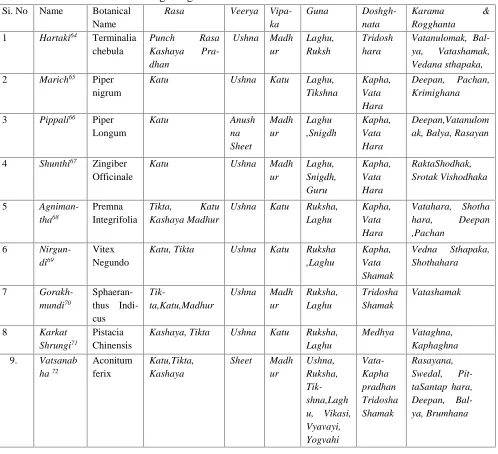
Table d: Mode of Action of Drug Drug Review Si. No Name Botanical
Name
Rasa Veerya
Vipa-ka
Guna
Doshgh-nata
Karama &
Rogghanta
1 Hartaki64 Terminalia
chebula
Punch Rasa
Kashaya
Pra-dhan Ushna Madh ur Laghu, Ruksh Tridosh hara Vatanulomak, Bal-ya, Vatashamak, Vedana sthapaka,
2 Marich65 Piper
nigrum
Katu Ushna Katu Laghu,
Tikshna
Kapha, Vata Hara
Deepan, Pachan, Krimighana
3 Pippali66 Piper
Longum Katu Anush na Sheet Madh ur Laghu ,Snigdh Kapha, Vata Hara Deepan,Vatanulom ak, Balya, Rasayan
4 Shunthi67 Zingiber
Officinale
Katu Ushna Madh
ur Laghu, Snigdh, Guru Kapha, Vata Hara RaktaShodhak, Srotak Vishodhaka 5 Agniman-tha68 Premna Integrifolia Tikta, Katu Kashaya Madhur
Ushna Katu Ruksha,
Laghu
Kapha, Vata Hara
Vatahara, Shotha
hara, Deepan
,Pachan
6
Nirgun-di69
Vitex Negundo
Katu, Tikta Ushna Katu Ruksha
,Laghu
Kapha, Vata Shamak
Vedna Sthapaka, Shothahara
7
Gorakh-mundi70
Sphaeran-thus Indi-cus Tik-ta,Katu,Madhur Ushna Madh ur Ruksha, Laghu Tridosha Shamak Vatashamak 8 Karkat Shrungi71 Pistacia Chinensis
Kashaya, Tikta Ushna Katu Ruksha,
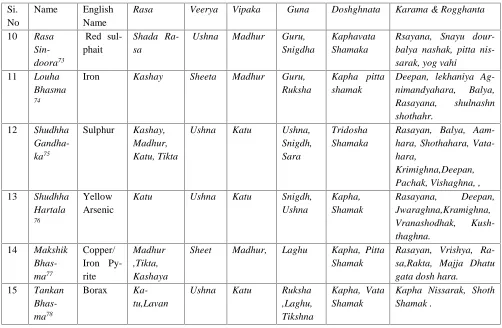
Table e: Rasa - Bhasma Si.
No
Name English Name
Rasa Veerya Vipaka Guna Doshghnata Karama & Rogghanta
10 Rasa Sin-doora73
Red sul-phait
Shada Ra-sa
Ushna Madhur Guru,
Snigdha
Kaphavata Shamaka
Rsayana, Snayu dour-balya nashak, pitta nis-sarak, yog vahi
11 Louha
Bhasma
74
Iron Kashay Sheeta Madhur Guru,
Ruksha
Kapha pitta shamak
Deepan, lekhaniya Ag-nimandyahara, Balya, Rasayana, shulnashn shothahr. 12 Shudhha Gandha-ka75 Sulphur Kashay, Madhur, Katu, Tikta
Ushna Katu Ushna,
Snigdh, Sara
Tridosha Shamaka
Rasayan, Balya, Aam-hara, ShothaAam-hara, Vata-hara,
Krimighna,Deepan, Pachak, Vishaghna, ,
13 Shudhha
Hartala
76
Yellow Arsenic
Katu Ushna Katu Snigdh,
Ushna
Kapha, Shamak
Rasayana, Deepan,
Jwaraghna,Kramighna, Vranashodhak, Kush-thaghna.
14 Makshik
Bhas-ma77
Copper/ Iron Py-rite
Madhur ,Tikta, Kashaya
Sheet Madhur, Laghu Kapha, Pitta
Shamak
Rasayan, Vrishya, Ra-sa,Rakta, Majja Dhatu gata dosh hara.
15 Tankan
Bhas-ma78
Borax Ka-tu,Lavan
Ushna Katu Ruksha
,Laghu, Tikshna
Kapha, Vata Shamak
Kapha Nissarak, Shoth Shamak .
Table f: Shallaki Tablet Si.No Name Botanical
Name
Rasa Veerya Vipaka Guna Doshaghnata Karama & Rogghanta
1. Tab Shallaki79 Boswelliya serrata Kashay, Tikta, Madhura
Ushna Katu Laghu,
Ruksha
Kaphapitta shamak
Shothahara , Vedana Sthapan
Table g: Anupan–Lahasun Swarasa Si
No.
Name Botanical Name
Rasa Veerya Vipaka Guna Doshaghnata Karama &
Rogghanta
1. Rason80 Allium
Sativum
Madhur, Lavan, Katu, Tikta, Kashay
Ushna Katu Snigdha,
Guru, Tikshna
VataKaph Shamak, Pitta Vardhak
Rasayan
Table h: Sahapana–Madhu
Si. No. Name Rasa Anu Rasa Veerya Vipaka Guna Doshaghnata Karama & Rogghanta
1. Madhu81 Madhur Kashaya Ushna Madhur Laghu, Vishal, Ruksha
Kaphapitta shamak
THE BETTER RESULT OF VATAGAJAN-KUSH RAS ALONG WITH SALLAKI TABLET THAN SINGLE VATAGAJAN-KUSH RAS & SINGLE SALLAKI TABLET. ON THE BASIS OF AYURVEDA
CON-CEPT
VATAGAJANKUSH RAS
This medicine is prepared in Pharmacy of
Shubhdeep Ayurved medical college Indore
(M.P.)
Vatagajankush Ras is combination of Sonth, Marich, Pippali works as deepan & Aam pa-chan, improves digestion. Vatsnabh has prop-erty of vikasi, vyavayi, yogvahi which makes it easy to digest along with all the drugs pre-sent in Vatagajankush ras. It opens all the mi-crochennals and easy to reached on cellular level. Hritaki, Agnimanth, Karkatshrangi also works as Deepan, Vatanulomak, Kapha nis-sarak, Vatashamak. All Ras-Bhasma’s in-creases Agni viz. Jatharagni, Dhatwagni, Bhutagni. Works as Balya, Rasayan, Vata pradhan Tridosh Shamak.
Hence it is proving that we can use this Vatgajankush ras in specially Vata pradhan Vyadhi along with Kapha or Pitta Dosh Prakop. It is Vata Pradhan Tridosh Shamak, Aam pachak, Dhatupushtikarak, Baly Rasya-na, Brimhan.
SALLAKI TABLET
The Doshkarma is Aampachak & Kaphapitta Shamak. According to classics Sallaki has potent Vata Kaphahara properties.
Hence, it is proving that according to classics it is Kapha pitta shamak. But due to its overall Guna dharma also works on Vata Dosh. So, we can use it in all disorder those are Kaphapitta pradhan Vata Dosh prokopak. It is Vatashamak, balya, Rasayan,
Dhatupush-tikark etc. So, there is combination of both the drugs has a great result and Works as Tridosha Shamak. Comparatively single Drugs act on Specific Doshas like only Pitta-Kapha shamak Or Vata Shamak.
ON THE BASIS OF EXPERIMENTAL STUDY
On the basis of observation and clini-cal finding described in cliniclini-cal study, Vata-gajankush Rasa along with Sallaki tablet is comparatively better medicine than single medicine of Vatagajankush ras or single med-icine of Sallaki Tablet. As it has shown more relief in symptoms considered for present study.
CONCLUSION
The Conclusion thus drawn from the observations are presented as below:
ON THE BASIS OF OBSERVATION Patients having Vatakaphaj & vatapittaj
prakriti are more affected by this disease than other prakriti.
Patients of 40- 60 age group are more af-fected by this disease than other age group. Male Patients are more affected by having
Mandagni in this disease.
Service (Felid work job) and Businessmen are more affected by this disease.
and 1.67 % patients were having Anya Ni-dan.
ON THE BASIS OF RESULTS
Vatagajankusha ras along with Sallaki tablet has shown more significant in Manage-ment of Gridhrasi. Which affecting the lum-bar region and lower limbs. It is identified by radiating pain all through the limb and dys-function of that limb.
This Ayurvedic remedy has its ad-vantage over modern analgesics because anal-gesics may occasionally cause allergic reac-tion gastrointestinal disturbance such as nau-sea, vomiting, dyspepsia and heart burn etc. whereas this ayurvedic preparation is totally free from all the above side effects.
This is to conclude that it can be said that Vatagajankusha ras along with sallaki tablet is more effective than singal Vatagajan-kusha ras or singal sallaki tablet for the treat-ment of Ghridhrasi. But still more scientific work is to be done to generalize the outcome. I hope this study will show the way of further study.
REFERENCES
1. Acharya JT, editor. Charaka Samhita of Agnivesha, Chikitsasthana, Ch. 28, Ver. 15-18. 4thed. Varanasi:
Chau-khambha Surbharati Prakashana; 1994. p. 617.
2. Acharya JT, editor. Charaka Samhita of Agnivesha, Sutrasthana, Ch. 20, Ver. 11. 4thed. Varanasi: Chaukhambha Surbharati Prakashana; 1994. p. 113.
3. Acharya JT, editor. Charaka Samhita of Agnivesha, Chikitasthana, Ch. 28, Ver. 56-57. 4thed. Varanasi: Chaukhambha
Surbharati Prakashana; 1994. p. 619. 4. Acharya JT, editor. Sushruta Samhita of
Sushruta, Nidansthana, Ch. 1, Ver. 74. 4thed. Varanasi: Chaukhambha Prakasha-na; 1980. p. 268.
5. Pinto RZ, Maher CG, Ferreira ML, Fer-reira PH, Hancock M, Oliveira VC, et al. Drugs for relief of pain in patients with sciatica: Systematic review and meta-analysis. BMJ 2012; 344: e497.
6. Valat JP, Genevay S, Marty M, Rozenberg S, Koes B. Sciatica. Best Pract Res Clin Rheumatol 2010; 24:241-52.
7. Shastri RD, editor. Bhaisajyaratnavali of Govind Das Sen, Ch. 26, Ver.115-118. 20thed. Varanasi: Chukhambha Prakashan; 2010. p. 625.
8. Bhavaprakash Nighantu - Girijashahay Pandey, 1969.
9. Braunwald E. 15th ed. New York: McGraw-Hil Medical Publishing Division; 2001. Harrison: Principles of Internal Medicines; p. 73.
10. Vol. 1. New Delhi: Council of Scientific and Industrial Research; 1948. Anon (CSIR). The Wealth of India, Raw Materials.
11. Felter H, Lloyd J. I and II. Cincinnati: Ohio Valley Company, US; 1898. Kings American Dispensatory.
12. Howes FN. Age-old resins of the Mediter-ranean region and their uses. Econ Bot. 1950; 4:307–16.
13. Krishnamurthy T, Shiva MP. Salai guggul (from Boswellia serrata Roxb.): Its ex-ploitation and utilization. Indian For-est. 1977; 103:466–74.
14. Verghese J. Olibanum in focus. Perfumer Flavorist. 1988; 13:2–11.
16. Maupetit P. New constituents in olibanum resinoid and essential oils.
17. Easy Ayurveda: Health & lifestyle blog by Dr. Hebbar BAMS, MD (Ayu.)
18. www.spine–health .com 19. www.spineuniverse.com
20. www.allaboutbackandneck pain.com 21. www.Ayurved.com
22. www.webmd.com
23. www.liveayurvedalife.com
Source of Support: Nil
Conflict Of Interest: None Declared
How to cite this URL: Verma Astha & A.K. Singh: A Clinical & Comparative Study Of Vatgajankush Ras And Sallaki Tablet In The Management Of Gridhrasi With Special Reference To Sciatica. International Ayurvedic Medical Journal {online} 2017 {cited February, 2017} Available from: