879 | P a g e
A STUDY ON OPINION MINING METHODOLIES
WITH MACHINE LEARNING APPROACHES
Tasneem Rahath
1, Safoora Fathima
2,
Sana Mateen
3ABSTRACT
Opinion mining tasks involve opinion word identification, classification (positive, negative or neutral) and identifying strength of opinion (positive (strong or weak), negative (strong or weak)), target identification on which opinion is given, opinion source identification and opinion summarization. Hence, Opinion Mining tasks require techniques from the field of natural language processing, information retrieval (IR), and text mining. The main concern is how to automatically identify opinion components from unstructured text and summarize the opinion about an entity from a huge volume of unstructured text.
This study presents a systematic literature survey that contains a comprehensive overview of different approaches of opinion mining. The aim of this study is to provide researchers and students access to the works in opinion mining as they frame new ideas and further develop the practice.
Keywords: Aspect Mining, Opinion Classification, Opinion Mining, Opinion Polarity, Opinion
Word
I.
INTRODUCTION
Opinion Mining needs use of natural language processing tasks for tracking the mood of the public about a
particular product or topic. Opinion mining, which involves in building a system to collect and examine and
categorize opinions about the product made in blog posts, comments, reviews or tweets. [31]
Opinion mining is the computational treatment of people's opinions, emotions and attitudes toward entities,
individuals, events, topics and their attributes. The opinion mining task is technically very challenging and
practically very useful. For example, businesses always want to know public or consumer opinions about their
products and services. People also want to know the opinions of existing customers before they use a service or
purchase a product.
An opinion is the private state of an individual and it represents the individual‟ s ideas, beliefs, judgments and
evaluations about a specific subject, topic or item.
Opinion Mining is a procedure used to extract opinion from text. “opinion mining is a recent discipline at the
crossroads of information retrieval, text mining and computational linguistics which tries to detect the opinions
expressed in natural language texts” [22].
An opinion has three main components, i.e., the opinion holder or source of the opinion, the object (aspect or
entity) about which the opinion is expressed and the evaluation, view or appraisal, that is, opinion. For opinion
880 | P a g e Opinion mining tasks involve opinion identification, opinion classification (positive, negative, and neutral),
opinion target identification, opinion source identification and opinion summarization. Hence, opinion mining
tasks require techniques from the field of natural language processing, information retrieval (IR), and text
mining.
II.
OPINION MINING TASKS
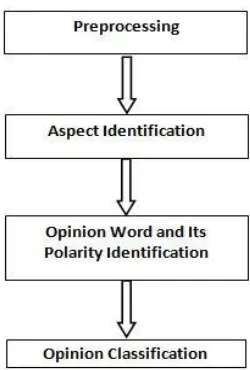
Figure -1 Aspect Based Opinion Mining
2.1
Preprocessing
Preprocessing the text is the process of cleaning text and preparing the text for classification. User-generated
reviews require preprocessing to remove noise before the mining process can be performed. This is because
these reviews are usually written by non experts and frequently contain mistakes in spelling, grammar, use of
non dictionary words such as abbreviations or acronyms of common terms (domain specific), punctuation
mistakes, incorrect capitalization, and so forth. The preprocessing involves several steps: spelling check, online
text cleaning, white space removal, expanding abbreviation, stemming, stop words removal, tokenization, and
sentence boundary detection.
2.2 Aspect Identification
Mining aspect and opinion of products or services commented by customers. Aspects are also called features
that are features of some entity or service. In aspect extraction, product or service features (aspects) are
extracted from each sentence. Aspects can be frequent or infrequent. Frequent aspects are those which are
commented by many people which are most talked about. Infrequent Aspects are not talked by many people. In
review, features may be mentioned explicit or implicit. Features which are mentioned in a sentence directly are
called as explicit features and features which are not mentioned directly are called implicit features.
For example, “Hotel room was very clean and spacious”
In this sentence reviewer has mentioned about room directly. So it is explicit feature. It is easy to extract such
features. Now consider following sentence,
881 | P a g e In this sentence reviewer is talking about speed of elevator but it is not mentioned directly in the sentence. So
here speed is implicit feature. It is difficult to understand and extract such features from sentence.
2.3 Opinion word extraction
In opinion word extraction, opinion words mentioned on its related aspect or entity or target are identified. If a
sentence contains one or more opinion words and its related targets then the sentence is called an opinion
sentence. Opinion words are generally identified by adjectives.
2.3.1 Opinion Word Polarity Identification
In opinion word polarity identification, semantic orientation or polarity (positive or negative) of each opinion
word is identified.
2.4 Opinion Classification
The Classification task aims to determine the opinions' polarity (positive, negative or neutral) regarding the
features being commented on.
Identifying opinion words in each review and deciding whether each opinion word is positive, negative or
neutral.
An opinion is simply a positive or negative view, attitude, emotion or appraisal about an entity or an aspect of
the entity from an opinion holder. Positive, negative and neutral are called opinion orientations. Other names for
opinion orientation are sentiment orientation, semantic orientation, or polarity. In practice, neutral is often
interpreted as no opinion.
It also aims to determine the strength and polarity of the opinions regarding the product‟ s features. Opinion strength may be inferred from adjective choice (e.g., “disappointing” is milder than “awful”) or from qualifiers (e.g., “very good” is stronger than “good”).
III DIFFERENT APPROACHES FOR OPINION MINING
3.1 Opinion Mining using Machine Learning Approach
Pang et al. [23] tested Naïve Bayes Classifiers, Maximum Entropy, and Support Vector Machines (SVM) to see
which would best classify the movie reviews in an earlier 1400 text version of the Polarity Dataset. The answer
was fairly conclusive: SVMs outperformed the other two algorithms with most combinations of features, and
had the highest scores overall. Based on this result, most of the sentiment analysis research based on machine
learning has made use of SVMs. Pang et al. [23] also tested a number of feature types like (one-word) unigrams
and (two-word) bigrams, with or without appended part of speech tags or indicators of their position in the text.
The optimal SVM classifier did best with only unigram features.
Dave et al. [6] examines product reviews from C|net for classification. The studied corpus consists of reviews
from 4 largest categories of C|net (in total, 448 reviews). A review is mentioned as Positive if it is rated in C|net with three or more stars, and as negative for one and two stars. Before aspect extraction, reviews‟ texts get
preprocessed. Preprocessing contains POS tagging, negation words like not and never are identified. The
approach also extracts N-grams (unigrams, bigrams and trigrams). The SVM classifier is used for classification
and yields the accuracy value of 85.8% using ten-fold cross-validation without stratification. Dave et al. [6]
882 | P a g e Using the Appraisal Theory of Martin and White (2005), Whitelaw et al. (2005)[33] used features that not only
took into account the Orientation (positive or negative) of adjectives in the text, but also their Attitude Type
(appraisal, judgment, or affect) and Force (low, neutral, or high). They tested a number of combinations, and
got the best results (better than all preceding studies) from a SVM trained on a bag of words plus a set of
features that reflected the frequency of “appraisal groups” (adjectives and their modifiers) grouped according to
their Attitude Type and Orientation. Not surprisingly, appreciation was the Attitude Type most relevant for
predicting sentiment in the movie review corpus. The inclusion of Force features, however, degraded
performance.
Esuli and Sebastiani [8] note that this task can be divided into three interrelated subtasks: determining whether a
certain unit of language is subjective, determining the orientation or polarity of subjective language, and
determining the strength of that orientation. Esuli and Sebastiani [8] use machine learning techniques to classify
individual words as positive or negative using their WordNet glosses. The first step is to derive a set of features
(positive and negative words) with enough coverage to train a classifier. This is accomplished using two small
sets of seed words (e.g., good, nice, etc. and bad, mean, etc., from (Turney and Littman, [27]) that are expanded
iteratively using the WordNet synonym, antonym, hyponym, and hypernym relations. When the set of terms
was sufficiently large, the glosses and sample sentences were used to train the classifier. The hypernym relation
proved too general, and the hyponym relation was only somewhat helpful; the best results were achieved when
the synonyms and antonyms of adjectives alone were used to expand the term sets. Having separate features for
negated items (e.g., not good) also improved accuracy as compared to the GI lexicon.
Kennedy and Inkpen (2006) [16] used the entire Polarity dataset (2000 reviews) for both semantic and machine
learning testing. They tested a number of combinations of options, finding that the use of contextual valence
shifters (Polanyi and Zaenen, 2006) boosted the performance of both models (particularly the semantic model),
and that, while the semantic model was very sensitive to the dictionary chosen (adding Google PMI dictionaries
decreased performance, for instance), the SVM classifier always did best with lemma unigrams and bigrams;
limiting unigrams to the ones in previously existing polarity dictionaries (e.g., the GI) was counterproductive.
Overall, the SVM classifier outperformed the counting (semantic) method by a large margin: the best
term-counting model had an accuracy of only 67.8%, as compared to 85.9% for the SVM classifier. A hybrid SVM
classifier trained on the output from each model (comparable to Mullen and Collier 2004) did the best of all,
reaching 86.2% accuracy. The authors note that this last performance increase was possible in part because the
classifiers seems to make different mistakes; the term-counting model is far better at classifying positive
reviews correctly, while the SVM classifier does better on average with negative reviews.
Li et al. [17] proposed a machine learning approach to incorporate polarity shifting information into document
level sentiment classification. Pang et al. [19] proposed a word between a negation trigger word/phrase. Li et al.
used binary classifier to divide sentences in a document into two parts: sentences which contain polarity shifting
structure and sentences without polarity shifting structure. They first proposed a machine learning based
classifier to detect polarity shifting and then apply two classifier combination methods to perform polarity
classification.
Wilson, Wiebe and Hwa [34] used Supervised Machine Learning techniques to classification of intensity of
883 | P a g e strength of opinion. Authors presented promising results in identifying opinions in deeply nested clauses and
classifying their intensities.
3.2 Opinion Mining using unsupervised Approach
Turney [30], which not only attempts to classify full texts, but eschews a unigram (single word) approach in
favor of two-word bigrams, extracted according to their part of speech (i.e., adjective/noun pairs, adverb/verb
pairs, etc.). The SO values of these bigrams are derived by calculating their Pointwise Mutual Information
(PMI).
Another unsupervised approach is the lexicon based method, which uses a dictionary of sentiment words and
phrases with their associated orientations and strength, and incorporates intensification and negation to compute
a sentiment score for each document (Taboada et al., [29]).
Polanyi and Zaenen [24] focused on how context affects the polarity of a valence (polar) term. They assumed a
numerical +2/-2 value (a valence) on positive/negative words in the lexicon (including adjectives, nouns, verbs,
and adverbs), and then suggested how this numerical value should change based on the surrounding context.
Negation is the case of a contextual valence shifter; the authors proposed that the presence of a negating word
(such as not) should switch the sign on the valence, +2 for clever becomes -2 for not clever. The presence of an
intensifier (very) or a downtoner (somewhat) affects the valence by increasing or decreasing the absolute value;
if good is +2, somewhat good is +1, whereas bad (-2) becomes very bad (-3). Valence shifters, for instance, are
probably less useful to an SVM classifier because they require an increase in the number of features, with each
feature requiring further independent examples.
3.3 Subjectivity Classification
Subjectivity classification classifies sentences into two classes, subjective and objective (Wiebe, Bruce and
O'Hara, 1999). An objective sentence expresses some factual information, while a subjective sentence usually
gives personal views and opinions which might not be fact.
In (Wiebe, 2000), Wiebe proposed an unsupervised method for subjectivity classification, which simply used
the presence of subjective expressions in a sentence to determine the subjectivity of a sentence. Since there was
not a complete set of such expressions, it provided some seeds and then used distributional similarity (Lin,
1998) to find similar words, which were also likely to be subjectivity indicators. However, words found this
way had low precision and high recall.
In (Pang and Lee, 2004), a mincut-based algorithm was proposed to classify each sentence as being subjective
or objective. The algorithm works on a sentence graph of an opinion document, e.g., a review. The graph is first
built based on local labeling consistencies (which produces an association score of two sentences) and
individual sentence subjectivity score computed based on the probability produced by a traditional classification
method (which produces a score for each sentence). Local labeling consistency means that sentences close to
each other are more likely to have the same class label (subjective or objective). The mincut approach is able to
improve individual sentence based subjectivity classification because of the local labeling consistencies. The
purpose of this work was actually to remove objective sentences from reviews to improve document level
884 | P a g e Wilson, Wiebe and Hwa [34] pointed out that a single sentence may contain both subjective and objective
clauses. It is useful to pinpoint such clauses. It is also useful to identify the strength of subjectivity. A study of
automatic subjectivity classification was presented to classify clauses of a sentence by the strength of
subjectivity expressed in individual clauses, down to four levels deep
(
neutral, low, medium, and high). Neutral indicates the absence of subjectivity. Strength classification thus subsumes the task of classifying a sentence assubjective or objective. The authors used supervised learning. Their features included subjectivity indicating
words and phrases, and syntactic clues generated from the dependency parse tree.
Benamara et al. (2011)[3] performed subjectivity classification with four classes, S, OO, O and SN, where S
means subjective and evaluative (their sentiment can be positive or negative), OO means positive or negative
opinion implied in an objective sentence or sentence segment, O means objective with no opinion, and SN
means subjective but non-evaluative (no positive or negative sentiment).
3.4 Aspect Extraction Approaches
Lein Zhang and Bing Liu [35] had focused on mining features of an entity. They used unsupervised method
“Double Propagation” for feature extraction. It mainly extracts noun features. Dependency Parser was used to
find relations between opinion words and features.
Double propagation works well for medium sized corpora. For large and small corpora, it can result in low
precision and low recall. Then author introduced “part whole” and “no” patterns to increase the recall. And
feature ranking applied to improve precision.
Jorge Carrilo and Laura Plaza has focused on measuring the polarity and strength of opinions. Their approach
discovers feature automatically from reviews using unsupervised model. The set of discovered features are small
and meaningful enough for the user. And lastly, system estimates the weight of each product feature in the
verall user opinion to predict a more precise rating.
Hu and Liu [12] proposed a technique based on association rule mining to extract product features. The idea can
be summarized briefly by two points: (1) finding frequent nouns and noun phrases as frequent aspects. (2) Using
relations between aspects and opinion words to identify infrequent aspects. The idea is as follows: The same
opinion word might be used to describe or modify different aspects. Opinion words that modify frequent aspects
may modify infrequent aspects, and thus can be used to extract infrequent aspects.
Jakob and Gurevych (2010) used CRF. They trained CRF on review sentences from different domains for a
more domain independent extraction. They also used domain independent features e.g. tokens, POS tag,
syntactic dependency, word distance, and opinion sentences.
Li et al [17] used and integrated two CRF variations, i.e., Skip- CRF and Tree-CRF, to extract aspects and
opinions. Original CRF, which can only use word sequences in learning, Skip-CRF and Tree- CRF enable CRF
to exploit structure features. However, a limitation of CRF is that it only captures local patterns rather than long
range patterns. It has been shown in (Qiu et al., [25]) that many feature and opinion word pairs have long range
dependencies
.
Experimental results in (Qiu et al., [25]) indicate that CRF does not perform well.885 | P a g e Mita Dalal and Mukesh Zaveri (2014) [5] used fuzzy functions for classification of online user reviews. They
proposed an approach to perform fine-grained sentiment classification of online product reviews by
incorporating the effect of fuzzy linguistic hedges on opinion descriptors.
Animesh Kar and Deba Mandal [15] introduced fuzzy opinion miner (FOM) a fuzzy approximation system to
determine the strength of opinion about product in reviews. FOM outputs a set of opinion phrases which are
ranked based on strength and the overall intensity of the product.
Pratik N. Kalamkar and Anupama G. Phakatkar [14] used fuzzy logic algorithmic approach to classify opinion
words into different category. Their Proposed approach used conditional random field for aspect extraction.
Classification of opinion related to aspect word is done using fuzzy logic algorithmic approach. Ranks Entities
based on desired aspect of entities. Their Fuzzy Logic system follows steps like fuzzification and
defuzzification. Fuzzification is the process where special degree is associated with each opinion word. Finally,
fuzzy results are converted into crisp values using Memdani‟ s defuzzification function.
Nadali and Kadir [27] used fuzzy Logic for classification of reviews. At first fuzzification of inputs is done.
Then membership function is defined for finding membership value for each input. Defuzzification is used to
get final output.
Shaidah Jusoh and Hejab M. Alfawareh [13] used approach which evaluate sentiment word and sentiment word
modifier. Their opinion fuzzy set contains only two types of linguistic variables first is sentiment word and
second is sentiment word modifier. Lexicon of sentiment word of positive sentiment, lexicon of negative
sentiment word and lexicon of sentiment word modifier are developed. Each word in the list of token are
matched with developed lexicons. If they are matched then sentiment word has been recognized and then word
in token list is labeled as SenWord Assigns Fuzzy values to fuzzy sets opinion. Fuzzy set operation is conducted
on the opinion fuzzy sets to determine sentiment either it is positive or neutral.
IV RESEARCH ISSUES AND CHALLENGES
Despite number of research efforts, the current opinion mining studies and applications still have limitations and
margins for improvement. Accordingly, opinion mining suffers from a number of problems, such as accuracy,
scalability, quality, standard of data, natural language understanding comprehension, among others.
Some of the major challenges related to natural language processing, such as context dependency, semantic
relatedness and ambiguity, have made opinion mining difficult. As practical applications require high accuracy,
some of the work must be performed manually because of the challenging problems with the natural language
processing.
Most of the existing research regarding opinion mining is domain dependent, which limits the scope
generalization of the information. Machine-learning systems, which are domain dependent, require that data be
manually labeled; it is very a difficult task to manage. Hence, there is need for generalized domain independent
for the automatic identification and classification of opinion components.
One of the important problems of opinion mining is the identification of opinion targets from unstructured text.
The opinion target is defined as the entity or features of an entity about which an opinion is expressed.
Another problem is domain dependency, which can be a problem when the target features that are relevant to a
886 | P a g e a knowledge base for each domain with relevant features and attributes is a difficult but real concern. Hence,
generalized procedures are used to identify and disregard the domain dependency of features (Qiu et al., 2009).
V CONCLUSION
This paper discusses about techniques used by other authors for opinion mining. Opinion mining is the mining
of opinions from the text. It can be of document level, sentence level or aspect level. There are different
approaches for mining opinions from the text. Supervised techniques need training and testing data. It takes
more time in labeling data. Unsupervised Techniques learn from examples. Labeling data is not needed in
unsupervised techniques.
REFERENCES
[1] Al-maimani, maqbool, naomie salim, and Ahmed m. al-namani. "Semantic and fuzzy aspect of opinion
mining." Journal of Theoretical and Applied Information Technology 63.2 (2014).
[2] Arora, Piyush. Sentiment Analysis for Hindi Language. Diss. International Institute of Information
Technology Hyderabad, 2013.
[3] Benamara, Farah, Baptiste Chardon, Yannick Mathieu, and Vladimir Popescu. Towards Context-Based
Subjectivity Analysis. in Proceedings of the 5th International Joint Conference on Natural Language
Processing (IJCNLP-2011). 2011.
[4] Brooke, Julian. A semantic approach to automated text sentiment analysis. Diss. Simon Fraser University,
2009.
[5] Dalal, Mita K., and Mukesh A. Zaveri. "Opinion Mining from Online User Reviews Using Fuzzy
Linguistic Hedges." Applied Computational Intelligence and Soft Computing 2014 (2014).
[6] Dave, Kushal, Lawrence, Steve, and Pennock, David M. 2003. Mining the peanut gallery: Opinion
extraction and semantic classification of product reviews. In Proceedings of the Twelfth International
World Wide Web Conference (WWW 2003).
[7] De Albornoz, Jorge Carrillo, et al. "A joint model of feature mining and sentiment analysis for product
review rating." Advances in information retrieval. Springer Berlin Heidelberg, 2011. 55-66.
[8] Esuli, Andrea and Fabrizio Sebastiani. Determining term subjectivity and term orientation for opinion
mining. in Proceedings of Conf. of the European Chapter of the Association for Computational Linguistics
(EACL-2006). 2006.
[9] Guohong Fu, Xin Wang (2010), „Chinese Sentence-Level Sentiment Classification Based on Fuzzy
Sets‟, Coling 2010: Poster Volume, Pages 312-319, Beijing, August 2010.
[10] Gupta, Narendra, Giuseppe Di Fabbrizio, and Patrick Haffner. "Capturing the stars: predicting ratings for
service and product reviews." Proceedings of the NAACL HLT 2010 Workshop on Semantic Search.
Association for Computational Linguistics, 2010.
[11] Haddi, Emma, Xiaohui Liu, and Yong Shi. "The role of text pre-processing in sentiment analysis."
Procedia Computer Science 17 (2013): 26-32.
[12] Hu, Minqing, and Bing Liu. "Mining and summarizing customer reviews." Proceedings of the tenth ACM
887 | P a g e [13] Jusoh, Shaidah, and Hejab M. Alfawareh. "Applying Information Extraction and Fuzzy Sets for Opinion
Mining."
[14] Kalamkar, Pratik N., and Anupama G. Phakatkar. "Review Based Entity Ranking using Fuzzy Logic
Algorithmic Approach: Analysis."
[15] Kar, Animesh, and Deba Prasad Mandal. "Finding opinion strength using fuzzy logic on web reviews."
International Journal of Engineering and Industries 2.1 (2011): 37-43.
[16] Kennedy, Alistair, and Diana Inkpen. - "Sentiment classification of movie reviews using contextual