SECTION 2: MEASUREMENT
Perinatal Information Systems for Quality Improvement:
Visions for Today
Terri A. Slagle, MD
ABSTRACT. Today clinical information is used for a multitude of purposes beyond patient care documenta-tion including quality review and improvement pro-cesses, allocation of resources, budgetary and long-term planning, productivity measurement, and justification to payers for services provided. Providers in perinatal med-icine are faced with the challenge of finding methods to meet these information needs. Case examples of the different approaches to collecting and using obstetric and neonatal information are described. The role of com-puter-based patient records is outlined and solutions available to perinatal medicine are reviewed. Pediatrics 1999;103:266 –277; computer-based patient records, contin-uous quality, improvement, databases, information sys-tems, perinatal medicine, neonatology.
ABBREVIATIONS. JCAHO, Joint Commission on Accreditation of Healthcare Organizations; NCQA, National Committee for Qual-ity Assurance; HEDIS, Health Plan Employer Data and Informa-tion Set; HMO, health maintenance organizaInforma-tion; ICD-9,
Interna-tional Classification of Diseases, 9th edition; CPT, Current
Procedural Terminology; NICU, neonatal intensive care unit; HIMSS, Health Information and Management Systems Society; HISD, Healthcare Information Systems Directory; CDC, Centers for Disease Control and Prevention; AHIMA, American Health Information and Management Association; UHDDS, uniform hos-pital discharge data sets; HL7, Health Level 7; NPIC, National Perinatal Information Center; VON, Vermont Oxford Network; NNIS, National Nosocomial Infection Surveillance System; ECMO, extracorporeal membrane oxygenation; NICHD, National Institutes of Child Health and Human Development; CPR, com-puter-based patient records; IOM, Institute of Medicine; MDS, Medical Data Systems; FHR, fetal heart rate; ODMS, obstetrical data management system.
N
ever in the history of medicine has thede-mand for information been so great. In the past, patient information was primarily used by the health care team directly providing care to the patient. Now clinical information is used for a mul-titude of additional purposes including quality view and improvement processes, allocation of
re-sources, budgetary and long-term planning,
productivity measurement, and justification to
pay-ers for services provided.1In 1979, 71% of hospital information system spending was on business sys-tems for patient billing and materials management. By 1993 a dramatic shift had occurred, with 52% of health care information dollars going toward sys-tems to handle direct clinical patient data and an-other 29% for miscellaneous consulting systems for use in areas other than business or direct patient documentation.2Data requests to obstetrics and neo-natology come in from other hospital departments, state and federal agencies, payers, and outside ac-creditation agencies such as the Joint Commission on Accreditation of Healthcare Organizations (JCAHO)3 and the National Committee for Quality Assurance (NCQA).4Increasingly health consumer groups like the National Business Coalition on Health,5 which are charged with monitoring the costs and quality of care provided, are entering the data game. These diverse information needs in an era of health care reform and decreasing health care reimbursement present a tremendous challenge to providers seeking to enter the electronic age.
There are two basic components of computerized information—the data and the software (often a da-tabase) to store and handle that data. Health care consultant Sharon Graugnard cautions, “It is impor-tant to turn raw data, of which there is plenty, into meaningful information. Technology should be the facilitator, not the solution.”6To that end, many de-cisions need to predate the choice between internally building a database or selecting a vendor to help meet perinatal information needs. This article re-counts examples of the experiences of perinatal care providers in developing and using a diverse range of systems to handle obstetric and neonatal informa-tion. In part all these efforts have touched on some of the following issues in making a choice of an infor-mation system for perinatal medicine:
1. Why collect data?
2. What data are needed to generate the desired outputs?
3. How are the data going to be collected? 4. Who is the data collection going to include? 5. Where will the information reside?
WHY HAVE A PERINATAL INFORMATION SYSTEM?
Decisions on the issues of populations, data set size, collection methods, and software technologies should be based on the types of outputs desired. No From the California Pacific Medical Center, San Francisco, California.
Received for publication Sep 9, 1998; accepted Sep 9, 1998.
Address correspondence to Terri A. Slagle, MD, California Pacific Medical Center, 3850 California St, San Francisco, CA 94118.
Disclosure: Product names are used in examples to help guide readers into
finding information on a specific type of product and are not meant to infer an endorsement. Dr Slagle is a founding partner in Site of Care Systems, a vendor reported on in this article.
one sets out to collect data solely for the sake of collecting data, although many have succeeded in doing just that. In a survey of tertiary neonatal in-tensive care units, satisfaction was highest among database users who frequently used the majority of the information they had collected.7Information sys-tems were used to compile statistical information (92% of the 237 centers with a database), generate patient care forms (38%), and support quality assur-ance activities (72%). With increasing frequency, a major reason to collect information on patients is to assess and improve the quality of care.8,9
Continuous quality improvement is a concept that originated in business that enlists the entire organi-zation to work toward measuring and improving a product (in this case, care).8Accreditation organiza-tions are increasingly focused on measuring clinical performance and have heightened the demands for information and the visibility of information systems that can serve up the data. Key programs include the ORYX initiative of JCAHO that is directed primarily toward health care institutions3,10 and the Health Plan Employer Data and Information Set (HEDIS) of NCQA used by health maintenance organizations.4
The ORYX initiative was the result of a JCAHO move toward a more continuous, data-driven accred-itation process. The desire for objective, comparative information resulted in a program of reporting insti-tutional outcomes (called performance measures) to JCAHO via an outside vendor.3 The timeline for increasing the number of patients in whom perfor-mance measures are required is based on a predeter-mined percentage of discharges. Obstetric and nurs-ery services remain largely hospital-based and, therefore, may satisfy the JCAHO mandated increase from 20% to 35% of yearly discharges sampled over the first 4 years of the program.10 Seeking out an acceptable vendor for the ORYX process who also meets other data needs may help justify the cost of a computerized data solution. Many companies deal-ing with perinatal information have made their prod-ucts ORYX compliant. In addition, some enterprise-wide solutions include obstetric and infant items in the performance measures they can report to JCAHO. An updated list of ORYX vendors is avail-able from the JCAHO Web site (http://www. jcaho.org/perfmeas/oryx/oryx frm.htm).10
Measures tracked by health maintenance organi-zations (HMOs) also attempt to reflect on and pare perinatal care. The usual vehicle for these com-parisons is the HEDIS measures of NCQA.4,11HEDIS measures referable to perinatal medicine include on-set and amount of prenatal care and rates of cesarean section, vaginal birth after cesarean and infant low birth weight. HMOs are routinely judged and judge their physicians by these report cards.6Most infor-mation systems designed to collect and report HEDIS measures will lack sufficient information to independently meet perinatal medicine needs. How-ever, those seeking out a new perinatal information solution should consider whether that system will be an adjunct to any required HEDIS reporting activi-ties.
Information technologies for use in quality
assur-ance activities have been divided by Aranow and Coltin into four broad types based on the origin of the data they use.9These technologies are 1) codifi-cation of data that use an ability to rapidly manipu-late and compare coding data such as the
Interna-tional Classification of Diseases, 9th edition (ICD-9) and
Current Procedural Terminology (CPT), 2) case-mix systems that rely on analytic techniques in their de-sign to severity adjust and group patients or encoun-ters by resource use, 3) computer-based records and 4) expert systems to provide rule-based procedures for decision support through the use of monitors (or alerts) for real time surveillance and off line elec-tronic access to knowledge sources from expert “con-sultants.” These methods are used alone or in tan-dem to meet the computer-based information needs of quality improvement programs. Perinatal medi-cine work has been concentrated in the use of coded data (see below) but expanding options using the other three categories can be expected. Case-mix sys-tems for severity rating are beginning to be tested on obstetric12and neonatal13 patients with variable suc-cess. The expanding functionality of departmental databases to include extensive patient information is making the record more readily accessible for quality review purposes.14,15 Although the decision-based segment of health care informatics is rapidly grow-ing, experience with expert systems in perinatal medicine has been largely restricted to the computer-assisted interpretation of electronic fetal monitor strip data16and management of technologies such as ventilators in the neonatal intensive care unit (NICU).17 Vendor lists for software applications in the case-mix (utilization review), electronic record, and decision support categories can be found on the Web pages of health information organizations such as Health Information and Management Systems So-ciety ([HIMSS], http://www.himss.org/) and the Healthcare Information Systems Directory ([HISD], http://www.health-infosys-dir.com/). With contin-ued internal goals to monitor and improve care and mounting external pressure to report outcomes the question “why collect data?” is often the easiest step in deciding to seek out a perinatal information sys-tem solution.
WHAT DATA DO WE NEED?
have embraced the benefits offered by the availabil-ity of personal computers.7The step from a paper log to a computerized one is often the first exposure to a computerized information solution.23
A minimal data set does not necessarily mean a small number of data items but rather a strategy to collect only data that focuses on information that is critical. Maresh and colleagues22in London reported how their minimal obstetric database of 106 essential items yielded simple statistical reports, summary data on maternal and infant stays and computer-generated birth notifications. Escobar et al19 under-took the development of a neonatal minimal data set for Northern California Kaiser after they found hos-pital-based legacy systems to be inadequate to 1) identify clusters of preventable adverse outcomes in a timely manner and 2) perform feasibility assess-ments for research trial design. After close attention to data element definition, the investigators aimed for information that could be reliably obtained by a trained research assistant. A file server model with high-speed phone lines for data exchange was used. Structured training of research assistants, error de-tection algorithms, and data audits optimized data quality. The successes and pitfalls of their design are provided in enough detail to assist other providers seeking to design similar data sets.
An alternative approach to minimal data sets is to “control” the content of the medical record and un-lock the information historically stored in the paper chart. This expanded data approach embraces some of the concepts of electronic medical record design (see below). The following case study for a maximal data approach shows this type of information solu-tion is a reality for today and not just a dream for the future.
A Case Study
For decades the quality improvement process for the obstetrics and neonatology services at California Pacific Medical Center (formerly Children’s Hospital of San Francisco) was entirely conducted by peer review of individual cases that were hand-selected for examination. This process relied on summary administrative data that were collected after patient discharge, often were incomplete, and at times ques-tioned by the physician reviewers. Hand-recorded delivery log books served as the source of statistical data. The overall quality of care provided was fre-quently overshadowed by individual bad outcomes and the committee felt that the forest (general service performance) was being lost among the trees (indi-vidual cases). In 1988, the hospital administration approved a grant for computer hardware purchase and formed a task force to investigate revising the approach to data collection to one that would sup-port a more reliable method of monitoring care prac-tices. A perinatologist and neonatologist spear-headed the project with the goal of developing a single integrated system to serve the needs of both disciplines.
The medical record was defined as the most reli-able source of clinical data and the process of physi-cian and nurse documentation was reengineered to
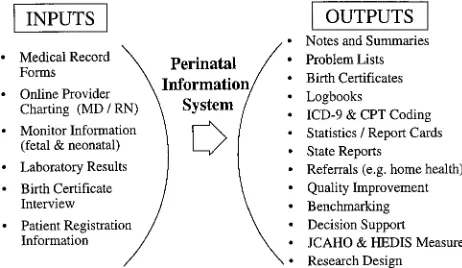
include data collection as an essential purpose for the patient record. The basic philosophy was that data would be collected once and then harvested for a multitude uses. It was hypothesized that if everyone was seeing the same information continuously, a more robust and relied on data set would result. In line with a template for database success,18the rela-tional database was designed after the desired out-puts from the system were identified. Broad-based reporting allowed the project to add stakeholders and enhanced the chance for success. A wish list with all potential inputs and outputs served as the blue-print for the initial and subsequent design effort (Fig 1). A fourth generation language relational database program (4th Dimension, ACI, Cupertino, CA) was chosen because of its ability to support queries on any data field, in a large data set, on an immediate (on the fly) basis, without the use of a programmer. Once the outputs were identified, data elements needed to generate the outputs were defined. Each piece of information was placed on a standardized chart form in one location in the medical record to be completed by the care provider deemed most likely to know the information. The fill-in-the-blank and choice list format of the forms standardized both the type and definition of the data collected. Data entry was performed from copies of the medical chart forms by the clerical personnel who were responsible for completion of the state birth certificate. The in-creased efficiency of birth certificate entry and print-ing allowed these same personnel time to input other, nonvital statistic information into the system. Using this model also guaranteed a complete set of demographic information was available in the clini-cal data set. A goal of having .95% of all birth certificates completed for parental signature before hospital discharge insured that the data set was al-ways current. Data collection on the intensive care nursery population was handled initially by physi-cian collected data sheets. These data sheets started with tracking a minimal number of diagnoses and procedures and expanded yearly as the requests for more specific data grew. Commercialization of the product has allowed the expanded functionality of creating history and physical and daily progress notes and has eliminated the need for the separate data sheets.
Examples of the type of quality improvement au-dits accomplished with electronic review of large
data sets underscore the power of a comprehensive, integrated obstetric and neonatal relational database in the quality assessment process. Cesarean section rates were steady at about 24% until detailed, phy-sician-specific report cards were distributed. Com-mittee and department review of these data fueled a subsequent decrease in the cesarean delivery rate to
,19%.24A policy on encouraging mothers with pla-centa previa to bank autologous blood in the event a transfusion would be required was deemed to be cost-ineffective after database review showed the need for transfusion to be small even in the highest risk subset of women at our center.25Electronic data review allowed us to make an educated choice be-tween the screening methods suggested by the Cen-ters for Disease Control and Prevention (CDC) policy statement on reducing group B streptococcal disease in infants.26 The clinical profile of our population over the past 5 years revealed missed opportunities for chemoprophylaxis when a risk-based strategy was used and a downward trend in invasive disease with a data-driven move toward a culture-based pro-tocol.
HOW ARE THE DATA GOING TO BE COLLECTED? The acquisition of data is a time-consuming effort and, like the Holy Grail, an ideal data set is fre-quently elusive. In a review on the quality of health care, Brook et al27noted that “It will never be possi-ble to produce an error-free measure of the quality of care.” Given the inherent problems with all biologic data, it is essential that consumers of health care information understand the basic principles for good data to make educated decisions on what data they want and to accurately interpret what they get.
A critical part of the design or selection process of a perinatal information system is formulating a col-lection process that yields the best data possible. To achieve this goal it is necessary to examine the char-acteristics that define data quality. The American
Health Information Management Association
([AHIMA], http://www.ahima.org/) has laid out a comprehensive series of guidelines to insure high-quality data.28These key characteristics are outlined in Table 1. Accountability should be determined for who will design, coordinate, standardize, monitor and carry out data collection for each perinatal infor-mation effort.
There are a myriad of ways centers use to collect data. Data forms, trained chart abstractors, and data entry personnel have been long-standing adjuncts to data collection. Many centers adapted the techniques
they first refined in research trials to their daily data collection activities. As the demands for information outpace moneys to collect and maintain large data sets, using existing hospital administrative data sets or tapping into select data kept in other hospital repositories, such as registration and laboratory sys-tems, is playing a more prominent role in perinatal data activities. The introduction of technologies that use the efforts of care providers documenting their care in electronic record systems offers promise as an alternative means to acquire outcome data.
Administrative data found on state discharge tapes or universal billing forms represent a potential rich repository of patient information, if the data can be shown to be reliable. Uniform hospital discharge data sets (UHDDS) include patient identifiers, dis-charge diagnoses, procedures and financial informa-tion. There are many reports of the use of this infor-mation both locally and at the state or federal levels to measure, and in some instances, impact perinatal and neonatal care.29 –31
Rosen et al29 reported on the state of Michigan’s Patient Outcomes Measures Program that was based on the UHDDS. Local institutions were supplied with their data and that of peer institutions. Through this program one institution was able to show im-provement in their rates of cesarean section, birth trauma, and vaginal births after cesarean section. Administrative data were used in a Voluntary Hos-pital Association pilot project on benchmarking.30 Experience with discharge data in Ontario, Canada, raised concerns on an increase in readmission rates after the early discharge of healthy newborns.31
Although successes underscore the importance of administrative data sources, there may be pitfalls in using them. Case studies have questioned the valid-ity of using ICD-9 coding for qualvalid-ity improvement efforts.19Medical record documentation from which the codes are generated is often incomplete, illegible, or contains contradictions. Exact criteria and defini-tions for specific diagnoses often are lacking. In stud-ies of medical record personnel-coded patient charts in both medicine32 and neonatology33 error rates of 20% to 40% were noted for some diagnoses and procedures. The practice of “up-coding” a record to garner higher payment has been cited a source of potential error in these data sets.34In addition, even perfect ICD-9 and CPT codes may fall short of giving a full picture of the clinical situation.35
One benefit of problem-oriented electronic records is that they force the care provider, generally a phy-sician, to assign exact diagnoses to each patient en-counter. This improved documentation serves to manage the content of the administrative data set. The definitions of specific diagnoses and clinical sit-uations also can be improved through efforts to stan-dardize medical language such as wider adoption of a more comprehensive clinical data indexing system like the Standardized Nomenclature of Medicine (SNOMED).36
Despite the limitations of data sets from hospital discharge coding, success with their use in measur-ing care trends coupled with their wide availability makes them a frequent choice for perinatal
informa-TABLE 1. Characteristics of Data Quality
Accessibility—easy to obtain Accuracy—is correct and valid
Comprehensiveness—all required items included Consistency—values the same across the application Currency—up to date
Definition—clear meaning and acceptable values Granularity—correct level of detail
Relevancy—meaningful to the process
tion needs. Because physician and other care pro-vider documentation is the cornerstone for coded data, a schema to continuously improve the quality of this data set is essential. Even if administrative data sets play no role in departmental perinatal in-formation efforts, physicians should be reminded of the routine use of these data by local hospital admin-istrations, state and federal agencies, networks, and payers and make a concerted effort to improve their quality. Discipline-specific coding guidelines have been shown to improve encoded data.37Those inter-ested in improving their coding compliance are en-couraged to visit the AHIMA Web site for a detailed strategy to accomplish this goal.38
A means of enhancing the quality of the data is to aim for primary data— data that comes into the sys-tem directly from the source. For a great deal of medical information, especially diagnosis assign-ment, the source of the data should be the care pro-vider. To help accomplish this, information systems are increasingly moving toward direct care provider entry. To date a major obstacle to this has been a reluctance, or inability, to type. Many direct entry systems use choice lists and templates to ease the process. Newer technologies such as voice recogni-tion39and an ability to parse structured text for data acquisition40offer hope to reluctant computer users. Electronic data interchange standards such as Health Level 7 (HL7) are working to manage the protocols (or data definitions) for information. These standards help different applications, written by different ven-dors, to share information. An efficient communica-tion and informacommunica-tion exchange between systems will allow information in laboratory and registration sys-tems to electronically populate selected fields of peri-natal information systems and reduce data entry time and errors. Detailed facts on the HL7 system, participants, and uses can be found on the Duke University Web site dedicated to the topic (http:// www.mcis.duke.edu/standards/HL7/hl7.htm).
WHO SHOULD THE DATA SET INCLUDE? Choosing which patients or clinical encounters to monitor is often based on the complexities and costs of data acquisition. If information on an entire pop-ulation (all mothers delivering at the institution and their infants) is desired, systems based on the UHDDS are often used. These activities can be either locally based using case-mix or utilization review products, or centrally located through vendors such as the National Perinatal Information Center (NPIC), HCIA Inc, or hospital networks like the Voluntary Hospital Association.
The NPIC (Providence, RI) was designed to mea-sure outcomes for hospitals offering care to high-risk mothers and newborns. The nonprofit organization performs research using diagnoses and procedure codes, demographics, all patient refined diagnosis-related groups, payer, and financial data from mem-ber hospitals. In use since 1985, the Perinatal Center Database contains information on .10 000 000 pa-tient discharges and averages data on approximately 150 000 to 200 000 newborns each year.41 Enrollees have access to comparative data broken down into
clinical (neonatal and obstetric), management, and quality efficiency reports.
HCIA Inc (Baltimore, MD) is a health information management company whose health care database with .325 000 000 patient discharges derived from
.7000 hospitals is one of the largest in the United States.42Unlike NPIC, all patient groups are included in their databases. Clinical and financial decision support applications are the mainstay of the HCIA product line. Administrative data from disparate systems is translated into universal codes (Interna-tional Classification of Clinical Services) that are used to benchmark clinical performance and out-comes, profile best practices, and manage the costs and delivery of health care. Their high profile in the field is accentuated by maintaining a list of “100 Top Hospitals.”
Many centers choose to target their data collection toward a selected population so that a much more detailed evaluation can be made and a more robust data set is attainable. Often the choice of the popu-lation is motivated by a specific quality of care issue and directed toward a high-risk population or pro-cedure. Examples of perinatal information systems that target select populations include the Vermont Oxford Network (VON) that observes infants in a specific weight group, the National Nosocomial In-fection Surveillance System (NNIS) of the CDC with a focus on all intensive care patients (adult, pediatric, and infant), and efforts to track a specific high-cost therapy such as extracorporeal membrane oxygen-ation use.
reported information from 250 nurseries represent-ing .20 000 infants to their member institutions.45 VON has been accepted as an ORYX provider by the JCAHO.
The CDC Infection Surveillance Program includes data on patients cared for in neonatal, pediatric, and adult intensive care units. The data collection focuses on the use of invasive procedures and associated nosocomial infection rates.46,47 Participation is open to all interested institutions with an average daily census of 100 inpatients. Centers must agree to fol-low the NNIS surveillance methodology, collect timely data, have a Pentium-based personal com-puter to enter the data into and transmit it via a modem to the centralized CDC database. There are no charges to participate and approximately 120 nurseries currently participate in the program.47
The Extracorporeal Life Support Organization reg-istry of extracorporeal membrane oxygenation (ECMO) use is maintained as an electronic forms-based data set and serves as an example of data collection on patients who receive a specific thera-py.48 The level of detail collected on each patient treated with ECMO is extensive and the registry regularly reports outcomes in peer reviews fo-rums.48,49
WHERE WILL THE INFORMATION RESIDE? Finally, the time to choose an information solution has arrived. The explosion in the demand for infor-mation has expanded both the number of medical information software vendors and the acceptance of hospital administrators that accessing information is part of the cost of doing business. Options for peri-natal information solutions at this point include 1) build your own, 2) tap into existing research data-bases, 3) participate in an outside data analysis ser-vice, 4) wait and prepare for an hospital-wide com-puter-based patient record, or 5) seek out and purchase a department-based solution. Individual groups may decide to use only one method or a combination of them.
Developing Your Own Database
There are numerous examples of locally developed perinatal and neonatal databases serving the needs of single institutions,15,50,51 hospital and health care provider networks19,52and even entire regions.20This approach to managing increasingly complex data sets not only is popular (74% of neonatal databases in use in 1989 were “homegrown”) but has been highly successful in meeting perinatal information needs.7
Myers and Gletcher53used a perinatal database in their successful program to lower cesarean rates. Their voluntary initiative was aided by the constant review and dissemination of both department-wide and individual statistics that the computer-based in-formation system allowed. Regionalization of peri-natal information was demonstrated by Molin20 in his description of southern Sweden’s quality assur-ance activities. A locally designed database received information either from paper forms or via electronic transmission from locally based versions of the mas-ter data structure. Merging a departmental database
with administrative data presents another successful
model to examine perinatal information.54
Wirtschafter et al52 used their internally developed perinatal information system as the springboard for designing southern California Kaiser’s neonatal out-comes research activities.
In a milieu of needing information yesterday, a lengthy design phase in creating a database may be unacceptable more in terms of time rather than money. The cost of maintaining local systems may be substantial. Escobar et al19reported 1995 annual da-tabase costs of $300 000 to maintain a minimal data set for their 11-unit network. At least half of these costs were attributable to data collection activities. A cost analysis should be considered before a “do it yourself” approach is chosen a priori as a less expen-sive option. As larger hospital networks are forming, some locally designed systems may become avail-able as shared solutions with potentially lower costs.
Research Data Banks
Many local database development schemes have been the outgrowth of systems designed for a spe-cific research project that were expanded to meet other data needs.7Databases for research have been used by individual centers,19in formal research con-sortiums such as the National Institutes of Child
Health and Human Development (NICHD)55and on
a membership44,46 or voluntary49 basis. The data for these purposes are often rigorously controlled with strict data definitions and data quality control ef-forts.56
The NICHD is a federally funded research coop-erative of 12 tertiary academic centers with postgrad-uate medical training programs. The group main-tains data in a central database designed for the NICHD that is populated via modem transfer from personal computers at the individual centers. Data collection is performed by trained personnel dedi-cated to maintaining a detailed and accurate data set. The level of detail maintained in the system supports examining patterns of care and resource use. Tyson
and members of the research network55
demon-strated the depth of their information system in a report on outcomes of 1126 infants weighing be-tween 501 g and 800 g at birth. Although the NICHD database is not available for general use, its extensive design and data quality can serve as a source of ideas for database developers.
Data Services
hos-pitals already hold contracts with one or more ven-dors and those reviewing their perinatal information options should check with their own quality im-provement, case management, and financial services to see what products are already available or being considered.
Computer-based Patient (CPR) Records—Harvesting the Electronic Patient Record
The Institute of Medicine (IOM) published their task force report on the CPR in 1991 (http:// www2.nas.edu/iom).1They subtitled the report “an essential technology for health care” having reached the unequivocal conclusion that electronic record-keeping is a necessity for health care to make cost sensitive advances in the quality and efficiency of care. The IOM cited five reasons why the CPR con-cept was ready to take off:
1. demands for patient data and health services research were growing,
2. technology was more powerful and affordable, 3. computers were recognized as a tool to enhance efficiency,
4. the population was aging and more mobile, and 5. there were pressures for health care reform. CPR and their clinical data repositories offer the newest option for monitoring outcomes. The basic features of these systems are the storage and retrieval of patient demographics, clinical documentation, physician and nurse order entry, and retrieval and laboratory and pharmacy tracking. An ideal CPR also includes outcomes measurement, clinical re-search support, and quality improvement activities in its core functionality. Because of the rich reposi-tory of data, the electronic record offers an ideal medium for incorporation of clinical pathway and variance tracking. Ready access to decision support and other knowledge-based sources are a key com-ponent to the concept that a CPR improves care. The IOM’s 12 essential attributes for an ideal CPR are outlined in Table 2.
There are at least 40 companies working on an electronic documentation system that could be
clas-sified as a CPR.57Although the installed base is small for products that are fully functioning in all aspects of a complete computer-based record, most of these companies have been health care information ven-dors for years. Their path of entry into the CPR field is varied and include a primary foundation in the admission, discharge, transfer (ADT) activities of pa-tient registration and billing systems (eg, SMS, Malvern, PA, and HBO and Company, Atlanta, GA), strengths in laboratory or pharmacy-based systems (eg, Cerner Corporation, Kansas City, MO, and Med-itech, Westcott, MA), a basis as a data repository or data warehouse (eg, Oacis Healthcare Systems, Greenbrae, CA) or a system built primarily around development of the CPR (eg, HealthVISION Corpo-ration, Santa Rosa, CA). In thinking about electronic records, providers should be reminded that the CPR is a goal and not necessarily a specific product.
Hospitals throughout the world are embarking on the selection of a CPR, often with requests for pro-posal processes that span months to years. Templates for the successful selection of a comprehensive insti-tution-wide solution are available in the litera-ture1,58,59as are comparison feature lists of the prod-ucts.60
There are several unique aspects of perinatal med-icine that must be considered before assuming a hospital-wide CPR will meet all departmental infor-mation needs. First, a CPR is slated to be a womb-to-tomb repository of patient information. In meet-ing the needs of all the patient populations served, the granularity of detail may be insufficient for an obstetric or neonatology service to measure its qual-ity and outcomes. Physicians in perinatal medicine are encouraged to take an active role in their institu-tion or network’s CPR selecinstitu-tion process to insure that all expected data needs are met. Specific examples of the desired outcomes to be measured are critical to investigate whether any given CPR product has suf-ficient detail to serve as a perinatal information source. Does the CPR keep the information you want to retrieve? Is the information uniformly kept in all cases so that both numerators and denominators can be measured? Remember, if critical information is stored in an electronic block of typed dictation you may not be any further ahead than you were looking at a paper chart.
Second, a primary purpose of a CPR is the rapid entry and retrieval of information on an individual patient. In contrast, quality improvement activities often require aggregate data from a specific group of patients. Does the CPR allow the full patient popu-lation to be queried for a specific attribute (eg, a birth weight range or the presence of a diagnosis such as uterine rupture)? Can the questions be asked directly of the CPR (or its repository), or must the data be exported or downloaded into a separate program? Is someone with programming expertise needed to per-form a data query or export? Will a query of the repository adversely impact the speed of daily activ-ities? If the desire is sufficient flexibility to find out the day before the board of directors are scheduled to meet how many mothers living in a particular region
TABLE 2. Twelve Desirable Attributes for Computer-based Patient Records (Adapted from the Institute of Medicine’s Task Force on Computer-based Records)1
A CPR should:
• Contain problem lists
• Support recording health status and functional level • State the logical basis for all diagnoses and conclusions • Be able to be linked to other clinical patient records • Address comprehensively patient information confidentiality
• Be accessible in a timely manner by all who have authorized access
• Allow selective retrieval and formatting of information by users
• Be linked to local and remote knowledge, literature, and administrative databases
• Provide decision analysis tools, clinical reminders, and prognostic risk assessment
• Use a defined vocabulary and support structured data • Help providers and institutions manage and evaluate quality and costs
of the city were delivered last quarter, make sure to ask the vendor how easily this is accomplished.
Third, a CPR generally does not link one patient record to another. In perinatal medicine critical in-formation and outcome measures for one patient (the mother) may reside entirely in another patient’s chart (her infant). If records cannot be linked, is the necessary maternal information also kept in the in-fant’s record and inin-fant’s information in the maternal record? Can maternal and infant records be matched if information is exported?
Finally, a complete CPR has a rich knowledge base either imbedded (in the form of rules) or accessible (in the form of links to the literature.) Pregnant women and sick newborns will require different rules than most hospital-based patients. Does the CPR allow rules to be written for specific popula-tions? Within a group of patients can rules be further defined, such as different drug dosing alerts for term and very preterm infants? Is enough money bud-geted for the custom rules to be developed?
As of 1991, the IOM felt that there were no CPR systems that met all their criteria (Table 2.)1Hewlett Packard executive Gary Eichorn commented the lack of such products in the past was because “It’s not easy. The reason it has to be done now is basic survival. This is the most complex computer task I’ve ever seen.”2A CPR implementation process is often undertaken in stages with registration, order entry, and laboratory functionality preceding provider doc-umentation activities. The lack of mature CPR prod-ucts, the high cost of a total solution (estimates range from $40 000 000 –$200 000 000 to realize a complete solution)59and improved connectivity between infor-mation systems made possible through data ex-change standards such as HL7 may be swinging the pendulum away from a single hospital-wide infor-mation systems solution toward a “best of breed” philosophy.57
Niche Solutions in Perinatal Medicine
Obstetricians and neonatologists have attempted to harvest clinical data for non statistical reporting since the 1970s. Efforts rose out of a desire to auto-mate discharge summary generation,14,51facilitate the completion of some of the multitude of forms and letters that clinical care requires,22 and the fact fetal and neonatal monitoring have made electronic infor-mation a routine part of perinatal care. Niche solu-tions in perinatal medicine have come from two basic routes, one founded on the strengths of provider documentation and the other from the monitor-based aspects of care.
Lowe et al14 described their group’s transition from clerical staff entry of data sheets to bringing physicians and nurse practitioners to the computer to create their daily progress notes on-line. This pro-cess that began in 1988, before the advent of graph-ical user interfaces and other adjuncts to direct pro-vider input, was found to be reliable and time efficient. Janik50 showed that neonatal database in-formation was cleaner, with a reduction in missing information and fewer data entry errors when the physicians moved to direct on-line entry in lieu of a
system that previously relied on clerical entry of chart information. A report that showed that primary care physicians preferred computer-generated sum-maries of neonatal intensive care stays to dictated summaries further set the stage for the commercial-ization of neonatal information systems.61 This in-creased satisfaction was based on the relevance of the information provided for continuing care. Although moving care providers to the data collection source insures primary data, it may be a difficult task to accomplish. A successful action plan for getting phy-sicians to participate in clinical information systems was presented at the 1998 HIMSS session under the title “You can lead physicians to work stations, but can you make them sign-on?”62
Medical Data Systems ([MDS], Wayne, PA) was the first company to commercially market a compre-hensive neonatal information system in the United States. Since then, Dr William Lowe started to dis-tribute the database he reported on in the literature14 under the company name of MetaSoft (Charlottes-ville, VA), and Site of Care Systems (San Francisco, CA) began marketing the redesigned perinatal infor-mation systems started at California Pacific Medical Center. All three companies have migrated their neo-natology products to a real time interface in which at least some of the database information is directly entered by physicians and nurse practitioners. A list of features of the neonatology component of these companies is presented in Table 3.
These systems generate comprehensive chart doc-umentation including admission histories and phys-icals, daily progress notes, and compiled discharge summaries. A primary goal of such systems is to make select information in these patient reports ac-cessible for later review. Electronically abstracting clinical, demographic, statistical, and outcome data from notes entered directly into a computer by the provider is only as good as the quality of the docu-mentation. Documentation detail in these systems is encouraged through a balance of structured data collection (fields) and text.
Both MDS and Site of Care Systems offer applica-tions for use outside of the neonatal intensive care unit. MDS began marketing efforts with a neonatal solution and have expanded into obstetrics with their Obstetric Information System. Site of Care Systems’ initial efforts were in The Perinatal Data Center with the expanded daily charting for infants as an outgrowth of that product. Integrated high-risk developmental follow-up modules also have been developed by both companies. The National Neo-Knowledge Network offered to MDS clients is mar-keted as a competitor to the VON. It compiles and compares data from all birth weight groups.
could be used as the front end of the complete record by electronically transferring select data items or summary documents into the larger repository.
On labor and delivery units, perinatal information needs also may be met in part by revisions to elec-tronic fetal heart rate (FHR) monitoring and archiv-ing systems. Fetal monitor strips have always con-tained some patient identifier information on them. Expansion of this basic field information to include placement of nursing notations on the electronic strip originated in an effort to avoid the storage of paper strips solely to capture the bedside documentation of responses to FHR changes. Addition of summary prenatal, delivery and infant information completed the natural progression of FHR monitoring devices into obstetrical database management systems (ODMS). Companies who develop software for FHR monitoring are in various stages of developing and/or forming alliances to enhance the database qualities of their systems.
A framework for evaluating ODMS and an analy-sis of four of the five currently marketed solutions in the United States is presented in the ECRI review of health devices.63 ECRI scientific, engineering, and analytic staffs perform extensive technical evalua-tions of products in structured and non biased man-ner. The basic surveillance and archiving of ODMS products can be expanded to include tracing anno-tations, narrative notes, nursing assessments, sum-mary diagnoses and procedures, and basic statistical reporting. An underlying goal is to replace some or all the paper chart. The programs variably use form-based entry, flowcharts, hierarchies of menus,
pop-up lists, and bar coding to facilitate data entry. Some offer integration with other information sys-tems through HL7 interfaces or download informa-tion into external database packages to support more extensive data query activities. The full functionality of on-line charting linked to FHR monitoring devices may require a personal computer in each labor suite and an upgrade to newer versions of monitoring and archiving software. Basic information on these com-panies is listed in Table 4. On a similar theme, elec-tronic bedside nursing charting linked into neonatal monitors (eg, CareVue [Hewlett Packard, Andover, MD] and NeoChart/NeoQuIc [Spacelabs, Redmond, WA]) offer an alternative source of NICU informa-tion if mechanisms to download or query the data are included with these products.
The health care information industry is a rapidly growing segment of the software industry. As noted in a Wall Street Journal article on this expansion “Much of the innovation has come from computer-literate doctors who saw their practices getting clogged by paper records.”2These efforts are increas-ingly finding their way into the marketplace either as start-up companies or as acquisitions of larger soft-ware vendors. As the health information market ex-pands, new vendors with perinatal medicine options and new angles on using current computerized sys-tems are sure to appear for those not wanting to build or revise their own database.
CONCLUSION
A perinatal information system choice often is driven by the need to measure and improve the
TABLE 3. Comparison of Features of Commercially Available Neonatal Information Systems
Features* Medical Data Systems MetaSoft Site of Care Systems
Neonatal intensive care unit product name
NeoKnowledge NeoNotes The Daily Baby
Daily notes, summary reports, problem lists
Yes Yes Yes
Custom reports available Yes Limited to built in reports Yes
Adaptable for use in normal newborns
Yes Only one set of entry screens Separate entry screens for well babies
ICD-9 and CPT coding Full Available for most common
diagnoses & procedures
Full
Physicians orders Parenteral nutrition orders All fluid and parenteral nutrition orders
No
Statistical reporting Built in, with ability to query on all accessible elements
Some, with ability to open data in external database to query
Built in, with ability to query on all accessible elements
Built in report faxing Yes Yes Yes
Technical features
Current platforms Windows 95, NT stand alone or multi-user
Windows 95, NT stand alone or multi-user
Windows 95, NT and Macintosh stand alone or multi-user
Supports linkages to other hospital systems (HL7)
Custom interfaces available, HL7 compliant
Custom interfaces being considered
Custom interfaces available, HL7 member
User support: on line help, manuals and phone support
Yes Yes Yes
Data size limitations None None None
Audit trails, password security Yes Yes Yes
Error checking at data entry of key fields
Yes Yes Yes
Company description Privately held, in business since 1985
Privately held, in business since 1996
Privately held, in business since 1996
Company a JCAHO ORYX vendor
Yes No Yes
quality of care but is influenced by time and man-power constraints. Locally grown databases offer a custom solution but may take a lot of time, effort, and technical expertise to design and maintain. Com-mercially available products offer a turn-key solution but may require changing local practices and a cap-ital budget process to purchase. As the practice of medicine today is far from static, ongoing costs to update, revise, and expand any perinatal informa-tion system should be anticipated. The perinatal lit-erature offers many examples of successful database design, selection, and use. Providers selecting their first information system or looking for a change should use these sources in making an informed choice.
National attention on cesarean section and infant mortality rates stand as a testament to a fascination with perinatal data. Hierholzer suggested that, “ . . . We must view data as sand; tiny discrete particles with substance but basically without fixed structure, frequently accumulating in forms of great beauty or built into ‘castles’ of great appeal. These temporary forms are subject to the winds of change and the waves of fad and politics. In this elemental form sand and data present great danger, able to blind and bury us.”64Perinatal medicine has a rich history of using information to monitor, measure, and improve care. Many options are available to enhance and refine these efforts. In the end, we can hope to achieve Hierholzer’s goal and fashion our sand into a lens that enhances our vision regarding the way in which we care for mothers and infants.
APPENDIX: Web Site Addresses to Assist Perinatal Information System Selection Efforts Governmental Agencies
AHCPR (Agency for Health Care Policy and Re-search): http://www.ahcpr.gov:80/clinic
Source of health care policy information
HCFA (Health Care Financing Administration): http://www.hcfa.gov
Information on governmental regulations in health care
IOM (Institute of Medicine): http://www2.nas. edu/iom
Reports on computer-based records and patient confidentiality
NNIS (National Nosocomial Infection Surveillance program of the CDC) http://www.cdc.gov/ncidod/ diseases/hip/nnis.htm
A voluntary system for monitoring nosocomial in-fection rates
Sites for Health Care Information
AHIMA (American Health Information Manage-ment Association): http://www.ahima.org/
Excellent source of data collection standards, in-formation, and guidelines
AMIA (American Medical Informatics Associa-tion): http://www.amia.org/
Source for conferences and presentations on infor-mation technology
CHIM (Center for Healthcare Information Man-agement): http://www.chim.org/
Trade association for vendors and consultants CPRI (Computer-based Patient Record Institute): http://www.cpri.org/
Information on standards in record computeriza-tion
HISD (Healthcare Information Systems Directory): http://www.health-infosys-dir.com/
Information on vendors
HIMSS (Health Information and Management Sys-tems Society): http://www.himss.org/
Information on vendors, trade shows, and publi-cations
HL7 standards: http://www.mcis.duke.edu/
standards/HL7/hl7.htm
Extensive site for information regarding HL7-based data exchange
JCAHO (The Joint Commission on Healthcare Accreditation): http://www.jcaho.org/
Information on the ORYX program (http://www. jcaho.org/perfmeas/oryx/oryx frm.htm is the di-rect ORYX Web area)
NCQA (National Committee for Quality
Assurance): http://www.ncqa.org/ Information on HEDIS and HMO review
NAHDO (National Association of Health Data Or-ganizations): http://www.nahdo.org/
Association that brings together public and private sector of health care information
Neonatology on the Web: http://www.neonatolo-gy.org/
Maintained by Dr Ray Duncan at Cedars Sinai Medical Center it offers up-to-date information on computer technology use in the NICU
Registry of State Level Efforts to Integrate Health Information: aspe.os.dhhs.gov/statereg/
TABLE 4. Obstetrical Data Management Systems Linked to Fetal Monitoring Technologies
Company Main Software Product(s) Comment
Air-Shields Inc, Hatboro, PA WatchChild Manufactures fetal monitor devices, software division in Huntington Beach, CA, recently sold by Vickers to Hill Rom
Hewlett-Packard Company, Andover, MA OB TraceVue Manufactures fetal monitor devices
LifeServ, Clearwater, FL Cygnet Peritronics Only Peritronics product reviewed by ECRI61 Marquette Medical Systems, Milwaukee, WI QMI Quantitative Sentinel Manufactures fetal monitor devices under
Corometrics division
QMI software division in Annapolis, MD
Spacelabs Medical, Redmond, WA BirthNet Not reviewed by ECRI63
Extensive source of state regulations impacting healthcare information
Selected Information System Vendors
Air-Shields: no Web site available WatchChild ob-stetrical data management system
First Databank: http://www.firstdatabank.com/ Markets knowledge-based systems for diagnostic decision support
HCIA: http://www.hcia.com/
Health information content company that special-izes in clinical and financial decision support sys-tems
Hewlett-Packard Company: http://www.
hp.com/mpg/
OB TraceVue obstetrical data management system, CareVue products
LifeServ: http://www.lifeservtech.com/
Cygnet and Peritronics obstetrical data manage-ment systems
Marquette Medical Systems: http://www.
mei.com/
QMI Quantitative Sentinel obstetrical data man-agement system
MDS (Medical Data Systems): http://www. mdsinfo.com/
NeoKnowledge, National NeoKnowledge Net-work and Obstetric Information System
MetaSoft: http://www.ms-systems.com/ NeoData neonatal documentation system
NPIC (National Perinatal Information Center): http://www.npic.org/
A nationwide consortium of patient discharge in-formation
Site of Care Systems: http://www.siteofcare.com/ The Perinatal Data Center and The Daily Baby soft-ware
Spacelabs:
http://www.spacelabs.com/moni-tor.html
BirthNet obstetrical data management system, NeoChart and NeoQuIc
VON (Vermont Oxford Network): http://www. vtmednet.org/vtoxford/
Database for infants weighing 401 to 1500 g The Web addresses for companies that market computer-based patient records, case management, and decision support products are available through the HIMSS and HISD vendor reference lists that can be accessed at these organizations’ Web sites.
REFERENCES
1. Dick RS, Steen EB, eds. The Computer-Based Patient Record: An Essential
Technology for Health Care. Washington DC: National Academy Press;
1991
2. Fisher L. Diagnosis: choking on paper. Wall Street Journal. 1995;October 21:B17
3. Koss RG, Bowie MK, Sprenger SL, Loeb JM. ORYX: the evolution in accreditation. J Clin Outcomes Management. 1997;4:16 –20
4. Iglehart JK. The National Committee for Quality Assurance. N Engl
J Med. 1996;335:995–1000
5. A conversation with Sean Sullivan. Med Interface. 1997;Feb:66 – 67 6. Edlin ML. Define your health plan’s value with quality reporting. Health
Manage Technol. 1996;July:17–19
7. Slagle TA, Gould JB. Database use in neonatal intensive care units.
Pediatrics. 1992;90:959 –970
8. Kritchevsky SB, Simmons BP. Continuous quality improvement
con-cepts and applications for physician care. JAMA. 1991;266:1817–1823 9. Aronow DB, Coltin KL. Information technology applications in quality
assurance and quality improvement, part 1. Jt Comm J Qual Improve. 1993;19:402– 415
10. ORYX program. JCAHO.http://www.jcaho.org/perfmeas/oryx/ oryx frm.htm (15 June 1998)
11. Jordan HS, Straus JH, Bailit MH. Reporting and using health plan performance information in Massachuesetts. Jt Comm J Qual Improve. 1995;21:167–177
12. Keeler EB, Park RE, Bell RM, Gifford DS, Keesey J. Adjusting cesarean delivery rates for case mix. Health Serv Res. 1997;32:511–528
13. Kotagal UR, Perlstein PH, Atherton HD, Donovan EF. Acuity scores as predictors of cost-related outcomes of neonatal intensive care. J Pediatr. 1995;126:88 –93
14. Lowe WW, Ciszek TA, Gallaher KJ. Comprehensive computerized neo-natal intensive care unit data system including real-time, computer-generated daily progress notes. Pediatrics. 1992;89:62– 66
15. Ohlsson O, Leeke T, Watson-MacDonell J, Forbes S. Data quality as-sessment for perinatal events in an on-line obstetrical database (O-DB) and a health records database (HR-DB). Pediatr Res. 1997;41:207. Ab-stract
16. Keith RD, Beckley S, Garibaldi JM, Westgate JA, Ifeachor EC, Greene KR. A multicentre comparative study of 17 experts and an intelligent computer system for managing labour using the cardiotogram. Br J
Obstet Gynaecol. 1995;102:688 –700
17. Snowden S, Brownlee KG, Dear PR. An expert system to assist neonatal intensive care. J Med Eng Technol. 1997;21:67–73
18. Jenkins D. A practical introduction to databases. Biomed Instrumen
Tech-nol. 1989;23:109 –112
19. Escobar GJ, Fischer A, Kremers R, Usatin MS, Macedo AM, Gardner MN. Rapid retrieval of neonatal outcomes data: The Kaiser Permanente neonatal minimum data set. Qual Manage Health Care. 1997;5:19 –33 20. Molin J. A regional perinatal database in southern Sweden—a basis for
quality assurance in obstetrics and neonatology. Acta Obstet Gynecol
Scand. 1997;164:37–39
21. Dooley SL, Freels SA, Turnock BJ. Quality assessment of perinatal regionalization by multivariate analysis: Illinois 1991–1993. Obstet
Gy-necol. 1998;89:193–198
22. Maresh M, Beard RW, Combe D, et al. Selection of an obstetric data base for a microcomputer and its use for on-line production of birth notifi-cation forms, discharge summaries and perinatal audit. Br J Obstet
Gynaecol. 1983;90:227–231
23. Broekhuizen FF, Fox R. Computerized labor and delivery logbook. A first step to a perinatal database in a university-affiliated community hospital. Am J Perinatol. 1985;2:150 –153
24. Main EK. Reducing cesarean section rates with data-driven quality improvement activities. Pediatrics. 1999;103(suppl):374 –383
25. Regenstein AC, Main EK. Placenta previa: transfusion frequency and the utility of autologous blood donation. Am J Obstet Gynecol. 1997;176: S144. Abstract
26. Centers for Disease Control and Prevention. Prevention of perinatal group B streptococcal disease: a public health perspective. MMWR. 1996;45:1–33
27. Brook RH, McGlynn EA, Cleary PD. Quality of health care: measuring quality of care. N Engl J Med. 1996;335:996 –970
28. AHIMA Data Quality Management Task Force. Issue: data quality management model. American Health Information Management Asso-ciation (AHIMA). http://www.ahima.org.html (15 June 1998) 29. Rosen LS, Schroeder K, Hagan M, Acord-Szczesny J, Garavaglia M.
Adapting a statewide patient database for comparative analysis and quality improvement. Jt Comm J Qual Improve. 1996;22:468 – 481 30. Krivenko CA, Chodroff C. The analysis of clinical outcomes: getting
started in benchmarking. Jt Comm J Qual Improve. 1994;20:260 –266 31. Lee KS, Perlman M, Ballantyne M, Elliott I, To T. Association between
duration of neonatal hospital stay and readmission rate. J Pediatr. 1995; 127:758 –766
32. Corn RF. Quality control of hospital discharge data. Med Care. 1980;18: 416 – 426
33. Slagle TA, Le HA. Database information: fact or fiction. Pediatr Res. 1991;29:266. Abstract
34. Lagnado L. Hospitals profit by “upcoding” illness. Wall Street Journal. 1997;April 17:B1
35. Chute CG, Cohn SP, Campbell KE, Oliver DE, Campbell JR. The content coverage of classical systems. J Am Med Inform Assoc. 1996;3:224 –233 36. Kudla KM, Rallins MC. SNOMED: a controlled vocabulary for
quality of clinical data. American Health Information Management Association (AHIMA). http://www.ahima.org.html (15 June 1998) 38. Prophet S, Hammen C. Coding compliance: practical strategies for
success. American Health Information Management Association (AHIMA). http://www.ahima.org.html (15 June 1998)
39. Herman S. Voice recognition and the creation of medical reports. Pro-ceedings of the 1998 Annual HIMSS Conference; February 22–26, 1998; Orlando, FL. 1998;4:25–32
40. Hripcsak G, Friedman C, Alderson PO, DuMouchel W, Johnson SB, Clayton PD. Unlocking clinical data from narrative reports: a study of natural language processing. Ann Intern Med. 1995;122:681– 688 41. NPIC, About the National Perinatal Information Center. http://
www.npic.org.html (15 June 1998)
42. HCIA. http://www.hcia.com.html (25 June 1998)
43. Horbar JD. The Vermont-Oxford Neonatal Network: integrating re-search and clinical practice to improve the quality of care. Semin
Peri-natol. 1995;19:124 –131
44. The investigators of the Vermont-Oxford Trials Network database project. The Vermont-Oxford Trials Network: very low birth weight outcomes for 1990. Pediatrics. 1993;91:540 –546
45. Vermont Oxford Network. http://www.vtmednet.org/;m012663/ vtoxford.htm (August 8, 1998)
46. Gaynes RP, Martone WJ, Culver DH et al. Comparison of rates of nosocomial infections in neonatal intensive care units in the United States. National Nosocomial Surveillance System. Am J Med. 1991; 91(suppl):192–196
47. National nosocomial infection surveillance system (NNIS). CDC. http://www.cdc.gov/ncidod/diseases/hip/nnis.html (15 June 1998) 48. The Extracorporeal Life Support Organization. Extracorporeal Life
Sup-port at the University of Michigan. http://www.med.umich.edu/ ecmo/ELSO reg.html (28 June 1998)
49. Meyer DM, Jessen ME. Results of extracorporeal membrane oxygen-ation in neonates with sepsis: the Extracorporeal Life Support Organi-zation experience. J Thorac Cardiovasc Surg. 1995;109:419 – 425 50. Janik DS, Swarner W, Henriksen KM, Wyman ML. Computerized
new-born intensive care data recording and reporting: II. an online system.
J Pediatr. 1979;94:328 –330
51. Finer NN, Fraser AJ. Neonatal data base and automated discharge
summary using a personal computer and proprietary software.
Pediat-rics. 1985;76:269 –273
52. Wirtschafter DD, Jones KR, Thomas JT. Using health care outcomes to improve patient care in the NICU. J Qual Improve. 1994;20:57– 65 53. Myers SA, Gleicher N. A successful program to lower cesarean-section
rates. N Engl J Med. 1988;319:1511–1516
54. Perlstein PH, Atherton HD, Donovan EF, Richardson DK, Kotagal UR. Physician variations and ancillary costs of neonatal intensive care.
Health Serv Res. 1997;32:299 –311
55. Tyson JE, Younes N, Verter J, Wright LL. Viability, morbidity, and resource use among newborns of 501- to 800-g birth weight. JAMA. 1996;276:1645–1651
56. Horbar JD, Leahy KA. An assessment of data quality in the Vermont-Oxford Trials Network database. Controlled Clin Trials. 1995;16:51– 61 57. Johnson RL, Trends in health care and health care systems. Proceedings
of the 1998 Annual HIMSS Conference; February 22–26, 1998; Orlando, FL. 1998;1:323–330
58. Kannan R, Bellalouna P, Carroll T, Mikwee L, Vredeveld D, Zak M. Architecting a health care data warehouse: a template for success. Proceedings of the 1998 Annual HIMSS Conference; February 22–26, 1998; Orlando, FL. 1998;1:421– 438
59. Drazen E. Why don’t we have computer-based patient records? Amer-ican Health Information Management Association (AHIMA). http:// www.ahima.org.html (15 June 1998)
60. Borch K, CPR product hotlist. Health Management Technology. 1996;July: 42– 44
61. Brazy JE, Langkamp DL, Brazy ND, De Luna RF. Do primary care physicians prefer dictated or computer-generated discharge summa-ries? Am J Dis Child. 1993;147:986 –988
62. Bruno CJ, Wilson M, VanFossen D. You can lead physicians to work stations, but can you make them sign-on? Proceedings of the 1998 Annual HIMSS Conference; February 22–26, 1998; Orlando, FL. 1998;1: 243–1254
63. ECRI. Obstetrical data mangement systems. Health Devices. 1997;26: 83–122
1999;103;266
Pediatrics
Terri A. Slagle
Perinatal Information Systems for Quality Improvement: Visions for Today
Services
Updated Information &
http://pediatrics.aappublications.org/content/103/Supplement_E1/266
including high resolution figures, can be found at:
References
#BIBL
http://pediatrics.aappublications.org/content/103/Supplement_E1/266
This article cites 41 articles, 5 of which you can access for free at:
Subspecialty Collections
http://www.aappublications.org/cgi/collection/neonatology_sub
Neonatology
sub
http://www.aappublications.org/cgi/collection/fetus:newborn_infant_
Fetus/Newborn Infant
sub
http://www.aappublications.org/cgi/collection/quality_improvement_
Quality Improvement
following collection(s):
This article, along with others on similar topics, appears in the
Permissions & Licensing
http://www.aappublications.org/site/misc/Permissions.xhtml
in its entirety can be found online at:
Information about reproducing this article in parts (figures, tables) or
Reprints
http://www.aappublications.org/site/misc/reprints.xhtml
1999;103;266
Pediatrics
Terri A. Slagle
Perinatal Information Systems for Quality Improvement: Visions for Today
http://pediatrics.aappublications.org/content/103/Supplement_E1/266
located on the World Wide Web at:
The online version of this article, along with updated information and services, is
by the American Academy of Pediatrics. All rights reserved. Print ISSN: 1073-0397.