Arm Control
Masoumeh Hafezzadeh
*and Hasan Masoumi
Faculty of Electrical Engineering, ISLAMIC AZAD UNIVERSITY of KAZERUN, IRAN
Corresponding author:
Masoumeh Hafezzadeh
ABSTRACT: This paper presents an optimal fuzzy logic based controller design procedure to control a robot arm for industrial applications. The robot is a repeated task plant. The control of sucha plant under parameter variations and load disturbances is one of theimportant problems. The aim of this work is to design Geno-Fuzzy, PSO based, and imperialist competitive algorithms basedcontroller suitable for online applications to control single link rigidrobot arm plant. The simulation results using MATLAB/SIMULINK indicated the effectiveness of the proposed controller.
Keywords: Fuzzy, Controller Design, Robot.
INTRODUCTION
The problem of self-adjusting the parameters of the controller to compensate for the plant parameters variations and disturbances was the origin of adaptive systems [1]. Adaptive control system can be solved using fuzzy control technique by neural-fuzzy system [2] or genetic-fuzzy model [3]. Generally, in adaptive control system, identification is an essential part to determine, online, the disturbances through either explicit or implicit techniques.The Identification is the process of constructing amathematical model of a dynamic system using experimentaldata from that system [3]. Identification is an important andintegral part in the control of dynamic systems. There are twotypes of identification methods, the first is the forwardidentification, and the second is the inverse identification [4].The problem of identification consists of setting up a suitablyparameterized identification model and adjusting theparameters of the model to optimize a performance function.Two forms of identification are currently used in modernadaptive systems: The forward identification and inverseidentification. Based on the form of identification used, thereexist two techniques of control: The parallel model followingscheme and the inverse model following scheme.In this work inverse identification method is previewed withits simulation results. Genetic-fuzzy inverse online control, PSO based, and imperialist competitive algorithms based controller isstructured with simulation results.
1. Dynamic Modeling of Robot Arm Manipulators
1044
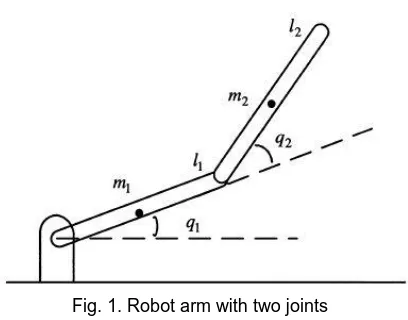
Fig. 1. Robot arm with two jointsThe dynamic equation of a robot with n-degree of freedom using Newton-Euler method is as follows;
( )
( , )q
( )
M q q C q q
G q
(1)Where
[q ,...,q ]
1 T nq
is the position vector,
[q ,...,q ]
1 T nq
and
[q ,...,q ]
1 T nq
are the velocity and acceleration, respectively. The dynamic equation for a robot arm with two joints is given as follows [6]:
2 2
1 2 2 1 2 2 1 2 2 1 2 1 2 1 1 2
2 1 2 2 2 2 1 2 2 1 2 2 2 12 1 2 1 1
(
)
m
(2
) (m
m ) l
m
2 m
m
(m
m )
m l
q
q
l l c
q
q
q
l l s q
l l s q q
l gc
l gc
(2)
2 2
2
m
2 1 2 2 1l l c q
m
2 1 2 2 1l l s q
m
2 1l gc
12m l q
2 2(
1q
2)
For these equations, the matrices
G q
( )
,M q C q q
( ), ( , )
are;2 2 2
1 2 1 2 2 2 1 2 2 2 2 2 1 2 2
2 2
2 2 2 1 2 2 2 2
(
)
2
( )
m
m l
m l
m l l c
m l
m l l c
M q
m l
m l l c
m l
2 1 1 2 2 2 1 1 2 2
2 1 1 2 2
( , )
0
m l l q s
m l l q s
C q q
m l l q s
1 2 1 1 2 2 12
2 2 12
(
)
( )
m
m gl c
m gl c
G q
m gl c
(3)Where,
c
1
cos( ),
q c
1 2
cos( ),
q
2s
1
sin( ),
q s
1 2
sin( ),c
q
2 12
cos(
q
1
q
2)
. Then, the equations of the system can be expressed as;11 12
21 22
( )
M
M
M q
M
M
11 12 21( , )
0
C
C
C q q
C
(4)1
2
1045
11 2 3 1 2 2 2
12 2 3 1 2 2 2
21 2 3 1 2 1 2
1 1 2 3 1 1 2 3 2 12
2 2 3 2
2(
)
(
)
(
)
(
)
(
)
(
)
C
m
m l l q s
C
m
m l l q s
C
m
m l l q s
G
m
m
m gl c
m
m gl c
G
m
m gl
c
12(5)
2. Optimal Fuzzy Logic based Controller Design
The basic idea of Fuzzy Logic Control (FLC) centre on the labelling process in which thereading of a sensor is translated into a label as performed by human expert controllers (Yanet al., 1994), (Van der Rhee, 1990), (Gupta et al., 1979). The general structure of a fuzzy logiccontrol is presented in Fig. 2.
Fig. 2. General structure of a fuzzy logic control
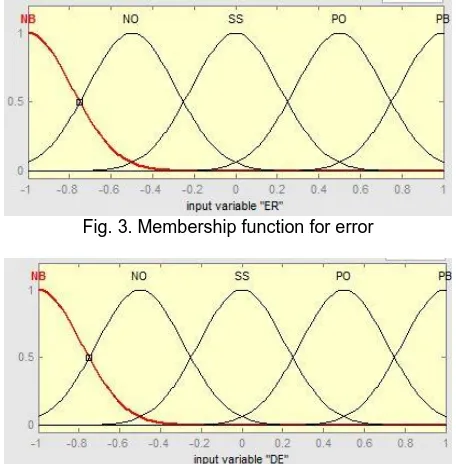
Figures 3-4 show the membership functions considered for the error and its derivative, respectively. Fig. 5 shows the membership functions for output of fuzzy inference system. The fuzzy inference system database rule is given in Table I. Each rule defines the relation between inputs and outputs.
Fig. 3. Membership function for error
1046
Fig. 5. Membership functions for output of fuzzy inference systemTable 1. Fuzzy rules
e
PB PO
SS NO
NB
SS NO
NO NB
NB NB
PO SS
NO NO
NB NO
e
PO PO
SS NO
NO SS
PB PO
PO SS
NO PO
PB PB
PO PO
SS PB
3. Simulation Results
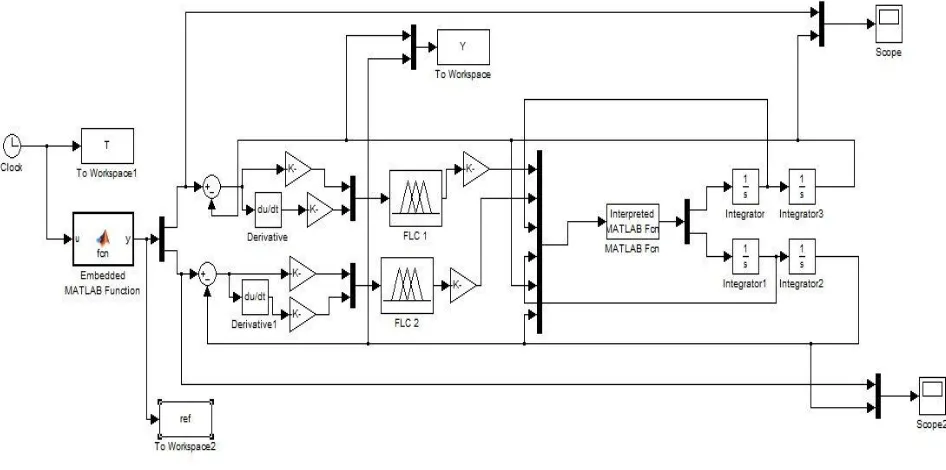
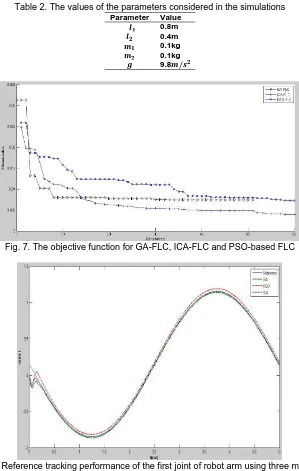
Fig. 6 shows the implemented MATLAB/SIMULINK model. The values of the parameters considered in the simulations are given in Table II. The objective function has been optimized using three methods: GA-FLC (Genetic Algorithm based Fuzzy Logic Controller), ICA-FLC (Imperialist Competitive Algorithm based Fuzzy Logic Controller), and PSO-based FLC (Particle Swarm Optimization method based Fuzzy Logic Controller). The optimization of the objective function using these methods is shown in Fig. 7. Reference tracking performance of the first and second joint of robot arm using three methods is shown in Figs. 8-9. This results show the effectiveness of the proposed artificial intelligence based methods in controlling the robot arm in the term of reference tracking and good accuracy.
1047
Fig. 7. The objective function for GA-FLC, ICA-FLC and PSO-based FLCFig. 8. Reference tracking performance of the first joint of robot arm using three methods
1048
CONCLUSION
In this work, genetic-fuzzy onlineforward controller is structured. Theplant parameters of are identified byforward genetic fuzzy identificationmodel and then used by the controller tocontrol this plant.The identification process iscontinuing in the normal conditions ordisturbance conditions. The workidentifier in the normal conditions tomake the tracking is more accurate aswell as for the small variations in someplant parameters. The objective function was optimized using for GA-FLC, ICA-FLC and PSO-based FLC. The simulation results showed the suitability of the proposed artificial intelligence based methods to control the robot arm joints accurately.
REFERENCES
1- Astrom KJ, Wittenmark B. 1989. “Adaptive Control”, Addison Wesley, 1989.
2- Seng TL, Khalid M, Yusof R, Omatu S. 1998. “Adaptive Neuro-Fuzzy Control System by RBF and GRNN Neural Networks”, Intelligent and Robotic Systemn Journal, vol. 23, PP.267-289, 1998.
3- Passino KM, Yurkovich S. 1998. “Fuzzy Control”, Addison Wesley Longman, Inc., 1998.
4- Kuschewski JG, Hui S, Zak SH. 1993. “Application of Feedforward Neural Networks to Dynamical System Identification and Control”, IEEE Transaction on Control System Technology, vol.1, No.1, March 1993.
5- Abdulbaqi JN. 2004. “Neuro-Fuzzy Control of Robot Arm”, M.Sc. Thesis, Department of Electrical Engineering, Basrah University, 2004.
6- Herrero JM, Blasco X, Martinez M, Salcedo JV. 2002. “Optimal PID Tuning with Genetic Algorithms for Nonlinear Process Models”, 15th Triennial World Congress, Barcelona, Spain, 2002.
7- Mitchell M. 1998. “An Introduction to Genetic Algorithms”, Aisradford Book, The MIT press, Cambridge, Massachusetts, London,England, 1998.
8- Younis HA. 2000. “Attacking Stream Cipher Systems Using Genetic Algorithm”, M.Sc. Thesis, Department of Computer Science, Basrah University, 2000.
9- Schmidt M, Stidsen T. 1996. “HybridSystems: Genetic Algorithms, NeuralNetworks, and Fuzzy Logic”, AarhusUniversity, Denmark, 1996.
10- Lightbody T, Irwin GW. 1997. “NonlinearControl Structures Based on EmbeddedNeural System Models”, IEEE Transactionson Neural Networks, vol.8, No.3, May 1997.