© Global Society of Scientific Research and Researchers
http://ijcjournal.org/
A Framework for an E-government Based on Service Oriented
Artichitecture
Dayah Mohamed Ali
a*, Dr. Wilson Cheruiyot
b, Dr. Michael W. Kimwele
caComputer Science, Jomo Kenyatta University of Agriculture and Technology b,cComputer Science, Jomo Kenyatta University of Agriculture and Technology Kenya
a
Email: [email protected]
b
Email: [email protected]
cEmail: [email protected]
Abstract
Electronic government is use of information and communication technologies in government to provide public
services, to improve managerial effectiveness and to promote democratic values; as well as a regulatory
framework that facilitates information intensive initiatives and fosters the knowledge society. To develop
framework for an e-government may dynamically change in e-Government system requirements and the need
for a highly autonomous approach for government agencies. The public Agency Professional Survey is based on
service oriented architecture that will be used to gather the benefits experienced by departments that are
currently involved in the e-Government initiatives. The expected findings may include the outcome of the
implementation of e-Government initiatives in terms of operational efficiency and organizational effectiveness
towards the online public services delivery channel. The study e-Government Based on Service Oriented
Architecture will be helpful in implementation framework of e-Government in Governments.
Keywords: G2G; G2C; G2B; E-Government.
1. Introduction
Electronic government or “e-Government” is defined as “the use of information and communication
technologies in government to provide public services, to improve managerial effectiveness and to promote
democratic values; as well as a regulatory framework that facilitates information intensive initiatives and fosters
the knowledge society”.
---
Government is actually a dynamic mixture of goals, structures and functions [1]. According to this,
E-Government becomes a natural extension of the technological revolution that has accompanied the knowledge
society. The E-Government added new concepts such as: transparency, accountability, citizen participation in
the evaluation of government performance.
E-Government may be related into three groups’: citizens, businesses and services, and governmental
departments of the country.
2. Theoretical background
2.1 Concepts of E-government & its importance
E-Government is included as “utilizing the Internet and the World-Wide-Web for delivering government
information and services to citizens”. As the researcher (and other examiners believe that it is not only citizens
to deliver government information and services but includes local organization for a government. It may also
include using other ICTs in addition to the Internet and the Web, such as “database, networking, discussion
support, multimedia, automation, tracking and tracing, and personal identification technologies” [2].
According to Means and Schneider believes e-Government is the relationships between governments, their
customers (businesses, other governments, and citizens), and their suppliers (again, businesses, other
governments, and citizens) by the use of electronic means [3].
E-Government is defined as the use of technology, especially Web-based applications to enhance access to and
efficiently deliver government information and services [4].
2.2 Categories of E-Government
E-Government’s efforts can be categories into three broad categories: Government to-Government (G2G),
Government-to-Citizen(G2C), and Government-to-Business (G2B).
G2C services usually offer bundled services to provide value to specific groups of citizens who find themselves
in prototypical “life situations”. Examples include persons who have just moved to a new city, newly married
couples or unemployed people receiving government compensation. Each member of such a group has similar
service requirements. Since the entire population of a country is regarded as a potential target group, these
services require the most extensive national infrastructure and their implementation will provide the biggest
challenges to less developed countries.
G2B services cover all service interactions between an administration and the private sector.
Typical areas include customs, tax and revenues, procurement and company registration. For lower income
countries, these services might be easier to implement than G2C services because the private sector tends to
G2G services are those that a public institution offers to other public institutions. A good example is the
General Auditor’s office, which has regular process interactions with other departments. Some of these
processes, such as the compilation of financial reports on spending or revenues collected, could be supported by
or executed through online systems. Similarly, information on contact details for staff in other agencies, human
resource matters concerning civil servants, union activities or other topics of common interest, could be shared
through G2G services. These services also include less interactive processes, such as the provision of
information to other public entities or public servants.
2.3. Benefits of E-Government framework
There are many advantages that can gain e-Government framework, these include:
• E-Government is considered one of the promising technologies that provide interoperability and
integration between various ranges of services, implemented by different software applications,
running on a variety of platforms in government organizations
• E-Government project is designed to enable citizens to process transactions online in a timely and
efficient fashion .
• e-Government has many different importance which are as follows: (1) work process which allows the
government agency to inter-operate in work processes across government agencies. (2) Knowledge
sharing which allows the government agency to share knowledge across government agencies. (3)
Value creation which enables government agencies in creating value in inter-operating government
agencies. (4) Strategic alignment which enables inter-operating government agencies sharing an
aligned strategy.
E-Government will make the government more transparent, efficient, and enable government information and
services to be delivered to citizens much faster and easier. One does not need to go to different government
offices when a mouse click at his/her home or other locations will do the same work in minutes.
One of the benefits of E-Government in developed countries is cost reduction in the transfer of information and
online transactions [5]. E-Government has many advantages serve as criteria for measuring the efficiency of
administrative work and general quality.
The essential task of government is governance, which means the job of regulating society and not just working
with marketing and sales.
2.4 1Web Application Framework
A webapp framework is a set of tools that support webapp development with: A standard design model (e.g.,
MVC), User interface toolkit, Reusable components for common functions (authentication, e-commerce, etc.),
Figure1: Web Application Framework
A webapp framework based on PHP has Features: use of MVC design paradigm, Centralized database, and
action definitions link user interface events to Controller and View modules .
2.5 Service oriented Architecture
Services are intangible commodities and economic activities that require specialized knowledge and skills and
are offered by service providers over a communication media to service consumers. These self-describing, open
components are being communicated over the Internet hence, e-Services – the delivery of services by
employing Information and Communication Technologies and infrastructures [6].
2.5.1 Architectures describe different viewpoints
conceptual view: entities of application domain and their relationships process view: system runs, concurrency, synchronization
implementation view: software artefacts (subsystems, components, source code) runtime view: components at runtime and their communication
Architectures make systems comprehensible and controllable for structuring according to different viewpoints
and enables communication between different stakeholders.
2.5.2 Architecture Types
Architecture types can be classified as: a) Web Platform Architecture (WPA) which is platform (Infrastructure)
consists of: Hardware, Software modules & configurations, and Choice of software platform (e.g., J2EE, .NET).
b) Web Application Architecture (WAA) which may contain the following:
Conceptual view of how key business processes and needs are separated & implemented Often domain-specific
Greater complexity requires greater modularity
Web Services is a kind of SOA (Service Oriented Architecture) service type that depends on rigorous set of
standards and the most preferable service type because of its interoperability i.e. having a capability of
integration. [6]
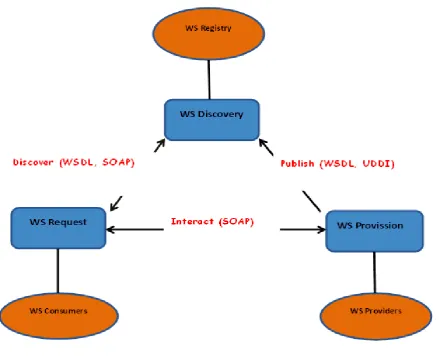
The World Wide Web Consortium (W3C) has developed web service architecture to show the basic
functionalities and core technologies which are very helpful to aid conceptualization. The following figure
shows the basic architecture.
Figure 2: Web services architecture .
Web Services technologies allow applications to pass standardized messages (SOAP messages) over composite
computing systems [7]. These programming language, operating system and hardware platform independent
software systems are shared and easily be accessed over standard Internet protocols offering richness, flexibility
and scalability features needed by service providers.
3. Materials and Methods
This research is employed exploratory research purpose to gather as much information as possible, discover
general insight and get a deeper understanding of electronic identity management systems that uses web services
and other integrated technologies. With this method we will come up with a clear understanding of the problem
under the study. Furthermore, we will utilize descriptive method to collect and present citizens’ perception
about trustworthiness of their government in managing their sensitive personal information and their
identity management system successful in its implementation.
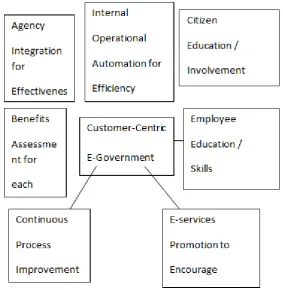
4. E-Government implementation scope
The Figure 3.1 below describes the breakdown of activities for e-Government implementation that constitutes
the scope of this study.
Figure 3: E-Government implementation scope
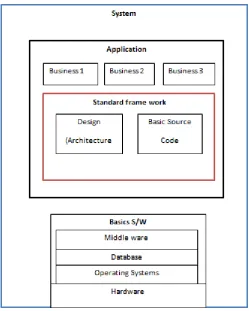
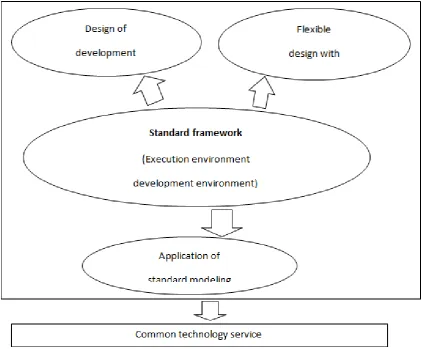
4.1 Standard Framework Development
E-Government Standard Framework is Collection of source code and reusable design supporting application
development.
4.1.1 System
Automated system for specific business requirements satisfaction (E: Personal Management system etc.).
4.1.2 Application
Development using source code and standard framework providing design by business functions, which have to
be materialized in each construction project.
Recycling assets defined base source code and design, which is repeatedly using in SI project by specific
technology and application forming base structure.
4.1.4 Basic of S/W
Movement of S/W from the bottom of Application, for application behavior.
Figure 4: Standard framework development
4.2 Status examination of using the framework
Execution survey, interview and material research for status examination of Framework using in e- Government
project.
4.2.1 Survey
o Present conditions or state of arts in.
o Recognition of the open source framework.
o Recognition about e- Government Standard Framework.
4.2.2 Interview
o Impact on selected business, difficult in change.
o Consideration details etc. during building e-Government Standard Framework.
4.2.3 Research on Materials
o E-government laws
o Information budget
o E-Government Annual Report
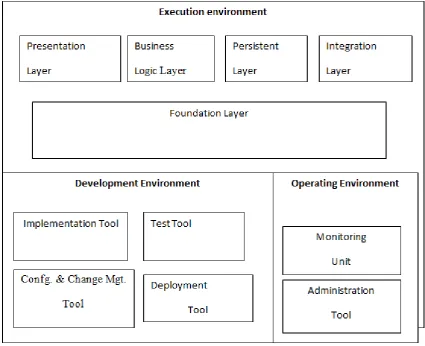
4.3 Conceptual architecture
Configuration standard framework realization, development and operation etc. Environment, Service group and
services.
Figure 5: Conceptual architecture
4.3.1 Environment
o Huge system classification of Standard Framework, in main stakeholders’ (developers operators,
o Consist by 4 types of environments.
o Existing environment: Providing functions needed for business program realization and
o business service,
o Development environment: Providing support tools for development on business Program.
o Operating environment: Providing operation tools for business program monitor and management.
o Management environment: Providing tools and procedures, which support Standard Framework
operation and maintenance.
4.3.2 Service Group
System Classification group focus on Standard Framework Service functions.
4.3.3 Service
Unit services provided by standard framework.
4.4 Open Source
Selection best Open Source through analysis and verification for building open standard framework which
utilize open source.
4.4.1 Open source analyses
o Preparation plan for selection Standard Framework Open Source and licensing guideline.
o Establishment “Open Source SW evaluation Process” by utilizing international SW evaluation process
model and practical SW evaluation process.
o Select Open Source license without restriction in distribution and reusability
4.4.2 1st logical verification
Target: ISP-Open Source derived during requirement definition.
Method: Assessment 1st filter requirement derived from Open Source SW evaluation plan.
• Select Open Source without limitations related to community and reusability.
• Select Open Source without limitation in connection and coordination and definition quality
properties which will be compiled in execution environment service.
• Select by 100 satisfaction for establishment essential requirements derived each service
4.4.3 2nd physical verification
Target: 76 kinds of Open Source (execution environment , development environment 14), which were
selected by Open Source SW 1st evaluation.
relative importance level.
• Evaluation by measurement criteria as functionality, reliability, usability, efficiency,
portability etc.
• Open Source SW selection through functional testing and quality testing about maintainability
4.4.4 Selection Results
Primary selected Open Source
o Business process:
o Date process:
o Implementation tool: Net beans
o Test tool
o Distribution tool:
o Status management tool: Subversion
4.5 Perform results of the execution environment
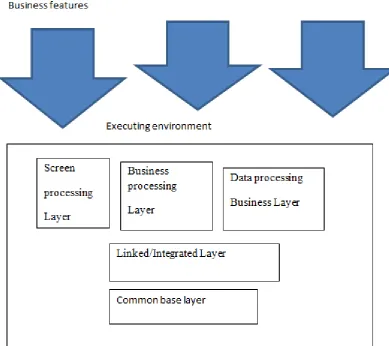
Implementation Standard Framework execution environment of 5 types of Layers as Screen processing,
business processing, data processing, connection processing, common base etc.
4.5.1 Screen processing layer
(Ajax Support)
Providing architecture required for implementation UI component interface and screen (UI Adaptor etc.).
4.5.2 Business processing Layer
Providing function etc. which shows mapping from business flow to screen flow (Web Flow function etc.).
4.5.3 Data processing Layer
Providing DB related various connection and SL processing functions (DB connection, SL processing).
4.5.4 Linked/Integrated Layer
Providing Web Service, Connection metadata functions (Web Service etc.).
4.5.5 Common base Layer
Management, common use function etc.)
Figure 6: execution environment
4.6 Perform results of the management environment
Management environment development for internal processing and effective reception of standard framework
various inquiry and request.
4.6.1 Simple function contact
o Apply method
o Confirmation of Function’s present
o Confirmation of request process
4.6.2 Business support request
o Scene support request.
o Request & Review support request.
4.6.3 Function improvement request
o Adding new functions.
o Improvement existing..
o functions & applying measures.
4.6.4 Error correction request
o Function errors’ correction.
o Compatibility error correction.
o Procedure error correction.
4.7 execution results
Design standardization of framework base that consider reuse.
4.7.1 Common technology service
Section Development
Security Confirmation of users name, authority management
User directory/ common
confirmation
General login, confirmation login
Cooperation Notice board, supervising
association of likeminded users,
managing community
System Management Common code, managing menu,
managing log
System /Service connection Managing status of connection, managing connection authority
Statistics/reporting Statistics of notices, statistics of connection
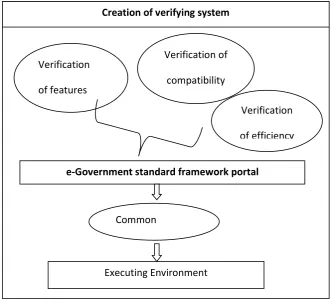
4.8 Creation of e-Government Frame portal
Figure 8: e-Government frame portal
Creation of verifying system
Verification
of features
Verification of
compatibility
Verification
of efficiency
e-Government standard framework portal
Common
4.8.1 Creation of framework portal
Creation of portal, which applies execution environment, development environment, common component.
4.8.2 Verification of framework and common
Component
o Verification of features (existence of mistakes), compatibility (solution OS, web browser), efficiency
(TPS).
o Completion of creation and proceeding management of model
5. Discussion
Since E-Government is the use of digital technologies to transform government operations in order to improve
effectiveness, efficiency, and service delivery, the researcher decided to develop an E-government framework
based on SOA. Another reasons gained to develop this framework due to it has the following effects:
To increase internal efficiency in public administration. To create new services.
Easy access to information.
To participate global information networks. Information sharing among Institution. Online access to public services. Individual efficiency.
High Performance in teamwork. Transparent state.
6. Conclusion
We categories into three broad categories: Government to-Government (G2G), Government-to-Citizen (G2C),
and Government-to-Business (G2B). We focus that the E-Government will make the government more
transparent, efficient, and enable government information and services to be delivered to citizens much faster
and easier.
We mentioned that E-government is based on web Application framework and it is a set of tools that support
webapp development with: A standard design model User interface toolkit, Reusable components for common
functions, Database support, and Support for distributed system integration.
We consider the status examination by using a framework consist of Execution survey, interview and material
research for status examination of framework using in e- Government project. Finally we presented standard
development. We also mentioned configuration standard framework realization, development and operation.
7. Recommendation
There is further improvement in terms of efficiency and easy to use for achieving enhanced web-application
framework. So that there is need for high-speed huge servers that have secure protocols.
References
[1] Theresa A. Pardo, “Realizing the Promise of Digital Government: It’s More than building a Web Site”,
Center of Technology in Government, University of Albany, 2000.
[2] Jaeger, P. T. (2003). The endless wire: E-Government as a global phenomenon. Government Information Quarterly, 20(4), 323−331.
[3] Means, G., & Schneider, D. (2000). Meta-capitalism: The e-business revolution and the design of 21st
century companies and markets. New York: John Wiley & Sons Inc.
[4] Brown, M. M., & Brudney, J. L. (2001, October). Achieving advanced electronic government services:
An examination of obstacles and implications from an international perspective. Paper presented at the
National Public Management Research Conference, Bloomington, IN.
[5] Danish Dada, "The Failure of E-Government in Developing Countries: A Literature Review", The
Electronic Journal on Information Systems in Developing Countries, Vol. 26 Issue 1 (2006), pp. 1 -10
[6] Bean, J. (2010). SOA and web services interface design: Principles, techniques, and standards. (SOA
and web services interface design.) Amsterdam: Elsevier/Morgan Kaufmann.
[7] Bertino, E., Martino, L., Paci, F., & Squicciarini, A. (2010). Security for Web Services and
Service-Oriented Architectures. (Security for web services and service-oriented architectures.) Berlin,