168
© Global Society of Scientific Research and Researchers
http://ijcjournal.org/
Analyzing Cost Estimation Model to Optimize COCOMO
II for Enterprise Level Software
Muhammad Javed Shad
a*, Faisal Bahadar
ba
Department of information technology hazara university mansehra. Pakistan
a
Email: [email protected]
bEmail: [email protected]
Abstract
The stimulus to carry out this research is to find out the best ERP cost estimation model while implementing
ERP in the context of Pakistan. For this purpose study has utilized qualitative and quantitative approach.
Initially the comparison of existing several cost estimation model has been done through literature review. On
the basis of substantive literature review, one ERP cost estimation mode has been chosen i.e. COCOMO. In
second phase, in order to validate this model in the context of Pakistan, the study has adapted a questionnaire
from relevant study and survey has been done of the IT companies operating in Pakistan which are also involved
in ERP implementation. Sample has been collected from 27 companies and data analysis is done in a statistical
software (SPSS). On the basis of results obtained from the SPSS and with the support of literature findings has
been extracted. Findings indicate that COCOMO II is the best model to estimate the ERP implementation cost in
the context of Pakistan. Moreover it is recommended to validate his model in the other countries. Findings
would be beneficial for the future studies and contributes in the knowledge of scientific community. Moreover,
results of this study can be helpful for other companies in Pakistan who are involved in ERP implementation
process and looking for best model to estimate cost of ERP implementation.
Keywords: ERP; ERP implementation; software engineering; Cost estimation model.
1. Introduction
Nowadays, a large number of businesses, finances and many other organizations which has been performing
different tasks linked with several industrial and academic domains adopted by different software applications
[15].
169
These software applications have been simulated in the real time environment so that the organization can
perform their required task efficiently and effectively. Number of Mobile and software applications are utilized
by different organizations such as “Customer Relationship Management, Enterprise Resource Planning, Word
processing, Document management system and many others” [13].
Enterprise Resource Planning solution can be utilized to perform number of business management activities
such as Employee records [10], Resources management [16], Product planning, cost and development [17],
Marketing and sales activities [20], Inventory management, Manufacturing or service delivery, Shipping and
payments [3]. ERP solutions are highly complex information system and are interlinked with number of
modules.
Cost is considered as one of the core variables in production, retail, and accounts. Demand and need of the
software application is increasing day by day. Software companies has been utilizing different software models
for the Cost Estimation [2]. There are number of existing software engineering cost estimation models such as
“Analysis Effort method, COCOMO, COSYSMO, Function Point Analysis and many others models” [10]. The
cost estimation of any software application is considered as one of the challenges and time consuming. It have
been analyzed from different research studies that a large number of companies have failed to analyses and
identify the correct cost estimation for the software application [18]. One of the main reasons of the wrong
software cost estimation is the selection of the inappropriate methodology which results into the erroneous cost
[10]. There are number of parameters which are involved in the software cost such as “Hardware and software
costs, Travel and training costs, Effort costs, Licensing, Line of code (LOB)”.
Cost estimation is considered as the process of forecasting excepted value in the development of the software
applications. Cost estimation is based on number of different parameters and these parameters are always
predicated at the initial stages of the software development. However, it have been analyzed that most of the
software development methodologies have defined the cost estimation in the initial phases [18]. There are
number of mechanisms which are defined by different companies to control the cost, once the project is
executed but there are several stages in which the unpredictable cost element of the software solution may lead
in some sort of financial deadlock [14].
1.1 Problem statement
The software development companies have being facing the cost estimation issue. The cost estimation is one of
the main reasons of the failure of the software application in ERP Implementation projects. This research study
will be conducted to analyze and identify the different cost estimation, Models and perform different tests to
identify that which software engineering cost estimation Models fits best of the Enterprise Resource Planning
Projects Implementation.
1.2 Research question
170
1. Identify the best cost estimation model for the Enterprise Resource Planning Projects Implementation
and conduct a close comparison between the existing cost estimation models within the perspective of
cost as a main variable?
2.Literature Review
Software methodologies are always considered as one of the critical aspect in the software engineering during
the design, development and implementation of the software application. There are number of critical
parameters which are involved in the design and development of software application [5].
There are number of cost estimation models which have been utilized for different project costs. The cost
estimation model is built on the calculation and is mathematically approved formula. These models predict and
forecast the value which can occur in the future. The research study presented by [8] conducted to analyze the
software development effort and cost estimation based on the utilization of the Fuzzy Model.
Neuro-Fuzzy Model is considered under the umbrella of the artificial intelligence. Neuro-Neuro-Fuzzy Model are built on the
Fuzzy logic and Artificial Neural Network.
Cost estimation is not only required during the software planning or development but the technologies are also
required during the software migration. The research [7] focused on the software migration and the cost
estimation utilizing the COCOMO II and Enterprise Architecture Modeling. The framework of the Meta model
has been developed in the research study for the calculation of the Software Migration Project. The framework
is built on the COCOMO II estimation model and Enterprise Architecture Modeling techniques. The proposed
framework in the research has better estimation as compared to the other estimation techniques. According to
the results, it has been estimated that the proposed framework has increased the estimation accuracy to ten
percentages. The proposed solution has been conducted with the help of real time case study. The results
concluded that proposed Meta model [7] is useful, especially after company specifically calibrates with expert
estimates.
The [1] presented the research which has being conducted an in-depth analysis for the Empirical Software Effort
Estimation Models. These Effort Estimation Models has been utilized in number of different software and
application development. The model utilized in this research includes COCOMO estimation model, SEER-SEM
estimation Model, SLIM estimation model, REVIC estimation Model, COSTMODL estimation Model. The
models have been conducted in the simulation environment and from the results it has been concluded that each
model is benefit according to the software requirement and specification and however well the requirement has
been calculated. According to the Basha and Ponnuranga “There no cost estimation model which fit best for all
situations and environment”. The size-related measurement can’t be performed in the proposed solution.
There are number of different suggestions which have been provided to identify different models for the cost
estimation of the ERP however, a large group of the SME suggest that the COCOMO-II should be utilized for
the cost estimation of the ERP solution. Improvement are also suggested to automation and integrated new
171
3.Comparison of Existing Cost Estimation ModelsThere are number of cost estimation model which can be utilized for the Enterprise Resource Planning Projects
Implementation. Most of these cost estimation model has different features and benefits. The selection of the
model various from different business requirements, project size, structure and project planning.
Table 1: Comparison of Existing Cost Estimation models [6,11,12,21]
Existing Model Software Industry ERP Implementation
Modified by Software Cost Estimator
Strength Weakness
1 Analysis Effort method
Yes No No Estimate the Length of
the Job required to
completed the individual task
Utilized the Previous
Experience during
calculation, Accurate estimate
Can’t be Utilized for
the ERP cost
Estimation Single tasked
2 COCOMO Yes Yes Yes Accurate for Small
projects,
Estimate cost as a function of program size.
Can’t be directly utilized for ERP solution,
Less Drivers as compared to COCOMO™ II
3 COCOMO™ II Yes Yes Yes productivity
measurement, Easy to Use, Results Accurate, Easy to Use.
Can’t be directly utilized for ERP solution
4 COSYSMO No No Can be integrated with
quite number of Programming
languages.
Can’t be Utilized for the ERP cost Estimation
5 Evidence-based Scheduling
Yes No No Sequential Calculations,
Can be integrated with Agile Approach
Results not Accurate Can’t be Utilized for the ERP cost Estimation
6 Function Point Analysis
Yes Yes Yes Support ISO Standards,
Can be utilized with ERP
Function Points were highly correlated to lines of code (LOC)
In summary this chapter of literature review has been presented on the related research conducted in the domain
of the Cost Estimation Models utilized in the Enterprise Resource Planning Projects Implementation. The
chapter has provided different aspects of the researches. There are number of intelligence models and tools
which have been developed in the past for the estimation of the project.
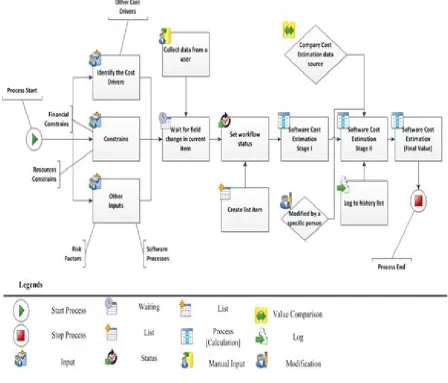
4.Conceptual Model
172
has been presented in this section. The proposed model is the extension of the Cocomo-II or in simple the
Cocomo-II and its drivers can be consider as the base for the formulation of the conceptual mode. There are few
Cocomo-II drivers which have been added so that the standard can be developed. The base model of [19] has
been modified and new cost driver has been added.
Figure 1: Conceptual Model
5.Methodology
In the first phase, the research problem has been identified. The main emphasis of the problem was to identify
the Cost Estimation Models which fit best for the Enterprise Resource Planning. In the phase two, the
comparison of in-depth analysis of the existing model are presented.
In the third phase, the data collection techniques have been identified. The quantitative and qualitative data
technique has been utilized in the research study. The questionnaire has been developed to analyze different
perspectives of the cost estimation utilized in the software industry of Pakistan Once the data is collected, the
analysis was performed in the fourth phase and based on that analysis the interpretation of the research report
173
Resource Planning Projects implementation. Once all the data analysis and the other phases are completed. The
recommend model for the Cost Estimation Models in Enterprise Resource Planning Projects Implementation has
been suggested from the evidence collected from the Quantitative and Qualitative data finding.
It has been analyzed that there are more than 1500 software development companies operating and executing
different sort of project in Pakistan.
Raosoft application has been utilized to identify and analyses the Sample Size which can be utilized for the
research. The sample size of 27 has been identified for this research.
6.Results And Discussion
Selection of the right cost estimation model can lead in the overall success of the software project within the
context of the cost, budget estimation and planning. The data is collected by the help of the questionnaire from
the software and application companies working in Pakistan.
In this chapter, the details discussion and verification has been performed on the data which has been extracted
from the questionnaire conducted in the software and application development companies working in the
Pakistan region. The data analysis has been conducted to evaluate the best cost estimation model.
7.Results
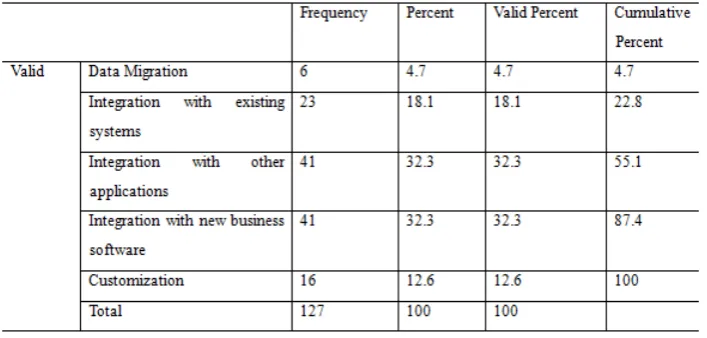
Following are the results extracted from SPSS. Results are presented in graphical and tabular form:
174
Figure 3: cost estimation models used by companies
175
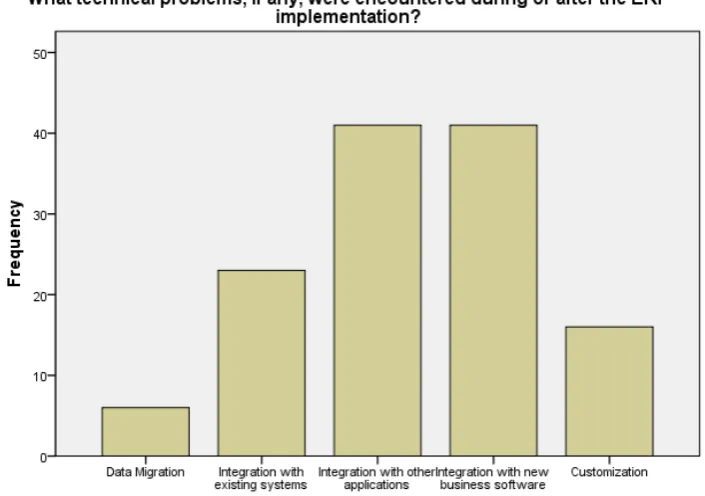
Figure 5: Technical Problems in ERP implementation
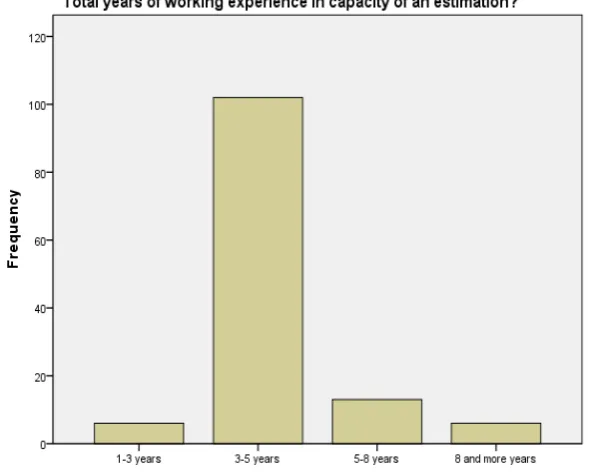
Table 2: Years of working experience
176
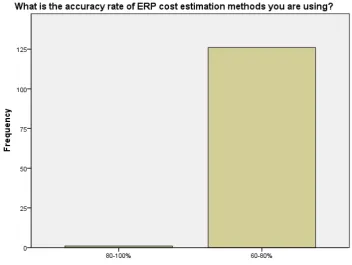
Table 4: ERP cost estimation method
Table 5: Technical Problems in ERP implementation
8. Discussion on Results
1. Most of the people involved in the cost estimation have the experience of around 3 - 5 Years. The
Team Lead and Manager are mostly involved in the cost estimation. However, I has been analyzed
during the survey that most of the software and application development companies don’t have the risk
manager involved so most of the estimation may go wrong,
2. Private software and application development companies are most active in performing the cost
estimation,
3. Software and application development companies emphasis on the utilization of the cost estimation
model. However, there are eight main cost estimation models which has been presented on the
questionnaire. Most of the software and application development companies emphasis on the Cocomo
and Cocomo-II,
9.Conclusion & Recommendations
The aim of the study was to conduct a research on identification and validation of best ERP implementation cost
estimation model in the context of Pakistan. The study has been conducted by using qualitative and quantitative
177
Moreover, a survey has been conducted in the ERP implementation companies operating in Pakistan with the
help of an adapted questionnaire in order to validate the best selected COCOMO – II model. Data was collected
through adapted questionnaire and results were analyzed by statistical means in SPSS 20. Findings validated the
COCOMO – II model as the best fits for ERP cost estimation in the context of Pakistan. Findings further
indicated that this model can be utilized by the companies who are in the process of ERP implementation.
Findings would be beneficial for the future studies and contributes in the knowledge of scientific community.
Moreover, results of this study can be helpful for other companies in Pakistan who are involved in ERP
implementation process and looking for best model to estimate cost of ERP implementation.
This study has recommended that further models need to best tested and validated regarding ERP cost
estimation in the context of Pakistan. Lastly, it is suggested that COCOMO – II model can be used by the ERP
implementation companies in order to best analyze their cost estimation while implementing ERP in the
organizations
10. Limitations of The Study
The major limitation of the study is small sample size. Due to limited resources and time constraint it was not
possible for the researcher to incorporate large sample size. Therefore, study consider this factors as a limitation.
Future researches can consider this limitation and emphasize on increase in sample size.
References
[1] Basha, S., & Ponnurangam, D. (2010). Analysis of empirical software effort estimation models. arXiv
preprint arXiv:1004.1239 .
[2] Boehm, B. W., & Valerdi, R. (2008). Achievements and challenges in cocomo-based software resource
estimation. Software, IEEE , 25 (5), 74-83.
[3] Daneva, M. (2007). Approaching the ERP project cost estimation problem: An experiment. Proceedings
of the First, (pp. 500-500).
[4] Daneva, M., & Wieringa, R. (2008). Cost estimation for cross-organizational ERP projects: research
perspectives. Software Quality Journal , 16 (3), 459-481.
[5] Equey, C., Kusters, R. J., Varone, S., & Montandon, N. (2008). Empirical Study of ERP Systems
Implementation Costs in Swiss SMEs. In ICEIS (1)(pp. 143-148).
[6] Gharehchopogh, F. S. (2011). Neural networks application in software cost estimation: A case study.
Innovations in Intelligent Systems and Applications (INISTA). 2011 International Symposium on, (pp.
69-73).
178
using COCOMO II and Enterprise Architecture Modeling. PoEM (Short Papers), (pp. 39-48).
[8] Kashyap, D., Tripathi, A., & Misra, A. (2012). Software Development Effort and Cost Estimation:
Neuro-Fuzzy Model. Software Development Effort and Cost Estimation:Neuro-Fuzzy Model .
IOSRJCE.
[9] Kusters, R. J., Heemstra, F. J., & Jonker, A. (2009). ERP Implementation Costs: A Preliminary
Investigation. In Enterprise Information Systems (pp. 95-107). Springer.
[10] Lagerstrom, R., Baldwin, C., MacCormack, A., & Aier, S. (2014). Visualizing and Measuring
Enterprise Application Architecture: An Exploratory Telecom Case. System Sciences (HICSS), 2014
47th Hawaii International Conference on, (pp. 3847-3856).
[11] Menachemi, N., Shin, D. Y., Ford, E. W., & Yu, F. (2011). Environmental factors and health
information technology management strategy. Health care management review , 36 (3),275-285.
[12] Mittas, N., & Angelis, L. (2013). Ranking and clustering software cost estimation models through a
multiple comparisons algorithm. Software Engineering, IEEE Transactions on , 39 (4), 537-551.
[13] Plecka, P., & Bzdyra, K. (2013). Algorithm of selecting cost estimation methods for ERP software
implementation. Applied Computer Science, 9.
[14] Rosa, W., Packard, T., Krupanand, A., Bilbro, J. W., & Hodal, M. M. (2013). COTS integration and
estimation for ERP. Journal of Systems and Software , 86 (2), 538-550.
[15] Shekhar, S., Kumar, U. (2016). Review of Various Software Cost Estimation Techniques. International
Journal of Computer Applications, 141 (11), 00975 – 8887.
[16] Sumner, M. (2007). Enterprise resource planning. Pearson Education.
[17] Somers, T. M., & Nelson, K. (2001). The impact of critical success factors across the stages of
enterprise resource planning implementations. System Sciences, 2001. Proceedings of the 34th
Annual Hawaii International Conference on, (pp. 10--pp).
[18] Seth, A., Agarwal, H., & Singla, A. (2014). Techniques for Evaluating Service Oriented Systems: A
Comparative Study. 2014 .
[19] Samuel, L., Lance, T., & Seth, B. (n.d.).
http://www.computing.dcu.ie/~renaat/ca421/report.html#3. Retrieved 01 02, 2015, from
http://www.computing.dcu.ie/~renaat/ca421/report.html#3:http://www.computing.dcu.ie/~renaat/ca421
179
[20] Umble, E. J., Haft, R. R., & Umble, M. M. (2003). Enterprise resource planning: Implementation
procedures and critical success factors. European journal of operational research , 146 (2), 241-257.
[21] Zia, Z., Rashid, A., & uz Zaman, K. (2011). Software cost estimation for component-based
fourth-generation-language software applications. IET software , 5 (1), 103-110.
Author Biographies
1. Muhammad Javed Shad (Corresponding Author). Author is a Master scholar in the discipline of
computer sciences and working on the thesis for the completion of MS (CS) degree. Author has a wide
range of industry/academic experience. Author intends to increase his contribution in the scientific
community.
2. Mr Faisal Bahadar (Co-author). Author is currently appointed as Assistant professor in the IT
department of Mansehra University. Author has several research papers in the domain of computer
science. Author intends to do more researches in the area of software engineering to contribute in
![Table 1: Comparison of Existing Cost Estimation models [6,11,12,21]](https://thumb-us.123doks.com/thumbv2/123dok_us/8398835.1685739/4.595.45.554.198.587/table-comparison-existing-cost-estimation-models.webp)