MECHANICAL PROPERTIES OF HIGH
STRENGTH SELF - COMPACTING
CONCRETE USING SELF CURING
COMPOUND (PEG ̵ 600)
1
N.Sarathschandra,
2M.Venkateswarlu,
3N.venkateswarlu,
4K.Sundeep Kumar
1Assistant Professor, 2Assistant Professor, 3Assistant Professor, 4Assistant Professor1Department of Civil Engineering,
1NBKR Institute of Science & Technology, Nellore, India DOI:http://doi.one/10.1729/Journal.19888
Abstract:
This paper is aimed to utilize the benefits of Self-curing compound in high strength (M60) Self-
compacting concrete. A Self-curing compound is provided to absorb water from atmosphere to achieve better
hydration of cement in SCC without submerging into water. Self-curing compound is Polyethylene glycol of
molecular weight 600 (PEG-600) of dosages ranging between0.1% to 2% by weight of cement added to mixing
water. SCC is characterized by its fresh properties like flowability, filling ability and resistance to segregation
and bleeding are done by slump flow, J-ring, V-funnel, L-box and U-box tests on SCC to satisfy EFNARC
specifications. Whereas hardened properties like compressive strength is tested at 7, 14, 21 & 28 days, tensile
and flexural strengths are tested after 28 days of curing. An attempt has been made in the investigation reported
in this project to study mechanical properties like Compressive strength, Tensile strength and Flexural strength
of High strength SCC in the presence of Self-curing compound. There may be an improvement in the mechanical
properties of High strength SCC with Self-curing compound are observed and compared with High strength
SCC without Self-curing compound. This paper confirms that specimens with 0.5% of PEG achieved better
mechanical properties.
Key words - Self- Compacting Concrete, Self-Curing Compound, Polyethylene Glycol, Compressive Strength, Flexural Strength, Split Tensile Strength.
I. INTRODUCTION
However, even mix contains enough water, any loss of moisture from the concrete will reduce the initial water cement ratio and result in incomplete hydration of cement especially with the mixes having low water cement ratio.This results in very poor quality of concrete. To minimize these problems like compaction and curing by using suitable curing compounds in self-compacting concrete is the better solution.
II.LITERATURE REVIEW:
Elsewhere, Edamatsu, Nishida, and Ouchi [9], The Rational Mix Design Method was developed in Japan and has been presented in various forms by multiple authors including but not limited to Okamura[1] and Ozawa[2] (1995); Ouchi[9], Hibino[8], and Okamura[1] (1997); Edamatsu[9], Nishida[9], and Ouchi[9] (1999); Okamura[1], and Ouchi[9] (2003). The use of this method has been suggested in Europe by EFNARC [6] (2001) and in the US by the Precast/Prestressed Concrete Institute (PCI 2003).The method generally consists of six steps. Alternatively, Okamura [1] and Ozawa[2] (1995) suggested that equal volumes of sand and coarse aggregate be used. Elsewhere, Edamatsu[9], Nishida[9], and Ouchi[9] (1999) suggested a method for determining the optimum sand content. S. VenkateswaraRao eatl developed standard and high strength Self-Compacting Concrete (SCC) with different sizes of aggregate based on Nan-su’s[4] mix design procedure. The results indicated that SCC can be developed with all sizes of graded aggregate satisfying the SCC characteristics. Khayat’s [8],objective is compressive strength and modulus of elasticity were greater for SCC samples than those obtained from the medium fluidity conventional concrete. It was noted that there is a significant change in the mix proportions with respect to packing factor, effective size of aggregate, fine aggregate – total aggregate ratio, fly ash content, cement content and water content in S. VenkateswaraRao eatl’s work. I.M. Nikbin et al, [12] noticed that W/c ratio has greater effect on tensile and compressive strengths than E-modulus. K.Cpandaa and P K Balb [15], concluded that the compressive strength, flexural strength and split tensile strength of the SCC with 100% natural aggregate is less than the normal vibrated concrete (NVC) with 100% natural aggregate.Subramanian and Chattopadhyay [7]are research the Portland cement was partially replaced with fly ash and blast furnace slag, in the same percentages as Ozawa [2] has done before and the maximum coarse aggregate size did not exceed 25mm. It was difficult to obtain a mixture that was at the same time fluid of aggregate may result either in a mixture with inadequate flowing ability, or alternatively one with a tendency for coarse aggregate to segregate. Therefore, it became necessary to incorporate a viscosity-modifying agent in the concrete mixture.While coming to usage of self-curing compounds in concrete, Wen-Chen Jau [18] stated that self-curing concrete is provided to absorb water from moisture from air to achieve better hydration of cement in concrete. It solves the problem that the degree of cement hydration is lowered due to no curing or improper curing, and thus unsatisfactory properties of concrete. The self-curing agent used in the study was poly acrylic acid (PAA) and polyvalent alcohol. Roland Tak Yong Liang, Robert Keith Sun [17] carried work on internal curing composition for concrete which includes a glycol and a wax. The invention provides for the first time an internal curing composition which, when added to concrete or other cementitious mixes meets the required standards of curing as per Australian Standard AS 3799.
A.S. El-Dieb, ea tl [21]investigates using laboratory synthesized water-soluble polymers: polyethylene glycol (PEG) and polyacrylamide(PAM) as self-curing agents and its effect on the degree of hydration, water absorption, permeable pores and micro structural characteristics of Portland cement mixtures without and with 8% silica fume replacement. Prof. Nanak ea tl [24]: investigates the variation in compressive strength of medium strength, self-compacted concrete with 3 different curing techniques is discussed about Immersion, external curing methods and PEG. Internal curing with Polyethylene Glycol gives 5% lesser compressive strength than immersion curing. FerhatBingöl, IlhanTohumcu [25] presents the effect of air curing, water curing and steam curing on the compressive strength of Self Compacting Concrete (SCC). Relative strengths of concretes with mineral admixtures were determined higher than concretes without admixtures at steam curing conditions.
III.SCOPE AND OBJECTIVES OF WORK:
FROM DETAILED LITERATURE REVIEW THE FOLLOWING POINTS ARE EVIDENT:
The use of self-compacting concrete is very useful to completely filling formwork, achieving maximum compaction, even
The use of water reducing chemicals in concrete will give better performance compared conventional concrete.
The use of self-curing compound is necessitated in normal concrete to achieve maximum hydration compared to other
conditions.
There is need to do work on self-curing compounds used in high strength self-compacting concrete.
Scope and Objectives:
The objectives of the paper are stated below
To develop SCC mix design methodology for high strength concrete (i.e., M60) and evaluate the fresh properties. To study the water retention capacity and mechanical properties of proposed concrete.
To study the effect of water reducing compound (super plasticizer), self-curing compound and its dosage on fresh
properties and mechanical properties of self-compacting concrete.
IV. EXPERIMENTAL WORK:
The experimental study consisted of arriving at a suitable mix proportions that satisfies the fresh properties of self-compacting concrete as per EFNARC [6] specifications. Standard cube moulds of 150mm x 150mm x 150mm made of cast iron were used for casting standard cubes. And also prisms of size 500mm x 100mm x 100mm and cylinders of diameter 150mm and depth 300mm made of cast iron were used for casting.
The program was consisted of casting and testing 60Mpa Self-Compacting and self-curing Concrete. The dosage of super plasticizer was kept at 0.5%, 1.0%, 1.5% & 2.0%.Based on studies available in the literature. From the different trails, decided 1.1% of super plasticizer, optimum dosage to achieve required fresh properties of SCC in this study. Self-curing compound poly ethylene glycol-600 of different dosages 0%, 0.5%, 1.0% and 1.5% was added to high strength SCC. And specimens were tested after 7, 14, 21 and 28 days, of curing period. Take weight loss of specimens at 3, 7, 14, 21 and 28 days. The prisms and cylinders tested after 28 days of curing. The mix design methodology adopted was modified Nan Su method.
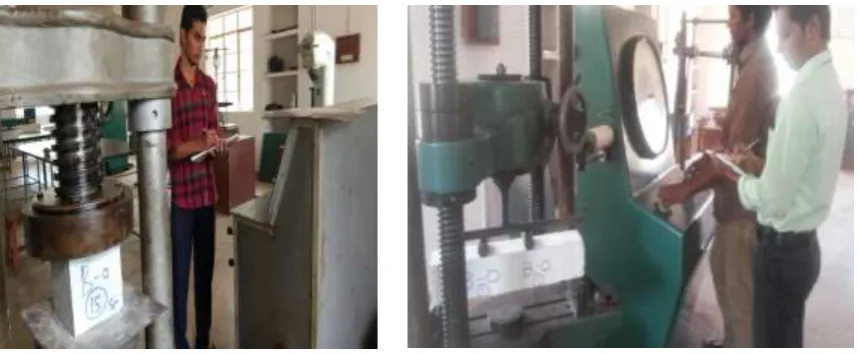
Figure 4.1: Flow measurement Figure 4.2: J-Ring experiment
V.MATERIALS USED:
The different materials used in this investigation are
Cement:
Cement used in the investigation was 53 Grade Ordinary Portland cement confirming to IS: 12269[19]. The specific gravity of cement was 3.14 and specific surface area of 225 m2/g having initial and final setting time of 40 min and 560 min respectively.
Fine Aggregate:
The fineaggregate that falls inzone-II conforming to IS 383-1970 was used. It has fineness modulus and specific gravity of 3.07 and 2.65.
Coarse Aggregate:
Crushed granite was used as coarse aggregate. The coarse aggregate was obtained from a local crushing unit having 20mm nominal size, well graded aggregate according to IS: 383[20].The specific gravity was 2.8, while the bulk density was 1487 kg/m³.
Mineral admixtures: Fly ash:
Fly ash is a by-product obtained during the process of combustion of pulverized coal in electric power generating plants. Fly ash produced from Meenakshi thermal power plant Nellore, was used as partial addition for cement and its physical properties are shown in Table 5.1.
Table 5.1 Physical Properties of fly ash
S. No. Physical properties Results
1 Colour Grey
2 Bulk density 847 kg/m³
3 Specific gravity 2.17
Silica fume:
The silica fume was used in this experiment conforms to ASTM C 1240 and IS 15388:2003 [8]. The silica fume is in white colour powder form. Silica fume has been procured from Astra chemicals Ltd-Chennai and properties are shown in Table 5.2.
Table 5.2 Physical Properties of Silica fume
S. No. Physical properties Results
1 Particle size 0.5µm-1μm
2 Bulk density 624 kg/m³
Chemical admixtures: Super Plasticizer:
High range water reducing admixture confirming to Master GLENIUM SKY 8662 commonly called as super plasticizers was used for improving the flow or workability for decreased water-cement ratio without sacrifice in the compressive strength. Properties of GLENIUM SKY 8662 are given below in table 5.3.
Table 5.3 Physical Properties of Super plasticizer
S. No. Physical properties Results
1 Form Liquid
2 Air entrainment <2.0%
3 Specific gravity 1.20
4
Chloride content
<0.2%
Polyethylene glycol (PEG):
Polyethylene glycol is a condensation polymers of ethylene oxide and water with the general formula H (OCH2CH2) n OH, where n is the average number of repeating ox ethylene groups typically from 4 to about 180.
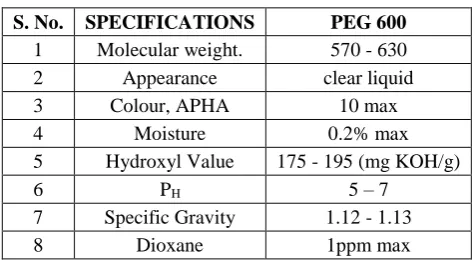
Table 5.4 Specifications of PEG 600
S. No. SPECIFICATIONS PEG 600
1 Molecular weight. 570 - 630
2 Appearance clear liquid
3 Colour, APHA 10 max
4 Moisture 0.2% max
5 Hydroxyl Value 175 - 195 (mg KOH/g)
6 PH 5 – 7
7 Specific Gravity 1.12 - 1.13
8 Dioxane 1ppm max
VI. RESULTS AND DISCUSSIONS:
Fresh properties:
Table 6.1 Fresh properties
S.No Test method Dosage of PEG-600 EFNARC Specifications
0.00% 0.50% 1.00% 1.50%
1 SLUMP FLOW(mm) 705 710 703 650 550-900
2 SLUMP T 500 (sec) 3 3 3 4 2 - 5
3 J-RING (mm) 3 4 1 3 0-10
4 L-BOX 0.8 0.93 0.875 0.857 0.8-1.0
5 V-FUNNEL (Sec) 10 9 10 14 8 - 10
Discussions on fresh properties results:
From the table 6.1, it was concluded that
Fresh properties in SCC of SP at 1.1% were given satisfactory result compare to other mixes. Therefore optimum dosage
of super plasticizer at 1.1% to achieve required fresh properties of SCC. Self-curing compound poly ethylene glycol-600 of different dosages 0%, 0.5%, 1.0% and 1.5% were added to high strength SCC.
Horizontal flow and flowability of SCC with 1.5% of PEG-600 is less than other mixes. This indicates the mix sticky and
cohesive. From this it is understood that as the increasing in PEG dosage increases viscosity of the mix. Due to this workability decreases.
Water retentivity test:
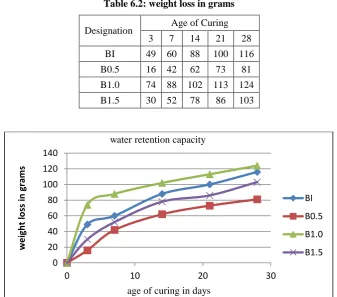
Self-compacting concrete with 0% dosage of PEG-600 subjected to indoor curing was studied by weighing the samples at 3, 7, 14, 21 and 28 days, with digital weighing machine of accuracy 5 gm. The work was carried out a temperature of 33ºc and at relative humidity of atmosphere between 20-30% with reference to weather report.
Table 6.2: weight loss in grams
Designation Age of Curing
3 7 14 21 28
BI 49 60 88 100 116
B0.5 16 42 62 73 81
B1.0 74 88 102 113 124
B1.5 30 52 78 86 103
Figure 6.1: weight loss vs age of curing
Discussions:
From table 6.2 and figure 6.1, Percentage weight loss for Mix B-0 (I) is undergoing relatively higher weight loss when compared to other mixes, which indicates lower water retentivity after 28 days of casting. The Mix B-0 (I) may be considered as conventional mix of indoor curing based on % of self-curing point of view. But the Mix B-1.5 has got higher % of weight loss when compared to conventional mix of indoor curing B-0 (I).
Finally percentage of weight loss is less at 0.5% of self-curing compound in PEG-600 used specimens. Therefore the optimum dosage of self-curing compound is 0.5% in self-compacting concrete with PEG-600 used specimens.
0 20 40 60 80 100 120 140
0 10 20 30
we
ig
h
t
lo
ss
in
gr
am
s
age of curing in days water retention capacity
BI
B0.5
B1.0
Compressive Strength:
The strength of concrete depends on the hydration and which in turn depends on the water retention capacity of a certain concrete. While water curing is an ideal condition as explained earlier, in some cases water curing is not possible. In the present study PEG-600 of 0.5%, 1.0% and 1.5% dosages were casted and tested.
Table 6.3: compressive strength in MPa
Designation Age of curing in days
7 14 21 28
BW 39.11 43.11 52.00 55.11
BI 35.33 37.11 41.56 48.44
B0.5 37.33 42.22 49.78 54.00
B1.0 35.11 38.22 44.00 52.89
B1.5 33.33 40.89 46.22 51.11
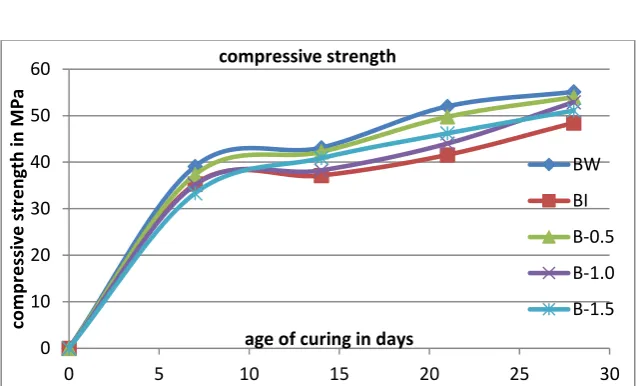
Figure 6.2: compressive strength vs age of curing
Discussions:
The above Table 6.3 and fig 6.2 has shown variation of compressive strength in SCC with PEG-600 of different dosages of 0%, 0.5%, 1.0% and 1.5% are added.
At 7 days curing B-0.5 has shown maximum compressive strength compared with other mixes excluding wet curing
specimens. It indicates better earlier strength. The maximum compressive strength of B-0.5 is nearer to B-0 (W). Among B mixes, B-0.5
B-0 (W) has given better later gain in compressive strength than other mixes. But among the self-curing compound mixes,
0.5% of PEG-600 has given better later strength. The optimum dosage of self-curing compound is 0.5% of the PEG-600 in SCC specimens.
0 10 20 30 40 50 60
0 5 10 15 20 25 30
co
m
p
re
ssi
ve
st
re
n
gth
in
M
Pa
age of curing in days compressive strength
BW
BI
B-0.5
B-1.0
Flexural Strength:
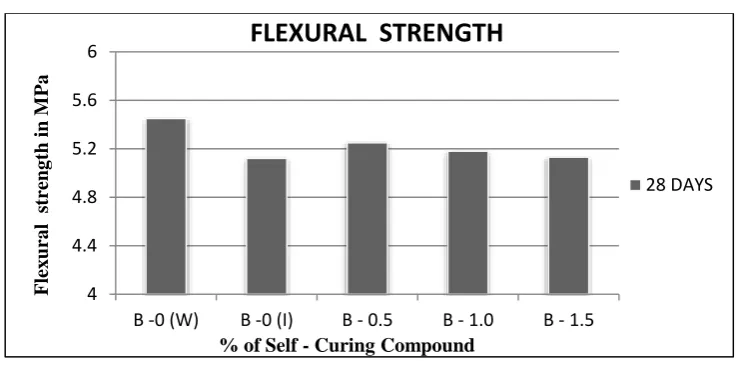
In the present study PEG-600 of 0.5%, 1.0% and 1.5% dosages were casted and tested. Flexural strengths were determined and tabulated in Table 6.4. The resulting plots of flexural strength against Mix proportions as shown in fig 6.3.
Table 6.4 Flexural strength MPa
S.NO Mix Proportion Flexural Strength in Mpa
1 B -0 (W) 5.45
2 B -0 (I) 5.12
3 B - 0.5 5.25
4 B - 1.0 5.18
5 B - 1.5 5.13
Figure 6.3: flexural strength vs % of self-curing compound
Discussions:
The above Table 6.4 and fig 6.3 has shown variation of flexural strength in SCC with PEG-600 of different dosages of 0%, 0.5%, 1.0% and 1.5% are added. From the plots it was encountered that After 28 day curing SCSCC specimens have shown better flexural strength than conventional concrete. Among SCSCC mixes B-0.5 has shown better flexural strength when compared to other mixes of SCSCC (B-1.0 and B-1.5). The optimum dosage of self-curing compound is 0.5% of the PEG-600 in SCSCC specimens.
Split Tensile Strength:
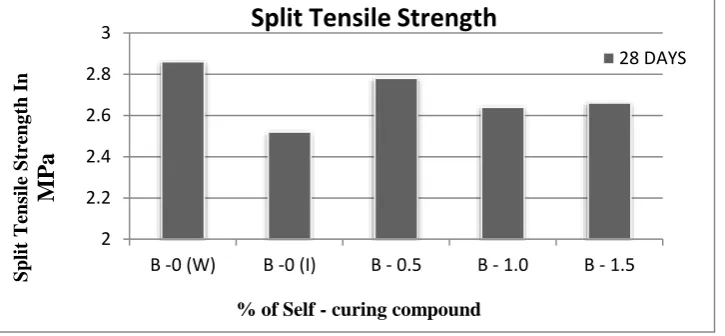
In the present study PEG-600 of 0.5%, 1.0% and 1.5% dosages were casted and tested. Split tensile strengths were determined and tabulated in Table 6.5. The resulting plots of Split tensile strength against Mix proportions as shown in fig 6.4.
Table 6.5 split tensile strength in MPa
S.NO Mix Proportion Split Tensile Strength in MPa
1 B -0 (WC) 2.86
2 B -0 (IC) 2.52
3 B - 0.5 2.78
4 B - 1.0 2.64
5 B - 1.5 2.66
4 4.4 4.8 5.2 5.6 6
B -0 (W) B -0 (I) B - 0.5 B - 1.0 B - 1.5
28 DAYS
FLEXURAL STRENGTH
F
lex
ura
l
st
re
ng
th in M
P
a
Figure 6.4: split tensile strength vs % of self-curing compound
Discussions:
From the above figure 6.4, it is cleared that After 28 day curing SCSCC specimens have shown better split tensile strength than conventional concrete. Among SCSCC mixes B-0.5 has shown better tensile strength when compared to other mixes of SCSCC (B-1.0 and B-1.5). The optimum dosage of self-curing compound is 0.5% of the PEG-600 in SCSCC specimens.
Conclusions:
After interpretation of results and discussions the following conclusions were evolved.
The Fresh Properties of SCSCC were more reliable and satisfied values as per EFNARC [6] specifications at a dosage of
1.1% of Super plasticizer with 0.5% of PEG-600.
At 7 and 28 days curing, SCC with PEG-600 of 0.5% shown maximum compressive strength compared with other mixes
of PEG used specimens. But this compressive strength less than conventional wet cured specimens. From this It is clearly understood that specimens with 0.5% of PEG achieved better earlier strength as well as later strength.
It imports that better filling ability, less porosity and hence better hydration, which leads to better formation of C-S-H gel,
due to this gain more strength.
When compared to conventional concrete, the Flexural Strength and tensile strength of mixes was better at a dosage of
0.5% PEG-600. But these values nearer to the wet curing specimen’s strength.
This is attributed due to low water cement ratio or better sealing capacity of PEG-600. The capillarity suction of water is
increasing with increase in percentage dosage of PEG-600 up to 0.5%.
Finally, from this paper it was concluded that the optimum dosage of SCC specimens with PEG-600 is 0.5%.
2 2.2 2.4 2.6 2.8 3
B -0 (W) B -0 (I) B - 0.5 B - 1.0 B - 1.5
28 DAYS
Split Tensile Strength
Sp
lit
T
ens
ile
Str
eng
th In
M
P
a
REFERENCES
[1] Hajime Okamura and Masahiro Ouchi (2003), “Self-Compacting Concrete”, Journal of Advanced Concrete Technology Vol.1, No.1, 5-15, April 2003.
[2] Ozawa K., Kunishima, M., Maekawa, K. and Ozawa, K, “Development of High Performance Concrete Based on the Durability Design of Concrete Structures”. Proceedings of the second East-Asia and Pacific Conference on Structural
Engineering and Construction (EASEC-2), Vol. 1, pp. 445-450, January 1989.
[3] Domone, P.L. and Jin, J. ‘Properties of mortar for self-compacting concrete’ Proceedings of RILEM International Symposium on Self-Compacting Concrete, Stockholm, September 1999, RILEM. Paris 109-120.
[4] Nan Su, Kung-Chung Hsu, His-Wen Chai, “A simple mix design method for self-compacting concrete”, Cement and Concrete Research, 6 June 2001, pp1799-1807.
[5] “Specifications and guidelines for self-compacting concrete.” published by EFNARC in February 2005.
[6] Subramanian .S and Chattopadhyay (2002),”Experiments for Mix Proportioning of Self Compacting Concrete”, Indian Concrete Journal, January, Vol., PP 13-20.
[7] KHAYAT, K. H. Workability, testing, and performance of self-consolidating concrete. ACI Materials Journal, v. 96, n. 3, p.346-353
[8] Edamastu,Y., Nishida.,n.,Ouchi, M(1999)" a rational mix design method for self-compacting concrete considering interaction between coarse aggregate and mortar particles" proceedings of the first international RILEM symposium on self-compacting concrete, Stockholm, swedon,309-320
[9] S. VenkateswaraRao, M.V. SeshagiriRao, P. Rathish Kumar “Effect of Size of Aggregate and Fines on Standard And High Strength Self compacting Concrete”, Journal of Applied Sciences Research, 6(5): 433-442, 2010.
[10]S VenkateswaraRao, M V SeshagiriRao, D Ramaseshu international RILEM conference on advances in construction materials through science and engineering-2011. 271-280.
[11] Sikender Mohsienuddin Mohammad, "AN EXPLORATORY STUDY OF DEVOPS AND IT'S FUTURE IN THE
UNITED STATES", International Journal of Creative Research Thoughts (IJCRT), ISSN:2320-2882, Volume.4, Issue 4, pp.114-117, November-2016, Available at :http://www.ijcrt.org/papers/IJCRT1133462.pdf
[12]Sikender Mohsienuddin Mohammad, "CONTINUOUS INTEGRATION AND AUTOMATION", International Journal of Creative Research Thoughts (IJCRT), ISSN:2320-2882, Volume.4, Issue 3, pp.938-945, July 2016, Available at:http://www.ijcrt.org/papers/IJCRT1133440.pdf
[13] Sikender Mohsienuddin Mohammad, "CONTINUOUS INTEGRATION AND AUTOMATION", International Journal
of Creative Research Thoughts (IJCRT), ISSN:2320-2882, Volume.4, Issue 3, pp.938-945, July 2016, Available at:http://www.ijcrt.org/papers/IJCRT1133440.pdf
[14] Mohammad, Sikender Mohsienuddin, Continuous Integration and Automation (July 3, 2016). International Journal of
Creative Research Thoughts (IJCRT), ISSN:2320-2882, Volume.4, Issue 3, pp.938-945, July 2016, Available at SSRN: https://ssrn.com/abstract=3655567
[1] I.M. Nikbin et al. / Construction and Building Materials 57 (2014) 69–80
[2] K C Panda and P K Bal / Procedia Engineering 51 ( 2013 ) 159 – 164
[3] Roland Tak Yong Liang, Robert Keith Sun, “Composition and Methods for Curing Concrete” Patent No.: US6, 468,344
BI, Date of Patent Oct.22, 2002.
[4] Wen-Chen Jau “Self-Curing Concrete”, United States Patent application publication, pub.No: U.S. 2008/0072799 A l, pub: date: March.27, 2008.
[5] A.S.EI-Dieb / Construction and Building Materials 21(2007) 1282-1287.
[6] M.Collepardi, A. Borosi, S. Collepardi, R. Troli and M.Valente, “Self-Curing, Shrinage-Free Concrete”, ACI material
[7] A.S.EI-Dieb T.A. EI- Maaddawy and A.A.M Mohmoud, “Water – Soluble Polymers as Self-curing Agent in Silica fume Portland cement mixes”, ACI Material Journal Vol.278 (2011) 1-18.
[8] S.Zhuotovsky, Kovler / Cement and Concrete research 42 (2012) 20-26.
[9] M.V. Jagannadha Kumar ISSN : 2319 – 1163 Volume: 1 Issue: 1 Strength Characteristics of Self-curing Concrete Page No.51-57
[10] IS: 12269 -1987 "Indian Standard Specification for 53 Grade Ordinary Port land Cement", First Reprint September 1993.
[11] IS: 383-1970 "Indian Standard Specification for Coarse and Fine Aggregates from Natural Sources for Concrete (Second Revision)", Ninth Reprint September 1993.