Facilitating transformative learning for community development: Experiences from
Zimbabwe
P. TIRIVANHU
Centre for Sustainable Agriculture, Rural Development and Extension, University of the Free State, Bloemfontein 9300, South Africa
Corresponding author: [email protected] African Journal of Rural Development, Vol. 1(3): December 2016: pp. 255 - 270
This article is lincenced under a Creative Commons license, Attribution 4.0 International (CC BY 4.0)
Date received: 1 April, 2016 Date accepted: 24 April, 2016 ISSN 2415-2838
ABSTRACT
This paper asserts problematic frames of reference among community members and the breakdown in community wide dialogue as key contributing factors towards the slow pace in rural development and social change. The frames of reference are considered problematic partly because they influence community members to view development programmes negatively. It is argued that transformative learning through dialogue enhances sustainable social change. The praxis for facilitating community wide transformational learning was explored using a mixed methods research methodology with the Mhakwe Comprehensive Community Initiative in Zimbabwe as a case study. Qualitative data were collected from action research, focus group discussions and key informant interviews. Quantitative data were collected using a structured questionnaire following a multi stage stratified sampling procedure (n=65). Based on the findings, key enablers for transformative learning include: addressing community polarity; creating communicative space; refining Frames of Reference; and developing dialogue infrastructure. Transformative learning was found to be enhanced through creating positive energy and leveraging indigenous knowledge. The study concludes that development institutions need to embrace transformative learning as a strategy for sustainable social change.
Key words: Comprehensive Community Initiative, Dialogue, rural development, sustainable social change RÉSUMÉ
Cet article expose la problématique de cadres de référence parmi les membres de la communauté et la ventilation dans le vaste dialogue communautaire comme étant des facteurs clés contribuant à la lenteur du développement rural et du changement social. Les cadres de référence sont considérés comme problématiques en partie parce qu’ils influencent les membres de la communauté à considérer négativement les programmes de développement. Il est soutenu que l’apprentissage transformationnel par le dialogue améliore le changement social de façon durable. La praxis pour faciliter l’apprentissage transformationnel communautaire a été explorée à l’aide d’une méthodologie mixte de recherche appliquée à l’Initiative Communautaire Complète Mhakwe au Zimbabwe. Les données qualitatives ont été recueillies à l’aide de la recherche-action, les entretiens de groupes et entretiens individuels avec des informateurs clés. Les données quantitatives ont été recueillies à l’aide d’un questionnaire structuré suivant la procédure d’échantillonnage multi-stratifiée (n = 65). Sur la base des résultats, les outils clés pour l’apprentissage transformationnel sont: adresser la polarité communautaire; créer un espace de communication; raffiner les cadres de référence; et développer des infrastructures de dialogue. L’apprentissage transformationnel pourra être renforcé grâce à la création d’énergie positive et la rentabilisation des connaissances endogènes. L’étude conclut que les institutions de développement doivent adopter l’apprentissage transformationnel comme une stratégie pour un changement social durable.
Mots clés: Initiative Communautaire Complète, Dialogue, Développement rural, Changement social durable
INTRODUCTION
Rural communities in southern Africa face a myriad of development challenges that are multi-faceted, interrelated, dynamic, need multi stakeholder interventions, contextual, and socio-culturally
256
Facilitating transformative learning for community development
organised local planning systems; breakdown in community dialogue; ill funded local development institutions; poor local leadership capacities; unsustainable development interventions by external funders; marginalisation of some groups (women, youths) in development interventions and politicization of development interventions. This is in addition to climate change related problems that are now a real burden to the poor through negative impacts on agricultural productivity. In the case of Zimbabwe, the attrition of development experts in civil society, and financially constrained government and local authorities that are unable to deliver services limit the optimism of the poor to address their challenges.
Concerted efforts have been made since the 1990s to tackle these challenges by governments, local and international development partners and funding agencies. Such efforts include donor funded projects and partnerships between private sector companies and governments in research and development programmes. But how relevant are these efforts in the midst of perpetuating poverty levels in Africa? It is argued in this paper that, sustainable change needs to be rooted in transforming marginalised communities’ shared Frames of Reference, i.e., their deep rooted beliefs and mental constructs on how poverty can be tackled. This, it is argued, could lead to more deep rooted as opposed to superficial change (Korte and Chermack, 2007), which will be sustainable beyond external interventions and funding of the same. Transformational learning, which focuses on refining Frames of References (FoRs), might contribute to such a change process.
There is growing realisation from expert based interventions by practitioners in community development towards promoting transformational learning by communities (Lange, 2004; Affolter et al., 2009). This raises critical questions on how such transformational learning can be achieved within communities, particularly those communities currently going through transition from formal work to vending, and from non-farmers to farmers, or from small land owners to relatively larger land owners through agrarian reform process in Zimbabwe. This paper asserts that, promoting community wide dialogue, although not a panacea, could promote learning and knowledge co-creation. What mechanisms are therefore important for such transformative dialogue? How do practitioners create effective learning environments through dialogue for local development? This paper is the result of a search to find a participatory way of life that structures a platform for developing an enabling environment and for accompanying the implementation of community development programmes. The challenge is in the
benefactors and beneficiaries having a common platform for minds meeting and owning the process as a whole and not as different parts of society. This takes cognisance that the selected process must address current trends of human development as well as contribute to broader organizational development and academia. Among other issues, this paper focuses on the process of changing community mindsets for self-development as it is the basis on which sustainable community development occurs. Five research questions are addressed; Firstly, what are the critical factors in ensuring a community wide dialogue and learning architecture? Secondly, how is transformative learning enhanced? Thirdly, what factors determine effective engagement in community dialogue? Fourthly, how can community learning for social change be facilitated and finally, how do dialogue and transformative learning contribute towards local level development? Experiences from facilitation of a transformative learning process in Mhakwe Ward of Zimbabwe are used as a case study.
CONTEXT OF THE STUDY
This paper is written in the context of providing lessons from a communal area setting for emergent communities after the agrarian reforms in Zimbabwe. It focuses on the transformative processes within a communal area where the population is from the familial and tribal groups rooted in history with established and shared traditions and institutions. It does make a deliberate departure from the Fast Track Land Resettlement Programme (FTLRP) in Zimbabwe that started in 2000. While the FTLRP context brought challenges to the community development practice in Zimbabwe, it affected communal areas as well, and the whole society broadly. New forms of communities emerged in resettlement areas, composed of people from different cultural, political and socio-economic backgrounds (Munyuki-Hungwe, 2011). In essence strangers were grouped together. A key challenge in the FTLRP lies in how development practitioners can convert these groups into functional communities (Chiweshe, 2011). According to Matondi (2012), two forms of communities have emerged in the post fast track land programme; formal and informal communities. The former comprising people who were allocated land formally and the later are people who occupied land and congregated into former farm workers compounds creating a community of mostly middle-aged members. Such processes created diverse relationships depending on areas of origin and how people were resettled.
P. TIRIVANHU
policy makers, are fragmented and are essentially a survival strategy (Chiweshe, 2011). Although individuals in such communities are likely to have diverse knowledge to share from the different experiences and back-grounds, a lot of tension has been observed particularly with regards to constructive dialogue. Strengthening of such communities is critical for knowledge sharing and improving livelihoods.
There has been growing interest on the nature of these emergent communities and how they impact on livelihoods (Munyuki-Hungwe, 2011; Matondi, 2012; Hanlon et al., 2013). This issue has sparked huge debates with some for example (Hanlon et al., 2013) claiming improved productivity and improved livelihoods by resettled farmers. Bangwayo-Skeet et al. (2010) and Zikhali and Chilonda (2012) claim resettled farmers to be more technically efficient than communal farmers with regards to minimising labour and fertiliser use per given area. On the contrary other scholars such as Hove and Gwiza (2012) relate the food insecurity crisis in Zimbabwe to the FTLRP. Despite these controversies, an important agenda is on understanding these emergent communities and the need for enhancing resilience and transformative learning through community wide dialogue. This paper posits that resettled communities can learn from communal area community organising and development interventions. This is critical in reaffirming that Zimbabwe is not all about post fast track resettlement communities, but also communal, urban, old resettlement, and small scale commercial farmers. It thus draws lessons from a case study of the transformative learning process in Mhakwe communal land.
OVERVIEW OF THE MHAKWE
COMPREHENSIVE COMMUNITY INITIATIVE Mhakwe ward is located in Chimanimani district, Manicaland province in south eastern Zimbabwe. It has a total land area of 6,290 hectares of which 486 hectares are arable. The Ward has an estimated population of 2,483 with 52% being female (Zimbabwe National Statistical Agency, 2013). The majority of the people are of the Ndau ethnic group. The Ndau are generally taken as conservative and secretive. The Ndau people are also found in the adjacent districts of Chipinge and Mozambique. The Ward has six villages; Chikutukutu, Mandidzidze, Muchada, Mukowangedai, Nechirinda and Zimunda. These are led by traditional leaders or Sabhukus (Sabhuku meaning the custodian of the village register/book).
The Mhakwe Comprehensive Community Initiative (CCI) was funded by the WK Kellogg Foundation, an American private philanthropic organisation, from 2004-2010. It was a multi-sectoral programme;
covering entrepreneurship development, cultural preservation, health, education and skills and leadership development. It aimed at transforming the community towards a mindset of “self drive” to allow self development, utilisation of local capacities and tapping on local knowledge to tackle development issues. The programme had a knowledge and learning component that focused on “soft’ issues aimed at harnessing, upgrading, restoring, and applying rural intellectual capital for local development. A key component for the community knowledge sharing and learning was the resuscitation of community wide dialogue. This emerged from an observation on the dearth of community dialogue. The breakdown in dialogue was attributed to: declining confidence in discussing and utilising local solutions for local problems; lack of resources by local level development institutions particularly the Village Development Committees to convene dialogue forums; political and social tensions within the community; and belief that dialogue was now mainly a domain of Non Governmental Organisations (NGOs) for discussing their operational modalities as opposed to community led dialogue.
The conceptualisation of the Mhakwe CCI followed a bottom-up processes starting at the lowest level of community, which is the family or household. Investments were made in creating viable family projects. Selected family members were trained implicitly in capacities that enabled them to carry through community projects. The process helped communities to build confidence in their ability to plan and implement successful projects with a collective spirit to build and restore community intellectual capacity. Deliberate attempts were made to ensure that these ‘paraprofessionals’ became community oriented, and were willing to teach and facilitate for other families to build their own projects. The process aimed at renewing the love and pride of a community the individuals built collectively. Emphasis was also placed on bringing back the African culture as a base to build the new value of self-drive mindset in the community through dialogue. This paper explores the facilitation process for transformative learning that was conducted in Mhakwe ward through community wide dialogue. CONCEPTUAL FRAMEWORK FOR
UNDERSTANDING TRANSFORMATIVE LEARNING THROUGH COMMUNITY WIDE DIALOGUE
258
Facilitating transformative learning for community development
a process of changing, shapping or controlling behaviour and constructing understanding based on experience from a wide range of sources.
Reproductive, also referred to as instrumental learning (see for example Mezirow, 2000) entails objective learning, i.e., discovering the world through observation and description while Communicative and Transformative learning imply subjective learning, i.e. learning through constructing the world in our minds through communication and reflection. This paper will focus on transformative learning, which is succinctly defined by Mezirow, 2003 as:
“... learning that transforms problematic frames of reference—sets of fixed assumptions and expectations (habits of mind, meaning perspectives, mindsets)—to make them more inclusive, discriminating, open, reflective, and emotionally able to change. Such frames of reference are better than others because they are more likely to generate beliefs and opinions that will prove more true or justified to guide action”
In the context of the Mhakwe CCI, this entailed understanding of local development challenges and people’s roles in it by critically challenging assumptions that shaped how people perceived local development and their roles. Transformative learning focuses on transforming problematic Frames of Reference (FoR) with regard to perceptions, expectations, beliefs and knowledge on local development (Mezirow, 2006). FoRs guide interpretation of the world and involve cognitive, affective and conative dimensions that shape perceptions, cognition, feelings and meaning making (Mezirow, 2000). They are influenced by cultural paradigms, language and personal experiences. They have two dimensions; habit of the mind and resulting points of view. The former is a set of assumptions that frame interpretation of meaning and experiences. Examples include moral norms, religious beliefs, dreams, values etc. Habits of the mind are expressed as resulting points of views (expectations, beliefs attitudes and judgements) that shape interpretations of local development.
Transformative learning occurs when problematic FoRs are refined, through critical reflection of one’s tacit assumptions and expectations and those of other community members. This should be coupled by interpreting their relevance to local development within the context, history, culture and roles in local development. Transformative learning is grounded on the principles of transformation theory that assume no fixed truths or totally definitive form of knowledge (Mezirow, 2000). Thus knowledge on local development in Mhakwe is viewed as dynamic, and
contextual to beliefs, culture, language and experiences. This justifies the need to reflect and critique FoRs on which knowledge claims and conceptualisation of the world are rooted. Transformative knowledge can contribute to social change. Korte and Chermack (2007) define two forms of social change; superficial and deep change. In the context of rural development, the former would arguably involve compliance and meeting donor expectations and targets while the later would involve changing deeply held FoRs. Transformative learning is associated with the latter.
Borrowing from Mezirow (2000) and, Goodwin and Hallam (2006), dialogue for transformative learning would invariably involve, searching for common understanding on development issues, assessing justification for interpretations or beliefs, assessing evidence and alternatives and reaching collective experiences and best judgments. Effective participation in dialogue requires emotional intelligence, i.e., emotional maturity or wisdom, awareness, empathy and control, understanding one’s emotions, understanding one’s emotions, understanding others and handling relationships. Other conditions for dialogue include; an environment conducive for participation, speaking and listening; appreciation of differences; critical self-reflection; alliance building respect for others, self-respect, willingness to accept responsibility for a common good, willingness to welcome diversity and to approach others with openness (Dessel and Rogge, 2008).
A critical aspect for initiating transformative learning through dialogue is the need for opening communicative space (Wicks and Reason, 2009). In the context of this paper, this is constituted when local development issues are opened for community wide discussion through democratic dialogue for transformative learning. Creating a communicative space would therefore entail establishing relations, developing a learning agenda, creating a common vision, developing legitimacy, developing trust, positionality of facilitators in the dialogue process and understanding local power and cultural dynamics.
METHODOLOGICAL ISSUES AND DATA COLLECTION APPROACHES
259
P
.
TIRIV
ANHU
Table 1: Key dialogue sessions in Mhakwe Ward
Session Knowledge co-creation agenda Frequency of sessions and key stakeholders
Community based planning meetings Incorporating local knowledge into community planning Village and ward level meetings conducted in 2004 during the Incorporating views and knowledge of the marginalised inception of the Mhakwe CCI. Representatives from the entire
community sectoral spectrum
Monitoring meetings with Mhakwe Development Reflective Monitoring, establishing learning points from Fortnightly
Trust implementation and learning circles Stakeholders include; Mhakwe Development Trust, Councillor,
Development partners in the Ward, WK Kellogg Foundation Development Facilitators
Village Development Committee (VIDCO) meetings Village level planning and reflections Once every three months
and village assemblies Sharing lessons on village projects VIDCO members for VIDCO meetings and everyone over the age of Sharing lessons with development facilitators and other 18 years for village assembly meetings
development partners
Ward Development Committee (WADCO) meetings Ward level planning Once every three months
and ward assemblies Sharing knowledge on ward level projects WADCO members and everyone over 18 years of age for ward assembly meetings
Community based monitoring and evaluation Drawing lesions from program implementation Quarterly
committee review meetings Sharing lessons with entire community Stakeholders include community representatives, representatives Informing program facilitators on lessons learnt from Chimanimani Rural District Council (RDC), NGOs working in Feeding lessons into program implementation Mhakwe, local government departments, Africa university
Community training programs Sharing knowledge on rural development Continuous, demand driven training
Capacity building of community members Key stakeholders were; Community paraprofessionals; specialised Reflections on the Mhakwe CCI consultants, program facilitators, Chimanimani RDC, government
departments, and Africa university (1)
260
Facilitating transformative learning for community development
Table 1: Contd.
Session Knowledge co-creation agenda Frequency of sessions and key stakeholders
Community of practice meetings Sharing good practices Done periodically
Planning Stakeholders were local groupings in specific sectors. Examples include Tigere Indigenous Chicken producers, Tsika ne Magariro cultural promotion group and community newsletter group
Ward level community progress review meetings Sharing lessons learnt Twice a year, whole community involved with other stakeholders Understanding how change occurs including Africa University, Chimanimani RDC, District
Administrator’s office, program facilitators, government departments and other NGOs working in the ward
Stakeholder coordination forum Evaluating alternative approaches Once a year, done with community representatives and all Reflecting on taken for granted assumptions in CCI development partners working in the ward
design and implementation
Understanding interactions among various community sectors
Formative evaluation feedback meetings Drawing lessons from program implementation Annually. Done with the assistance of external consultants Understanding how change occurs in communities
Summative evaluation feedback meetings Drawing lessons from program implementation Was done in 2012 with external consultants Informing future program designs
Source: Author, Field Notes and Surveys
P. TIRIVANHU
dialogue sessions, evaluation reports, video recordings, community newsletters, audio recordings, community gatherings and ceremonies and informal interactions.
Data from Action Research were complemented with data collected from surveys, Focus Group Discussions (FGDs) and Key Informant Interviews in August 2013 at the summative evaluation phase of the CCI. During this phase, a total of fifteen (15) Key Informant Interviews were conducted. Four (4) FGDs were held (with representatives of youths, women, traditional leaders and opinion leaders). Quantitative data was collected using a structured questionnaire following a multi stage stratified sampling procedure, where households were clustered into 28 socio-economic sectors and randomly selected. A total of sixty five households (n=65) were interviewed. Qualitative data was analysed using thematic reviews while quantitative data was analysed using SPSS version 21 and Stata version 10.
UNFOLDING RESULTS AND DISCUSSIONS FROM ACTION RESEARCH
Facilitating a transformational learning architecture in Mhakwe ward through promoting community wide dialogue
Addressing polarisation of the Mhakwe community
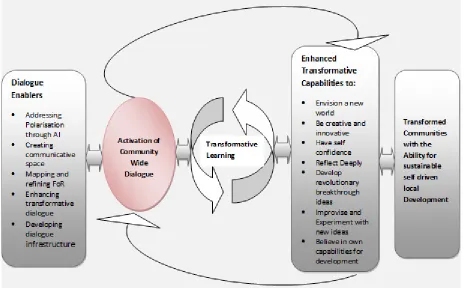
The facilitation process involved strengthening of dialogue enablers. These included; addressing polarisation within the community; creating
communicative space; mapping and refining problematic Frames of reference (FoR); enhancing transformative dialogue and developing dialogue infrastructure. These catalysed a community wide dialogue process which enhanced cycles of transformative learning. The resulting outcomes were enhanced transformative capabilities that strengthened community “self-drive” for locally driven development. The prototype that was utilised is outlined in Figure 1. It highlights the dialogue enablers (discussed in proceeding sections) that activated dialogue and transformative learning and the transformative capabilities by the community.
A key challenge in the facilitation of dialogue in Mhakwe ward was polarisation within the community. During the survey, polarisation was observed to have been compounded by a number of factors. There were perceptions of marginalisation in development programmes by some sections of the community including the youths, disabled and the elderly. Some of these marginalised groups had lost faith in participating in the local development discourse. There was a tendency of personalising NGO funded programmes by some community groups. This created camps around specific projects, for example names such as “veSave the Children; veCARITAS” which meant “Save the Children people” and “the CARITAS people” were common. Such personalisation was, to a large, extent, fuelled by competing and uncoordinated activities by
262
Facilitating transformative learning for community development
NGOs who fought for space yet serving the same community. Some NGOs for instance, personalised projects and would not allow partnerships with other NGOs. In most instances this blocked non-beneficiaries to engage and share knowledge since they felt their knowledge would only be utilised productively by those involved in the projects without any benefits accruing to them.
The community had a diversity of stakeholders, some having competing interests, priorities, views on social change, and frames of reference. Harmonising such diversity was a challenge in facilitating dialogue. At the inception of the programme, there were contestations over local chieftainship. This created divisions among some traditional leaders thus complicating engagement by some leaders in community dialogue. Some traditional leaders refused to participate in dialogue sessions that were held in rival leaders’ meeting places. The community faced periodic phases of political polarisation, particularly during the election periods. Such periods often disrupted the learning agenda due to politicisation of some dialogue fora including communities of practice for reflection and knowledge sharing and peer review meetings.
In recognition of the preceding contextual issues, the facilitators adopted and applied Appreciative Inquiry (AI) for developing an enabling environment for community wide dialogue. The origin of Appreciative Inquiry is linked to the original works of David Cooperrider in the late 1980’s (Finegold, 2002). The approach deviates from the traditional assumptions that community systems have inherent flaws that need to be fixed through systematic problem solving and interventions (Thatchenkery and Chowdhry, 2007). Rather than treating communities as problems, focus was placed on identifying positive capacities through dialogue. This energized the community for positive change through building on strengths of previous experiences and leveraging indigenous knowledge. The concept of AI is summarised by Cooperrider and Srivastva (2007) who state:
“Appreciative Inquiry, in essence, is an attempt to generate a collective image of the future by exploring the best of what is and has been. The basic rationale of Appreciative Inquiry is to begin with a grounded observation of the best of what is, articulate what might be, ensure the consent of those in the system to what should be, and collectively experiment with what can be” (Cooperrider and Srivastva, 1987).
The initiation of transformative dialogue through AI initially identified the best of “what is” and “what has been” for the Mhakwe community. This process was
conducted through village level meetings in all the six villages. Focus was on the uniqueness, extra-ordinary capabilities, events that the community is proud of, innovations and key developmental milestones in the Ward. These as identified in the community development plans included; The community’s’ receptiveness to innovation and openness to suggestions; ability for hard work; peaceful co-existence even with divergent political views; the ability to initiate projects with limited external support; and the community being friendly and willing to offer their services whenever needed. These identified uniqueness factors were utilised in initiating the appreciative community wide dialogue process. A series of dialogue sessions (see Table 1) were conducted during the action research process for peer review, sharing of experiences through reflections (most significant change stories) and planning.
Developing communicative space
Relationship building was deemed as fundamental in the facilitation process for a number of reasons. Firstly the dialogue and transformative learning agenda posed some challenges with regards to expectations from the community. In most of the previous NGO projects in Mhakwe, the relationship between facilitators and the community had been in the form of expert/subject dichotomy. Facilitators were viewed as experienced and knowledgeable problem solvers who brought ideas and solutions to solve community challenges. However, with regards to the transformative learning agenda a different relationship had to be created. Consideration or factor was based on mutual learning, knowledge co-creation and where communities had to initiate and drive the learning agenda. Mindset change of leaders was necessary for them to support the change process and appreciate the need for them to learn in the process. The strategy was for the facilitators to convince the community leadership that the Mhakwe CCI was purely a helping hand in passing and won’t stay in Mhakwe forever to solve community problems. Communities needed to capitalise on the programme to gain competencies that will help them to solve current and future programmes on their own. An analogy of a person who is ploughing their field and a passerby helps them briefly and then leaves, was consistently used to remind traditional leaders that the field was theirs and once the period for the CCI elapsed, they would have to continue on their own.
P. TIRIVANHU
risk of raising community expectations since the WK Kellogg Foundation had been in partnerships and funded a number of projects that had been implemented in parts of Chimanimani District prior to the prototype. There was need to clarify the distinction between prior investments that focused on “tangible” outputs as opposed to the learning process that focussed on “soft” processes.
Finally, it was felt critical by the facilitators to map and understand the cultural values and power dynamics within the Ward. Interactions with Facilitators from other NGOs who had worked in the Ward had indicated the importance of understanding power dynamics and cultural values. This was particularly crucial at the inception stage of the programme due to struggles over Chieftainship in the Ward. There was also political polarisation due to elections of Councillorship in the Ward between Zimbabwe African National Union Patriotic Front (ZANU PF) and Movement for Democratic Change Tsvangirayi (MDC T). The Councillorship kept changing hands between the two parties and this at time derailed progress as new Councillors had to familiarise and catch up with project activities. These factors have also been found to be important in improving mutual participation by facilitators and community members in studies by Arieli et al. (2009) that highlight the importance of roles, tasks and boundaries in creating mutual inquiry space. In recognition of these challenges, the facilitation process initially involved in-depth sensitisation with each Village head and the Chief. These ‘personalised’ meetings went a long way in creating relationships and trust between the traditional leadership and the facilitation team. Traditional leaders became more open to discuss progress and constraints within their villages. A series of village and Ward level meetings were then conducted to ensure a Ward level appreciation of the programme.
Mapping and refining problematic Frames of Reference
The way communities engage in development programmes is influenced by their Frames of Reference (FoR) or cognitive frameworks. These are applied to interpret and understand the world and build individual pattern of knowledge. They are influenced by norms, beliefs, language, values, culture, experiences including failure and success (Korte and Chermack, 2007; Biggs et al., 2011; Bossche et al., 2011).When individual community members work on a community project their actions are based on shared or collective norms, beliefs and values. A fundamental component in the facilitation process of the Mhakwe CCI was the refining of constructs of frames of reference of community members from total dependence on external assistance towards a mindset of “self-drive”. At the inception of
the programme in 2004, a series of sensitisation meetings were conducted at the village level in all the six villages in Mhakwe. A part of the agenda of these meetings was to make explicit FoR on donor support and local development, understanding the dynamics of community wide dialogue, and setting up the leaning agenda. During this process, four key elements of shared frames of reference emerged on donor support and local development, as general beliefs that:
Firstly, local development was primarily a domain of government and the donor community. This was evidenced by the reluctance by the community in some instances to initiative projects which necessarily didn’t need external assistance. An example was the case of the Chitopo water project which was funded by Towards Sustainable Utilisation of local Resources Organisation (TSURO dze Chimanimani). The community could not clear a path for the water tank to be accessible; instead, they still waited for TSURO to clear the road. Discussions with traditional leaders indicated that in the past road clearance for community projects was a community responsibility.
Secondly, external development assistance was supposed to bring immediate “tangible” benefits such as infrastructure, food aid, agricultural inputs as opposed to “soft’ benefits such as training, skills development and learning. Such beliefs were constantly echoed by a popular Shona statement by some opinion leaders; “Kurebesa munamato sadza richipora” which when translated into English meant “Prolonging the prayer for the food while the food is getting cold”. They believed that activities that focussed on “soft” aspects were merely a waste of time.
Thirdly, donor funding is ‘free money’ that is time bound and short lived. Community members needed to benefit while it was still available and utilise it before the next donor came; and lastly; dialogue on local development is project and donor specific. This was evidenced by the coining (or naming) of community groups around specific projects to a specific donor who provided funding.
264
Facilitating transformative learning for community development
The fundamental principle is on shared principles that one can only exist as part of a community (Munyuki-Hungwe, 2011). “I am because we are”.
A series of dialogue sessions led to the development of shared FoR constructs that later drove the transformative learning agenda. Such contructs that resonated at most dialogue sessions included; Development starts with me; Development is for me; I have an important role to play in my own development; I am because we are; I need to understand and own my development agenda; I have to drive my own development agenda; Solutions for our own problems lie within us; and donor funding is like (chema) token of bereavement which won’t support the family forever.
Another strategy was based on appreciative peer learning. The underlying assumption was that community members learnt more when they were exposed to real life experiences and they appreciate the capabilities of their peers. Community members were exposed to communities that showed high levels of transformative learning and self-drive. Inter communities of practice were then facilitated which facilitated continuous exchange of knowledge and experiences between the Mhakwe and other communities. Such programmes were facilitated with communities from Binga, Marondera and Chipinge.
Shifting the focus of dialogue
A critical issue in allowing transformative learning was to transform community dialogue sessions from problem solving to learning. Prior to the CCI interventions, community dialogue focused on, deliberative discussion for prioritising issues from ‘shopping lists’ of preferred interventions, mediation of conflicts and deliberations between the community and external change agents. A shift towards transformation dialogue entailed; crafting fora for exchanging positive experiences, enhance learning, critical reflection of issues, and appreciating community potential for social change and growth. A critical element was enabling Village Heads and the Chiefs to understand their roles in development and develop their emotional intelligence to be able to separate development dialogue from mediation of conflict and be able to stand back and see the world in the perspectives of the others and share knowledge. Such a process allowed the dialogue process to be critical and unveil underlying assumptions in local development. This was a challenging process, as some leaders would initially walk out of dialogue sessions when their positions were criticised. Continuous discussions with these leaders on the importance of deep reflection and critiquing ultimately led them to understand the agenda of the transformative dialogue sessions.
Another challenge was in inculcating the knowledge co-creating agenda. Communities regarded the facilitators as experts who are supposed to provide solutions to identified development issues. Continuous re-emphasizing finally led to the acknowledgement that communities had local knowledge which if harnessed would solve a large number of local development issues. Other skills that were deemed important to effective transformative dialogue included; capacity for community for deep listening, respecting each other’s ideas, ability for self-reflection, willingness to change and coming to share not to listen. An “infection model” was adopted as a mobilisation strategy for community wide dialogue. It was believed that the transformative learning process was not about numbers but knowledge generated for social change. The principle was that, as the knowledge on local development increased, and FoRs changed, more people would be “infected” and join the bandwagon. The key streams of dialogue already indicated in Table 1included; community based planning sessions; MDT monitoring meetings; training programmes; community based research; and communities of practice meetings.
Engaging multiple stakeholders in dialogue
A key challenge in facilitating transformative learning was to develop strategies for engaging various stakeholders in community wide dialogue within the Mhakwe CCI. These included traditional leaders, youths, various NGOs working in Mhakwe, Government departments, women, community champions or opinion leaders and other community groups including churches. Strategies and agenda for dialogue for these various stakeholders are discussed here.
Engaging traditional leadership
P. TIRIVANHU
to train youths and women in laying irrigation pipes and initiated dialogue sessions on planning community gardens; development of systems for water tariffs and utilisation of local skills in irrigation water management. However, the capacity building of traditional leaders was received with mixed feelings. The following quotation from a KII with a school teacher shows how some community sections felt:
“...the programme helped through funding leadership and skills development seminars and workshops. This was a way of producing people capable of spearheading social projects. It was hoped that training leaders would strengthen citizen participation in local decision making. This did not realise expected results because the same people particularly village heads were in the training leaving behind the rest of the people” Key Informant Interview with a School Teacher held at Mhakwe Primary School on 25 August 2013.
Such assertions are attributed to the fact that the introduction of the LeAD programme was a top down initiative which was not part of the initial community based planning for the CCI. It was a reactive process by the facilitators for the need to effectively engage traditional leadership. This shows the risks of deviation and applying top down interventions in the midst of implementing CCIs.
Engaging Councillors
Councillors are the link between Wards and the Rural District Council. They chair Ward Development Committees (WADCOs) that are responsible for deliberating ward development issues. These issues are deliberated at the RDC level through the Rural District Development Committee (RDDC). Councillors are political appointees, who in the case of Mhakwe were constantly changing between ZANU PF and MDC T political parties. The facilitators of the CCI felt there was need to continuously orient councillors from politically oriented engagement in development issues. Despite engaging in community leadership programmes, a special training and orientation programme was developed in partnership with Chimanimani RDC and the District Administrators office. The curriculum of the training programmes covered aspects including; conflict management, roles and responsibilities of Councillors in local development; basics of community development; legislated local development systems; and managing community dialogue sessions. These programmes motivated councillors to engage in community dialogue and some of them became community champions. For example, Murimindishe group, a community of practice for medicinal plants was established by a former Councillor
in Mhakwe ward as part of the CCI family projects initiative.
Engaging local development partners
Prior to the implementation of the CCI prototype, relations among most NGOs working in Mhakwe were characterised by fighting for space and ownership of projects. In some cases, collaborative work was complicated by the fact that different NGOs had different indicators for success and different time frames for implementation. Besides they were ultimately accountable to different funding agencies. However creating a common agenda between these NGOs and the community was critical for knowledge sharing. An NGO coordination forum was established and coordinated by MDT. The agenda was to share knowledge on local development activities and creation of synergies. The forum went a long way in clearing turf among NGOs who at the inception of the CCI competed for recognition and ownership of community projects. In addition communities shared experiences with NGOs on their own perspectives of transformational processes.
The engagement of local government departments including: extension service, social welfare, District Administrators, Chimanimani RDC, education department, health etc. was, to a large extent, limited by the availability of transport facilities to Mhakwe due to lack of financial resources. Results from quantitative surveys at the summative phase (n=65) indicate that 69% of the respondents felt that government departments were effective in engaging the community in dialogue. They main reasons were; government department provided expertise when needed (36.9%) and; relevant departments collaborated well in giving joint support (33.9%). However, some sections of the community, particularly NGO representatives felt the participation by government departments was driven by the need for travel and subsistence allowances.
Other active stakeholders
266
Facilitating transformative learning for community development
recorded and disseminated proceedings of dialogue sessions. This was through minutes, reports and newsletter articles.
Dialogue Infrastructure
The development of dialogue infrastructure was viewed as important in promoting community wide dialogue. Infrastructure is not taken in the sense of physical structure but as important components of the Transformative learning system. It brought a sense of renewed commitment by the community to resuscitating dialogue. Dialogue infrastructure included the construction of village courts (Mapungu); modernising and professionalising dialogue platforms through Information Communication Technologies (ICTs); and resuscitating Village Development Committees (VIDCOs). The contribution of these infrastructures is briefly discussed here.
Construction of Village Courts. These were jointly constructed at the request of the community in recognition of the need for meeting places that would allow free participation in democratic transformational dialogue. Communities provided labour, and other locally available building materials. These places become hubs of dialogue on all issues pertaining to village development. They brought a renewed commitment to village level dialogue.
Modernising through ICTs. ICTs were instrumental in encouraging youths to participate in community wide dialogue. Youths became active in conducting research and documenting local knowledge. A community newsletter (The Voice of Mhakwe) was established. Youths were trained in news writing editing and photography. The newsletter became a major tool for knowledge sharing. Electronic copies of community deliberations were made available for discussions. A
community based Geographical Information Systems (GIS) youth team was established which provided spatial information to support community dialogue Resuscitating Village Development Committees (VIDCOs). These are structures mandated to drive local level development. However, in most villages, they were non-functional and were not constituted based on the statutory instruments. They are governed by the Rural District Councils Act. The programme facilitated their resuscitation guided by the statues. This revived dialogue at the village level.
RESULTS AND DISCUSSION FROM EVALUATION OF THE DIALOGIC
TRANSFORMATIVE LEARNING PROCESS
Exploring factors affecting participation in dialogue
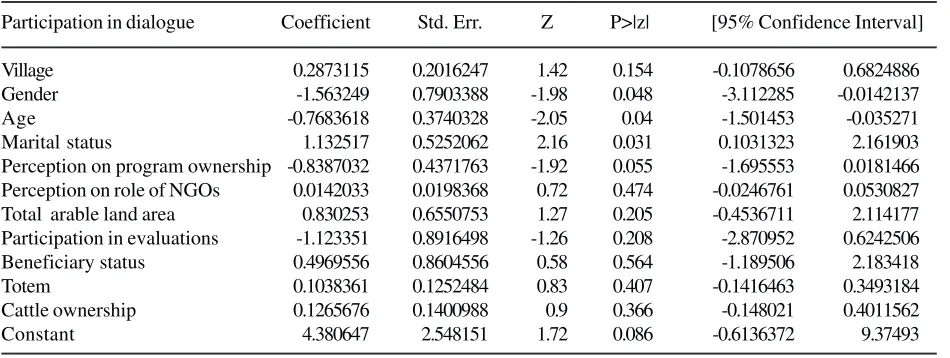
This section explores factors that impacted on participation by community members in dialogue. Binomial logistic regression at the summative evaluation phase (with dummy variables; 1=participation in dialogue and 0=non participation) indicated key factors affecting participation in dialogue as; the village where respondents resided; gender; age; marital status; perceptions on who owned the programme; perceptions on the role of Non-Governmental Organisations; total land area possessed by the household; participation in evaluations; beneficiary status; totem of respondent; and cattle ownership (see Table 2). These variables contribute 20% of the explanation for participation in dialogue (Pseudo R2 = 0.2064). Studies by for example,
Bukenya et al. (2003) show that Pseudo R2 figures of
above 0.20 in rural development are considered as good in testing goodness of fit. These variables are in line with Li and Marsh (2008) who proposed a tripartite structure of variable for civic engagement and dialogue; demographic, cultural and social stratification variables. Following this typology, the Demographic variables are;
Table 2: Binomial Logistic Regression Results for Participation in Dialogue (n=65)
Participation in dialogue Coefficient Std. Err. Z P>|z| [95% Confidence Interval]
Village 0.2873115 0.2016247 1.42 0.154 -0.1078656 0.6824886
Gender -1.563249 0.7903388 -1.98 0.048 -3.112285 -0.0142137
Age -0.7683618 0.3740328 -2.05 0.04 -1.501453 -0.035271
Marital status 1.132517 0.5252062 2.16 0.031 0.1031323 2.161903
Perception on program ownership -0.8387032 0.4371763 -1.92 0.055 -1.695553 0.0181466 Perception on role of NGOs 0.0142033 0.0198368 0.72 0.474 -0.0246761 0.0530827 Total arable land area 0.830253 0.6550753 1.27 0.205 -0.4536711 2.114177 Participation in evaluations -1.123351 0.8916498 -1.26 0.208 -2.870952 0.6242506
Beneficiary status 0.4969556 0.8604556 0.58 0.564 -1.189506 2.183418
Totem 0.1038361 0.1252484 0.83 0.407 -0.1416463 0.3493184
Cattle ownership 0.1265676 0.1400988 0.9 0.366 -0.148021 0.4011562
Constant 4.380647 2.548151 1.72 0.086 -0.6136372 9.37493
P. TIRIVANHU
village, gender, age and marital status. Cultural variable is the totem and the social stratification variables are; perception on ownership, perceptions on roles of NGOs, total land area, number of cattle, participation in evaluations and beneficiary status. The impacts of these variables on participation in community wide dialogue are discussed here.
The contribution of the village where respondents resided can be explained by differential benefits at the village level and varied leadership styles of village heads. Funding of village projects was based on the level of creativity and community commitment to kick-start projects. While some villages such as Chikutukutu had vibrant projects (the Chikutukutu micro irrigation scheme) in some villages such as Zimunda, projects were not active. Some villages did not have vibrant projects at the village level hence community members felt there was little to share and learn from. Some village heads used coercion, failed to create democratic processes and conducive learning environments. The issue of the impacts of differential benefits at the village level is further highlighted by the following statements from Focus Group Discussions with youths and opinion leader representatives held in August 2013:
“...some villages felt that particular villages benefited more than others. This created a crack within the community. This will even affect future donor programmes. Even if we are to call traditional leaders now, they would not work in the same way as they did at the start of the programme, because of differences in benefits and some decisions that were made. There is need for a big meeting to manage the situation”.
“...what made it worse was that some of the people who benefited did not even make it a secret that they were benefiting more. Even when people were discussing during meetings, they always wanted to dominate. Some people then felt as if they were being used. The situation was always biased towards certain directions”
Gender, age and marital status were statistically significant (p<0.05). The significance can be explained by the deliberate focus by the programme on promoting participation of women and youths, including targeted leadership training and targeted projects. The contribution of marital status as a statistically significant variable can be explained by two scenarios; firstly there was a statistically significant association between marital status and leadership positions (X2
3= 13.0842; P =
0.004) this could provide a push factor for participating in dialogue as leaders were de facto participants since they led the dialogue sessions.
Secondly, seventy five percent (75%) of the respondents for the survey were married. The contribution of marital status although highlighted by a number of authors is not well articulated. For example Nummela et al. (2008) mentions a close association between trust and engagement in dialogue but report low levels of trust among the divorced and separated. In this study, there was statistically significant association between marital status and age X2
12 =
32.3332; P= 0.001). Li and Marsh (2008) in a study for participation in political dialogue explain such an association to the fact that individuals who were once married were above 60 years of age and were not interested in political debates.
The feeling that community members and local institutions owned the programme through decision making, identifying partners, controlling financial resources and were in charge of Monitoring and Evaluation, brought in legitimacy and sense of empowerment which increased the propensity for participation in dialogue. Survey results indicated that 60% of the respondents perceived the programme as being owned by the community. Deliberations during dialogue session reflected renewed commitment to dialogue. Words such as “chirochedu” in Ndau, meaning “our thing” in English during dialogue sessions reflected a high sense of ownership and continued commitment to dialogue. The contribution of ownership to participation in dialogue is echoed in studies by Ritchie et al. (2004) that highlight the importance of specifying the parity of input by community members, over representation by some local institutions and agreement on who the “community” should comprise. Such issues can create infighting among community members that can affect community dialogue.
268
Facilitating transformative learning for community development
households participated more in dialogue since they exppected to learn and benefit more.
The influence of participation in evaluation towards engaging in dialogue is explained by the fact that community members who were engaged in the Community Based Monitoring and Evaluation process were mandated to share knowledge during reflection and dialogue sessions. On the other hand totemismas a contributing variable to engagement in dialogue can be linked to the skewed distribution of totems in the ward. A person’s totem comprises three elements; Mutupo, Chidao and Dzinza. These are the patrilineal clan, sub clan and sub section of the clan. They have religious and symbolic meanings. They trace family roots and geographical location of the great -grand parents of the clan (Chimhanda, 2013; Barr et al., 2014). Survey results indicated that 55% of respondents were of the Moyo Chirandu totem with other notable totems being Beta (10%); Maphosa (6%), Soko (5%) and Chihwa (5%). Action research experiences indicate that one of the most active, influential and charismatic village head from Chikutukutu was of the Moyo Chirandu totem. The village head is one of the development champions and commands large gatherings at dialogue sessions.
Impacts on social change
The first impact was the resuscitation of community dialogue. Prior to the Mhakwe CCI interventions, there was dearth in community wide dialogue. There was evidence of an increase in the number of communities of practice for women and youths. These were initiated from recognising the importance of knowledge sharing. Examples include; the Tigere Group, comprising indigenous poultry producers who met periodically to share knowledge and experiences; the Mhakwe Youth Empowerment group, comprising youths who engaged in various income generating activities and shared experiences and the Herbal garden group who met to share knowledge and experiences on the production and processing of herbal medicines. VIDCO meetings were reactivated and allowed a platform for community planning and review of progress. The community had a different view on the approach to planning at VIDCO meetings. They were now realising the importance of harnessing knowledge from their own people which resulted in the inclusion of formerly marginalised groups (women and youths) in main stream local development activities. Household survey results indicated that 54% of the respondents still participated in dialogue after funding for the Mhakwe CCI ran out.
Experiences from the action research process indicate shifts in frames of reference for some traditional leaders who now showed self-drive through initiating village projects without waiting for external assistance. Within
such projects, there was realisation of the need for harnessing and sharing local knowledge. For example a borehole repair group was established from retired and some experiences local experts to maintain small scale irrigation schemes and boreholes. Other observable qualitative measures included renewed hope in local development, confidence in local solutions and commitment by community members to solving and contributing to local initiatives. Some changes in behavioural traits and conduct in meetings were observed, including openness by women towards providing more critique and improved participation in debates
CONCLUSIONS AND LESSONS FOR COMMUNITY DEVELOPMENT
This study explored the facilitation of community wide dialogue as a tool for transformative learning. The rationale for transformative learning as an approach for rural development interventions was given in the introductory sections. It is rooted in the need for refining FoR that guide assumptions, actions, beliefs and meaning making. It is argued that refining problematic frames of reference that impede self-drive mindsets is fundamental for facilitating deep rooted social needs. Five fundamental research questions were addressed in this paper. Firstly, what are the critical factors in ensuring a community wide dialogue and learning architecture? Secondly how is transformative learning enhanced? Thirdly, what factors determine effective engagement in community dialogue? Fourthly, how can community learning for social change be facilitated and finally, how do dialogue and transformative learning contribute towards local level development?
P. TIRIVANHU
Key factors that affect participation in dialogue were identified as; the village where respondents resided; gender; age; marital status; perceptions on who owned the programme; perceptions on the role of Non-Governmental Organisations; total land area possessed by the household; participation in evaluations; beneficiary status; totem of respondent; and cattle ownership. Transformative learning was found to have positive impact on social change, particularly increasing the number of communities of practice, improved innovation and motivation at village level; improved behavioural traits among individuals including confidence in local skills, confidence in local solutions, and openness and improved critiquing by women during dialogue. Transformative learning through community wide dialogue offers a promising model for community empowerment. Development institutions need to embrace transformative learning as a strategy for sustainable social change.
STATEMENT OF NO CONFLICT OF INTEREST
The author of this paper hereby declares that there are no competing interests in this publication.
REFERENCES
Affolter, F., Richter, K., Afaq, K., Daudzai, A., Massood, M. and Rahimi, N. 2009. Transformative learning and mind-change in rural Afghanistan. Development in Practice 19 (3):311-328.
Arieli, D., Fiedman, V. and Agbaria, K. 2009. The paradox of participation in action research. Action Research 7 (3):263-290.
Bangwayo-Skeet, P.F., Bezabih, M. and Zikhali, P. 2010. Are Zimbabwe’s fast track land reform farms more technically efficient than communal farms? Quarterly Journal of International Agriculture 49 (4):319-339.
Barr, A., Dekker, M. and Fafchamps, M. 2014. The formation of community-based organizations: An analysis of a quasi-experiment in Zimbabwe. World Development 66:131-153.
Biggs, D., Abel, N., Knight, A., Leitch, A., Langston, A. and Ban, N. 2011. The implementation crisis in conservation planning: Could “mental models” help? Conservation Letters 4:169-183.
Bossche, P., Gijselaers, W., Segers, M., Woltjer, G. and Kirschne, P. 2011. Team learning: building shared mental models. Instructional Science 39:283-301.
Bukenya, J., Gebremedhin, T. and Schaeffer, P. 2003.Analysis of quality of life and rural development: Evidence from West Virginia Data. Growth and Change 34 (2): 202-218.
Chimhanda, F. 2013. Relevance of theology in relation to spirituality: An African Bantu perspective. Scriptura 112 (1):1-17.
Chiweshe, M.K. 2011. Farm level institutions in the emergent communities in post fast track Zimbabwe: A case of Mazowe District. PhD Thesis, Rhodes University.
Dessel, A. and Rogge, M. 2008. Evaluation of intergroup dialogue: A review of the empirical literature. Conflict Resolution Quarterly 26 (2):199-238.
Finegold, M., Holland, B. and Lingham, T. 2002. Appreciative inquiry and public dialogue: An approach to community change. Public Organization Review: A Global Journal 2:235-252. Goodwin, T. and Hallam, S. 2006. Lifelong learning: The role of emotional intelligence. In Sutherland, P. and Crowther, J. Lifelong Learning. pp. 117-126. Routledge. New York.
Hanlon, J., Manjengwa, J. and Smart, T. 2013 Zimbabwe takes back its land. Kumarian Press. Johannesburg.
Hove, M. and Gwiza, A. 2012. The fast track land reform programme and food insecurity: A case of Zimbabwe from 1992-present. American International Journal of Contemporary Research 2 (8):282-293.
Korte, R. and Chermack, T. 2007.Changing organizational culture with scenario planning. Futures 39: 645-656.
Lange, E. 2004. Transformative and restorative learning: A vital dialectic for sustainable societies. Adult Education Quarterly 54 (2):121-139. Li, Y. and Marsh, D. 2008. New forms of political
participation: Searching for expert citizens and everyday makers. British Journal of Political Science 38 (2): 247-272.
Matondi, P.B. 2012. Zimbabwe’s fast track land reform. Zed Books, London and New York.
Mezirow, J. 2000. Learning as transformation: Critical perspectives on a theory in progress. Jossey-Bass. San Francisco.
Mezirow, J. 2003. Transformative learning as discourse. Journal of Transformative Education 1 (1):58-63.
Mezirow, J. 2006. An overview on transformative learning. In: Sutherland, P. and Crowther, J. Lifelong Learning: Concepts and contexts (24-38). Routledge. London and New York.
Munyuki-Hungwe, M. 2011. In search of ‘Community’ in Zimbabwe’s fast track resettlement area of Mazowe District. PhD Thesis, Lund University. Nummela, O., Sulander, T., Rahkonen, O., Karisto, A.
and Uutela, A. 2008. Social participation, trust and self-rated health: A study among ageing people in urban, semi-urban and rural settings. Health and Place 14:243-253.
270
Facilitating transformative learning for community development
Ritchie, D., Parry, O., Gnich, W. and Platt, S. 2004. Issues of participation, ownership and empowerment in a community development programme: Tackling smoking in a low-income area in Scotland. Health Promotion International 19(1): 51-59.
Rusinga, O., Chapungu, L., Moyo, P. and Stigter, K. 2014. Perceptions of climate change and adaptation to micro climate change and variability among smallholder farmers in Mhakwe communal area, Manicaland Province, Zimbabwe. Ethiopian Journal of Environmental Studies and Management 7 (3):310-318.
Thatchenkery, J. and Chowdhry, D. 2007. Appreciative inquiry and knowledge management: A social constructionist perspective. Edward Elgah Publishing Limited. Northhampton.
Uitdewilligen, S., Waller, M. and Pitariu, A. 2013. Mental model updating and team adaptation. Small Group Research 44 (2):127- 158.
Van der Veen, R. 2000. Learning natural resource management: Deepening the basis of rural management. ISNAR. The Hague.
Wicks, P. and Reason, P. 2009. Initiating action research: Challenges and paradoxes of opening communicative space. Action Research 7 (3):243-262.
Zikhali, P. and Chilonda, P.2012. Explaining productivity differences between beneficiaries of Zimbabwe’s fast track land reform programme and communal farmers. Agrekon: Agricultural Economics Research, Policy and Practice in Southern Africa 51 (4):144-166.