Research Forum
Introduction to band structure calculations using the LAPW method
Shivraj Gurung
Pachhunga University College, Aizawl 796 001, India
Received 28 March 2012 | Revised 25 July 2012 | Accepted 30 July 2012
ABSTRACT
This paper is a discussion on a brief introduction to the density functional theory (DFT). The for-malism and the approximations made for easy computation has been mentioned along with the two theorems of Hohenberg and Kohnon which the density functional theory is based. In the end, the Kohn-Sham equation which turned density functional theory into a practical tool to obtain the ground state density has been explained along with the LAPW method.
Key words: Hatree Fock; density functional; linearized augmented plane wave; Kohn-Sham equation; density functional theory.
Corresponding author: Gurung Phone: +91-9862572955
E-mail: [email protected]
INTRODUCTION
The study of the properties of a solid espe-cially the electronic band structure is a com-plex quantum mechanical many body prob-lem whose exact solution is well nigh impossi-ble, as such many approximate methods have been developed. In general there are two types of methods for quantum mechanical ap-proaches: Hartree Fock (HF) method and
Density Functional Theory (DFT).1 HF is
based on wave function description in which exchange is treated but correlation is ignored. The density functional theory on the other hand is based on the electron density rather than on the wave function and treats both ex-change and correlation but only approxi-mately. In the density functional theory, the
calculation of ground state properties such as band structure, optical properties, lattice pa-rameter, equilibrium volume, phonon fre-quencies, elastic constants etc, which are based on the calculation of the total energy, are described quite accurately. However, the treatment of excited states is not rigorously justified. This is due to the fact that the
Hohenberg-Kohn1 theorem is exact only for
the ground state and that the Kohn-Sham
(KS) eigenstates2 must not be interpreted as
single-electron states. Apart from this, ap-proximations must be made also in the ground state calculations for describing ex-change and correlation effects. In spite of this, the interpretation of the KS states in terms of excited states has been successful for a variety of materials. Moreover, it has been claimed that the KS wave functions hardly differ from
the many-body wavefunctions.3-5 Thus it can
theory is one of the most successful methods for calculating lattice properties of a solid. We discuss here the basic formalism of band structure calculation by using the linearised
augmented plane wave (LAPW) method.6-10
FORMALISM
A solid is a collection of a heavy positively charged nuclei and lighter negatively charged electrons. If we have N nuclei, we are dealing with N+ZN electromagnetically interacting quantum particles. This is a quantum many body problem and the exact many particle hamiltonian for such a system is,
(1)
where Mi is the mass of the nucleus at Ri, me is
the mass of the electron at ri. The first term is
the kinetic energy operator for the nuclei, the second term represents kinetic energy opera-tor for the electrons. The last three terms de-scribe the coulomb interaction between elec-trons and nuclei, between elecelec-trons and other electrons and between nuclei and other nu-clei. It is impossible to solve Eq. (1) exactly, as such in order to obtain acceptable appro-priate eigen states, approximations are made.
BORN-OPPENHEIMER APPROXIMATION
In this approximation, the nuclei which are heavier and are therefore much slower than the electrons are taken stationary and are assumed to be in instantaneous equilibrium with the electrons. As a consequence, the nu-clei do not move anymore and their kinetic energy is zero so that the first term in Eq. (1) vanishes and the last term reduces to a con-stant. Thus we are left with kinetic energy of the electron gas, the potential energy due to electron-electron interactions and the
poten-tial energy of the electrons in the (now exter-nal) potential of the nuclei. Thus the Hamilto-nian can be written as,
(2)
The quantum many body Hamiltonian ob-tained after Born-Oppenheimer approxima-tion is much simpler than the original one but still far too difficult to solve. One of the well known methods used to reduce Eq. (2) to an approximate but tractable form is the density functional theory.
DENSITY FUNCTIONAL THEORY
Density functional theory is a universal approach to the quantum mechanical many body problem, where the system of interact-ing electrons is mapped in a unique manner onto an effective non-interacting system with the same total density. It is based on the two
theorems of Hohenberg and Kohn.1
First theorem: There is one to one
corre-spondence between the ground state density ρ
( r ) of a many electron system and the
exter-nal potential Vext. This means that the ground
state expectation value of any observable Ôis
a unique functional of the exact ground state electron density
(3)
Second theorem: For Ô being the
hamilto-nian Ĥ, the ground state total energy
func-tional is of the form
(4)
(5)
where, , the
Hohen-berg-Kohn density functional is universal for
any many electron system. EVext[ρ] reaches its
minimal value (equal to the ground state total energy) for the ground state density
corre-sponding to Vext. The consequence of the
sity functional theory is that the electron
den-sity ρ( r ) uniquely defines the total energy E
ji i j
j i
j
i i j
j
i i j
i i e i i Z Z e e Z e m M
H i i
R R 8 1 r r 8 1 R R 4 1 2 2 ˆ 2 2 2 2 2 2 2 , r R
ji i j
j i
j
i i j
j
i i j
i i e i i Z Z e e Z e m M
H i i
R R r r R R ˆ , r R 2 2 2 2 2 2 2 8 1 8 1 4 1 2 2 j
i i j
j i
j
i i j
j
i i j
i i e i i Z Z e e Z e m M
H i i
R R r r R R ˆ , r R 2 2 2 2 2 2 2 8 1 8 1 4 1 2 2 ext V V T
Hˆ ˆ ˆ ˆ
Oˆ O
ext V E
H
T V
Vext
E ext V ˆ ˆ ˆ
T
V
F
HK
ˆ
ˆ
of a system and is a functional E[ρ] of particle potential, which consists of a classical mean-field part and an exchange-correlation part that in principle incorporates all correlation effects exactly.
THE KOHN-SHAM EQUATIONS
The equations of Kohn and Sham2 turned
density functional theory into a practical tool to obtain the ground state density. The Kohn-Sham theorem can be formulated as:
The exact ground-state density ρ( r ) of an
N-electron system is
(6)
Where the single-particle wave functions φi
( r ) are the N lowest-energy solutions of the
Kohn-Sham equation
(7) Where, the Kohn-Sham Hamiltonian is
(8)
where, Vxc is the exchange correlation
poten-tial and Vext is the external potential from the
nucleus. It must be noted that the
single-particle wave function φi ( r ) are not the wave
functions of electrons but they describe mathematical quasi-particles without a direct physical meaning. Only the overall density of these quasi-particles is guaranteed to be equal to the true electron density. Also the
single-particle energies εi are not single electron
en-ergies.
Both the Hartree operator VH and the
ex-change-correlation operator Vxc depend on
the density ρ( r ), which in turn depends on
the φi ( r ) which are being searched. This
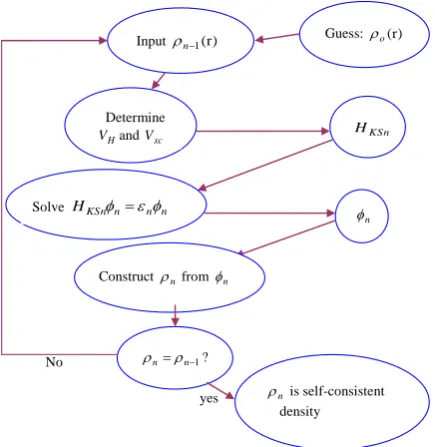
means we are dealing with a self-consistency problem. To overcome this, an iterative
pro-cedure11 is needed (Fig. 1). Some starting
den-sity ρ0 is guessed, and a Hamiltonian HKS1 is
constructed with it. The eigenvalue problem
is solved and results in a set of φ1 from which
a density ρ1 can be obtained. Most probably
ρ0 will differ from ρ1. Now ρ1 is used to
con-struct HKS2, which will yield a ρ2, etc. This
procedure is continued till the series
con-verges to a density ρf which will generate HKSf
which yields as solution again ρf so that this
final density is in consistent with the Hamil-tonian.
THE LAPW METHOD
The linearised augmented plane wave (LAPW) method is based on the density func-tional theory for the treatment of exchange and correlation and uses, e.g. the local spin density approximation (LSDA). Like most energy-band methods, the LAPW method is a procedure for solving the Kohn-Sham equa-i
i i KS
H
ˆ
ext xc H o
KS T V V V
Hˆ ˆ ˆ ˆ ˆ
(r)
(r) rr r
) r ( 4
2
2 2 2
ext xc
o i
e
V V
d e
m
yes
Determine
H
V and Vxc
Solve HKSnnnn
n
Construct n fromn
1
n
n
?
n
is self-consistent density
KSn
H
Guess: o(r)
No
Input n1(r)
Figure 1. Flow chart for the nth iteration in the self con-sistent procedure to solve Kohn-Sham equations.
N
i
i i 1
) r ( ) r ( )
r
(
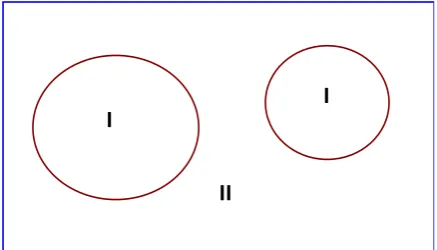
tions for the ground state density, total energy and (Kohn-Sham) eigenvalues (energy bands) of a many electron system (crystal) by intro-ducing a basis set which is especially adapted to the problem. This adaptation is achieved
by dividing the unit cell into (I)
non-overlapping atomic spheres (centered at the
atomic sites) and (II) an interstitial region
(Fig. 2).
In the two types of regions different types of basis sets are used:
(a) Inside the atomic sphere I of radius Rt,
a linear combination of radial functions times
spherical harmonics Ylm ( r ) is used as given
below12
(9) where ul( r,El ) is the (at the origin) regular
solution of the radial Schrödinger equation
for energy El (chosen normally at the centre
of the corresponding band with l-like
charac-ter) and spherical part of the potential inside the sphere I; ůl( r,El ) is the energy derivative
of ul evaluated at the same energy El. A linear
combination of these two functions consti-tutes the linearization of the radial function.
The coefficients Alm and Blm are functions of kn
determined by requiring that this basis func-tion matches each plane wave (PW), the cor-responding basis function of the interstitial
region. ul and ůl are obtained by numerical
integration of the radial Schrödinger equation on a radial mesh inside the sphere.
(b) In the interstitial region II, a plane
wave expansion is used
(10)
where kn = kn + Kn ; Kn are the reciprocal
lat-tice vectors and k is the wave vector inside
the first Brillouin zone. Each plane wave is augmented by an atomic-like function in every atomic sphere.
The solution to the Kohn-Sham equations are expanded in this combined basis set of LAPW’s according to the linear variation method
(11)
and the coefficients Cn are determined by the
Rayleigh-Ritz variation principle. The conver-gence of this basis set is controlled by a
cut-off parameter RmtKmax = 6 – 9, where Rmt is the
smallest atomic sphere radius in the unit cell
and Kmax is the magnitude of the largest K
vec-tor in Eq. (11). On the basis of these approxi-mations, FORTRAN programmes had been written and developed into a code called
WIEN2k11 code, which is a multiple tasked
code. This code can be used to compute band structure as well as other properties like den-sity of states, x-ray spectra, optical properties etc.
REFERENCES
1. Hohenberg P & Kohn W (1964). Inhomogeneous electron gas. Phys Rev, 136 (3B), 864-71.
2. Kohn W & Sham LJ (1965). Self-consistent equations including exchange and correlation effects. Phys Rev, 140 (4A), 1133-38.
3. Hybertsen MS & Louie SG (1986). Electron correlation in semiconductors and insulators: Band gap and quasipar-ticle energies. Phys Rev, B34, 5390-5413.
4. Levine ZH and Allan DC (1989). Linear optical response in silicon and germanium including self-energy effects. Phys RevLett, 63, 1719-1722.
5. Levine ZH & Allan DC (1991). Quasiparticle calculation of
lm
lm l l lm, l l
lm, u E B u E Y
A
n n
n k (r, ) k (r, ) (r)
k
I
II
I
Figure 2. Partitioning of the unit cell into two: atomic spheres (I) and an interstitial region (II).
r k
n
n
i
k e
ω
1
n n n
C
kk
the dielectric response of silicon and germanium. Phys Rev, B43, 4187-4207; Ernst A, Henke J & Thapa RK (2005). Antiferromagnetic films on a ferromagnetic substrate: a first principle study of Mn on Fe(001). J Phys Cond Matter,
17, 3269-3284.
6. Andersen OK (1973). Simple approach to the band-structure proble. Solid State Commun, 133-136; Andersen OK (1975). Linear methods in band theory. Phys Rev, B 12, 3060-3083.
7. Blaha P & Schwarz K (1983). Electron densities and chemical bonding in TiC, TiN, and TiO derived from en-ergy band calculations. Int J Quantum Chem, XXIII, 1535-1552.
8. Novak P, Boucher F, Gressier P, Blaha P & Schwarz K (2001). Electronic structure of the mixed valence system (YM)2BaNiO5 (M=Ca, Sr). Phys Rev, B63, 235114-235121. 9. Singh DJ (1994). Plane Waves, Pseudopotentials and the
LAPW Method. Kluwer Academic Publishers, Boston,