
Iterative Minimum Bit Error Rate Multiuser Detection in Multiple Antenna Aided OFDM
L.Xu, S.Tan, S.Chen, L.Hanzo
1School of ECS, Univ. of Southampton, SO17 1BJ, UK.
Tel: +44-23-8059 3125, Fax: +44-23-8059 3045
Email:
1[email protected], http://www-mobile.ecs.soton.ac.uk
Abstract –A novel iterative Multiuser Detector (MUD) is proposed for employment in Space Division Multiple Ac-cess (SDMA) aided Orthogonal Frequency Division Multi-plexing (OFDM) systems, where the uplink transmissions of the users share the same bandwidth. The individual users’ signals are differentiated with the aid of their unique user-specific Channel Impulse Responses (CIRs). The MUD commences its operation on a subcarrier by subcarrier ba-sis from the Minimum Mean Square Error (MMSE) MUD antenna array weight vector and invokes the Conjugate Gradient (CG) algorithm for the sake of iteratively adjust-ing the array weight vector in the direction of the MUD’s true Minimum Bit Error Rate (MBER) solution. Recur-sive Systematic Convolutional (RSC) codes are used for en-hancing the system’s attainable BER performance, which exchange extrinsic information with the MBER MUD for the sake of achieving a turbo-detection aided iteration gain, resulting in the creation of a powerful turbo MBER MUD for employment in multiuser SDMA OFDM systems. The novel benefit of the proposed system is that it is capable of supporting up to a factor two higher number of users than the number of receiver antennas. Explicitly, the technique advocated outperforms other SDMA MUDs with the ad-vent of its MBER optimization criterion and turbo detec-tion structure. Up to 2dBs of iteradetec-tion gains are attained.
1. INTRODUCTION
Space Division Multiple Access (SDMA) is capable of sub-stantially increasing the achievable system capacity with the aid of employing antenna arrays [1, 2]. In recent years, Or-thogonal Frequency Division Multiplexing (OFDM) has at-tracted intensive research interests owing to its numerous ben-efits, such as for example that of converting frequency selec-tive channels to parallel non-dispersive flat fading channels [2]. Combining these two techniques has the promise of achieving reliable wireless communications at high data rates with the aid of efficient MUD algorithms. The family of the Minimum Bit Error Rate (MBER) MUDs has the potential of outperforming the classic Minimum Mean Square Error (MMSE) receivers, since it directly minimizes the Bit Error Ratio (BER), rather
The financial support of the EPSRC UK and that of the European Union in the framework of the Phoenix and Newcom projects is gratefully acknowl-edged
than the mean-squared error (MSE) [3, 4]. Numerous tech-niques, including the Conjugate Gradient (CG) algorithm and Genetic Algorithms (GA) may be invoked for calculating the MBER MUD weight matrix [3, 4].
Since the discovery of the turbo principle in 1993 by Berrou, et al[5], iterative detection has found applications in channel coding [6], channel estimation, equalization [6] and multiuser detection [6, 7]. The conventional MMSE algorithms can also be combined with iterative detection by employing the covari-ance matrix of the estimated transmit signals to represent the extrinsic information forwarded by channel decoders [8, 9]. Similarly, an iterative MBER MUD can also be created by fur-ther developing the original MBER algorithms of [3, 4].
Hence, in this contribution, we will propose a novel it-erative soft-in-soft-out (SISO) MBER MUD and investigate its performance in comparison to iterative MMSE algorithms employed as the benchmark scheme in the context of SDMA OFDM using Recursive Systematic Convolutional (RSC) codes and BPSK modulation of each OFDM subcarrier. We assume that perfect Channel State Information (CSI) is available at the receiver. Our results will demonstrate that the proposed detec-tor is capable of significantly outperforming the MMSE MUD, especially in the so-called over-loaded scenarios, namely when the number of SDMA users supported is higher than the num-ber of receiver antennas at the base station. The CG is utilized for arriving at the MUD’s weight vectors.
The outline of this contribution is as follows. In Section 2, the MBER system model is introduced, while the focus of Section 3 is the design of the iterative MBER SDMA MUD. Our system performance results are presented in Section 4, fol-lowed by our conclusion in Section 5.
2. SYSTEM MODEL
2.1. Space Division Multiple Access
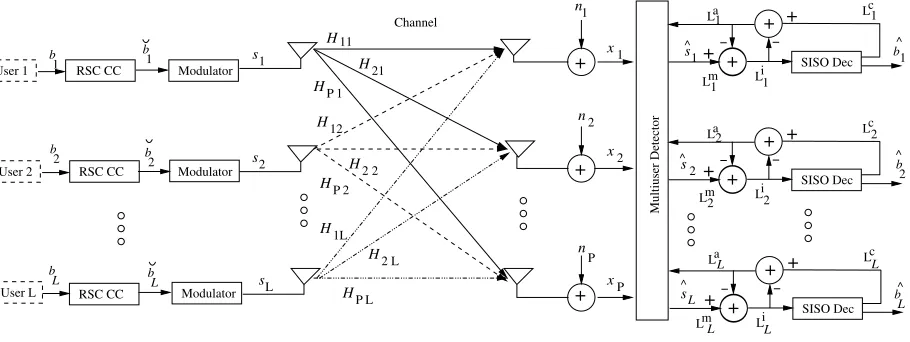
Fig. 1 portrays the SDMA uplink transmission scenario con-sidered. In this approach, each of the Lsimultaneous users is equipped with a RSC encoder and a single transmission an-tenna, while the base-station’s receiver has a P-element an-tenna array. The iterative MUD benefits from exploiting both the channel’s input information and the extrinsic information
Modulator +
n
xP
P Modulator
1
b
User 2 2
b
RSC CC
b L
User L
1
n
SISO Dec
^s
2
SISO Dec SISO Dec
2
b
1
b
b L
Channel
Multiuser Detector
s
1
H
H2 HP
H2 HP
H2 H
1
2
L
s
s 1
1 1 2
2 1
H
2
H1L
L L P User 1 RSC CC
Modulator RSC CC
+ x1
+
x n2
2
+ + +
+
+ + +
+
^
1
s
+ + +
+ 1
^ b
1
1 1
2
b ^
2
2 2
L b^
L
L
2 1
L ^
sL
L
Lc La
Li
Lc Lc La
Li
Lm Lm
La
[image:2.595.88.543.69.240.2]Lm Li
Figure 1: Schematic of the iterative SDMA OFDM uplink scenario, where each of theLusers is equipped with a RSC channel code and a single transmit antenna, while the BS’s receiver is assisted by a P-element antenna array followed by iterative processing.
a-priori informationLa for the SDMA MUD. The outputs of the MUD are forwarded to a bank of SISO channel decoders for the sake of generating the a-posteriori informationLc for carrying out the final decisions concerning the original source bits. No interleavers have to be invoked in this scheme for im-proving the efficiency of the extrinsic information generated, since we achieve an iteration gain for a given user with the the aid of the a-priori knowledge of the other user’s interfer-ence, extracted from the antenna array. The set of complex signals,xp[n, k], p ∈1, . . . , P received by theP-element an-tenna array in thek-th subcarrier of then-th OFDM symbol is constituted by the superposition of the independently faded signals associated with the L users sharing the same space-frequency resource [2]. In addition to the Multiple Access In-terference (MAI), the received signal was also corrupted by the Gaussian noise at the array elements. The indices[n, k]have been omitted for notational convenience during our forthcom-ing discourse, yieldforthcom-ing [2]:
x = Hs+n = ¯x+n, (1)
wherexis the(P×1)-dimensional vector of received signals,s
is the(L×1)-dimensional vector of transmitted signals gener-ated from the RSC encoded bits,nis the(P×1)-dimensional noise vector and¯x represents the noiseless component ofx. The complex valued signal,sl, transmitted by thel-th user af-ter channel coding,l∈1, . . . , Land the AWGN noise process,
np, at any antenna array elementp,p∈1, . . . , Pare assumed to exhibit a zero mean and a variance ofσ2
l and2σn2, respec-tively.
Furthermore,His the Frequency Domain Channel Transfer Function (FDCHTF) matrix having a dimension of(P ×L), constituted by the set of channel transfer factorsHp l, which describes the independent, stationary and complex-Gaussian
distributed fading process between the single transmitter an-tenna associated with a particular userland the reception array elementp ∈ 1, . . . , P characterized by a zero-mean and unit variance.
The soft estimatesˆl of the l-th user’s signal may be ex-pressed as a linear combination of all the L users’ received signals by appropriately weighting the corresponding P sig-nals by the array weight matrixW, resulting in the Log
Like-lihood Ratios (LLR) of MUD’s output:
Lm( ˆsl) = lnP(sl= +1|sˆl=w
H l x,W)
P(sl=−1|sˆ=wHl x,W)
= lnP( ˆsl=w
H
l x|sl= +1,W)
P( ˆsl=wlHx|sl=−1,W)
, (2)
where the weight vector wl is the l-th column of the array
weight matrixW. Then the estimate of thel-th user’s
transmit-ted signalˆslcan be expressed with the aid of Eq. 1 as follows:
ˆ
sl = wHl x = w H
l Hs+w H l n
= ¯sl+wHl n, (3)
where s¯l is the noiseless MUD output of thel-th user. The most popular MMSE MUD aims for finding a unique array weight vectorwlby minimizing the MSE expressed as MSE= E[(ˆsl−sl)2]. For the iterative MMSE MUD, the estimated symbols¯ˆ(l(i)M M SE)of thel-th user during thei-th decoding it-eration can be written as follows [8, 9]:
¯ˆ
s(l(i)M M SE) = ¯ˆs(li(M M SE−1) )+vlwlH(M M SE)
∗ (Hs¯ˆ(i−1)
(M M SE)−x), (4)
wherevlis the variance ofsˆlgiven by [8]:
vl = Var[ˆsl] = 1− |s¯ˆ
(i−1)
l(M M SE)| 2,
andwH
l(M M SE)is the Hermitian of thel-th column of the
MMSE array weight matrixWM M SE, which is given by [9]:
WM M SE = (HVHH+|¯ˆs(i−1)
l |
2h
lhHl + 2σn2I) −1
H, (6)
wherehlis thel-th column of the FDCHTF matrixHand V = diag[v1. . . vL]. (7)
2.2. Exact MBER Multiuser Detection
Before embarking on a discourse on iterative MBER MUD in the next section, the exact MBER algorithms dispensing with iterations [3, 4] will be briefly outlined here for the conve-nience of the reader. Explicit knowledge of the FDCHTF ma-trixHis assumed, which can be generated with the aid of the channel estimation techniques outlined for example in Chapter 16 of [2]. Alternatively, a number of adaptive techniques may be used for circumventing this problem [10, 11].
The probability of errorPEencountered at the MUD’s out-put regarding the transmitted BPSK-modulated bits˘b(lj)∈ {±1} withj ∈ 1, . . . , Nb of userlafter the RSC encoder may be written as [3]:
PE(wl) =
1
Nb Nb
j=1 Q
sgn(˘b(lj))· ℜ[w H l ¯xj]
σn
wH l wl
, (8)
whereNb is the number of equiprobable combinations of the binary vectors of the L users, since no a-priori information is available concerning the specific likelihood of the individ-ual multiuser bit sequences. For BPSK, we haveNb = 2L. Furthermore, 2σ2
nis the variance of the noise, while¯xj, j ∈
1, . . . , Nbconstitutes the noiseless received signal vectors. The MBER MUD aims for finding the specific weight ma-trix, which guarantees attaining the minimum ofPE(wl) for-mulated in Eq.8 [11]. However, the complex, irregular shape of the BER cost function prevents us from deriving a closed-form solution. Therefore, several strategies based on the steepest-descent technique, on the Conjugate Gradient (CG) algorithm and on Genetic Algorithms (GA) have been proposed for the sake of approaching the exact MBER solution [3, 4, 11].
The philosophy of the gradient based techniques is to search
for the MBER MUD’s weight vectorswlcommencing from an
initial solution such as the MMSE solution and then to modify the weight in a direction opposite to the gradient of the BER cost function given by [3]:
∇wlPE(wl) =
1
Nb
√ 2πσn
wlwH
l −wHl wlI
(wH l wl)
3 2
(9)
·
Nb
j=1 e
−(ℜ[¯s (j)
l ])2
2σ2
nwH
lw
l
·sgn(˘b(lj))·¯xj,
with¯s(lj) = wHl ¯xj.
3. ITERATIVE MBER MUD ALGORITHM
Although the non-iterative MBER algorithms are capable of outperforming the MMSE MUD, the performance of both of these schemes may be further enhanced, when some form of a-priori information concerning the legitimate multiuser bit vec-tors can be exploited. Below, we introduce the CG algorithm aided iterative MBER MUD. BPSK modulation is used, while multilevel modulation schemes constitue our future research.
When a-priori information concerning the likelihood of all the legitimateNb= 2Lnumber of BPSK modulatedL-user bit sequence becomes available, Eq.8 and Eq.10 can be updated as follows:
PE( ¯wl) = Nb
j=1
P(s(j))Q sgn(˘b (j)
l )· ℜ[ ¯w H l ¯xj]
σn
, (10)
∇w¯lPE( ¯wl) =
1 √
2πσn
·
Nb
j=1
P(s(j))e
−(ℜ[¯s (j)
l ])2
2σ2n
·sgn(˘b(lj))·(w¯ls¯(j)
l −¯xj), (11) where w¯l is the normalized weight vector andP(s(j))is the
a-priori information to be defined more explicitly below. All the other notations are defined as before.
Provided that the RSC-encoded bits of allLusers are inde-pendent, the probabilityP(s(j))can be expressed as :
P(s(j)) =
L
l=1
P(s(lj)), j∈1, . . . , Nb, (12)
whereP(s(lj))represents the probabilities of eitherP(s
(j)
l =
1) orP(s(lj) = 0), depending on thel-th user’s bit at thej -th bit positionj ∈ 1, . . . , Nb= 2L of theL-user transmitted symbol vector, which is the a-priori information provided by thel-th user’s SISO channel decoder, gleaned from the knowl-edge of the surrounding bits.
Hence, the weight matrix generated in the presence of a-priori information may be computed according to Eq.10, Eq.11 and Eq.12 using the steepest-descent gradient technique, the CG algorithm or a GA [4]. The soft output LLR of the iterative MBER MUD after the weight matrix has been acquired can be expressed as:
Lm( ˆsl) = lnP(sl= +1|x,W) P(sl=−1|x,W)
(13)
= lnP( ˆsl=w¯
H
l x|sl= +1,W)
P( ˆsl=w¯lHx|sl=−1,W)
= ln
∀j:s(lj)=+1P(s (j))e
−(ℜ[ˆsl−¯s (j)
l ])2
2σn2
∀j:s(lj)=−1P(s(j))e
−(ℜ[ˆsl−¯s (j)
l ])2
System Parameters
SDMA
Number of users 2, 4, 5, 6
Number of receiver
antennas 2
OFDM
Number of subcarriers 128
Length of cyclic prefix 32
Modulation BPSK
CG
Step Size,µ 0.1
Termination scalar,β 0.05
Maximum number of
iterations 3000
Channel Coding
Type RSC
Code rate 1/2
Constraint Length 3
Turbo interleaver
block length 2048
Decoder type Approximate Log MAP [6]
MBER MUD Exact MBER MUD
Channel impulse 3-path SWATM
[image:4.595.321.563.60.261.2]response symbol-invariant [2 p.78]
Table 1: Parameters for the simulations.
where the numerator and denominator partition the entireNb=
2L
number of elements of theLusers’ received vector spaceS
into the subsetsS+1
l andS −1
l , corresponding tosl = +1and
sl=−1, respectively.
During the first iteration, namely when no a-priori informa-tion is available, all the probabilitiesP(s(lj)),j ∈ 1, . . . , Nb,
l∈1, . . . , Lused in Eq.12 are set to1/2, resulting inLa l = 0. By subtracting the a-priori informationLa
l from the MUD’s
soft outputLm( ˆsl), the combined channel and extrinsic
infor-mationLi
l is attained and exploited by the SISO channel de-coders for the sake of generating the a-posteriori information
Lc
l, as seen in Fig.1. The extrinsic informationLal to be sup-plied to the MBER MUD for the next iteration is generated by removingLilfromLcl, again, as portrayed in Fig.1.
4. SIMULATION RESULTS
In this section, the attainable performance of the proposed erative MBER MUD is investigated in comparison to the it-erative MMSE MUD benchmarker described in Section 2.1. Our system parameters are summarized in Table 1. We will demonstrate that with the advent of the iterative MBER MUD the number of users that can be supported by the system may be significantly increased at the cost of an increased complex-ity.
In Fig. 2, we invoked the single-user single-antenna bound as the best achievable performance limit. The solid lines iden-tified by the different legends characterize the performance of the proposed turbo MBER detector parameterized by the iter-ation index, while the dashed lines represent the turbo MMSE
Two-antenna Two-user scenario
Iteration Number Eb/N0(dB) Iteration gain (dB)
0 6.81 0.0
1 6.32 0.49
2 6.31 0.50
Four-user scenario
Iteration Number Eb/N0(dB) Iteration gain (dB)
0 11.37 0.0
1 8.43 2.94
2 8.45 2.92
Five-user scenario
Iteration Number Eb/N0(dB) Iteration gain (dB)
0 16.72 0.0
1 10.41 6.31
[image:4.595.67.294.61.351.2]2 9.35 7.37
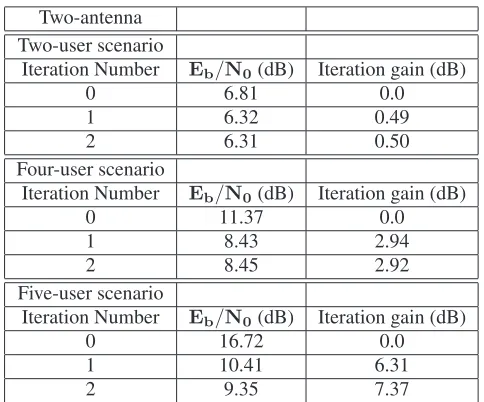
Table 2: Simulation results of User1 for the Turbo MBER MUD to arriveBER= 10−4when different number of users
are loaded employing two receiver antennas.
algorithms. The curves demonstrate that the MBER algorithm outperforms the MMSE MUD, although not only the turbo MBER detector but also the turbo MMSE MUD achieves a useful iteration gain. As the number of users exceeds the num-ber of uplink receiver antennas, the MMSE algorithm fails to remove the MAI, which becomes evident in both Fig. 2(c) and Fig. 2(d). By contrast, the MBER algorithms remain capable of attaining an adequate performance even in the so-called rank-deficient over-loaded scenarios, when the number of users is significantly higher than the number of receiver an-tennas.
5. CONCLUSION
In conlusion, a novel iterative MBER MUD was proposed, which is capable of outperforming the iterative detection aided MMSE MUD. This is particularly so in heavily over-loaded so-called rank-deficient scenarios, when the number of uplink transmitters is higher than the number of uplink receiver an-tennas. Iteration gains on the order of 2dB were achieved. Our performance results are summarized in Table [2]. The focus of our future work is the construction of similar multi-level turbo receivers using a variety of sophisticated channel decoders [6], various multi-level modems and differentially encoded as well as detected modulation schemes, which allow us to avoid chan-nel estimation at the cost of an SNR loss. Further challenging research problems are in the area of multiuser channel estima-tion designed for rank-deficient overloaded scenarios, which can be solved with the aid of genetic algorithms.
6. REFERENCES
0 2 4 6 8 10 12 10−8
10−7 10−6 10−5 10−4 10−3 10−2 10−1 100
BER
Average Eb/N0 (dB) 2Antennae 2Users Performance: User 1
single user MBER iter1 MBER iter 2 MBER iter 3 MMSE iter 1 MMSE iter 2 MMSE iter 3 MMSE iter 4
(a) Two-antenna, two-user scenario, User 1
0 2 4 6 8 10 12 14 16 18 10−8
10−7 10−6 10−5 10−4 10−3 10−2 10−1 100
BER
Average Eb/N0 (dB) 2Antennae 4Users Performance: User 1
single user MBER iter1 MBER iter 2 MBER iter 3 MMSE iter 1 MMSE iter 2 MMSE iter 3 MMSE iter 4
(b) Two-antenna, four-user scenario, User 1
0 2 4 6 8 10 12 14 16 18 10−8
10−7 10−6 10−5 10−4 10−3 10−2 10−1 100
BER
Average Eb/N0 (dB) 2Antennae 5Users Performance: User 1
single user MBER iter1 MBER iter 2 MBER iter 3 MMSE iter 1 MMSE iter 2 MMSE iter 3 MMSE iter 4
(c) Two-antenna, five-user scenario, User 1
0 2 4 6 8 10 12 14 16 18 10−8
10−7 10−6 10−5 10−4 10−3 10−2 10−1 100
BER
Average Eb/N0 (dB) 2Antennae 6Users Performance: User 1
single user MBER iter1 MBER iter 2 MBER iter 3 MMSE iter 1 MMSE iter 2 MMSE iter 3 MMSE iter 4
[image:5.595.89.535.70.447.2](d) Two-antenna, six-user scenario, User 1
Figure 2: BER performance of User 1 when different number of users are supported by the SDMA system employing two receiver antennas and 128-subcarrier OFDM for communicating over the symbol-invariant SWATM channel [2 p.78].
[2] L. Hanzo, M. M¨unster, B. J. Choi and T. Keller,OFDM and MC-CDMA. West Sussex, England: John Wiley and IEEE Press, 2003.
[3] M. Y. Alias, A. K. Samingan, S. Chen, and L. Hanzo, “Multi-ple Antenna Aided OFDM Employing Minimum Bit Error Rate Multiuser Detection,”IEE Electronics Letters, vol. 39, no. 24, pp. 1769–1770, 27 November 2003.
[4] M. Y. Alias, S. Chen, and L. Hanzo, “Genetic algorithm assisted minimum bit error rate multiuser detection in multiple antenna aided OFDM,” Vehicular Technology Conference, VTC2004-Fall. 2004 IEEE 60th, vol. 1, pp. 548–552, 26-29 September 2004.
[5] C. Berrou, A. Glavieux, and P. Thitimajshima, “Near Shannon Limit Error-correcting Coding and Decoding: Turbo-codes,” in
Proceedings of International Conference on Communications (ICC), vol. 2, (Geneva, Switzerland), pp. 1064–1070, 23-26 May 1993.
[6] L. Hanzo, T. H. Liew and B. L. Yeap, Turbo Coding, Turbo Equalisation and Space Time Coding for Transmission over Wireless channels. West Sussex, England: John Willy and IEEE Press, 2002.
[7] M. C. Reed, C. B. Schlegel, P. D. Alexander, and J. A. Asentor-fer, “Iterative Multiuser Detection for CDMA with FEC: Near Single User Performance,”IEEE Transactions on Communica-tions, vol. 46, no. 12, pp. 1693–1699, December 1999. [8] M. Tuchler, A. C. Singer, and R. Koetter, “Minimum Mean
Squared Error Equalization Using A Priori Information,”IEEE Transactions on Signal Processing, vol. 50, pp. 673–683, March 2002.
[9] H. V. Poor, “Iterative Multiuser Detection,” IEEE Signal Processing Magazine, pp. 81–88, January 2004.
[10] C.-C. Yeh and J. R. Barry, “Adaptive Minimum Bit-Error Rate Equalization for Binary Signalling,” IEEE Transactions on Communications, vol. 48, no. 7, pp. 1226–1235, July 2000. [11] S. Chen, A. K. Samingan, B. Mulgrew, and L. Hanzo,
![Figure 2: BER performance of User 1 when different number of users are supported by the SDMA system employing tworeceiver antennas and 128-subcarrier OFDM for communicating over the symbol-invariant SWATM channel [2 p.78].](https://thumb-us.123doks.com/thumbv2/123dok_us/8506531.348961/5.595.89.535.70.447/performance-different-supported-employing-tworeceiver-subcarrier-communicating-invariant.webp)
