Licensed under Creative Common Page 696
http://ijecm.co.uk/
ISSN 2348 0386
EFFECT OF HUMAN RESOURCE MANAGEMENT PRACTICES
ON PERFORMANCE OF PUBLIC UNIVERSITIES IN KENYA
Naftal Mutahi
Department of Business Administration, Egerton University, Kenya [email protected]
J. R. Busienei
Department of Business Administration, Egerton University, Kenya
Abstract
Public universities are labour intensive institutions which depend on people for effective service
delivery. This study sought to establish the relationship between strategic human resources
management practices and performance of public universities in Kenya. The study was guided
by the following specific objectives: To establish the effect of resourcing practices on
performance of public universities; to determine the effect of reward management on
performance of public universities; to assess the effect of training and development on
performance of public universities and to determine the combined effect of resourcing practices,
reward management and training and development on performance of public universities in
Kenya. The study was a census with a target population of the public universities in Kenya and
their constituent colleges. Senior HR officers and administrators were the units of analysis
where a response rate of 58% was obtained. Data was collected using semi-structured
questionnaire and was subsequently analyzed using SPSS. Research findings suggested that
strategic human resource management practices have a significant effect on the performance of
public universities in Kenya. Further, findings revealed that reward management, training and
development and resourcing practices respectively influenced the performance of public
universities. Based on the findings following key recommendations were made: Management of
public universities to develop employment policy that encourages job security; invest in HR
information systems to automate resourcing practices; government to ensure that selection in
public universities is based on equal employment opportunity principle, management to conduct
a staff competency analysis in order to address training and development needs.
Licensed under Creative Common Page 697 INTRODUCTION
A consensus has emerged among scholars and practitioners alike that the business environment has become more competitive than in the past because of globalization (Busienei 2013). Businei 2013 argues that in order to survive in this new era, businesses must focus even harder on their competitive strengths so as to develop appropriate long - term strategies. The researcher further state that the way an organization manages people can influence its performance. In particular HRM practices such as resourcing practices, job design, employee participation and empowerment, team-based production systems, extensive employee training and performance-contingent incentive compensation are widely believed to improve the performance of organizations (Busienei, 2013). Impact of human resource management practices on organizational performance has been a widely researched area for years. Results of studies, from developed countries to developing countries have been time and again showing that HR practices have significant impact on organizational performance (Busienei, 2013). But unfortunately very insufficient number of studies have been conducted in this area of context in Kenya and other developing countries (Busienei, 2013). Considerable evidence suggests that investments in training produce beneficial organizational outcomes (Barrel, 1994).
According to Dessler (2008), higher institutions of learning can adopt various HRM practices to enhance employee skills as well as motivate them to work harder towards achieving the set targets. Higher institutions of learning can improve the quality of current employees by providing comprehensive training and development activities. Considerable evidence suggests that investments in training produce beneficial organizational outcomes (Knoke 1994). The effectiveness of skilled employees will be limited, however, if they are not motivated to perform their jobs. Organizations can implement merit pay or incentive compensation systems that provide rewards to employees for meeting specific goals. Performance management as a process explicitly recognizes that in today’s globally competitive industrial environment, every employee’s efforts must focus on helping the company to achieve its strategic goals.
Human Resources Management Practices in Public Universities in Kenya
Licensed under Creative Common Page 698 managers in achieving this goal provides meaningful success and effectiveness in institutions of higher learning. Yet even within this narrower definition of the goal of broad-access institutions, the meaning of success or effectiveness is difficult to define or measure (Munjuri, 2011).There has been rapid expansion in the higher education sector of Kenya. More people are seeking higher education from the few universities we have. The university education system is also isolated from the society. A meaningful modern education system should stimulate all aspects of human intellectual potential. It should not simply emphasize access to knowledge, but also uphold the richness of local cultures and values, supported by valuable disciplines of the humanities and social sciences, including philosophy, literature and arts (Kipkebut, 2010).
The report by World Bank (2004) points out that higher education institutions, such as universities, colleges and polytechnics, are labor intensive organizations; they depend on people for the delivery of their services. The reports confirms the institutions the quality of the staff in institutions of tertiary education is thus central to their effectiveness, in the same way that it is to all people-centered organizations (Munjuri 2011). In business and the professions there is a wide recognition that the skills of their staff need to be continually strengthened and enhanced. In the face of challenges from national and international competitors the better companies are investing more resources in the continual training and retraining of employees at all levels. They focus not only on the competences of their staff, but also give time to stressing the need for commitment to the organization’s goals and to promoting a capacity to chage. Should not be the same be true of our institutions of higher education? They are crucial to national aspirations for economic development and, if such capacity building aims are to be achieved, the institutions will have to make the most effective use of all their human resources (Munjuri, 2011).
Performance of Public Universities in Kenya
Licensed under Creative Common Page 699 Studies have confirmed that the nature of training provided by Kenyan public universities does not adequately prepare the higher cadre human resources does not adequately prepare the higher cadre human resources that are required for development. In an editorial article in the Daily Nation (July 12, 2007) it was observed that Education in Kenya has largely operated in isolation from the economic sector it is supposed to serve. The result has been that its products have at times been found wanting in vital skills that have hampered their absorption into the economic mainstream. The university education system is also isolated from the society. A meaningful modern education system should stimulate all aspects of human intellectual potential. It should not simply emphasize access to acknowledge, but also uphold the richness of local cultures and values, supported by the valuable disciplines of the humanities and social sciences (Clarke, 2001).
Human resource management practices are critical for success in any higher institution of learning. The commonly utilized human resource practices to enhance performance include but not limited to: recruitment and placement, training and development, performance appraisal, compensation and benefits and employee relations and the issues and challenges encountered in the implementation of these practices among others. However, this study will look consider resourcing practices; reward management; training and development to enhance performance which is operationalized by; labour turnover, employee job satisfaction, employee empowerment, and employee job commitment. Scholars have argued that recruiting and selecting high potential employees at some point in time doesn't automatically guarantee that they will perform effectively (Olando, 2006). Training is an expensive venture and organizations need some assurance of return on investment on training, in the form of enhanced productivity. The total reward concept emphasizes on combining intrinsic and extrinsic motivators to get a complete package. Organizations use performance-related pay as an extrinsic motivator to recognize and reward those employees that meet the set performance targets. Intrinsic motivation is provided when people feel that the work they do is intrinsically interesting, challenging and important and involves the exercise of responsibility, autonomy or freedom to act, and opportunities for advancement and growth. This argument is consistent with the conclusions made by Pfeffer (1994) and Busienei (2013).
Statement of the Problem
Licensed under Creative Common Page 700 and its effect on organization performance. Most of these research works have focused on the effect of human resource management practice in enhancing organizational commitment and performance. Munjuri (2011) studied on the effect of human resources management practices in enhancing employee performance in catholic institutions of higher learning in Kenya. The researcher found that the performance-related pay had the greatest impact on increasing employees level of performance. Kibkebut (2010) considered human resources management practices and organizational commitment in higher educational institutions. In his research kiptkebut [2010] found that human resource management practices were more important than demographic characteristics in influencing organizational commitment; demographic characteristics and differ in their influence on each dimension of organizational commitment; and private universities had more superior HRM practices than public universities. On the other hand, Balatbat (2010)considered the perceived implementation of human resources management practices and demographic variables of employees in private higher education institutions. The researcher found that all the human resources management practices were implemented to a great extent. Based on the foregoing empirical studies among others, limited systematic study has been undertaken to show the effect of human resources management practices on performance of public universities in the Kenyan context and that there was need for the same. From the statement of the problem, the following broad research questions is raised: What is the effect human resource management practices on the performance of public universities in Kenya?
General Research Objective
To establish the relationship between human resource management practices and performance of public universities in Kenya.
Specific Objectives
1.To establish the effect of resourcing practices on the performance of public universities in Kenya.
2.To determine the effect of reward management on the performance of public universities in Kenya.
3.To assess the effect of training and development on the performance of public universities in Kenya.
Licensed under Creative Common Page 701 Hypotheses
H1: There is no statistically significant relationship between resourcing practices and
performance of public universities in Kenya.
H2: There is no statistically significant relationship between reward management and
performance of public universities in Kenya.
H3: There is no statistically significant relationship between employee training and development
on performance of public universities in Kenya.
H4: There is no statistically significant relationship between the combined effect resourcing
practices, reward management, training and development on performance of public universities in Kenya.
Significance of the Study
The study will provide insight to organizations on the effect the various HRM practices have on employee performance, hence enabling them to take the necessary action in order to improve overall organizational performance. The management of higher institutions of learning in Kenya would find this study informative and useful to them in their daily operations. This study would equip the managers of these higher institutions of learning and other policy makers with the knowledge of effects of human resources management practices and its applicability in managing activities. The study will enable the government more specifically, the Ministry of Education, to develop and implement human resources management policies that are tailor-made to enhance performance. This study paves the way for other researchers in this field towards identifying areas for further research. The study will also add to the increasing body of theoretical knowledge in the human resource management field, in particular, it will enrich human resource practices in relation to firm performance among others. This therefore, lays down the foundation for other similar replicative studies with extensions in developing countries. However, in this respect, recommendations for further research will be presented at the end of this study.
Scope of the Study
Licensed under Creative Common Page 702 in terms of research output, number of students enrolled, number of graduates, web ranking and completion rate.
Study Limitations and Delimitations
The researcher faced the following challenges: Primary data collection was the main source of obtaining the relevant information. However, not all respondents were comfortable with providing information as they were unsure on the use of the information that they provided. However, the researcher assured the respondents that the information sought would be used for academic purposes and that utmost confidentiality would be assured to them. Other respondents found it difficult to take time off their busy work schedules as they viewed the researcher taking up too much of their valuable time. The researcher addressed this challenge by taking minimum time administering questionnaires.
Assumptions of the Study
The study was carried out on the basis of the following assumptions:-
1.That all the respondents would give genuine, truthful, and honest responses to the research questions and interviews.
2.That strategic human resource management practices affected performance of public universities in Kenya.
3.That the sample taken would be a fair representation of the population and therefore the findings would be generalized.
4.That the target population was uniform
LITERATURE REVIEW
Human Resource Management
Licensed under Creative Common Page 703 the use of appropriate HRM practices and positive employee attitudes among them job satisfaction and commitment. Defined by Storey (1995): Human resource management is a distinctive approach to employment management which seeks to obtain competitive advantage through the strategic deployment of a highly committed and skilled workforce, using an array of cultural, structural and personnel techniques. It is clear that human resources management is an important part of today’s business management.
Licensed under Creative Common Page 704 competitor can imitate other resources like technology and capital but the human resource are unique According to busienei [2013]. According to Khatri (2000), people are one of the most important factors providing flexibility and adaptability to organizations.
Licensed under Creative Common Page 705 Employee involvement, for example, keeping employees informed of key changes in the organization. Performance appraisals with links to contingent reward systems, for example, gathering customer feedback to recognize the work by employees over and above their expected duties, which in turn is likely to lead to a bonus for staff. Recently, Saxena and Tiwari (2009) examined the HRM Practices implemented by leading IT Companies such as TATA, Infosys and Wipro in India. They developed the 3cTER Framework of HRM practices and identified Training and Development, Employer-Employee Relations, Recognition through Rewards, Culture building, Career Development, Compensation and Benefits as important HRM Practices. Parallel to the understanding that human resources are vital for an organization, human resource management function is also going up in organizational hierarchy. Human resource management aims to ensure that the organization obtains and retains the skilled, committed and well-motivated workforce it needs. This means taking steps to assess and satisfy future people needs to enhance and develop the inherent capacities of people-their contributions, potential and employability-by providing learning and continuous development opportunities. It involves the operation of recruitment and selection procedures, management development and training activities linked to the needs of the business (Campion and Thayer, 1985).
HRM-Licensed under Creative Common Page 706 outcomes as mediating variables also produced mixed results with respect to causation (Wright et al, 2005).
In summary, it may be argued that while there is a growing body of theory and empirical research demonstrating relationships between HRM policies, collective employee attributes, and firm outcomes, additional studies in this area are needed (Purcell and Kinnie, 2007). Furthermore, although it was accepted that HRM is positively related to organizational performance, there is great need for additional evidence to support the HRM-performance relationship from different contexts (Gerhart, 2007). Specifically, while a few investigations have been initiated in emerging markets and in transitional countries (Huselid, 1995; Guest, Michie, Conway and Sheehan, 2003). To fill this gap and to further examine the process through which HRM policies impact organizational performance, it is important to conduct analysis in non-US/UK context. Thus, the purpose of this paper is to investigate how HRM influences organizational performance and for a better understanding of the relationship between these two variables, to take into account that business strategies influence HRM in the Kenyan universities context.
Resourcing Practices
Licensed under Creative Common Page 707 practices such as training and compensation had significant impact on perceived organizational performance. Two recent studies (Billah and Islam, 2009) in context of Kenya also found that HR practices have significant association with employee turnover and organizational commitment. No much research has been done in Kenya pertaining to HR practices and performance of higher institutions of learning.
Reward Management
Compensation refers to all types of pay or rewards going to employees and arising from their employment (Dessler, 2007). Compensation is very much important for employees because it is one of the main reasons for which people work. Employees’ living status in the society, satisfaction, loyalty and productivity are also influence by the compensation (Aswathappa, 2008). Delaney and Huselid (1996) found that incentive compensation was associated with perceived market performance in USA. Employee compensation system resulted in better organizational performance in Indian firms (Singh, 2004). Moyeen and Huq (2001) studied HRM practices of 92 medium and large business enterprises (Public and private sector) located in Dhaka, Bangladesh. They found that only 62% of surveyed organizations had an HR/Industrial Relations (IR) department. HRM practices of ten higher institutions of learning in Bangladesh were examined by Akhter (2002). She measured correlation between employee’s opinions regarding HRM practices in their institution, their age, education and experience.
Licensed under Creative Common Page 708 failure to recognize a worthy employee can raze his self esteem and can also result to the destruction of the confidence of his co-workers.
Finally, employee recognition should still not just stop from acknowledgement sand evaluation of employees. Employers should also be happy to see their laborers accomplish their jobs well. Therefore, they should also have the initiative to guide these workers to do their jobs effectively and efficiently. To conclude everything managers and employers should always observe fair employee recognition which is ensured by proper employee evaluation and maintained by constant employee direction. This should be applied to all the members of the organisation and not just to selected people. Remember that everyone can contribute and affect the whole organisation – positively or negatively.
Training and Development
Training and development is considered to be the most common HR practice (Tzafrir, 2006). Training and development refers to any effort to improve current of future employees’ skills, abilities, and knowledge (Aswat happa, 2008). Thang and Buyens (2008) through reviewing 66 studies conducted in different parts of the world opined that training and development leads to superior knowledge, skills, abilities, attitudes and behaviour of employees that eventually enhance organizational performance. Hoque (1994) unearthed that training and development had positive impact on organizational effectiveness in Bangladeshi context. Training refers to the methods used to give new or present employees the skills they need to perform their jobs (Dessler, 2008).Training refers to improving competencies needed today or very soon (Jackson and Schuler, 2000).Training is the planned and systematic modification of behaviour through learning events, programmes and instruction which enable individuals to achieve the levels of knowledge, skill and competence needed to carry out their work effectively (Armstrong, 2006). Dessler (2008) argued that the training process starts with determining what training is required. Analyzing training needs depends on whether you are training new or current employees. The main task in analyzing new employees' training needs is to determine what the job entails and to break it down into subtasks, each of which you then teach to the new employee. Analyzing current employees' training needs can be done through task analysis and performance analysis.
Licensed under Creative Common Page 709 are gathered. Person needs analysis identifies gaps between a person's current capabilities and those identified as necessary or desirable (Dessler, 2008).Second, designing a training program involves setting training objectives and choosing the training methods. Training methods can be divided into on-the-job training and off-the-job training methods. On the job training methods include coaching, mentoring, job rotation. Off-the-job methods include formal courses, lecture, discussion, role playing and case study (Armstrong, 2006).Third, actual implementation of the training is done. It is important to increase learning during training. This can be done by providing for active participation; increasing self efficacy; matching training techniques to trainees' self efficacy; providing opportunities for enactive mastery; ensuring specific, timely, diagnostic, and practical feedback; and providing opportunities for trainees to practice new behaviours (Jackson and Schuler, 2000).Fourthly, training should be evaluated to check on its effectiveness.
Does the trainee use what was learned in training back on the job? This is also a critical measure of training success. We all know coworkers who have learned how to do something but choose not to. If learning does not transfer to the job, the training effort cannot have an impact on the employee's or organization's effectiveness. Kirk et.al. (2002) further argues that measuring whether training has transferred to the job requires observation of the trainee's on-the-job behaviour or viewing organizational records. Has the training or HRD effort improved the organization's effectiveness? Is the organization more efficient, more profitable, or better able to serve its clients or customers as a result of the training program? Meeting this criterion is considered to be the bottom line as far as most managers are concerned.
Licensed under Creative Common Page 710 the organization, one that is oriented towards performance improvement; provide higher levels of service to customers.
Performance of Public Universities
Organizational performance comprises the actual output or results of an organization as measured against its intended outputs (or goals and objectives). Organizational performance is the concept of measuring the output of a particular process or procedure, then modifying the process or procedure to increase the output, increase efficiency, or increase the effectiveness of the process or procedure (Smith, 2004).The roles of higher education institutions are clear. First, they should provide education and training within a structure that combines research and teaching. Second, they should offer professional training in fields such as Medicine, Engineering, Architecture, Law and Teaching. Third, these institutions should operate as research centers, responsible for carrying out research in a broad range of disciplines.
Fourth, they should play a part in regional development as well as developing international contacts, and contacts, and last but not least, they should play a social function in fostering the intellectual and social development of the society. But scholars and critics alike have never stopped blaming the system, which most of them went through, and their critiques are somewhat justified. Studies have confirmed that the nature of training provided by Kenyan public universities does not adequately prepare the higher cadre human resources that are required for development. In an editorial article in the Daily Nation (July 12, 2007) it was observed that Education in Kenya has largely operated in isolation from the economic sector it is supposed to serve. This study will however focus on research output, number of students enrolled, number of graduates produced, web ranking and completion rate of students as measures of performance in public universities in Kenya.
Research Output
Licensed under Creative Common Page 711 successful research as an important factor in evaluation and believed are essential requirements for promotion. He further recommends university lectures should increase research productivity. The importance of research to a university cannot be Overemphazized Sulot [2012].
Web Ranking
Based on web biometric ranking different factors are considered which includes, academic web presence, research out put,scholary communication and economic relevance of technology transfer to industry, community engagement other important factors considered are rate of impact, opennes and academic excellence. According Peterking [2011] webmetric ranking of the world university id done by cybermetric lab .it offer information according to the web presence an assessment of the scholarly content, visibility and impact of university on the web.based on ranking in 2015 webmetric used different ranking factors based on academic web presense, research out put,including not only forms[e-journals reposition]publication but also scholarly communication and economic relevance of technology transfer to industry. The webmetrics data is collected between January 1st and 10th, and corresponding period in July, each variable is obtained atleast to times during period and the maximum value is chosen for mistakes or error. Havard university is top ranked in the world, while university of Nairobi leads the local ranking. If web performance of an institution is below the expected position according to their academic excellence, university authorities should reconsider their web open access and transparency policy, promoting substantial increases of the volume and quality of their e- publications (webmetric 2015).
Student enrolment
Licensed under Creative Common Page 712 Completion rate of students
Completion rate is the number of successful graduates compared to the number of students admitted. When the completion rate is high, it reflects a good performance of the university. Several factors may affected completion rate, e.g. riots, political influence, economic challenges among others. The general completion rate has been going up according to Tracy B. [2013], university of Nairobi performance in producing of graduates was close to an average rate of 17% from 2001-2007, equivalent to cohort rate of 53%. According to Nyang’au [2014], self sponsored students are majority in Kenyan universities. This tremendous expansion of undergraduate education when combined with declining funding translates into more and more students being admitted into institutions that were originally designated to accommodate few students. Severe crisis of overcrowding that’s not uncommon to find students standing or seating outside of lecture halls. The factor points to worrisome cohesion that Kenyan public higher education institutions produce graduates who are ill equipped to complete effectively in the modern global economy, Odiambo [2011]. Only half of more the than 50,000 graduates annually are suitable for employment.
Number of graduates
Number of graduates in the public universities has been soring tremendously due to expansion of public universities. Double intake has been critical in influencing the number of graduates. This is a reflection of improved performance. According to Chacha C. [2004], there has been a continuous demand for education in Kenya and the university system has been forced to be more innovative to meet increasing demand. Among other ways, public universities responded to development by enacting private sponsored module II program. This ultimately increase the number of graduates in public universities. According to Sifuna [1998], study reveal that the rapid expansion of university was spontaneous to high demand. The increasing demand has been contributed to lack of planning. The direct consequences of poor quality graduates has been increasing unemployment. Poor quality of graduates and consequently graduate unemployment can have serious social, economic and economic ramifications as witnessed during the arab spring.
Empirical Studies
Licensed under Creative Common Page 714 monitoring, evaluation and/or appraisal in order to manage individual performance. Finally, they investigate if the actual implementation of these IPM activities is influenced by factors addressed by the rationales of adoption from a Resource Based View and a Neo-Institutional approach.
Conceptual Framework
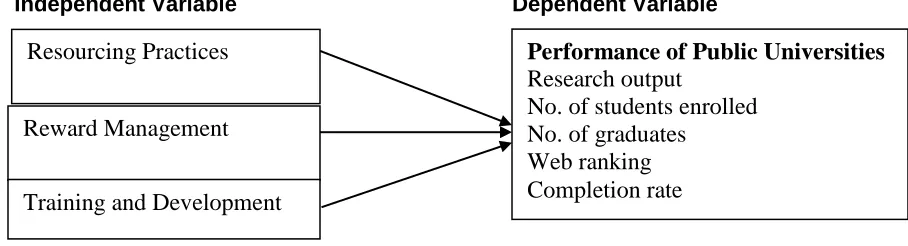
The conceptual framework indicated below show both independent and dependent variables proposed by the study. Mugenda and Mugenda, (2003), define a variable as measurable characteristic that assume different values among the subjects. Kothari, (2004), defines a dependent variable as one that depends upon other variables or is as a consequence of other variables. An independent variable is defined as one that is antecedent to the dependent variable. The dependent variable,” performance of higher institutions of learning in Kenya” is the subject of this study and is the one that is influenced by the independent variables (resourcing practices, reward management, training and development). Institutional performance is indicated by research input, number of students enrolled, number of graduates, web ranking and completion rate. The study can be conceptualized as shown in Figure 1.
Figure 1: Relationship between Human Resource Management Practices and Performance of Public Universities
Independent Variable Dependent Variable
RESEARCH METHODOLOGY Research Design
This study was carried out through a correlational research design. This approach provides the an opportunity to establish the relationship between human resource management practices and performance of public universities in Kenya. The adopted research design allowed the researcher to test the hypotheses. The correlational research design is considered because of the relationships amongst the study variables.
Resourcing Practices
Reward Management
Training and Development
Performance of Public Universities
Research output
No. of students enrolled
No. of graduates
Licensed under Creative Common Page 715 Population
This study focused on all the 31 public universities and their constituent colleges in Kenya as shown in Appendix II. It mainly targeted non-teaching staff .The staff was however represented by the head of human resource management in each of these public universities. In the event that the heads of HR were not available then a key informant from the HR department responded to the questions. This was attributable to the fact that the study needed key informants on strategic human resource management practices in public universities. All the universities were targeted due to their small number hence there was no need of sampling. This therefore implied that each university or constituent college was represented by one respondent hence a total target of 31 respondents.
Data Collection
This study mainly relied on primary data collected using a questionnaire. Questionnaires are appropriate for studies since they collect information that is not directly observable (Mellenberg, 2008; Franker 2006). The questionnaire consisted of three sections: Section A captured questions on the respondents‘ background information. Section B on the other hand focused on human resources management practices ranging from: Resourcing practices, reward management, training and development. Finally section C focused on Performance of public universities in Kenya. Performance was measured in terms of research output, number of students enrolled, number of graduates, web ranking and completion rate.
Data Analysis and Interpretation
Both descriptive and inferential statistics were used in analyzing data. This entailed frequencies and percentages, means and standard deviations, Pearsons correlation analysis and regression analysis. Prior to data analysis the questionnaires were coded based on a five point likert scale used in the questionnaire. SPSS 20.0 was used to perform the analysis of quantitative data. Pearsons correlation and multiple regression analysis were used to test for the research hypotheses. The research was as modelled by this linear regression equation:
Y=α+βx1+ βx2+ βx3+ µ where,
Y = Performance of public universities α= Correlation constant
X1= Resourcing practices
X2 = Reward management
Licensed under Creative Common Page 716 ANALYSIS AND INTERPRETATIONS
Response Rate of the Study
The researcher administered 31 questionnaires in total and managed to obtain 18 completed questionnaires representing 58% response rate.
Reliability Analysis
In this study to ensure the reliability of the instrument Cronbach’s Alpha was used. Cronbach Alpha value is widely used to verify the reliability of the construct. Therefore, Cronbach Alpha was used to test the reliability of the proposed constructs. The findings indicated that resourcing practices had a coefficient of 0.847, reward management 0.751 and training and development 0.881. All constructs depicted that the value of Cronbach’s Alpha are above the suggested value of 0.5 thus the study was reliable (Nunnally and Bernstein, 1994; Nunnally, 1974). On the basis of reliability test it was supposed that the scales used in this study is reliable to capture the constructs.
Table 1. Reliability Analysis
Human Resource Management Practices Cronbach’s Alpha Comments
Resourcing practices .847 Accepted
Reward management .751 Accepted
Demographic Profile
Gender of Respondent
Respondents were further required to indicate their gender. The research findings revealed that majority (56%) of the respondents were female and the remaining 44% of them were male.
Figure 2. Gender of Respondent
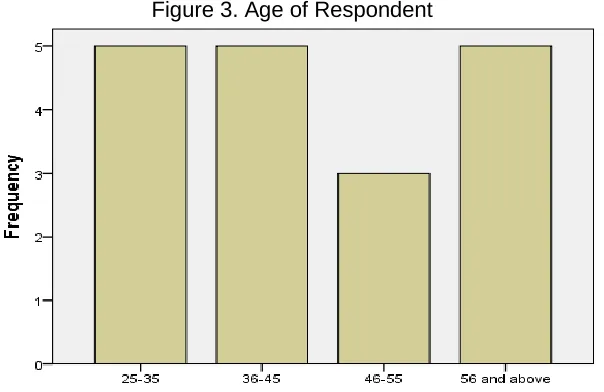
Licensed under Creative Common Page 717 Minority (17%) of the respondents indicated that they were aged between 46-45 years while the rest (83%) of the respondents were equally distributed between the age groups 25-35, 36-45 and 56 and above years as shown in Figure 3.
Figure 3. Age of Respondent
Period Worked
Majority (83%) of the respondents that they had been working in their institutions for a period of between 6-10 years while the rest (83%) of the respondents were equally distributed between periods of 16-20, 21-25, 25 and above each 6%. This therefore reveals that majority of the respondents had worked for a period long enough to enable them comment on the factors under study as shown in Figure 4.
Figure 4. Period Worked
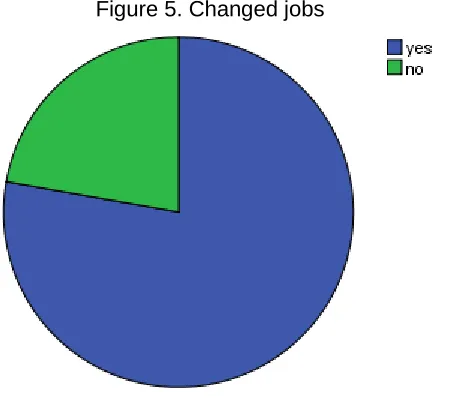
Licensed under Creative Common Page 718 Respondents were further required to indicate whether they had changed jobs before. Majority (78%) of the respondents indicated that they had changed jobs before and the remaining 22% of them indicated otherwise. This implies high employee turnover in public universities as shown in Figure 5.
Figure 5. Changed jobs
Desire to Change Job in Future
Majority (50%) of the respondents indicated that they had a desire to change their jobs in the future, 35% indicated otherwise and 15% didn’t respond. The findings are as presented in Figure 6.
Figure 6. Desire to change jobs
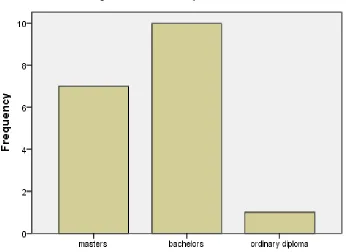
Licensed under Creative Common Page 719 Respondents were further required to indicate the highest academic qualifications they had attained. Majority (56%) of the respondents indicated that they had attained Bachelors Degree level of education. They were followed by those who had attained Masters Degree as represented at 39%. Only 5% of the respondents had attained that they had attained Diploma level of education. The findings are as presented in Figure 7.
Figure 7. Academic Qualifications
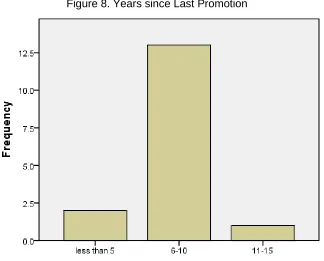
Years since Last Promotion
Licensed under Creative Common Page 720 Figure 8. Years since Last Promotion
Human Resources Management Practices
This section focuses on the findings of various human resource management practices and their effect on performance of public universities in Kenya. It specifically analyzes data on resourcing practices, reward management and training and development.
Resourcing Practices
Respondents were required to indicate their level of agreement with various resourcing practices. Items that were measured on a five point Likert-Type scale ranging from 1 being “Not at all” to 5 being “To a very great extent”. Means of between 3.36 - 4.25 and standard deviations of between 0.622- 1.401 were registered. On average majority of the respondents were of the opinion that the resourcing practices applied to a great extent as revealed by means of 3.83. Specifically the study findings revealed that majority of the respondents agreed that employee - supervisor relationship enhances team spirit to a very great extent (4.25). They further indicated that duties and responsibilities were clearly defined in their organizations to a very great extent (4.21). On the contrary, the findings revealed that sudden exit of key people has minimal impact on working of pulic university (3.36). The findings are as presented in Table 2.
Licensed under Creative Common Page 721
Resourcing Practices Mean Std Deviation
Employment policy encourages employee job security 3.71 .726
Recruitment of staff is based on meritocracy 3.93 .917
Compensation strategies enhances staff morale 3.86 1.027
Training and development encourages performance 4.00 .961
Training and development is on merit 3.36 1.336
Our human resource culture enhance performance 3.64 .842
Human resource policies encourages employee decision making
3.71 .914
Human resource policies enhances employee empowerment
3.71 .726
Employee - supervisor relationship enhances team spirit 4.25 .622 Duties and responsibilities are clearly defined in my
organization.
4.21 .975
I would recommend others to work for the university 4.21 .802
Sudden exit of key people has minimal impact on working of University
3.36 1.336
Attrition rate is low and people are satisfied in their jobs 3.57 1.016 The use of Information technology in HR is a win-win
situation for both employees and managers
3.57 1.016
I understand human resources information system (HRIS) is an important tool in increasing human resource
effectiveness in the institute
4.00 .784
Recruitment and selection is based on equal employment opportunity principle
4.07 .917
Our recruitment and selection process is open and objective
3.93 .917
The relationship between the employee and supervisor is cordial
3.79 1.122
Overall Mean 3.83 0.942
Reward Management
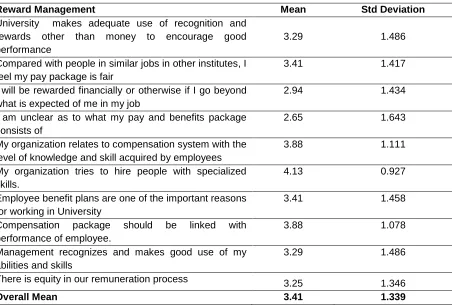
Licensed under Creative Common Page 722 rewarded financially or otherwise if they went beyond what is expected of them in their job. The findings are as presented in Table 3.
Table 3. Reward Management
Reward Management Mean Std Deviation
University makes adequate use of recognition and rewards other than money to encourage good performance
3.29 1.486
Compared with people in similar jobs in other institutes, I feel my pay package is fair
3.41 1.417
I will be rewarded financially or otherwise if I go beyond what is expected of me in my job
2.94 1.434
I am unclear as to what my pay and benefits package consists of
2.65 1.643
My organization relates to compensation system with the level of knowledge and skill acquired by employees
3.88 1.111
My organization tries to hire people with specialized skills.
4.13 0.927
Employee benefit plans are one of the important reasons for working in University
3.41 1.458
Compensation package should be linked with performance of employee.
3.88 1.078
Management recognizes and makes good use of my abilities and skills
3.29 1.486
There is equity in our remuneration process 3.25 1.346
Overall Mean 3.41 1.339
Training and Development
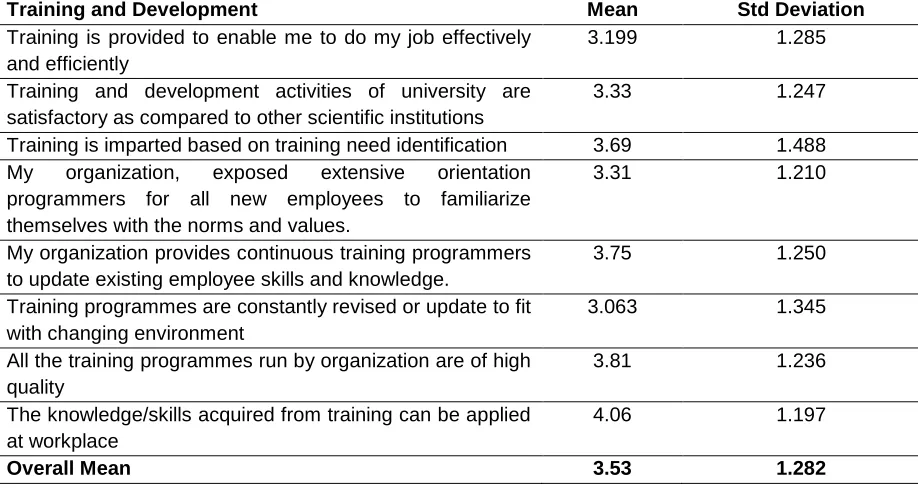
Respondents were further required to indicate their level of agreement with various training and development practices in public universities in Kenya. Items that were measured on a five point Likert-Type scale ranging from 1 being “Not at all” to 5 being “To a very great extent”. Means of between 3.06–4.06 and standard deviations of between 1.197- 1.489were registered. On average, majority of the respondents agreed that the various aspects on training and develiopment in their universities were true to a moderate extent as shown by a mean of 3.53. Specifically, the study findings revealed that majority of the respondents agreed that the knowledge and skills acquired from their training could be applied at their workplace to a very great extent (4.06). They further indicated that all their training programmes run by organization were of high quality (3.81) to a great extent. However majority of the respondents that disagreed that their training programmes were constantly revised or update to fit with changing environment as compared to other scientific institutions.
Licensed under Creative Common Page 723
Training and Development Mean Std Deviation
Training is provided to enable me to do my job effectively and efficiently
3.199 1.285
Training and development activities of university are satisfactory as compared to other scientific institutions
3.33 1.247
Training is imparted based on training need identification 3.69 1.488 My organization, exposed extensive orientation
programmers for all new employees to familiarize themselves with the norms and values.
3.31 1.210
My organization provides continuous training programmers to update existing employee skills and knowledge.
3.75 1.250
Training programmes are constantly revised or update to fit with changing environment
3.063 1.345
All the training programmes run by organization are of high quality
3.81 1.236
The knowledge/skills acquired from training can be applied at workplace
4.06 1.197
Overall Mean 3.53 1.282
Performance of Public Universities
Respondents were required to indicate their level of agreement with various aspects on performance of public universities in Kenya. Items were ranked on a L ikert-Type scale ranging from 1 being “Strongly Disagree“ to 5 being “Strongly Agree“. Means of between 3.25 - 4.06and standard deviations of between 0.647- 0. 985 were registered. On average, a mean of 3.706 was registered as pertaining to various performance aspects. The study findings specifically revealed that majority of the respondents agreed that their students graduated within the stipulated time (4.06). Further, the findings revealed that majority of the graduates from the university were well equipped to undertake HRM- related research projects (3.83). However, the findings revealed that majority disagreed that their universitie are ranked highly in the web ranking (3.25). The findings further revealed that majority of the public universities in Kenya invested in research. The findings are as shown in Table 5.
Table 5. Performance of Public Universities
Promotion Mean Std Deviation
The university has invested in research 3.61 .979
Graduates from the university are well equipped to undertake HRM- related research projects
3.83 .985
Students from the university graduate within the stipulated time 4.06 . 873
The university has a high enrollment rate 3.78 .647
The university is ranked highly in the web ranking 3.25 .856
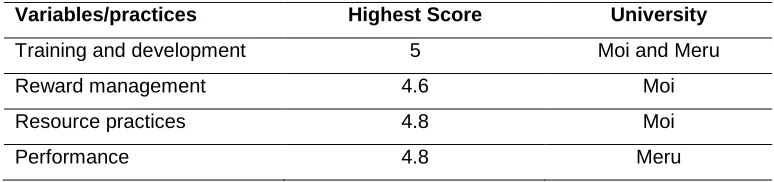
Licensed under Creative Common Page 724 Table 6. Some data for Specific University Performance
Variables/practices Highest Score University
Training and development 5 Moi and Meru
Reward management 4.6 Moi
Resource practices 4.8 Moi
Performance 4.8 Meru
From the table above, the highest mean on performance is 4.8, training and development was 5, resource practices is 4.8 and reward management is 4.6. Moi and Meru scored highly in training and development so the management can emulate those universities in terms of training and development. Moi was the highest in the overall performance.
Relationship between Human Resource Management Practices and Performance of Public Universities in Kenya
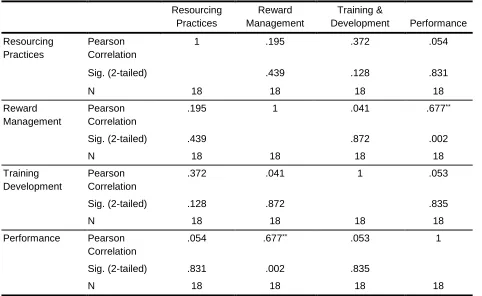
The study analyzed the correlation between the various components of strategic HR practices (resourcing practices, reward management, and training and development) and the performance of public universities in Kenya. The results of the pertinent correlation analysis are as outlined in Table 7.
Licensed under Creative Common Page 725 Table 7: Results of Correlation Analysis between Strategic Human Resource Practices and
Performance of Public Universities Resourcing
Practices
Reward Management
Training &
Development Performance
Resourcing Practices
Pearson Correlation
1 .195 .372 .054
Sig. (2-tailed) .439 .128 .831
N 18 18 18 18
Reward Management
Pearson Correlation
.195 1 .041 .677**
Sig. (2-tailed) .439 .872 .002
N 18 18 18 18
Training Development
Pearson Correlation
.372 .041 1 .053
Sig. (2-tailed) .128 .872 .835
N 18 18 18 18
Performance Pearson Correlation
.054 .677** .053 1
Sig. (2-tailed) .831 .002 .835
N 18 18 18 18
**. Correlation is significant at the 0.05 level (2-tailed).
Hypotheses Testing
H1: There is no statistically significant relationship between resourcing practices and
performance of public universities in Kenya.
The results of the correlation analysis indicated that the the relationship between resourcing practices and performance was weak and not statistically significant (r = 0.054; p > 0.05). Therefore, the the first null hypothesis failed to be rejected.
H2: There is no statistically significant relationship between reward management and
performance of public universities in Kenya.
The relationship between reward management and performance was established to be positive, strong and statistically significant (r = 0.677; p < 0.05). The results led to the rejection of the second null hypothesis.
H3: There is no statistically significant relationship between employee training and development
Licensed under Creative Common Page 726 The relationship between training and development and performance was found to be weak and not statistically significant (r = 0.053; p > 0.05). This implied that the third null hypothesis was not rejected.
Regression Analysis
Multiple linear regression analysis models the relationship between human resource management practices and performance of public universities in Kenya. The coefficient of determination (r2) and correlation coefficient (R) shows the degree of association between
human resource management practices and performance of public universities.
The research findings indicated that there was a strong positive relationship (R= 0.608) between the variables. The study also revealed that 37% of public universities performance could be explained by human resource management practices as shown in Table 8.
Table 8. Model Summary
Model R R Square Adjusted R
1 .608 .628 .535
Table 8 shows the results of ANOVA test which revealed that the combined independent variables have significant effect on performance of public universities. This can be explained by high F values (6.75) and low p values (0.06) which are less than 5% level of significance.
Table 9. ANOVA
Model Sum of
Squares Df Mean Square F Sig.
Regression 4.167 3 .1389 6.752 .06
Residual 2.469 12 .206
Total 6.631 15
Table 9 shows the results of regression coefficients which reveal that a positive effect was reported for all the human resource management practices. Further, the findings reveal that reward management had the greatest effect (0.266) on performance. This was followed by training and development and then resourcing practices at 0.147 respectively.
Table 9. Regression Coefficients
Unstandardized Coefficients
Standardized Coefficients
T Sig. B Std. Error Beta
Licensed under Creative Common Page 727
Resourcing practices -.073 .148 -.105 -.491 .631
Reward management .498 .142 .695 3.499 .004
Training and development .035 .115 .064 .303 .766
a. Dependent Variable: Performance Y = β0+ β1X1+ β2X2+ β3X3+£
Y= 2.154 - 0.073X1 + 0.498X2 + 0.035X3
From this study it was evident that at 95% confidence level, reward management returned statistically significant values when regressed against performance (β = 0.498; p < 0.05). More so, as indicated reward management strongly influenced performance of public universities in Kenya. Both resourcing practices and training and development were found to have little effect on performance and their effect on performance was further established not to be statistically significant at 0.05 level of significance (95% confidence level). Conclusively, public universities ought to emphasize more on reward management than in resourcing practices and training and development.
Hypotheses Testing
H4: There is no statistically significant relationship between strategic HR practices (the
combined effect resourcing practices, reward management, training and development) on performance of public universities in Kenya.
The results of the regression analysis indicated that relationship between strategic HR practices and performance was statistically signficant (p < 0.05) and as such, the fourth null hypothesis was rejected.
Summary of Findings
Licensed under Creative Common Page 728 selection was positively related to all organizational performance variables suchas effectiveness, efficiency, innovation and quality.
The finding of the study revealed that reward management positively influenced performance of public universities in Kenya. Results of the inferential statistics such as unstandardized regression coefficients and Pearsons correlation analysis show a strong and positive effect on performance. This was further complemented by the fact that majority of the respondents agreed that employee benefit plans were one of the important reasons for working in public universities. Further, the findings revealed a better package in public universities motivated employees to work well hence better performance. However, it was clear from the study findings that financial rewards were minimal in public universities whenever they went beyond what was expected of them in their jobs. The findings are similar with the findings of Aswathappa (2008) who argues that compensation is very much important for employees because it is one of the main reasons for which people work. Employees’ living status in the society, satisfaction, loyalty and productivity are also influence by the compensation. The finding of the study revealed that training and development though positively influenced performance in public universities in Kenya, its effect was quite marginal. Results of the inferential statistics such as unstandardized regression coefficients show a positive but weak effect on performance. This further indicates that training and development is not a huge driving force of performance in public universities in the country. The findings differed from the findings of Thang and Buyens (2008) who through reviewing 66 studies conducted in different parts of the world opined that training and development leads to superior knowledge, skills, abilities, attitudes and behaviour of employees that eventually enhance organizational performance.
CONCLUSIONS AND RECOMMENDATIONS
The objective of this study was to establish the relationship between strategic human resource management practices and performance of public universities in Kenya. Based on previous studies, resourcing practices, reward management and training and development were expected to have a positive effect on performance. The study findings led to the conclusion that reward management is more important than resourcing practices and training and development in as far as enhancement of public universities‘ performance was concerned.
Licensed under Creative Common Page 729 This ensures that they are incorporative hence acceptable, accessible, ethically sound, have a positive perceived impact, relevant, appropriate, innovative, efficient, sustainable and replicable. This therefore calls for establishing strategies that meet employees’ needs. Specifically the study recommends: The management of public universities to develop an employment policy that encourages employee job security; The management of public universities to invest in human resources information system so as to increase human resources effectiveness; Ensure recruitment and selection in public universities is based on equal employment opportunity principle; Management of public universities to link the compensation package with performance of employees; There is need to conduct a Training Needs Analysis in public universities which will identify the relevant training for various employees. Thereafter, employees will be trained so as to conduct their jobs effectively and efficiently and Management to review training programmes constantly to fit with the changing environment.
RECOMMENDATIONS FOR FURTHER RESEARCH
This study focused on the public universities in Kenya and therefore, generalizations cannot adequately extend to private universities. Based on this fact among others, it is therefore, recommended that a broad based study covering both public and private universities in Kenya be done to find out the relationship between strategic human resource management practices and their performance. It is also suggested that future research should focus on other strategic human resource management practices on organizational performance.
REFERENCES
Armstrong, M. and Stephens, T.(2006). Employee reward Management practice, London and Philadelphia, Kogan Page Ltd.
Aswathappa K. (2005). Human Resource and Personnel Management.Tata McGraw Hill Edu-cation Page 131 & 193.
Baker, B. E. and Huselid, M.A. (2006).Strategic Human Resource Management: Where Do We Go From Here?;Journal of Management, 32: 898-925.
Balatbat (2010).Comparative Perfomance of Public Listed Construction Company. Australia Evidence Volume 28, Page 919-932.
Bartel A.P. (1994), Productivity savings from the implementation of employee training pro-grams, Industrial Relations, 4(4): 411-425.
Boserie, P. Detz, G. & Boon (2005).Commodities and Contradictions in HRM and Performance Research;Human Resource Management Journal, 15: 67-94.
Busienei, J.R; (2013). Effect of Business Strategy and Organizational Structure on the Relation-ship between Human Resource Strategic Orientation and Performance of Pri-vate Manufacturing Firms in Kenya; (Unpublished Ph.D Thesis), University of Nairobi
Licensed under Creative Common Page 730 Campion, M. A. and Thayer, P.W. (1985).Development and field evaluation of an interdiscipli-nary measure of job design, Journal of Applied Psychology, 70, 29-43.
Chandler, G. N., and G. M. McEvoy, 2000, “Human Resource Management, TQM, and Firm Performance in Small and Medium- Size Enterprises”, Entrepreneurship: Theory and Practice, 25 (1); 43-58.
Clarke, M. (2008).The New Covenant of Employability, Employee Relations, Page 121-144.
Chacha C. (2004). Reforming Higher Education in Kenya.Challenges, Lessons and Opportunities.
Dessler, G. (2008). Human Resource Management (11th edition), New Delhi, Prentice Hall, of India private Ltd.
Dinah J. Kipkebut (2010). Human Resources Management Practices and Organizational Commitment in Higher Educational Institutions: A Kenyan Case.
Gerhart, B. and Milkovich, G. T. (1992).Employee Compensation: Research and Practice.
Guest (1997).Human Resource Management and Perfomance.A review and research agenda.The international journal of Human Resource Management.
Huselid, Mark A.(1995). The Impact of Human Resource Management Practices on Turnover, Productivity, and Corporate Financial Performance. The Academy of Management Journal, 38 (3): 635-672.
Khateri, N. (2000). Managing Human Resource for Competitive Advantage; A Study of Companies in Singapore; International Journal of Humana Resource Management, 2:336-365.
Kidombo, H.J (2009). Human Resource Management orientation and Strategic Responses to Environmental Change.Africa journal of Business and Economics.
Kirimi Mwiria, et al (2007); Public and Private Universities in Kenya; East African Publishers, Nairobi, pg 56.
Katru A.A. (2006). Human Resource Management System in on organization performance. International journal of Human Resource Management19, 1853.
Knoke, D. and Kalleberg, A. L. (1994).Job Training in U.S. Organizations, American Socio-logical Review, 59: 537-546.
Koch & Mc Cralt (1984).Group Interaction and Performance.New York Prince Hall.
Kothari (2001).Participation the New Tyranny? London: Zed Books.
Miller, K. and Monge, P. (1986).Participation, satisfaction and productivity: A meta- analytic Review, Academy of Management Journal, 29,727-753.
Munjuri, M (2011). The Effects of Human Resources Management Practices in Enhancing Em-ployee Performance in Catholic Institutions of Higher Learning in Kenya.
Noe, R. A., Hollenbeck, J.R., Gerhart, B., and Wright, P.M. (2007).Human Resource Man-agement: Gaining a competitive advantage, 5th edition, New Delhi, Tata McGRAW-Hill publishing Company Ltd. Nyang’au J. (2014). Higher Education as an Instrument of Economic Growth in Kenya.Kent State University.
Odhiambo G. (2011). Higher Education Quality in Kenya. A Critical Reflection of Key Chal-lenges, Quality in Higher Education.
Oloruntoba,A.,Ajayi,MT.[2006]Gendernand research attainment in Nigeria agricultural univer-sity.JHEA,PRESS.
Pery,r,Clifton,RMence,V,Struthers,C.S.[2000]Faculty in translation,A longitudinal analysis controlland type of instutionin the research productivity of hired faculty.research in higher education volume 2.
Licensed under Creative Common Page 731 Pfeffer, J and Sutton, R.I (2006). Hard facts, dangerous half-truths, and total nonsense: Prof-iting from evidence-based management. Boston: Harvard Business School Press.
Pfeffer, J. (1994). Competitive Advantage through people: unleashing the power of the work force, Boston, Harvard Business School Press practice in Britain, Blackwell Publishers Ltd, Oxford UK.
Polit, D.F. (2004). Nursing Research Principles and Methods. Philadelphia:
Redman and Matthew (1998).Secure Quality and Human Resource Management: A review and research agenda. Em arad Group Publishing
Sifuna D. (1998).The Governance of Kenya Public Universities.Research in Post-Secondary Education. Volume III, number 2.
Smith (2004).Strategic Planning for Public Relation.Routledge Publishers.
Storey, J. (1995).Human Resource Management: A Critical Edition Illustrated Routledge Pub-lishers.
Sulot,T.[2012]. Factors affectingresearch productivity in public universities inKenyathe case of moi university,Eldoret.
Thang, N.N. and Buyens, D. (2008).What Do We Know About Relationship Between Training and Farm Management.Bangkok Thailand.
Tracy B. and Nicol C. (2013).University and Economic Development in Africa.
Waithaka, E. (2010); Strategies Adopted by University of Nairobi to Achieve Sustainable Com-petitive Advantage; Unpublished MBA Project (School of Business - University of Nairobi, Kenya).
Wisdom,J.T[2009] Challenges of developing and retaining next generation of academics.deficit in academia staff capacity at African university.university of albana Canada,
Wright etal (2005).The HR – Missing Variables in Theory of Strategic Human Resource Man-agement, Working Paper Cornel University.
APPENDIX I: Questionnaire
SECTION A: BACKGROUND INFORMATION
Profile of Respondent
1. Name of University ………
2. Position/Title ……….
3. Gender Male [ ] Female [ ]
4. Number of years worked
Less than 5 [ ] 6-10 [ ] 11-15 [ ] 16-20 [ ] 21-25 [ ]
25 and above [ ]
5. Have you ever changed your job before?
Yes [ ] No [ ]
6. Would you wish to change your job in future
Yes [ ] No [ ]
7. In terms of performance, how would you rank your University?
Excellent [ ] Above Average [ ] Average [ ] Below Average [ ]
8. Age Bracket
Licensed under Creative Common Page 732 9. Number of years since last promotion
Less than 5 [ ] 6-10 [ ] 11-15 [ ] 16-20 [ ] 20 and above [ ]
10. Given an opportunity, would you wish to change your career now?
Yes [ ] No [ ]
11. Highest Level of Education
Ph.D [ ] Masters [ ] Bachelors [ ]
Higher Diploma [ ] Ordinary Diploma [ ] A-Level [ ]
O-Level/KCSE [ ] Primary [ ]
12. Number of students enrolled in the university ………
13. Number of students graduated in the last 3 years
……… ……… ………
14. Estimate the completion rate of students in the university ………
15. Web ranking of the university ………..
SECTION B: HUMAN RESOURCES MANAGEMENT PRACTICES
Please indicate with a tick the extent to which the following statements are true regarding how human resource practices are managed in your organization.
Resourcing Practices
No t a t a ll L it tle ex tent M o dera te ex tent T o a g re a t ex tent T o a v er y g re a t ex tent
1. Employment policy encourages employee job security
2. Recruitment of staff is based on meritocrity
3. Compensation strategies enhances staff morale
4. Training and development encourages performance
5. Training and development is on merit
6. Our human resource culture enhance performance
7. Human resource policies encourages employee
decision making
8. Human resource policies enhances employee
empowerment
9. Employee - supervisor relationship enhances team
spirit
10. Duties and responsibilities are clearly defined in my
organization.
Licensed under Creative Common Page 733
12. Sudden exit of key people has minimal impact on
working of University '
13. Attrition rate is low and people are satisfied in their
jobs
14. The use of Information technology in HR is a win-win
situation for both employees and managers
15. I understand human resources information system
(HRIS) is an important tool in increasing human
resource effectiveness in the institute
16. Recruitment and selection is based on equal
employment opportunity principle
17. Our recruitment and selection process is open and
objective
18. The relationship between the employee and supervisor
is cordial
Reward Management
1. 3
.
1
University makes adequate use of recognition and
rewards other than money to encourage good
performance 2. 3
.
2
Compared with people in similar jobs in other
institutes, I feel my pay package is fair 3. 3
.
3
I will be rewarded financially or otherwise if I go
beyond what is expected of me in my job 4. 3
.
4
I am unclear as to what my pay and benefits package
consists of 5. 3
.
5
My organization relates to compensation system with
the level of knowledge and skill acquired by
employees 6. 3
.
6
My organization tries to hire people with specialized skills.
7. 3
.
7
Employee benefit plans are one of the important
reasons for working in University 8. 3
.
8
Compensation package should be linked with
performance of employee.
9. 3
.
9
Management recognizes and makes good use of my