IJSRR, 8(2) April. – June., 2019 Page 4690
Research article Available online www.ijsrr.org
ISSN: 2279–0543
International Journal of Scientific Research and Reviews
Super Harmonic Mean Labeling of Some Graphs
Vijayan A.
1and Radhika V.S.
*21
Department of Mathematics, Nesamony Memorial Christian College, Marthandam,Tamil Nadu, India.
Email Id :[email protected]
2*
Department of Mathematics,Maria College of Engineering and Technology, Attoor,Tamil Nadu, India.
Email Id:[email protected]
Manonmaniam Sundaranar University,Tirunelveli, Tamil Nadu, India
ABSTRACT
Let G be a graph with p-vertices and q-edges. Let f : V(G) {1, 2,…, p + q} be a injective
function. For a vertex labeling f, the induced edge labeling f(e = uv) is defined by f(e) =
2f(u) f(v) f(u) + f(v)
or
2f(u) f(v) f(u) + f(v)
. Then f is called a Super Harmonic mean labeling if f(V(G)) {f(e)
/eE(G)} = {1, 2, …, p+q}. A graph which admits super harmonic mean labeling is called Super Harmonic mean graph. In this paper, we investigate super harmonic mean labeling of some standard graphs.
KEYWORDS:
Graph, Super harmonic mean labeling, Super harmonic mean graphs.*Corresponding author
V.S. Radhika
Department of Mathematics,
Maria College of Engineering and Technology, Attoor, Tamil Nadu, India.
IJSRR, 8(2) April. – June., 2019 Page 4691
INTRODUCTION
We begin with simple, finite, connected and undirected graph G = (V, E) with p-vertices and q-edges. For a detailed survey of graph labeling we refer to Gallian1. For all other standard terminology and notations we follow Harary 2. S. Somasundaram and R.Ponraj introduced mean labeling of graphs in 3. R.Ponraj and D. Ramya introduced super mean labeling of graphs in4. S. Somasundaram and S.S. Sandhya introduced the concept Harmonic mean labeling in 5 and studied their behaviour in 6, 7, 8. S. Sandhya and C.David Raj introduced super harmonic mean labeling in 9. In this paper we investigate super harmonic mean labeling of Ladder graph attached with pendant vertex, comb graph attached with pendant vertex, Middle graph, Double Triangular snakes attached with pendent vertex and Alternate Double Triangular snakes. We now give the following definitions which are useful for the present investigation.
Definition 1.1:
A graph labeling is an assignment of integers to the vertices or edges or both subject to certain conditions. If the domain of the mapping is the set of vertices (or edges) then the labeling is called a vertex labeling (or an edge labeling).
Most of the graph labeling problems have following three common characteristics. 1. a set of numbers for assignment of vertex labels.
2. a rule that assigns a label to each edge. 3. Some conditions there labels must satisfy.
Definition 1.2:
A function f is called a mean labeling of graph G if f : V(G) {0, 1, 2,…,q} is injective and
the induced edge function f: E(G) {1, 2,…,q} defined as follows is bijective.
f(e = uv) =
f(u) + f(v)
, f(u) + f(v) is even 2
f(u) + f(v) + 1
, f(u) + f(v) is odd. 2
The graph which admits mean labeling is called a mean graph.
Definition 1.3:
A function f is called a harmonic mean labeling of graph G if f :V(G){1,2,…q+1} is
injective and the induced edge function f: E(G){1,2, ...,q} defined as f(e = uv) = 2f(u) f(v)
f(u) + f(v)
or 2f(u) f(v)
f(u) + f(v)
IJSRR, 8(2) April. – June., 2019 Page 4692
The graph which admits harmonic mean labeling is called a harmonic mean graph.
Definition 1.4:
Let f : V(G) {1, 2, …p +q} be an injective function. For a vertex labeling f, the induced
edge labeling f(e = uv) is defined by f(e) = 2f(u) f(v)
f(u) + f(v)
or
2f(u) f(v) f(u) + f(v)
. Then f is called a
super harmonic mean labeling if f (V(G)) {f(e) / e E(G)} ={1, 2,…, p+ q}. A graph which admits super harmonic mean labeling is called super harmonic mean graph.
Definition 1.5:
The corona G1 G2 of two graphs G1 and G2 is defined as the graph G obtained by taking
one copy of G1 (which has P1 vertices) and P1 copies of G2 and then joining the ith vertex of G1 to
every vertices in the ith copy of G2.
Definition 1.6:
The graph Pn K1 is called comb.
Definition 1.7:
The graph Cn K1 is called crown.
Definition 1.8:
The Ladder Ln, n 2, is the product graph Pn P2 and contains 2n vertices and 3n 2 edges.
Definition 1.19:
The Middle graph M(G) of a graph is the graph whose vertex set is V(G) E(G) and in which two vertices are adjacent iff either they are adjacent edges of G or one is a vertex of G and the other is an edge incident with it.
Definition 1.10:
A Double Triangular Snake D(Tn) consists of two triangular Snakes that have a common
path.
Definition 1.11:
An Alternate Double Triangular Snake A(D(Tn)) consists of two Alternate Triangular Snakes
that have a common path.
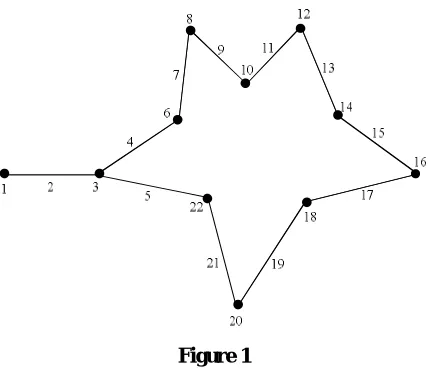
Example 1.12:
IJSRR, 8(2) April. – June., 2019 Page 4693
Figure 1
Remark 1.13:
In a Super Harmonic mean labeling, the labels of vertices and edges are together form{1, 2, 3, …, p + q}.Now we shall use the following theorems for reference.
Theorem 1.14:
10Crowns are Super Harmonic Mean graphs.
Theorem 1.15:
10Comb is a Super Harmonic Mean graph.
Theorem 1.16:
11Double Triangular Snakes and Alternate Double Triangular Snakes are Super Geometric Mean graphs.
2. MAIN RESULTS
Theorem 2.1:
Let G be a graph obtained from a Ladder Ln, n 2 by joining a pendant vertex with a vertex
of degree two on both sides of upper and lower path of the Ladder. Then G is a super Harmonic mean graph.
Proof:
Let Ln = Pn P2 be a Ladder. Let G be a graph obtained from a Ladder by joining pendant
vertices u, w, x, z with v1, vn, u1, un (vertices of degree 2) respectively on both sides of upper and
IJSRR, 8(2) April. – June., 2019 Page 4694
Figure 2
Here p + q = 5n + 6.Define a function f : V(G) {1, 2, …, p + q} by f(u) = 1, f(v1) =
5,f(vi) = 5i, 2 i n,f(w) = 5n + 5,f(x) = 3, f(ui) = 5i + 3, 1 i n except for i = 4m 1, m = 1, 2,
3, … In this case, f(ui) = 5i + 2.Also, f(z) = 5n + 6.Edges are labeled with, f(vivi+1) = 5i +2, 1 i
n 1 except for the case i = 4m 1, m = 1, 2, 3, … . In this case, f(vivi+1) = 5i + 3.Also, f(uv1) =
2,f(vn w) = 5n + 2, f(x u1) = 4, f(uiui+1) = 5i + 4, i i n 1,f(un z) = 5n + 4,f(vi ui) = 5i +1,1 i
n. Therefore, f(V(G)) {f(e) : e E(G)} = {1, 2,…, p + q}. Hence, the edge labels are distinct.Hence, G is a super harmonic mean graph.
Example 2.2:
A Super Harmonic Mean Labeling of G when n = 5 is shown below.
Figure 3
Theorem 2.3:
Let G be a graph obtained by joining a pendant vertex with a vertex of degree two of a comb graph. Then G is a super harmonic mean graph.
Proof :
Comb (Pn K1)is a graph obtained from a path Pn = v1v2 … vn by joining a vertexui to vi, 1 i
n. Let G be a graph obtained by joining a pendant vertex w to vn (a vertex of degree 2) . The graph is
displayed below.
IJSRR, 8(2) April. – June., 2019 Page 4695
Here p + q = 4n + 1.Define a function f : V(G) {1, 2, …, p + q}by f(vi) = 4i 1, 1 i n,
f(w) = 4n + 1,f(ui) = 4i 3, 1 i n. Edges are labeled with f(vi vi+1) = 4i, 1 i n 1,f(vn w) = 4n,
f(viui) = 4i 2, 1 i n.Therefore f(V(G)) {f(e) : e E(G)} = {1, 2,…, p + q}.Then the edge
labels are distinct. Hence, G is super harmonic mean graph.
Example 2.4:
A Super Harmonic Mean labeling G when n = 6 is shown below.
Figure 5
Theorem 2.5:
Let G be a graph obtained by joining a pendant vertex with a vertex of degree two on both sides of a comb graph. Then G is a super Harmonic mean graph.
Proof :
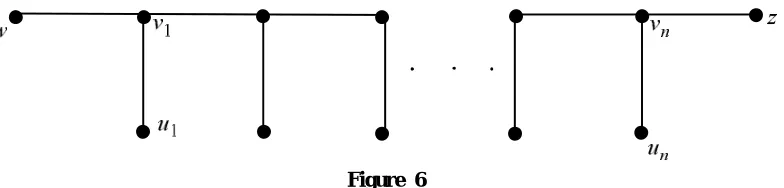
Comb (Pn K1) is a graph obtained from a path Pn = v1v2…vn by joining a vertex ui to vi, 1 i
n.
Let G be a graph obtained by joining pendant vertices w and z to v1 and vn respectively. The
graph is displayed below.
Figure 6
Here p + q = 4n + 3.Define a function f : V(G) {1, 2, …, p + q} by f(w) = 1, f(v1) = 3,
f(vi) = 4i + 1, 2 i n,f(z) = 4n + 3, f(u1) = 6,f(ui) = 4i - 1, 2 i n,Edges are labeled with f(wv1) =
2, f(v1 v2) = 4i + 1,f(vivi+1) = 4i + 2, 2 i n 1,f(vn z) = 4n + 2,f(vi ui) = 4i, 1 i n, Therefore,
f(V(G)) {f(e) : e E(G)} = {1, 2,…, p + q}. Hence, the edge labels are distinct. Thus f is a super harmonic mean graph.
Example 2.6:
IJSRR, 8(2) April. – June., 2019 Page 4696
Figure 7
Theorem 2.7:
The middle graph of a path is a super harmonic mean graph.
Proof :
The middle graph M(G) of a graph G is the graph whose vertex set is {v : v V(G)} {u : u U(G)} and the edge set is {uiui+1 : ui U(G) and ui and ui+1 are adjacent edges of G}
{viui : vi V(G), ui U(G) and vi is incident with ui}.Then join each u1 and um by a pendant vertex
namely w and z respectively. Let G be a graph with vertex set V(G) U(G). Here the vertex set consists of the vertices namely, V ={w, v1, v2, …, vn-2, z} and U = {u1, u2, …, um}. The graph is
displayed below.
u1
w v1 vn 2
um z
Figure 8
Here p + q =2n +3m -2, Define a function f : {v(G) U(G)} {1, 2, …., p + q} by f(w) = 1 f(vi) = 5i + 1, 1 i n 2, f(z) = 5(n 1) ,f(ui) = 5i 2, 1 i n 1.The edges are labeled with,
f(wu1) = 2,f(viui) = 5i 1, 1 i n 2,f(viui+1) = 5i +2, 1 i n 2,f(z um) = 5m 1,f(ui ui+1) = 5i,
1 i n 2.Therefore, f(V(G)) {f(e) : e E(G)} = {1, 2,…, p + q}.Then the edge labels are distinct. Therefore, M(G) is a super harmonic mean graph.
Example 2.8 :
The super harmonic mean labeling of the middle graph M(G) when n = 7 and m = 6 is displayed below.
IJSRR, 8(2) April. – June., 2019 Page 4697
Theorem 2.9:
A Double Triangular Snake D(Tn) attached with one pendant vertex is a super harmonic mean
graph.
Proof:
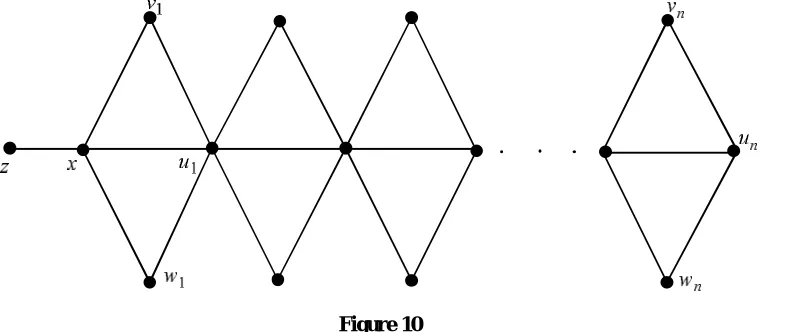
Let D(Tn) be the Double Triangular snake. Consider a path x, u1, u2, …., un. Join x u1 and
uiui+1with two new vertices vi and wi, 1 i n - 1.Let G be a graph obtained by attaching one
pendant vertex with D(Tn). The graph is displayed below.
Figure 10
Here p + q = 8n + 3.Define a function f : V(G) {1, 2, …, p + q} by f(z) = 1,f(x) = 6,f(ui) = 8i +
3, 1 i n,f(v1) = 3,f(vi) = 8i - 1, 2 i n ,f(wi) = 8i + 1, 1 i n Edges are labeled with, f(zx) = 2,
f(x u1) = 8,f(uiui+1) = 8j 2 for all 1 i n 1 and 2 j n,f(x v1) = 4, f(v1 u1) = 5,f(viui) = 8i, 2 i
n, f(x w1) = 7,f(ui wi) = 8i + 2, 1 i n,f(ui vi+1) = 8i +4, 1 i n -1,f(ui wi+1) = 8i +5, 1 i n -1.
Hence , f(V(G)) {f(e) : e E(G)} = {1, 2,…, p + q}. Then the edge labels are distinct. Therefore, G is a super harmonic mean graph.
Example 2.10:
Super harmonic mean labeling of D(T5) attached with one pendant vertex is shown below.
IJSRR, 8(2) April. – June., 2019 Page 4698
Theorem 2.11:
Alternate Double Triangular snake A(D(Tn)) is a super harmonic mean graph.
Proof:
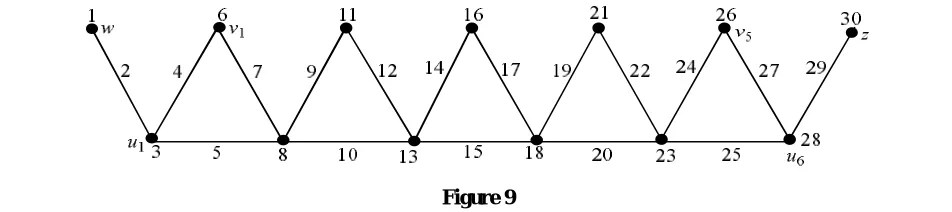
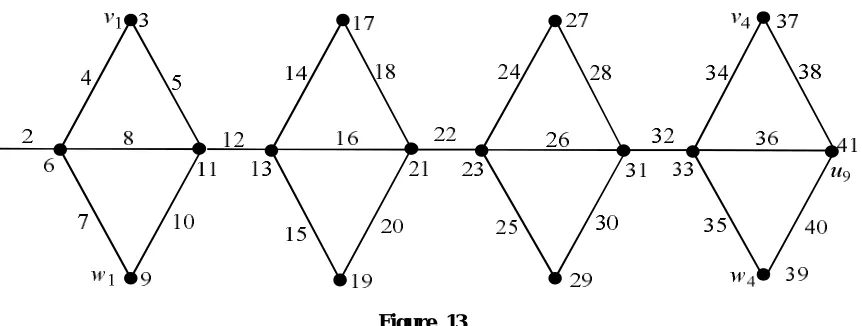
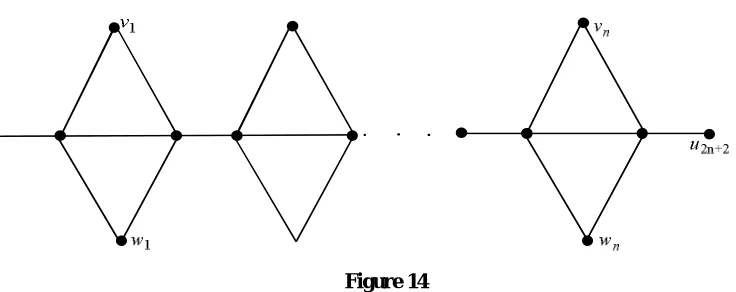
Let G be a graph A(D(Tn)).Consider the path u1u2 … um.To construct G, join ui and ui+1
(alternatively) with two new vertices vi and wi, 1 i n. If A(D(Tn)) starts from u2, we consider two
cases.
Case 1:
In this case m = 2n+1. The graph is displayed below.
Figure 12
Here p + q = 10 n+1. Define a function f : V(G) {1, 2, …, p + q} byf(u2) = 6, f(u2i - 1) = 10i -
9, 1 i n + 1, f(u2i) = 10j + 3, for 2 i n and 1 j n 1, f(v1) = 3, f(vi) = 10j + 7, 2 i n, 1 j
n 1, f(wi) = 10i - 1, 1 i n. The edges are labeled with f(u2i-1 u2i) = 10i - 8, 1 i n,f(u2 u3) = 8, f(u2i u2i+1)
= 10i - 4, 2 i n ,f(vi u2i) = 10i - 6, 1 i n,f(v1u3) = 5,f(vi u2i+1) = 10i - 2, 2 i n,f(u2 w1) = 7, f(u2i
wi) = 10i - 5, 2 i n,f(u2i+1 wi) = 10i, 1 i n .Hence f(V(G)) {f(e) / e E(G)} = {1, 2,…, p + q}.
Therefore, we get distinct edge labels.The labeling pattern of A(D(T4)) is shown below.
Example 2.12:
Figure 13
In this case f provides a super harmonic mean labeling of G.
IJSRR, 8(2) April. – June., 2019 Page 4699
In this case, m = 2n + 2,The graph is displayed below
Figure 14
Here p+q = 10 n + 3.Define a function f : V(G) {1, 2,…, p + q} by,f(u2) = 6,f(u2i - 1) = 10i -
9, 1 i n + 1, f(u2i) = 10j + 3, 2 i n + 1and 1 j n,f(v1) = 3,f(vi) 10j + 7, 2 i n and 1 j
n 1, f(wi) 10i 1, 1 i n. The edges are labeled with f(u2i-1 u2i) = 10i - 8, 1 i n + 1, f(u2
u3) = 8,f(u2i u2i+1) = 10i 4, 2 i n,f(vi u2i) = 10i - 6, 1 i n,f(v1u3) = 5, f(vi u2i+1) = 10i - 2, 2 i
n,f(u2 w1) = 7, f(u2i wi) = 10i - 5, 2 i n,f(u2i+1 wi) = 10i, 1 i n.Hence , f(V(G)) {f(e) / e E(G)} = {1,
2,…, p + q}. Hence the edge labels are distinct. The labeling pattern of A(D(T4)) is shown below.
Example 2.13:
Figure 15
In this case also, f provides a super harmonic mean labeling of G. Therefore, In both cases, A(D(Tn) is a super harmonic mean graph.
REFERENCES
1. Gallian JA. A Dynamic Survey of Graph Labeling. The Electronic Journal of Combinatorics.2012; DS6.
2. Harary F. Graph theory. Narasa Publishing House Reading. New Delhi; 1998.
3. Somasundaram S and Ponraj R. Mean labeling of graphs. National Academy of Science letters.2003; 26: 210-213.
IJSRR, 8(2) April. – June., 2019 Page 4700
5. Somasundaram S, Sandhya SS and Ponraj R. Harmonic mean labeling of graphs. Communicated to Journal of Combinatorial Mathematics and Combinatorial computing. 6. Sandhya SS, Somasundaram S and Ponraj R. Some results on Harmonic mean graphs.
International Journal of Contemporary Mathematical Sciences.2012; 7(4): 197 - 208.
7. Sandhya SS, Somasundaram S and Ponraj R. Some more results on Harmonic mean graphs. Journal of Mathematics Research.2012; 4(1): 21 - 29.
8. Sandhya SS and Somasundaram S. Harmonic mean labeling of some cycle related Graphs. International Journal of Mathematical Analysis.2012; 6(40) :1997 - 2005.
9. Sandhya S and David Raj C.Super Harmonic mean labeling. Proceedings of Kanyakumari Academy of Arts and Sciences.2013; 3: 12 - 20.
10.Jayasekharan C, Sandhya SS and David Raj C. Some Results on Super Harmonic Mean graphs. International Journal of Mathematics Trend and Technology.2014; 6(3): 215 - 224. 11.Sandhya SS, Ebin E Raja Merly and Shiny B. Super Geometric mean labeling on Double