1
rORAM: Efficient Range ORAM with
O
(log
2
N
)
Locality
Anrin Chakraborti
∗, Adam J. Aviv
†, Seung Geol Choi
†, Travis Mayberry
†, Daniel S. Roche
†, Radu Sion
∗ ∗Stony Brook University,
{
anchakrabort, sion
}
@cs.stonybrook.edu
†
United States Naval Academy,
{
aviv, choi, mayberry, roche
}
@usna.edu
Abstract—Oblivious RAM protocols (ORAMs) allow a client to access data from an untrusted storage device without revealing to that device any information about their access pattern. Typically this is accomplished through random shuffling of the data such that the storage device cannot determine where individual blocks are located, resulting in a highly randomized access pattern. Storage devices however, are typically optimized for sequential
access. A large number of random disk seeks during standard ORAM operation induce a substantial overhead.
In this paper, we introduce rORAM, an ORAM specifically suited for accessing ranges of sequentially logical blocks while
minimizing the number of random physical disk seeks. rORAM ob-tains significantly better asymptotic efficiency than prior designs (Asharov et al., ePrint 2017, Demertzis et al., CRYPTO 2018) re-ducingboththe number of seeks and communication complexity by a multiplicative factor of O(logN). An rORAM prototype is 30-50x times faster than Path ORAM for similar range-query workloads on local HDDs, 30x faster for local SSDs, and 10x faster for network block devices. rORAM’s novel disk layout can also speed up standard ORAM constructions, e.g., resulting in a 2x faster Path ORAM variant. Importantly, experiments demonstrate suitability for real world applications – rORAM is up to 5x faster running a file server and up to 11x faster running a range-query intensive video server workloads compared to standard Path ORAM.
I. INTRODUCTION
ORAM. An attacker viewing communications or tracking accesses of a storage user can determine a wealth of private information. Data encryption does not prevent this since access patterns often reveal nearly as much as the data contents themselves [28]. Oblivious RAM (ORAM) [27, 38, 41] aims to solve this by making access patterns indistinguishable to an adversary observing reads/writes to untrusted storage.
Typically, ORAM performance metrics have focused on communication overhead, or bandwidth, loosely describing the number of additional data reads/writes needed to perform a single access [27]. More recently, other metrics have included local computation complexity and round complexity. Numer-ous ORAM constructions [10, 38, 40, 41, 42, 45] have been proposed and studied optimizing these performance measures.
Data locality and range ORAM. One important measure, so far largely overlooked, isdata locality, the spatial locality of data in storage, where related data is stored adjacent in memory rows or blocks on disk. Due to caching effects at all levels of the memory hierarchy, it has long been understood that taking advantage of spatial locality can have significant performance benefits. In particular, a single cache miss overhead is more costly than executing 100 instructions. Disk seek overhead costs (e.g., time) often exceed 10000 times the bandwidth cost of reading a single sequential block from
that disk [17]. This observation has led to the development of efficient data structures and algorithms which improve performance by optimizing data locality in storage [18].
However, in the case of ORAMs, the randomization neces-sary to ensure privacy seems to be in direct conflict with data locality. Even for a single access, a typical ORAM requires many non-sequential accesses to the untrusted data store. Even worse, the upper-layer (e.g., file systems) generating optimized accesses with high degree of locality to the underlying storage, gains no benefit when using a standard ORAM to interface with a physical store. This is because in ORAMs, the physical locations have no correlation with their logical addresses.
To address this, recently, Demertzis et al. [21] considered locality for ORAMs in the context of searchable encryption and provided an ORAM construction withO(1)disk seeks and O(N1/3log2N)blocks communication complexity. This is a logarithmic improvement over Path ORAM in the number of seeks (Table I), but the significant bandwidth blowup renders the construction suitable only for very specific applications.
Further, in [21], range accesses – a key use case where locality stemming from upper-layer accesses (e.g., in a file system) should be heavily leveraged – are still inefficient. For a range of size r, the number of disk seeks required isO(r) (note the dependence on the range size).
Asharov et al. [9] specifically considered the issue of supporting efficient range queries for ORAMs, bymaking disk seeks independent of the range size. They show that ORAM range query locality directly conflicts with standard ORAM security requirements. By definition, a standard ORAM must not reveal whether a client requests any r random items or a contiguous region of length r. An ORAM protocol that provides both locality and security must necessarily incur prohibitive bandwidth overhead.
Asharov et al. further observed that carefully relaxing the traditional ORAM security definition to match realistic scenarios allows for significantly more efficient solutions. Specifically, if leaking the rough size (i.e., ⌈log2r⌉) of each accessed range is acceptable, it is possible to design a range ORAM construction with O(log3N·(log logN)2) seeks per operation,independent of the length rof the range(Table I). For comparison, consider that Path ORAM needs O(r·
log2N)seeks forrsequential accesses, where the dependency on r stems mainly from a lack of locality. [9] does better asymptotically whenr= Ω(logN·(log logN)2), at the cost ofO(logN)times higher communication complexity.
which is often times much more expensive, especially when data is outsourced to remote servers.
To mitigate this, we ask the following important question:
Can we construct an efficient range ORAM scheme with data locality, while ensuring that accesses to a small range is asymptotically as fast as the traditional ORAMs?
rORAM answers affirmatively and provides a highly effi-cient range query mechanism with locality, with O(log2N) seek and O(r·log2N) non-amortized communication com-plexity, O(logN) times more efficient than existing work. Importantly, note that for singleton ranges, rORAM has the same asymptotic bandwidth requirements as standard Path ORAM [41] with a server-side position map!
A. Security & Application Setting
Security of range ORAM. At first glance, it may seem that allowing range size leaks seriously weakens ORAM security. However, in most practical cases, this leak already exists inherent to the deployment.
For example, a typical file system running on top of an ORAM issues a majority of its accesses in tightly time-adjacent bursts of sequential block ranges. This immediately leaks the range sizes to any underlying untrusted storage. In fact, explicitly hiding range sizes may be futile if the under-lying storage is already aware that a file system runs on top of it. In the following, we detail several other considerations that strengthen the case for accepting range size leaks.
First, consider that rORAM leaks only the rough length of a range, where the actually queried range size is always a power of 2, i.e., i = ⌈log2r⌉. Thus for any user-desired range length, e.g, {1,2,3, . . . ,maxlen}, the leakage profile will be{⌈log21⌉,⌈log22⌉,⌈log23⌉, . . . ,⌈log2maxlen⌉}. This leakage contains O(log2N) different values and can be un-derstood as O(log2N)different possible padding lengths. Of course, padding any arbitrary length r always to a fixed N
provides the best security, but it also greatly increases com-munication costs. Having variable padding lengths provides a tuning knob to trade off between efficiency and security.
More importantly, even with fixed-length padding (the most secure option), standard ORAMs leak significant information, mainly through the timing channel discussed above, not cap-tured by the ORAM security definition. As discussed, for a typical file system deployed on top of a standard ORAM block device, accesses to different files/metadata/etc. are highly correlated and can be determined accurately using timing information on the number of blocks requested within a given time window. No practically viable solution exists for this leak.
Application setting. Many applications, such as searchable encryption, are well suited to less strict ORAM security guarantees. Weaker ORAMs have been previously used to design efficient dynamic searchable encryption schemes [32]. Range ORAMs are particularly useful in this setting [21].
Further, as shown by experiments (Section VII), rORAM is extremely well suited for deployment with traditional file systems (e.g., ext4 file server). File systems typically generate requests of variable sizes for both reading/writing files and
updating metadata. To achieve acceptable I/O throughputs, the underlying ORAM block device needs to support efficient queries for arbitrarily-sized ranges of sequential blocks.
Accordingly, rORAM is designed to efficiently execute range queries of variable sizes. This significantly speeds up file system operation and for large file applications (e.g., a video server), the gains are even more noticeable. For example, rORAM features a 5x speedup over Path ORAM running a typical file server and an 11x speedup for a video server application running on a local HDD.
In summary, rORAM generalizes standard ORAMs that do not specifically support range queries, and provides an easy-to-tune tradeoff between performance and security:
Applications querying only singleton ranges achieve the same security guarantees as on a traditional ORAM at similar costs. Applications querying entire ranges get significant performance increase at an easily quantifi-able security cost, namely leaking the size of the range.
B. rORAM Highlights
Locality-aware disk layout and batch writes. As we will see later, a main rORAM building block is a modified version of Path ORAM. We first introduce a new technique for reducing the number of seeks in a Path ORAM.
Tree-based ORAMs, such as Path ORAM, update data in the server-side tree through an eviction operation, which reads a specific path in its entirety and writes back as many blocks as possible from the client-localstash along the path. To prevent overflows, consecutive eviction paths are chosen with minimum overlap, usually in bit-reversed lexicographical ordering1 of the leaf identifiers [26].
However, this has a detrimental effect on the number of seeks required when evictions are performed in batches, since successively chosen eviction paths are topologically distant from each other in the tree. Specifically, when tree nodes are stored at random locations, the number of seeks required to batch bevictions isO(b·logN)(note the dependence on b). Since range queries write back multiple blocks to the tree, a more efficient batching mechanism is desirable. By design, rORAM enables many evictions to execute with very few seeks – the number of seeks is independent of the number of evictions performed. To this end,rORAM disk layout ensures that tree nodes accessed in successive evictions are physically located next to each other on the storage device.
In particular, the paths (i.e., corresponding to leaf nodes) in the ORAM tree are labeled in bit-reversed lexicographic ordering. Then, the physical buckets at each level of the tree are stored adjacent to each other, following the same bit-reversed ordering (see Figure 2 and Figure 3).
As a result, when performingb evictions together, buckets can be fetched (and written back) level-by-level. Due to the physical layout of the tree, the b mod 2i buckets required from leveli, will be adjacent to each other on physical storage
1In bit-reverse ordering, numbers are ordered by treating the leftmost bit as
Seeks Bandwidth Server Space Client Storage Leakage
rORAM (this work) O(log2
N) O(r·log2
N) O(NlogN) O(L·λ) ⌈log2r⌉ Asharov et al. (Range ORAM) [9] O(log3
N·(log logN)2
), amort. O(r·log3
N), amort. O(NlogN) O(L·λ) ⌈log2r⌉ Path ORAM (rec. PM) [41] O(r·log2
N) O(r·log2
N) O(N) O(λ) none
Path ORAM (local PM) [41] O(r·logN) O(r·logN) O(N) O(N) none
Demertzis et al. [21] O(r) O(r·N1/3·log2N) O(N) O(N1/3log2N) none
TABLE I
PERFORMANCE COMPARISON FOR A CLIENT ACCESSING A REGION OFrCONTIGUOUS BLOCKS.LIS THE MAXIMUM RANGE SIZE SUPPORTED BY THE RANGEORAMSCHEMES ANDλIS THE SECURITY PARAMETER. ALL COMPLEXITIES ARE IN TERMS OF NUMBER OF BLOCKS.
and can be read with only 1 seek. Effectively,bevictions now require in total O(logN) seeks,independent ofb.
Interestingly, since rORAM applies this technique to Path ORAM itself, it achieves better efficiency not only for range query applications but also for standard Path ORAM perfor-mance. Experiments show a 2x speedup for standard Path ORAM equipped with the disk-aware layout and batched evictions (Section VII).
Multiple sub-ORAMs with different data locality. rORAM deploys O(logN) separate Path ORAM based sub-ORAMs, each of which contains a copy of the same data at all times. Further, each sub-ORAM is optimized to serve a different range size with minimal disk seeks.
Specifically, the ith sub-ORAM is optimized for access to a contiguous range of lengthrwhere⌈log2r⌉=i. This leaks the rough size of the given range, but it allows the sub-ORAM to be highly efficient in serving the query.
Locality-sensitive mapping. The locality-aware disk layout only ensures that multiple batched evictions incur a small number of disk seeks independent of the batch size. However the layout does not provide any seek-related guarantees when queryingfor multiple blocks from different random paths in a Path ORAM tree. This is because Path ORAMs place blocks along random tree paths, regardless of the block address. As a result, fetching a logically related range of blocks still requires fetching multiple random paths from the tree, unavoidably incurring a large number of seeks. Specifically, if each node of the tree is stored at a random location on disk, fetching a range of size rrequires O(r·logN)seeks.
To mitigate this, rORAM introduces a novel block mapping scheme consistent with the locality-aware disk layout. In particular, the scheme places the first block in a range onto a random path in the tree, andall subsequent blocks in the range are placed along paths that are stored adjacent to each other on disk. Now, reading a range of sizerrequires onlyO(logN) seeks! Critically, as we will show, with an appropriately-sized stash, the mapping provides standard privacy assurances.
Efficient management of multiple position maps. Note that since rORAM duplicates data across multiple sub-ORAMs, updates to a block in one sub-ORAM should be reflected to the other sub-ORAMs as well to ensure consistency. This is challenging because the sub-ORAMs are initialized with their own random seeds, and hence the location of a particular block in one sub-ORAM does not immediately provide its location in the other sub-ORAMs.
Further, in the presence of a stateless or limited-storage client, the position maps associating logical to physical ad-dresses in each of the sub-ORAM trees must also be stored obliviously on the server. This is a well-known problem with
tree-based ORAMs like Path ORAM. Locating and updating a block in all the sub-ORAMs using their corresponding position maps will unfortunately result in O(log3N) seeks and communication overhead.
To tackle this, rORAM introduces a newdistributed position map. First, each block in each sub-ORAM stores additional information allowing rORAM to immediately look up the physical location of that same block in the other ORAMs, not unlike the case of pointer-based oblivious data structures [44]. Second, note that if a client accesses a range using theith sub-ORAM, the positions of the blocks in the accessed range need to be updatedonly in theith sub-ORAM. The range needs to be evicted to the other trees as well, but there is no need to refresh the positions in the other sub-ORAMs since they are still hidden and look random to the adversary – the range has not been read from those trees, and the (deterministic) eviction schedule is independent of the positions.
As a result, rORAM needs only O(log2N) seeks for the position map accesses and updates per operation, matching the asymptotic cost of the data access itself.
Simplicity of construction & evaluation. A key advantage of rORAM is the simplicity of implementation and deployment. Prior solutions [9] are amortized and use complex building blocks (such as locality-friendly oblivious sort etc.)
rORAM mechanisms can be implemented with simple yet effective modifications to existing tree-based ORAM designs. rORAM is evaluated in detail for real workloads, and com-pared against standard ORAMs. rORAM is 30-50x times faster than Path ORAM for similar range query workloads on local HDDs, 30x faster for local SSDs, and 10x faster for network block devices. Further, the rORAM locality-aware physical layout can be deployed independently to speed-up standard Path ORAM by a factor of 2x. Finally, application benchmarks demonstrate that rORAM is up to 5x faster running a file server and up to 11x faster running a range-query intensive video server workloads compared to Path ORAM.
C. Summary
Based on the construction presented herein, rORAM makes the following contributions:
1) A new oblivious range ORAM construction that opti-mizes data locality and is faster by a factor ofO(logN) over previous results [9] (Table I).
3) A new distributed position map construction for effi-ciently locating block replicas in multiple ORAMs. 4) An open-source implementation of rORAM. To the best
of our knowledge, rORAM is the first implementation of a Range ORAM construction.
5) Micro-benchmarks showing significant performance in-crease for range-query workloads compared to standard ORAMs. For example, rORAM is 30-50x faster than Path ORAM for range queries of size ≥210 blocks on local HDDs, 30x faster for local SSDs, and 10x faster for network block devices.
6) Application benchmarks showing suitability for real world applications: rORAM is up to 5x faster running a file server and up to 11x faster running a range-query intensive video server across several platforms.
II. PRIORWORK
Oblivious RAM (ORAM) and applications. ORAM protects the access pattern so that it is infeasible to guess which oper-ation is occurring and on which item. Since the seminal work by Goldreich and Ostrovsky [27], many works have focused on improving ORAM efficiency (e.g., [10, 34, 38, 42, 45]).
ORAM plays as an important tool to achieve secure cloud storage [31, 39] and secure multi-party computation [22, 30, 42] and secure processors [24, 29]. There also have been works to hide the access pattern of protocols accessing individual data structures, e.g., maps, priority queues, stacks, and queues and graph algorithms on the cloud server [35, 44].
Locality in searchable encryption. Data locality has been a useful metric for evaluating searchable symmetric encryption [8, 14, 19]. In these models, the client stores their data remotely and encrypted, but the server can perform searches upon the data (e.g., a keyword search) without revealing the plain text. While related, searchable symmetric encryption does not protect against access patterns, e.g., revealing whether the same data item has been accessed multiple times.
ORAMs with locality. In the closest related work to this one, Asharov et al. [9] first introduced the weaker security model for range ORAMs by which the size of the range is leaked to provide data locality. Their construction, built on top of a hierarchical ORAM construction [27], also makes use O(logN)series of ORAMs by which each ORAM forms the layer in the tree. Locality is achieved by storing the ranges on each level as increasingly larger blocks of size 2i. They show that the number of seeks per access isO(log3N·(log logN)2). Further, [9] proposes a more relaxed definition for File ORAMs where the sizes of individual files are revealed per access. This results in better asymptotic performance at the cost of less access flexibility. First, File ORAMs do not provide any opportunity for padding accesses in contrast to the variable-length padding options available for range ORAMs – access to individual files/metadata of different sizes are always distinguishable and multiple accesses to the same file can be linked using the file size. Second, File ORAMs cannot support efficient arbitrary-sized reads/edits to portions of large files – files are always accessed in their entirety. In this work, we adapt the security setting and flexibility of range ORAMs but
with a more efficient construction. We primarily compare our work against the range ORAM construction in [9].
Data locality has been used previously as a performance metric in the setting of write-only ORAMs. In this security model, reads are assumed to be unobservable by an attacker, but writes to data can be observed and must be obfuscated. First introduced by Blass et al. [11] in the context of protecting hidden volumes, a randomized procedure was used to achieve obliviousness. Later, Roche et al. [36] showed that write-obliviousness can be achieved with deterministic, sequential writing patterns. However, the data locality of reads was not evaluated, and depends largely on the write pattern itself.
Improvements for the position map have been produced by using temporal locality. FreeCursive [24] employs a PosMap Lookaside Buffer (PLB) to reduce the overhead of using a position map. While leveraging temporal locality in the position map, this work does not providespatialdata locality. ORAMs have also been used to expand searchable encryp-tion with locality. Work by Demertzis et al. [21] proposed a hierarchical square-root ORAM [27] to support searchable en-cryption. This scheme makes use of locality-preserving version of Melbourne Shuffle [33] to achieveO(1)seeks, but requires O(N1/3log2N)communication and local storage with higher server storage. It also does not support range queries naturally, which adds a multiplicative cost to communications and seeks.
III. BACKGROUND& SECURITYDEFINITIONS
ORAM. An Oblivious RAM (ORAM) protocol allows a client to store and manipulate an array ofN blocks on an untrusted, honest-but-curious server without revealing the data or access patterns to the server. Specifically, the logical array of N
blocks is indirectly stored into a specialized back-end data structure on the server, and an ORAM scheme specifies an access protocol that implements each logical access with a sequence of physical accesses to that back-end structure. An ORAM scheme is secure if for any two sequences of logical accesses of the same length, the physical accesses produced by the protocol are computationally indistinguishable.
More formally, let ~y = (y1, y2, . . .) denote a sequence of operations, where each yi is a Read(ai) or a Write(ai, di); here, ai ∈ [0, N) denotes the logical address of the block being read or written, and di denotes a block of data being written. For an ORAM schemeΠ, letAccessΠ(~y)denote the physical access pattern that its access protocol produces for the logical access sequence~y. We say the schemeΠissecure if for any two sequences of operations~x and~y of the same length, it holds
AccessΠ(~x) ≈c AccessΠ(~y),
where ≈c denotes computational indistinguishability (with respect to the security parameterλ).
A. Range ORAM and Locality
Let let ~y = (y1, y2, . . .) denote a sequence of opera-tions, where each yi represents an access to a range of sequential blocks. Let yi be either ReadRange(ai, ℓi) or
WriteRange(ai, ℓi, d1, . . . , dℓi). Here, ai refers to a logical
block as before, but additionally ℓi indicates the number of sequential blocks to access starting with ai. d1, . . . , dℓi are
the blocks of data to be written to the logical addresses
ai, ai+ 1, . . . , ai+ℓi.
Letlen(yi)signify the lengthℓi for of the range accessyi.
A Range ORAM schemeΠis secure if for any two sequences of operations ~x and ~y of the same length, subject to the following constraint:
∀i:⌈log2(len(yi))⌉=⌈log2(len(xi))⌉
it holds that
AccessΠ(~x) ≈c AccessΠ(~y),
where ≈c denotes computational indistinguishability (with respect to the security parameter λ).
Informally, this means that a Range ORAM can leak the rough size of the ranges that are being accessed by each operation. That is, the length of two accesses only needs to be within (2k,2k+1] for some k in order for them to be indistinguishable. In other words,O(logℓi)bits are leaked per access, which is the order of magnitudeof the range.
Locality and seeks. Locality of an algorithm is well defined in prior works [9, 19]. Informally, this isthe number of seeks required on the storage medium during the execution of that algorithm. If an ORAM algorithm performs accesses to the physical storage at the addresses~z= (z1, z2, . . .), in that order, then aseekis defined as an indexisuch thatzi+16=zi+1. The total number of seeks across~zis thelocalityof the algorithm.
B. Path ORAM
One of the most efficient ORAM constructions currently known is Path ORAM, presented in the seminal work of Stefanov et al. [41]. Path ORAM works by storing data blocks in a complete binary tree with N leaf nodes (or buckets). Each bucket in the tree has space for a small constant number of blocks, denoted Z. During initialization, leaf buckets are numbered0 toN−1and blocks are each given random tags (or positions) from the range [0, N). In addition, there is a single small stasharea which holds some blocks temporarily. The tree maintains aninvariantthat if a block has tagp, it will existeither in the stash or somewhere along the path from the root of the tree to the pth leaf node.
Data access and eviction. In order to retrieve a block, the client must first determine the path position tagtfor the block. This is done by maintaining a map, called the position map, that relates logical block addresses to their random positions. Once the tag t has been found, the client retrieves the entire path from root to the tth leaf node and stores the buckets on this path locally. The requested logical block is accessed by scanning the retrieved buckets. The chosen block is then assigned to a new random leaf node (i.e. a tag), and its tag is updated accordingly and stored back in the position map. Finally the updated block itself is appended to the stash area.
Note that this occurs invariably as the tag is reassigned for every access in order to hide the access pattern.
Because the stash has a fixed size, eventually it is necessary to evict blocks from the stash back to the tree buckets. In the simplest setting, every data access (which involves appending one new block to stash) is followed immediately by rewriting, or evicting, along a single path in the tree. In this step, the client picks a path in the tree (either randomly or deterministically using bit-reversed ordering [26, 41]) and retrieves the buckets for that path from the storage device. The existing blocks in that path are then re-ordered, along with the blocks in stash, so that every block is stored as far down in the path as it can go, subject to the invariant and the size of the buckets. Any block which still does not fit in the path is stored back to the stash area.
Bucket and stash size. Because each bucket has a fixed size, as does the stash area, it is possible for the scheme to “break” by running out of room in the stash, a situation referred to asstash overflow. The original Path ORAM used a random eviction strategy and showed that if the bucket size is at least Z ≥ 5, the probability of stash overflow decreases exponentially in the stash size [41]. The Ring ORAM construction improved this further, demonstrating that
Z≥3is sufficient with adeterministiceviction strategy [34].
Position map. The map storing each block’s tag can be quite large; it isNlog2N bits long. If the client is not capable of storing the map locally, it can be stored recursively in a series of O(logN) smaller ORAMs on the server. Alternatively, one can use an oblivious data structure (more specifically, an oblivious trie [36, 41]) to store the position map. In either solution, the total communication overhead for a single access with Path ORAM is O(log2N).
Access Complexity. ORAMs are typically evaluated in terms of bandwidth – the number of data blocks that are downloaded/uploaded in order to complete one logical request. Path ORAM features an overall bandwidth ofO(logN) data blocks, whereN is the total number of blocks in the ORAM. This asymptotic bound holds only under the large block size assumptionwhen the data blocks size isΩ(log2N)bits.
rORAM has the same large block size assumption and all access complexities reported in this paper indicate the number of physical blocks that are accessed overall for fulfilling a particular logical request.
Seeks. If Path ORAM is used as a Range ORAM to retrieve a sequential range of blocks, each block is stored along a random path, and it would requireO(r·logN)seeks to fetch data blocks, whereris the number of blocks in the range. If the position map is stored server-side recursively, the position map access will additionally require O(r·log2N) seeks. A locality-friendly ORAM, as we achieve here, should require a number of seeksindependent of the range sizer.
IV. RORAM CONSTRUCTIONOVERVIEW
To this end, we show how to achieve data locality for both queries and evictions for each of the sub-ORAMs. This is the result of two key insights – i) using a locality-aware disk layout that dramatically reduces the number of seeks required for performing multiple evictions in batches, and ii) a novel locality-sensitive block mapping mechanism which reduces seeks when querying for blocks in a range.
Finally, we describe a novel distributed position map scheme for efficient query and update of the multiple sub-ORAMs.
A. Core Construction
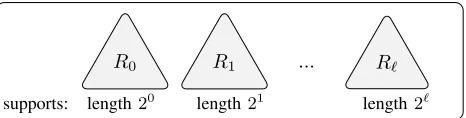
Multiple ORAMs each covering a subset of ranges. We use multiple sub-ORAMs to store ranges of a specific length, as with the prior work [9]. Let N be the total number of blocks stored in the rORAM, and L≤N be a parameter indicating the maximum range size that will be supported. Then the rORAM construction makes use ofℓ+ 1Path ORAMs, where
ℓ = ⌈log2L⌉; these individual Path ORAMs are labeled
R0, R1, . . . , Rℓ. An access on ORAM Ri will always access
exactly2i blocks (see Figure 1) which are logically sequential in the range. Note that R0 is a Path ORAM as it would normally be constructed, with a range size of just one block. Within a given ORAM Ri, N data blocks are partitioned into ranges of length2i, and letrj
i denote thejth range inRi, i.e., rij:= [j·2i,(j+ 1)·2i). Each ORAMR
i is specifically tailored so that contiguous ranges of length 2i are located close to each other on storage. The tradeoff is that ranges can only be queried in their entirety, consequentlyℓ+ 1 separate ORAMs: to support any size range with low overhead.
If the client requests a range that is exactly rji, this could be fulfilled with a single access on Ri by requesting range
j. However, we must consider a client requesting an arbitrary range, which may not start on a power-of-two boundary. One strategy for fulfilling such requests in a single access would be to upgrade the query to the next, larger-range ORAM until
ri
j ∈ri ′
j′, but there is an issue with this approach. In particular, even for a small range, as small as size 2, it is sometimes impossible to cover the range with a single access, unless the length of ranges of an ORAM is N. For example, suppose
N = 64and consider a range [31,33). No range of the form
[a·2i,(a+ 1)·2i)can cover[31,33).
Fortunately, there exists a solution [9, 20, 23]. If a range overlaps a boundary, we can fulfill the request with two accesses of the same power-of-two size. For example, access to the range[15,22)of length 7 would be covered by accessing ORAM R3 (i.e., ⌈log27⌉ = 3) with two ranges [8,16) and
[16,24). We stress that so as not to leak information about the range boundaries, we shouldalwaysperformtwoaccesses even if the entire request fits within a single range; note that whether a range query is handled by a single access or two is indeed leaks information about the range.
Comparison with [9]. One crucial difference here compared to the prior work [9] that similarly uses sub-ORAMs to duplicate data and serve range queries of different sizes, is that the sub-ORAMs R0, . . . , Rℓ in rORAM have the same physical block size regardless of the served range size. This means that a single access in a given sub-ORAM Ri occurs on 2i blocks and is completed as a single batchedoperation.
R0 R1 ... Rℓ
supports: length20
length21
length2ℓ
Fig. 1. rORAM Organization. rORAM storingN blocks and support-ing ranges up to2ℓconsists ofℓ+ 1tree-based ORAMsR
0, . . . , Rℓ.
Each component ORAMRi containsN blocks and supports ranges
of size2i. All ORAMs have the same block size.
In contrast, sub-ORAMs in [9] have different physical block sizes; a range is effectively stored and accessed as a large physical block (called a superblock), concatenating the content of the regular blocks in the range. We will see that retaining the same block size for all sub-ORAMs is the key to making rORAM more efficient. For this, we first introduce the operations supported by each sub-ORAM.
Operations forRi. RecallRisupports range queries of length
2i. This requires two operations:
• ReadRange(a): Takes as input a logical address a and
returns the 2i blocks in the range [a, a+ 2i) from the ORAM. Hereamust be a multiple of2i, as ina=b·2i.
• BatchEvict(k,stash): Perform k evictions as a batch
to write back multiple blocks to the ORAM from the
stash for each of the k evicted paths. Evictions occur in a deterministic order, and a global counter is used to maintain this order.
Remarks about BatchEvict. Now, recall that in rORAM (and also in [9]), all sub-ORAMs should consistently maintain the same data. By implication, updates in any ORAM Rj, must be followed by updates to every otherRi fori6=j.
Specifically, aReadRangeoperation on sub-ORAMRjwill be followed by a BatchEvict(2j,stash) to all ℓ + 1 ORAMs. Therefore, we cannot assume that evictions to sub-ORAMRk will always in be in batches of2k blocks.
With different physical block sizes (superblocks) in [9], it is difficult to perform eviction of a small range in a larger-block ORAM efficiently. Intuitively, in order to update a single block out of the several blocks that constitute asuperblock, the entire superblock needs to be refreshed lest it leaks privacy. This becomes a significant overhead with larger superblocks. To overcome this, [9] relies on amortizing the cost using a hierarchical ORAM [27]. In this amortized construction, eviction is significantly slower (by a factor of O(logN)) than standard tree-based ORAMs,In contrast, by maintaining the same physical block size across all sub-ORAMs, rORAM can perform non-amortized evictions to each sub-ORAM with the same asymptotic complexity as the underlying tree-based ORAM. This is critical for ensuring that singleton range queries in rORAM can be performed with the same asymptotic complexity as standard tree-based ORAM queries.
Operations on rORAM. rORAM operations are internally composed of operations on each sub-ORAMRi. For rORAM, we have the following operation:
• Access(id, r): Given a range of sizerbeginning at logical
identifier id, with ⌈log2r⌉ = i, run Ri.ReadRange(a1) and Ri.ReadRange(a2) with a1 = ⌊id/2i⌋ and a2 =
The updated data blocks are then appended to the stash of all ℓ + 1 sub-ORAMs. Then, for each Rj, call
Rj.BatchEvict(2i+1,stash).
As mentioned previously, anAccessrequires twoReadRange’s to occur (to avoid leaking properties of the range) resulting in 2i+1 data blocks. For every Access, we need to perform the same magnitude of BatchEvict’s for all ℓ+ 1 ORAMs, updating the data which is duplicated in each tree.
Remark about Choosing L. The choice of an appropriate max range size,Lprimarily depends on the application. How-ever, the trade-off is that a largerLrequires a larger client-side storage. This is because anL-size query necessitates the local storage ofLblocks. This is reflected in the rORAM stash size bound (Table I). One thing to note here is that due to rORAM’s O(log2N) bandwidth overhead, for query sizes ≥ N
log2N, downloading the entire database is faster than accessing the range from an ORAM. Consequently, an appropriate upper bound is L < logN2N, thus ensuring that the rORAM stash size is sub-linear in N.
More importantly, applications rarely access very large ranges all at once, possibly to reduce the overall access latency. Instead, a typical application e.g., a file system breaks down a large access into multiple smaller sequential accesses, often not exceeding 1MB in size. In this case, it suffices to initialize rORAM with L = 28 blocks. In general, for almost all applications, a reasonable value of L=O(√N) blocks with O(√N)client-side storage. Larger range queries (if any) can
be broken down into smaller range queries of appropriate size.
B. Insight 1: Locality-aware Physical Layout
A common extension to Path ORAM is to use a determin-istic eviction strategy using bit-reversed ordering of the paths, as described by Gentry et. al [26]. In bit-reverse ordering, counting occurs with the least significant bit on the left, as compared to natural ordering, where the most significant bit is to the left and the least significant is the right. For example, counting in 3-bits, the number to follow 000 is not 001 but rather 100, leading to the sequence of 3-bit-reversed number ordering as 000 (0), 100 (4), 010 (2), 110 (6), 001 (1), 101 (5), 011 (3), 111 (7) — with the decimal value in parenthesis. Each bucket of the tree is now labeled with both its level in the tree and its bit-reversed ordering in that level, as in Figure 2. That is, a bucket labeled asvij signifies thejth bucket among those at level i.
Evicting paths in this order ensures a good “spread” over the tree, making it less likely that any blocks get stuck, by chance, in the higher buckets of the tree and cause an overflow. But as we will show, the bit-reverse ordering can also be leveraged for the physical layout of the tree to achieve data locality.
Locality-aware physical layout of Ri. An important obser-vation is that the the path eviction schedule also implies the deterministic ordering in which data is evicted to nodes within levels of the tree; in particular:
The nodes at the same level are ALSO evicted accord-ing to the bit-reversed order.
Let P(p) be a path from the root to a leaf with position p. For example, in the tree in Figure 2, the three consecutive
v0
0
v0
1
v0
2
v0
3 v43
v2
2
v2
3 v63
v1
1
v1
2
v1
3 v35
v3
2
v3
3 v37
Fig. 2. Labeling of ORAM tree buckets.A bucket labelvij signifies the
jth bucket among those at leveliin bit-reversed order.
v00
v0
1 v
1 1
v20 v 1
2 v
2
2 v
3 2
v0
3 v
1
3 v
2
3 v
3
3 v
4
3 v
5
3 v
6
3 v
7 3
Fig. 3. Physical disk storage of ORAM Ri.Buckets at each level are
stored sequentially according to the bit-reversed order.
eviction pathsP(v2
3), P(v33), P(v34)visits bucketsv22, v23, v20at level 2,v0
1, v11, v10at level 1, andv00, v00, v00. At each level, the buckets are accessed according to the bit-reversed order (with wraparound).
If the ORAM stores each level sequentially on the storage device, according to the bit-reversed eviction ordering of the level (see Figure 3), evictions can be done with optimal number of seeks. Consecutive evictions, as is the case for
BatchEvict, occur in bit-reverse order sequentially for each level in the tree. To the best of our knowledge, rORAM isthe first construction that considers the physical layout to improve efficiency of ORAM performance.
O(logN)seeks independent of range size. With a sequential layout of buckets on disk that matches the bit-reversed order at each levelxin theRjsub-ORAM tree,Rj.BatchEvict(k)will visit min(k,2x) buckets, stored physically adjacent to each other, at levelxsequentially. Thus, reading and writing back to each level requires at most 2 seeks, with wraparounds, and the ORAM tree has logN + 1 levels. The total number of seeks performed forRj.BatchEvict(k)is thereforeO(logN). Note that the number of seeks is independent ofk, the number of eviction operations performed as a batch. Updating (ℓ+ 1) sub-ORAMs will requireO(ℓ+ 1·logN) =O(log2N)seeks.
C. Insight 2: Locality-sensitive Mapping
Tree-based ORAM schemes map logical addresses to paths in the ORAM tree, along which the block corresponding to the logical address is placed. For Path ORAM, a logical address is mapped to a new random path every time the corresponding block is accessed.
Recall that ReadRange on ORAM Ri reads exactly 2i blocks. Using the traditional mapping mechanism (i.e., assign-ing a random path for each block) will not provide locality, resulting inO(2i·logN)seeks to read 2i random paths.
Our approach. rORAM uses a hybrid of random and deterministic placement policies for mapping blocks to paths:
• For blocks that do not belong to the same range, a
purely random strategy can be applied since no locality guarantees are required.
• For blocks that belong to the same range, it is desirable
to place these blocks along paths that are stored close to each other on disk.
The first requirement implies that blocks in different ranges can be mapped to random paths in the tree, independent of each other. While allowing better locality, the second requirement has implications on the security of the scheme. Specifically, blocks that belong to the same range will not be mapped independently to paths. Accessing a range of a particular size will be clearly observable based on the paths read. Since we allow the size of queried ranges to be leaked anyway, this does not actually reveal any further information.
Locality-sensitive mapping. Keeping the locality-aware physical layout in mind, we map the blocks in the same range in Ri to paths that occur successively in the bit-reversed ordering of their leaf identifiers.Then, the blocks in the range will appear physically adjacent to each other across levels, and we can reduce the number of seeks required to read the range. In particular, consider logical addresses in[j·2i,(j+ 1)·2i) in Ri. Letting a=j·2i, the addresses are mapped to paths in the tree as follows:
• Address a: Addressa is mapped to a random path, i.e.,
P(vr
h)whereris chosen at random and h= logN.
• Adresss a+j: For j = 1, . . . ,2i−1, addressa+j is
mapped to a path P(vhr+jmodN).
This ensures that Ri.ReadRange requires O(logN) disk seeks: sequentially scan 2i buckets from each level of the tree (with wraparound), that are invariably adjacent to each other on storage. Note that the number of seeks required is independent of the range size, 2i.
D. Insight 3: Distributed Position Map
Although, the above techniques can achieve the desired O(logN) seeks for ReadRange and O(log2N) seeks for BatchEvict’s, a critical challenge we are yet to address is optimizing the cost of multiple position map lookups while updating ℓ+ 1 sub-ORAMs. We detail our solution by first describing the challenges involved.
Challenges of na¨ıve position map construction. In rORAM, each of the sub-ORAMs is uniquely addressed for the blocks they store, even though the same data blocks are duplicated across all ORAMs. As a result, a separate position map has to be maintained for each sub-ORAM. If stored locally, this extra data is handled at no added cost, but typically the size of the position map would exceed local storage requirements, and would need to be stored securely in the remote storage. Typically this requires a recursive ORAM or an oblivious trie [36, 41] to store the position map obliviously – both
data a p0 p1 · · · pℓ
Fig. 4. The structure of a physical block.In addition to data, the block contains the logical address a and the path locationsp0, . . . , pℓ of
the block in ORAMsR0. . . , Rℓrespectively.
solutions require O(logN) disk seeks and bandwidth for a position map query2.
Recall that an Access operation executes ReadRangeonce and BatchEvict (ℓ+ 1)times. Each operation needs to look up the corresponding position-map in order to translate a logical address to a tree path, which increases both seeks and bandwidth for Ri.BatchEvict from O(logN) to O(log2N). Consequently, Access requires O(ℓ ·log2N) = O(log3N) seeks and bandwidth.
The goal is to reduce the overall number of seeks and bandwidth from O(log3N) to O(log2N) for Access in rO-RAM, and the key to achieving this is to reduce the number of expensive position-map look-ups to just one.
Reusing physical paths in unread Path ORAMs. A key observation is that sinceReadRangereads paths corresponding to a range from only one of the sub-ORAMs, say Ri, the locations of these blocks in the other ORAMs,Rj6=Ri still remain hidden. Recall that while data is duplicated across the ORAMs, the paths (or sometimes called tag hereafter) along which the same logical data blocks are placed in the different sub-ORAMs are independently assigned. Thus, the location of blocks in the queried range in Ri, does not reveal any information about their location in the other sub-ORAMs.
After the ReadRange the data blocks may be updated, and these updates must propagate to all the other ORAMs through a commensurate number of BatchEvict’s. During a
BatchEvict to sub-ORAM Rj 6= Ri, the queried blocks can be written back along the same paths to which they are already mapped, effectively reusing their tags. This eliminates the expensive position map updates for these ORAMs. Reusing the tags in all the other sub-ORAMs is an important stepping stone for achieving better efficiency, because the(ℓ+1)BatchEvict’s will now only need to update the position map forRi. We note that a similar observation has been made in a different context of constructing a PIR-based 2-server ORAM [43].
Unfortunately, this is not enough to reduce the position map lookups because while tags are only being updated in one of the sub-ORAMs, a position map look up is required in all the other sub-ORAMs to determine the existing tags of the data being evicted as part of the BatchEvict. As a result, the number of seeks and communication remainO(log3N).
Pointer-based oblivious data structures. To solve the prob-lem of updating multiple ORAMs where data may be dupli-cated, we propose a new distributed position map construction leveraging pointer-based oblivious data structure techniques, initially introduced by Wang et al. [44] and subsequently used by several ORAM solutions [15, 35, 36, 44]. In particular,
2Note that the position map for each of the range ORAMs only needs to
alongside each physical block we store the path tag of that block in all ORAMs, as shown in Figure 4.
As an example, to query a a range of length 2 at logical addresses aandb=a+ 1 the following procedure is used:
1) Refer to the position map ofR1 and obtain the path tag
p1 ofa inR1.
2) Read the two consecutive physical paths (according to the reversed-bit order) based onp1inR1. Let
(da, a, p0, p1, . . . , pℓ), (db, b, q0, q1, . . . , qℓ)
be the two physical blocks retrieved in this stage. Here
pj (resp.,qj) denotes the path tag for addressa(resp.,b) in ORAMRj.
3) Choose p′
1 at random. Compute q1′ to be next to p′1 according to the reversed-bit order. Let d′
a, d′b be the updated data.
4) Update the position map ofR1so that the path tag ofa should be p′
1. 5) Fori= 0, . . . , ℓ:
Push the following two blocks in the stash forRi:
(d′
a, a, p0, p′1, p2. . . , pℓ), (d′b, b, q0, q′1, q2. . . , qℓ).
Then, execute Ri.BatchEvict(2).
Note that the above procedure uses only a single position-map access (i.e., for R1) in order to identify the path tagp1, which needsO(log2N)seeks. The path tags in other ORAMs were obtained from the retrieved physical blocks and then reused inBatchEvict, which requiresO(log2N)seeks as well. Consequently, rORAM only requiresO(log2N)seeks in total.
Handling duplicates. One thing to note here is that after the required range has been read from Ri, it is evicted back to all ORAMs R0, . . . , Rℓ and so there must be a process for handling duplicates. Since we do not read blocks in the range from Rj but add copies during the batched eviction, a block may have multiple copies in the tree that need to be removed during subsequent evictions.
This, however, is not a problem. Since the path tag will be reused in Rj, its old copy will also be along the same path that includes a newer copy and will be lower down in the tree. Thus, when the path is retrieved during an eviction the duplicate blocks in the lower level would be recognized as older and safely overwritten.
V. FORMALDESCRIPTION
Position map and stash. rORAM requires two supporting data structures, the position map and the stash, similar to Path ORAM. Each sub-ORAM in rORAM has a position map similar to the position map for existing tree-based ORAMs with a couple of modifications:
• Instead of mapping a block ID (i.e., logical address) to
a leaf identifier (i.e., physical location), a range ID is mapped to a leaf label.
• The leaf label stored for a range corresponds to the leaf
to which the first block in the range is mapped. This is enough since once the leaf label of the first block is known, the leaf labels for the remaining blocks can be easily determined due to the locality-sensitive mapping.
Depending on the setting, each position map is stored either on the client-side or on the server side (in a recursive ORAM or in an oblivious trie). rORAM also stores a stash for each ORAM on the client-side to handle overflows from the tree.
Notations and parameters. LetN be the number of logical blocks that rORAM stores, andLbe the maximum range size the rORAM needs to support. Letℓ=⌈log2L⌉. Then, rORAM hasℓ+ 1ORAMsR0, R1, . . . , Rℓ.
Leth=⌈log2N⌉denote the height of each ORAM treeRi. A bucket labelvr
i signifies therth bucket among those at level
iin bit-reversed order. In an ORAM tree T, letPT(vhr)be a path from the root to a leafvr
h; we will often omit subscriptT if obvious from the context. Note that the following property holds in an ORAM tree:
P(vhr) ={vrmod 2
j
j :j= 0, . . . , h}.
In the algorithm descriptions, we useVj to refer to the set of nodes on levelj among the currently-considered paths.
Let PMi and stashi denote the position map and stash for ORAM Ri. Let cntbe a global integer variable, initially 0, which is used to track the deterministic eviction schedule according to the bit-reversed order.
A physical bucket(d, a, p0, . . . , pℓ)is valid if everypj falls in the valid range [0, N). Let Z be the number of physical blocks that a bucket vij contains. Dummy (invalid) blocks are used to pad buckets to approriate size in case the bucket contains less than Z real data blocks.
ReadRange. The ReadRange operation for ORAM Ri is described in Algorithm 1, and it returns the result set of blocks with position meta-data as well as a new path position,
p′
for the start addressa. The operations performs three tasks: 1) Query the position map to determine the leaf label to
which the first block in the range is mapped (Step 3). 2) Update the position map with a new leaf label for the
first block in the range (Steps 4-5).
3) Retrieve the buckets along the paths to which the blocks of the range are mapped,level by levelwhile scanning for the required blocks (Steps 6–9). Note that the if-statement on Step 9 handles the duplicates by ignoring older blocks on lower levels.
Algorithm 1 Ri.ReadRange(a)
1: LetU:= [a, a+ 2i).
2: result←Scanstashifor blocks in rangeU.
3: p←PMi.query(a) // Get the leaf labelpfor addressa
4: p′←[0, N) // random leaf labelp′
5: PMi.update(a, p′)// Update the position map for addressa
6: forj= 0, . . . , hdo
7: Read the ORAM bucketsV ={vtmod 2j
j :t∈[p, p+ 2i)}.
8: foreach valid blockB= (d, a, p0, . . . , pℓ)inV do
9: ifB.a∈UandB6∈resultthenresult←result∪ {B}
10: return(result, p′)
BatchEvict. The BatchEvictoperation is described in Algo-rithm 2. The operation performs three tasks:
1) Read the buckets from the server along the nextkeviction pathslevel by level(Steps 1-5).
Algorithm 2 Ri.BatchEvict(k)
//cnt: a global integer variable tracking the eviction schedule //h= logN: the height of the ORAM tree.
// Fetch buckets from server 1: forj= 0, . . . , hdo
2: Read ORAM bucketsVj={vtmod 2
j
j :t∈[cnt,cnt+k)}.
3: foreach valid blockB= (d, a, p0, . . . , pℓ)inV do
4: ifstashihas no block with addressB.athen
5: stashi←stashi∪ {B}
// Evict paths and write buckets back to server
6: forj=h, . . . ,0do// Evicting paths: bottom-up, level-by-level 7: forr∈ {tmod 2j:t∈[cnt, k+cnt)}do// For each path
8: S′← {(d, a, p0, . . . , p
ℓ)∈stashi:pi≡r (mod 2j)}
9: S′←Selectmin(|S′|, Z)blocks fromS′ 10: stashi←stashi/ S′
11: vrmod 2j
j ←S′.
// Write back buckets to server 12: forj= 0, . . . , hdo
13: Write the ORAM buckets{vtmod 2j
j :t∈[cnt,cnt+k)}.
3) Write back the updated buckets read to the tree in the level-by-level manner (Steps 12-13).
Access protocol in rORAM. We are ready to give the formal description of the Access protocol of rORAM. The protocol supports any range of sizer≤L starting at any given addres
a ∈ [0, N −r). As explained in Section IV, this will be partitioned into two ranges of size ⌈log2r⌉.
The Access protocol, described in Algorithm 3, takes the following input:athe start address of the range;ris the size of the range;opis the operation, eitherreadorwrite; andD∗
the new data, optionally, to be updated during a write for data in the range. The operation is performed in two main tasks, each performed twice to cover arbitrary ranges obliviously:
1) Perform twoReadRanges on the first/second half of the range, retrieve data, and update positions (Steps 4–7). 2) Perform a BatchEvict by updating the each ORAM’s
stash with the new data (Steps 10-13). Note that Step 11 is necessary to first remove any old “stale” data from the stash with the same address as one in the range. On a write, the data is updated between these steps (Steps 8– 9). On a read, the values fetched within the requested range are returned at the end (Step 15).
Algorithm 3 Access(a, r, op, D∗)
1: Leti∈[0, ℓ)such that2i−1
< r≤2i 2: Leta0=⌊a/2i⌋ ·2i
3: D← {}
// Perform two ReadRanges to cover the range[a, a+r) 4: fora′∈ {a0, a0+ 2i}do
5: (Ba′, . . . , Ba′+2i−1, p′)←Ri.ReadRange(a′)
6: forj∈[0,2i) do
7: Ba′+j.pi←p′+j// update positions for all blocks
// Update data if writing 8: ifop= “write”then
9: forj∈[a, a+r)doBj.d←D∗j
// Update stashes and evict in each tree 10: forj= 0, . . . , ℓdo
11: stashj←stashj\ {B∈stashj:a0≤B.a < a0+ 2i+1}
12: stashj←stashj∪ {Ba0, . . . , Ba0+2i+1−1}
13: Rj.BatchEvict(2i+1)
14: cnt←cnt+ 2i+1
15: ifop= “read”then returnD
VI. ANALYSIS
Correctness and obliviousness. Correctness of our protocol follows by inspection. Obliviousness, with leakage of the length of the given range, holds from the following facts:
• All data items exchanged over the network are encrypted
with IND-CPA secure encryption.
• ReadRange: We choose ORAM Ri based only on the
length of the range. In ORAMRi, the paths selected for reading do not reveal any information to the adversary other than the fact that two ReadRange operations oc-curred onRi.
• BatchEvict has a deterministic schedule.
Only the second item, onReadRange, warrants some addi-tional explanation. Recall that every read in ORAMRiwill be a block of 2i consecutive positions in the bit-reversed order. An adversary therefore learns from eachReadRangeonRithe first position of the range. But this first position is chosen at random, then invalidated and re-assigned randomly after each time it is revealed. Therefore the adversary learns nothing from this observation.
Bandwidth and locality. Note each Access(a, r, op, D∗)
performsReadRangetwice and BatchEvict(ℓ+ 1)times.
• ReadRange: The position map access (Steps 3-5) needs O(log2N)seeks and bandwidth. As to reading the paths (Steps 6-9), we need O(rlogN) bandwidth, sinceO(r) paths are retrieved with each path havingO(logN) buck-ets. For locality, thanks to the bit-reversed disk layout, reading buckets in a given level (Step 7) takes at most 2 seeks, which implies that O(logN)seeks are necessary in total. Overall, we have
– Bandwidth:O(log2N+rlogN)
– Locality:O(log2N+ logN) =O(log2N).
• BatchEvict: It performs reading and writingO(r)paths.
By applying the argument right above, we have:
– Bandwidth:O(rlogN)
– Locality:O(logN).
Access has bandwidthO(rlog2N)and localityO(log2N).
Stash analysis. Consider ORAMRi in our construction and let Li be the length of a range in Ri; that is, we have Li =
2i≤N. The following theorem shows that the size of stash is stabilized aroundLi·λ, whereλis the security parameter. We note that this bound is essentially the same as that in the previous work [9], where ORAMRi is a usual tree-based ORAM whose block size is large enough for a block to contain a range of sizeLi entirely; therefore, the size of the stash for
Ri therein has the same bound.
Theorem 1. Suppose ORAM Ri has bucket size Z ≥3. Let
st(Ri)be the number of blocks in the stash after a sequence of operations in ORAMRi. Then, forLi≤N/4,
Pr[st(Ri)> Li·(λ+ 1)]<3.5·Li·Z−λ.
SinceLi≤N/4is independent ofλ, the probability above decreases exponentially in λ.
All labels with an even (resp., odd) number belong to the left (resp., right) half.
Going further, let T0, T1, T2, T3 be subtrees in Figure 2, each containing two leaf nodes such that Tk is rooted with node
vk2. Observe that each subtreeTk contains all leaf nodes v3j such that j≡k (mod 4).
This property provides the ORAM with an interesting partitioning power. In particular, consider a length-4 range
(a, a + 1, a+ 2, a+ 3); this range will be assigned some leaf labels (r, r+ 1, r + 2, r + 3), where r is chosen ran-domly. Then, blocks a, a + 1, a+ 2, a+ 3 will belong to
Trmod 4, T(r+1) mod 4, T(r+2) mod 4, T(r+3) mod 4 respectively. In other words, each Tk will haveexactly one block, no more or no less, from the range.
Therefore, in general, in ORAM Ri, we will have 2i subtrees, each of which behaves as a single block ORAM. A union bound over these2isubtrees proves the above theorem. The complete proof is found in Appendix XI.
VII. EMPIRICALMEASUREMENT
A. Implementation Details
rORAM is implemented on top of a publicly available Java library [2, 10] that provides optimized implementations of several well-known ORAM schemes, including Path ORAM. The implementation requires about 2000 LOC and is publicly available on github [4] (currently redacted for submission).
First range ORAM implementation. To the best of our knowledge, this is thefirst implementation and evaluation of a range ORAM constructionsince previous theoretical construc-tions [9, 21] are non-trivial to implement and have not been empirically verified.More importantly, these constructions are asymptotically less efficient (by a factor ofO(logN)) for both seeks and bandwidth compared to rORAM (Table I).
In fact, notwithstanding the complexity of implementation, due to the high bandwidth overhead (which is often times more expensive than seeks), it is not immediately clear whether these construction provide any real speedup over bandwidth-optimized standard ORAMs on hardware.
Instead, we use Path ORAM as a comparison point. While Path ORAM is not optimized for seek performance, it does provide a good baseline and the addition of the locality-aware physical layout with a relaxed security definition does indeed result in a more efficient native Path ORAM construction.
Data layout. The layout of data on disk requires careful consideration in the measurements. Prior work primarily fo-cused on performance metrics related to communication and computation, and as such, may have used layouts that failed to expose the costs of disk seeks. For example, a standard data layout for evaluation is to store tree-based ORAM’s in a series of individual, smaller files, e.g., one bucket per file. While this layout eliminates the costs of seeks within files—each file/bucket is read in a single seek access—the measurement of a query time will then mostly capture the costs of computation and accesses of local memory but not the costs of seeks. Additionally, this storage technique is prohibitively expensive or impossible for larger databases. A 4 TB ORAM (including the position map) would require more than232files, exceeding
the number of that can be allocated in a ext4 file system
with 32-bit inode labeling [3]. To better capture the impact of seeks using a more realistic setup, we store the entire rORAM in multiple 1GB files.
Platform. All benchmarks were performed on Linux installa-tion with Intel Core i7-3520M processors running at 2.90GHz and 8GB+ of DDR3 DRAM. The devices of choice were:
1) Local Hard Drive: 1TB IBM 43W7622 SATA HDD run-ning at 7200 RPM. The average seek time and rotational latency of the disk is 9ms and 4.17ms respectively. The data transfer rate is 300MB/s.
2) Local Solid State Drive: 1 TB Samsung-850 Evo SSD. 3) Network Block Device: 1TB Amazon EBS [1] volume (cold storage HDD) mounted as an iSCSI device [5]. The network bandwidth between the local client and the t2.large Amazon instance hosting the EBS volume is measured to be around 40 - 60MBps usingiperf[6].
B. Measurement Techniques
Setup. A 16GB database size is used for evaluation (222 blocks of 4KB each). We instantiate Path ORAM with a recursively stored position map and a locally stored stash of size set for 128-bits of security according to [25]. The rORAM setup supports a maximum range size of L = 214. Each test comprises of 5 trials with a new random permutation to initialize the ORAMs. Results are collected with a 95% confidence interval.
Metrics. The main metrics for evaluation are query access time and overall query throughput. As noted in [10], high query access times for logically related queries (such as a range) is the major bottleneck for synchronous ORAMs. This forces applications to wait indefinitely while multiple logically related blocks are fetched individually, one at a time.rORAM solves this problem by allowing range queries for multiple logically related data blocks.
Traditionally, ORAMs are evaluated based on the average time required to complete a query (query access/response time). The query access time is measured as the time elapsed between the time when a query (for any range size) was initiated and the time when the query was finally completed. For tests, we generate random queries (of different sizes) at a steady rate and measure the clock-time required to complete these queries. The next query is issued only when the previous one has completed. Note by design Path ORAM supports only synchronous query processing. Asynchronous versions of Path ORAM [37] can easily replace the synchronous versions used in our implementation.
C. Query Access Time