A Lossless Image Compression Technique using
Location Based Approach
Mahmud Hasan, Kamruddin Md. Nur
Abstract— In modern communicative and networked computing, sharing and storing image data efficiently have been a great challenge. People all over the world are sharing, transmitting and storing millions of images every moment. Although, there have been significant development in storage device capacity enhancement sector, production of digital images is being increased too in that proportion. Consequently, the demand of handsome image compression algorithms is yet very high. Easy and less-time-consuming transmission of high quality digital images requires the compression-decompression (CODEC) technique to be as simple as possible and to be completely lossless. Keeping this demand into mind, researchers around the world are trying to innovate such a compression mechanism that can easily reach the goal specified. After a careful exploration of the existing lossless image compression methods, we present a computationally simple lossless image compression algorithm where the problem is viewed from a different angle- as the frequency distribution of a specific gray level over a predefined image block is locatable, omission of the most frequent pixel from the block helps achieve better compression in most of the cases. Introducing the proposed algorithm step by step, a detailed worked out example is illustrated. The performance of the proposed algorithm is then measured against some standard image compression parameters and comparative performances have been considered thereafter. It has been shown that our approach can achieve about 4.87% better compression ratio as compared to the existing lossless image compression schemes.
Index Terms— Bits Per Pixel, Frequency Distribution, Image Differencing, Location Preserving, Lossless Image Compression, Mean Square Error, Most Frequent Pixel.
———————————————————
1 Introduction
WITH the invention of recent smart computing devices, generating, transmitting and sharing of digital images have excessively been increased. The more the small electronic devices are incorporating cameras and providing the users with technologies to share the captured images directly to the Internet, the more the storage devices are grasping the necessity of effectual storing of huge amount of image data. Since image data contains much more values than simple text or document files, transmission of raw image over any network claims extra demand on bandwidth [1]. Therefore, image needs to be compressed before they are either stored or transmitted. Diverse studies and researches have been conducted regarding how an image data can be best compressed apart from sacrificing the quality of the image. The theories and inventions of the image compression algorithms without affecting image quality comprise a standard of image compression- lossless image compression [2,3,4]. However, another standard of image compression, known as lossy image compression, was formed by discovering a fact that- an image naturally contains huge amount of psychovisually redundant data that can pose almost no distinction on human eyes. Therefore, small loss in psychovisually redundant data has relatively less impact on overall image information [1,2,5,6]. Lossy compression techniques emphasize on compression ratio rather than quality. The expertise is then exercised considering how much compression ratio is achieved by preserving maximum possible quality [2].
Lossless image compression schemes, on the other hand, measure their expertise by just considering how much compression ratio is achievable when quality is guaranteed [3]. Although, lossy compression standards are now taking a large place in digital imaging industry for personal and less important images, they are not considered satisfactory in systems where millions of high quality images need to be stored without compromising their quality. Today's advanced medical science and satellite imaging are producing thousands of digital images and keeping those images for further decision or researches. But such images need always to contain the best level of quality [7,8]. In this paper, we suggest a novel image compression algorithm that uses a location based approach. Images are first divided into a number of non-overlapping blocks of 4×4 dimension in order to take the advantages of block processing [9]. Then for each 4×4 block, the proposed method simply finds out the most frequent pixel and deletes all of its occurrences permanently. Other pixels are encoded in such a way that the decoding phase can completely regenerate the block. Section 3 of this paper discusses our proposed scheme in details.
2
B
ACKGROUND ANDR
ELATEDS
TUDYBeing an age-old issue, lossless image compression techniques have noticed decent inventions of distinguished theory and algorithms. A good number of researches [7,10,11,12,13,14,15] can be taken into consideration for instance. Each research presented a compression technique that is somehow better than its older counterparts. We can divide all the lossless image compression algorithms in two parts- one considering the inter-pixel redundancy and working on geometric domain or spatial domain [10,12,13,14] while the other taking advantage of psychovisual redundancy and working on frequency domain or DCT domain [5,6,16]. Transforming the domain from spatial to frequency for an image takes a considerable amount of time, although, it makes ————————————————
Mahmud Hasan is currently teaching at the Dept. of Computer Science & Engineering as a full-time lecturer in Stamford University Bangladesh. E-mail: [email protected]
transformation and therefore they have a very reduced computational time. Most of such techniques compress images based on some basic properties (inter pixel redundancy, pixel differencing, ordering and differencing etc.) of images and decide the bits per pixel (bpp) required to encode the image. The lesser the value of bpp, the more compression ratio is achieved. The famous LZ77 for lossless data compression used a somewhat different approach which is related to our task. The LZ77 used a location based approach and original information was represented by an triple where one entry consists of the location [17]. A couple of image compression researches use region based compression technique considering the fact that every image contains some regions and an entire region can be represented by a single gray level and some region properties. Fractal image compression using region based approach is popular in image compression arena as referenced by [18,19,20]. However, we do not directly use the region based approach, rather, we take into consideration the independent probability of the pixels within a particular block and observe where and how the pixels are lying. Then we take advantage of the most frequent pixel's occurrence within the block. The next section will give us a clear view about the proposed method.
3 P
ROPOSEDM
ETHODThe proposed method takes an input image and divides it into a number of 4×4 non-overlapping blocks. For the first block, it checks which gray value is the most frequent. Since each pixel is usually represented by 8 bits, the Most Frequent Pixel (MFP) must possess the maximum number of bits in the block. We simply delete all the occurrences of the most frequent pixel from the block and represent all other pixels in an array like data structure. The block to array conversion is performed according to a left-to-right-top-to-bottom manner. Now the Second Most Frequent Pixel (SMFP) and its frequency is searched. For a block, it is guaranteed that the frequency of any pixel except MFP and SMFP will be less than or equal to the frequency of the SMFP. Thus, if k bits are required to denote SMFP's frequency, any pixel frequency of the block can be denoted by k bits. The encoded bit stream is then organized as follows.
a. 8 bits for MFP.
b. 4 bits for frequency of MFP.
c. 4 bits for denoting Individual Pixel Frequency. These bits represent a number k.
d. 8 bits for SMFP.
e. k bits for denoting SMFP's frequency. f. 4 bits for Encoding each SMFP location. g. Steps d to f for each distinguished pixel of the block.
image. The encoding and decoding steps can be more precisely described by the steps mentioned in the following subsections.
3.1 Encoding Steps
Step1: An image is divided into a number of 4×4 non-
overlapping blocks.
Step2: The block is converted to an array of 16 elements.
Left-to-right-top-to-bottom approach is followed for the conversion.
Step3: Find the MFP in the array and delete all of its
occurrences. The array now contains less than 16 elements.
Step4: Write MFP by first 8 bits of the encoded bit stream.
Then write 4 bits that will represent MFP's frequency.
Step5: Find the frequency of SMFP. If k bits are required to
represent this frequency, write k by next 4 bits.
Step6: Write next pixel value P of the block by 8 bits.
Step7: Write frequency of P by k bits and each position of
P's occurrence by 4 bits.
Step8: Repeat Step 6 to Step 7 for each distinguished pixel
of
the block.
Step9: Repeat Step 2 to Step 8 to cover the whole image.
If the image is color image, the color planes are to be separated first, then the proposed method can be individually used upon each color plane.
3.2 Decoding Steps
Step1: Read the first 8 bits, it represents MFP of the block.
Read next 4 bits, it will give us the frequency of MFP.
Step2: Read the value of k from next 4 bits.
Step3: Read next 8 bits for a pixel and further k bits for its
frequency.
Step4: Read next 4 bits to find location of the pixel of Step
3. Repeat Step 4 n times where n is the number given by k bits.
Step5: Repeat Step 3 to Step 4 unless all distinguished
Fig. 1. Example Block Calculation using the Proposed Method
4 A
D
ETAILEDE
XAMPLEAn example block is calculated in figure 1 according to the proposed algorithm so that the steps we suggested are more clarified.
5 P
ERFORMANCEA
NALYSISThe proposed algorithm has been applied on over 200 textbook gray-scale and color images. The average compression ratio achieved by the proposed algorithm for gray-scale images is 8.77% while for color images the percentage is 23.85.
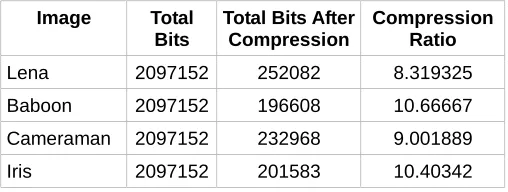
Table 1 shows a portion of our study for gray-scale images. Table 2 shows the same for color images.
The pixels of a 4×4 block generally contain same or similar value. Since the success of proposed scheme depends largely on the frequency of the MFP, our best case happens when all the pixels of the block contain the same gray value. On the other way round, our worst case happens when 16 pixels of a block are of 16 different gray levels. In such worst case, our
proposed algorithm suffers from storing of overhead or unnecessary bits. However, studying 100,000 test blocks from different famous images, the worst case occurrence has been observed only 79 times.
As we claimed our algorithm to be lossless, we performed several experiments to prove this. One way to show this is simply to take the original image and decompressed image and find the difference between these two. If no change occurs, the resulting matrix should contain all zeros i.e. a black image. Figure 2 shows this result for the famous test image Lena.
Using another way to prove the mechanism to be lossless, we have calculated its Mean Square Error (MSE) according to equation 1.
(1) TABLE2
PERFORMANCE ANALYSIS FOR COLOR IMAGES
Image Total
Bits
Total Bits After Compression
Compression Ratio
Lena 6291456 976137 6.445259
Baboon 6291456 442754 14.20982
Cameraman 6291456 259309 24.26239
Iris 6291456 195585 32.16737
. TABLE1
PERFORMANCE ANALYSIS OF GRAY-SCALE IMAGES
Image Total
Bits
Total Bits After Compression
Compression Ratio
Lena 2097152 252082 8.319325
Baboon 2097152 196608 10.66667
Cameraman 2097152 232968 9.001889
The next section of this paper deals the proposed method with some existing image compression algorithms.
6 C
OMPARATIVES
TUDYR
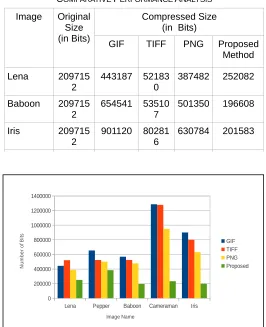
ESULTSThe proposed method and other lossless image compression mechanisms like GIF, TIFF and PNG are applied on 200 textbook images and results are obtained accordingly. We have gained better compression ratio in 83% cases (for 166 images) and failed in rest 17% cases. Figure 3 illustrates such a comparative study for some famous images. Table 4 shows the related data used in figure 3.
7Further Research
Our proposed technique has been developed based on the idea that maximum pixels of a 4×4 block will have the same gray value. The performance analysis portion showed that still there are cases where our method does not provide better result; rather, it results in a lot of overhead bits in worst case. Although, statistically worst case of the proposed method seldom comes, further studies in location based image
compression arena can modify our worst case complexity. A second generation coding can be applied on the bit stream we have obtained for each individual block so that more compression can be achieved. The computational time consumed by the proposed method can be compared to the consumed time of GIF, TIFF and PNG and case dependent optimum method can be suggested.
8 C
ONCLUSIONWe presented a novel image compression technique using location based approach in this paper. Our proposed algorithm is independent of image and completely lossless. We achieved 8.77% average compression ratio for the gray-scale images and 23.85% average compression ratio for color images. Our algorithm has been compared with some existing image compression techniques and for 83% test images, our algorithm obtained better result. The best case and worst case are measured for the proposed scheme and it is statistically proven that the probability of occurrence of worst case is very rare. In addition, further scope of our task is discussed in order to conduct future studies on this area.
Image MSE
Lena 0.00
Baboon 0.00
Peppers 0.00
Cameraman 0.00
Image Original Size (in Bits)
Compressed Size (in Bits)
GIF TIFF PNG Proposed Method
Lena 209715
2
443187 52183 0
387482 252082 Baboon 209715
2
654541 53510 7
501350 196608
Iris 209715
2
901120 80281 6
630784 201583
Fig. 2. Original and Decompressed Image Differencing
Lena Pepper Baboon Cameraman Iris 0
200000 400000 600000 800000 1000000 1200000 1400000
GIF TIFF PNG Proposed
Image Name
N
u
m
b
e
r
o
f
B
it
s
REFERENCES
[1] Ralf Steinmetz and Klara Nahrstedt, “Multimedia: Computing, Communications and Applications,” 1st Edition, Pearson Education Inc. ISBN: 81-7808-319-1, 2005.
[2] Rafael C. Gonzalez and Richard E. Woods, “Digital Image Processing,” 2nd Edition, Pearson Prentice Hall. ISBN: 81-7758-168-6, 2005.
[3] Tinku Acharya and Ajoy K. Ray, “Digital Image Processing: Principles and Applications,” John Wiley & Sons, Inc. ISBN: 10 0-471-71998-6, 2005. [4] M. Nelson and J. L. Gailly, “The Data Compression Book,” 2nd ed. New
York: M & T Books, 1996.
[5] Gregory K. Wallace, “The JPEG Still Picture Compression Standard,” IEEE
Transactions on Consumer Electronics, 1991.
[6] Pennebaker WB and Mitchell JL., “JPEG still image data compression standard,” Van Nostrand Reinhold; 1993.
[7] Jan-Yie Liang, Chih-Sheng Chen, Chua-Huang Huang and Li Liu, “Lossless Compression of Medical Images using Hilbert space-filling Curves,” Computerized Medical Imaging and Graphics-32, pp. 174-182., 2008.
[8] Sayood K., “Introduction to data compression,” 2nd ed. Moorgan Kaufmann; 1991.
[9] Lu Zhang, Bingliang Hu, Yun Li and Weiwei Yu, “An Algorithm for Moving Multi-target Prediction in a Celestial Background,”
Communications in Computer and Information Science (CCIS) 61, pp 41-47, 2009.
[10] Sunil Kumar Pattanik, K. K. Mahapatra and G. Panda, “A Novel Lossless Image Compression Algorithm using Arithmetic Modulo Operation,” IEEE International Conference on Cybernetics &
Intelligence Systems (CIS) and Robotics Automation & Mechatronics (RAM) (CIS-RAM 2006), Thailand, pp. 234-238, 2006.
[11] Komal Ramteke and Sunita Rawat, “Lossless Image Compression LOCO-R Algorithm for 16 bit Image,”2nd National Conference on
Information and Communication Technology (NCICT), pp. 11-14, 2011.
[12] Syed Ali Hassan and Mehdi Hussain, “Spatial Domain Lossless Image Data Compression Method,” International Conference of
Information and Communication Technologies, 2011.
[13] Al-Wahaib and M. S. KokSheikh Wong, “A Lossless Image Compression Algorithm Using Duplication Run Length Coding,” IEEE Conference on
Network Application Protocols and Services, pp. 245-250, 2010.
[14] C. Saravanan and R. Ponalagusamy, “Lossless Grey-Scale Image Compression Using Source Symbol Reduction and Huffman Coding,”
International Journal of Image Processing, IJIP, Vol-3. Issue-5, pp. 246-251, 2009.
[15] Kubasova, O. and Toivanen, P., “Lossless Compression Methods for Hyperspectral Images,” International Conference on Pattern Reognition
(ICPR), 2004.
[16] Sheng-Chieh Huang, Liang-Gee Chen and Hao-Chieh Chang, “A Novel Image Compression Algorithm by Using LOG-EXP Transform,”
[17] Jacob Ziv and Abraham Lempel, “A Universal Algorithm for Sequential Data Compression,” IEEE Transaction on Information Theory (23-3), pp. 337-343, 1977.
[18] Belloulata, K., Stasinski, R. and Konrad, J., “Region-based image compression using fractals and shape-adaptive DCT,” International
Conference on Image Processing, pp. 815-819, 1999.
[19] Kamel Belloulata and Janusz Konrad, “Fractal Image Compression with Region-Based Functionality,” IEEE Transaction on Image
Processing, Vol-11, No-4, 2002.
[20] Hannes Hartenstein, Matthias Ruhl and Dietmar Saupe, “Region -Based Fractal Image Compression,” IEEE Transaction on Image