Strategically Smart Or Proficiency-Driven?
An Investigation Of Reading Strategy Use
Of EFL College Students In Relation
To Language Proficiency
Shu-Fen Lai, De Lin Institute of Technology, Taiwan
Chen-Hong Li, National Penghu University of Science and Technology, Taiwan Richard Amster, Suffolk County Community College, USA
ABSTRACT
Reading strategy use has long been considered an important factor in the evaluation of effective second language (L2) reading. It is generally believed that proficient and less-proficient readers differ in their reading process and strategy use. The purpose of this study was to examine the reading strategy use of high- and low-proficiency level college students in Taiwan and the reading problems that might arise in their reading process. A General English Proficiency Test (GEPT) and a modified reading strategy questionnaire, based on Carrell (1989), were administered to 45 Taiwanese college students. The results show that language proficiency has a significant effect on strategy choice and use, and high achievers and low achievers are different in the quality and quantity of their reading strategy use. More proficient learners in the study were found to utilize more top-down and context-related strategies, while less-proficient learners tended to focus on bottom-up and lexical-related strategies. Also, limited vocabulary knowledge is the most important reader factor of Taiwanese college students’ reading problems. The study concludes with a discussion of implications for L2 reading instruction and learning in the classroom setting.
Keywords: Reading Strategy; Language Proficiency; Reading Difficulty; Vocabulary Knowledge
INTRODUCTION
xford (1990) defines language learning strategies as “specific actions taken by the learner to make learning easier, faster, more enjoyable, more self-directed, more effective, and more transferable to new situations” (p. 8). Several studies have found that high-proficiency and low-proficiency learners are different in their learning process and strategy use (Alsheikh, 2011; Kojic-Sabo & Lightbown 1999; Li, 2010; O’Malley & Chamot, 1990; Park, 1997; Sodoski , 1999). O’Malley and Chamot (1990) stated that more proficient readers use more strategies to help them comprehend texts successfully. Sodoski (1999) pointed out that the use of reading strategies, in particular, is important to learners’ comprehension, can improve reading comprehension, and differentiates good readers from poor ones. The research consensus suggests that good language learners know how to handle their learning problems during the learning process. Therefore, a careful analysis of what reading strategies that high achievers use will have a beneficial impact on raising low achievers’ awareness of such effective strategies and on helping them become “constructively responsive readers” (Pressley & Afflerbach, 1995). In order to provide a clearer picture about the reading strategy use of college students in Taiwan, this study investigated whether or not a difference in reading strategy use and reading problems exists between proficient and less-proficient college students.
86 http://www.cluteinstitute.com/ © 2013 The Clute Institute LITERATURE REVIEW
Language Proficiency and Reading Strategy Use
In accordance with the definition in the Longman Dictionary of Language Teaching and Applied Linguistics (2002), reading strategies are ways of accessing the meanings of text. According to Anderson (1999), reading strategies are the mental activities that readers use to construct meaning from text. Variables that affect reading strategy use are readers’ prior knowledge (Pritchard, 1990), text type (Kucan & Beck, as cited in Chen 1999) and readers’ proficiency (Kletzien, 1991). Language learning strategy use is considered to have potential influence on language acquisition and it is generally believed that a strong relationship exists between strategy use and language proficiency. A number of research studies have highlighted the crucial role of language proficiency level in reading strategy choice and use (Carrell, 1989; Kletzien, 1991; Kojic-Sabo & Lightbown 1999; Li, 2010; O’Malley & Chamot 1990; Park, 1997; Sodoski, 1999). Kletzien (1991) found that proficient readers not only use a variety of strategies, but they also use them more often than less proficient readers. Carrell (1989) stated that advanced readers tend to use more global or top-down reading strategies, while less successful readers tend to be more local or bottom-up in their choice of strategies. In addition, less-proficient readers are less active in monitoring their learning process and they seem unable to select appropriate strategies to cope with their reading problems. Park (1997) conducted a study exploring the relationship between language proficiency and strategy use. A total of 332 (intermediate to advanced levels) university students in Korea participated in the study. A linear relationship between language learning strategies and TOEFL scores was found. The result of the study suggested that language proficiency and learning strategies are highly correlated and that teachers could help students become more aware of their strategy use.
The results of Sodoski’s study (1999) also acknowledged that more proficient learners employ more strategies and are more flexible and consistent in their strategy use. Examining whether there was a relationship between strategy use and proficiency level, Kojic-Sabo and Lightbown (1999) claimed that there was a close relationship between the amount of strategy use and levels of success in language learning. Two recent studies further demonstrated a relationship between strategic reading and improved language proficiency. Li (2010) investigated students’ awareness of reading strategy use at the senior middle school level in China and found that reading strategy use varies with readers’ strategy preferences, gender, and language proficiency. Successful readers not only used more strategies than less successful readers, but they also used them at a higher rate than the less successful readers. Given a different profile of learner capability, Alsheikh (2011) examined metacognitive reading strategy use of three advanced proficient Hausa (L1) readers who were also literate in English and French as a second language. The findings showed that the least proficient reader relied heavily on translation in the reading process and the three readers all used more reading strategies when the reading texts were not written in their L1. In other words, it seems that reading strategy use correlates with reading proficiency level as well as the language used in the reading text.
Chinese EFL Students’ Reading Difficulty
Reading is a complex process that involves the reader and the text and L2 reading is considered a more complex one which relates to psychological, methodological, and linguistic paradigms. In the field of psycholinguistics, three major approaches were used to identify reading as a cognitive process: 1) bottom-up processing, 2) top-down processing, and 3) the interactive approach (Anderson 1999; Bernhardt, 1991; Carrell, 1989). In addition to the text and the three cognitive processes, reading comprehension also involves many other variables; for example, the vocabulary knowledge that L2 readers have acquired. Vocabulary knowledge is, as Sternberg (1987) posited, “highly predictive, if not determinative, of one’s level of reading comprehension” (p.90). Continuing this line of thought, Anderson and Freebody (1986) also claimed that vocabulary is a requisite for reading comprehension and that “people who do not know the meanings of very many words are most probably poor readers” (p. 367).
comprehension performance. Field (as cited in Chern 1993) demonstrated that Chinese L2 students tend to focus more on details than on the main idea and they also prefer to use a dictionary than infer the word meaning of a word from the context. Chen (1998) stated that more than 60 % of Taiwanese college students’ English vocabulary size is smaller than the basic 3,000-word family threshold level, which in turn causes their difficulties in reading and affects their comprehension performance.
As documented in the research above, even though reading strategy use and language proficiency level are closely related, there is little information on the relationship between the two in Taiwanese context. Also, vocabulary knowledge is a good predictor and indicator of students’ level of reading comprehension. However, further examination of other variables that are involved in the reading process will provide insight into a better understanding of the problems L2 learners may have in doing their reading.
The following questions are to be specifically addressed in this study to fill the research gaps:
1. Is there any significant difference in reading strategy use between high- and low-proficiency level Taiwanese college students in a reading task? If so, what are the differences in reading strategy use between the two groups of students?
2. What are the difficulties Taiwanese college students have in doing their reading?
METHODOLOGY
Participants
Convenience sampling was used to select 93 college students in Taiwan to participate in the study. These prospective participants coming from two classes, including 31 male students and 62 female students aged from 18 to 25, were grouped by proficiency levels based on their scores on the GEPT, a standardized language proficiency test recognized by the Ministry of Education of Taiwan. High-level students (n = 26) in the study obtained a GEPT score of 70 (a passing grade for the GEPT) or above and low-level students (n =19) scored at or below 40.
Instruments
The materials used in the study consisted of a modified reading strategy questionnaire based on the Carrell (1989) study and a GEPT reading passage of approximately 300 words. The questionnaire was written in Chinese to assure that no language barriers discouraged participants from replying on strategy use, and it included 26 items on a 5-point Likert Scale measuring the participants’ reading strategy use (and frequency) as well as their reading difficulties. The internal consistency reliability coefficient of this 26-item questionnaire was Cronbach α = .713, indicating that the 26 items were reliably measuring the same construct.
Procedures
The participants read a passage of approximately 300 words, which was taken from the GEPT reading comprehension test, and then completed the modified reading strategy questionnaire. An independent-samples t-test was used to find whether there was a significant difference in reading strategy use and reading difficulties between the two groups of students. Additionally, descriptive statistics were calculated and compared for items 21 to 26 in the questionnaire to identify the most frequently used strategies by the two groups.
RESULTS
88 http://www.cluteinstitute.com/ © 2013 The Clute Institute
Table 1: Summary of the Independent-Samples t-test for Reading Strategy Use by High and Low Achievers
Strategy Description Group N M p
When I read silently in English, the thing(s) I do to read effectively is:
No. 12. understanding the meaning of each words High
Low 26 19 3.47 4.12 .012
No. 13. translating words, phrases into Chinese High
Low 26 19 3.47 4.06 .043
No. 17. relating the text to what I already know about the topic High Low 26 19 3.82 3.06 .047
No. 18. looking up words in the dictionary High
Low 26 19 2.88 3.76 .006
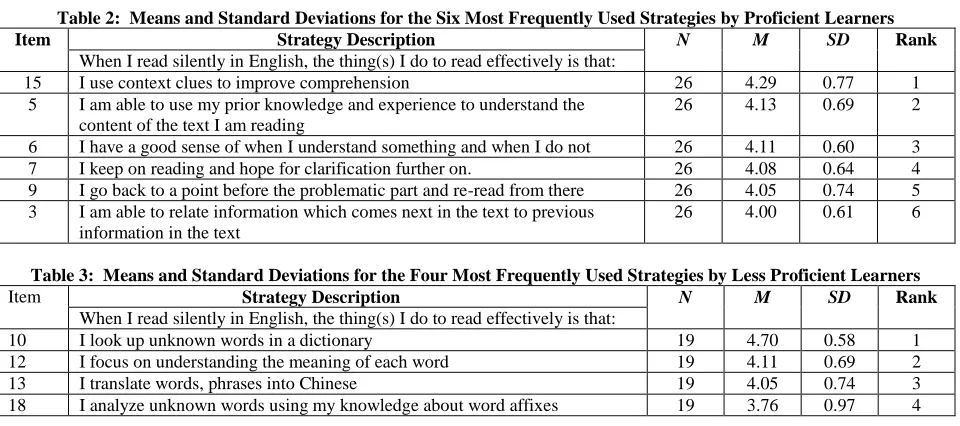
Table 2 shows the six global or top-down strategies that are most frequently used by the high achiever group. Judging from the four most frequently used strategies by the low-level readers, as displayed in Table 3, they, on the contrary, tended to use bottom-up processing to compensate for their understanding of the reading text.
Table 2: Means and Standard Deviations for the Six Most Frequently Used Strategies by Proficient Learners
Item Strategy Description N M SD Rank
When I read silently in English, the thing(s) I do to read effectively is that:
15 I use context clues to improve comprehension 26 4.29 0.77 1
5 I am able to use my prior knowledge and experience to understand the content of the text I am reading
26 4.13 0.69 2
6 I have a good sense of when I understand something and when I do not 26 4.11 0.60 3 7 I keep on reading and hope for clarification further on. 26 4.08 0.64 4 9 I go back to a point before the problematic part and re-read from there 26 4.05 0.74 5 3 I am able to relate information which comes next in the text to previous
information in the text
26 4.00 0.61 6
Table 3: Means and Standard Deviations for the Four Most Frequently Used Strategies by Less Proficient Learners
Item Strategy Description N M SD Rank
When I read silently in English, the thing(s) I do to read effectively is that:
10 I look up unknown words in a dictionary 19 4.70 0.58 1
12 I focus on understanding the meaning of each word 19 4.11 0.69 2
13 I translate words, phrases into Chinese 19 4.05 0.74 3
18 I analyze unknown words using my knowledge about word affixes 19 3.76 0.97 4
Table 4 shows the statistical results for the two groups in terms of their reading difficulties. It seems safe to say that both proficient and less-proficient learners have the same problems or difficulties in their reading process and insufficient vocabulary knowledge (as in item 22) is the most crucial reader factor to their reading problems.
Table 4: Summary of Independent-Samples t-test for Reading Difficulties by High and Low Achievers
Strategy Description Group N M p
When I read silently in English, the thing(s) that makes the reading difficult is:
No. 21. the sounds of the individual words High
Low 26 19 2.71 3.24 .159
No. 22. recognizing the words High
Low 26 19 3.81 3.68 .572
No. 23. the grammatical structures High
Low 26 19 3.06 3.47 .168
No. 24. relating the text to what I already know about the topic High Low 26 19 3.18 3.00 .544
No. 25. getting the overall meaning of the text High
Low 26 19 3.29 3.41 .679
No. 26. the organization of the text High
DISCUSSION
The findings of this study are worthy of further discussion. First, the results show a significant difference in reading strategy use between high- and low-level students. Four reading strategies, including items 12, 13, 17, and 18, were significantly different between the two groups. The finding lends support to the results of previous studies (Alsheikh, 2011; Kletzien, 1991; Kojic-Sabo & Lightbown, 1999; Li, 2010; Park, 1997) in that there is a close relationship between reading strategy use and proficiency level, and that high-level learners and low-level learners are different in their strategy choice and use. In other words, the awareness of reading strategy use, as suggested by Pressley and Afflerbach (1995), is a characteristic of superior reading comprehension and successful learning.
Second, with regard to the most frequently used strategies, high-level students tended to use “context clues” to relate the reading text to what they already know about the topic, while low-level students preferred to use lexical-level clues for reading comprehension, as in “translating words, phrases into Chinese” and “looking up unknown words in a dictionary”. The findings are consistent with the proficiency-theoretic perspectives on reading strategy use (Carrell, 1989; Li, 2010; O’Malley & Chamot 1990; Sodoski, 1999) in that low-achievers tend to use more local or bottom-up strategies while high-achievers tend to use more global or top-down strategies.
Third, in terms of reading difficulty, it seems safe to say that both proficient and less-proficient learners have the same problems or difficulties in their reading process and insufficient vocabulary knowledge, as in item 22 “recognizing the words”, is the most crucial reader factor to their reading problems. This finding accords with the
studies of Chen (1998) and Chern (1993) in that limited or insufficient vocabulary knowledge is the major cause to EFL college students’ imperfect reading comprehension performance.
LIMITATIONS OF THE STUDY
As a small-scale survey study, the findings might not be generalized to students at the secondary level or students who have good literacy skills. Future studies could combine quantitative and qualitative approaches, such as a survey, an interview with students, and classroom observations, to achieve triangulation at the level of data collection in order to provide in-depth findings and strengthen the dependability and validity of the results.
CONCLUSION AND IMPLICATIONS
This study examined the reading strategy use in relation to language proficiency of college students in Taiwan. This survey study supports the results of previous studies that proficient and less proficient learners differ significantly in their reading strategy choice and use. Given that reading strategy use varies with learners’ language proficiency, language instructors should take their students’ proficiency into consideration in a classroom setting where reading strategy instruction/training is the main concern.
Second, the results show that high achievers use global/top-down strategies in case of comprehension breakdown, while poor readers tend to focus more on local/bottom-up strategies, parsing the language at the lexical level. Therefore, it is critically important to raise the low achievers’ awareness of what effective reading strategies are, to teach them when, where and how to use them in a reading task, and, ultimately, to help them become constructively responsive readers.
Third, the study indicates that the limited vocabulary size is the most important reader factor for Taiwanese college students’ reading problems. Given the great quantity of vocabulary required for effective reading and the limited vocabulary knowledge of Taiwanese college students, vocabulary instruction deserves more attention.
AUTHOR INFORMATION
90 http://www.cluteinstitute.com/ © 2013 The Clute Institute Dr. Chen-Hong Li (corresponding author), Assistant Professor in the Department of Applied Foreign Languages at National Penghu University of Science and Technology, Taiwan, received his B.A. in English from National Chengchi University, M.A. in Linguistics from University of Wisconsin-Madison, and Ph.D. in English with concentration in Composition & TESOL from Indiana University of Pennsylvania, U.S.A. His research interests include ESL/EFL education, L2 listening/reading assessment, and computer-assisted language teaching and learning. Mailing address: Department of Applied Foreign Languages, National Penghu University of Science and Technology, No. 300 Liu-He Rd., Makung, Penghu 88046, Taiwan. E-mail: [email protected] (Corresponding author)
Richard A. Amster is Assistant Professor at Suffolk County Community College in New York. His research interests include curriculum planning and development. E-mail: [email protected]
REFERENCES
1. Alsheikh, N. O. (2011). Three readers, three languages, three texts: The strategic reading of multilingual and multiliterate readers. The Reading Matrix, 11, 34-53.
2. Anderson, N. J. (1999). Exploring second language reading. Boston, MA: Heinle & Heinle.
3. Anderson, R. C. & Freebody, P. (1986). Vocabulary knowledge. In H. Singer & R. B. Ruddell (Eds.),
Theoretical models and processes of reading (pp. 343-371). Newark: International Reading Association. 4. Anderson, N.J.(1999). Exploring second language reading: Issues and strategies. Heinle &Heinle
Publishers.
5. Bernhardt, E. B. (1991). Reading development in a foreign language. Norwood, NJ: Ablex
6. Carrell, P. L. (1989). Metacongnitve awareness and second language reading. The Modern Language Journal, 73, 121-134
7. Chen, B. C. (1999). Discrepancy of reading strategies for academic purposes. Proceedings of the Eighth International Symposium on English Teaching, 223-233. Taipei: The Crane Publishing Co., Ltd. 8. Chen, H. J.(1998). A preliminary investigation on Taiwanese EFL learners’ vocabulary size. Proceedings
of the Fifteenth Conference on English Teaching and Learning in the Republic of China, 193-211. Taipei: The Crane Publishing Co., Ltd.
9. Chern, C. H. (1993). Chinese students’ word-solving strategies in reading in English. In Huckin, T., Haynes, M. & Coady, J., (Eds.), Second language reading and vocabulary learning. (pp. 67-85).Norwood: Alex Publishing Corporation.
10. Green, J. M., & Oxford, R.L. (1995). A closer look at learning strategies, L2 proficiency, and gender.
TESOL Quarterly, 29, 261-297.
11. Huckin, T., Haynes, M. & Coady, J. (Eds.), (1995). Second language reading and vocabulary learning.
Norwood: Alex Publishing Corporation.
12. Kletzien, S. B. (1991). Strategy use by good and poor comprehenders’ reading expository text of different levels. Reading Research Quarterly, 26, 67-86.
13. Kojic-Sabo, I. & Lightbown, P. M. (1999). Students’ approaches to vocabulary learning and their relationship to success. The Modern Language Journal, 83, 176-192.
14. Li, F. (2010). A study of English reading strategies used by senior middle school students. Asian Social Science, 6(10), 184-192.
15. Mokhtari, K., & Reichard, C. A. (2002). Assessing students’ metacognitive awareness of reading strategies.
Journal of Educational Psychology, 94(2), 249-259
16. O’Malley, J. M., & Chamot, A. U. (1990). Learning strategies in second language acquisition. Cambridge: Cambridge University Press.
17. Oxford, R. (1990). Language learning strategies: What every teacher should know. Rowley, MA: Newbury House.
18. Park, G. P. (1997). Language learning strategies and English proficiency in Korean University Students.
Foreign Language Annals, 30, 211-221.
19. Pressley, M. & Afflerbach, P. (1995). Verbal reports of reading: The nature of constructively responsive reading. Hillsdale, NJ: Lawrence Erlbaum Associates.
21. Richards, J. C. & Schmidt, R. (2002). Longman dictionary of language teaching & applied linguistics. New York: Person Education Limited.
22. Sadoski, M. (1999). Comprehending comprehension. Reading Research Quarterly, 34, 493-501.
23. Sternberg, R. J. (1987). Most vocabulary is learned from context. In M.G. Mckeown, & M.E. Curtis (Eds.),