Study On Various Privacy-Preserving Data
Mining Techniques For Information Extraction
B. Santhosh Kumar
,
V.Thiruppathy Kesavan,
T.DaniyaAbstract: The conventional scheme for information extortion might accomplish better on the mining of data needed to create a categorisation policy made use for preceding classification in an administered data-based issues. Moreover, most of the schemes conceal the individuality of the concepts where the data belongs to which might be a significant cause of violating confidentiality. The intention is to resolve the problems by employing a graph and hypothetical scheme based on k segmentation of figures which offers the generation of an intricate choice-based tree categoriser arranged into a precedence-based ladder. The analysis reveals that the system provides precision and effectiveness. Several enhancements are prevailing in cooperative information estimation. Therefore, the intention is to preserve unique subtle confidential information which is a crucial dispute for safeguarding confidentiality during extraction in a scattered setup. There are several efforts for designing confidentiality in information extraction. Therefore, for mining the combination in terms of time division, the following combination-based policies are analysed. For offering improved and analysis the prevailing confidentiality safeguarding scheme it does not focus on sequential nature of the combination-based systems. Therefore, the intention is to design systems with a suitable demonstration which aids to secretly decode subsequent combination-based policies which shared to all the sharing events.
Index Terms: Information Extraction, Confidentiality, Safeguarding, Repositories, Segmentation, Scheme, Mining,
————————————————————
1
I
NTRODUCTIONTHe analytical illustration offers trade buying system greatest of the products from the preceding year one could forecast the level of products which requires goods for the impending periods. The authentication could verify on the ailments such as viral with the exception that it is probable to locate the acknowledgment and withdrawal identification in terms of scams. The information extraction employs for diverse objectives in both the private and public firms. The organisation like banking, insurance, medicals, and purchasing usually make use of information extraction to minimise the expenses, improve analysis and escalates trades. Consider the insurance and banking organisation employing information extraction applications for identifying scams and aid in threat evaluation. Information extraction is the assessment of experimental information sets to locate unpredicted associations and to abstract the information in a fresh manner that is both understandable and needful to the creator of the data. The information extraction employs for diverse objectives in both the private and public firms.
Fig. 1: Information Extraction
The information extraction is a cross-discipline domain conveying collected schemes from machine learning, prototype identification, arithmetic, repositories, and conception to resolve the problems related to data mining from extensive deposits.
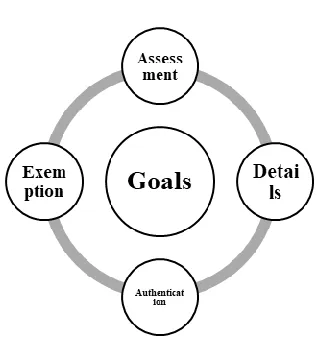
Fig. 2: Goals of Information Extraction
The progress of repository schemes, information gathering, repository generation, IMS and network DBMS, relational information prototype, relational DBMS, improved repository prototype, object-oriented repository, information collection centre, depositories, hypermedia repositories and prevailing internet repositories requires operating the scheme of information extraction. The analytical illustration offers trade buying system greatest of the products from the preceding year one could forecast the level of products which requires goods for the impending periods. The authentication could verify on the ailments such as viral with the exception that it is probable to locate the acknowledgment and withdrawal identification in terms of scams. The organisation like banking, insurance, medicals and purchasing usually make use of information extraction to minimise the expenses, improve analysis and escalates trades. Consider the insurance and banking organisation employing information extraction applications for identifying scams and aid in threat evaluation. The usage of user-related information gathered over the present periods the firms could design prototypes which forecasts the threats prevailing to the users in terms of credits or regarding the privileges during an accident might be false and shall inspect more carefully. The medical society roughly makes use of information extraction to aid the analysis of the efficiency of the scheme or medicines. The pharmaceutical firms make use of information extraction of the chemical substances and genetic components to support the governance of studies on new ————————————————
Dr.B.Santhosh Kumar is currently working as a Sr.Assistant Professor in GMR Institute of Technology, Rajam, Andhra Pradesh, India,
PH-9843622130. E-mail: [email protected]
V. Thiruppathy Kesavan is presently working as a Professor in GMR Institute of Technology, Rajam, Andhra Pradesh, India,
PH-99487769076. E-mail: [email protected]
management for ailments. The vendors could employ the data gathered using attraction programs to evaluate the efficiency of choosing the items and position related choices, voucher offers and the frequency of items bought regularly. The firms like telephone service suppliers and music clubs could make use of information extraction to generate a segment assessment to examine which users are probable to continue as users and which ones are probably to migrate to the opponent.
2.
L
ITERATURES
URVEYThe data exploration is required to make logic and usage of information. Even though the information extraction and data exploration in repositories was view regularly as replacements, information extraction is crucially a segment of the data exploration process. Abdur Rahman and Khan (2017) portrayed that the user relationship management system is employed to administer the associations among the firms with the prevailing and viewpoint users. The information extraction use in firms for performing choices and predicting potential users. The extensive analysis based on the current review is performed based on the usage of information extraction schemes for user relationship management. The study of the existing analysis is examined based on various information extraction schemes used in diverse varieties of trade, firm zones and industries. The demonstration of significant analysis offered the resolved issues along with the designed systems, impacts, restrictions and recommended probable enhancements for every planned scheme analysis during the investigation. The substantial study in information extraction scheme employs for user relationship management is performed. Abhishek Sachan et al. (2017) entailed that the information extraction schemes are employed widely for removing the hidden, formerly new and possibly needful data from the immense information set by making use of arithmetic and intelligent systems. The judgement of frameworks or analysis might reveal the data which might negotiate the privacy and confidentiality requirements. The confidentiality safeguarding is a crucial feature in information extraction, and the study of attaining some information extracted objectives without losing the confidentiality of the peoples is not only challenging but also a process of real-time significance. The assessment of privacy safeguarded information extraction scheme shall regard the outcomes of these schemes in extracting the consequences along with preserving confidentiality. The confidentiality shall protect in all the three features of extraction as the related policies, categorisers and grouping. The intention is to analyse the usual and conventional efficient schemes in terms of confidentiality safeguarding in information extraction. Abou – El – Ela Abdou et al. (2013) described that information extraction is the mining of immensely attractive prototypes or data from an immense volume of information. The key intention of the confidentiality safeguarded information extraction is to enlarge the conventional information extraction schemes to work with the info altered to wrap the delicate data. The main problem found the mechanism of changing the information and device to recollect the outcomes of the information extraction from the modified data. The confidentiality safeguarded information extraction contemplates the issues of executing information extraction scheme on private information which is not regarded to disclose to the parties performing the programme. In contrast, the confidentiality safeguarded information dispersal might not mandatorily Knott to a precise information extraction process, and the information extraction process might be indefinite at the time of information broadcasts. The confidentiality safeguarded information extraction knows the mechanism to alter the current information into a form which protects against the confidentiality
mislaying the principle of information and not distributing them with precise data are a great dispute. These disputes encourage the improvement of the safeguarding in information extraction schemes. Confidentiality preservation is a quite complex dispute in enhancing the systems in information extraction methods such as k – closeness and variety make it essential to improve an effective technique with improved precision and minimised information costs. Anthony Sheela and Vijayalakshmi (2017) entailed that the information extraction on perpendicularly or straight segmented information set has the overhead of safeguarding the confidential information. The disconnection is a scheme which protects the disclosure of information. The intention is to design a disconnection and adjacency scheme which accomplished on the perpendicularly segmented information. A third party controller is employed to segment the information repeatedly among various parties. The parties disconnect the information by locating the differences when the described fixed value extent achieved. The disconnection preserves the arithmetic association among the elements. Awalia W. Putri and Laksmiwati Hira (2017) entailed that presently the information is acquired universally, and the issue of privacy or confidentiality of data becomes crucial since the data could mines from the report by employing information extraction which occasionally might carelessly reveal these data. For safeguarding the privacy of the information and assuring accurate data extraction in terms of actual data using confidentiality preserved information extraction. The analysis designs a hybrid modification in privacy safeguarded information extraction which acts as a combiner of the two prevailing schemes based on the existing review the entropy-based segmentation schemes and aggregated alteration scheme. For calibrating the designed system, the estimation of the employment and the confidentiality estimation employed. The usage assessment for estimating the precision of the data and confidentiality metric for evaluating the mechanism of the closeness of the actual value acquired after modification and the extent they are biased. The results of analysis reveal that the designed scheme offers improved outcomes than the prevailing systems in utilisation and confidentiality, but the information will be safeguarded and could employ for estimating information extraction. Bhargav Sundararajan et al. (2017) entailed that the information extraction schemes are increasing its importance for performing estimations location of unfamiliar prototypes to gain advantages from the user’s information. These categorise as primary data discovery and misappropriation of extraction. These classify as primary misappropriation of data discovery and retrieval. For overcoming the schemes, a confidentiality safeguarding based extraction schemes designed. The basic understanding of the conventional systems is to safeguard the information extraction schemes their advantages and setbacks. Celina Alexandre et al. (2017) described that currently, mobile slips broadly employs for making purchases. Anyway, these applications have large prospective in offering current services for the users like an exhibition of promotion operations based on the user favourites. The intention is to perform an analysis of the information extraction for a current mobile payment environment where the performance and preferences of the users examine for generating a focused promotion exhibition using their mobile payments. The CRISP information extraction scheme employs for accomplishing the analysis related to the information extraction. Chalapathi Rao and Kiran Kumar (2017) portrayed that the big data create from several source-based communication, sensors and digital images, videos, audios and for diverse areas comprising healthcare termed as big data. The features of big data include extent, speed and diversity. The helpful information could mine from the big data with the aid of information extraction schemes. The immense volume of
warmth of information. Several analyses conduct on the preservation of information in the arrangement of the progressive metering framework to secure the horizontal procedures in information combination. The exploitation of data regards as confidentiality breaches which provide the preservation and distribution of delicate information. Therefore it is crucial to creating a structure and plan suitable schemes to preserve combined information effectively and to avert conflicts in safety. The system comprises information categorisation and scoring schemes to assure information is protected adequately. The intention is to design a confidentiality safeguarding model Forough Farazzmanesh and Monireh Hosseini (2017) portrayed that in the present day’s modest background, the users are the most crucial benefit to any organisation. Hence the firms shall comprehend the mechanism of maintenance and value of the Teamsters for every user. A scheme aiding the user’s diverse viewpoint in different angel consider. The focus is to employ a new system with the aid of information extraction schemes for matching and estimating the position of the users among the network. Moreover, the system used in real-time applications which subsidises to implement and execute a scheme for finding and describing network elements of a valued network in the conception of trade to trade associations. For performing the approach the usage of segmentation methods and schemes are proposed to examine the user’s information set and to examine the valued network. Consequently, the implementation of new policy network realises and deliberates the mechanism of a firm to append values to its users. The designed scheme offers a chance for the promotion managers to acquire an in-depth comprehension of their trade users, the features and framework to their user's valued network. The intention is to initially subsidise their variety to emphasis entirely in the extensive information set analysis to examine the system. The fresh scheme represents that the forthcoming review of value network moreover acquires the tools related to information extraction. Here the recognition of value elements of the network is performed along with its value flows within the telecommunication firms by making use of the current information for depicting its enhancements in the system by non – stop observation. Gayathri and Poorna (2017) described that the escalated set, storage and assessment of precise individual information creates severe disputes to safeguard the individualities to which the information belongs. In diverse circumstances, the mined data is extremely safe, and it requires to refine before distribution for resolving the issues related to confidentiality. The information extraction has the ability of voluminous mining information with reduced time. The data mined by the intellectual information extraction scheme might disclose most delicate data fitting an individual or a firm. The data correspond to an individual, or a firm might face diverse levels of delicateness. This information is provided only to the verified users and for assuring the safety of delicate information based on the entry limitations which is not a comprehensive scheme. They might bother the usage of the results of information extraction, and with the aid of data, the user might locate the delicate information items from the non – sensitive information termed as interference issue. The confidentiality safeguarded information extraction offers a solution for preserving the delicate data by creating an information extraction schemes which can be made use on repositories without bothering the precision of outcomes acquired by information extraction. Meanwhile, without negotiating the confidentiality of the people, the intention is to analyse a wide variety of different schemes for the relationship-based policy concealed scheme. Geetha Ramani et al. (2017) portrayed that computation based schemes are immensely helpful in medical image estimation to help medical experts. Glaucoma is a vision menacing retinal disorder which requires care
sets for safeguarding confidentiality and preserving precision to change the information into environment and preservation. The accuracy of the grouping before and after the confidentiality safeguarding and modification analyse. Jasor Pridmore and Lalu Elias Hamalainen (2017) entailed that the promotions are always reliant on the input of new varieties of user’s information through their past dependants on the conversions of this information into more and more efficient manner for directing and appealing the users. The intention on the digital categorization of the users is focused on varied promotion directions starting with the associated promotions and marching towards the analytical promotions and more prevailing attempts are performed towards the combined promotions. The objective governing the categorization of users is intended on more efficiently engaged and besieged chunks towards redundant purchasing actions. Therefore as concluding actions the change to the social media promotions and social user association management is limited to several crucial restrictions. Though the arrival of social media and introduction of this space for promotions it has generated an elaborated means for tracing and categorizing the performance of the user. The aim is to focus the restrictions of the training for all but for several chosen promotion in the efficacious marketplaces. The intention is to inspect the restrictions while making use of socially related information. Instead of the capacities of the big data conventional manner of categorization and separation deceases tough and are viewed and are estimated as more efficient. The capability for the users to keenly contribute in the forms of promotions has loosened the arrival of social media, analysis of contribution in the diverse channel for the user’s contributions represent that it is done rarely. The social media continues unexecuted. The goal is to point the restrictions of precise promotion separations. It represents the descriptions of the user enablement and limited contributions together with the slow and iterative adjustment to extremely valued tendencies by most firms. Jeanine Schutte et al. (2017) portrayed that the electronic banking is becoming very prevalent every day. The business colleges have recognized that the alteration to offer electronic-based services to their users for enduring appropriate and strive in an economic environment. A causal feature to the proportion of user withholding is due to the regular usage of diverse online features which therefore withstands all the merits of electronic banking several are still uncertain in making use of them due to safety-related disquiets. The viewpoint is the gender, age, level of education, wages, nationality and domain of expertise with an influence on the employment of the electronic banking. The analysis explodes on the mechanism of data identification and information extraction operations which are employed to regulate the features of the performance of the electronic banking of immense overall value of the people at South African banks. The demonstrations represent that the extent of products and age has the crucial influence on the electronic banking performance. The value of the user separation is that the financial colleges could offer more precise service to their users based on their favourites and performance of online banking. Jerry Chun – Wei Lin et al. (2017) described that the confidentiality safeguarded information extraction is a growing issue which has become a crucial dispute in the past eras. The confidentiality safeguarded information extraction comprises concealment of delicate data for assuring which could not be explored by the information extraction schemes. Diverse confidentiality safeguarded information extraction schemes are designed and several of these schemes are implemented for concealing delicate and regular item set or relationship policies. The concealment of delicate data prevailing within the repository could have adverse setbacks like concealing other non – delicate data and design of repeated data. The location of a collection of item
safety and confidentiality related problems prevailing in terms of information related to big healthcare and deliberates the manner in which they could be resolved. The key intention is to focus on the currently designed schemes based on adjacency and encoding, evaluation of their benefits, restrictions and forthcoming analysis trends. Mohammad Hasan Aghdaie (2017) entailed that the providers are the crucial segment of day to day supply chain and firms more than they are dependent on their providers. Suitable victory in the present day’s market is based on the manner they are efficacious firms dealing with the providers. The providers of the characteristic organization are not similar to the firms are forced to make decisions deliberately about their providers and precisely shall have substitute policies in handling them. Hence the categorization of the providers could hold the main responsibility in provider association management to handle, calibrate and improve efficient associations with their individual providers. The provider categorization could be entailed as categorizing the providers based on their likeness. The intention is to design a freshly combined diverse element choices and information extraction schemes to assess the providers and categorization. The prevailing studies are employed to choose the most appropriate conditions for experimenting and building a structure. The designed scheme comprises a mixture of fuzzy clustered logical tree based process, simple additional balancing and two-phase group assessment as the information extraction tools. The fuzzy set based scheme is used to integrate the human decisions and imprecise data into the framework. Mohanrao and Karthik (2017) entailed that the process of information extraction is employed to locate the prototypes among the dozen of domains in the immense repositories. The prime dispute in information extraction is to preserve the confidentiality of private data. For distributing the information while safeguarding the confidentiality information creator must accomplish the objective of confidentiality safeguarding. The information disquiet is employed to safeguard the confidentiality of the delicate data. The designed scheme makes use of these delicate elements to create a standardized value which generates distributed information. The produced information records resemble unlike from the actual records and the dispersal of information values is also unlike from the actual broadcasts. The designed scheme offers a minimal proportion of faults with the prevailing schemes. Mrutyunjaya Panda et al. (2016) described that the progressive agreement search scheme is employed for its ability in locating solution space based on local and universal manner. In contrast the wavelet-based characteristics assortment due to its capability in offering restricted regularity data related to the signal functions which makes it a favourable one for effective categorization. The analysis in this phase entails that the wavelet-based neural network might be confined to fall in a local minimal while fuzzy balancing search based scheme efficiently resolves the issues and capable to acquire closer optimal solutions. Here a hybrid wavelet-based outward basis function RBF neural network WRBF and characteristic subgroup progressive search based fuzzy visibility categorizer HSFD schemes are designed as a scheme in information extraction for image separation based on the categorization. The intention is to make use of Lena RGB based image, magnetic resonance image MR and estimated tomography CT image for evaluation are considered. It is monitored that the produced results of the wavelet-based RBF neural networks outdo the progressive search based fuzzy visibility categorizers. Natthawat Rattanamethawong et al. (2017) performed an analysis to group the graduates into chunks for an improved recognition of their features, routines, a variety of performance and attention. For illustration graduate records gathered from 300 universities are acquired and employed based on their relevant element values comprising of
confidentiality safeguarded information extraction. The intention is to focus on confidentiality safeguarding scheme with fuzzy logic, neural network schemes, safe aggregation and several encoding schemes. It assures several disputes faced in safeguarding the confidentiality of several conditions. Rupampreet Kaur and Kiranbir Kaur (2017) entailed that the information extraction is employed to mine crucial data from the voluminous information to hoard them and to review them in an efficient way. The concealed data could be mined from the immense set of information. The objective is to explore the schemes employed for effective clustering of information. The clustering might be performed in a way where the clusters could identify the cluster members and cluster could also identify which are not clustered members. Several schemes for user separation in information extraction comprises grouping and subsection identification. Since diverse restrictions and the intention of grouping schemes, it paves a way for improved enhancements in the schemes in information extraction. Safima Yousef and Smitha Karunan (2017) describes that the remote sensors create an immense volume of information from satellites. Presently there are immense needs for real-time information for remote sensing of applications and to mine needful data from the satellite images. The intention is to analyse the diverse extraction scheme in diverse satellite-based image applications. A two-level combination scheme is employed to mine the level of the sea. The behaviour is minimized because of the lack of characteristics mining. The tree domain combining scheme is employed to mechanically mine the sea and land regions. The combination schemes could be very well featured by administered data aggregated with the characteristics mining. The outcomes in fetching the real-time logical framework are employed to identify the land and sea levels. The sensors are implemented in the forest regions exposed to the temperature and pressure for identification of fire but the expense in installing the sensor is high. The sensors could be shattered distressed due to the modification in climates and due to animals. The problems could be retarded by making use of the extracted satellite image application for discovery of fire using the real-time logical framework. The characteristics of the satellite images could be mined employing the scale invariant characteristics modification scheme. The rapidity in identifying the satellite image could be escalated based on the usage of Hadoop which is a parallel processing model. Sandra S. Liu and Jie Chen (2013) offered illustrations on the mechanism of making use of information extraction schemes in locating patient chunks related to their favourites for required healthcare elements and their demographic features. The information was acquired from a diverse number of peoples acquiring the patient care at the health network. The information extraction and existing tree-based grouping with average associations and Pearson synchronization schemes are used and are evaluated on the manner where each and every scheme best possibly regulates separation data. The information extraction tools are located three diverse chunks based on the group assessment. These three groups have crucially diverse demographic outlines. It is evident that the analysis discloses on evaluation against the conventional numerical schemes the information extraction offers an effective and efficient tool for marketplace separation. During the involvement of several group variables, the scholars and graduates require making use of feature-based assessment for minimizing the variables to precisely and expressively comprehend the groups. The attention and applications in information extraction are growing in diverse trades. Therefore the scheme is rarely employed to the healthcare user knowledge management. The intention is to reveal an effective and efficient application of information extraction schemes which could help the considerate favourites of the patient’s healthcare. Saranya and Satheeskumar (2016) performed an analysis
preservation of safety is a massive feature of data extraction which might also offer the acquirement of some determination in data extraction without losing the privacy of the persons. The evaluation of confidentiality safeguarded information extraction schemes might not overlook the drawbacks of these schemes in extracting the results along with recollecting confidentiality. Within the restrictions of confidentiality, there are two ways which moreover is nothing but a division of investigation in its initial life. The victory of confidentiality safeguarded information extraction schemes is calibrated in terms of effectiveness, information utilization, the extent of indecision or conflicts to the information extraction schemes. However, no confidentiality preservation schemes are prevailing which outdoes all the prevailing and possible schemes. Instead, a scheme can contribute to improve than other on one precise condition. The intention is to depict the prevailing conditions of confidentiality safeguarded information extraction model and strategies. Shyma Mogtaba and Eiman Kambal (2016) portrayed that the confidentiality safeguarding is a great dispute in information extraction. The safety of the delicate data becomes a significant problem while discharging the information to the external parties. The relationship policy based extraction can be very needful during these conditions. It can be helpful to locate all the probable mechanism so that non – private information could disclose the private information which is normally termed as interpretation issues. The problem is addressed based on the relationship policy based extraction scheme in the confidentiality safeguarded information extraction so that no delicate data could be extracted from the repositories. The intention is to design a framework for concealing delicate relationship policies. The framework is implemented based on the rapidly concealed delicate relationship policy-based scheme making use of java eclipse models. The designed scheme is combined with Weka open source information extraction tools. The framework examination and assessment reveals its effectiveness by equalizing the transmission among the utilization and confidentiality safeguarding in information extraction with minimized setbacks. Sneha Shinde et al. (2017) performed an assessment on the mechanism of how the supplier could assign the private information to the belief third parties in order that the outflow of information will be reduced by locating mortified mediators. The designed scheme is based on the safely communicated information. The creator of the information is termed as provider comprising the private information like user or the information related to the patient, firm confidences, reasonable data and fresh mechanism to the belief third party termed as mediators which possibly could communicate the information unlawfully external to the borders so that the outflowed information and the mediator could be identified by the provider occasionally if the information is lost and prevailing within the illegal place like internet or on someone PDAs. It is also possible to append false intention to enhance the possibilities of identifying the outflows and the third party. Tannane Parsa Kord Asiabi and Reza Tavoli (2015) entailed that the users are the most precious benefits of the firm. Because of their trade domain, it is mandatory to favour the user management of the firms. The information extraction and machine learning schemes are mad use by the trade firms in the prevailing years to enhance the user association management which is a policy for creating, preserving and vigorous trustworthy along with everlasting user association. The information extraction is the data exploration process by evaluating an immense collection of information from different viewpoints and detailing them into needful data. The information extraction has diverse schemes in user association management but the intention is to perform fundamental categorization and separation schemes. The intention is to analyse
characteristics and exploration directories are designed presently to permit likeness evaluation among the encoded images. The intention is based on evaluating these two key policies of schemes precisely homomorphic encoding based schemes and directory-based schemes for assuring privacy. The implementation of fresh and regular parameters estimates the safety benefits in these individual varieties of information and applications. The evaluation of these policies in terms of their exploration, behaviour, safety benefits and effectiveness in estimation is performed. The viewpoints acquired based on the analysis and evaluation will aid the proposal of the real-time schemes and suitable safety conscious cloud hypermedia systems. Wenlong Cheng et al. (2017) entailed meanness comprising scarce and minimal score depicting excessive significance for information extraction among the social networks especially in the process like separation and identification. Conventionally designing schemes are dependent on an incremental scheme which reduces the focused function with convex l1 standards or nuclear restrictions. Conversely, the acquired outcomes based on the convex optimization are normally suboptimal to solutions of the actual scant or minimized score issues. The intention is to design a fresh vigorous subspace separation scheme by combining to standards and Schattan p – standard restrictions. The proposed scheme acquires similarity graphs which could better seize the local geometrical framework and the universal data. As a result, the scheme is more reproductive, discriminative and vigorous. An effective sequential modified direction scheme is acquired to understand the designed scheme. Based on the advanced and broad range of analysis performed over the public information sets the designed scheme resembles to be more efficient and vigorous as evaluated against the prevailing schemes. Zhiqiang Ge et al. (2017) described that the information extraction and assessment is playing a prominent part in data exploration and performing choices in the process firms over several decades. The computation-based engine in information extraction and assessment, machine learning assists as a fundamental tool for data mining, information framework identification and analysis. From the viewpoint of machine learning, the intention is to offer an overview on the prevailing information extraction and assessment applications in the process firms over the prevailing decades. The existing information extraction schemes and assessment are examined using eight non – administered and ten administered learning schemes along with the application position of semi-centralized learning schemes. Diverse schemes are emphasized and portrayed for the forthcoming analysis on the information extraction and assessment within the process firms.
3
CONCLUSION
A fresh scheme for confidentiality safeguarding for the information set for the record concepts is designed while making use of information extortion notably in application connected with health care, military, and finance because privacy is an initial prerequisite. The scheme is based on the eradication of area-based data based on the element dependence based on the demonstration in terms of graphs based on the k – partite segmentation because this dependence which might disclose the actual individuality of the user. Followed by which the intention is to illustrate the scheme which could be employed to locate the universal and fractional sequences in a scattered implementation while preserving the confidentiality of the unique events which are in a synchronized installation. It is possible to elevate the scheme to locate universal series in sequential combination based policies secretly. The schemes are employed for safeguarding confidentiality which is divided based on the similar schemes and confidential distribution. Here the schemes are entailed based on demonstration and are concluded which is employed to
locate the fractional universal sequences. The designed schemes address the fresh issues where the universal sequences could be identified in a synchronized setup while preserving the confidentiality of the unique events.
References
[1] Abdur Rahman and Khan, M, N, A, 2017, ‘An Assessment of Data Mining Based CRM Techniques for Enhancing Profitability’, International Journal of Education and Management Engineering, Vol. 2, pp. 30 – 40. [2] Abhishek Sachan, Devshri Roy and Arun, P, V, 2017, ‘An
Analysis of Privacy Preservation Techniques in Data Mining’, Proceedings of the International Conference on Advances in Computing and Information Technology, pp. 119 – 128.
[3] Abou – El – Ela Abdou Hussein, Nermin Hamza and Heshman A. Hefny, 2013, ‘Attacks on Anonymization Based Privacy Preserving: A Survey for Data Mining and Data Publishing’, Journal of Information Technology, Vol. 4, pp. 101 – 112.
[4] Aggarwal, Charu, C and Philip S. Yu, 2008, ‘A General Survey of Privacy-Preserving Data Mining Models and Algorithms. In Privacy- Preserving Data Mining’, Kluwer International Series on Advances in Database Systems Springer, Vol. 34, pp. 11 52.
[5] Agrawal, Rakesh and Ramakrishnan Srikant, 1994, ‘Fast Algorithms for Mining Association Rules in Large Databases’, Proceedings of the an Francisco, USA: Morgan Kaufmann Publishers Inc. pp. 487 - 499.
[6] Ahn, H, Ahn, J, J, H, Oh, K, J and Kim, D, H, 2011, ‘Facilitating Cross-Selling In A Mobile Telecom Market To Develop Customer Classification Model Based On Hybrid Data Mining Techniques’, Expert Systems with Applications, Vol. 38, No. 5, pp. 5005-5012.
[7] Alper Bilge, Cihan Kaleli, Ibrahim Yakut, Ishan Gunes and Huesyin Polat, April2013, ‘A Survey of Privacy Preserving Collaborative Filtering Schemes’, International Journal of Software Engineering and Knowledge Engineering, Vol. 23, No. 8.
[8] Amin Y. Noaman, Farrukh Nadeem, Abdul Hamid M. Rajab, Arwa Jamjoom, Nabeela Al – Abdullah, Mahreen Nasir and Anser G. Ali, 2017, ‘Improving Prediction Accuracy of Central Line Associated Blood Stream Infections Using Data Mining Methods’, International Journal of BioMed Research.
[9] Anandhi Sheshasaayee and Lageshari, L, July 2017, ‘An Efficiency Analysis on the TPA Clustering Methods for Intelligent Customer Segmentation’, Proceedings of the International Conference on Innovative Mechanisms for Industry Applications, IEEE.
[10]Andrei V. Kelarev, Xun Yi, Hui Cui, Leanne Rylands and Herbert F. Jelink, Dec. 2017, ‘A Survey of State of the Art Methods for Securing Medical Databases’, Journal of Medical Sciences, Vol. 5, No. 1, pp. 1 -22.
[11]Ankit Patel, Patel Shreya and Krian Amin, Oct. 2017, ‘A Survey on Heuristic based Approach for Privacy Preserving in Data Mining’, International Journal of Scientific Research in Computer Science and Engineering, Vol. 5, No. 2, pp. 21 – 25.
[13]Atzmueller and Martin, March 2014, ‘Subgroup Discovery’, Wiley Interdisciplinary Reviews: Data Mining and Knowledge, Vol. 4, No. 2.
[14]Awalia W. Putri and Laksmiwati Hira, June 2017, ‘Hybrid Transformations in Privacy Preserving Data Mining’, Proceedings of the International Conference on Data and Software Engineering, IEEE.
[15]Ben Ahmed, Eya and Med Salah Gouider, 2010, ‘Towards a New Mechanism Of Extracting Cyclic Association Rules Based On Partition Aspect’, Proceedings of Fourth International Conference In Research Challenges in Information Science (RCIS), pp. 69 - 78.
[16]Bhargav Sundararajan, Deepthi Peri, Nita Radhakrishnan and Mehul Awasthi, Oct. 2017, ‘An Extensive Survey of Privacy Preserving Data Mining Techniques’, International Journal of Computer Science and Network, Vol. 6, No. 5. [17]Brito, Pedro Quelhas, Carlos Soares, Sérgio Almeida, Ana
Monte and Michel Byvoet, 2015, ‘Customer Segmentation in a Large Database of an Online Customized Fashion Business’, Robotics and Computer-Integrated Manufacturing, Elsevier.
[18]Celina Alexandre, Petru Bocsanean and Joao Mangana, 2017, ‘Marketing Behaviours Analysis in a Mobile Wallet Solution Using Data Mining’, International Journal of Computer Applications, Vol. 150, No. 11.
[19]Chalapathi Rao, M and Kiran Kumar, A, May 2017, ‘Challenges Arise of Privacy Preserving Big Data Mining Techniques’, International Research Journal of Engineering and Technology, Vol. 4, No. 5.
[20]Charu Sharma and Kanwal Garg, Aug. 2017, ‘A Novel Filtering Based Scheme for Privacy Preserving Data Mining’, International Research Journal of Engineering and Technology, Vol. 4, No. 8.
[21]Cheung, David, W, Jiawei Han, Vincent T. Ng, Ada W. Fu and Yongjian Fu, 1996, ‘A Fast Distributed Algorithm For Mining Association Rules’, Proceedings of the Fourth International Conference On Parallel, IEEE, pp. 31 - 43. [22]Cormac Dullaghan and Eleni Rozaki, Jan. 2017,
‘Integration of Machine Learning Techniques to Evaluate Dynamic Customer Segmentation Analysis for Mobile Customers’, International Data Mining & Knowledge Management Process, Vol. 7, No. 1.
[23]Evaldas Stankevicius and Kristina Kundaeliene, 2017, ‘Theoretical Approach to Taxpayers Segmentation’, Journal on Contemporary Issues in Business, Management and Education.
[24]Fiza Abdul Rahim, Asmirdar Abu Bakar, Salman Yussof, Roslan Ismail and Ramona Ramli, 2017, ‘Privacy Preservation Framework For Advanced Metering Infrastructure’, Proceedings of International Conference on Computing and Informatics.
[25]Forough Farazzmanesh, 2017, ‘Analysis of Business Customers Value Network Using Data Mining Techniques’, International Journal of Computer Applications, Vol. 121, No.10.
[26]Gayathiri, P and Poorna, B, 2017, ‘Association Rule Hiding for Privacy Preserving Data Mining: A Survey on Algorithmic Classifications’, International Journal of Applied Engineering Research, Vol. 12, No. 23, pp. 13917 – 13926.
[27]Ge, Xinjing, Li Yan, Jianming Zhu and Wenjie Shi, 2010, ‘Privacy Preserving Distributed Association Rule Mining Based On the Secret Sharing Technique’, Proceedings of
International Conference In Software Engineering and Data Mining (SEDM), pp. 345 - 350.
[28]Geetha Ramani, R, Sugirtharani, S and Lakshmi, B, May 2017, ‘Automation Detection of Glaucoma in Retinal Fundus Images Through Image Processing and Data Mining Techniques’, International Journal of Computer Applications, Vol. 166, No. 8.
[29]Hadi Roshan and Masoumeh Afsharinezhad, 2017, ‘The New Approach in Market Segmentation by Using RFM Model’, Journal of Applied Research and Industrial Engineering, Vol. 4, No. 4, pp. 259 – 267.
[30]Haen, J, D, Van den Poel, D and Thorleuchter, D, 2013, ‘Predicting Customer Profitability during Acquisition: Finding the Optimal Combination of Data Source and Data Mining Technique’, Expert Systems with Applications, Vol. 40, No. 6, pp. 2007-2012.
[31]Herve Chabanne, Amaury de Wargny and Jonathan Milgrun, 2016, ‘Privacy Preserving Classification on Deep Neural Network’, International Journal of Computer Applications, Vol. 120, No. 10.
[32]Hina Vaghashia and Amit Ganatra, June 2015, ‘A Survey: Privacy Preservation Techniques in Data Mining’, International Journal of Computer Applications, Vol.119, No.4, pp.20-26.
[33]Hirva Divecha and Sheetal Mehta, May 2014, ‘Privacy Preserving Based on Geometric Transformation Using Data Perturbation Technique’, International Journal of Software and Hardware Research in Engineering, Vol. 2, No. 5.
[34]Jason Pridmore and Lalu Elias and Hamalainen, 2017, ‘Market Segmentation in Action: Marketing and ‘Yet To Be Installed’ Role of Big and Social Media Data’, SSOAR Journal, Vol. 42, pp. 103 – 122.
[35]Jeanine Schutte, Alte Van Der Merwe and Fransonet Reyneke, Dec. 2017, ‘Using Data Analytics And Data Mining Methods To Determine A High Net Worth Individuals Electronic Banking Behavior’, Journal of Internet Banking and Commerce, Vol. 22, No. 3.
[36]Jerry Chun – Wei Lin, Tzung Pei Hong, Philippe Fournier Viger, Qianken Liu, Jia Wei Wong and Justin Zhan, 2017, ‘Efficient Hiding of Confidential High Utility Item Sets with Minimal Side Effects’, Journal of Experimental and Theoretical Artificial Intelligence, Vol. 29, No. 6.
[37]Ji Li, Jianghong Wei, Wenfen Liu and Xuexian Hu, 2017, ‘PMDP: A Framework for Preserving Multiparty Data Privacy in Cloud Computing’, Journal of Security and Communication Networks.
[38]Kantarcioglu and Murat, 2008, ‘A Survey of Privacy-Preserving Methods Across Horizontally Partitioned Data’, Privacy-Preserving Data Mining and Advances in Database Systems, Springer, Vol. 34, pp. 313 - 335. [39]Kargupta, Hillol, Kamalika Das and Kun Liu, 2007,
‘Multi-party, Privacy-Preserving Distributed Data Mining Using a Game Theoretic Framework’, Proceedings of the 11th European Conference on Principles and Practice of Knowledge Discovery in Databases, pp. 523 - 531. [40]Karim Abouelmehdi, Abderrahim Beni – Hessane and
Hayat Khaloufi, 2018, ‘Big Healthcare Data: Preserving Security and Privacy’, Journal of Big Data, Vol. 5, No. 1. [41]Kim, J, T, 2014, ‘Privacy and Security Issues for
[42]Kou, G, Peng, Y, Shi, Y and Chen, Z, 2007, ‘Privacy – Preserving Data Mining of Medical Fata using Data Separation Based Techniques’, Data Science Journal, Vol. 6.
[43]Mohammad Hasan Aghdaie, Sep. 2017, ‘Data Mining Group Decision Making With Fuzzy AHP: An Application in Supplier Evaluation and Segmentation’, ResearchGate Publication.
[44]Mohana Chelvan, P, Perumal, K, 2017, ‘On Privacy Preserving Data Mining Techniques: Merits and Demerits’, International Journal of Computer Sciences and Engineering, Vol.5, No. 9, pp.210-214.
[45]Mohanrao, M and Karthik, S, April 2017, ‘Perturbation Based Privacy Preserving Data Mining’, SSRG International Journal of Computer Science and Engineering.
[46]Mrutyunjaya Panda, Aboul Ella Hassanien and Ajith Abraham, April 2016, ‘Hybrid Data Mining Approach For Image Segmentation based Classification’, Journal of Rough Sets and Data Analysis, Vol. 2, No. 3, pp. 65 – 81. [47]Natthawat Rattanamethawong, Sukree Sinthupinyo and
Achara Chandrachai, 2017, ‘An Innovation Model of Alumni Relationship Management: Alumni Segmentation Analysis’, Journal of Social Sciences, Elseiver, pp. 1 – 11. [48]Nivedita Bairagi, Punit K. Johari, 2017, ‘A Novel Approach for Privacy Preserving using Animal Migration Optimization and RSA Algorithm’, International Journal of Computer Sciences and Engineering, Vol.5, No.6, pp.193-197.
[49]Özden, Banu, Sridhar Ramaswamy and Abraham Silberschatz, 1998, ‘Cyclic Association Rules’, Proceedings of the Fourteenth International Conference on Knowledge in Databases, pp. 412 - 421.
[50]Pallavi D. Bagul and Waghmare, March 2017, ‘A Survey of Data Mining Techniques for Improvement of Prediction Analysis’, International Journal of Innovative Research in Computer and Communication Engineering, Vol. 5, No. 3. [51]Paryasto, M, Alamsyah, A, Rahardjo, B and Kuspriyanto,
2014, ‘Big – Data Security Management Issues’, Proceedings of 2nd International Conference on Information and Communication Technology.
[52]Pooja S. Kade and Dhande, N, M, Jan. 2017, ‘A Paper on Web Data Segmentation for Terrorism Detection Using Named Entity Recognition Technique’, International Research Journal of Engineering and Technology, Vol. 4, No. 1.
[53]Priyanka G. Masal and Patil, B, M, Sep. 2017, ‘Encrypted Big Data With Data Deduplication in Cloud’, International Journal of Computer Applications, Vol. 174, No. 6. [54]Rajesh, N, Sujatha, K and Arul Lawrence, Jan. 2016,
‘Survey on Privacy Preserving Data Mining Techniques Using Recent Algorithms’, International Journal of Computer Applications, Vol. 133, No. 7.
[55]Robert Stackowiak, Venu Mantha, Art Licht and Ambreesh Khana, Feb. 2015, ‘Big Data in Financial Services and Banking:-Architect’s Guide and Reference Architecture Introduction’, Oracle Enterprise Architecture White Paper – Improving Banking and Financial Services Business Performance with Big Data.
[56]Rupampreet Kaur and Kiranbir Kaur, May – June 2017, ‘Data Mining on Customer Segmentation: A Review’, International Journal of Advanced Research in Computer Science, Vol.8, No. 5.
[57]Safmina Yousef and Smitha Karunan, 2017, ‘Satellite Image Mining In Real Time Data Analytical Architecture’, IOSR Journal of Computer Engineering, pp. 49 – 54. [58]Samet, Saeed, Ali Miri and Pedersen, T, 2009, ‘Secure
Two and Multi-Party Association Rule Mining’, Proceedings of the Second IEEE International Conference in Knowledge Sciences, pp. 17 - 19. 2009.
[59]Sandra S. Liu and Jie Chan, 2009, ‘Using Data Mining To Segment Healthcare Markets From Patients Preference Perspectives’, International Journal of Healthcare Quality Assurance, Vol. 22, No. 2, pp. 117 – 134.
[60]Saranya, P and Satheesh Kumar, May 2016, ‘A Survey on Feature Selection of Cancer Disease Using Data Mining Techniques’, International Journal of Computer Science and Mobile Computing, Vol. 5, No. 5, pp. 713 – 719. [61]Savita Lohiya, Priyanka Ramayi, Ashwin Pillai and Sriram
Veturi, March 2017, ‘Privacy Feedback System Using Data Mining and Outlier Detection Algorithm’, International Journal of Innovative Research in Computer and Communication Engineering, Vol. 5, No. 3.
[62]Shi, Elaine, Hubert Chan, T, H, Eleanor G. Rieffel, Richard Chow and Dawn Song, 2011, ‘Privacy-Preserving Aggregation of Time-Series Data’, Proceedings of the International Conference on Data Science and Security. [63]Shobana, Maheshwari and Savithri, 2015, ‘Study on Big
data with Data Mining’, International Journal of Advanced Research in Computer and Communication Engineering, Vol. 4, No. 4.
[64]Shreyans Gupta and Hrushabh Bhadkambar, Oct. 2017, ‘Survey Paper on Privacy Preserving Data Mining Techniques’, International Journal of Engineering Sciences and Research Technology, Vol. 6, No. 10.
[65]Shyma Mogtaba and Eiman Kambal, June 2016, ‘Association Rule Hiding for Privacy Preserving Data Mining’, Proceedings of the International Conference on Advances in Data Mining, Applications and Theoretical Aspects, pp. 320 – 333.
[66]Sneha Shinde, Vaishali Singan and Shradha Asati, Jan. 2017, ‘Data Leakage Detection in Data Mining System’, International Journal For Research in Emerging Science and Technology, No. 1.
[67]Steenkamp, Jan-Benedict E, M and Frenkel Ter Hofstede, 2003, ‘International Market Segmentation: Issues and Perspectives’, International Journal of Research in Marketing, Vol. 19, No. 3.
[68]Stephen Nabareseh, Ing, Feb. 2017, ‘Predictive Analysis: A Mining Technique in Customer Churn Management for Decision Making’, Thesis on Faculty of Management and Economics.
[69]Tannane Parsa Kord Asiabi and Reza Tavoli, Aug. 2015, ‘A Review of Different Data Mining Techniques in Customer Segmentation’, Journal of Advances in Computer Research, Vol. 6, No. 3, pp. 51 – 63.
[70]Tapasya Dinkar, Aniket Patel and Kiran R. Amin, 2016, ‘Preserving the Sensitive Information Using Heuristic Based Approach ‘, IEEE.
[71]Touhidul Hasan, A, S, M, Qingshan Jiang and Chengming Li, Oct. 2017, ‘An Effective Grouping Method for Privacy Preserving Bike Sharing Data Publishing’, Journal of Future Internet, Vol. 9, No. 65.
Conference on Advances in Computing Communications and Informatics.
[73]Vaidya, Jaideep, 2008, ‘A Survey of Privacy-Preserving Methods Across Vertically Partitioned Data’, Proceedings of International Series on Advances in Database Systems and Privacy-Preserving Data Mining, Springer, Vol. 34, pp. 337 - 358.
[74]Vassilios S. Verykios, Elisa Bertino, Igor Nai Fovino, Loredana Parasiliti Provenza, Yucel Saygin and Yannis Theodoridis, March 2004, ‘State of the Art in Privacy Preserving Data Mining’, Newsletter of SIGMOID, ACM, Vol. 33, No. 1.
[75]Verykios, Vassilios, S and Aris Gkoulalas-Divanis, 2008, ‘A Survey of Association Rule Hiding Methods for Privacy’, Proceedings of International Conference on Privacy-Preserving Data Mining, IEEE, pp. 267 - 289. [76]Vinothkumar, J and Santhi, V, Dec. 2016, ‘An Extensive
Survey of Privacy Preserving Data Mining Approaches for Medical Datasets’, International Journal of Pharmacy and Technology, Vol. 8, No. 4, pp. 4979 – 4988.
[77]Wang, Weiping, Bing Deng and Zhepeng Li, 2007, ‘Application of Oblivious Transfer Protocol in Distributed Data Mining with Privacy Preserving’, Proceedings of The First International Symposium on Data, Privacy, and E-Commerce, IEEE, pp. 283 - 285.
[78]Wenjun Lu, Avinash Varna and Min Wu, March 2014, ‘Confidentiality – Preserving Image Search: A Comparative Study Between Homomorphic Encryption and Distance Preserving Randomization’, IEEE Transactions of Data Mining.
[79]Wenlong Cheng, Mingbo Zhao, Naixue Xiong and Kwok Tai Chui, 2017, ‘Non – Convex Sparse and Low – Rank Based Robust Subspace Segmentation for Data Mining’, Sensors Journal, Vol. 17.
[80]Wong, R, Li, J, Fu, A and Wang, K, 2006, ‘(k)-Anonymity: An Enhanced k-Anonymity Model for Privacy Preserving Data Publishing’, Journal of Knowledge and Data Mining, pp. 754–759.
[81]Xiao – Bai Li and Sumit Sarkar, Sep. 2006, ‘Privacy Protection in Data Mining: A Perturbation Approach for Categorical Data’, Journal of Information Systems Research.
[82]Yogendra Kumar Jain, Vinoth Kumar Yadav and Geetika S. Panday, July 2011, ‘An Efficient Association Rule Hiding Algorithm for Privacy Preserving Data Mining’, International Journal on Computer Science and Engineering, Vol. 3, No. 7.