1876
Optimization Of Hybrid Renewable Energy
Systems Using Soft Computing Approaches
Rita Banik, Srimanta Ray, Priyanath Das, Ankur Biswas (IJSTR-0220-31077)
Abstract: The momentous growth in the conventional energy prices has encouraged the exploitation of the renewable energy applications like solar, wind, hydro based energy, etc. that are eco-pleasant and include prospective to be extensively used. A hybrid system merging the renewable energy sources can offer a more economic energy in comparison to the solitary exploitation of such systems. The reliability of energy system increases appreciably when two systems are hybridized with the stipulation of storage device. An optimum design is a necessity that can be carried out by reducing the net present cost (NPC), investment costs or by reducing the levelized cost of energy (LCE) or by multiobjective optimization etc. Many recent studies have focused on optimization, sizing, operation, design and control of the hybrid renewable energy systems (HRES). Soft computing techniques are alternate approaches to conventional techniques that are capable to solve complex practical problems in various fields and provide the best optimization. In this perception, this paper presents a detailed investigation of optimization of hybrid energy system using soft computing approach in the literature that may create major contributions to utilization of renewable energy. Published literature presented in this paper illustrates the potentiality of soft computing approaches as an optimization tool for hybrid energy systems.
Index Terms: Hybrid energy system, Power system reliability, Optimization, Renewable energy integration, HRES, Soft computing, SOS.
—————————— ——————————
1 INTRODUCTION
THE fast exhaustion of fossil fuel resources demands an acute exploration for unconventional sources of energy to supply the demands. The sun being the lone living source of energy irradiates expected power of about 175,000 TW approx. Rapid raise of renewable energy and its efficiency would result in economic promotion and major energy precautions. It would not only trim down environmental pollution which may be grounds of burning of fossil fuels but also recover environmental fitness, and lessen global warming [1]. A considerable opportunity of renewable energy resources exist over extensive geographical areas, in contrast to other energy sources. Elevated oil prices, paucity of oil, and rising government support when combined with climate change and global warming anxiety augments the renewable energy demand. From various research studies it is perceived that solar energy may generate most of the world's electricity need in the next 50 years that will condense the discharge of greenhouse gases which contribute in global warming and damage the environment. Alternative energy resources like renewable energy can be utilized to produce power extensively by combining multiple resources in a suitable arrangement. The arrangement between more than one renewable energy or at least one renewable source to conventional source can be either grid connected or stand-alone mode. The energy creation in such hybrid systems is more economical and reliable in comparison with the systems using lone energy source [2]. Hybrid system scheming is a complex task since various characteristics must be taken into account. Reliability and cost are two of these characteristics, where optimization and control strategy must be obtained. The design issue engrosses a considerable number of variables which is why classic design techniques are unable to achieve
good results. Soft Computing approaches like Fuzzy logic,
Artificial Neural Network, Genetic Algorithm etc. have established a substantial concentration because of its potential
of being a very effectual and competent design optimization technique for solving various nonlinear problems, where mathematical models are not available. Soft computing deals with approximate models and furnishes resolution to complex problems. This paper presents the survey of different soft computing approaches which are used for optimization problems in the hybrid energy system and demonstrates its effectiveness.
2 ENERGY SOURCES AND CONFIGURATION
Solar energy being an attractive supplement for boosting green energy helps to overcome severe power constraints and cut pollution, while hydroelectric energy an almost free of running cost and pollution free, wind energy, biomass that can be used directly or indirectly to produce heat, fuel cells, geothermal energy, energy from tides, the seas and hot hydrogen combination along with non-renewable energy are different forms that can be utilized to generate electrical energy. Every source of renewable energy posses its own particular operating descriptions, it is important to formulate a benchmark method to integrate the energy sources in an integrated hybrid system. In general, three types of possible configuration exists for integrating various sources of renewable energy viz: Hybrid-grid configuration as shown in figure 1, Hybrid- off-grid configuration as shown in figure 2, and individual supply of grid configuration [3],[4],[5].
————————————————
Rita Banik is currently pursuing Ph.D. program in Electrical Engineering in NIT Agartala, India, E-mail: [email protected]
Dr. P.Das is currently associated with NIT Agartala India
Dr. S. Ray is currently associated with NIT Agartala, India
1877
Fig.1. Schematic diagram of integrated solar- wind- hydro- battery based grid connected system
Fig.2. Schematic diagram of integrated hybrid DC coupled configuration of hydro-wind–solar system
.
3 ENERGY
SYSTEM
RELIABILITY
CRITERIA
AND TOOLS
Reliability of energy system under altering weather condition is the major apprehension for designing hybrid systems like solar-wind-hydro power generation systems. HRES is attaining popularity in applications of power development especially in remote region because of advances in renewable energy innovations and consequent increase in cost of petroleum items. The key benefit of HRES is that it utilizes the operating uniqueness of renewable power production technology to achieve efficiency, superior than that could be attained if solitary power source is used. It can also deal with restrictions in terms of efficiency, flexibility, reliability, emissions, etc. HRES reliability studies offer the crucial information regarding energy generation (capable for delivering the required load demand all the way through). Literature survey shows that most of the researchers mainly consider parameters like EENS, EIR, LPSP, and LA etc.[6]. In addition, a reliable HRES should have achieved optimality in the following criterion: 1. Unit sizing, 2. ACS, 3. LCE, 4. NPC.
3.1 Cost optimization
The architecture of the hybrid energy system must assure an optimal balance between power required by the load and the system cost. The objective function to reduce the total cost of the energy produced, including the cost of all components in the system (i.e., cost for attainment of PV generator, turbine and battery). The total cost of the system is given by,
Costtotal =Costpv +Costturbine +Cost battery (1)
The cost of each item is given as product of Ucost , Egen and
Nitem given by,
Citem Ucost X Egen X Nitem (2)
So the objective function is expressed as follows, Costtotal = Upv X EpvX Npv + Uturbine X Eturbine X Nturbine +
Ubattery X Ebattery X Nbattery (3)
Total cost of the hybrid system is further splitted into different cost constraints like NPC, ACS, LCE, PBP, IRR etc. which are to be evaluated as considered by the various authors. According to the research study the different constraints of cost analysis are explained in literature [7].
3.1.1 ACS
The ACS is the total annualized sum of capital cost of each component of hybrid system, replacement of battery and maintenance of each component. Considering the sources of the HRES, the ACS can be articulated as,
ACS = Cacap(PV + Wind + Battery) + Carep(Batteyr) +
Camain(PV + Wind + Battery) (4)
3.1.2 LCE
LCE is the net current value of the unit cost of produced energy over the duration of a generating system. It is seen that LCE is defined as the fraction of ACS to the total electricity
produced (ET) annually by the system given as,
LCE = (5)
Another way to express LCE with respect to the cost of average generation for‗t‘ number of year as,
LCE =
= ∑
( )
∑
( )
(6)
3.1.3 NPC
NPC represents the total cost encompassing income and expenditure of a hybrid system over its life cycle. Thus NPC [8] can be expressed as,
NPC =
(7)
Net present cost can also be expressed in terms of total capital outlay (TCO) as,
NPC = ( )
(8)
3.2 Sizing of component
The unit sizing of hybrid system should be optimal for proficient and cost-effective exploitation of the renewable energy sources in HRES. Optimal sizing is the prerequisite to make the system work in ideal conditions. Optimizing resources with proper synchronization in hybrid system are essential to attain satisfactory reliability and cost of the system. Solar PV cell, PV module slope angle, number of wind turbines, batteries, controller, inverter, cable and additional accessories etc, are considered as variables for optimal sizing [9].
3.3 LPSP
A reliable hybrid system is one which ensures uninterrupted supply of power in the system to feed the demand load, but at any instance it may have some amount of power loss which is measured as LPSP. This probability of insufficient power supply is defined as LPSP, given by,
LPSP =
0 T
t
Powerfailuretime
T
=
0
(
available( )
( ))
Tneeded
t
Time P
t
P
t
T
1878
3.4 Available Software tools
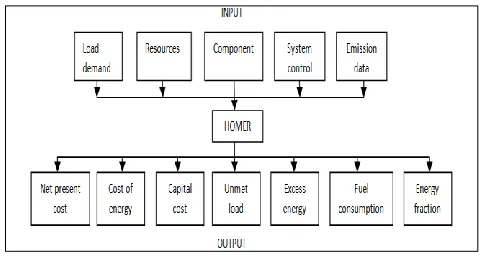
Simulation is the most convenient technique for evaluating the operation of HRES. A variety of software tools are available through which optimization of reliability can be obtained, which is carried out by comparing the operation or performance, unit sizing, power supply losses and production cost for energy of different types of hybrid system configurations. among the prominent tool for sizing which is developed by the National Renewable Energy Laboratory (NREL), United States. Solar photovoltaic, wind, hydro, batteries, diesel and other fuel generators are energy component models of HOMER [10],[11]. The architecture of the HOMER software is presented in figure 3.
Fig.3. Architecture of HOMER software
Other software tools available for optimization of HRES includes HYBRID2, HOGA, TRANSYS, RET Screen, GAMS, ORIENTE, Opt Quest, LINDO, WDILOG2, DIRECT, DOIRES,
SimPhoSys, GSPEIS, GRHYSO [12],[13],[14] etc. A
comparison of the widely used software tools considering several constraints and their architecture are presented in figure 4.
Fig.4. Architecture of (a) HYBRID2, (b) HOGA, (c) TRNSYS,
(d) RETScreen software
4 SOFT COMPUTING APPROACHES OF
OPTIMIZATION
For the power reliability analysis of HRES to be formulated is done by determining the optimization of the system along with its most favourable type, location, and sizing of different components of the generation units placed in particular places, so that the system satisfies the desired demand of load with low cost and high efficiency. From the literature survey, the
design of the HRES can be evaluated through sizing of different components, supply probability constraints, cost of the system etc. Various soft computing approaches for optimising the different constraints of HRES are summarized in figure 5.
Fig.5. Soft Computing approach for different constraints
A fair amount of research for optimization of system reliability of HRES based power generation scheme have been done in the past few years and also going on using commercially available computer tools, AI techniques, multi objective design, analytical and statistical approach, etc. Most of the literature available optimized the system using the cost criterion, Awan [15] optimized the HRES for the minimum NPC. Ndukwe et. al. [16] simulated on HOMER for optimum sizing and cost analysis of HRES. Bhandari et al. [17] detailed optimization using linear programming to minimize the cost through utilization of utmost capability of the energy system, considering the monthly variation on production and load demand into account. Aziz et al. [18] used HOMER tool for optimization by investigating the techno-economic and environmental performance of the proposed system under the load following strategy, cycle charging strategy, and combined dispatch strategy taking NPC and COE values into consideration. Mekontso et al. [19] presented a literature of techniques used in recent optimal sizing of HRES.
4.1 Artificial Intelligence (AI) based approaches
1879
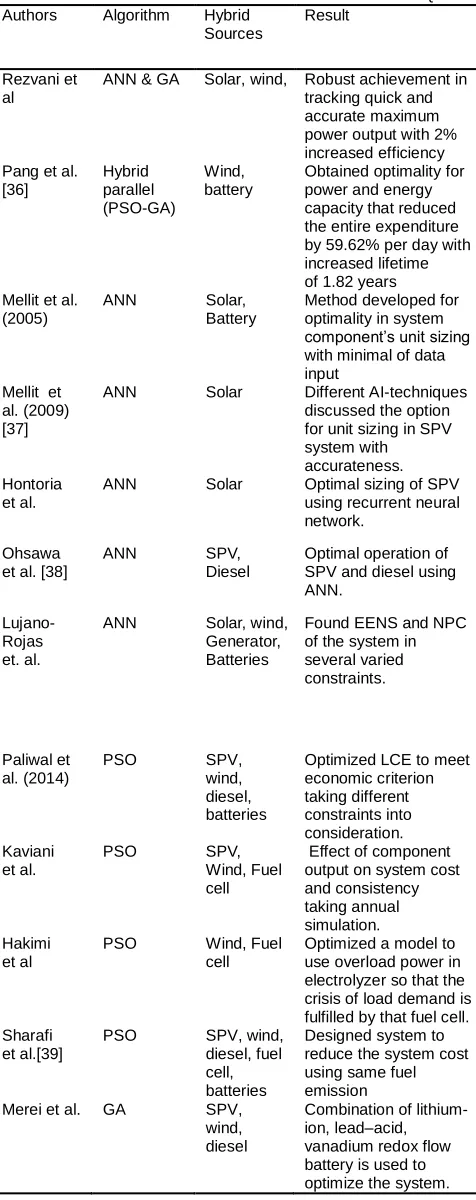
based on the combined distributed character of wind speed to maximize the social benefit and rate of smoothing the instability of wind. In the proposed paper, a case for the wind instability and curtailment probability, and the expenses of hydrogen fabrication and fuel cells has been deeply analyzed and reported that if the expenses of fuel cell and hydrogen fabrication system fall down, the overall system offers additional social benefits and the probability of smoothing fluctuations also increases, even if the wind varies uncontrollably. Mellit et al. (2005) [23] designed a methodology for optimum sizing in hybrid solar and battery system and proposed LPSP oriented power reliability and economic model in accordance with yearly cost of system. Hontoria et al. [24]modelled a stand-alone PV system taking solar radiation into consideration using ANN. Lujano-Rojas et al. [25] minimized a hybrid pv-wind-diesel-battery system to estimate EENS and NPC under a range of varied operating conditions using ANN for simulation. Paliwal et al. (2014) [26] optimized the LCE of a pv–wind–diesel oriented hybrid system using PSO to satisfy economic standard taking storage unit volume, number of cycle, replacements and battery SOC into consideration. Kaviani et al. [27] optimized the reliability parameter of a hybrid system consisting of solar,wind and fuel cell, and revealed the effect of large accuracy component output after annual simulation of 1 hour time step on consistency and cost of the system. PSO method was utilized by Hakimi et al. [28] to use the overload power of hybrid wind and fuel cell in electrolyser so that the crisis of load demand is fulfilled by that fuel cell. An oval discrete chaotic DHSSA algorithm was designed for optimal sizing of hybrid PV-wind-battery system by Askarzadeh [29]. The annual cost computed through the system was optimized in comparison with other algorithms like discrete HS and HSSA. Merei et al. [30] conceded study on GA to achieve optimality in net present value for a hybrid system consisting of PV, wind and diesel taking different blend of battery technology (lithium-ion, lead– acid, VRB or vanadium redox flow battery). Paliwal et al. (2018) [31] implemented hybrid wind-hydro- battery system integrated to grid and presented optimality in sizing and operations of battery storage using artificial bee colony (simulated in Matlab) to obtain maximum revenue in HPES. A biogeography oriented optimization algorithm was proposed by Kumar et al. [32] for hybrid PV and wind system that converged to give a global optimum solution through minimalism. The solutions are evaluated by comparing the result with several optimization algorithms like GA, PSO and other computer aided tool, HOMER. Arabali et al. [33] utilized GA algorithm and two-point estimation method to reduce the system cost and increase efficiency in an integrated SPV-wind system connected to battery. The maximum storage capacity of the battery is calculated so that the energy excessed can be used for various load crisis. Power reliability of a hybrid solar-wind-battery oriented integrated system was proposed by Yang et al. (2008) [34] using GA taking LPSP and ACS into objective consideration and revealed that system with 3 to 5 days of battery storage was suitable for the desired LPSP of 1% and 2%. Various studies of optimization based on AI approaches are summarized in Table 1 among two popular algorithms are detailed out.
4.2 Genetic Algorithm (GA) Method
GAs used to optimize both constrained and unconstrained complex problems. The algorithm is termed as evolutionary
algorithm since as it modifies the individual‘s population based on evolution. A complete flowchart of the algorithm is represented in figure 6. The algorithm produces random set of individuals of a population initially which proceeds as the source for the successive iterative steps. The main stages of the algorithm that generate new set of results are selection, crossover, and mutation.
Fig.6. Genetic Algorithm flowchart
4.3 Particle Swarm Optimization Method
PSO is another type of stochastic evolutionary algorithm used for optimization. This algorithm executes on the principle of moving the particles from candidate solution space via search space which is essential based on prior knowledge (parameters with best fitness), the information shared with neighborhood (best fitness of other particles) and stochastic changing of the moving direction. A modified PSO algorithm has been used for tuning the parameters of power system stabilizer PSS4B [35]. The detailed flowchart of the algorithm is presented in figure 7
1880 TABLE 1
SUMMARY OF AI BASED OPTIMIZATION TECHNIQUES Authors Algorithm Hybrid
Sources
Result
Rezvani et al
ANN & GA Solar, wind, Robust achievement in tracking quick and accurate maximum power output with 2% increased efficiency Pang et al.
[36]
Hybrid parallel (PSO-GA)
Wind, battery
Obtained optimality for power and energy capacity that reduced the entire expenditure by 59.62% per day with increased lifetime of 1.82 years Mellit et al.
(2005)
ANN Solar, Battery
Method developed for optimality in system component‘s unit sizing with minimal of data input
Mellit et al. (2009) [37]
ANN Solar Different AI-techniques discussed the option for unit sizing in SPV system with accurateness. Hontoria
et al.
ANN Solar Optimal sizing of SPV using recurrent neural network.
Ohsawa et al. [38]
ANN SPV,
Diesel
Optimal operation of SPV and diesel using ANN.
Lujano- Rojas et. al.
ANN Solar, wind, Generator, Batteries
Found EENS and NPC of the system in several varied constraints.
Paliwal et al. (2014)
PSO SPV,
wind, diesel, batteries
Optimized LCE to meet economic criterion taking different constraints into consideration. Kaviani
et al.
PSO SPV,
Wind, Fuel cell
Effect of component output on system cost and consistency taking annual simulation. Hakimi
et al
PSO Wind, Fuel cell
Optimized a model to use overload power in electrolyzer so that the crisis of load demand is fulfilled by that fuel cell. Sharafi
et al.[39]
PSO SPV, wind, diesel, fuel cell, batteries
Designed system to reduce the system cost using same fuel emission Merei et al. GA SPV,
wind, diesel
Combination of lithium-ion, lead–acid, vanadium redox flow battery is used to optimize the system.
Askarzade h
DHSSA, HS, SA
SPV, wind, battery
Minimized annual cost using DHSSA.
Kumar et al.
BBO, PSO, GA
PV, wind battery
Developed BBO algorithm that converged to simplicity and also compared with other algorithm. Arabali
et al.
GA SPV,
wind, batteries
Reduced overall cost and improved efficiency with increasing storage capability. Also stored overload energy to meet crisis. Paliwal et
al (2018)
Artificial bee colony
Wind, hydro, battery
Considered two different scenarios of wind: moderate and abundant. Optimization in two stages: first for sizing, second for battery operation. Yang et al.
(2008)
GA Solar, wind, batteries
Designed battery storage of 3 to 5 being suitable for the desired LPSP of 1% and 2%.
Xu et al. [40]
GA SPV, wind batteries
LPSP for the system was determined through simulation of 8760 hours.
4.4 Multi objective design
1881
the cost of a solar-wind-hydro based hybrid configuration and improved the utility in peak requirement. Katsigiannis et al. [48] developed Pareto optimal set using non-dominated sorting GA for a system hybridized with solar and wind energy and found GHG emission taking life cycle analysis into consideration. Various research studies on multi-objective optimization as mentioned are combined in Table 2.
TABLE 2
SUMMARY OF MULTI-OBJECTIVE APPROACH Authors Hybrid
sources Design constrain t Result Abbes et al. SPV, wind, batteries Generato rs
Designed 120 Pareto optimal set and found a solution which satisfied 95% of domestic energy requirement. Ippolito et al. Solar, batteries Power and voltage limit, power transfer
Studied three scenarios and found that for intermediary values of objective function, development of voltage profile was very appropriate functions.
Li et al. Hydro, PV Energy generatio n and utilization
Optimal operation in a case study of different wet year, normal year, and dry year with multiple objectives to maximize energy generation Maheri et al. PV, wind diesel Reliabilit y, LCE
Developed two algorithms: one algorithm for reliability of system taking cost into consideration, while other for economic system taking reliability into consideration. Abedi et al. PV, wind, fuel cell, battery and diesel Storage energy level, tilt angle
Optimized overall cost, unmet load, and fuel discharge via fuzzy techniques and nonlinear programming. Designed of energy source uncertainty related to Weibull-Beta probability distribution function.
Tant et al. SPV, batteries
Total annual cost limit
Presented the relation curves between voltage control and the objectives of peak shaving for low-voltage distribution grid. Ould et al.
[49]
Solar, wind, Batteries
LPSP Designed Pareto optimal set and established that load profiles highly influenced the cost of the optimal solution. Moura et al. Solar, wind, hydro Energy use, maximum reliability, actual power, annual growth
Minimized hybrid solar-wind-hydro based system to maximize its utility in peak demand maintaining low cost criteria.
Katsigiann is et al.
SPV, wind Preliminar y cost, component s' size, unmet load, capacity insufficienc y Developed non-dominated Pareto-set by NSGA-II and also estimated the discharge of gas taking component‘s life cycle analysis.
Arnette et al. [50]
Solar, wind, biomass, coal plant Biomass transport, cost, generation
Checked cost and emission under different conditions like minimize cost, emission and weight.
4.5 Analytical approach
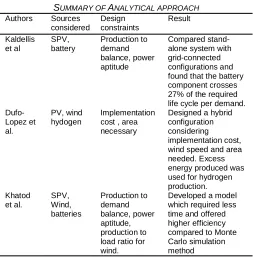
Analytical approach is a method in which computational models of the system components are developed for determining the feasibility of the HRES. Therefore considering the components sizing, set of feasible system can be designed to evaluate the system performances. It can be also assessed by analyzing single or multiple response indexes of several arrangements. Kaldellis et al. [51] studied hybrid SPV-battery system and compared a stand-alone system with grid-connected and found battery crossed 27% of the requisite life cycle energy demand. Dufo-Lopezet al. [52] proposed a PV, wind and hydrogen based integrated system considering implementation cost, wind speed and area into account. The excess energy produced was used for hydrogen production. Khatod et al. [53] proposed a model on PV-battery based system using Beta and Weibull distributions, which requires less time and is very efficient compared to Monte Carlo simulation method. Summary of various research on analytical approach mentioned in literature are given in Table 3
.
TABLE 3
SUMMARY OF ANALYTICAL APPROACH Authors Sources
considered Design constraints Result Kaldellis et al SPV, battery Production to demand balance, power aptitude Compared stand-alone system with grid-connected configurations and found that the battery component crosses 27% of the required life cycle per demand. Dufo-Lopez et al. PV, wind hydogen Implementation cost , area necessary
Designed a hybrid configuration considering implementation cost, wind speed and area needed. Excess energy produced was used for hydrogen production. Khatod et al. SPV, Wind, batteries Production to demand balance, power aptitude, production to load ratio for wind.
Developed a model which required less time and offered higher efficiency compared to Monte Carlo simulation method
4.6 Statistical modelling approach
1882
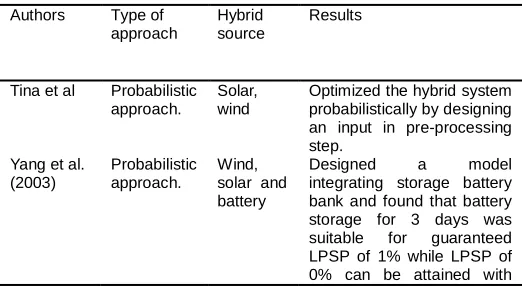
suitable to ensure LPSP of 1% while LPSP of 0% can achieved with batteries of capacity 5 days storage. Bagul et al. [56] designed a PV-battery based system and found a method using three events probability density for unit sizing PV-array with batteries, offering higher accurateness with low computational complexity and proper management for distribution of excess energy. An iterative approach is accomplished through recursive solution that terminates when optimal solution is achieved for the system. From literature survey it is seen that in iterative approach for most of the cases, to optimize the model, LPSP constraint is used for achieving consistency while LCE or net present value constraint is used for economic cost for system cost. Solar panel capacity, wind energy rated power, and storage capacities of batteries are few parameters chosen by majority of the authors. From the several iterative studies it is concluded that to attain reliability at desired level, the designed configuration should have the lowest LCE or net present value compared to all other probable set of arrangements. Thus in iterative process, the cost of system is optimized with linear values of constraint or with the use several linear programming methodologies. However, some drawback of iterative techniques is that it does not optimize constraints that directly or indirectly affect system cost like the slope angle of PV module, PV area, swept area for wind turbine, system height of wind turbine. In experimental approach author manipulated one or more parameter and controls and measured the change in other parameters. Ali et al. [57] designed a power processing unit which is capable to supply uninterruptible power, voltage stabilization, better efficiency, unity power factor operation etc. Yamegueu et al. [58] modelled a PV-diesel hybrid system and found that for optimization of reliability, diesel generator rated power must be equal to peak load demand and also verified that the proposed system is efficient for high load and more solar radiation. In graphical approach, certain decision variables are considered for optimizing the hybrid system. Borowy et al. [59] designed a
solar-wind-battery taking irradiance and speed into
consideration and a methodology is developed to optimize the size by correlating the number of PV modules with batteries in which the minimal cost is attained at the tangent of the curve. Vick et al. [60] graphically developed a most efficient solar-wind hybrid system and improvement of the hybrid water pumping system using controller additionally. Various Statistical modelling approaches are summarized in Table 4.
TABLE 4
SUMMARIES OF STUDIES BASED ON STATISTICAL MODELLING APPROACH
Authors Type of approach
Hybrid source
Results
Tina et al Probabilistic approach.
Solar, wind
Optimized the hybrid system probabilistically by designing an input in pre-processing step.
Yang et al. (2003)
Probabilistic approach.
Wind, solar and battery
Designed a model integrating storage battery bank and found that battery storage for 3 days was suitable for guaranteed LPSP of 1% while LPSP of 0% can be attained with
batteries of capacity 5 days
Bagul et al. Probabilistic approach. Solar, batteries
Designed hybrid PV-battery system and found a methodology for unit sizing using 3 events probability density. Accurate, Less computation time and managed proper distribution of excess energy.
Karaki et al. [61]
Probabilistic approach
Wind, solar and battery
Designed a methodology to control the output in case of hardware stoppage and energy variation by extending the storage size constraint for battery to accomplish desired demand load.
Geleta et al. [62]
Iterative approach.
Wind, solar and battery
Arrived an optimal solution of NPV = 74, NW T = 1 and
NBattery = 12) and total cost
$7085.97. Gupta et al.
[63] Iterative approach. Solar, hydro, biogas, biomass
To resolve optimal resource allocation, a model is developed showing the resources of less unit generation cost provide more of the total energy demand.
Ekren and Ekren [64] Iterative approach. Solar, wind, batteries
Used the Opt Quest tool in ARENA software to optimize the PV area sizing, battery storage and swept area of wind turbine.
Zhang et al. [65] Iterative approach. Solar, diesel, batteries
Proposed optimization technique using linear programming for total hybrid system component sizing. Yang et al.
(2009) [66]
Iterative approach.
Wind, solar and battery
To optimize the cost 5 variables were considered.
Kellogg et al. [67]
Iterative approach.
Solar and wind
Installed a stand-alone system and justified via comparing with conventional grid power considering load demand and line extension.
Ashok et al. [68]
Iterative approach.
Wind, Solar and small hydro
Developed a methodology to support the system in terms of hardware design Ali et al. Experimenta
l approach
Solar, wing generator and battery
Designed a power processing unit which is able to supply uninterruptible power, voltage stabilization, better efficiency, unity power factor operation Yamegueu et al. Experimenta l approach
Solar and diesel
1883 Markvart
[69]
Graphical construction
Solar, wind
Obtained optimality in system taking monthly solar and wind data considering the demand supply constraint.
Borowy et al.
Graphical construction
Wind, solar and battery
A method is developed to optimize the size by correlating between the number of PV module and battery from which the minimal cost was attained at the tangent of the curve. Vick et al. Graphical
construction
Solar and wind
Developed a most efficient hybrid system and improvement of the hybrid water pumping system taking additional controller
5 RESULT OF OPTIMIZATION
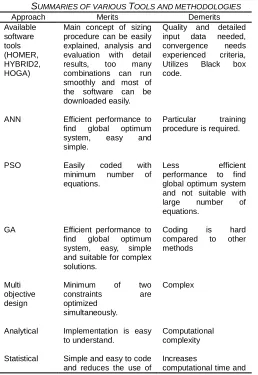
In optimization process, most of the researchers concerted on component sizing, LPSP, LA, EENS, Different cost analysis of energy etc taking diverse categories of constraints in consideration. In order to optimize different methodologies viz. AI (ANN, PSO, GA etc), multi-objective design, analytical, statistical approaches are used. Some of the commercially available software tools like HOMER, HOGA, HYBRID2, TRNSYS, RETScreen are utilized. In this paper a comparative study of the different tools and methodologies of optimization is summarized in Table 5.
TABLE 5
SUMMARIES OF VARIOUS TOOLS AND METHODOLOGIES
Approach Merits Demerits
Available software tools (HOMER, HYBRID2, HOGA)
Main concept of sizing procedure can be easily explained, analysis and evaluation with detail results, too many combinations can run smoothly and most of the software can be downloaded easily.
Quality and detailed input data needed, convergence needs experienced criteria, Utilizes Black box code.
ANN Efficient performance to find global optimum system, easy and simple.
Particular training procedure is required.
PSO Easily coded with minimum number of equations.
Less efficient performance to find global optimum system and not suitable with large number of equations.
GA Efficient performance to find global optimum system, easy, simple and suitable for complex solutions.
Coding is hard compared to other methods
Multi objective design
Minimum of two constraints are optimized
simultaneously.
Complex
Analytical Implementation is easy to understand.
Computational complexity Statistical Simple and easy to code
and reduces the use of
Increases
computational time and
time-specific data efforts.
After the comparative study this paper proposes a different methodology is proposed by combining Symbiotic Organism Search (SOS) to execute competitively with PSO for improving the measure of convergence and quality of solution. SOS is a straightforward and dominant meta-heuristic algorithm that replicates symbiotic association strategy that creatures practice to live in the environs. The major benefit of SOS algorithms in comparison with other meta-heuristic algorithms is that the operations do not involve any explicit algorithm parameters. The algorithm has achieved high efficiency in resolving optimization problems in engineering field with rapid rate of convergence and less computation time [70],[71]. Symbiotic association can be classified as obligate and facultative. The obligate association, compel two organisms to be exclusively dependant on one another for survival while in facultative association, this dependency is discretionary. Three styles of association are observed in environment viz.,
mutualism, commensalism and parasitism. Mutualism
describes the association among two diverse species of organisms in which both individuals acquire benefits. In Parasitism category, one species is gained while other harmed. Living organisms undertake symbiotic association to adapt themselves in the surroundings and in long-term they develop their fitness to stay alive in the ecology. SOS algorithm mimics the symbiotic relations among organisms that are utilized for obtaining the fittest organism in the search space of population of candidate solutions to seek the optimal global solution.Flowchart of the methodology is shown in figure 8. The algorithm for SOS implementation is given below: Algorithm 1
1. Initialize While do
2. Mutualism phase
3. Commensalism phase
4. Parasitism phase
until (covergence)
Fig.8. Symbiotic Organisms Search flowchart
6 CONCLUSIONS AND FUTURE SCOPE
1884
standalone applications inline with overall rise of energy requirement and scarcity of conventional energies. Whenever hybrid systems are combined with the conservative source of energy, it develop into an appropriate way out to the current challenges faced by the society regarding reliability, stability and durability issues of power generation and transmission. Taking different constraints into consideration the HRES may be modelled to optimize in according with load demand for any particular region. Several optimization techniques are used by the different researchers to optimize reliability, sizing of components of the hybrid system are discussed and summarized. However from research it is found that lot of work has been carried out in this field, still more research and efforts are required to make HRES more reliable and sustainable at an optimum cost. After the comparative study this paper proposed a different methodology by combining SOS to perform competitively with PSO to improve the convergence rate and quality of solution. Energy losses in conversion process will be reduced to a large extent and improve system stability in case of a standalone HRES. Emphasis will be also given in improving the durability and performance of battery storage at minimum cost.
7 REFERENCES
[1]. Bhatt, M.P. Sharma, R.P. Saini, ―Feasibility and
sensitivity analysis of an off-grid micro hydro–
photovoltaic–biomass and biogas–diesel–battery
hybrid energy system for a remote area in Uttarakhand state, India,‖ Renewable and Sustainable Energy Reviews, vol. 61, pp.53-69, 2016
[2]. M. Muselli, G. Notton, A. Louche, ―Design of
hybrid-photovoltaic power generator, with optimization of energy management,. Sol Energy, vol. 65, no.3, pp. 143–57, 1999
[3]. Chauhan, R.P. Saini, ―A review on integrated
renewable energy system based power generation for stand-alone applications: Configurations, storage option, sizing methodologies and control,‖ Renewable and Sustainable Energy Reviews, vol 38, pp. 99-120, 2014.
[4]. R. Lasseter, A. Abbas, C. Marnay, J. Stevens, J.
Dagle, R. Guttromson, A.S. Meliopoulous, R. Yinger, J. Eto, ―Integration of distributed energy resources -The CERTS Micro grid Concept,‖ California Energy Commission. P500-03-089F. 2003.
[5]. F.A. Farre, M.G. Simoes, ―Integration of Alternative
Sources of Energy,‖ Hoboken, NJ: Wiley; 2006.
[6]. H. Yang, W. Zhou, L. Lu, Z. Fang, ―Optimal sizing
method for stand-alone hybrid solar–wind system with LPSP technology by using genetic algorithm,‖ Solar Energy, vol. 82, pp. 354–367, 2008
[7]. R. Luna-Rubio, M. Trejo-Perea, D. Vargas-Vazquez,
G.J. Rios-Moreno, ―Optimal sizing of renewable hybrids energy systems: A review of methodologies,‖ Solar Energy, vol. 86, pp. 1077–10882012. doi: 10.1016/j.solener.2011.10.016
[8]. G.J. Dalton, D.A. Lockington, T.E. Baldock, ―Feasibility
analysis of stand-alone renewable energy supply options for a large hotel,‖ Renew Energy, vol. 33, no.7,
pp. 1475–1490, 2008. doi:
10.1016/j.renene.2007.09.014
[9]. P. Suhane, S. Rangnekar, ―Optimal Sizing of Hybrid
Energy System using Ant Colony Optimization,‖ IJRES, vol. 4, pp. 936-942. 2014
[10]. A.M.A. Haidar, P.N. John, M. Shawal, ―Optimal
configuration assessment of renewable energy in Malaysia,‖ Renewable Energy, vol. 36, no. 2, pp. 881– 888. 2011.
[11]. G. Tzamalis, E.I. Zoulias, E. Stamatakis, E. Varkaraki,
E. Lois, F. Zannikos, ―Techno-economic analysis of an autonomous power system integrating hydrogen technology as energy storage medium,‖ Renewable Energy, vol. 36, no.1, pp. 118–124. 2011
[12]. E. Mazhari, J. Zhao, N. Celik, S. Lee, Y.J. Son, L. Head, ―Hybrid simulation and optimization-based design and operation of integrated photovoltaic generation, storage units, and grid,‖ Simulation Modelling Practice and Theory, vol. 19, no.1, pp. 463-481. 2011
[13]. J.S. Ramos, H.M. Ramos, ―Sustainable application of
renewable sources in water pumping systems: optimized energy system configuration,‖ Energy Policy, vol. 37, no. 2, pp. 633–643. 2009
[14]. E.S. Hrayshat, ―Techno-economic analysis of
autonomous hybrid photovoltaic–diesel–battery
system,‖ Energy for Sustainable Development, vol. 13, no. 3, pp. 143–150. 2009
[15]. A.B. Awan, ―Performance analysis and optimization of
a hybrid renewable energy system for sustainable NEOM city in Saudi Arabia,‖ Journal of Renewable and Sustainable Energy, vol. 11, no. 2, 025905. 2019. https://doi.org/10.1063/1.5071449.
[16]. Ndukwe, T. Iqbal, X. Liang, J. Khan, ―Optimal Sizing
and Analysis of a Small Hybrid Power System for Umuokpo Amumara in Eastern Nigeria,‖ International Journal of Photoenergy, Article ID 6960191: 8 pages. 2019. https://doi.org/10.1155/2019/6960191
[17]. Bhandari, A. Sung-Hoon, A. Tae-Bong, ―Optimization
of hybrid renewable energy power system for remote installations: Case studies for mountain and island,‖ International Journal of Precision Engineering and
Manufacturing, vol. 17, pp. 815-822, 2016.
doi:10.1007/s12541-016-0100-2.
[18]. A.S. Aziz, M.F.N. Tajuddin, M.F. Adzman, M.A.M.
Ramli, S. Mekhilef, ―Energy Management and Optimization of a PV/Diesel/Battery Hybrid Energy System Using a Combined Dispatch Strategy,‖
Sustainability. Vol. 11, pp. 683, 2019.
doi:10.3390/su11030683
[19]. Mekontso, A. Abdulkarim, I.S. Madugu, O. Ibrahim,
Y.A. Adediran, ―Review of Optimization Techniques for
Sizing Renewable Energy Systems,‖ Computer
Engineering and Applications, vol. 8, no. 1, pp.13-30, 2019.
[20]. Rezvani, A. Esmaeily, H. Etaati, M.
Mohammadinodoushan, ―Intelligent hybrid power generation system using new hybrid fuzzy-neural for photovoltaic system and RBFNSM for wind turbine in the grid connected mode,‖ Frontiers in Energy, 2017; doi:10.1007/s11708-017-0446-x
[21]. K.R. Kumar, M.S. Kalavathi, ―Optimal Sizing of Grid
1885
Journal of Innovative Technology and Exploring Engineering, vol. 8, no. 4, pp. 412- 418, 2019.
[22]. Y. Jiang, B. Wen, Y.Wang, ―Optimizing unit capacities
for a wind‐hydrogen power system of clustered wind farms,‖ International Transactions on Electrical Energy
Systems, e2707, 2018.
https://doi.org/10.1002/etep.2707.
[23]. Mellit, M. Benghanem, A. HadjArab, A. Guessoum, ―An
adaptative artificial neural network model for sizing stand-alone photovoltaic systems: application for isolated sites in Algeria,‖ Renewal Energy, vol. 30, no. 10, pp. 1501–1524, 2005.
[24]. L. Hontoria, J. Aguilera, P. Zufiria, ―A new approach for
sizing stand-alone photovoltaic systems based in neural networks,‖ Solar Energy, vol. 78, pp. 313–319. 2005.
[25]. J.M. Lujano-Rojas, R. Dufo-Lopez , J.L.
Bernal-Agustin, ―Probabilistic modelling and analysis of stand-alone hybrid power systems,‖ Energy, vol. 63, pp. 19– 27. 2013.
[26]. P. Paliwal, N.P. Patidar, R.K. Nema, ―Determination of
reliability constrained optimal resource mix for an autonomous hybrid power system using particle swarm optimization,‖ Renewable Energy, vol. 63, pp. 194– 204, 2014.
[27]. A.K. Kaviani, G.H. Riahy, S.H.M. Kouhsari, ―Optimal
design of a reliable hydrogen- based stand-alone wind/PV generating system, considering component outages,‖ Renewable Energy, vol. 34, pp. 2380–2390, 2009.
[28]. S.M. Hakimi, S.M. Moghaddas-Tafreshi, ―Optimal
sizing of a stand-alone hybrid power system via particle swarm optimization for Kahnouj area in south- east of Iran,‖ Renewable Energy, vol. 34, pp. 1855– 1862, 2009.
[29]. A.Askarzadeh, ―A discrete chaotic harmony
search-based simulated annealing algorithm for optimum design of PV/wind hybrid system,‖ Solar Energy, vol. 97, pp. 93–101. 2013.
[30]. G. Merei, C. Berger, D.U.Sauer, ―Optimization of an
off-grid hybrid PV–wind– diesel system with different battery technologies using genetic algorithm,‖ Solar Energy, vol. 97, pp. 460–473, 2013.
[31]. N.K. Paliwal, A.K. Singh, N.K. Singh, P. Kumar,
―Optimal sizing and operation of battery storage for economic operation of hybrid power system using
artificial bee colony algorithm,‖ International
Transactions on Electrical Energy Systems, e2685, 2018.doi:10.1002/etep.2685
[32]. R. Kumar, R. A. Gupta, A.K. Bansal, ―Economic
analysis and power management of a stand-alone
wind/photovoltaic hybrid energy system using
biogeography based optimization algorithm,‖ Swarm and Evolutionary Computation, vol. 8, pp. 3–43, 2013.
[33]. Arabali, M. Ghofrani, M.E. Amoli, M.S. Fadali, Y.
Baghzouz, ―Genetic algorithm- based optimization approach for energy management,‖ IEEE Transactions on Power Delivery, vol. 28, no. 1, pp. 162–170. 2013. doi: 10.1109/TPWRD.2012.2219598
[34]. H. Yang, W. Zhou, L. Lu, Z. Fang, ―Optimal sizing
method for stand-alone hybrid solar–wind system with LPSP technology by using genetic algorithm,‖ Solar
Energy, vol. 82, pp. 354–367, 2008. doi: 10.1016/ j.solener. 2007.08.005
[35]. Wang, N. Ma, M. Wei, Y. Liu, ―Parameters tuning of
power system stabilizer PSS4B using hybrid particle
swarm optimization algorithm,‖ International
Transactions on Electrical Energy Systems, e2598, 2018. doi:10.1002/etep.2598
[36]. M. Pang, Y. Shi, W. Wang, S. Pang, ―Optimal sizing
and control of hybrid energy storage system for wind power using hybrid Parallel PSO-GA algorithm,‖ Energy Exploration & Exploitation, vol. 37, no.1, pp.
558–578. 2019. https://doi.org/10.1177/
0144598718784036.
[37]. Mellit, S.A. Kalogirou, L. Hontoria, S. Shaari, ―Artificial
intelligence techniques for sizing photovoltaic systems: A review,‖ Renewable and Sustainable Energy Reviews, vol. 13, pp. 406–419, 2009.
[38]. Y. Ohsawa, S. Emurd, K. Arai, ―Optimal operation of
photovoltaic/diesel power generation system by neural network,‖ In: Proceedings of the Second International Forum on Applications of Neural Networks to Power Systems. pp. 99–103, 1993
[39]. M. Sharafi, T.Y. ELMekkawy, ―Multi-objective optimal
design of hybrid renewable energy systems using PSO-simulation based approach,‖ Renewable Energy, vol. 68, pp. 67–79, 2014.
[40]. D. Xu, L. Kang, L. Chang, B. Cao, ―Optimal sizing of stand-alone hybrid wind/PV power systems using genetic algorithms,‖ In: Proceedings of the Canadian conference on electrical and computer engineering. pp.1722–1725, 2005
[41]. D. Abbes, A. Martineza, G. Champenois, ―Life cycle
cost, embodied energy and loss of power supply probability for the optimal design of hybrid power systems,‖ Mathematics and Computers in Simulation,
vol. 98, pp. 46–62. 2014. doi:
10.1016/j.matcom.2013.05.004
[42]. M.G. Ippolito, M.L. DiSilvestre, E.R. Sanseverino, G.
Zizzo, G. Graditi, ―Multi- objective optimized management of electrical energy storage systems in an islanded network with renewable energy sources under different design scenarios,‖ Energy, vol. 64,pp.: 648–662, 2014.
[43]. F-F. Li, J. Qiu, J-H. Wei, ―Multiobjective optimization for
hydro-photovoltaic hybrid power system considering both energy generation and energy consumption,‖ Energy Science & Engineering, vol. 6, no. 5, pp. 362– 370. 2018.doi:10.1002/ese3.202
[44]. Maheri, ―Multi-objective design optimisation of
stand-alone hybrid wind– PV–diesel systems under uncertainties,. Renewable Energy, vol. 66, pp. 650– 661, 2014.
[45]. S. Abedi, A. Alimardani, G.B. Gharehpetian, G.H.
Riahy, S.H. Hosseinian, ―Comprehensive method for optimal power management and design of hybrid RES- based autonomous energy systems,‖ Renewable and Sustainable Energy Reviews, vol. 16, no. 3, pp. 31577–31587, 2012.
1886
[47]. P.S. Moura, A.T. DeAlmeida, ―Multi-objective
optimization of a mixed renewable system with
demand-side management,‖ Renewable and
Sustainable Energy Reviews, vol. 14, no. 5, pp. 1461– 8, 2010.
[48]. Y.A. Katsigiannis, P.S. Georgilakis, E.S. Karapidakis, ―Multi objective genetic algorithm solution to the optimum economic and environmental performance problem of small autonomous hybrid power systems with renewable,‖ IEEE Transaction on Renewable Power Generation, vol. 4, no. 5, pp. 404–419, 2010, doi: 10.1049/iet-rpg.2009.0076
[49]. B. Ould, V. Sambou, P.A. Ndiaye, C.M.F. Kebe, M.
Ndongo, ―Optimal design of a hybrid solar–wind– battery system using the minimization of the annualized cost system and the minimization of the loss of power supply probability (LPSP),‖ Renewable Energy, vol. 35, no. 10, pp. 2388–2390, 2010.
[50]. Arnette, C.W. Zobel, ―An optimization model for
regional renewable energy development. Renewable and Sustainable Energy Reviews,‖ vol. 16, pp. 4606– 4615, 2012.
[51]. J.K. Kaldellis, D. Zafirakis, E. Kondili, ―Optimum
autonomous stand-alone photovoltaic system design on the basis of energy payback analysis,‖ Energy, vol. 34 no. 9, pp. 1187–1198, 2009
[52]. R. Dufo-Lopez, J.L. Bernal-Agustin, F. Mendoza,
―Design and economical analysis of hybrid PV–wind systems connected to the grid for the intermittent production of hydrogen,‖ Energy Policy, vol. 37, no. 8, pp. 3082–3095, 2009.
[53]. D. Khatod, V.K. Pant, J. Sharma, ―Analytical approach
for well-being assessment of small autonomous power system with solar and wind energy sources,‖ IEEE Transaction on Energy Conversion, vol. 25, no. 2, pp. 535–545, 2010.
[54]. Tina, S. Gagliano, ―Probabilistic analysis of weather data for a hybrid solar/ wind energy system,‖ International Journal of Energy Research, vol. 35, no.
3, pp. 221–232, 2011, doi:10.1002/er.1686
[55]. H.X. Yang, L. Lu, J. Burnett, ―Weather data and
probability analysis of hybrid photovoltaic–wind power generation systems in Hong Kong,‖ Renewable Energy, vol. 28, no. 11, pp. 1813–1824, 2003.
[56]. A.D. Bagul, Z.M. Salameh, B. Borowy, ―Sizing of a
stand-alone hybrid wind photovoltaic system using a
three-event probability density approximation,‖ Solar
Energy, vol. 56, no. 4, pp. 323–335, 1996.
[57]. S.M. Ali, A. Pattanaik, L. Nayak, N. Mohanty,
―Application of Off Grid Solar PV System for Power
Processing Unit,‖ International Journal of
Computational Engineering Research, vol. 2, no. 6, pp. 182-191, 2012.
[58]. D. Yamegueu, Y. Azoumah, X. Pyb, N. Zongo,
―Experimental study of electricity generation by Solar PV/diesel hybrid systems without battery storage for off-grid areas,‖ Renewable Energy, vol. 36, pp. 1780-1787, 2011.
[59]. B.S. Borowy, Z.M. Salameh, ―Methodology for
optimally sizing the combination of a battery bank and PV array in a wind/PV hybrid system,‖ IEEE Transaction on Energy Conversion, vol. 11, no. 2, pp. 367–373, 1996.
[60]. B.D. Vick, B.A. Neal, ―Analysis of off-grid hybrid wind turbine/solar PV water pumping systems,‖ Solar
Energy, vol. 86, pp. 1197–1207, 2012. doi:
10.1016/j.solener.2012.01.012
[61]. S.H. Karaki, R.B. Chedid, R. Ramadan, ―Probabilistic
performance assessment of autonomous solar–wind energy conversion systems,‖ IEEE Transaction on Energy Conversion,‖ vol. 14, pp. 766–772, 1999.
[62]. D.K. Geleta, M.S. Manshahia, ―Optimization of Hybrid
Wind and Solar Renewable Energy System by Iteration Method,‖ Advances in Intelligent Systems and Computing, pp. 98–107, 2018. doi:10.1007/978-3-030-00979-3_10
[63]. Gupta, R.P. Saini, M.P. Sharma, ―Steady-state
modelling of hybrid energy system for off grid electrification of cluster of villages,‖ Renewable Energy, vol. 35, pp. 520–535, 2010.
[64]. B.Y. Ekren, O. Ekren, ―Simulation based size
optimization of a PV/wind hybrid energy conversion system with battery storage under various load and auxiliary energy conditions,‖ Applied Energy, vol. 86, no. 9, pp. 1387–1394, 2009.
[65]. X. Zhang, S.C. Tan, G. Li, J. Li, Z. Fang, ―Components
sizing of hybrid energy systems via the optimization of power dispatch simulations,‖ Energy, vol. 52, pp. 165– 172, 2013.
[66]. Yang, W. Zhou, C. Lou, ―Optimal design and
techno-economic analysis of a hybrid solar–wind power generation system,‖ Applied Energy, vol. 86, no. 2, pp. 163–169, 2009.
[67]. W.D. Kellogg, M.H. Nehrir, G. Venkataramanan, V.
Gerez, ―Generation unit sizing and cost analysis for stand-alone wind, photovoltaic and hybrid wind/PV systems,‖ IEEE Transaction on Energy Conversion, vol.13, no. 1, pp. 70–75,1998.
[68]. S. Ashok, ―Optimised model for community-based
hybrid energy system,‖ Renewable Energy, vol. 32, no. 7, pp. 1155–1164, 2007.
[69]. T. Markvart, ―Sizing of hybrid PV–wind energy
systems,‖ Solar Energy, vol. 59, no. 4, pp. 277–281, 1996.
[70]. M.Y. Cheng, D. Prayogo, ―Symbiotic organisms
search: a new metaheuristic optimization algorithm,‖ Computers & Structures, vol. 139, pp. 98–112, 2014.
[71]. D. Prasad, V. Mukherjee, ―A novel symbiotic organisms
![figure 1, Hybrid- off-grid configuration as shown in figure 2, and individual supply of grid configuration [3],[4],[5]](https://thumb-us.123doks.com/thumbv2/123dok_us/8638473.1428181/1.612.316.557.593.737/figure-hybrid-configuration-shown-figure-individual-supply-configuration.webp)