Examining The Undergraduate Construction
Technology Students’ Use Of Computer And
Internet In UEW: A Structural Equation Modelling
Approach
Humphrey Danso, Simon Gyasi Nimako
Abstract: - This paper empirically examines the the use of computer and Internet facilities among the undergraduate construction technology students in UEW, Ghana. The study was a cross-sectional survey of 499 respondents using structured questionnaire personally administered. A usable 358 questionnaire were returned, representing 71.7% response rate and analysed using Structural Equation Modelling approach. The findings indicate that the proposed model has high goodness-of-fit for student’s use of computer. It also found that access to Internet, classroom based learning with Internet and non-classroom based learning with Internet could be influenced by students’ computer use. Theoretically, the study fills the dearth of conceptual models in understanding the critical determinants that influence students’ computer use in the high education level in developing country context. It provides important implications for educational management in higher education. This paper contributes to the body of knowledge in the area of computer application in education.
Index Terms: - Access to Internet, Computer use, classroom-based learning, educational management, non-classroom-based learning
————————————————————
1
I
NTRODUCTIONIn the past few decades, computer and Internet have become essential tools of students’ academic life at all levels of education worldwide. Computer related occupations are the fastest growing segment of the modern job market, and the mastery of computer technology gives a competitive edge to individuals and nations alike (Sonia, 1999). This attests to the fact that, for students to be competitive in world of work in future, it is relevant to be abreast with the use of computer and Internet from schooling time. Presently, it has become important for students to use computer and Internet for their academic work, without these students cannot cope with their studies. This issue is critical, particularly for developing countries, due to the magnitude of the investment involved in buying and maintaining computer and Internet facilities, and providing adequate training for students. Students are faced with computers both at home and at school, and governments worldwide have introduced schemes to equip schools with classroom computers and Internet connections (Fuchs & Woessmann, 2004).
Educational specialists see computer use in the instructional process as a revolution against traditional teaching approaches (Al-Ajlouni, 2003). As a result of this revolution, which has brought about drastic changes in the educational process, children’s computer use has become an imperative requisite (Al-Barakat & Bataineh, 2008). Many students worldwide especially those in higher education use computer for aiding their studies. However, the benefits students derive from using computer could be affected by access (ACC) to Internet, classroom based learning (CBL) with Internet and non-classroom based learning (NCBL) with Internet. The University of Education, Winneba (UEW) was established by the University of Education, Winneba, Act 672 on May 14, 2004. It was originally established by PNDC Law 322 (1992) as the University College of Education of Winneba (UCEW) through the amalgamation of seven diploma awarding institutions, viz: the Specialist Training College, the Advanced Teacher Training College, the National Academy of Music - all located at Winneba; the School of Ghana Languages, Ajumako; College of Special Education, Mampong-Akwapim; St. Andrews Training College, Mampong-Ashanti and the Advanced Technical Teacher College, Kumasi. The University has four Campuses: the Winneba Campus, the Kumasi Campus, the Mampong-Ashanti Campus and the Ajumako Campus. This study focused on the use of computers and Internet facilities by undergraduate Construction Technology students at Kumasi Campus. Students at UEW have access to computers and Internet resources for their academic work including on-line registration of courses at the beginning of each semester and on-line access of examination results at the end of each semester. The university has made computers available at various points such as library, commercial centres and Students’ Representative offices equipped with Internet facilities including Broadband and free Wireless connection for student use. There is therefore the need to find out the extent at which student are using these facilities to improve their learning. Therefore, the main problem of the study was whether the students at UEW were using computers and Internet resources for the betterment of their academic work. The purpose of the study was to determine the extent to which learners’ use of computers could influence their use of internet ————————————————
Humphrey Danso is a Lecturer at the Department of Technology Education, University of Education, Winneba, Ghana and currently pursuing PhD program in Civil Engineering at University of Portsmouth, United Kingdom.
E-mail: [email protected]
91 for academic and non-academic purposes.
2.CONCEPTUAL
FRAMEWORK
AND
HYPOTHESES
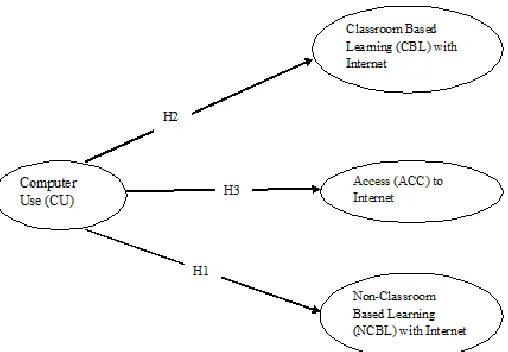
The conceptual framework and the hypotheses for the study is discussed in this section and presented in Figure 1.
Figure 1: Conceptual framework and hypothesised
relationships
2.1 Computer Use (CU) with Internet
The increasingly widespread requirement of students on the knowledge of computer and Internet use is a ―must‖ if their engineering or scientific training is to be complete. Undergraduates who major in engineering and technology related courses, for instance, consider knowledge in the use of computer and Internet as crucial to the development of their technical capabilities. Universities today are in transition, much of the changes we see is driven by economic pressures and demand for graduate who will be able to function in a knowledge society (Peat & Franklin, 2002). To cope with these pressures and demand, the majority of the universities are turning to the use of computer, Internet and intranets to deliver courses in distance mode as well as to enhance on-campus educational programs. Healy (1999) and Weikart (1995) were of the view that computer use promotes cognitive development in both children and adults, specifically in the area of visual intelligence, where certain computer activities, particularly, games may enhance the ability to monitor several visual stimuli at once, to read diagrams, recognize icons and visualize spatial relationships. Use of computers and the Internet has been associated with improvements in student’s learning, labor market prospects, and everyday lives. Since these technologies have the potential to improve access to information, to help get tasks done better or more quickly, to facilitate communication, helps students gain computer literacy, and also indicate how well prepared the current generation of students will be to enter a workforce where computer literacy is in demand (U.S National Research Council, 1999). The Institute of Education Sciences (IES)of U.S. Department of Education statistical analysis report on computer and Internet use by students, revealed that about 91 % of students up to grade 12 used computers, and about 59 % used the Internet in the year 2003 (DeBell & Chapman, 2006).Computers can help students visualize objects that are difficult or impossible to view. For example, computers can be
used to display human anatomy, molecular structures, or complex geometrical objects. Exploration and manipulation of simulated environments can be accomplished with computers from virtual laboratory experiments that may be too difficult, expensive, or dangerous to perform in a school environment to complex virtual worlds like those used in airplane flight simulators (Douglas & Arnold, 2000). Computers also facilitate communication among students, between students and teachers, and beyond the classroom to distant students, instructors and experts. In the view of Fuchs and Woessmann (2004), computers can be used as means for learning other skills, such as math, reading and science, which in turn may give rise to positive labor-market outcomes. In construction industry, computer usage is very important. According to Danso (2012, pp. 41), structural design and analysis Computer-Aided Design (CAD) software programs have become popular in most Construction Industries and Universities offering civil engineering and related programs in the globe. He further stated that the construction industry use Structural CAD programs for not only designing and analysis of buildings and structures but also for application of reinforcement. It is therefore important for students to abreast themselves with the use and application of computers software in their fields of study.
2.2 Access (ACC) to Internet
Access to Internet is important to students in their studies. It enables them to get information as quick as possible all over the globe in order to facilitate their academic activities and research work. IES report on computer and Internet use by students in the year 2003, revealed that about 45 % of students accessed Internet from home, and 43 % accessed the Internet from school in US (DeBell & Chapman, 2006). The Library Research Center (LRC) of the University of Illinois conducted a study with funding from the American Library Association. The results indicated that among libraries who reported access to the Internet in the 1997FSCS census, 96.3% had computer terminals (or work stations) that provided public access to the Internet (Library Research Center, 2000). Nicholas et al. (2003) conducted a study in the UK to examine the use of the web for health information and advice. More than 1,300 people were surveyed. The study showed that 66% of the respondents accessed the Internet from home, 28%from work, and the remainder (6%) used a combination of both work and home. Asemi (2005) did a case study of Medical Sciences University of Isfahan (MUI), Iran. The results of the study showed that all the respondents used the Internet frequently because all faculties had an Internet connection. This indicates the importance of Internet in students’ life in the universities and colleges.
positive attitudes toward the use of computers in teaching and learning. They found that a computer-enriched learning environment was positively correlated with students' attitudes toward computers in general, and the role of computers in facilitating teaching and learning. According to IES report on computer and Internet use by students in the year 2003, about 46 % of students used the Internet to complete school assignments (DeBell & Chapman, 2006). The study by Hong
et al. (2003) in Malaysia found that students with better basic skills in the Internet and perceived the learning environment to be supportive of using the Internet for their learning tasks generally had better attitudes toward using the Internet to improve their studies. Internet-supported learning has the potential to reduce costs. An investment in Internet learning technology is a direct investment in the delivery of learning, as opposed to facilities or non-academic programs. Additionally, increase in learning with Internet has a related decrease in the need for physical facilities, thus enabling serving more students at the same physical facility cost (Hong et al. 2003).
2.4 Non-Classroom-Based Learning (NCBL) with Internet
Computer and Internet can also be used by students for non-classroom based learning activities such as chatting, playing games, e-mailing, shopping, watching movies, among others. According to IES report on computer and Internet use by students in the year 2003, 36 % used the Internet for e-mail or instant messaging and 38 % used it to play games (DeBell & Chapman, 2006). Besides the good aspects of computer and Internet mentioned above, there may also be some negatives with their use. To the extent that time spent using computers displaces time spent on athletics and other physical activity, extensive computer use may contribute to a sedentary lifestyle that puts students at risk for obesity and associated health problems (Attewell et al. 2003). Computers and Internet can also distract students from learning. This may be particularly salient at home, where computers and Internet may be used mainly to play computer games. This can keep students from doing homework and learning at home (Fuchs & Woessmann, 2004). Survey evidence suggests that computers at home indeed tend to be mainly used as toys (Wirth & Klieme, 2003). Similarly, Internet access could offer distraction by chat rooms or online games, reducing the time spent on classroom based learning. The Internet is also a medium that exposes or provides access for some young people to several kinds of inappropriate material such as pornography and inappropriate advertising, online sexual solicitation (Mitchell et al. 2003), and the means to acquire cigarettes (Ribisl et al. 2003) or materials to facilitate cheating on school assignments (Lathrop & Foss, 2000). Based on the computer and Internet use, it is expected that computer use (CU) would influence student internet use for classroom-based learning (CBL), and non-classroom based learning (NCBL), as well as their quest to have readily available access to Internet (ACC), therefore, the following hypotheses are proposed:
H1: CU will have significantly positive influence on NCBL
H2: CU will have significantly positive influence on CBL
H3: CU will have significantly positive influence on ACC
3
RESEARCH
METHODOLOGY
3.1 Research design
The design used for this study was that of survey which relied on questionnaire to generate data for the analysis. The study was to examine the undergraduate construction technology students’ use of computers and Internet facilities in their learning.
3.2 Population and Sampling
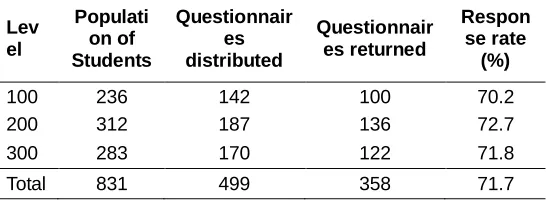
The population consisted of building construction students of UEW in Ghana. A stratified sampling technique was adopted for the study according to their levels (i.e. 100, 200 and 300; these levels represent first, second and third years of being in the university). This was based on explanation by Hunt and Tyrrell (2001) that in statistical surveys, when subpopulations within an overall population vary, it is advantageous to sample each subpopulation (stratum) independently. During the time of the study, the level 400 students had gone for internship which is mandatory for all final year students; therefore, they were not included in the study. 60% of students from each level were selected for the study. This was based on the assertion made by Nwana (1992) which states that if the population is a few hundreds, a 40% or more sample size will do.Out of the 499 questionnaire administered, a usable 358 were returned, representing 71.7% response rate(see Table 1).
Table 1: Population and Sample Size
Lev el
Populati on of Students
Questionnair es distributed
Questionnair es returned
Respon se rate (%)
100 236 142 100 70.2
200 312 187 136 72.7
300 283 170 122 71.8
Total 831 499 358 71.7
3.3 Research Instrument
93 Table 2: Constructs and Indicators
4 ANALYSIS OF RESULTS
4.1 Respondents’ Characteristics
For the characteristics of the respondents, in terms of gender, 94.4% of the respondents were males and 5.6% were females. 3.9% of the respondents were 20 years and below, 47.5% of them were within the ages of 21 and 30 years, 43.6% were between 31 and 40 years, and 5% were above 40. This
implies that majority of them were matured students. In terms of class level, 27.9% of them were at level 100 (first year), 38% were at level 200 (second year) while 34.1% were at level 300 (third year). For the respondents who own computer, 54.7% of respondents owned a computer which 45.3% do not owe a computer. This means a good number of them do not have computer, meaning they rely largely on computers at commercial centres like library and students’ centres. Out of those who owed computer, 68% used laptop, 27% used desktop while 5% used notepad/palmtop. While 87.7% had an e-mail address, 12.3% of the respondents did not.
4.2 Analysis for Proposed Model
Data was analysed using SPSS version 16.0 and Amos version 18.0 to perform Confirmatory Factor Analysis (CFA) and Structural Equation Modelling (SEM) to test the hypothesized relationships among the constructs in the proposed model (see Figure 1). According to Hair et al. (2006) SEM approach involves several methods such as covariance structure analysis, latent variable analysis, confirmatory factor analysis, path analysis and linear structural relations analysis, and can estimate the interdependent, multiple regression equation simultaneously among different constructs. In SEM, first, the reliability and validity of the constructs are assessed, followed by assessment of model fitness and then the path co-efficient of the hypothesized relationships.
4.3 Reliability
Reliability is defined as the extent to which a questionnaire, test, observation or any measurement procedure produces the same results on repeated trials (Miller, 2005). In short, it is the stability or consistency of scores over time or across raters. For a good construct reliability, all the items should be derived from empirical studies with strong theoretical background (Hair
et al. 2006), and should have high factor loadings greater than or equal to 0.5 and high composite reliability (CR) value greater than or equal to 0.7 (DeVellis, 2003). From Table 3, all constructs had strong theoretical background. From Table 3, the Cronbach alphas indicate values greater than 0.70, implying acceptable level of reliability for each construct, except ACC, which was 0.594which was somehow close to 0.70, however, it had a composite reliability of 0.795 and therefore can be accepted. Construct item reliability values are shown by the factor loadings or standardised estimates presented in Table 3. It indicates that all the items have high factor loading above 0.5 implying that the individual items explain well the variances of the construct they represent.
4.4 Construct Validity
Construct validity are assessed through convergent validity and discriminant validity (Hair et al. 2006). Convergent validity refers to how indicators together explain a construct and shows the extent to which each measure correlates with other measures of the same latent construct (Hair et al. 2006). Convergent validity could be assessed through item reliability, composite reliability, and the average variance extracted (Fornell & Larcher, 1981). As already demonstrated for item reliability, in Table 3, the factor loadings of items to their respective constructs are strong providing evidence to support the convergent validity of the items measured (Anderson & Gerbing, 1988). The composite reliability (CR), which is a measure of internal consistency comparable to coefficient Construct
Code Measurement items
No. of item s
Source
Computer Use
CU1 Generally I use computer as part of my studies
6
Modified from Gay, et al. (2006) Gay, et al. (2006) CU2 I use computer for typing my
assignment myself
CU3 I use computer for solving mathematical problems
CU4 I use computer for doing my sketches/drawings
Self-developed Self-developed CU5 I use computer for writing
letters myself
CU6
I use computer for listening and watching recorded lessons
Classroom Base Learning with Internet
Access to Internet
CBL1 I use Internet for receiving assignment from lecturers
2
2 Self-developed Self-developed Gay, et al. (2006) CBL2 I use Internet for submitting
assignment to lecturers
ACC1 I have Internet access on campus
Non-Classroom Base Learning with Internet
ACC2 I have Internet access at my hostel/hall of residence
5
Gay, et al. (2006) Self-developed Self-developed NCBL
1 I use Internet for research
NCBL 2
I use Internet to check end of semester result myself
NCBL 3
I visit or login at the university’s web page
Self-developed NCBL
4
I download movies from the Internet
NCBL 5
alpha (Fornell & Larcker, 1981), are all in excess of 0.70. Thus, CR for each construct is at acceptable level. Finally, we use the Average Variance Extracted (AVE), which measures the amount of variance captured by the construct in relation to the amount of variance attributable to measurement error. Convergent validity is judged to be adequate when AVE equals or exceeds 0.50. It is estimated as the square root of the variance extracted. As shown in Table 3, all the AVE values in the diagonal are greater than 0.5. Therefore, taken together, the evidence from the high composite reliability values, high factor loadings, combined with high AVE estimates provide strong evidence in support of convergent validity.
4.5 Discriminant Validity
Discriminant validity refers to the extent to which the measure of a construct does not correlate with measures of other constructs, and thus measures the extent to which constructs are distinct. At the construct level, discriminant validity is considered adequate when the variance shared between a construct and any other constructs (covariance) in the model is less than the variance which that construct shares with its measures (Fornell et al. 1982). The variance shared by any two constructs is obtained by squaring the correlation between the two constructs. The variance shared between a construct and its measures corresponds to AVE. For discriminant validity to be judged adequate the AVE for a given construct should be greater than the correlations between that construct and all other constructs. As indicated in Table 3, the AVE estimates in the diagonal are greater than the covariance below the diagonal (inter-construct correlations). Therefore, discriminant validity appears satisfactory at the construct level in the case of all constructs. This indicates that each construct shared more variance with its items than it does with other constructs. Since the results show good discriminant validity for the constructs, the constructs in the proposed research model are deemed to be adequate.
Table 3: Assessment of Reliability, Construct and Discriminant validity, and Descriptive statistics Constr
ucts CU CB
L AC
C NC
BL FL α t CR ME AN SD
CU 0.8
73
0.8 77
0.7 87
Item 1 0.698 3.631 1.251
Item 2 0.7
42
3.01 1
1.6 15
Item 3 0.7
49
2.06 7
1.4 18
Item 4 0.8
05
2.27 9
1.4 55
Item 5 0.8
07
3.06 7
1.6 14
Item 6 0.6
46
2.55 3
1.5 38 CBL 0.4
16 0.8 47 0.7 67 0.8 70
Item 1 0.824 1.469 1.027
Item 2 0.7
55
1.54 1
1.1 26 ACC 0.3
42 0.2 95 0.8 48 0.5 94 0.7 95
Item 1 0.5
93
3.01 6
1.4 37
Item 2 0.7
13
3.95 5
1.4 31 NCBL 0.6
53 0.3 76 0.5 28 0.9 27 0.8 28 0.7 24
Item 1 0.6
91
3.70 3
1.3 41
Item 2 0.7
07
2.70 9
1.7 24
Item 3 0.8
09
3.26 8
1.4 38
Item 4 0.7
05
3.31 2
1.4 40
Item 5 0.5
95
3.22 9
1.4 99 Note: The covariance are below the diagonal, AVE estimates are in diagonal; SD –Standard deviation; FL –Factor Loading; CR – Composite reliability; α – Cronbach alpha
CU = Computer Use; CBL = Classroom Base Learning – with Internet; ACC = Access – to Internet; NCBL = Non-Classroom Base Learning – with Internet
4.6 Model goodness-of-fit
95 2006). However, the ratio of the chi-square to its degree of
freedom is good (4.41). Some fit-indices are closer to their corresponding recommended values (GFI = 0.897, AGFI = 0.853, NFI = 0.852, CFI = 0.881, TLI = 0.856), and the rest are above their corresponding benchmarks (RMSR = 0.012, PGFI = 0.640, PCFI = 0.730, PNFI = 0.706). Therefore, there is good fit for the model. Thus, we proceed to examine the regression co-efficient for the estimated structural model.
Table 4: Goodness-of-fit Indices for Proposed Model
Goodness-of-fit Indices Benchmark Value
Absolute goodness of fit measure
Chi-square (CMIN) P≥
0.5(N<250) 0.000
Chi-square /degree of freedom ≤ 3 383/87= 4.41
Goodness-of-fit Index (GFI) ≥ 0.90 0.897
Adjusted Goodness-of-fit Index (AGFI) ≥ 0.80 0.853
Absolute badness of fit measure
Root Mean Square Residual (RMSR) ≤ 0.1 0.012
Incremental fit measure
Normed Fit Index (NFI) ≥ 0.90 0.852
Comparative Fit Index (CFI) ≥ 0.90 0.881
Turker Lewis Index (TLI) ≥ 0.90 0.856
Parsimony fit measure
Parsimony Goodness-of-Fit index (PGFI) ≥ 0.50 0.640
Parsimony Comparative of Fit index
(PCFI) ≥ 0.50 0.730
Parsimony Normed of Fit index (PNFI) ≥ 0.50 0.706
Note: Table 4 shows the goodness-of-fit indices for the proposed model against the benchmark
4.7 Assessing hypothesized relationships
Table 5 and Figure 1 provide a summary of the results of hypotheses testing for analysing the path co-efficient. For analysis of CU, the results in Table 5 and Figure 1 depict the standardised regression estimates for the computer use variables. The results show that all the hypotheses were supported by the data. Specifically, it indicates that computer use significantly influences NCBL by 86.1% (β = 0.861, p < 0.001), supporting hypothesis H1. Computer use significantly influences CBL by 55.5% (β = 0.555, p < 0.001), supporting H2. Computer use significantly affects ACC positively by 52.8% (β = 0.528, p < 0.001), supporting hypothesis H3. The results also indicate that, generally, the proposed model helps predict construction technology students’ use of computer by 86.5% in the research context.
Table 5: Results for Hypothesis Testing Hypo
thesi s
Path
Std.β
S.E. C.R. p-value
Results
1
NCBL <---
C U
0.86 1
0.0 81
10.6
09 ***
Support ed
2
CBL <---
C U
0.55 5
0.0 66
8.36
4 ***
Support ed
3
ACC <---
C U
0.52 8
0.0 92
5.76
1 ***
Support ed
Notes: ***Significant at 0.001, Std.β = Standardised regression co-efficient; S.E. = Standard error, P-value = significance: co-efficients are Maximum Likelihood Estimates, C.R. = Critical Ratio
CU = Computer Use; CBL = Classroom Base Learning – with Internet; ACC = Access – to Internet; NCBL = Non-Classroom Base Learning – with Internet
5 DISCUSSION AND IMPLICATIONS TO THEORY
AND PRACTICE
The principal objective of the research is to examine the use of computer and Internet facilities among the undergraduate construction technology students in University of Education, Winneba, Ghana. The findings of this study make several contributions to the theory and practice relating to computer and internet use in higher education.
5.1 Theoretical Implications
findings that CU could be significantly influenced by Internet access. This could be justified by the finding that Internet access both on campus and hostel/residence of students is important to students’ learning through computer use. These findings suggest that there is a strong relationship between students’ computer use and their willingness to access the Internet. This finding contributes to the academic debate in the computer application literature. The finding is consistent with US National Research Council Report (1999) that Internet access have the potential to improve access to information, to help get tasks done better or more quickly, to facilitate communication, help students gain computer literacy, and also indicate how well prepared the current generation of students will be to enter a workforce where computer literacy is in demand. Another study from DeBell and Chapman (2006) revealed that about 45% of students in the US as at 2003 accessed Internet from home, and 43 % access Internet from school. Internet access besides helping students in their research also helps them to register their courses and access their end of semester results with their computers at their own comfort. Again, the finding that CU has significant positive influence on CBL is another unique contribution of the study. Thus, the more students engage in the use of computers personally, the more they adopt it in different aspects of their class-room-based learning activities. Generally, this finding is consistent with previous study by DeBell and Chapman (2006) which revealed thatabout 46 % of students in US as at 2003 used the Internet to complete school assignments. Again, the finding is supported by Gay, et al. (2006) who found that students from University of West Indies of Barbados used Internet for school-related activities such as research and school assignment. In addition, the finding that CU has significant effect on NCBL is another contribution to the study. Thus, students’ computer use could also affect significantly their use of the computer for NCBL activities. According to DeBell and Chapman (2006) study, 36 % of students in US as at 2003 used the Internet for e-mail or instant messaging and 38 % used it to play games. Again, Gay, et al. (2006) also found in their study that students use Internet for emails and chatting. These are non-classroom based activities with the use of Internet which must be controlled in order not to take students’ greater part of their learning time.
5.2 Managerial implications
This paper offers several implications and recommendations to management of higher learning institutions in particular and the educational institutions in general. First, it found that NCBL has the strongest influence on students’ computer use. Previous studies (Mitchell et al. 2003; Ribisl et al. 2003; Lathrop & Foss, 2000) found that Internet is a medium that exposes or provides access for some young people to several kinds of inappropriate material such as pornography and inappropriate advertising, online sexual solicitation, and the means to acquire cigarettes or materials to facilitate cheating on school assignments. This implies that the more students use computer and Internet for non-classroom base learning, the more they are likely to use greater part of their time on indirect classroom activities and expose them to inappropriate materials. It is recommended that management should put in effective strategies to manage NCBL Internet activities among students. Managing NCBL Internet activities includes both inducing it and reducing the effects on students’ time. Thus, generally, university managers should also attempt to
implement effective NCBL Internet strategies to promote students’ use of their time for learning classroom base activities. The study also found that computer use with Internet has significant influence on students’ CBL. Thus, classroom base learning with the aid of Internet has positive effect on students’ learning. Management of educational institutes should therefore focus more attention on encouraging students to use computer and Internet in activities related to their studies more than for non-classroom base activities. Management of universities should also ensure availability of computers and Internet facilities to their students for classroom base learning activities to promote effective learning. Finally, the study found that CU significantly influences students’ willingness to access to internet for various academic and non-academic work. Internet access was also found to be influenced by two important factors: access on campus and access at hostel/residence of students. Internet access helps students gain computer literacy, and also indicate how well prepared the current generation of students will be to enter a workforce where computer literacy is in demand (U.S National Research Council Report, 1999). This implies that managers of educational institutions should train their students to conform with current trends in the field of work for which access to Internet and application of computer is a necessity, in order for the students to fit into the workforce after graduation.
6 LIMITATIONS AND DIRECTIONS FOR FUTURE
RESEARCH
The findings of the paper should be interpreted within its limitations. First, it is limited in terms of its external validity. Thus, while the findings are consistent with much of the empirical literature, these findings could typically be generalised to the specific context of Ghana’s higher education sector. Similar studies should be done in other educational level contexts in different countries to compare the results before global generalisations could be made. The critical aspect of computer and Internet use identified in this present study are not exhaustive in the educational contexts. Therefore, future research should explore other critical factors that could affect students’ learning in developing country contexts such as Internet quality in educational institutions, students’ satisfaction with Internet in schools and effects of computer and Internet on students’ performance, among others.
7 CONCLUSION
97 computer and Internet use. The limitations of the present study
are noted, the implications to theory and management have been discussed, and recommendations for future research have been suggested.
R
EFERENCES[1] Al-Barakat, A.A. & Bataineh, R.F. (2008). Jordanian student teachers' use of computers to develop primary stagepupils' literacy skills. International Journal of Education and Development using Information and Communication Technology, 4(4), 64-87.
[2] Al-Ajlouni, K. (2003). The Effect of Using Computer in Teaching an Academic Course forStudents in the Faculty of Educational Sciences at the University of Jordan on theirAchievment. Dirasat, Educational Sciences, 30(1), 60-73.
[3] Asemi, A. (2005). Information Searching Habits of Internet Users: A Case Studyon the Medical Sciences University of Isfahan (MUI), Iran. Webology,2(1) : 1-9.
[4] Attewell, P., Suazo-Garcia, B. & Battle, J. (2003). Computers and Young Children: Social Benefit or Social Problem? Social Forces, 82, 277-297.
[5] Danso, H. (2012). Assessment of the awareness of structural computer aided design programs of universities in Ghana. European Journal of Social Sciences, 30 (1), 41 – 47.
[6] DeBell, M. & Chapman, C. (2006). Computer and Internet Use by Students in 2003 (NCES 2006–065). U.S.
Department of Education. Washington, DC: National Center for Education Statistics.
[7] DeVellis, R.F. (2003). Scale development: theory and applications (2nd ed.), Newbury Park, CA: Sage.
[8] Douglas, N. & Arnold, A.B. (2000). Computer-Aided Instruction. Microsoft Corporation, EncartaOnline Encyclopedia. Available at:http://encarta.msn.com
[9] Fornell, C., Tellis, G.J. & Zinkhan, G.M. (1982). Validity assessment: A structural equations approach using partial least squares. Proceedings American Marketing Associatio n Educators’ Conference.
[10]Fornell, C. & Larcker, D.F. (1981). Evaluating Structural Equation Models with Unobservable Variables and Measurement Error. Journal of Marketing Research,
48(1), 39-50.
[11]Fuchs, T. & Woessmann, L. (2004).Computers and Student Learning: Bivariate and Multivariate Evidence on the Availability and Use of Computers at Home and At School. Cesifo Working Paper No. 1321Category 4: Labour Markets.
[12]Gay, G., Mahon, S., Devonish, D., Alleyne, P. & Alleyne, P.G. (2006). Perceptions of Information and Communication Technology among Undergraduate Management Students in Barbados. International Journal
of Education and Development using information and Communication Technology, 2(4): 6-17
[13]Hair, J.F.Jr., Black, W.C., Babin, B.J., Anderson, R.E. & Tatham, R.L. (2006). Multivariate data analysis (6th ed.). Upper Saddle, NJ: Pearson Prentice Hall.
[14]Healy, J.M. (1999). Failure to Connect: How Computers Affect Our Children’s Minds and What We Can Do About It. New York: Simon & Schuster/Touchstone.
[15]Hong, K.S., Ridzuan, A.A. & Kuek, M.K. (2003). Students' attitudes toward the use of the Internet for learning: A study at a university in Malaysia. Educational Technology & Society, 6(2), 45-49.
[16]Hunt, N. & Tyrrell, S. (2001). Stratified Sampling. Webpage at Coventry University (Accessed 12 July 2012).
[17]Lathrop, A. & Foss, K.E. (2000). Student Cheating and Plagiarism in the Internet Era: A Wake-up Call. Englewood, CO: Libraries Unlimited.
[18]Library Research Center (2000). Survey of Internet Access Management in Public Libraries.
[19]Graduate School of Library and Information Science, University Of Illinois.
[20]Miller, M.J. (2005). Reliability and Validity: Graduate Research Methods. Western International University.
[21]Mitchell, K.J., Finkelhor, D. & Wolak, J. (2003). The Exposure of Youth to Unwanted Sexual.
[22]Material on the Internet: A National Survey of Risk, Impact, and Prevention. Youth & Society, 34, 330-58.
[23]Mitra, A. & Steffensmeier, T. (2000).Changes in Student Attitudes and Student Computer Use in a Computer-Enriched Environment. Journal of Research on Technology in Education, 32(3), 417-433.
[24]National Research Council (1999). Committee on Information Technology Literacy and Computer Science and Telecommunications Board, Commission on Physical Sciences, Mathematics and Applications. Being Fluent with Information Technology. Washington, DC: National Academy Press.
[25]Nicholas, D. (2003). The British and Their Use of the Web for Health Information and Advice: A Survey. Aslib Proceeding 5(6): 258-260.
[26]Nwana, O.C. (1992). Introduction to educational research.
Ibadan: Heinemann Educational Books (PLC).
[27]Peat, M. & Franklin, S. (2002). Supporting Student Learning: the Use of Computer-Based Formative Assessment Modules. British Journal of Educational Technology, 33(5): 515-523.
Sales of Cigarettes to Minors. Journal of the American Medical Association, 290, 1356-1359.
[29]Sonia, J. (1999). Computers in the Classroom: How Effective? TechKnowLogia, 1999: 31-34.
[30]Wade, M.V. (2006). Likert-type scale response anchors. Clemson International Institute for Tourism & Research Development, Department of Parks, Recreation and Tourism Management. Clemson University.