O
Url: http://usnsj.com/index.php/JEE Email: [email protected]
Developing the Students’ Ability in Reading through Speed Reading
Technique
A. Introduction
Reading is one of the basic communication skills, but it has a very complex process. It can be said that reading is a process in which reader finds information given by the writer in the written form. Reading is an important skill of English. It is a source to get information La Ode Muh. Idrus Hamid B.
Universitas Sembilanbelas November Kolaka [email protected]
+6285298685236
Muh. Yunus
Universitas Sembilanbelas November Kolaka
ISSN: 2502-6909 Vol. 1, No. 1, March 2016
URL: http://usnsj.com/index.php/JEE/article/view/JEE007
© 2016 JEE All rights reserved
Abstract
This study was designed to improve the Students’ Ability in Reading through Speed Reading at the first year of SMKN 1 Watunohu. The writer formulated a study question “How can speed reading developing the students’ ability in reading at the second year of first year of SMKN 1 Watunohu?” In addition, the objective of the study was generally aimed to improve the students’ reading ability through speed reading at the first year of SMKN 1 Watunohu.
The design of this study was collaborative Classroom Action Research (CAR). It means that when doing the study, the writer collaborated with the English teacher of first year of SMKN 1 Watunohu. The subject of this study was the first year of SMKN 1 Watunohu in academic year of 2014/2015. This study was conducted in two cycles.
The development of students’ ability in reading at the first year of SMKN
1 Watunohu supported by some evidences. First, it could be seen from the improvement of the average students’ value which showed from preliminary study the students only reached average 43.56 or only 32% or 6 from 26 students got the score greater than or equal to 72. Second, the average of the students’ value was
58.74 in the first cycle where only 44% or 8 from 26 students got the score greater than or equal to 72.
Meanwhile in the second cycle, the average value of the students’ reading ability through speed reading became 87.42, there were 88.00% or 24 from 26 students got the greater than or equal to 72. Third, the students were actively involved in the teaching and learning process. It can be seen from the result of analysis of observation sheet. So it can be concluded that speed reading can improve the students’ reading ability at the first year of SMKN 1 Watunohu.
Keywords: reading ability, speed reading, action research
AUTHORS INFO ARTICLE INFO
and the researcher can increase students’ vocabulary. No one can get much information without reading. Reading is the easiest and the cheapest way to get information.
Students can read not because of incidentally or pushed by inspiration, but because at teach. Reading not natural activity, but component set that dominated personally and gradual, then integration and be automatic. In this case, Wouldiam S. Gray in Oka, (2005:34) emphasized that reading not other than reader activity which apply amount of skill cultivates story is written (reading) at read it in order to realize reading.
In English, there are four skills that should be mastered, they are: listening, speaking, reading, and writing. The reading skill became very important in the education field, students need to be exercised and trained in order to have a good reading skill.
In process of study usually a student feels enjoyment read but merely as code solution event, but more as erudition acceptance and happiness. Person like would come up calm and ripe because has various addition experience, as can enjoy but merely from fiction but also nonfiction at read it. Reviewed from child aspect, possibility their finds joy but very base on upbringing and directive parents and teacher. Lesson aim reading for students is create the students love to read. Usually this matter can be stimulated with use story. Students make us their reading ability with enjoy, according to need, what merely comfort or erudition adder.
Speed reading is a collection of methods for increasing reading speed without an unacceptable reduction in comprehension (Wikipedia). Using fast reading supposed students can efficient in use time in learn. By speed reading students can read information more quickly. The students may also get a better understanding of it, as we would hold more of it in short term memory. Speed reading also is how can the students read with better comprehension during quicker and remember it well also at the same time Nurhadi (1987: 31-32) declare to read fast and effective is kind reads that give top priority speed, without leaving comprehension towards the reading aspect.
One of four skill in English that very important is reading skill because generally in senior high school for example, reading is the main skill it’s mean that in the end of the students’ study they would get reading test in national examination or mostly the contain of the test is reading.
The writer chose SMKN 1 Watunohu based on the preliminary study that was done. The writer found some problems by interview the English teacher and the students, namely; first, the students were bored to read a text because it was not interesting. Second, the students have limited vocabulary so they are difficult to understand the reading text. Thirdly, the students did not know the structure of sentence, it made the students to work hard to translate the word in sentence of the text.
From the problems above the writer would apply one of teaching strategy. This was an interesting strategy and it can increase the students' reading comprehension, namely speed reading. This strategy was advantages to create the students’ atmosphere more active in learning English in the classroom.
Based on the background before, the writer was interested in carrying out the study entitle: Developing the Students’ Ability in Reading through Speed Reading Technique at the First Year Students of SMKN 1 Watunohu.
B. Literature Review
1. Definition of Reading
Reading is very closely applied to other language processes such as listening, speaking, and writing. It’s better understood when it is regarded as language processes (Taylor et al. 1983:3). Reading must be recognized that is a language process. It is closely linked to other language processes, particularly to cognitive process. It is centered in the brain and it involves all the process that brain uses in the normal course of mental activity like: we pay attention, we perceive, we remember, we forget, etc (Taylor et al, (1983).
Reading is an interactive process between what a reader already knows about given topic or subject and what write. Reading must be recognized that a complex skill, that is to say involves a whole series of skills. First of these is ability to recognize stylized shaped which are figure on a ground, curves, lines, and dots in patterned relationship. The second of the skill involved the complex be that is the ability to correlate the black marks on the paper by way of the formal elements of language. Let us say word as sound, with the meaning which those words symbolize (Broughton et al. in Sudirman, 1999:8).
this process the reader tries to create the meaning intended by the writer.
Based on the definition above the writer conclusion that reading is one of the activity to look for information in the text reading, with reading will open think firmament in face of a problem. In reading suppose the reader realizes what they reads, so that aim at specify can reach.
2. Levels of Reading
In language teaching, reading is one of the language skills of reading, each person may have different capability. The skill of someone is determined by his creativity himself and capability when he is reading. In relation with this, reading material also effect a reader to develop his reading skill. Based on this, psycholinguistic particularly those who are expert in reading make classification of reading levels.
Simanjutak (1988:26) says that expert set up reading curriculum into four levels, mainly: a. Initial Level
The instructional goals in initial level are the students will be able: 1) To read silently a passage of at least two paragraphs in length
2) To demonstrate comprehension by responding to oral or written question within their vocabulary and grammar.
b. Elementary Level
1) To read short English selection of passages b. To demonstrate and understand the content c. To identify sequence of event.
2) To recognize cause and effect and perceive organization. The study of this level is the ability
1) To read follow instruction of direction b. To use or consult reference of direction. 2) To comprehend information on graphs, charts, maps, and well.
c. Intermediate Level
1) Develop greater ability to comprehend more complex content areas of the instructional materials.
2) Apply reading ability to develop of study skill c. Develop critical reading ability 3) Continue refine reading skill acquired at the earlier levels e. Refine word attack skills 4) Scan for including sentences, main idea, and specific information
The studies of this level are as follows:
1) Reading and following instruction and directions.
2) Skimming to locate information found in reference materials d. Advanced Level
The instruction goals of this level are the students will:
1) Continue to refine the reading skills acquired at earlier levels and will also refine text attack skills.
2) Develop critical reading ability.
3) Apply reading ability to development of study skills. 4) Read selection of increased difficult for study purposes.
5) Develop greater ability in comprehending more complex are instructional materials. 6) Scan for including sentences, main ideas specific information.
There are two study skills in this level, namely:
1) Using content area of the text book and reference materials used by native English speaking peers.
2) Scanning to locate specific details of informing and adjust to rate of speed the level of difficult of a selection.
3. The Strategy of Reading a. Skimming
Skimming is to read text superficially a rapidly in order obtain the gist or main idea it is a skill that requires concentration. There are three basic aims in skimming, namely: 1) To get impression from a book of articles or short stories.
2) To find specific cases from a reading material. 3) To look for material that we need in library
chapter headings, subheadings, etc. This is sometimes called previewing, when the reader glances quickly through a newspaper to see what the main items of the day are. This will often mean just glancing at headlines when the reader goes through a particular passage such as newspaper and article merely to get gist.
b. Scanning
Scanning is to read a text quickly in order to locate a specific item of information. We simply have or eyes through the text until we find what we are looking for, whether it is a name, a date, or less of specific information. In addition, there are some procedures for scanning, they are:
1) Keep in mind only the specific information to be a located.
2) Read the section containing the clues to get the information needed
Here the reader is on the lookout for a particular item or items. He believes is the next. For example the name of the scorer in a football report. It is fairly fast reading with instant rejection of all irrelevant data, perhaps most of the text.
4. Kinds of Reading
There are kinds of reading, they were: a. Reading aloud
Reading aloud is very important device that cannot be over looked in achieving the goal because it is a great aid in developing our habits to practice. In reading aloud the students will get experience in producing sound that should be practice as many times as possible.
b. Silent reading
Silent reading tends to reinforce the readers to find out the meaning of the words. This kind of reading leads the readers to have better comprehension. Silent reading is a skill to criticize what is written. To discuss something written means to draw inferences and conclusion as well as to express a new idea on the basic of what is read.
c. Speed reading
This kind of reading is used to improve speed and comprehension in reading. This skill of speed reading must run side by side with the main purpose of reading that is comprehension. The rate of speed reading, however, depends on the kinds of material. The rate of speed reading a story or narration will be different from the reading scientific material.
5. Concept of Speed Reading
Speed reading is technique of improving a reader’s reading ability, improving both the speed at which text can be assimilated, and the level of understanding of the material. Speed reading is the ability to read as many 10,000 to 25,000 words a minute (Berg 2002).
It is safe to say that almost anyone can double his speed of reading maintaining equal or even higher comprehension. In other words anyone can improve the speed with which he gets what he wants from his reading.
The average college of students reads between 250 and 350 words per minute on fiction and non-technical materials. A good reading speed is around 500 to 700 words per minute, but some people can read a thousand words per minute or even faster on these materials. (Berg, 2002).
In order to reach the maximum speed reading, the readers need to understand the physical factors involved in the reading processes and how these affects the speed which the reader read. There three physical factors that are influence. They are as follows:
a. Eye Movements
The visual symbol a reader sees on the printed page are the means by which his mind interprets what she reads, in other words, reading is a visual as well as mental process. This section is intended to explain the visual role in the total reading process.
1) Fixation
2) Recognition Span
The number of words a reader recognizes and perceives during one fixation is called his or her recognition span. Many studies have been made to determine the number of words the ayes is capable or seeing time. The result of this study indicates that the ayes can actually see not more than two or words for fixation. (Zoon, 1980:5) 3) Regression
In the reading process, a reader regresses when he or she goes back and rereads what he or she just reads. Some regression era normal, even necessary, in order to gain complete understanding of what the readers read. However, habitual regression not only decreases the reader’s speed but lower his or her level comprehension as well.
b. Lip Movement
As mentioned earlier, reading is a complex process, reading is both a visual and mental process. The mind is capable or perceiving the massage directly from the eyes contact with printed page. Therefore, lip movements are seldom necessary and in fact, will interfere with reader’s speed of reading. There are two kinds of lip movements which are not accepted. They were as follows:
1) Vocalization
If a reader moves his or her lips or whispers each word as he or she reads, he or she is vocalizing. This indicates that he or she did fixating on each word and pronouncing the words as he or she is reading orally. This practice will limit his or her reading rate. (Simanjutak, 1988:46).
2) Sub Vocalization
Although a reader might not actually whisper or moves his or her lips while reading, he o she might say the words to him or herself. In other words, he or she vocalizes. Since thinking is essential to the reading process.
3) Phrasing
In other to comprehend what a reader reads, he or she must read for ideas. An idea is seldom contained in a single word, but rather in a group of words. When the reader speaks, he or she does not distinctly say each individual word instead, he or she speaks in phrases.
Learning to read rapidly and well presupposes that you have the necessary vocabulary and comprehension skill. When the students have advanced on the reading comprehension materials to a level at which that the students can understand college level materials, they will be ready to speed reading practice in earnest. Understanding the role of speed in the reading process is essential. There is some reason to believe that the factors producing slow reading are also involved in lowered comprehension, most adults are able to increase their rate of reading considerably and rather quickly without lowering comprehension. These same individual seldom show an increase in comprehension is actually better at higher rates of speed. Such results, of course, are heavily dependent upon the method used to gain the increased rate. Simply reading more rapidly without actual improvement in basic reading habits usually result in lowered comprehension.
Some of the facts which reduce reading rate as follows: a. Limited perceptual span: word-by-word reading.
b. Slow perceptual reaction time: slowness of recognition and response to the material.
c. Vocalization, including the need to vocalize in order to achieve comprehension. d. Faulty eye movements, including inaccuracy in placement of the page, in return
sweep, in rhythm and regularity of movement.
e. Regression, both habitual and as associated with habits of concentration.
f. Faulty habits of attention and concentration, beginning with simple inattention during the reading act and faulty processes of retention.
g. Lack of practice in reading, due simple to the fact that the person has read very little and has limited reading interest so that very little reading is practiced in the daily or weekly schedule.
h. Fear of losing comprehension, causing the person to suppers more time on the individual words.
always read slowly.
j. Poor evaluation of which aspects are important and which are unimportant. k. The effort to remember everything rather than to remember selectively.
There are two very encouraging things about increasing reading speed in: (1) it is easiest reading skills to improve, and (2) no matter how fast people read, they can learn to read still faster. As an excellent reader people can still achieve higher speed in reading. When people want to increase their reading speed they can do, so if they understand rapid reading, having careful guidance in applying these principles and are willing to practice.
When we try to read fast, it is important for us also to know: first is how to pronounce every word in the text. Second, people or the students which can read fast, can cover the text and understand the meaning of the lines in print faster and widely, than the people who can only read slowly, they can only see and understand short angle of the line in the text. Poor readers usually view glance a small, meaningless units of few letters words. For some people they will think that they can really read faster if they could learn to grasp more large meaningful units’ throughout each eye pause. Some people also think that they comprehension may improve if a reader learned to read in understanding thought units rather than separate words or in small units or translating them into first language words per words which finally the words itself do not have much a meaning in themselves. Third, to increase our reading speed is to learn to grasp longer units or thought. Fourth, thing to do for faster reading skills is to quicken the reading pace. Just as one can walk faster when he wants to, he can also read faster if he wants to.
Basic condition for increased reading is rate. A well planned program prepare for maximum rate by establishing the necessary condition. Four basic conditions include:
a. Have the eyes checked.
Before embarking on a speed reading program, make sure that any correctible eye defect may have are taken care by checking with the eye doctor. Often, very slow reading is related to uncorrected eye defect.
b. Eliminated the habit of pronunciation words as read.
If the sound out words in the throat or whisper them, you can read slightly only as fast as you can read aloud. You should be able to read most material at least two or three times faster silently than orally. If you are aware or sounding or hearing words as you read, try to concentrate on key words and meaningful ideas as you force yourself to read faster.
c. Avoid regressing (rereading)
The average student reading at 250 words per minute regresses or rereads about 20 times per page. Rereading words and phrases is a habit which will slow your reading speed down to a snail’s pace. Usually, it is unnecessary to reread words, for the ideas you want are explained and elaborated more fully in later contexts. Furthermore, the slowest reader usually regresses most frequently. Because he reads slowly, his mind has time to wander and his reading reflects both his inability to concentrate and his mind has time to wander and his rereading reflects both his inability to concentrate and his lack of confidence in his comprehension skills.
d. Develop a wider eye span
This will help you read more than one word at a glance. Since written material is less meaningful if read word by word, this will help you learn to read by phrase or thought units.
Speed reading helps the students to read and understand text more quickly. It is an essential skill in any environment where are the students had to master large volumes of information quickly as the norm in fast-moving professional environment.
The most important trick about speed reading is to know what information you want from a document before you start reading it. If you only want an outline of the issue that document discusses, then you can skim the document very quickly and extract only the essential fact. If you need to understand the real detail of the document, then you need to read it slowly enough to fully understand it. You will get greatest time saving from speed reading by learning to skim excessively detailed documents.
and then moving your eyes to the next block of word, and so on. You are reading blocks of word at a time, not individual words one by one. You may also notice that you do not always go from one block to the next, sometimes you may move back to a previous block if you are unsure about something.
A skilled reader will read many words in each block. They will only dwell on each block for instant, and will then move on. Only rarely will the reader’s eyes skip back to a previous block of words. This reduces the amount of work that the reader’s eyes have to do. It also increases the volume of information that can be examined in a period of time.
A poor reader will become bogged down, spending a lot of time reading small block of words. They will skip back often, losing the flow and structure of the text and overall understanding of the subject. This irregular eye movement will make reading tiring. Poor readers tend to dislike reading, and may find it hearer to concentrate and understand written information.
C. Methodology
1. Research Design
The design of this study was conducted Collaborative Classroom Action Research (CAR). It means that in doing the study the writer collaborated with one of the real teacher of SMKN 1 Watunohu. They would work together in planning and action, implementation the action, observing the action and analyzing and reflecting the action. In this case the writer as a teacher and the real teacher as a observer. The real teacher would observer all activities were done by the teacher and the students as long as the implementation of the reading speed in teaching and learning process. In observing the action, study used the observation sheets that were arranged.
In conducting the study would be done the action in the form of cycles referring to the model of Kemmis, and Mc. Taggart R (1998), which consists of four steps. They were planning an action, implementing and action, observing the action, and reflecting the action. It means that if the first cycle fails, the design would be continue to the first cycle. The study stopped if the criteria of success achieved.
2. Participants (Population and Sample)
This study conducted at the first year of SMKN 1 Watunohu who registered in academic year of 2014/2015.
The subject of the study was the first year students. Class X/a with 26 students. The writer chose this class because this class was ever thought when the writer conducted PPL in this school and he knew that this class was broken down in reading.
3. Instruments
The study used observation sheet and reading test to collect the data as the instrument of the study.
a. Observation sheet
The observation sheet used to observe the teacher and the students’ activities during the teaching and learning process in each cycle. It aims to evaluate the effect of the action that has been carried out.
b. Reading test
Reading test was used to know the improvement before and after use speed reading.
4. Step of the Study
In conducting this study, the writer will applied some steps such as a preliminary study, planning, implementing, observing, analyzing, and reflecting.
a. A preliminary study
activities which did by the writer as a teacher. Before conducting the study there were meeting between the writer and collaborative teacher to discuss some important points, such as preparing suitable strategy, preparing instrument, design lesson plan, and preparing criteria of success. Writer designs lesson plan, it was important to make the implementation of speed reading technique.
b. Implementing
The implementation of speed reading technique concept was conducted at the first year students of SMKN 1 Watunohu. The implementation was actually the manifestation of what was design in the lesson plan. It was conducted for 2 x 45 minutes in a meeting. There were two meetings in a week.
c. Observing
The writer collected the data. There were two kinds of data were used in this study: qualitative and quantitative. Qualitative data was taken from the result of the observation sheet during the teaching and learning process. Meanwhile, the quantitative data was taken from the result of the reading test given at the end of each cycle.
5. Data Analysis and Reflecting
This part was divided in two points, data analysis and reflecting. The writer and observer analysis and reflecting the result of the implementation of the action by speed reading in teaching and learning process, whether the study stops or continue to the next cycle.
a. Data Analysis
During the observation process in each cycle the writer was collected the data. After the data was collected, the researcher analyzed the result of the data taken from the observation and reading test. Analysis data would be conducted in each cycle.
b. Reflecting
After analysis the data, the writer and observer did reflection towards the implementation of the strategy in teaching and learning process. Reflection was very important to do evaluate the effect of the action that would be carried out, it was intended to see whether the effect of the action success or not. In other words, reflection is intended to see to successfulness or the failure of what was done in the previous action or during the action. The writer and observer predetermined criteria.
D.Findings and Discussion
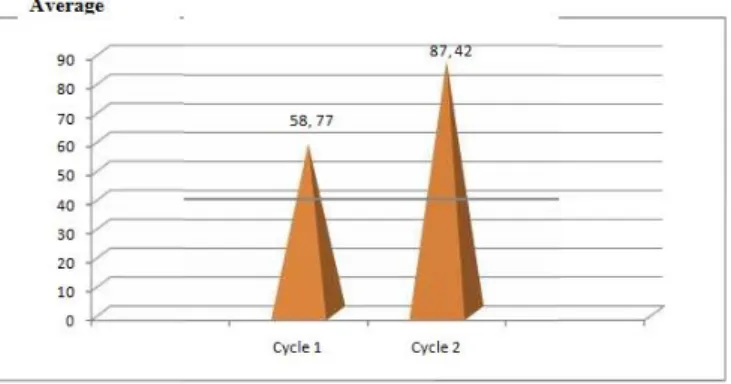
The result of the research also showed that reading could increase the students’ ability in reading at the first year of SMKN 1 Watunohu. It could be seen from the average score of the improvement of students’ ability in reading by using speed reading after action was 58, 77 in the first cycle in which 30.84 % or 8 of the students’ got the score greater than or equal to 72. in the second cycle, the average score of the students’ ability in reading by using speed reading was 87.42 and 88% there were or 24 of 26students’ could reach the criteria of success. The increased of the students’ reading ability can be seen in figure 4.1
Figure 4.1 The Increasing of the Students’ Reading Ability
E. Conclusion
SMKN 1 Watunohu. The increasing could be seen from two aspects. Firstly, the average scores that the student’ got was 58.77 in first cycle, it increased to be 87.42 in the second cycle. Secondly, the students were actively involved in the teaching and learning process. It could be seen from the result of analysis observation sheet that in first cycle was 3. It belongs to fair. The increasing was caused by some factors. First, they always involved in reading activity by team work. Second, they always shared with their friends in team and third, they always did regular practice in reading.
Based on the conclusion of this research, the writer suggested that students’ speed reading technique could increase in reading ability and can facilitated students in reading. It is suggested to the English learner. And English teacher should be able to implementation of speed reading technique in English lesson.
F. References
Berg. (2002). Suggestion for Improving Speed Reading. http//www.idi.no/english/guidelines/ guidelines55.asp.
Harris, Albert & Sipay, Edward R. (1980). How to Increase Reading Ability. Sevent Edition (Revised and Enlarged). New York: Longman Inc.
Nurhadi, (1987). Membaca Cepat dan Efektif. Bandung: SinarBaru.
Kemmis, s & Mc Taggart R. (1998). The Action Research Planner. Deakin University Pres Victoria.
Oka. ( 2005). Research for Reading. Sevent Edition (Revised and Enlarged). New York: Longman Inc.
Simanjutak, Edithia Gloria. 1988. Developing Reading Skills for EFL Students. Jakarta: Departement Pendidikan dan kebudayaan, Direktorat Jendral Pendidikan Tinggi. Sudirman. (1999). The Correlation Between Reading Habit and Writing Skills. Unpublished
Thesis Unismuh Makassar.
Taylor, Barbara. (1983). Study Skill. Third Edition New York: Scottforesman. www.wikipedia.com