1607
Implementation Of The Drill Method In Learning
Art And Culture In High Schools
Andi Padalia, Heriyati Yatim
Abstract: The purpose of this study was to determine the increased interest and mastery of learning through the application of the drill method in arts and culture subjects in high school. The type of research used quantitative, and researchers describe the results of research with numbers/values. Research subjects were high school students with 36 students, 11 male students and 25 female students. Data collection techniques used are observation, documentation and questionnaire. The classroom action research instrument used was an attitude observation instrument and performance test techniques. From the results of the study, it obtained empirically that an increase before the implementation of the action was only 40% interested and after the implementation of the action increased to 90%. The results of applying the drill method can improve the learning achievement of high school students in Pangkep Regency in learning dance. This was proven empirically in the first cycle, there were 60% of students who reached the minimum completeness criteria of the applied research, and in the second cycle increased by 90%. Various learning methods have often used methods of discussion, demonstration. Based on the application of the drill method in Cycle I and Cycle II can increase the interest of high school students in learning dance. The application of such learning methods may not be able to achieve the expected goals, and this is due to the condition of high school students who find it difficult to understand the learning material.
Index Terms: Dance Learning, Instruction, Learning Methodology, Students, Teacher.
—————————— ——————————
1.
INTRODUCTION
The view of the concept of learning continues to experience changes and developments following the development of science and technology [1]. Learning is synonymous with teaching activities [2]. Teaching activities carried out by the teacher to convey knowledge to students. Learning is a system, which consists of various components that interconnected with one another. The learning components include curriculum, goals, teacher, students, material, methods, media and evaluation [3]. The implementation of learning is the operationalization of learning planning, so it cannot separate from the teaching/learning plan that has made. Therefore, its implementation will depend on how teaching planning as the operationalization of a curriculum [4]. Education is an essential effort for the physical and spiritual development of students in development and aims to create quality human resources [5]. Education is a conscious and planned effort to create an atmosphere of learning and learning process so that students actively develop their potential [6]. Students have spiritual strength, self-control, personality, intelligence, noble character, and the skills needed by themselves, society, nation and state. Education is also a conscious effort to develop the potential of Human Resources (HR) through teaching activities. Two educational concepts relate to others, namely learning and instruction. The concept of learning rooted in the part of students or students, and the concept of learning is rooted in the part of educators or teachers [7], [8]. Magner [9], states learning as a behavioral goal to be achieved or students can do that according to competence. Whereas Dejnozka and Kavel [10], stated that learning objectives are a specific statement expressed in the form of behavior that manifested in a written form that illustrates the expected learning outcomes. Another understanding states that learning objectives are statements about skills or concepts that expected to be mastered by students at the end of the learning period [11]. Learning
objectives are the direction to be directed from a series of activities carried out in the learning process. Learning objectives formulated in the form of specific, actual, and measurable competency behaviors that expected to occur, be owned, or be mastered by students after participating in specific learning activities [12]. In the process of teaching and learning, there will be interactions between students and teachers [13]. Students are a person or group of people as seekers, recipients of the lessons they need, while the teacher is a person or group of people who work as processors for teaching and learning activities and a set of other roles that enable effective teaching and learning activities to take place [14]. The learning process requires precise specific methods to achieve effective and efficient learning goals. Learning methodology is a way of doing activities between educators and students when interacting in the learning process [15]. Educators need to know and learn teaching methods in order to deliver the material and be well understood by students. Teaching methods practiced while teaching and are made as attractive as possible so that students gain knowledge effectively and efficiently. Based on preliminary observations made at high school, it seems clear that at the school, the learning of art and culture (dance) was running less optimally. Student interest in dance learning is meager, this is due to learning methods that are not following student needs. The teacher during the lesson only shows dance videos to students without teaching them directly. This has an impact on the lack of student interest in dance subjects. Students feel bored because they only watch videos without directly applying the material taught. Teachers must be able to apply multimethod, multi-strategies, and multi-models in learning activities, so that learning is more varied, meaningful, not dull, and can achieve the expected learning goals [16]. Teaching methodology in the world of education needs to be owned by the teacher because the success of the Teaching and Learning Process depends on the way of teaching the teacher [17]. If the way of teaching the teacher is suitable according to the students, then the students will be diligent, diligent, enthusiastic about the lessons given so that it expected that there would be changes and behavior in students both in their speech, manners motor skills and lifestyle. There are many teaching methods used by educators; one of the teaching methods used is the ————————————————
Andi Padalia, Associate Professor, Department of Arts, Drama, Dance and Music, Faculty of Arts and Design, Universitas Negeri Makassar, E-mail: [email protected].
1608 drill/training method [18]. A good teacher must master a variety
of teaching methods so that they can choose and determine the right methods and approaches that must be applied to individual subjects as well [19]. Teaching methods that often used in the teaching and learning process at this time are conventional, in this case, the lecture method, because this method is considered more practical, easy to implement, and does not need equipment and can do to teach students whose numbers are relatively large [20]. The right method causes the child to concentrate and be comfortable in the teaching and learning process, but in the teaching and learning process, the teacher expected to deliver the learning method in advance to a particular eye because each method is different from each subject. Drill Exercise Learning is a way of teaching by giving exercises to what students have learned to acquire a particular skill [21]. The word exercise implies that something always repeated, but somehow the first learning situation and the real learning situation, he will try to practice his skills. If the learning situation is changed in conditions so that demands a changing response, then the skills will be more refined. Some skills can be perfected in a short period and some that require quite a long time. It should be noted that the exercise not given to students without understanding, so a basic understanding precedes the exercise [22]. Good teaching methods are methods that can deliver students in a variety of activities; in this case, students must be allowed to practice their abilities, for example completing assignments and exercises [23]. One method used by teachers in accounting learning is the drill or training method [24]. Drill or practice is a teaching method that can use to activate students when the teaching and learning process takes place because the drill method requires students always to learn and evaluate the exercises provided by the teacher. Learning that we expect it is not just hearing, obtaining or absorbing information conveyed by the teacher. Learning must touch students fundamentally [25]. Learning must be interpreted as a personal activity of students in using their potential thoughts and conscience, both structured and unstructured, to gain knowledge, build attitudes and have skills, individual [26]. Therefore, learning is a process of behavior change thanks to experience and practice. That is, the purpose of the activity is a change in behavior, both concerning knowledge, skills and attitudes, even covering all aspects of the organism or person. Teaching and learning activities such as organizing learning experiences, processing teaching, and learning activities, assessing the process, and learning outcomes, all of which included in the scope of teacher responsibilities. So, the essence of learning is changing [27].
2.
RESEARCH
METHOD
2.1 Research Approach
This research is a class action research. This type of research can offer new ways and procedures to improve and enhance the professionalism of educators in the teaching and learning process in the classroom by looking at the real conditions of students. The study was conducted collaboratively between researchers and students. The researcher acts as a teacher while the learning process is ongoing. This action research has a tremendous impact in terms of improving the quality of learning and can help teachers in solving learning problems in schools. Through classroom action research, it expected that there would be changes in student behavior in the learning
process, as well as the existence of solutions to every problem in the learning process [28], [29].
2.2 Research Procedure
This research conducted through a classroom action research design consisting of two cycles. Where each success cycle level adjusted to the competencies that expected to be mastered by students [30]. The research mechanism of each cycle includes four stages: action planning, action implementation, discussion, and reflection. This cycle was carried out during three meetings. Three meetings for learning and one meeting for evaluation. Each cycle will see the extent to which the objectives have achieved. The aim is as a reflection so that teachers can improve their ability to understand the actions given in the next cycle.
1) Stages of Cycle I Action Planning
Consultation preparations to equalize the perceptions between researchers and teachers of arts and culture in high school. In determining strategies to increase interest in learning dance through the drill method and prepare learning tools that are appropriate for teaching materials. Action Implementation
At this stage, it is the implementation of an application plan by applying the drill method. At this stage, the process of observing the implementation of actions using the observation sheet.
Researchers conduct observations on the implementation of actions in the research cycle using research instruments and observing the teacher in the initial action before the author gives dance teaching material.
Reflection Stage
The activity in this step is to examine, analyze, and evaluate the results of the implementation with the actions that have taken. Problems in the first cycle will be followed up on in the next cycle.
2) Stages of Cycle II
Based on the results of the actions carried out in the first cycle, then improvements and additions to the learning tools were carried out in the second cycle. The implementation of actions in the second cycle adjusted to the changes to achieve. The results achieved in this cycle will be collected and analyzed to determine conclusions.
2.3 Sample and Instrument
The sample in this study were 36 high school students in Pangkep Regency, consisting of 11 males and the remaining 25 females. The research instrument that used is through observation of the aspects of attitude and then aspects of the performance of dances performed by students with the assessment criteria in the form of a score of 1 (one) for very bad to 5 (five) for very good.
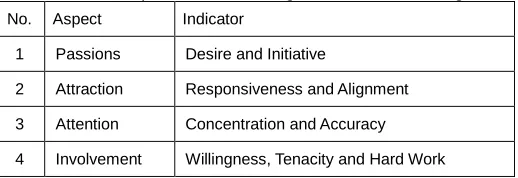
Table 1. Aspects of observing attitudes in dancing
No. Aspect Indicator
1 Passions Desire and Initiative
2 Attraction Responsiveness and Alignment
3 Attention Concentration and Accuracy
1609 Table 2. An aspect of evaluation criteria in dancing
No. Aspect Description
1 Harmony
Aspect that emphasizes the overall interrelation of dances performed by dancers (compactness and memorization)
2 Wiraga
Wiraga is the essential physical/physical movement skill of a dancer. Motion is a standard substance of dance. There are a lot of physical parts of man that can channel inner expressions in the form of dance moves.
3 Wirama
Wirama is a pattern for achieving harmonious movement. In it, there are dynamics arrangements such as dance accents and tempo. There are two kinds of rhythm for dance.
4 Wirasa
Wirasa is a level of appreciation and inspiration in dance. such as firm, gentle, happy and sad, which expresses through gestures and facial expressions to give birth to beauty
1) Compactness is seen from all group members starting from the movements, floor patterns, and expressions. If the overall group members are maximal, they will get a score of 90-100 (very good). However, if only the range of 1 and 5 or one of the ranges of motion removed will get a value of 80-85 (good). Then if one-half of the variety of harvest dance eliminated, the score obtained is 50-65 (less). Score 25 and below if only compact in one range of motion. 2) Memorization assessed from all group members ranging
from motion and harmony of musical diversity 1 to 6. If the whole group members memorize the floor patterns and motion of all the variations, they will get a score of 90-100 (very good). Memorize the movements and songs of variety 1 and 5, will get a score of 80-85 (good). Then if one-half of the variety of harvest dance not memorized, the score obtained is 50-65 (less). Only memorize one range of motion and floor patterns, the score is 0-25 (poor).
3) Wiraga, assessed from all group members ranging from floor movements and pattern patterns from 1 to 6. If the overall members of the Maximum group display all the various dance movements and floor patterns then they will get a score of 90-100 (very good). However, if only the motion and floor patterns vary, 1 and 5 will get a value of 80-85 (good). Then if one-half of the variety of harvest dance then the score obtained is 50-65 (less). If only one range of motion and floor pattern are displayed then a score of 0-25 (poor)
4) Wirama, assessed from all members of the group, starting from the motion and floor patterns varying from 1 to 6. If the overall group members are Maximum in the rhythm of the movement and the pattern of the floor will get a score of 90-100 (very good). However, if only the rhythm of movement and floor patterns of the corresponding 1 and 5 will get 80-85 (good). Then if one-half of the variety of harvest rhythm dance is not appropriate, the score obtained is 50-65 (less). If you only memorize one range of motion and floor patterns, the score is 0-25 (poor).
5) Wirasa, assessed from all members of the group, starting from the motion and floor patterns varying from 1 to 6. If the overall members of the group Maximum in the delivery of taste will get a score of 90-100 (very good), however, if there is only a sense of motion and floor patterns varying 1 and 5 will get a value of 80-85 (good). Then if one half of the harvest dance variety is not delivered, the score obtained is 50-65 (less). If in the range of 1 to 6, there is no sense, then get a score of 0-25 (poor).
2.4 Research Design
The design used in this study was classroom action research. The research will be conducted through several learning cycles that contain stages of planning, implementation, observation/action, evaluation, and reflection at the end of each cycle which described as follows:
Fig. 1. Research Design
The research that will use is Action Research to find out the application of drill methods to increase students' interest in learning dance.
2.5 Data Analysis
In Krippondorf [31], said that data is a unit of information recorded by the media that can distinguish from other data, can be analyzed and relevant to specific problems. Data is the link between information in the sense that the data must link between the source of information and the original symbolic form on one side. On the other hand, data must be following theory and knowledge [32]. After the data is collected, the next step is data analysis. The data analysis technique is done by examining all data collected from various sources. Data processing and analysis in this research are qualitative data analysis and quantitative data analysis. Qualitative data analysis is data in the form of information in the form of sentences that give an overview of students' expressions of the level of understanding of a subject (cognitive), views or attitudes of students towards new learning methods (affective), student activities following lessons, attention, enthusiasm in learning, confidence, motivation to learn and the like, can be analyzed qualitatively [33].
3.
RESULT
AND
DISCUSSION
3.1 Cycle I
1610 harvest dance practice, only 21 students or 60% did it
seriously. In the second meeting, observations on the dance, students also looked enthusiastic and attentive, but in the activities of imitating the harvest dance movements conducted by researchers, only 20 students followed the harvest dance movements. At the third meeting of the first cycle, students' attention to dance learning activities was quite good, only 50% of students demonstrated the harvest dance in earnest while others only pretended to follow the activity, crouching and chatting alone. In the fourth meeting, from 7 groups, only three groups or 40% who want to perform a form of participation which is one indicator of interest. When allowed to ask questions and answer questions students have begun to show courage and confidence. Based on the assessment of observations made by the supervising teacher, the average result of students who are active in the first cycle of action is 21 students or 60%, while students who are not active are 15 students or 40%. To find out the extent to which students' interest in learning dance is measured using a harvest dance performance test. The results of student observations obtained as follows:
a) Attraction
Based on observations, it can be seen that 21 students or 60% who feel interested in learning dance after the teacher applies the drill method.
b) Feeling happy
Based on observations, it can be seen that 21 or 60% of students feel happy to learn dance after the teacher applies the drill method.
c) Attention
Based on observations, it can be seen that 21 students or 60% show excellent attention in learning dance after the teacher applies the drill method in learning dance.
d) Participation
Based on observations, it can seem that only three groups performed or 21 students, 60% of students participated in dance lessons after the teacher applied the drill method in learning dance.
e) Desire/awareness
Based on observations, it can be seen that 15 students or 40% of students do not have proper awareness in learning dance. Based on the results of the performance it can be seen that the acquisition score in the first cycle an average of 50%, so there is an increase from the average acquisition score of the results of class action research is 70, although it is still below the minimum completeness criteria of 75%.
3.2 Cycle II
Cycle II held four meetings. Student attention to dance material delivered by the drill method has increased, both at the first, second, third, and fourth meeting. When allowed to ask and answer questions students are very enthusiastic about asking things that are not understood. When students given the task to participate in dancing, students have shown that they have increasingly high interest. Based on the assessment of the results of observations made by the supervising teacher obtained active students in the second cycle of action as many as 35 students namely; 10 male students and 25 female students (100%) while inactive students were one male student (16.7%) (full results can see in the appendix). To find out the extent of students' interest in learning dance is measured using a dance performance test.
Student performance test results obtained as follows: a) Attraction
Based on observations or observations of male students, it can be seen that 35 students or 90% feel interested in learning dance after the teacher applies the drill method. This is much different from the first cycle of students' interest; namely, 21 or 60% are interested in learning dance after the teacher applies the drill method in dance learning.
b) Feeling happy
Based on observations or observations of students, it can be seen that 35 male students or 90% feel happy to learn dance after the teacher applies the drill method in learning dance.
c) Attention
Based on observational answers or observations, it can be seen that 35 students or 90% show good attention in learning dance after the teacher applies the drill method in learning dance. Student attention is shown by listening to the teacher's explanation well and orderly in learning in the classroom.
d) Participation
Based on observations, it can be seen that at the third meeting of the first cycle, only 60% of students or three groups want to display harvest dance after the teacher applies the drill method in learning dance. Student participation in the harvest dance is also shown by asking questions, expressing ideas, discussing in groups, and doing group assignments well.
e) Desire/awareness
Based on student observations, it can be seen that in cycle II, an increase in student awareness in learning dance, this is indicated by the existence of 35 students or 90%, which shows the awareness of learning dance without coercion and comes from oneself. Based on the results of student performance and observations it can be seen that on average all indicators of interest in the second cycle, obtained 90% or as many as 35 students who showed interest in learning dance, compared to the first cycle of student observation on all indicators of interest obtained by 60% or as many as 21 students who showed interest in learning dance. Based on the performance results, it can seem that the acquisition score on the second cycle is an average of 80, so there is an increase that exceeds the minimum completeness criteria and the average cycle I.
3.3 Student Activity
Student activities observed during the first and second cycles of action carried out included: attendance, attention to the teacher's explanation, expressing ideas/asking questions, and carrying out the teacher's duties properly. Based on observations made by observers during the action, it is obtained that the actions taken by the teacher by applying the drill method can increase students' interest during the learning process of cultural arts and materials for harvest dance, where the observations of student interest in learning in cycle II are better than in cycle I. The results of observations of students' learning interest in the learning process with dance material (harvest dance) in the first cycle obtained as follows:
1611 b) Student attention to the harvest dance material delivered
by the drill method was good enough. The use of LCDs, learning CDs, and videos can attract students' attention to observe the variety of harvest dance moves.
c) When allowed to ask and answer questions students have begun to show courage and self-confidence.
d) When students given the task to discuss and demonstrate dance moves, students do it reasonably well and full of awareness.
The results of observations of students' learning interest in the learning process with harvest dance art material in cycle II obtained as follows:
a) At the first meeting, there were 1 (one) male students who were absent, at the second meeting 1 (one) male student was absent, the third and fourth meetings 1 (one) male student was absent.
b) The students' attention to the harvest dance material delivered by the drill method was good, and the students realized the importance of paying attention to the teacher's explanation so that they could master the harvest dance movements well.
c) When allowed to ask and answer questions students are very enthusiastic about asking things that are not understood.
d) When students given the task to discuss and demonstrate harvest dance in groups, students do well and are full of awareness.
3.4 Student Learning Interest
The application of the drill method is proven to increase the interest in learning dance from high school students. The results of students 'observations of students' interest in learning dance showed a significant increase. Observation test results of student attitudes and interests’ indicators can be interpreted as obtained as follows:
a) Attraction
Based on student observations, it can be seen that all students feel interested in learning dance after the teacher applies the drill method in learning dance.
b) Feeling happy
Based on student observations, it can be seen that almost all students feel happy to learn dance after the teacher applies the drill method in learning dance.
c) Attention
Based on student observations, it can be seen that most students show proper attention in learning dance after the teacher applies the drill method in learning dance.
d) Participation
Based on student observations, it can be seen that most students have shown good participation in learning dance after the teacher applies the drill method in learning dance. e) Desire/awareness
Based on student observations, it can seem that most students have a good awareness of learning dance because students who do not perform indicators of awareness are only one male student. Based on observations of dance interest in learning above, it can see that students' interest in learning dance has increased from cycle I to cycle II as indicated by the increase in the answer "yes" to the indicator of student interest in learning.
The application of the drill method was proven effective in increasing the interest of high school students. The application of the drill method makes students interested in learning dance
by conducting observation activities — observations made on the variety of harvest dance moves that displayed via LCD or video. Likewise, direct observation of the harvest dance movement, the researcher demonstrates the harvest dance in front of the class. Students must make observations so students can understand, remember, and be able to demonstrate the variety of harvest dance moves. The use of the drill method makes students motivated to learn well, namely by paying attention to the teacher's explanation, asking questions that are not understood, expressing ideas, and carrying out the tasks of the teacher well. The use of drill methods also makes it easier for students to understand, remember, and be able to demonstrate a variety of harvest dance moves. The results of research conducted by [34], using several different methods to see the results of the application of psychological knowledge. The test results show that significantly, the drill method has advantages when reading practice. Mastery learning is the achievement of the minimum mastery level set by the teacher in the learning objectives of each unit of study. The incomplete completion of an assessment of learning outcomes determined by the standard measure of achievement of the minimum value that must be achieved by a student. The measurement of achieving a minimum value is known as the Minimum Completeness Criteria. The completeness criterion shows the percentage of the level of competency achievement so that expressed as a maximum score of 100. A maximum score of 100 is an ideal completeness criterion. National completeness targets expected to reach a minimum of 75. Education units can start from a minimum completeness criteria below the national target and then increase gradually.
40%
80%
60%
90%
25% 50% 75% 100%
Cycle 1 Cycle 2
Fig. 2. The average value of interest and minimum completeness criteria
1612 cycle carried out an average score of 74, so that there was an
increase even though it was still below the minimum completeness criteria, after the second cycle an average score of 80. The position of this score was above the minimum completeness criteria and the average cycle I. Observation activities in the learning process are essential for the direct involvement of students so that the learning process takes place full of meaning and leaves a deep impression for students. Observing activities give priority to the meaningfulness of the learning process. This activity has certain advantages, such as presenting real media objects. Students are happy and challenged and easy to implement. Observing activities are very beneficial for the fulfillment of students' curiosity so that the learning process has high meaningfulness. With the drill method, students discover the fact that there is a relationship between the object being analyzed and the learning material used by the teacher. The application of the drill method is essential in the use of instructional media which is very dominant as the observed media. So that students are easier to understand, remember, and demonstrate dance material taught by the teacher. Media video also makes it easier for students to copy harvest dance files, so that in addition to making observations at school, students can also observe themselves independently at home. The drill method is beneficial for fulfilling students' curiosity, so the learning process has high meaningfulness. With the drill method, students discover the fact that there is a relationship between the object analyzed and the learning material presented by the teacher [35]. This rarely happens in conventional learning patterns. In conventional learning patterns, teachers often deliver material that sometimes students can do but do not know that what they are doing is useful for them in realizing their competencies. The drill method helps the cognitive development process of students who stimulated to make the cognitive adaptation. The process of cognitive adaptation in the form of accommodation and assimilation [36]. Another benefit is in order to instill a sense of love in the environment and nature [37]. In verbal learning and learning skills, increasing the ability of learning outcomes can be achieved through practice and practice. Training usually is done by repeating a matter so that the expected abilities formed. The method of practice generally used to obtain a dexterity or a learned skill. Method of training (Drill), which is also called training, is the right way of teaching to instill certain habits [38]. Likewise, as a means to maintain good habits. Besides, this method is also good for obtaining dexterity, accuracy, opportunity and skills. The denotative drill is an action to improve skills and skills. As a method, Drill is a way to teach students to develop skills and skills and can develop attitudes and habits.
CONCLUSION
The drill method widely used in learning skills due to various considerations of the advantages of the method. The advantage of the drill method lies in the speed of mastery of the material as a result of repeated exercises. In a relatively short period, the expected mastery and skills can be obtained. This occurs because of the sufficient intensity of the practice and the repetitions that occur so students can master the skills or abilities taught. Will be embedded in each student's personal study habits routinely and discipline. This is thanks to the habits of students in the process of learning skills. Then the teacher also has a role in disciplining students because the
drill method will not work successfully without the role of the teacher who has the authority and expertise.
REFERENCES
[1] B.-S. Eylon and M. C. Linn, ―Learning and instruction: An examination of four research perspectives in science education,‖ Rev. Educ. Res., vol. 58, no. 3, pp. 251–301, 1988.
[2] K. Kwakman, ―Factors affecting teachers’ participation in professional learning activities,‖ Teach. Teach. Educ., vol. 19, no. 2, pp. 149–170, 2003.
[3] R. Duschl, ―Science education in three-part harmony: Balancing conceptual, epistemic, and social learning goals,‖ Rev. Res. Educ., vol. 32, no. 1, pp. 268–291, 2008.
[4] A. E. Carl, Teacher empowerment through curriculum development: Theory into practice. Juta and Company Ltd, 2009.
[5] J. Cohen, ―Social, emotional, ethical, and academic education: Creating a climate for learning, participation in democracy, and well-being,‖ Harv. Educ. Rev., vol. 76, no. 2, pp. 201–237, 2006.
[6] A. M. Idkhan and I. I. P. Djuanda, ―Implementation of Mechanical Technology Competence Learning Model with Maximum Likelihood Estimation,‖ International Journal on Advanced Science Engineering Informatioan Technology, vol. 9, no. 5, pp. 1535–1543, 2019.
[7] M. E. Gredler, Learning and instruction: Theory into practice. Macmillan New York, 1992.
[8] K. M. Kapp, The gamification of learning and instruction. Wiley San Francisco, 2012.
[9] R. F. Mager, ―Preparing instructional objectives.,‖ 1962. [10] D. E. Kapel and E. L. Dejnozka, ―The education
deanship: A further analysis,‖ Res. High. Educ., vol. 10, no. 2, pp. 99–112, 1979.
[11] R. E. Slavin and N. Davis, ―Educational psychology: Theory and practice,‖ 2006.
[12] A. M. Idkhan, ―The Contribution Knowledge of Entrepreneurship Self Efficiency, and Preparation of Instrumentation to the Entrepreneurial Intension and Its Impact In Entrepreneurial Preparation,‖ in Journal of Physics: Conference Series, 2018, vol. 1028, no. 1, p. 12083.
[13] D. G. O’Dell and T. Sulastri, ―The Impact of Using the Internet for Learning for Students with Technology Acceptance Model (TAM ),‖ Int. J. Environ. Eng. Educ., vol. 1, no. 2, pp. 46–52, 2019.
[14] R. J. Osborne and M. C. Wittrock, ―Learning science: A generative process,‖ Sci. Educ., vol. 67, no. 4, pp. 489– 508, 1983.
[15] A. Muhammad Idkhan and F. R. Baharuddin, ―Occupational Health And Productivity In Noise Exposure And Room Layout,‖ Int. J. Sci. Technol. Res., vol. 8, no. 11, pp. 516–522, 2019.
[16] A. Padalia and S. Salam, ―Effectiveness of Learning Tool Basic Dance South Sulawesi (Mandar) Sendratasik Education Study Program Faculty of Arts and Design Makassar State University.,‖ Int. Educ. Stud., vol. 8, no. 10, pp. 207–212, 2015.
[17] P. Ramsden, Learning to teach in higher education. Routledge, 2003.
1613 teachers and lecturers. David Fulton Publishers, 2013.
[19] J. Hattie, Visible learning for teachers: Maximizing impact on learning. Routledge, 2012.
[20] R. Allwright, D. Allwright, and K. M. Bailey, Focus on the language classroom: An introduction to classroom research for language teachers. Cambridge University Press, 1991.
[21] A. C. Ornstein, ―Practice and drill: Implications for instruction,‖ NASSP Bull., vol. 74, no. 525, pp. 112–117, 1990.
[22] U. M. Kani and T. U. Sa’ad, ―Drill as a Process of Education,‖ Eur. J. Bus. Manag., vol. 7, no. 21, pp. 175– 178, 2015.
[23] M. I. Ali, G. D. Dirawan, A. H. Hasim, and M. R. Abidin, ―Detection of Changes in Surface Water Bodies Urban Area with NDWI and MNDWI Methods,‖ International Journal on Advanced Science Engineering Informatioan Technology, vol. 9, no. 3, pp. 946–951, 2019.
[24] L. Birch et al., ―Obstetric skills drills: evaluation of teaching methods,‖ Nurse Educ. Today, vol. 27, no. 8, pp. 915–922, 2007.
[25] A. Padalia and B. Salawati, ―Analysis of the Need for Development of Dance Learning Devices in South Sulawesi in Students of Sendratasik Education FSD, State University, Makassar (Dance CD Dance Mallatu’Pakkuru Sumange Coffee and Dance’),‖ in International Conference Primary Education Research Pivotal Literature and Research UNNES 2018 (IC PEOPLE UNNES 2018), 2019.
[26] M. I. Ali, A. H. Hasim, and M. R. Abidin, ―Monitoring the Built-up Area Transformation Using Urban Index and Normalized Difference Built-up Index Analysis,‖ Int. J. Eng., vol. 32, no. 5, pp. 647–653, 2019.
[27] L. Sherry, ―Issues in distance learning,‖ Int. J. Educ. Telecommun., vol. 1, no. 4, pp. 337–365, 1995.
[28] C. Macintyre, The art of action research in the classroom. David Fulton Publishers, 2012.
[29] C. A. Mertler, Action research: Teachers as researchers in the classroom. Sage, 2009.
[30] P. Newby, Research methods for education. Routledge, 2014.
[31] K. Krippendorff, Content analysis: An introduction to its methodology. Sage publications, 2018.
[32] K. Malterud, ―Qualitative research: standards, challenges, and guidelines,‖ Lancet, vol. 358, no. 9280, pp. 483–488, 2001.
[33] J. E. Ormrod and B. D. Jones, Essentials of educational psychology: Big ideas to guide effective teaching. Pearson, 2014.
[34] H. Guetzkow, E. L. Kelly, and W. J. McKeachie, ―An experimental comparison of recitation, discussion, and tutorial methods in college teaching.,‖ J. Educ. Psychol., vol. 45, no. 4, p. 193, 1954.
[35] J. M. Keller, ―The Arcs model of motivational design,‖ in Motivational design for learning and performance, Springer, 2010, pp. 43–74.
[36] D. A. Kolb, Experiential learning: Experience as the source of learning and development. FT press, 2014. [37] A. A. Patak, H. A. Naim, A. Ma’ruf, and M. N. A. Ghafar,
―Design and Validation of Online Learning Environment Questionnaire,‖ International Journal on Advanced Science Engineering Informatioan Technology, vol. 6, no. 3, pp. 334–338, 2016.