1662
Performance Impacts Of Multipoint Relay Attack
Against OLSR Protocol
Abderrahim HAJJI SOUALFI, Said AGOUJIL
Abstract— A Mobile Ad-hoc NETwork (MANET) is an assembly of nodes with extreme flexible topology for establishing wireless communications and forming a dynamic network. In order to enable conversation between any nodes in a network, a routing protocol is employed. Currently, there are three major routing protocols classes: reactive, proactive and hybrid protocols. Optimized Link State Routing Protocol (OLSR) is one of the most used in MANET. It operates in table driven of proactive protocol. A major problem facing this protocol (OLSR) is security. Multipoint relay (MPR) attack is considered like the most efficient attack.This paper is organized into four large sections. In the first section, we talk about the main goal of "multipoint relays" (MPRs). Second Section is dedicated to the routing layer attack, especially MPR attack. The third section introduces simulation measurements and network layout. Finally, we discuss the simulation results in the last section, before concluding our paper.
Index Terms— inetmanet, Mobile Ad Hoc Network, MPR attack, OLSR, Omnetpp, Security.
—————————— ◆ ——————————
1 INTRODUCTION
MANET is a wireless multi-hop and a self-configuring network of mobile nodes. The nodes generate traffic which is forwarded to some other group of nodes. In MANET, each node acts as a host and a router to forward messages to other nodes out of the same wireless transmission range. Each node is free to move independently in any direction, and will therefore change its links to other nodes frequently. There is more than one path from one node to another [1]. The life-cycle of ad-hoc networks could be classified in three generations [2]. The first generation (1972) were called PRNET (Packet Radio Networks). The second generation (1980s) is implemented as a part of the SURAN (Survivable Adaptive Radio Networks) program. Mobiles become smaller, cheaper, and resilient to electronic attacks. In the 1990s, the concept of commercial ad-hoc networks arrived with laptop computers and other viable communications equipment. Since mid-1990s, a lot of work has been done on the ad hoc standards. Within the IETF (Internet Engineering Task Force), the MANET working group -third generation- was born, and made effort to standardize routing protocols.In MANET, routing protocols are divided in three categories: Proactive, Reactive and Hybrid protocols [3].Proactive routing protocols need to maintain a consistent view of the network topology. Indeed, when a network topology changes, respective updates must be propagated throughout the network to notify the change. Reactive routing protocols, routing paths are searched for when needed. Route discovery process is used in on demand routing by flooding the route request (RREQ) packets throughout the network. The third category -Hybrid routing protocols- combines the qualities of proactive and reactive routing protocol by using the GSP (Global positioning system). Nodes, in a geographical area, can be reached using proactive routing protocols. Outside this geographical area, reactive routing protocols will be used. The Optimized Link State Routing Protocol (OLSR) is developed for mobile ad hoc networks. It operates as a table driven, proactive protocol by exchanging topology information with other nodes of the network regularly. Each node selects a set of its neighbour nodes as "multipoint relays" (MPRs). In OLSR, only nodes selected as MPRs are responsible for forwarding control traffic, intended for diffusion in the entire network. MPRs provide an efficient technical for flooding
control traffic by reducing the number of transmissions required [4].
In such a network, limitation of bandwidth, energy resources and security topics are presented. In this paper, we take MPR attack as a security issue which a non MPR node floods/forwards normal/altered control messages. Our motivation is to analyse the negative effect of this attack by simulations, since there is no literature lightning this topic. The simulation of the attack is achieved using Omnetpp/inetmanet framework whose aim is to show the effectiveness of our proposed simulation method.
2
MULTIPOINT
RELAYS
(MPRS)
The realization of this work focuses to the availability of Multipoint relays (MPRs) in the Optimized Link State Routing Protocol (OLSR) for mobile ad hoc networks.
2.1 Optimized Link State Routing (OLSR)
the destination. Only MPRs nodes exchange periodically the TC messages in the entire network. Like a result, each node has a partial vision on the network topology and can form a route to every node in the network.
2.2 Multipoint Relay Purpose
The multipoint relay selection performs very well to disseminate the broadcasted packet into the network [7]. MPR is based on minimize the flooding of the network with broadcast packets. It provides efficient broadcast mechanism by reducing the number of transmissions required, which implies a decrease of the message overhead. This means that each node selects the smallest set (MPRs) of neighbour nodes that can reach all of its symmetric two hop neighbours which may forward its broadcasted messages.
The advantages of using multipoint relays are:
1. The link state information is created exclusively by nodes chosen as MPRs;
2. The number of control messages, flooded in the network, is minimized;
3. The MPRs nodes may choose to communicate only links between themselves and its selectors.
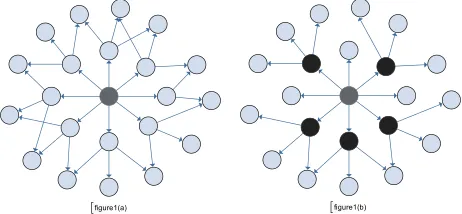
Fig. 1 illustrates a node, with 1 hop and 2 hop neighbors, broadcasts its messages through the network. In the first case (Fig. 1(a)), the network uses standard flooding which all node neighbours retransmit the messages, while, in the second case (Fig. 1(b)) only MPR nodes relay messages:
Fig. 1. Difference between standard flooding and OLSR flooding using MPRs
3 OLSR
VULNERABILITIES
Routing protocols operate in two steps [8], the first step discovering the network topology by exchanging control messages. In the second step, a source node transmits data messages to the destination. In the ad hoc network, those operations are exposed to several vulnerabilities, since there is no physical or administered interconnection dedicated. We concentrate on routing protocol, especially attacks against OLSR protocol. The attacker may have the goal, alteration of control messages, controlling the network traffic, perturbing the network topology and more. There are two main attacks categories on the OLSR protocol [9], ‘’incorrect traffic generation’’ and ‘’incorrect traffic relaying’’. In some cases, there is a coincidence between node misbehavior and node malfunction, battery exhaustion, radio interference, ....
Table 1 recaps a list of OLSR attacks and their consequences on the network:
Table 1
Summary of OLSR attack
4 MPR
ATTACK
In OLSR network, when a node receives an MPR flooding message, it checks if the sender is its MPR selector. If so, the node must communicate the message to the neighbours. If this is not the case, the node must not retransmit the message. This procedure prevents to communicate the message on large loops, especially in dense networks (that the main gain of using MPR mechanism in OLSR protocol).The attacker can exploit this rule to forward (altered)control messages even this node is not selected as MPR or to impede the correct relaying of control messages. The consequences of MPR attack are connectivity/message loss (Table 1) and unnecessary network overload.Indeed, an example of such an attack (Fig. 2): Node A sends a message to its neighbours’ nodes B, C and X. Nodes B and C are an MPR of A, while X is not. The nodes B and C (MPRs) will broadcast the message to the other neighbour’s: node B to nodes D, E, F and node C to nodes F, G, H. Node X (not an MPRs) must not broadcast the message. Node X uses the MPR attack to broadcast the message to its neighbours (nodes E, F, G). The result nodes E and G will receive a duplicate message when node F receives the message three times. The nodes E, F and G will compare the received messages before forwarding (broadcasting), if they are an MPRs, the recent one. This comparison (computation) will be repeated in each message receiving, generates thereby, an additional (unnecessary) processing time, which will be proportionally increased with the addition of other attackers:
Conflicting
routes
Connectivity
loss
Message
loss
Incorrect
traffic
generation
Incorrect
HELLO
generation ID
spoofing
✕ ✕ ✕
Link
spoofing
✕ ✕
Incorrect
TC
generation ID
spoofing
✕ ✕ ✕
Link
spoofing
✕ ✕
Incorrect MID/HNA
generation
✕ ✕ ✕
ANSN attack ✕ ✕
Incorrect
traffic
relaying
Message tampering ✕ ✕
Black hole attack ✕ ✕
Replay attack ✕ ✕ ✕
Worm hole attack ✕
MPR attack ✕ ✕
Message bombing and other DoS ✕ ✕
1664 Fig. 2. Node X performs an MPR attack
5 RELATED
WORK
MANETs are identified by self-organized and quick deployed networks. However, weaknesses are appeared like restricted information measure, battery power, procedure power, and security. Many articles have analysed security vulnerabilities of routing protocols in MANETs. Cédric Adjih, Thomas Clausen, Anis Laouiti, Paul Mühlethaler and Daniele Raffo [9] have introduced the MPR attack without presenting the real effect of this attack. Our purpose is to implement MPR attack, to show and compare, by simulations, the results.
6 MEASUREMENTS
This paper is focused to measure network performance in two cases: normal behaviour and under attack by collecting the network statistics (metrics): Packet Data Ratio (PDR), throughput and the end to end delay; these notions are given below:
6.1 Packet Data Ratio (PDR)
Packet data ratio (PDR) is the ratio of packets successfully received (by all destinations traffic) to the total sent (by all sources traffic). The opposite metric of PDR is packet loss ratio (PLR). They are oppositely proportional. The PDR metric represents the reliability of the protocol for sending all sent data packets:
𝑃𝐷𝑅 = 𝑇𝑜𝑡𝑎𝑙 𝑟𝑒𝑐𝑒𝑖𝑣𝑒𝑑 𝑝𝑎𝑐𝑘𝑒𝑡𝑠
𝑇𝑜𝑡𝑎𝑙 𝑠𝑒𝑛𝑡 𝑝𝑎𝑐𝑘𝑒𝑡𝑠
6.2 Throughput
Throughput is the number of messages successfully delivered per unit time. We measure throughput as number of bits delivered successfully per second to a destination. The throughput of a network is the useful transmission rate of the network over a communication channel:
𝑇ℎ𝑟𝑜𝑢𝑔ℎ𝑝𝑢𝑡 = 𝑇𝑜𝑡𝑎𝑙 𝑠𝑒𝑛𝑡 𝑏𝑖𝑡𝑠
𝑇𝑖𝑚𝑒 𝑑𝑎𝑡𝑎 𝑡𝑟𝑎𝑛𝑠𝑚𝑖𝑠𝑠𝑖𝑜𝑛
6.3 End to end delay: vector/histogram
End to end delay is the time elapsed between the emission of a message by a source node and his reception by a destination node. It includes latency for route discovery, transit time in intermediate node queues and transmission time from
one jump to another. This metric represents the effectiveness of the protocol in terms of response time and the choice of optimal paths:
End to end delay = Received time (destination) - Sent time(source)
- The histogram variant is the graphical presentation of the delay (end to end delay) by received group packets;
- The vector variant is the graphical presentation of the delay (end to end delay) by simulation time.
7 NETWORK
LAYOUT
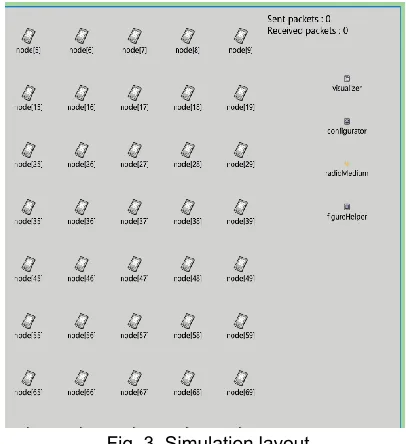
OLSR is a proactive protocol which offer high performance compared to other routing protocols [10], [11], [12]. Fig. 3 shows the design layout, simulated into omnetpp/imnetmanet framework. node[0] is taken as source packet while node[117] is the target. The nodes are chosen arbitrarily and placed in grid stationary layout, to ensure deliverance packets by various paths. We implement a large network density with 200nodes to show the attack efficiency:
Fig. 3. Simulation layout
Details of the components of the simulations are presented in Table 2:
Table 2
Simulations characteristics
Attribute Value
Routing protocol OLSR Simulation time 30 seconds No. of normal nodes 200 No. of malicious nodes Non MPRs
IP Addressing IPv4 (192.168.1.0/24)
Wireless standard IEEE 802.11g Link bandwidth 6 Mbps Transmission range 100m
Mobility Static
8 SIMULATION
RESULTS
Two different kinds of statistics are collected. The first concerns statics in normal running. The second focus on the attacked (MPR attack) network. Our attack concentrates on flooding topology control messages (TC messages) by non MPRs nodes.
8.1 Normal network
The following graphs (Fig. 4) present the simulation results in a normal environment:
Fig. 4. Simulation results in normal network
8.2 Attacked network
In this case, the simulation results are presented in the attacked network:
Fig. 5. Simulation results in attacked network
9 DISCUSSION
We will present, in this part, a comparison result based on packet data ratio, throughput and end to end delay metrics, before explaining the cause results:
9.1 Packet Data Ratio (PDR)
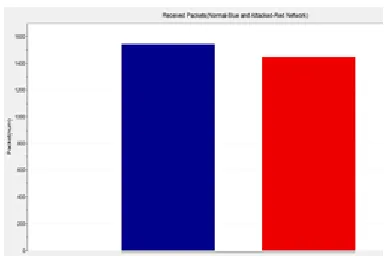
Packet Data Ratio (PDR) metric is presented in the top left of the figures 4 and 5. In the two cases (normal and attacked network) all sent packets are received: PDR =100%. But in the second case (attacked network-red column) the received packets are decreased compared to compared to the normal behavior (normal network-blue column):
Fig. 6. Received packets in two cases
Compared to the normal situation (blue column in Fig. 6), the number of packets (sent and received) in the attacked network (red column in Fig. 6) is reduced by:
Packets reduction=6,15%.
In the attacked scenario, a node receives a duplicate(s) topology control (TC) messages coming from all the neighbors nodes (MPRs and non MPRs nodes). So, the concerned node must compute and keep the recent TC message (to keep the update of the entire network). This additional operation will cause an unnecessary processing “time” of the received topology control (TC) messages comes from non MPRs nodes.
Since we are limited in simulation time (30 seconds), many packets do not have the opportunity (time) to be sent.
9.2 Throughput
The non-sent packets will not contribute to throughput (computed in the top right of the figures 4 and 5). As we know, the throughput is proportional to the “total sent bits” (cf. throughput definition). Considering there are non-sent packets in the attacked scenario, the “total sent bits” will decrease as well as the throughput:
Fig. 7. Average throughput in two cases
The average throughput in the normal network (blue column in Fig. 7):
Throughput_normal = 670,57 Kbps,
compared to:
The average throughput in the attacked network (red column in Fig. 7):
Throughput_attacked = 629,34 Kbps.
The average throughput is reduced by:
Throughput reduction = 6,15%. 9.3 End to end delay
1666 Table 3
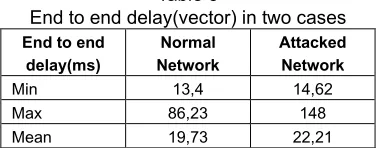
End to end delay(vector) in two cases
End to end delay(ms)
Normal Network
Attacked Network
Min 13,4 14,62
Max 86,23 148
Mean 19,73 22,21
The end to end delay measures the time between a sent and a received packet (cf. end to end delay definition). The augmentation of the “latency for route discovery” and “transit time in intermediate node queues” caused by the non-MPRs nodes will increase the end to end delay metric in the attacked network.
We note, in the histogram representation (Table 4), a large received group packet with a high end to delay interval (attacked network) compared to the normal situation:
Table 4
End to end delay (histogram) in two cases
Received packets
End to end delay(ms) Normal Network
End to end delay(ms) Attacked Network
380 [16,89 17,89] 214 [16,46 16,95]
10
CONCLUSION
The OLSR protocol does not define any special security measures [4]. Due to its proactive characteristic, the protocol diffuses periodically and clearly network topology information. This property makes OLSR a target for several attacks. MPR attack is one of the effective attacks. This attack becomes more efficient when a non MPR node broadcasts “altered” control messages. Through simulations, we have demonstrated that the attack affects the global performance of the network. To avoid this malicious behaviour, we must use an authentication mechanism to verify control messages node originator. Investigating this solution is part of our future work, taking in consideration the properties of manet routing protocols [13].
REFERENCES
[1] P.Jacquest, P.Mahetethaler and T. Chausen. “Optimized link state Routing Protocol for Adhoc networks”, Hipercom project BP 105, 78103 Le cheshaycedex, France.
[2] Ankur O. Bang, Prabhakar L. Ramteke. “MANET: History, Challenges and Applications”. International Journal of Application or Innovation in Engineering & Management (IJAIEM), Volume 2, Issue 9, September 2013.
[3] K.P. Manikandan, Dr. R. Satyaprasad and Dr. K. Rajasekhararao. “A Survey on Attacks and Defense Metrics of Routing Mechanism in Mobile Ad hoc Networks”. International Journal of Advanced Computer Science and Applications (IJACSA), Vol. 2, No.3, March 2011.
[4] Clausen Ed. and Jacquet Ed., “Optimized Link State Routing Protocol”. IETF: The Internet Engineering Task Force, RFC 3626, October 2003.
[5] Bounpadith Kannhavong, Hidehisa Nakayama, Yoshiaki Nemoto, Nei Kato and Abbas Jamalipour. “A survey of routing attacks in mobile ad hoc networks”. IEEE Wireless Communications, October 2007.
[6] Bounpadith Kannhavong, Hidehisa Nakayama, Nei Kato, Abbas Jamalipour and Yoshiaki Nemoto. “A study of a routing attack in OLSR-based mobile ad hoc networks”. International journal of communication systems, March 2007.
[7] Ayoub Abdellaoui, Jamal Elmhamdi and Halim Berradi. “Multipoint Relay Selection based on Stability of Spatial Relation in Mobile Ad hoc Networks”. International Journal of Communication Networks and Information Security (IJCNIS), Vol. 10, No. 1, April 2018.
[8] Mohamed Amine FERRAG, and Mehdi NAFAA. “Securing the OLSR routing protocol for Ad Hoc Detecting and Avoiding Wormhole Attack”. Cyber Journals: Multidisciplinary Journals in Science and Technology, Journal of Selected Areas in Telecommunications (JSAT), April Edition, 2011.
[9] Cédric Adjih, Thomas Clausen, Anis Laouiti, Paul Mühlethaler, and Daniele Raffo. “Securing the OLSR routing protocol with or without compromised nodes in the network”. Technical Report INRIA RR-5494, HIPERCOM Project, INRIA Rocquencourt, February 2005.
[10] Trapti Jain and Savita Shiwani. “Analysis of OLSR, DSR, DYMO Routing Protocols in Mobile Ad-Hoc Networks using Omnetpp Simulation”. Global Journal of Computer Science and Technology: E Network, Web & Security. Volume 14 Issue 1 Version 1.0, 2014.
[11] Sukhwinder Kaur, R K Bansal and Savina Bansal. “Performance Analysis of AODV, DSR and OLSR Routing Techniques for Ad-Hoc Mobile Networks”. International Journal of Computer Science Engineering and Information Technology Research (IJCSEITR). Vol. 3, Issue 5, Dec 2013, 195-200.
[12] Ravi Kumar, Prabhat Singh. “Performance analysis of AODV, TORA, OLSR and DSDV Routing Protocols using NS2 Simulation”. International Journal of Innovative Research in Science, Engineering and Technology (IJIRSET), Vol. 2, Issue 8, August 2013.