P.Srilatha
Abstract: This paper obtainable an evaluation of the association between left and right ear using four selected feature extraction algorithms: Principal Component Analysis (PCA), Speeded Up Robust Features (SURF), Geometric feature extraction and Gabor wavelet based feature extraction techniques in terms of performance issues given by of False Acceptance Rate (FAR), False Rejection Rate (FRR), and Genuine Acceptance Rate (GAR).The approach was evaluated on non-public ear dataset and simulated in MATLAB Environment. For these selected feature extraction algorithms, the right ears of the subjects are used as the gallery, and the left ear as the probe. The investigational results recommend the existence of some degree of symmetry in the human ears but the ear are not exactly identical as the recognition accuracy of the system deteriorated for three (PCA, SURF, and Gabor wavelet) of the feature extraction algorithms.
Keywords- Ear symmetry, Gabor wavelet,
Occlusion, Principal Component Analysis (PCA), Speeded Up Robust Features (SURF).
I. INTRODUCTION
Ear based totally popularity is of unique interest due to the fact in contrast to face reputation it isn't always suffering from factors such as temper or fitness. Significantly, the arrival of the outer ear is almost unaffected by way of aging (Iannarelli, 1989), making ear higher acceptable for lengthy-time period identification whilst as compared to other non-invasive techniques inclusive of face popularity. The capability for the use of the ear’s appearance as a way of private identity became diagnosed and encouraged as early as 1890 with the aid of the French criminologist Alphonse Bertillon (Bertillon, 1890). Human ears are located on both facets of the face and, consequently, the difficulty of symmetry of the structure of the 2 ears is a topic of the hobby.
Such an evaluation has several implications in a realistic popularity device.
One, if symmetry is hooked up, then the left ear of a man or woman’s probe image may be matched against their proper ear within the gallery database (or vice-versa). Secondly, occlusion is a primary hassle in Ear recognition, reconstructing in part occluded ear image will be possible if information about the opposite ear is available. Third, if the ears of a character are significantly asymmetrical, then this presents additional facts about their identity (Abaza et al., 2010).
The observe of Ear commenced with the paintings of Iannarelli (Iannarelli, 1989) where ear changed into claimed to be specific to every individual. The Ear turned into in addition categorized through dividing it into seven elements as shown in Figure 1. Medical reports have shown that the variation over time in ear is maximum substantive all through the length from 4 months to 8 years old and over 70 years antique (Li et al., 2015). Due to the ear’s stability and predictable changes, ear features are probably a promising biometric for use in a human identity (Bhanu et al., 2003). Burge et al.
(Burge et al., 2000) also studied the opportunity for automatic ear popularity. The approach localized the ear in an image with the aid of the usage of deformable contours on a Gaussian pyramid illustration of the gradient image. Afterwards, a series o aspect extraction and curve extraction techniques were used to construct a graph model of the ear. A graph matching technique turned into used to evaluate the similarity of two ears. Moreno and Sanchez (Moreno et al., 1999) describe a fully automated ear recognition machine. The machine relied on more than one functions concerning the contour of the outer ear, and the form and wrinkle records contained inside the ear picture to establish identity.
II. PROPOSED SCHEME
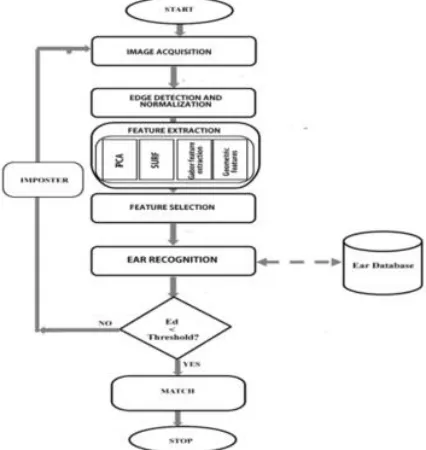
The proposed Ear Recognition System is divided into five major steps- Image acquisition, Edge detection and normalization, Feature extraction, Feature selection and Ear recognition. Fig.1 shows a proposed flow diagram for the ear recognition system.
Figure 1: Flowchart of the proposed Ear Recognition System.
Image Acquisition
The side image is acquired from a system’s web camera using the webcam object in Matlab. The webcam object connects to the camera establishing exclusive access and starts streaming. The image is then previewed and acquired using the Matlab snapshot function.
Edge Detection and Normalization
The Region of Interest (ROI) in this research work is the Ear; which is detected by trained a cascade detector in Matlab. After the ROI selection, the image is converted to grayscale and the edge detection is done using the canny edge detector [7]. Median filter is used to remove noises and Standard
deviation computation is made to enhance the dimension of the output image so that it helps to detect edges clearly. Normalization is done by considering the Ear image estimated mean (M) and variance (v). The input image I (x, y) is normalized by using the equations:
Feature Extraction
After completion of ROI selection, enhancement and normalization operations, the images are ready for feature extraction. The Concha is taken as the local feature and Outer Helix is taken as the global part of ear image. In this proposed approach, four key feature extraction techniques are used. The four feature extraction algorithms are selected based on their rank-1 performance as shown from the work of Anika et al. [8]. The four feature extraction algorithms considered in this research work are: 1. Principal Component Analysis (PCA)
2. Speeded Up Robust Feature (SURF) Transform 3. Gabor wavelet based feature extraction
4. Geometric features
Principal Component Analysis (PCA)
The ‘principal components’ are obtained by the Eigen decomposition of the covariance matrix of the ear data, the dimensionality is then reduced by finding a linear subspace of the original feature space on to which the ear data is projected such that the projection error is minimized. Each image’s pixels are taken row by row from top to bottom and converted to a row vector containing the gray scale or intensity values of that image. These row vectors are then concatenated in a single matrix so that each row in that matrix corresponds to an image. This process is done to training images as well as test images, keeping them in two separate matrices.
The covariance matrix is then calculated for the training images where each row represents an image (observation) and each column represent a pixel position (variable). Covariance is the measure of how much two variables vary together which is calculated using the following formula:
cov(xi,xj)= E((xi - µi) (xj- µj)) For i and j = 1,2,....,n ……….. (3)
n is the number of pixels per image (columns), then the resulting covariance matrix (C) will be of size (n x n).
If the covariance matrix (C) satisfies the relation Cei = λiei; where λi and ei for i=1,2…,n are the corresponding eigenvectors and eigenvalues respectively then matrix A from the eigenvectors sorted by decreasing eigenvalues is constructed.
Speeded Up Robust Feature Transform Features (SURF) There are two important steps involved in extracting SURF features from an Ear image. These are finding keypoints and computation of their respective descriptor vectors. SURF makes use of hessian matrix for key-point detection. For a given point P(x; y) in an image I, the hessian matrix is defined as:
Gabor feature extraction
For extracting features with Gabor filters, each point in the ear image is represented by local Gabor filter responses. A 2-D Gabor filter is obtained by modulating a 2-D sine wave with a Gaussian envelope.
Geometrical Method of Feature Extraction
A 2 step concentric geometrical methods of feature extraction based on numbers of pixels that have the same radius in a circle with the centre in the centroid and on the contour topology was used. The algorithm [9] for the feature extraction is presented below: Step 1: A set of circles with the centre in the centroid is created.
Step 2: Number of circles Nr is fixed and unchangeable.
Step 3: Corresponding radiuses are α pixels longer from the previous radius.
Step 4: Since each circle is crossed by the contour image pixels, the number of intersection pixels lr is counted.
Step 5: All the distances d between neighboring pixels is counted in a counter clockwise direction. Step 6: The feature vector that consists of all the radiuses with the corresponding number of pixels belonging to each radius are built and sum of all the distances between those pixels Σd are calculated.
Features Selection
The Sequential Floating Forward Selection method (SFFS) was used in order to select the most relevant and discriminating subset of features from the initial one and get rid of the redundant features. The SFFS algorithm is described by the following pseudocode: 1. Initialize feature to empty subset Y = {θ}; 2. Find the best feature and update Ym(forward) X+= argmin (J(Yk+x))
AεYk
Yk+1=Yk + X+ K= k+1
3. Find the worst feature(backward) x- = argmin (J(Yk + x))
aε Yk
4. If J(Yk- x-) < J(Yk) then Yk+1 = Yk-XK=k-1 Go to step 4 else Go to step 3 End if Ear Database
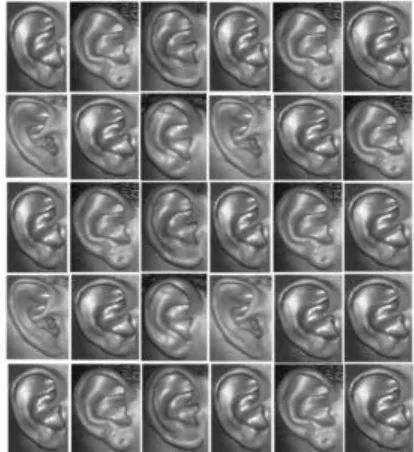
The ear database consists of 144 Ear samples taken from 72 subjects along with other attributes like name, physical identity and generated results of the processed images. Sample ear images from database are shown in Fig. 2.
Figure 2: Sample Ear images from database
For successful identification, the system compiles the inter-distance based on the image biometrics for both training images and test images and then compares the inter-distance, the inter-distance D is given by:
√ +
( , ) and ( , ) are coordinates of two intersections. The Euclidean distance ED is then calculated using the following formula:
√
Where and are the test and database ear
pattern inter-distances.
The algorithm for the matching is presented below: 1. To match two images (one test image T with another from the database db)
The Euclidean distance between the two weight matrices of those images is calculated.
2. A test run of the system is used to set a threshold. 3. If the Euclidean distance is higher than a threshold, the output is an imposter, otherwise system outputs a match.
III. CONCLUSION
This paper attempted to analyze the symmetry of the two ears by examining the performance of the ear biometric system using four feature extraction algorithms. The experimental results suggest the existence of some degree of symmetry in the human ears but the ears are not exactly identical as the performance of the system fell for three (PCA, Gabor, and SURF) of the four feature extraction algorithms,
REFERENCES
[1] A. Iannerelli, Ear Identification, Forensic Identification Series, Paramount Publishing Company, Fremount, California, 1989.
[2] M. Burge, W. Burger, ‘‘Ear Biometrics,’’ Biometrics: personal identification in networked society, in: A. K. Jain, R.Bolle, S. Pankanti (Eds.), 1998, pp. 273–286.
[3] M. Burge, W. Burger, Ear Biometrics in Machine Vision, in: Proceedings of the 21st Workshop of the Australian Association for Pattern Recognition, 1997.
[4] D.J. Hurley, M.S. Nixon, J.N. Carter, Force field energy functionals for image feature extraction, Image and Vision Computing 20 (5–6) (2002) 311– 318.
[5] D.J. Hurley, M.S. Nixon, J.N. Carter, Force field energy functionals for ear biometrics, Computer Vision and Image Understanding 98 (3) (2005) 491– 512.
[6] Abaza A. and Arun R. (2010). 'Towards Understanding the Symmetry of Human Ears: A Biometric Perspective'. In: Proc. of 4th IEEE International Conference on Biometrics: Theory, Applications and Systems (BTAS), (Washington DC, USA), pp. 1 -6.
[7] Abaza A. Hebert C. and Harrison MAF. (2010). 'Fast Learning Ear Detection for Real-time Surveillance'. In: Fourth IEEE International Conference on Biometrics: Theory Applications and Systems (BTAS), pp. 1 -6.
[8] Anika P, and Christoph B. (2012) July. Ear Biometrics: A Survey of Detection, Feature Extraction and Recognition Methods. Instittute of Engineering and Technology.; 2(4):718 -737.
[9] Bertillon A. (1980), La Photographie Judiciaire, avec un Appendice sur la Classification et l’Identification Anthropometriques, Gauthier-Villars, Paris, pp. 12-19.
[10] B. Bhanu, H. Chen, Human ear recognition in 3D, in: Proceedings of the Multimodal User Authentication workshop (MMUA), Santa Barbara, CA, 2003, pp. 91–98.
[11] H. Chen, B. Bhanu, Human ear recognition in 3D, IEEE Transactions on Pattern Analysis Machine Intelligence 29 (4) (2007) 718–737.
[13] J. Daugman, The importance of being random: statistical principles of iris recognition, Pattern Recognition 36 (2003) 279–291.
[14] Z.-X. Xie, Z.-C. Mu, Improved locally linear embedding and its application on multi-pose ear recognition, in: Proceedings of the International Conference on the Wavelet Analysis Pattern Recognition, Beijing, PR China, Nov. 2007, pp. 1367–1371.
[15] Z. Mu, L. Yuan, Z. Xu, D. Xi, S. Qi, Shape and structural feature based ear recognition, in: Sinobiometrics 2004, LNCS, vol. 3338, 2004, pp. 663–670.
[18] P. Yan, K.W. Bowyer, Biometric recognition using 3D ear shape, IEEE Transactions on Pattern Analysis Machine Intelligence 29 (8) (2007) 1297– 1308.
[19] B. Arbab-Zavar, M.S. Nixon, On shape-mediated enrolment in ear biometrics, in: Proceedings of the International Symposium on Visual Computing, ISVC’07, Nevada, USA, Nov. 2007.