Understanding The Impact Of Using Countdown
Timer On The Academic Motivation And Computer
Programming Anxiety Of IT Students: The Case Of
A State University In The Philippines
Cris Norman P. Olipas, Ruth G. Luciano
Abstract: This research aims to identify, analyze, and evaluate the impact of using countdown timer when administering programming exercises for the Bachelor of Science in Information Technology students in one of the state universities in Central Luzon, Philippines. This research utilized descriptive-correlational approach to describe the impact of using countdown timer on the academic motivation and programming anxiety of BSIT students. The researchers used purposive sampling to select the respondents of the study. They are the sophomore students who are exposed to the use of countdown timer every time they have laboratory exercises and/or programming activities. Responses were tallied, summarized and interpreted. Results show that there were common academic motivations and reasons why students pursue their college education – intrinsically and extrinsically. Also, this study found out how the sophomore students view the use of countdown timer when conducting programming exercises and the level of their programming anxiety. Lastly, significant impact was revealed indicating that the selected demographic profile of the respondents affects the programming anxiety and that the programming anxiety is being affected by the use of countdown timer.
Index Terms: Classroom Management, Countdown Timer, Instructional Tool, Programming Exercises —————————— ——————————
1
INTRODUCTION
The 21st century teaching and learning process requires extensive efforts for educators to utilize various resources and continuously improve the quality of learning for the students to successfully acquire the 21st century skills. These skills refer to a set of different competencies crucial for learners to obtain from formal, informal, and non-formal education. It empowers the students to produce, synthesize, and evaluate information from a wide array of sources. It also allows the students to understand and respect different types of individuals from diverse cultures. The use of modern tools in the education setting is one of the characteristics of 21st century learning; enabling the teachers to facilitate and effectively impart new knowledge and develop essential skills among the students. Furthermore, 21st century skills require strong critical thinking and interpersonal communication skills in order to effectively utilize the positive impact of today’s new development in the education landscape (Rich, 2010). Proponents of this discipline assert that students must be ―independent thinkers, problem solvers and decision makers‖ (Silva, E., 2009). Critical thinking and problem solving, collaboration and leadership, agility and adaptability, initiative and entrepreneurialism, effective oral and written communication, accessing and analyzing information, and curiosity and imagination are the survival skills needed for students to possess and master in order to acquire a job, succeed in college, and become leaders in different communities (Wagner, 2008; Saavedra, A. R., and Opfer, V. D., 2012).
Critical thinking and problem solving as some of the needed 21st century skills must be further enhanced and developed among the students to be fully realized. Lai (2011) presented different ideas about critical thinking, encompassing philosophical-traditional approach, cognitive-psychological approach, and educational approach. In the philosophical approach, Facione (1990) defines critical thinking as ―purposeful, self-regulating judgment which results in interpretation, analysis, evaluation, and inference, as well as explanation of the evidential, conceptual, methodological, criteriological, or conceptual considerations upon which that judgement is based‖. Sternberg (1986) presents a definition about critical thinking in a cognitive-psychological approach, stating that critical thinking is ―the mental process, strategies, and representations people use to solve problems, make decisions, and learn new concepts‖. The last approach in which Lai (2011) have mention covers the educational approach. Kennedy, et. al (1991) mentioned in their study that in the educational sector, critical thinking can be observed as the process of applying the Bloom’s Taxonomy from the comprehension level to evaluation. They added that the three highest levels which include analysis, synthesis, and evaluation are forms of critical thinking approaches. Critical thinking is learning to ―think independently‖. This skill enables the students to develop one’s idea and thought supported by existing evidences (Wallman, H., and Hoover, D., 2012). Crockett, LW (2019) cited the benefits of critical thinking and why it matters in today’s teaching and learning setup. Critical thinking boosts curiosity and enhances creativity. It strengthens the problem solving ability and allows independence in relation to coming up with decisions and judgements. Also, critical thinking encompasses other areas such as evaluative skills, organization and planning skills, creativity, and the like. In a nutshell, critical thinking is a skill for life. It involves sensible and coherent evaluation and analysis of ideas, inferences, assumptions, principles, arguments, conclusions, issues, statements, beliefs and actions. It may result to new skills which can be learned, mastered and used (Alcantara, E.C & Bacsa JM, P., 2017). _____________________________________
• Cris Norman P. Olipas is currently working as CICT Instructor at Nyeva Ecija University of Science and Technology, Nueva Ecija, Philippines. e-mail: [email protected]
236 The ability to perform problem-solving operations is a product
of a good critical thinking. Hidayata and Permana (2019) explained that problem solving allow students to practice their skills in making valuable choices and decisions based on the relevant information gathered. Like in Mathematics, computing disciplines like Information Technology utilizes problem solving activities. Through problem solving, Hudoyo (1979) explains that (1) students become skilled in choosing important and timely information, analyzing it, and examining the results before coming up with valuable insights and realizations; (2) intellectual satisfaction is felt; (3) increase in intellectual potentials; and (4) the process of discovering new things are intensifiedProblem solving, on the other hand, involves analyzing the factors or causes which contributes to an unwanted situation, introducing a set of alternatives or options which can be conducted to achieve the end goal, analyzing and evaluating the possible best solutions, implementing plans, and assessing the effectiveness of the solutions (Doyle, 2019). Brandwagt (2019) also mentioned that aside from self-discipline, attention to details, great communication skills, and passion for technology, excellent problem solving is one of the qualities needed to become successful IT professionals. It is important for computing professionals to possess excellent problem solving skills to be able to develop solutions to different challenges and difficulties faced by the members of the community. The computing discipline includes Information Technology as one of its significant programs. The Association of Computing Machinery (ACM) Information Technology Curricula 2017 includes IT educational outcome which aims to produce graduates with the ability to analyze complex, real-world problems to identify and define computing requirements and apply computation approaches to the problem-solving process (Information Technology, 2017). Critical thinking and problem solving are significant factors toward becoming a successful IT professional. Thus, it is important to equipped IT students with these ―soft‖ skills. The 21st
century teaching and learning process encourage educators to continuously improve the quality of education by utilizing available resources and new technologies. To achieve this endeavor, an all-encompassing, flexible, and relevant classroom management techniques and tools is essential. Classroom management refers to the wide variety of skills and techniques to make the students more organized, focused, attentive, and academically productive. When executed effectively, teachers can minimize behavioral problems that can impede learning. (Education Reform, 2014). Different effective classroom management strategies and techniques include modelling ideal behavior, offering different types of free study time, considering peer teaching and the use of educational tools and technology to supplement the lessons (Guido, 2018). The use of timer as a classroom management technique is one of the effective tools which can be utilized to increase the academic performance of students. It increases the sense of urgency to get the task done and make the students more focused about the activity. The use of timer also enables the teacher to fully utilize the instructional time and make the most out of it. Aban and Fontanil (2015) found out that the use of countdown timer to increase the involvement of students in performing problem solving tasks has significant positive impact to students. Wright (year) also mentioned the importance of using timer to boost students’ motivation and increase their involvement in classroom discussions. Researches also point out the positive impact of using
countdown timer in encouraging students to perform assigned task faster. This impact contributes to the development of students’ critical thinking and problem solving skills. These studies also affirmed the need to further study the impact of countdown timer in the classroom. Few studies have mentioned its impact in programming exercises, thus the researchers of this study find it as a gap that needs to be identified and filled. The results of this study will fill-in the gap on the impact of countdown timer when conducting programming exercises. IT students must possess critical and problem solving skills in order to cope-up with the changing needs of time and with the radical shift and need to conform to the required 21st century skills of the graduates. This study aims to answer the following research questions:
1. What is the demographic profile of the respondents in terms of:
1.1 sex; and
1.2 type of delivering senior high school institution graduated from?
2. What is the academic motivation level of IT students? 3. What is the usefulness of the countdown timer in
programming tasks and activities?
4. What is the computer programming anxiety level of IT students?
5. What is the relationship between the academic motivation level and the use of timer when conducting programming exercises among IT students?
6. What is the relationship between the anxiety level and the use of timer when conducting programming exercises among IT students?
7. What is the influence of the demographic profile of the respondents in the academic motivational level, anxiety
level and the use of timer when conducting programming exercises?
2 METHODOLOGY
This study utilized the quantitative approach using descriptive-correlational research to assess the implications of using countdown timer when conducting programming exercises for undergraduate sophomore students taking Information Technology. Dulock, H.L (1993) defined descriptive research as the systematic and accurate method of describing facts and characteristics of a given population or area of interest. This study focuses on discovering association between the use of timer and its impact to the level of academic motivation and anxiety among IT students. Three set of questionnaires were used as tools to gather data. These are: the Academic Motivation Scale (Vallerand, Pelletier, Blais, Brière, Senécal and Vallières, 1992), Computer Programming Anxiety Scale (CPAS), and Countdown Timer as an Instructional Tool (CTIT) Questionnaire. The Computer Programming Anxiety Scale was based from the IT Anxiety Scale by Lopez-Banilla & Lopez (2012) and the Timer as an Instructional Tool Questionnaire was inspired from Aban (2015) but further enhanced to suit in the needs of the context in order to assess how timer as an instructional tool affects the students’ performance in conducting programming exercises. The responses were rated using the scale presented in Table 1.
Programming Anxiety
RANGE QUALITATIVE DESCRIPTION 3.25 - 4.00 Highly motivated Strongly agree 2.50 - 3.24 Motivated Agree
1.75 - 2.49 Moderately motivated
Neither agree nor disagree 1.00 - 1.74 Not motivated Disagree
Content validity was done through the help of experts in the field of classroom management and instructional material management, and reliability test was established using Cronbach’s Alpha. Table 2 presents the results of reliability analysis.
Table 2: Reliability Analysis for the research instruments
INSTRUMENTS CRONBACH’S
ALPHA NO. OF ITEMS
Academic motivation scale .925 24 Countdown timer as an
instructional tool .861 15
Programming anxiety scale .868 10
3. RESULTS AND DISCUSSION
3.1 The demographic profile of the respondents
Figure 1 describes the sex demographic and distribution of the selected second year BSIT students who served as respondents in this study. Data shows that seventy-tree or 61% percent of the respondents are male while forty-seven or 39% are female.
Figure 1. Profile of the Respondents as to Sex
The above finding indicates that there are fewer female IT students, in the state university where this study was conducted, as compared to male students. It yielded to almost the same ratio in both international and local scenarios. This finding is supported by the study conducted by the Commission of Higher Education (2017), as cited in the study of Bantug and Luciano (2018), where they compared the Male versus Female Enrolment by discipline group. They found out the enrollment in IT related courses in public and private universities and colleges were comprised of 97.4% males and only 2.6% females. While Engineering and Technology courses were comprised of 59.4% males and 40.6% females.
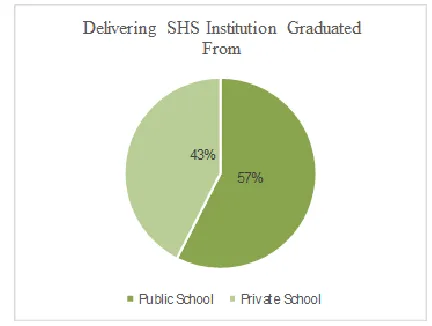
Figure 2. Profile of the Respondents as to Delivering SHS Institution
The figure above presents the profile of the student-respondents as to delivering SHS institution where they have finished their senior high school. It shows that more than half or 57% of the respondents graduated of public SHS while 43% of respondents are from private institutions.These data show the diversity of the background of the student-respondents. It further indicates that the university, particularly, the College of Information and Communications Technology (CICT), is not only catering those who graduated from public schools but also those that were products of different private schools in the province. This diversity can be an important factor in determining their instructional needs which can be used as bases in designing the student development plan of the college.
3.2 The Academic Motivation of Information Technology Students
Table 2.1 below shows the level of academic motivation of respondents due to intrinsic reasons. Intrinsic motivation refers to ―doing something because it is inherently interesting or enjoyable‖ (Ryan and Deci, 2000).
Table 2.1
Academic Motivation Level of IT Students (Intrinsic)
ITEMS MEAN
RATING VERBAL RATING RANK
AM_IN1 3.30 Highly motivated 4
AM_IN2 3.12 Motivated 7
AM_IN3 2.98 Motivated 9
AM_IN4 3.33 Highly motivated 2
AM_IN5 3.29 Highly motivated 5
AM_IN6 3.28 Highly motivated 6
AM_IN7 3.03 Motivated 8
AM_IN8 3.28 Highly motivated 6
AM_IN9 3.26 Highly motivated 3
AM_IN10 3.43 Highly motivated 1
GRAND
MEAN 3.23 Highly Motivated
238 excellence (µ= 3.26). The findings above indicate that
student-respondents have desires to: demonstrate competence, exercise their sense of self determination, and gain pleasure and satisfaction from what they are doing. Lancaster (2019), as cited in teachthought.com, says that intrinsic motivators contribute to the engagement of students to achieve great things. When positive intrinsic motivations manifest to students, they can easily excel and showcase positive impacts toward their academic endeavors. Brigss (2014) further explains the underlying principles behind why demonstrating competence, exercising self-determination, and gaining pleasure and satisfaction are the common intrinsic motivators of the respondents. Students’ positive self-esteem and being confident plays a vital role in motivating students’ to excel academically. These two could be the driving force why students chose them as the top reasons; the highest among the intrinsic academic motivators in this study.
Table 2.2
Academic Motivation Level of IT Students (Extrinsic)
ITEMS MEAN
RATING VERBAL RATING RANK
AM_EX1 3.20 Motivated 8
AM_EX2 3.50 Highly motivated 1
AM_EX3 3.29 Highly motivated 4
AM_EX4 3.22 Motivated 7
AM_EX5 3.50 Highly motivated 1
AM_EX6 3.30 Highly motivated 3
AM_EX7 3.29 Highly motivated 4
AM_EX8 3.26 Highly motivated 6
GRAND
MEAN 3.32 Highly Motivated
Table 2.2 above shows the level of ―extrinsic‖ academic motivation of student-respondents. Ryan and Deci (2000) explains that an extrinsic motivation pertains to doing something to attain some ―separable outcome‖. Extrinsic motivation is opposite from intrinsic motivation. The data show the reasons why most students pursue college education. The top three reasons are: preparing for the chosen career (µ= 3.50); having ―the good life‖ later on (µ= 3.50); helping me get a better career (µ= 3.30); and eventually, to have a better salary (µ= 3.29).Very often, students continue college education not because they enjoy them, but because it is necessary to obtain something else. In this case, that ―something else‖ is the job that they are aiming to get after they have finished their degrees. This job/career they believe will help them fulfill the kind of life that they would like to have in the future. Basillote et al. (2017), as cited by Bantug and Luciano (2018), found out that ―many Filipino families still prefer their children to take up college education rather than technical and vocational training, in the expectation they will get better-paying jobs or earn more.‖ This indicates that students’ upbringing and their parents’ belief in such benefit of higher education may have helped established this way of thinking and motivation.
3.3 The Usefulness of Countdown Timer in
Programming Tasks and Activities
Table 3.
Usefulness of Countdown Timer in Programming Tasks and Activities
ITEMS MEAN RATING VERBAL RATING
CT1 2.93 Agree
CT2 3.08 Agree
CT3 3.06 Agree
CT4 2.95 Agree
CT5 2.92 Agree
CT6 3.34 Strongly agree
CT7 3.09 Agree
CT8 2.86 Agree
CT9 2.83 Agree
CT10 2.92 Agree
CT11 2.88 Agree
CT12 2.87 Agree
CT13 3.08 Agree
CT14 2.87 Agree
CT15 3.16 Agree
GRAND
MEAN 2.99 AGREE
Table 3 above shows the data on the usefulness of timer in programming activity. The findings show that student-respondents agreed strongly that the use of timer in their programming activities made them feel nervous (µ=3.34). On the other hand, use of countdown timer has many advantages, among them are: it made them feel happy knowing that they have completed the task before the time ends (µ=3.16); motivates them in answering the programming exercise (µ= 3.08) and it helps them to think faster to respond to programming challenge immediately (µ= 2.88). The above findings reflect that the use of timer in programming activities increases the productivity of the student-respondents in accomplishing the task given to them. The study of Steel, et.al (2007), as cited by Aban and Fontanil (2015), stated that ―…with a countdown timer being present, students seem to be motivated to do the seatwork because they saw through the countdown timer an imminent deadline. The countdown timer lessened the amount of time to realization hence increasing motivation‖. On the contrary, those students who did not find countdown timer effective mentioned that it caused panic and pressure for them.
3.4 The Computer Programming Anxiety of Information Technology Students
Table 4.
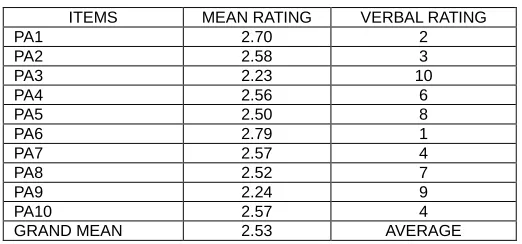
Description of the Programming Anxiety of the Respondents
ITEMS MEAN RATING VERBAL RATING
PA1 2.70 2
PA2 2.58 3
PA3 2.23 10
PA4 2.56 6
PA5 2.50 8
PA6 2.79 1
PA7 2.57 4
PA8 2.52 7
PA9 2.24 9
PA10 2.57 4
Data on Table 4 above reveal that student-respondents have high anxiety on programming activities. This is evident by the computed grand mean of 2.53 with verbal description of ―average level‖. This means that student-respondents are somewhat anxious in doing programming exercises because it made them feel nervous (2.79); computer programming jargons are confusing them (2.58); hesitation to perform exercises because of fear of making mistakes they cannot correct (2.56). The above findings suggest that teachers handling programming courses must continuously expose students to activities which will hone their programming skills. In one of the essays published in Essays UK they have cited the result of the research conducted by Ramalingam et al. in 2004. It states that ―… students’ who continuously practice their programming skills, easily reduce their anxiety since they gradually attain confidence in their skills‖. When these skills are not further improved upon, the students’ level of anxiety will continue rising up to the point where even the mentioning of the word programming itself result in a state of uneasiness.
3.5 CORRELATION OF RESPONDENTS’ PROFILE,
ACADEMIC MOTIVATION, USEFULLNESS OF USING COUNTDOWN TIMER AND PROGRAMMING ANXIETY
Table 5. Correlation Matrix
SGF S AM UCT PA
School graduate from
1
Sex .139 1
Academic
motivation .063 -.022 1 Usefulness of
countdown timer
-.023 -.049 -.085 1
Programming anxiety
-.212*
.216* -.125 .233* 1
* - denotes correlation at 0.05 level of confidence
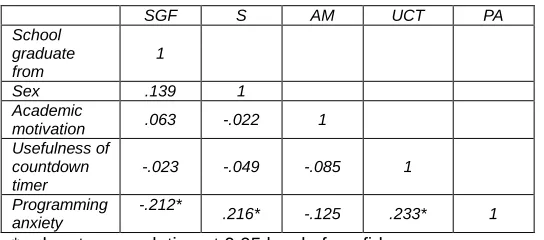
SGF – School Graduated From, S – Sex, AM – Academic Motivation, UCT – Usefulness of Countdown Timer, and PA – Programming Anxiety
The results of correlation shown in Table 5 indicate that the school from which the student-respondents graduated from is negatively correlated on their programming anxiety. This means that graduates of public secondary schools have higher level of programming anxiety as compared to those who have graduated from private secondary schools. The study of De Choudhury (2017) can be supportive of this finding. He suggests that the reason there are less posts about tuition anxiety at more expensive colleges is because their students tend to be more affluent than the average public school attendee. Therefore, the stresses of paying for college or going into debt aren't as great. De Choudhury also thinks that the wider variety of backgrounds at large public schools likely lends itself to a more robust sharing of stress and anxiety issues. In terms of the relationship between sex and programming anxiety, results of data analysis suggested that female respondents have higher anxiety (2.62) as compared to male (2.33) and that the difference is significant at 0.05 level. The internet article published in 2016 entitled ―Women Are More Likely to Suffer Anxiety to Men‖ supports this claim. It stated that results from the 48 studies were gathered to
describe the global distribution of anxiety disorders. One of the main findings of the study is that women were found to be twice as likely to be affected as men (female: male ratio of 1.9:1). This was consistently the case across different countries and co-existing health conditionsAnother interesting finding of the study is the positive correlation between programming anxiety and the use of countdown timer. A positive correlation means that is a relationship between two variables in which both variables move in tandem—that is, in the same direction. In this particular study, data show that when the use of countdown timer increases, the level of programming anxiety also increases
4 CONCLUSION
This study aimed at understanding the impact of using countdown timer as an instructional tool when conducting programming exercises among sophomore students in a state university in Central Luzon, Philippines. The study found out that most of the respondents were male and that they mostly came from public secondary high schools. An interesting results revealed that the respondents possessed high intrinsic academic motivations in terms of the desire to demonstrate competence, exercise sense of self-determination, and gaining pleasure and satisfaction in studying. On the other hand, extrinsic academic motivation revealed that respondents pursue higher education because they would like to prepare themselves for their chosen career, to have a ―good life‖ later on, equip themselves for a better career, and to have a better salary. The study also found out how sophomore students view the usefulness of countdown timer. Students view the use of countdown timer as a tool that makes them nervous but allows them to exert more effort, excel better, and do more in the classroom to achieve the expected outcomes. This is in consonance with the result on the level of programming anxiety. Another interesting result shows that only the programming anxiety is being affected by: (1) the type of high school graduated from; and (2) the sex of the students. Further, results reveal that the use of countdown timer has a positive impact to the programming anxiety of the sophomore university students. In view of the findings, further research is suggested to see the impact of the use of countdown timer to other year levels and to a diverse group of learners/respondents. The use of other variables relating to the performance of IT students when conducting programming exercises must also be looked into.
5 REFERENCES
[1] Aban, AK and Fontanil, L. (2015). ―Maintaining Students’ Involvement in a Math Lecture Using Countdown Timers.‖ Asia Pacific Journal of Multidisciplinary Research Vol. 3, No. 5, P1-9. December 2015, Part 1 E-ISSN 2350-8442
[2] Alcantara, E, C. & Bacsa, JM.,P. (2017). ―Critical Thinking and Problem Solving Skills in Mathematics of Grade-7 Public Secondary Students‖. Asia Pacific Journal of Multidisciplinary Research Vol. 5 No. 4, P.21-27.
[3] Bantug, Emilsa T. and Luciano, Ruth G. (2019). ―Analysis of the Expectations and Motivations of First Year IT Students for S.Y. 2018 – 2019‖. NEUST-CICT Research Journal, Vol. 4. ISSN 2345-8259
240 Retrieved from https://www.inteqna.
com/blog/5-qualities-an-it-technician-should-have
[5] Connolly, Murphy & Moore (2009). ―Programming Anxiety Amongst Computing Students – A Key in the Retention Debate?‖ IEEE Transactions on Education Vol 52. Retrieved https://www.academia. edu/21501377/Programming_Anxiety_Amongst_Com puting_Students_and_x2014_A_Key_in_the_Retentio n_Debate
[6] Doyle, A. (2019). ―Problem Solving Skills: Definition,
Steps, and Examples‖. Retrieved
https://www.thebalancecareers.com/problem-solving-skills-with-examples-2063764]
[7] Education Reform (2014). ―Classroom Management.‖ Retrieved https://www.edglossary. org/classroom-management/#targetText=Classroom
%20management%20refers%20to%20the,academical ly%20productive%20during%20a%20class.
[8] Essays, UK. (November 2018). ―Factors Affecting Programming Anxiety Amongst Students Education Essay‖. Retrieved from https://www.uk essays.com/essays/education/factors-affecting- programming-anxiety-amongst-students-education-essay.php?vref=1
[9] Dulock, H. L. (1993). ―Research Design: Descriptive Research‖. Journal of Pediatric Oncology Nursing, 10(4), 154–157. https://doi.org/ 10.1177/ 104345429301000406
[10] Facione, PA. (1990). ―Critical thinking: A statement of expert consensus for purpose of educational assessment and instruction‖. Millbrae, CA: The California Academy Press.
[11] Guido, M. (2018). ―20 Classroom Management Strategies and Techniques. Prodigy‖. Retrieved from
https://www.prodigygame.com/blog/classroom-management-strategies/
[12] Hidayati, N., and Permana, D., (2019). ―Assessment of Problem Solving Abilities and Student Learning Activities Based on Learning Tools: The Basis of Problem Based Learning Development‖. International Journal of Scientific and Technology Research. Volume 8, Issue 11, November 2019. P(453-456) ISSN 2277-8616
[13] Hudoyo, H., (1979). ―Development of mathematics curriculum and its implementation in front of the class‖
(Pengembangan Kurikulum
matematikadanpelaksanaannya di depankelas). Jakarta: Depdikbud.
[14] Importance of Intrinsic Motivation.
https://www.teachthought.com/learning/the-importance-of-intrin sic-motivation-in-transforming-learning/.
[15] Information Technology (2017). ―Information Technology Curricula 2017‖. Association of
Computing Machinery. Retrieved
https://www.acm.org/binaries/content/assets/educatio n/curricula-recommendations/it2017.pdf
[16] Lai, ER. (2011). ―Critical Thinking: A Literature Review. Research Report‖. Pearson
[17] Rich, E. (2010). ―How do you define 21st century learning.‖ Retrieved from https://www.edweek.org /tsb/articles/2010/
10/12/01panel.h04.html#:~:targetText=The%20term% 20%2221st%2Dcentury%20skills,students%20thrive% 20in%20today's%20world.
[18] Ryan, R., and Deci, E. (2000). ―Intrinsic and Extrinsic Motivations: Classic Definitions and New Directions‖. Contemporary Educational Psychology 25, 54-67. DOI 10.1006/ceps.1999.1020
[19] Saavedra, A. R., & Opfer, V. D. (2012). ―Learning 21st-Century Skills Requires 21st-Century Teaching‖. Phi Delta Kappan, 94(2), 8– 13. https://doi.org/10.1177/003172171209400203 [20] Silva, E. (2009). ―Measuring Skills for 21st-Century
Learning.‖ Phi Delta Kappan, 90(9), 630– 634. https://doi.org/10.1177/003172170909000 905 [21] Sternberg, R.J. (1986). ―Critical Thinking: Its nature,
measurement, and improvement. National Institute of Education‖. Retrieved from http://eric.ed.gov/ PDFS/ED272882.pdf
[22] Kennedy, M., Fisher, M.B., & Ennis, R.H., (1991). ―Critical Thinking: Literature review and needed research‖. In L. Idol & B.F. Jones (Eds.), Educational values and cognitive instruction: Implications for reform (pp. 11-40). Hillsdale, New Jersey: Lawrence Erlbaum & Associates.
[23] Vallerand, Pelletier, Blais, Brière, Senécal and Vallières, (1992). ―Academic Motivation Scale‖. Educational Psychological Measurement Vols 52 and 53.
[24] Wagner, T. (2008). ―Teaching and Testing the Skills That Matters Most‖. Retrieved http://www.tony wagner.com/teaching-testing-skills-that-matter-most/ [25] Wallmann, H. W., & Hoover, D. L. (2012). ―Research