Int J Physiother 2016; 3(6)
Page | 700
ORIGINAL ARTICLE
IJPHY
ABSTRACT
Background: Back pain caused by lumbar region pathologies is a condition that leads to loss of productivity and phys-ical disability, with high costs of diagnosis and treatment. This study was planned to investigate the effect of taping and soft orthosis application on the pain and functional disability in the pathology of lumbar region without neurological deficit.
Methods: This study is randomized controlled trial. Sixty-three volunteer patients were randomly divided into three groups of 21 people. Group I, soft orthotics and stabilization exercise program; Group II, Kinesio taping and stabiliza-tion exercise program; Group III, stabilizastabiliza-tion exercise program was applied. After obtaining demographic data of the participants; patients were evaluated in terms of range of motion and muscle strength. We used visual analog scale for pain level assessment, sit and reach test for flexibility assessment, timed up and go test (TUG) for functional ambu-lation and balance, modified Schober test for lumbar spine flexibility, Oswestry Disability Index in the assessment of functional disability. They were assessed at the pretreatment, third (post treatment) and six week (home programs and follow-up).
Results: The results showed that significant differences (p<0.05) occurred over time in the study parameters such as functional ambulation, flexibility, lumbar flexibility, functional disability, pain, strength, range of motion in all groups. In comparisons between groups, there was a difference mainly in favor of Group II (p<0.05).
Conclusions: We have concluded that in lumbar region pathologies without neurological deficits, stabilization exercises combined with orthotics and Kinesio taping applications reduces pain and functional disability.
Keywords: Low Back Pain, Tape, Orthosis, Exercise, Disability.
Received 19th October 2016, revised 07th November 2016, accepted 04th December 2016
www.ijphy.org
10.15621/ijphy/2016/v3i6/124733
CORRESPONDING AUTHOR
Int J Physiother. Vol 3(6), 700-706, December (2016) ISSN: 2348 - 8336
EFFECT OF KINESIO TAPING AND SOFT ORTHOSIS APPLICATION ON THE
PAIN AND FUNCTIONAL DISABILITY IN LUMBAR REGION PATHOLOGIES
WITHOUT NEUROLOGICAL DEFICITS: A RANDOMIZED CONTROLLED
EXPERIMENTAL STUDY
*1Burcu TALU
²Kezban BAYRAMLAR ³Gul BALTACI
*1Burcu TALU
Assistant Professor,
Inonu University, Faculty of Health Sciences Physiotherapy and Rehabilitation
Department, Malatya, Turkey. ²Professor, Hasan Kalyoncu University, Faculty of
Health Sciences, Physiotherapy and Rehabilitation Department, Gaziantep, Turkey.
³Professor, Guven Hospital, Physiotherapy and Rehabilitation Department, Ankara, Turkey.
INTRODUCTION
Back pain caused by lumbar region pathologies is a condition that leads to loss of productivity and physical disability, with high costs of diagnosis and treatment [1]. There are various preventive approaches and treatment options for low back pain. One of these treatment options is lumbar orthoses. Lumbar orthoses are spinal orthoses widely used in clinical practice for the conservative treatment of low back pain as well as primary and secondary prevention of such pains [2]. Their mechanism of action involves increasing intra-abdominal pressure [3], limiting torso movements [4], unloading lumbar paraspinal muscles [5], showing irritant effects and providing kinesthetic feedback [6]. They also have psychological effects such as massage, heating and stimulation [7]. Although they are commonly used in clinical practice, the number of randomized controlled studies investigating the use of lumbar orthosis for chronic back pain is rather limited, and the current findings available in this regard appears somewhat controversial [8,9]. Besides, the studies failed to demonstrate the superiority of orthoses in chronic low back pain over other treatment options [2,10]. Whether lumbar orthosis is effective in the treatment of sub acute and chronic low back pain is yet to be well established [11]. Another uninvestigated aspects are patient compliance with orthosis treatment and superiority of orthoses types over one another [12].
Kinesio tape, thanks to its flexibility allowing perfect adaptation to the stretching and loosening of the skin, has become more popular than other methods of taping materials. When Kinesio tape is properly applied, it lifts the skin, which increases the interstitial space between the skin and subcutaneous tissue, and thus improving blood flow. With increased circulation and blood flow, the
inflammation in that area is reduced, allowing the area to cool down. Applications of Kinesio taping for spinal conditions usually focus on postural support and back pain [13].
Dynamic muscular stabilization techniques provide the dynamic control strength required in the lumbar region and reduce repetitive motion injuries in the spinal segments. Specific stabilization exercises characterized by combined contraction of deep abdominal, transvers abdominal and multifidus muscles improve spinal segmental support and control. This information is in the light, orthosis, kinesiotaping and stabilization exercises have been shown to have effects on low back pain.
This study therefore aims to investigate the effect of taping and soft orthosis on the pain and functional disability in lumbar region pathologies without neurological deficits.
METHODS
All individuals participating in the study signed the “Informed Consent Form”. This study was approved by the University Clinical Research Ethics Committee (GO 14/94).
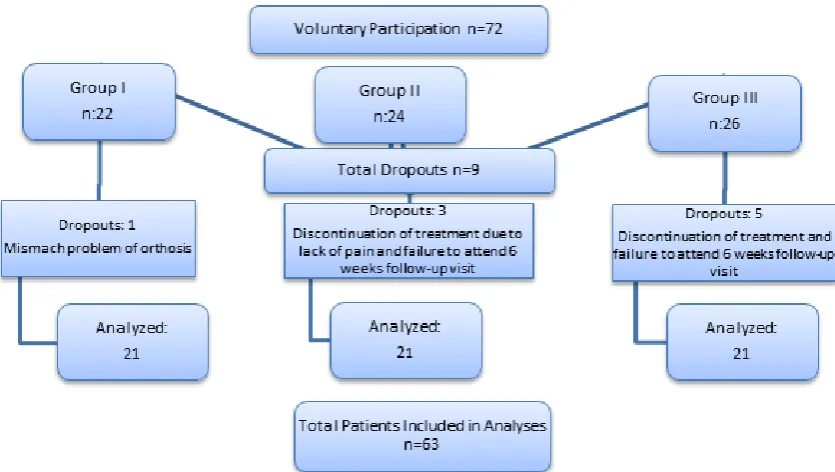
The current study initially included 72 patients (aged 18-55 years) with low back pain, who were able to attend the outpatient treatment program, complying with the prescribed exercise program. However, during the course of treatment, 9 participants were excluded from the study for various reasons, thus the study sample consisted of 63 patients. Patients were randomly divided into three groups of 21 people. The first group was treated with soft orthoses combined with stabilization exercise program; the second group, Kinesio taping and stabilization exercise program; third group just stabilization exercise program (Figure: 1).
Int J Physiother 2016; 3(6)
Page | 702
After obtaining demographic data of patients; a series of tests were performed to assess their joint range of motion and muscle strength. Other data collection tools included visual analog scale for assessment of pain intensity, sit and reach test for flexibility, timed up and go test (TUG) for functional ambulation and balance, modified Schober test for lumbar spine flexibility, Oswestry Disability Index for functional disability and Tampa Scale of Kinesiophobia for fear of movement.
After the initial evaluation prior to the treatment, the patients were included in a 3-week treatment program. They were reassessed and sent to their homes where they continued the prescribed stabilization exercise program. After 3 weeks of exercise, they were scheduled for outpatient follow-up appointments. At the end of 6 weeks, a final assessment of patients was performed.
The participants in Group I, along with stabilization exercises, were instructed to wear the prescribed underwire soft orthoses during waking hours, at least 6 hours per day for 3 weeks.
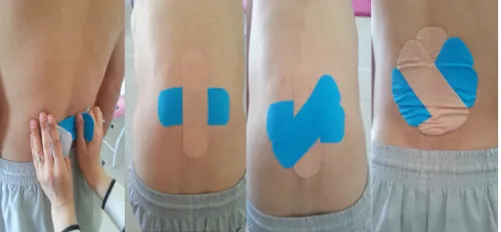
In Group II, along with stabilization exercises, the participants were applied Kinesio tapes (taking into consideration the color preference of patients among 4 different colors with no physical or chemical difference) using Lumbar Star Space Correction Technique (Figure 2). In this technique, 4 Kinesio I Tapes were used for each patient.
Figure 2 Space Correction Lumbar Star Taping Participants in Group III performed stabilization exercises designed to ensure biomechanical, neutral spine at every stage of neurodevelopmental process (supine, prone, side-lying, quadrupedal, bipedal). The exercise programs prescribed for each individual based on the patient’s muscle strength, clinical condition and pain intensity were administered by a physiotherapist. Participants were instructed to perform these exercises in 3 sets of 10 repetitions per day for 6 weeks.
Data Analysis
Normality of data was approved by Kolmogorov-Smirnov, it was decided that non-parametric analysis. Comparisons between the three groups were analyzed with the Kruskal-Wallis test; when differences found significant, Post-hoc analysis was used to determine the difference stems from which the group. In determining the significance of the difference between two means of data that does not meet the parametric Mann-Whitney U test was used
assumptions. each group in its own changes over time were analyzed using Friedman test; when differences found significant, Post-hoc analysis was used to determine the difference stems from which the group. In determining the significance of the difference between two means of data that does not meet the parametric assumptions paired Wilcoxon two-sample test was used. Bonferr the correction for all post-hoc corrections were made. Statistically significant in the analysis and p <0.05, while in the post-hoc analysis p <0.0167 value was evaluated assuming the. Mean ± standard deviation were calculated for variables determined by measurement.
RESULTS
This study included a sample size of 63 patients diagnosed with lumbar region pathology without neurological deficits. The participants were divided into 3 different groups of 21 people as Group I, Group II and Group III.
When the study groups were evaluated in terms of physical characteristics, there were no significant intergroup differences in height, body weight and body mass index (p>0.05), whereas the groups differed significantly in terms of mean patient age (p<0.05), which was caused by rather lower mean age of Group III (Table 1).
Table 1: Demographic Characteristics of Groups
n=63 Group In:21 Group II n:21
Group III n:21
Intergroup p<0.05 p<0.0167
X±SD X±SD X±SD 1-2 1-3 2-3
Age (years) 44.86 ±8.87 ±11.2543.38 36.29 ±9.83 0.025* 0.743 0.005* 0.080
Height
(cm) 164.67 ±9.75 167.38 ±11.63 ±10.51165.19 0.804 0.536 0.820 0.641 Body
weight (kg)
77.62
±11.50 ±16.7878.62 ±11.1672.10 0.284 0.960 0.151 0.194 BMI** (kg/
m²) 28.76 ±4.68 ±6.0428.14 26.57 ±4.62 0.368 0.379 0.155 0.669
*p<0.05, **Body Mass Index
The results showed that significant differences (p<0.05) occurred over time in the study parameters such as functional ambulation, flexibility, lumbar flexibility, functional disability, pain, strength, range of motion in all groups. In kinesiophobia assessment, only Group II showed significant differences. In comparisons between groups, there was a difference mainly in favor of Group II (p<0.05).
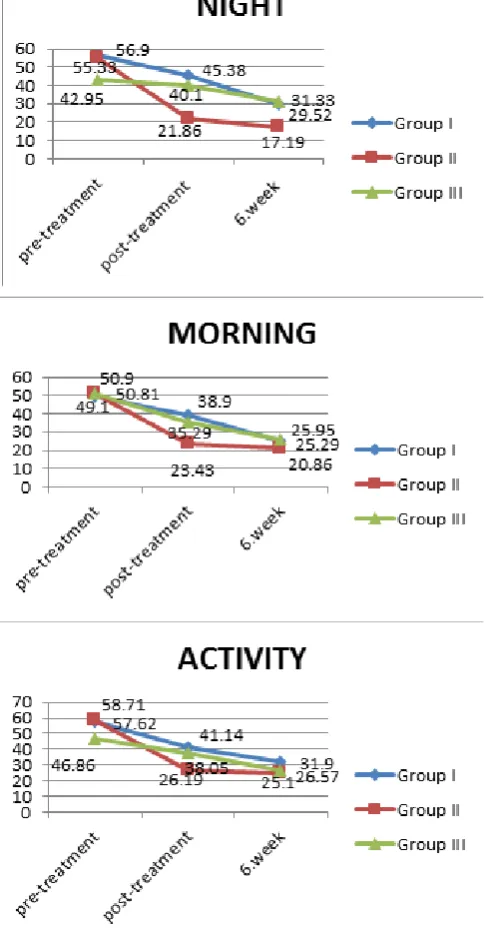
Figure 3: Comparisons of Pain Assessment Results When we look at the groups in terms of functional disability, assessments performed at pre-treatment, post-treatment and 6 weeks follow-up periods showed significant reductions in total scores (p<0.05). Group I and III differed significantly in post-treatment and 6 weeks follow-up evaluations (p<0.05). While Group II experienced reduction in functional disability, this decrease was not significant in the post-treatment evaluation (p>0.05). Intergroup comparisons of results obtained at post-treatment and 6 weeks follow-up showed significant differences between Group I and Group II, as well as Group II and Group III (p<0.0167), which was found to arise from a relatively greater reduction in disability rate of Group II (Figure 4).
Figure 4: Intergroup Differences and Differences over Time As Measured by Functional Oswestry Disability
Questionnaire
DISCUSSION
The present study found that the prescribed treatment regimens resulted in significant reduction in pain levels of all study groups, as revealed by 6 weeks follow-up assessments. In lumbar spine pathologies, pain develops as a result of deteriorated static and dynamic responses from biomechanical loads of the body. In cases where static and functional balance of columna vertebralis cannot be corrected, pain can lead to functional impairment. This balance may only be achieved through structures having sufficient flexibility and strength.
Post-treatment measurements showed that the therapeutic taping achieved 100% reduction in rest pain, as well as night, morning and activity pains as compared to pre-treatment results. Similarly, the orthosis application reduced morning and activity pain at a rate of 100%, while such improvement in night pain was achieved at 6 weeks. These findings indicated that participants receiving Kinesio tape and orthosis therapy experienced considerable reduction in pain immediately after treatment, which increased the exercise tolerance of the patients. The present study considered that Kinesio tape combined with the application of orthoses will provide psychological and functional benefits, thus allowing individuals to resume their social life in a short time.
Int J Physiother 2016; 3(6)
Page | 704
et al. (2010), 164 patients with chronic low back pain, patients were instructed to wear soft corsets during waking hours for 3 weeks. 65% of patients were reported to wear their corset for more than 7 hours [15]. Sato et al. (2012) argued that patients with chronic low back pain should wear a lumbar corset for at least 6 hours a day during a total of 6 week period (5 days a week), in the study, the increased duration of treatment was reported to adversely affect patient compliance [7]. In present study, the participants were advised to wear the corset for 6 hours a day during waking hours, which was a relatively short-term intended to increase patient compliance.
Functional disability measurement is an important component in the treatment planning for patients with low back pain, as their physical performance is rather different from other patients with clinical pain syndrome [16]. In his study, Fairbank (2000) [17] concluded that Oswestry Disability Index was a reliable and valid instrument, recommending its use in spinal pathologies. In present study, evaluation of the scores for Oswestry Disability Index showed that reduction in pain produced a positive effect on functional disability parameter in all three groups. The present study consider that further reduction in functional disability of taping group after treatment might be associated with the reduction in pain levels. Applications of Kinesio taping for spinal conditions usually focus on postural support and back pain [13,18-20]. Paoloni et al. (2011) [21] divided the study participants with chronic low back pain into three groups to receive either Kinesio taping alone, Kinesio plus exercise or exercise alone for a period of four weeks. For the assessment of patients, they administered Roland Morris disability questionnaire, VAS and superficial EMG for lumbar muscle function. The researchers found that all patient groups had reduced pain levels at post-treatment measurements, while exercise-alone group only experienced improvement in pain-related disability. Based on these findings, they concluded that Kinesio taping could not be recommended as a sole substitute for exercise therapy, though it may be effectively used as an additional, short-term approach in pain reduction. In their study including patients with chronic low back pain, Hwang-Bo et al (2015) [22] evaluated pain using VAS, and functional disability using the Oswestry Disability Index. They applied Kinesio tape with 130-140% stretch to the rectus abdominis, internal oblique, erector spinae, and latissimus dorsi muscles. Hwang-Bo et al (2015) found that pain and functional disability levels gradually declined, whereas muscle strength and pain-free range of motion progressively improved.
Added et al (2013) [1], in their study investigating the efficacy of Kinesio taping method in patients with chronic nonspecific low back pain, divided 148 patients into two groups to receive either conventional physiotherapy plus Kinesio taping or conventional physiotherapy alone. Patients were treated for a period of 5 weeks. Clinical parameters such as pain, disability, global perceived effect and treatment satisfaction were evaluated at 5 weeks,
3 months and 6 months. Added et al (2013) concluded that addition of Kinesio taping method to conventional physiotherapy produced a greater reduction in pain and functional disability, with an increased satisfaction with the treatment.
In their multicenter, randomized, controlled clinical study, Calmes et al. (2009) [23] investigated the effect of elastic lumbar corset use on the severity of pain and functional disability in subacute low back pain. They reported that, at the end of 3 months, the treatment with elastic lumbar belts produced significantly lower scores for VAS and functional disability. In this study, the use of elastic corsets was suggested as a non-pharmacological and complementary approach alongside conventional medical therapy in the treatment of back pain. Consistent with these findings, our study results showed that the use of elastic corset yielded significant reduction in pain intensity and functional capacity at the end of 3 weeks. The current findings seem to corroborate with the results of study conducted by Calmes et al (2009).
Finally, the generalizability of our study results may be subject to certain limitations. For instance, failing to communicate with the participants between week 3 and week 6, when they continued the stabilization exercise program at home after 3 weeks of treatment, can be considered as a limitation. However, this may be a negligible issue considering that they performed the prescribed exercises under the supervision of a physiotherapist for the initial 3 weeks and learned the routine quite well. Secondly, additional follow-up visits at 6 months and 12 months could have provided better insight for physiotherapists in the assessment and treatment planning. Lastly, the relatively small sample size can also be considered a limitation that calls for cautious interpretation of study findings.
CONCLUSION
As the incidence of low back pain in the general population is rather high among all age groups, prevention of this condition is of vital importance due to costs involved and quality of life reasons. In this regard, we believe that the exercise program employed in our study will provide significant contribution in the prevention of future low back problems.
Taking into account that back pain is the most common ground for medical reports of incapacity and our stabilization exercise program is effective in the prevention and treatment of low back pain, we believe that such an intervention might provide an indirect contribution to our country’s economy by reducing health spending by reducing national health expenditures through reductions in pain and functional disability, which are major causes of health-related work losses.
taping method may be argued to be superior to other interventions in terms of efficacy and duration, but further studies are needed to confirm these findings.
REFERENCES
[1] Added MA, Costa LO, Fukuda TY, et al. Efficacy of adding the Kinesio Taping method to guideline-endorsed conventional physiotherapy in patients with chronic nonspecific low back pain: a randomised controlled trial. BMC musculoskeletal disorders. 2013; 14: 301.
[2] an Duijvenbode IC, Jellema P, van Poppel MN and van Tulder MW. Lumbar supports for prevention and treatment of low back pain. The Cochrane database of
systematic reviews. 2008: CD001823.
[3] Arjmand N and Shirazi-Adl A. Role of intra-abdominal pressure in the unloading and stabilization of the human spine during static lifting tasks. Eur
Spine J. 2006; 15(8): 1265-75.
[4] Van Poppel MN, de Looze MP, Koes BW, Smid T and Bouter LM. Mechanisms of action of lumbar supports: a systematic review. Spine. 2000; 25(16): 2103-13. [5] Cholewicki J, Reeves NP, Everding VQ and
Morrisette DC. Lumbosacral orthoses reduce trunk muscle activity in a postural control task. Journal of
biomechanics. 2007; 40(8): 1731-6.
[6] Cholewicki J, Shah KR and McGill KC. The effects of a 3-week use of lumbosacral orthoses on proprioception in the lumbar spine. The Journal of orthopaedic and
sports physical therapy. 2006; 36(4): 225-31.
[7] Sato N, Sekiguchi M, Kikuchi S, Shishido H, Sato K and Konno S. Effects of long-term corset wearing on chronic low back pain. Fukushima journal of medical
science. 2012; 58(1): 60-5.
[8] Nadler SF. Nonpharmacologic management of pain.
The Journal of the American Osteopathic Association.
2004; 104: S6-12S.
[9] Oleske DM, Lavender SA, Andersson GB and Kwasny MM. Are back supports plus education more effective than education alone in promoting recovery from low back pain?: Results from a randomized clinical trial.
Spine. 2007; 32(19): 2050-7.
[10] Chou R, Huffman LH, American Pain S and American College of P. Nonpharmacologic therapies for acute and chronic low back pain: a review of the evidence for an American Pain Society/American College of Physicians clinical practice guideline. Annals of
internal medicine. 2007; 147(7): 492-504.
[11] Toda Y. Impact of waist/hip ratio on the therapeutic efficacy of lumbosacral corsets for chronic muscular low back pain. Journal of orthopaedic science : official
journal of the Japanese Orthopaedic Association. 2002;
7(6): 644-9.
[12] Roelofs PD, Bierma-Zeinstra SM, van Poppel MN, et al. Lumbar supports to prevent recurrent low back pain among home care workers: a randomized trial.
Annals of internal medicine. 2007; 147(10): 685-92.
[13] Kalron A and Bar-Sela S. A systematic review of
the effectiveness of Kinesio Taping--fact or fashion?
European journal of physical and rehabilitation
medicine. 2013; 49(5): 699-709.
[14] Saal JA. Dynamic muscular stabilization in the nonoperative treatment of lumbar pain syndromes.
Orthopaedic review. 1990; 19(8): 691-700.
[15] Cholewicki J, McGill KC, Shah KR and Lee AS. The effects of a three-week use of lumbosacral orthoses on trunk muscle activity and on the muscular response to trunk perturbations. BMC musculoskeletal disorders. 2010; 11: 154.
[16] Marshall PW and Murphy BA. Evaluation of functional and neuromuscular changes after exercise rehabilitation for low back pain using a Swiss ball: a pilot study. Journal of manipulative and physiological
therapeutics. 2006; 29(7): 550-60.
[17] Fairbank JC and Pynsent PB. The Oswestry Disability Index. Spine. 2000; 25(22): 2940-52; discussion 52. [18] Campolo M, Babu J, Dmochowska K, Scariah S and
Varughese J. A comparison of two taping techniques (kinesio and mcconnell) and their effect on anterior knee pain during functional activities. International
journal of sports physical therapy. 2013; 8(2): 105-10.
[19] Bae SH, Lee JH, Oh KA and Kim KY. The effects of kinesio taping on potential in chronic low back pain patients anticipatory postural control and cerebral cortex. Journal of physical therapy science. 2013; 25(11): 1367-71.
[20] Castro-Sanchez AM, Lara-Palomo IC, Mataran-Penarrocha GA, Fernandez-Sanchez M, Sanchez-Labraca N and Arroyo-Morales M. Kinesio Taping reduces disability and pain slightly in chronic non-specific low back pain: a randomised trial. Journal of
physiotherapy. 2012; 58(2): 89-95.
[21] Paoloni M, Bernetti A, Fratocchi G, et al. Kinesio Taping applied to lumbar muscles influences clinical and electromyographic characteristics in chronic low back pain patients. European journal of physical and
rehabilitation medicine. 2011; 47(2): 237-44.
[22] Choi J, Lee S and Hwangbo G. Influences of spinal decompression therapy and general traction therapy on the pain, disability, and straight leg raising of patients with intervertebral disc herniation. Journal of
physical therapy science. 2015; 27(2): 481-3.
Int J Physiother 2016; 3(6)
Page | 706
CitationTALU, B., BAYRAMLAR, K., & BALTACI, G. (2016). EFFECT OF KINESIO TAPING AND SOFT ORTHOSIS AP-PLICATION ON THE PAIN AND FUNCTIONAL DISABILITY IN LUMBAR REGION PATHOLOGIES
WITH-OUT NEUROLOGICAL DEFICITS: A RANDOMIZED CONTROLLED EXPERIMENTAL STUDY. International